The Bad Science And Greed Behind The “Intellectual Property Inhibiting Innovation” Argument. Part 3

For some time now the web/technology lobby has been arguing that copyright and other forms of intellectual property rights are inhibiting innovation.  And if you don’t actually  think about it you might agree.  I mean it sounds sort of like the argument against government over-regulation. Having to get permission from all those IP owners.  And then having to pay them all?  what a hassle!

But is this really true?

No and the Evidence is right in front of us.

A few months ago I spoke at the SF Music Tech Summit.  My talk was entitled “Meet the new boss, Worse than the old boss?”.  As a bit of hyperbole  I compared the new digital paradigm to the old record label model.  My conclusion was that under the new digital distribution model the artist gets a lower share of recorded music revenue.  And many of the profitable players in the new digital paradigm pay artists nothing.  Zero. Zilch. Nada.  As part of my presentation I was gonna stream  Nyan Cat with the following caption:

“Our Dystopic Future: This is what you get when you don’t pay content creators”

What is Nyan Cat?  If you are under 40 I suppose it needs no explanation.  But if you’re older?  Well Nyan Cat is the Pet Rock™ of the YouTube generation.  A nearly static animation of Nyan cat with an endlessly looped theme song. This version is 10 hours long.   And it has 457 trillion views or something like that.

http://www.youtube.com/watch?v=wZZ7oFKsKzY

I wouldn’t bother making fun of Nyan Cat except for the fact that some on the Copyleft regard Nyan Cat as a great cultural achievement.  I’m not kidding.  As detailed in an earlier Trichordist post  Fight For The Future gives out Nyan Cat awards to people who do “really awesome things for the Internet”  like making sure artists continue to be exploited by for-profit file-sharing sites. ( Right on! Fight for the Power! Way to unstick it to the man!)

Fight for the Future has all the hallmarks of another one of these Astroturf  “internet freedom”  groups but they have a special twist: a teen idol pop group sort of  cuteness.  Their “about” page reads more like it was written for a teenzine than a ”foundation”. They got Justin Bieber on their side! How adorable and teen oriented! So it shouldn’t be a surprise that we get Nyan Cat showing up with Fight for the Future for extra special “cuteness”.

But cute or not we are “sharing” that Nyan Cat Award.  We’re gonna start giving out our own Nyan Cat awards to deserving Digeridiots.  

++++++++++++++++++++++++++++++++

I got in a really tired and  boring argument with someone recently about what the founding fathers intended when they decided to:

promote the Progress of Science and useful Arts, by securing for limited Times to Authors and Inventors the exclusive Right to their respective Writings and Discoveries.

It’s totally clear. There are no subtle distinctions.   The founding fathers believed that people would “innovate” if they knew they would be rewarded for their innovations.    That’s the purpose of copyrights.

Right now some dumb ass is about to email me a particular Jefferson quote concerning patents. First of all  Jefferson would say anything after a glass or four of wine.  But more importantly quoting Jefferson instead of Madison on copyright is like asking Ringo instead of John about Strawberry Fields Forever.  Wait it’s worse. Quoting Jefferson instead of Madison on copyright is like asking Charlie Watts about Strawberry Fields forever.  Again Jefferson was the Patent guy!  But I digress.

The point is this. Copyright and intellectual property have been wildly successful.  And here are some easy quantitative ways to measure it:

Ask people how much they are willing to pay to watch Nyan Cat or any other user generated youtube phenomenon.  Compare that to how much people are willing to pay to watch The Avengers or some other Mega blockbuster forprofit and studiofunded movie. Do this over and over again. Unpaid content will lose.

Compare the sales of state funded movies with sales of privately funded movies. (quantity)

Compare critical acclaim. Are there any notforprofit movies in the AFI top 100 movies?  (quality)

This seems obvious to everyone right? I mean it’s stupid in this day to have to defend the right of creators to profit from their work? It’s stupid to have to explain that people will innovate if they are rewarded?  That this intelligent  system benefits everyone. right?  Did I wake up this morning in Soviet Virginia?  Why is a moderately successful rock musician having to argue the basic tenets of capitalism with the tech industry?

And why is the very pro capitalist  tech industry arguing against private property rights, one of the basic tenets of modern capitalism?  You know, like the right to sell and own shares of stock?

Especially  since within the Tech sphere you see many current examples of very very strict IP protection encouraging innovation not inhibiting it.

The Apple App store as a closed and protected system ensures  software developers will be rewarded for their efforts.  There is virtually no piracy in the apple app world.  Innovation has blossomed.  Developers, Consumers and the platform creators have all been richly rewarded.

The computer gaming world? The best talent, the most popular games and virtually all the money is in the DRM  (digital rights management) protected ecosystems like Xbox or Playstation.  Microsoft even goes so far as “banning” individual xbox’s from their servers if they detect “cracked” or pirated games.  If in fact copyrights inhibiting innovation why isn’t it hurting  the console gaming companies with their hyper strict DRM?  Shouldn’t their sales an innovation be lower?

Valve software which operates the Steam™ platform and is usually seen by gamers to be less restrictive  than the console gaming companies,  is ultimately just a digital rights management system.  A system for protecting the creators rights to profit from their copyrights.  And once again a highly innovative ecosystem of independent game makers has developed around this platform.

Sometimes the Digeridiots throw Steam into the anti-copyright pro “remix” camp because Steam has a lot of  “free” user generated content.   While it is true that Valve allows users to “mod” their games, make custom maps and host independent servers–Valve decides to let them because they have that choice. The notion that the creators of this user generated content don’t treat it as their IP and attempt to exploit it as their own is belied by a black market of kids buying and selling “admin” privileges for their custom maps and servers.  What are they selling?  Property rights in admin privileges.

The anti-copyright crowd can’t seem to bring themselves to admit that there is something  natural and fair to the notion that idea creators and authors should have the right to control and exploit their own creations.  In order to support their position that copyright laws need to be weakened or eliminated they have to make a non-reality based argument that somehow “the public” is suffering.   First the public is not suffering.  Second as my libertarian friends rightly point out, whenever someone is advocating violating individual rights  in favor of  “group rights” you are usually in a danger zone.  The copyleft is advocating a digital maoism.  A forced collectivization of intellectual property.  The “copyright is harming innovation” putsch  in academia is the first step.

Why are we always picking on Google?

They started it.

On the web today there exists an army of foundations, charities, bloggers, fake studies, fake musician advocacy groups, DC lobbyists and manchurian candidates that advocate  the weakening or elimination of all copyright and intellectual property protections.  What do many of them have in common?  (My hunch is all of them.) Direct or indirect funding from Google.  “Indirect” could include foundations funded by Google, or foundations that black box contributions from Google that get washed through a 501(c)(3).

Many people misunderstand something about Google.  “Don’t be evil” is not their corporate slogan.  It’s their corporate reminder.

 In part 4  I’ll look at the Web 2.0 proponents  claim that there is a great store of  innovation in “remixing” but copyright is blocking that innovation.  We’ll also talk about an obscure style of music that most web 2.0 proponents  have apparently never heard of.  it’s called Hip Hop.  See where i’m going with this?

The Bad Science And Greed Behind The “Intellectual Property Inhibits Innovation” Argument. Part 2.

For some time now the web/technology lobby has been arguing that copyright and other forms of intellectual property rights are stifling innovation.  And if you don’t actually  think about it you might agree.  I mean it sound sort of like the argument against government over regulation. Having to get permission from all those IP owners.  And then having to pay them…

But is this really true?

No and the Evidence is right in front of us.

Let’s start with the easiest of these dubious claims.

One of the most common arguments about innovation and copyrights concerns music copyrights.  In particular it is often argued that copyrights are inhibiting innovation in the music tech space.  The idea is that  sites that ignore copyright  like The Pirate Bay provide a much better service than the legitimate music sites. Never mind that these sites out-sleaze the record labels by paying nothing to the artists. Magazines like Forbes hail them as hubs of innovation! “Piracy is a service problem” the magazine states.

Here is Google’s Sergey Brin making the same argument:

“I haven’t tried it for many years but when you go on a pirate website, you choose what you like; it downloads to the device of your choice and it will just work – and then when you have to jump through all these hoops [to buy legitimate content], the walls created are disincentives for people to buy,” he said. **

And yes if you don’t think about it very hard this seems to ring true. Until you actually engage your neurons.

Are file-sharing sites really better than legitimate music sites like iTunes?  Are file sharing sites really hubs of innovation?  Do they really provide consumers with a better service?  I mean you can test this in your own living room.

And we did.  We put the Trichordist interns* to work.  We had a race.  I was to legally download “Poker Face” by Lady Gaga and the interns were supposed to illegally download it.  I beat them both times. The first time using iTunes and my iPhone and the second time using my MacBook and Amazon MP3 store. Both times I won the race and both times I had the song in less than one minute and thirty seconds.

We tried the same thing with a much more obscure song.   “Swim” by The Glands.  Again I won handily.  Actually the interns couldn’t even find the album version of “Swim”.  About ten minutes later  they found a legitimate free live version, giving lie to the notion that File-sharing/BitTorrent provides a distribution service for obscure and independent artists.

I was intrigued by the fact that the obscure yet critically acclaimed  Glands were not to be found on the illegal sites.  I started going through my own catalogue and discovered many of the rare Camper Van Beethoven tracks were also not available on bitTorrent or other file-sharing sites.  Time and time again I have heard from people that illegal file-sharing provides fans with access to these obscure and hard to find songs and artists.  Not true.  Yet all these “rare” and hard to find songs were readily available in iTunes.

This is typical of the bad science at the heart of the “copyright stifles innovation” argument.  It is an argument that flies in the face of easily accessible facts.  It is remarkably easy to disprove this argument yet no one seems to challenge this argument.  It’s another one of those quasi-religious beliefs we often find associated with the web.  It is one of the tenets of the religion of the internet. Proponents are given a religious exemption from the facts.

Further Sergey Brin and others are confusing an illegal arbitrage strategy with innovation.  Arbitrage is a strategy whereby a buyer exploits the difference in price of a commodity in two different markets.  In other words the file-sharing sites are exploiting the price difference between the “free”  illegal unlicensed version of the song  and the licensed paid version on iTunes or Amazon. This price difference, this arbitrage, is why file-sharing is profitable.  This is not innovation.  “The wall” brin describes is not the disincentive.  “The wall”  does not exist.  The disincentive is the price. Here Brin is  simply providing  a bullshit rationalization for unethical behavior.

(All proponents of file sharing: If you want music for free, if you feel that artists don’t need to be compensated, be a man about it,  just come out and say it instead of making up these bullshit arguments.)

When Google, as it is wont to do, argues that it is being hamstrung by “Hollywood” and copyrights you have to wonder if they are smoking crack.  Google’s revenue rose 29% last year to 37 billion dollars!  The much less evil Apple saw  iTunes revenue rise to 6 billion in 2011 and is predicting growth of 39% annually.  Spotify isn’t having a problem growing,  so where is the hell is innovation being stifled?  Google TV?   That’s not copyrights stifling innovation that’s just a sucky product.

It also should be also noted that Google suffers from terrible corporate governance and maybe shouldn’t be made the example for all the tech industry.  I feel bad for Google shareholders,  If this company had some “grown-ups” on board it’s possible that someone might have suggested that “declaring war on hollywood” was a bad idea when the very success of Google TV depends on those you are declaring war upon.  Instead Google TV becomes another expensive shareholder boondoggle like the Chrome Book or Driverless Car.  But I digress.

Maybe it’s just me,  but I’m tired of hearing how artists like myself,  how our  constitutional rights to control our own artistic works are inhibiting innovation in the tech world. It’s simply not true. Further Google should stop blaming copyright for their own unforced errors. The tech/web industry has been enormously successful.  How much more money do these guys need?  When your company is  wildly profitable and you are demanding even more ?

“There’s a word for that:  Greed”

+++++++++++++++++++++++++++++++++++++++++++++++

Next up we’ll look at how the DRM protected gaming world encourages innovation. We’ll give out some Nyan Cat Awards of our own. We’ll ask if Jefferson was the Ringo of Founding fathers.  And I’ll very briefly explain why we keep picking on Google.

* Trichordist doesn’t have interns.  I enlisted hungover band and crew members in my experiment.

**Apparently Sergey Brin has not used a legitimate media site since Apple abandoned DRM in 2007 .  He doesn’t consume any media? Or one of the richest men in the world is stealing music and films!  Re-read his statement!

The Bad Science And Greed Behind The “Intellectual Property Stifles Innovation” Argument. Part 1.

For some time now the web/technology lobby has been arguing that copyright and other forms of intellectual property rights are stifling innovation.  And if you don’t actually  think about it you might agree.  I mean it sound sort of like the argument against government over regulation. Having to get permission from all those IP owners.  And then having to pay them?  Bad for innovation!

But is this really true?

No. And  the evidence is right in front of us.  Sites that exploit artists by ignoring copyright obligations are not any more innovative or “better” than sites that honor copyright and don’t exploit artists.  You can easily measure this. I’ll show you  how in part two. .  The only reason consumers prefer these sites is because they get the stuff they want without paying for it. And the only way they can do that is by ripping off the artists.  This is not innovation.

Second the Apple App store provides a stunning example of the innovation that occurs when you protect intellectual property.  When you allow content creators to be rewarded for their efforts innovation blooms.  And  remember it’s not just those that create the content that profit from their works. Consumers are richly rewarded with very useful and stable products.    Everyone wins. It’s a net plus for the economy.

With a little more work you can compare the levels of innovation in countries with weak intellectual property protection and copyright protection with countries with robust IP protection.  There’s a reason China did not invent the iPhone, the web browser or search engine.

In fact you could argue that  the very triumph is of western capitalism is due to our decision to reward innovators by protecting IP.  The collectivist soviet union was brought down not so much by our missiles and aircraft  but by our robust economy and snowballing innovation.  They couldn’t compete.

That’s why I find it curious that there are a number of strange academic and “scientific” studies on the horizon attempting to show the opposite.  Call me jaded but I’m pretty sure  the next few months the digital maoists will be up on capitol hill waving their little red “internet freedom” books citing these studies.

http://www8.nationalacademies.org/cp/projectview.aspx?key=49249

This  is one from the National Academy of Sciences that is studying whether copyright inhibits innovation.  Much like Tony Blair telling his ministers “the fix is in” on the Bush administration’s Iraq pre-war intelligence,  I was told by several people  that this study has been “hijacked”  those that want to set us back 400 years by collectivizing intellectual property.  These studies often use private money to help fund and determine who’s on  these “ad hoc” committees,  hence they can be hijacked by commercial interests. And looking at the list of contributors to the study? I’d say the fix is in.*

Click to access w17503.pdf

Here is a study from the amusing  Pop Economist  Joel Waldfogel. Normally I like this guy.  He is arguing the same point but in reverse.   This is a little harder to explain. But basically he is arguing that he can measure the “quality” of music. And since advent of  file-sharing the “quality” has not decreased therefore file-sharing has no effect on musical “innovation”.  Which also implies that copyright does not encourage innovation.

Don’t worry about it if you didn’t follow all that.  Just remember you laughed or scoffed when you read “he can measure the quality of music”.   And you should.   No one can measure the quality of music.

To Prof Waldfogel’s credit he has devised an ingenious and very complex way of  seemingly measuring current  music “quality” and comparing it to past music.  The only problem is it does no such thing.  Frankly it doesn’t measure anything.  Further I’m reminded of a phrase normally applied in the financial industry:  Complexity is Fraud.  In this case a needlessly complex formulation leads to false conclusions.

I say needlessly complex, because there are much simpler and concrete ways to measure whether file-sharing is harming musical innovation:  sales,  length of albums,  time between albums,  number of “hits” on each album, ratio of old to new music in films and TV, etc etc.

But regardless even if you could measure “quality” and hence make an argument that not enforcing copyright isn’t harming music “quality”.  This study is totally useless to the broader argument about IP in general. Musicians can (unfortunately) sometimes subsidize production of recorded music with live revenues. Movies studios, actors, directors,  authors, comic book illustrators can not do anything like that.  Beyond the entertainment business what would Apple do  if Foxcon could just make it’s own version iPhone?  Sell t-shirts to recoup their R&D costs?  I believe the copyleft knows that because musicians will make  at least some music regardless of whether they are paid,  that some musicians can fall back on live revenues, they have a golden opportunity to argue copyright stifles innovation.  If this sounds totally cynical it because it is totally cynical.  How many digeridiots are out there arguing authors and film directors need to sell t-shirts? well actually there are a few,  but not many.  Everyone knows that won’t work.   The entire copyleft is focused on musicians cause this is the only place they can sort-of-just -barely make the half assed argument.

Tomorrow I’ll start debunking a bunch of the specific  “copyright is inhibiting innovation”  arguments. This should be fun.

++++++++++++++++++++++++++++++++++++++++++

Letter to Emily White at NPR All Songs Considered.

Recently Emily White, an intern at NPR All Songs Considered and GM of what appears to be her college radio station, wrote a post on the NPR blog in which she acknowledged that while she had 11,000 songs in her music library, she’s only paid for 15 CDs in her life. Our intention is not to embarrass or shame her. We believe young people like Emily White who are fully engaged in the music scene are the artist’s biggest allies. We also believe–for reasons we’ll get into–that she has been been badly misinformed by the Free Culture movement. We only ask the opportunity to present a countervailing viewpoint.

Emily:

My intention here is not to shame you or embarrass you. I believe you are already on the side of musicians and artists and you are just grappling with how to do the right thing. I applaud your courage in admitting you do not pay for music, and that you do not want to but you are grappling with the moral implications. I just think that you have been presented with some false choices by what sounds a lot like what we hear from the “Free Culture” adherents.

I must disagree with the underlying premise of what you have written. Fairly compensating musicians is not a problem that is up to governments and large corporations to solve. It is not up to them to make it “convenient” so you don’t behave unethically. (Besides–is it really that inconvenient to download a song from iTunes into your iPhone? Is it that hard to type in your password? I think millions would disagree.)

Rather, fairness for musicians is a problem that requires each of us to individually look at our own actions, values and choices and try to anticipate the consequences of our choices. I would suggest to you that, like so many other policies in our society, it is up to us individually to put pressure on our governments and private corporations to act ethically and fairly when it comes to artists rights. Not the other way around. We cannot wait for these entities to act in the myriad little transactions that make up an ethical life. I’d suggest to you that, as a 21-year old adult who wants to work in the music business, it is especially important for you to come to grips with these very personal ethical issues.

I’ve been teaching college students about the economics of the music business at the University of Georgia for the last two years. Unfortunately for artists, most of them share your attitude about purchasing music. There is a disconnect between their personal behavior and a greater social injustice that is occurring. You seem to have internalized that ripping 11,000 tracks in your iPod compared to your purchase of 15 CDs in your lifetime feels pretty disproportionate. You also seem to recognize that you are not just ripping off the record labels but you are directly ripping off the artist and songwriters whose music you “don’t buy”. It doesn’t really matter that you didn’t take these tracks from a file-sharing site. That may seem like a neat dodge, but I’d suggest to you that from the artist’s point of view, it’s kind of irrelevant.

Now, my students typically justify their own disproportionate choices in one of two ways. I’m not trying to set up a “strawman”, but I do have a lot of  anecdotal experience with this.

“It’s OK not to pay for music because record companies rip off artists and do not pay artists anything.” In the vast majority of cases, this is not true. There have been some highly publicized abuses by record labels. But most record contracts specify royalties and advances to artists. Advances are important to understand–a prepayment of unearned royalties. Not a debt, more like a bet. The artist only has to “repay” (or “recoup”) the advance from record sales. If there are no or insufficient record sales, the advance is written off by the record company. So it’s false to say that record companies don’t pay artists. Most of the time they not only pay artists, but they make bets on artists.  And it should go without saying that the bets will get smaller and fewer the more unrecouped advances are paid by labels.

Secondly, by law the record label must pay songwriters (who may also be artists) something called a “mechanical royalty” for sales of CDs or downloads of the song. This is paid regardless of whether a record is recouped or not. The rate is predetermined, and the license is compulsory. Meaning that the file sharing sites could get the same license if they wanted to, at least for the songs. They don’t. They don’t wanna pay artists.

Also, you must consider the fact that the vast majority of artists are releasing albums independently and there is not a “real” record company. Usually just an imprint owned by the artist. In the vast majority of cases you are taking money directly from the artist. How does one know which labels are artist owned? It’s not always clear. But even in the case of corporate record labels, shouldn’t they be rewarded for the bets they make that provides you with recordings you enjoy? It’s not like the money goes into a giant bonfire in the middle of the woods while satanic priests conduct black masses and animal sacrifices. Usually some of that money flows back to artists, engineers and people like you who graduate from college and get jobs in the industry. And record labels also give your college radio stations all those CDs you play.

Artists can make money on the road (or its variant “Artists are rich”). The average income of a musician that files taxes is something like 35k a year w/o benefits. The vast majority of artists do not make significant money on the road. Until recently, most touring activity was a money losing operation. The idea was the artists would make up the loss through recorded music sales. This has been reversed by the financial logic of file-sharing and streaming. You now tour to support making albums if you are very, very lucky. Otherwise, you pay for making albums out of your own pocket. Only the very top tier of musicians make ANY money on the road. And only the 1% of the 1% makes significant money on the road. (For now.)

Over the last 12 years I’ve watched revenue flowing to artists collapse.

Recorded music revenue is down 64% since 1999.

Per capita spending on music is 47% lower than it was in 1973!!

The number of professional musicians has fallen 25% since 2000.

Of the 75,000 albums released in 2010 only 2,000 sold more than 5,000 copies. Only 1,000 sold more than 10,000 copies. Without going into details, 10,000 albums is about the point where independent artists begin to go into the black on professional album production, marketing and promotion.

On a personal level, I have witnessed the impoverishment of many critically acclaimed but marginally commercial artists. In particular, two dear friends: Mark Linkous (Sparklehorse) and Vic Chesnutt. Both of these artists, despite growing global popularity, saw their total  incomes fall in the last decade. There is no other explanation except for the fact that “fans” made the unethical choice to take their music without compensating these artists.

Shortly before Christmas 2009, Vic took his life. He was my neighbor, and I was there as they put him in the ambulance. On March 6th, 2010, Mark Linkous shot himself in the heart. Anybody who knew either of these musicians will tell you that the pair suffered depression. They will also tell you their situation was worsened by their financial situation. Vic was deeply in debt to hospitals and, at the time, was publicly complaining about losing his home. Mark was living in abject squalor in his remote studio in the Smokey Mountains without adequate access to the mental health care he so desperately needed.

I present these two stories to you not because I’m pointing fingers or want to shame you. I just want to illustrate that “small” personal decisions have very real consequences, particularly when millions of people make the decision not to compensate artists they supposedly “love”. And it is up to us individually to examine the consequences of our actions. It is not up to governments or corporations to make us choose to behave ethically. We have to do that ourselves.

++++++++++++++++++++++++++++++++++++++++++++++

Now, having said all that, I also deeply empathize with your generation. You have grown up in a time when technological and commercial interests are attempting to change our principles and morality. Rather than using our morality and principles to guide us through technological change, there are those asking us to change our morality and principles to fit the technological change–if a machine can do something, it ought to be done. Although it is the premise of every “machines gone wild” story since Jules Verne or Fritz Lang, this is exactly backwards. Sadly, I see the effects of this thinking with many of my students.

These technological and commercial interests have largely exerted this pressure through the Free Culture movement, which is funded by a handful of large tech corporations and their foundations in the US, Canada, Europe and other countries.* Your letter clearly shows that you sense that something is deeply wrong, but you don’t put your finger on it. I want to commend you for doing this. I also want to enlist you in the fight to correct this outrage. Let me try to to show you exactly what is wrong. What it is you can’t put your finger on.

The fundamental shift in principals and morality is about who gets to control and exploit the work of an artist. The accepted norm for hudreds of years of western civilization is the artist exclusively has the right to exploit and control his/her work for a period of time. (Since the works that are are almost invariably the subject of these discussions are popular culture of one type or another, the duration of the copyright term is pretty much irrelevant for an ethical discussion.) By allowing the artist to treat his/her work as actual property, the artist can decide how to monetize his or her work. This system has worked very well for fans and artists. Now we are being asked to undo this not because we think this is a bad or unfair way to compensate artists but simply because it is technologically possible for corporations or individuals to exploit artists work without their permission on a massive scale and globally. We are being asked to continue to let these companies violate the law without being punished or prosecuted. We are being asked to change our morality and principals to match what I think are immoral and unethical business models.

Who are these companies? They are sites like The Pirate Bay, or Kim Dotcom and Megaupload. They are “legitimate” companies like Google that serve ads to these sites through AdChoices and Doubleclick. They are companies like Grooveshark that operate streaming sites without permission from artists and over the objections of the artist, much less payment of royalties lawfully set by the artist. They are the venture capitalists that raise money for these sites. They are the hardware makers that sell racks of servers to these companies. And so on and  so on.

What the corporate backed Free Culture movement is asking us to do is analogous to changing our morality and principles to allow the equivalent of looting. Say there is a neighborhood in your local big city. Let’s call it The ‘Net. In this neighborhood there are record stores. Because of some antiquated laws, The ‘Net was never assigned a police force. So in this neighborhood people simply loot all the products from the shelves of the record store. People know it’s wrong, but they do it because they know they will rarely be punished for doing so. What the commercial Free Culture movement (see the “hybrid economy”) is saying is that instead of putting a police force in this neighborhood we should simply change our values and morality to accept this behavior. We should change our morality and ethics to accept looting because it is simply possible to get away with it.  And nothing says freedom like getting away with it, right?

But it’s worse than that. It turns out that Verizon, AT&T, Charter etc etc are charging a toll to get into this neighborhood to get the free stuff. Further, companies like Google are selling maps (search results) that tell you where the stuff is that you want to loot. Companies like Megavideo are charging for a high speed looting service (premium accounts for faster downloads). Google is also selling ads in this neighborhood and sharing the revenue with everyone except the people who make the stuff being looted. Further, in order to loot you need to have a $1,000 dollar laptop, a $500 dollar iPhone or $400 Samsumg tablet. It turns out the supposedly “free” stuff really isn’t free. In fact it’s an expensive way to get “free” music. (Like most claimed “disruptive innovations”it turns out expensive subsidies exist elsewhere.) Companies are actually making money from this looting activity. These companies only make money if you change your principles and morality! And none of that money goes to the artists!

And believe it or not this is where the problem with Spotify starts. The internet is full of stories from artists detailing just how little they receive from Spotify. I shan’t repeat them here. They are epic. Spotify does not exist in a vacuum. The reason they can get away with paying so little to artists is because the alternative is The ‘Net where people have already purchased all the gear they need to loot those songs for free. Now while something like Spotify may be a solution for how to compensate artists fairly in the future, it is not a fair system now. As long as the consumer makes the unethical choice to support the looters, Spotify will not have to compensate artists fairly. There is simply no market pressure. Yet Spotify’s CEO is the 10th richest man in the UK music industry ahead of all but one artist on his service.

++++++++++++++++++

So let’s go back and look at what it would have cost you to ethically and legally support the artists.

And I’m gonna give you a break. I’m not gonna even factor in the record company share. Let’s just pretend for your sake the record company isnt simply the artists imprint and  all record labels are evil and don’t deserve any money. Let’s just make the calculation based on exactly what the artist should make. First, the mechanical royalty to the songwriters. This is generally the artist. The royalty that is supposed to be paid by law is 9.1 cents a song for every download or copy. So that is $1,001 for all 11,000 of your songs. Now let’s suppose the artist has an average 15% royalty rate. This is calculated at wholesale value. Trust me, but this comes to 10.35 cents a song or $1,138.50. So to ethically and morally “get right” with the artists you would need to pay $2,139.50.

As a college student I’m sure this seems like a staggering sum of money. And in a way, it is. At least until you consider that you probably accumulated all these songs over a period of 10 years (5th grade). Sot that’s $17.82 dollars a month. Considering you are in your prime music buying years, you admit your life is “music centric” and you are a DJ, that $18 dollars a month sounds like a bargain. Certainly much much less than what I spent each month on music  during the 4 years I was a college radio DJ.

Let’s look at other things you (or your parents) might pay for each month and compare.

Smart phone with data plan: $40-100 a month.

High speed internet access: $30-60 dollars a month. Wait, but you use the university network? Well, buried in your student fees or tuition you are being charged a fee on the upper end of that scale.

Tuition at American University, Washington DC (excluding fees, room and board and books): $2,086 a month.

Car insurance or Metro card?  $100 a month?

Or simply look at the  value of the web appliances you use to enjoy music:

$2,139.50 = 1 smart phone + 1 full size ipod + 1 macbook.

Why do you pay real money for this other stuff but not music?

++++++++++++++++++++++++++

The existential questions that your generation gets to answer are these:

Why do we value the network and hardware that delivers music but not the music itself?

Why are we willing to pay for computers, iPods, smartphones, data plans, and high speed internet access but not the music itself?

Why do we gladly give our money to some of the largest richest corporations in the world but not the companies and individuals who create and sell music?

This is a bit of hyperbole to emphasize the point. But it’s as if:

Networks: Giant mega corporations. Cool! have some money!

Hardware: Giant mega corporations.Cool! have some money!

Artists: 99.9 % lower middle class.Screw you, you greedy bastards!

Congratulations, your generation is the first generation in history to rebel by unsticking it to the man and instead sticking it to the weirdo freak musicians!

I am genuinely stunned by this. Since you appear to love first generation Indie Rock, and as a founding member of a first generation Indie Rock band I am now legally obligated to issue this order: kids, lawn, vacate.

You are doing it wrong.

+++++++++++++++++++++++++++++++++++++++++++++++++++++++++

Emily, I know you are not exactly saying what I’ve illustrated above. You’ve unfortunately stumbled into the middle of a giant philosophical fight between artists and powerful commercial interests. To your benefit, it is clear you are trying to answer those existential questions posed to your generation. And in your heart, you grasp the contradiction. But I have to take issue with the following statement:

As I’ve grown up, I’ve come to realize the gravity of what file-sharing means to the musicians I love. I can’t support them with concert tickets and t-shirts alone. But I honestly don’t think my peers and I will ever pay for albums. I do think we will pay for convenience.

I’m sorry, but what is inconvenient about iTunes and, say, iTunes match (that let’s you stream all your music to all your devices) aside from having to pay? Same with Pandora premium, MOG and a host of other legitimate services. I can’t imagine that any other legal music service that is gonna be simpler than these to use. Isn’t convenience already here!

Ultimately there are three “inconvenient” things that MUST happen for any legal service:

1.create an account and provide a payment method (once)

2.enter your password.

3. Pay for music.

So what you are really saying is that you won’t do these three things. This is too inconvenient.  And I would guess that the most inconvenient part is….step 3.

That’s fine. But then you must live with the moral and ethical choice that you are making to not pay artists. And artists won’t be paid. And it won’t be the fault of some far away evil corporation. You “and your peers” ultimately bear this responsibility.

You may also find that this ultimately hinders your hopes of finding a job in the music industry.  Unless you’re planning on working for free.  Or unless you think Google is in the music industry–which it is not.

I also find this all this sort of sad.  Many in your generation are willing to pay a little extra to buy “fair trade” coffee that insures the workers that harvested the coffee were paid fairly.  Many in your generation will pay a little more to buy clothing and shoes from manufacturers that  certify they don’t use  sweatshops.  Many in your generation pressured Apple to examine working conditions at Foxconn in China.  Your generation is largely responsible for the recent cultural changes that has given more equality to same sex couples.  On nearly every count your generation is much more ethical and fair than my generation.   Except for one thing.  Artist rights.

+++++++++++++++++++++

At the start of this I did say that I hoped to convert you to actively helping musicians and artists. That ultimately someone like you, someone so passionately involved in music is the best ally that musicians could have. Let me humbly suggest a few things:

First, you could legally buy music from artists. The best way to insure the money goes to artists? Buy it directly from their website or at their live shows. But if you can’t do that, there is a wide range of services and sites that will allow you to do this conveniently. Encourage your “peers” to also do this.

Second, actively “call out” those that profit by exploiting artists without compensation. File sharing sites are supported by corporate web advertising. Call corporations out by giving specific examples. For instance, say your favorite artist is Yo La Tengo. If you search at Google “free mp3 download Yo La Tengo” you will come up with various sites that offer illegal downloads of Yo La Tengo songs. I clicked on a link to the site http://www.beemp3.com where I found You La Tengo’s entire masterpiece album I Am Not Afraid Of You And I Will Beat Your Ass.

I also found an ad for Geico Insurance which appeared to have been serviced to the site by “Ads by Google”. You won’t get any response by writing a file sharing site. They already know what they are doing is wrong. However Geico might be interested in this. And technically, Google’s policy is to not support piracy sites, however it seems to be rarely enforced. The best way to write any large corporation is to search for the “investor’s relations” page. For some reason there is always a human being on the other end of that contact form. You could also write your Congressman and Senator and suggest they come up with some way to divert the flow of advertising money back to the artists.

And on that matter of the $2,139.50 you owe to artists? Why not donate something to a charity that helps artists. Consider this your penance. In fact I’ll make a deal with you. For every dollar you personally donate I’ll match it up to the $500. Here are some suggestions.

Nuci’s Space.   This is Athens Georgia’s home grown musician health and mental health charity.  This would be a nice place to donate money if you were a fan of Vic Chesnutt.

Home

Music Cares. You can also donate to this charity run by the NARAS (the Grammys). http://www.grammy.org/musicares/donate

Health Alliance for Austin Musicians.  Friends speak highly of this organization.

American Heart Association Memorial Donation. Or since you loved Big Star and Alex Chilton, why not make a donation to The American Heart Association in Alex Chilton’s name? (Alex died of a heart attack) https://donate.americanheart.org/ecommerce/donation/acknowledgement_info.jsp?campaignId=&site=Heart&itemId=prod20007

I’m open to suggestions on this.

I sincerely wish you luck in your career in the music business and hope this has been enlightening in some small way.

David Lowery

###

EDITOR’S UPDATE. 12:42 PM Central  6/19/2012 .  Trichordist does not allow any anonymous posting.  We generally like to verify people are using their real name or an identity that we can track back to a real person. We think think this keep the tone of the debate more honest and civilized.  But it takes a lot of work. This post has gone completely viral and we are getting thousands of visitors a minute.  While we normally enjoy our readers comments it’s not possible to verify and moderate this volume of comments.  We are just 4 guys doing this part time when we aren’t doing our other jobs.  If you feel like this somehow infringes your freedom of speech I would remind you that you have the entire world wide web to share your opinions about this article.  We will from time to time  continue to randomly select comments based on our personal whims for publication. We will also respond thoughtfully, nicely, rudely, absurdly or however we feel at the time. That’s our freedom of expression.

EDITOR’S UPDATE 11:12 PM Central 6/20/2012.  You realize we had over half a million visits to this site the last two days?   We will probably never get through the volume of comments.  However we are still from time time randomly selecting  comments and publishing. Especially people who’ve posted good, intelligent or funny comments before.  And many many of your comments have been great.  We especially enjoy those that maybe disagree but seek to find common ground.

Lately though we’ve adopted some totally random rules to cut down on the sheer volume.  If your IP address has “23” in it we immediately delete w/o reading.  If your wordpress handle has “girl” or “free” or “media” or “Tech” we delete immediately.  If you start with foul language or are extra angry we delete.  Unless of course we want you to look stupid then we publish your comments.   Today  we searched  for all comments that contained the words “market” “zero”  or  “marginal” and bulk deleted. This was specifically cause we don’t really want to explain that fixed costs really do matter and no matter what you heard from some idiot on the internet. If you play bass we delete.    Also “”McPherson”: bulk delete. The use of the words “consumer” , “ointment” , “dude”, “gatekeepers” and “dubstep” also resulted in a fair number of deletions. We are only joking about some of this.   If you feel that this somehow infringes your freedom  you have the whole free internet out there to express we’ve infringed your freedom.

The Trichordist Random Reader Weekly News & Links Sun Jun 17

Grab the Coffee!

This past weeks posts on The Trichordist:
* The Wall Of Shame Continues…
* CopyLike.Org – Pay Creators Like You Pay Everyone Else
* FarePlay.Org – An Open Letter
* Launch & Iterate, Google’s Permissionless Innovation
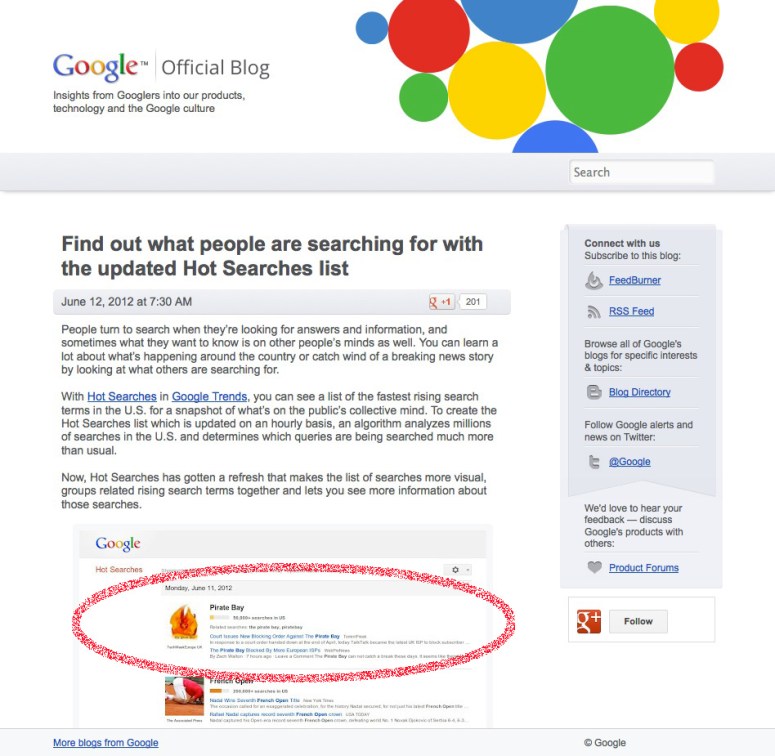
* Google Launches “Hot Trends”, The Pirate Bay Tops News Items…
* Artists Deserve To Be Compensated For Their Work by Mark Isham (Guest Post)

The biggest story of the week is no doubt the Pro-Creator/Copyright win in the court of public opinion which has the pro-piracy crowd tongue tied. Oatmeal Versus FunnyJunk is no doubt a case study for creators when looking at the illegal exploitation of their work. We applaud Matt Inman for turning the tables on those illegally exploiting his work in such a profound way. There’s much to be found on the Web this week about this story, and it deserves it’s own in depth post, until then this brief overview from Copyhype is our favorite:
http://www.copyhype.com/2012/06/oatmeal-v-funnyjunk-a-brief-observation/

21 Cents per stream? We’re watching this one with interest. New music streaming service Arena says, “101 Distribution has announced the launch of 101 Arena, the first and only free streaming music service to pay 100 percent of all advertising revenue generated directly to artists and film makers.” To put this in perspective, Spotify is only paying out .005 Cents per Stream according to most published accounts. More info at this link from PR Newswire:
http://www.prnewswire.com/news-releases/next-generation-streaming-app-puts-focus-on-artist-profit-148672305.html

Independent film distributor Kathy Wolf has launched a legal and legitimate online movie distribution and sharing platform. We’re always excited to see new models evolve that respond to the marketplace while respecting creators rights. The Huffington Post Reports:
http://www.huffingtonpost.com/kathy-wolfe/movie-file-sharing-goes-l_b_1575233.html
http://wolfeondemand.muvies.com/

Here’s a fun little post we found from Moses Avalon this week following a panel at the Music and Entertainment Industry Educators Association Summit. Nice plugs for both Robert Levine’s “Free Ride” and David Lowery’s “New Boss / Old Boss”. More here on the StumbleUpon Blog of Moses Avalon:
http://www.stumbleupon.com/su/18AuPZ/mosesavalon.com/free-ride/

There is a lot of debate over how search engines operate, including the filtering and ranking of search returns. The way search engines operate is suggested to effect everything from consumer choices to the aiding in the illegal exploitation of copyrighted works, SearchEngineLand.Com reports:
http://searchengineland.com/a-letter-to-the-ftc-regarding-search-engine-disclosure-124169

Think Social Media is a game changer? Maybe… Digital Music News Reports 93% of Americans still listen to Broadcast Radio…
http://www.digitalmusicnews.com/permalink/2012/120612radio#ipynIIM25jAuEyVZl53zA

Will Apple, Amazon and Google own .Love and .Music? Forbes is calling it the greatest land grab in history as tech and internet companies battle for the next generation of root level domain addresses.
http://www.forbes.com/sites/kashmirhill/2012/06/14/facebook-is-ignoring-the-greatest-internet-landgrab-in-history/

One of our favorite thinkers, Jaron Lanier gave a fantastic speech at the Personal Democracy Forum titled, “How to Not Create a New Cyber Plutocracy.” You can read more about Jaron and the Personal Democracy Forum at the link below, the YouTube video of his talk follows.
http://personaldemocracy.com/media/how-not-create-new-cyber-plutocracy


[ THE 101 ] [NEW BOSS / OLD BOSS ] [ SPOTIFY ] [GROOVESHARK ] [ LARRY LESSIG ]
[ JOHN PERRY BARLOW ] [ HUMAN RIGHTS OF ARTISTS ] [ INFRINGEMENT IS THEFT ]
[ THE SKY IS RISING : MAGIC BEAVER EDITION ] [SF GATE BLUNDERS PIRACY FACTS ]
[ WHY ARENT MORE MUSICIANS WORKING ] [ ARTISTS FOR AN ETHICAL INTERNET ]

The Trichordist International Translations – Deutschen, Français, Italiano, Español

Four international translations via Google Translate.

https://thetrichordist.wordpress.com/international-translations/

In German Via Google Translate : The Trichordist – Artists For An Ethical Internet
In der deutschen Via Google Translate: Die Trichordist – Künstler für eine ethische Internet
http://bit.ly/TrichordistGerman

In French Via Google Translate : The Trichordist – Artists For An Ethical Internet
En français Via Google Translate: Le Trichordist – Artistes pour un Internet éthique
http://bit.ly/TrichordistFrench

In Spanish Via Google Translate : The Trichordist – Artists For An Ethical Internet
En español a través de Google Translate: El Trichordist – Artistas para una Internet Ética
http://bit.ly/TrichordistSpanish

In Italian Via Google Translate : The Trichordist – Artists For An Ethical Internet
In italiano via Google Translate: Il Trichordist – Artisti Per Un Internet etica
http://bit.ly/TrichordistItalian

Artists Deserve to be Compensated For Their Work by Mark Isham

By Mark Isham for ibuymymusic.org
(Copyright in the Author, Posted with Permission)

Music is something that used to have a manageable business model, but with new technology appearing everyday, manageable isn’t even close. When Shawn Fanning decided to take a crack at technology and created Napster in 1999, the largest file sharing program in the world, he revolutionized the way in which music reaches its audience, changing the entire meaning behind the word “consumer.”

Illegal exploitation of the artists work is now a learned behavior. Artists’ popularity is now based on ticket sales, tweets and Facebook Likes, but not on music sales. Michael Jackson, the King of Pop, and Katy Perry, arguably the new Queen of Pop, both tied five number one singles off of one album by the Billboard Hot 100 Charts, Bad (1987) and Teenage Dream (2010). Yet, compare the sales of these two albums; that is a whole different kettle of songs.

Although music consumption is at the highest it has ever been, the majority of it is being consumed illegally. Steve Jobs had the right idea with the invention of iTunes, making music more accessible than ever. But even with success such as his, illegal distribution is the market owner. Digital music consumption has hit a plateau, only increasing by 13% in 2009. The reason why these sales are so low is that with just a click of a button, type in “Telephone” by Lady Gaga (the most illegally distributed song of 2010) and you will be lead directly to the first site in which you can get that song for free, thanks to Google. So Google profits from the illegal exploitation of the artists’ work, but not the artist themselves. This is the real problem: companies and corporations profiting by illegally distributing the artists work.

Employment numbers from the Bureau of Labor Statistics show a drop of 45.3 percent between August 2002 and August of 2011 “musical groups and artists”.  Music piracy hurts both the music producers and the music consumers. I’m not the only one affected by this; most, if not all, professional artists have taken a slump in recorded music sales due to the illegal distribution and leaks.

Michael Jackson’s Bad has sold over an estimated 30-45 million copies worldwide. Katy Perry’s Teenage Dream, combining digital and physical sales, has sold 5.5 million total album copies worldwide, a mere fraction of Jackson’s total sales. However, she has tied him with being the only artist to have five number one singles on the Billboard Hot 100 Chart from one album. Her total sales should represent her lasting power on the charts, but they don’t, proving further that the majority of listeners are gaining access to music illegally. Ask any teenager how they access their music — most will tell you they download it illegally.

I Buy My Music (www.ibuymymusic.org) is a new campaign I’ve launched with the hopes of making the realization that obtaining music illegally is taking away more than just money, it’s taking away art — an expression of feeling and power. I Buy My Music is a way of bringing awareness to the quality of life music brings to everyone — taking pride in buying art and supporting our artists and fellow man by reveling in his or her expression.

An artist is only an artist because of the music they produce — it’s their existence. Each song is an individual masterpiece, and the illegal exploitation of the artists work violates this human respect of art. We all love music and should be able to enjoy it. I would like us all to recognize that the artist can only continue to create music from our show of support by purchasing their music, rather than stealing it from them. With the continuation of illegal downloading, artists will be incapable of producing more high quality music that is representative of dedicated, committed and highly trained professionals. I admire and respect musicians, wanting them to continue with the creation of great music, and I encourage all of us to do the same before it’s too late.

Mark Isham, John Morton, Paul Williams

Launch and Iterate: Google’s Permissionless Innovation.

Every once in a while Google will accidentally reveal their true  nature through some cute slogan or catchphrase.

There is of course their famous corporate slogan  “Don’t be evil”.

As noted previously, we at The Trichordist believe that  “Don’t be evil” is not their corporate slogan but secretly their  corporate reminder.  Eric Schmidt has this written on the back of his hand in black marker.

Then there is their Net Neutrality campaign slogan they farmed out to one of their astro-turf organizations:  “We are the web.”   Yes Google we are quite aware that you think that “you are the web”. That you believe you own the web and all of our personal data.  Sergey Brin recently became apoplexic when discussing the fact that companies like Facebook and Apple have “closed” ecosystems that do not allow Google to scrape all of their data.    “How dare they? We Are the Web!”

Like Germans Google is mostly unintentionally funny.   Last week’s howler came in hearings on Capitol Hill. Google’s Internet Evangelist  Vint Cerf let this slip out:

“Such proposals raise the prospect of policies that enable government controls but greatly diminish the ‘permissionless innovation’ that underlies extraordinary Internet-based economic growth, to say nothing of trampling human rights,” said Vint Cerf.”

Now I understand that Vint Cerf was talking about some specific  proposals  from authoritarian governments that would  really truly be a threat to free access to the internet.  For once I agree with a Google spokesperson. But what caused me to guffaw was the phrase “permissionless innovation”.   It slipped out so smoothly and seemed so well-worn it was as if  Google’s collective Id  was speaking directly to us all.

It  seems particularly significant when you combine that with Van Lohman’s ( Google Senior Copyright Counsel)  cheerful admission of  Google’s “Launch and Iterate” copyright contempt strategy.  As reported in the Huffington Post:

Fred von Lohmann, senior copyright counsel at Google, reflected on how copyright has been an issue since the earliest search engines. Asked how to address the various obstacles of digital platforms, he cheerfully sloganeered “As we say at Google ‘launch and iterate,’ ” by which he meant the best approach for digital media companies, since the waters of copyright will remain murky for some time, is simply to launch content, learn from the inevitable public and legal response and then improve. The “launch and iterate” mentality allows for experiments in freedom of expression as well as public participation.

This same wonderful “experiment” also allows google to make plenty of money by exploiting artists without compensation.  But I digress.

From the Google Permissionless Innovation Department:

Google Books:  Don’t ask the authors if we can digitize their books, let’s just  monetize search within those books?

YouTube:  Let’s just put all this video content on the web and we’ll deal with the copyright owners later.

Shareholder rights:  Let’s screw virtually everyone but the founders by issuing new  non voting class c stock.  We’ll deal with the SEC and shareholder lawsuits later.

And of course you can apply “permissionless innovation” to many other rogue companies in the web space. After all according to the largely google funded copyleft  file-sharing sites are more innovative than sites like iTunes that seek permission.  That’s why consumers prefer The Pirate Bay to iTunes.  Not because they get stuff for free but because  The Pirate Bay is a pioneer in “permissionless innovation”.

I suppose the ultimate in “permissionless innovation” are the human trafficking sites.  No wonder Google apparently  refuses to restrict the flow of advertising dollars to these sites.  They are fellow “permissionless innovators”.

All sarcasm aside.  This is the problem with Google. It has never grown up.  There is something juvenile and narcissistic about it’s corporate culture. It’s slogan should be “you are not the boss of me”.  They have perverted the concept of internet freedom to mean don’t tell Google what to do ever.  Think I’m exaggerating?

” If we could wave a magic wand and not be subject to US law, that would be great.” —Sergey Brin quoted in The Guardian UK. 

Permissionless Innovation.  We love this phrase.  Do you mind if we Artists For An Ethical Internet keep it?

FarePlay.Org – An Open Letter


Below is an open letter from FarePlay founder Will Buckley – Support FarePlay.
http://fareplay.org/
https://www.facebook.com/FarePlay

An open letter.

FarePlay is an advocacy group supporting the rights of individuals to control the distribution and sale of their Intellectual Property.

Our mission is to confront the misinformation and misperceptions voiced by illegal downloading proponents to justify their actions.

The proponents of online piracy would have you believe that illegal downloading is a victimless crime and they are “entitled” to distribute anyone’s work without permission.  They talk about wealthy super-stars and corporate greed to justify their action and would have you believe that without unrestricted, unlimited free access to copyrighted material no one would be aware of the great music and film that’s out there.

It is time the truth be told by the people whose lives are directly impacted; the creative community.

We need to involve the musicians and filmmakers and empower them to have an open discussion with their fans about the impossible challenges they face when people are unwilling to pay for their music and film.  An online community where artists can communicate with their fans about the importance of fan support without the fear of ridicule and recrimination.

Most importantly, we need to change the conversation.
Will Buckley
founder, FarePlay