Two Simple Facts about Technology and Piracy : iTunes Vs. YouTube

Fact number one.

Unlike Google’s YouTube, Apple’s Itunes Store does not have a piracy problem, nor does it have an unmanageable issue with DMCA notices. This is often explained that this is because Apple does not allow user generated content from just anyone, therefore there is a barrier to entry that prevents such issues. But this is simply just not true, anyone can upload an album of music to Itunes using any one of the third party aggregation services such as Tunecore or CDbaby. And yet, there are not (as far as we know) hundreds or thousands of DMCA notices and content take downs on Itunes per day, as there are on YouTube. So why is this? In a word, intent.

If Apple, Spotify, Amazon and virtually every other legal and licensed distributor of digital music can put into place, the checks and balances that are capable of managing these rights effectively why is it so hard for Google to do the same YouTube? Think about it.

Fact number two.

YouTube can effectively filter content if it wants to. Since day one, we have never, ever seen any live porn on YouTube. Not a single live link to porn, ever. In debates in various online forums we have often proposed the challenge to anyone to present an active live link to full fledged porn on YouTube. It has NEVER happened. No one has EVER been able to present a live link to an active porn video on YouTube in the six plus years we and our friends have presented the challenge. Talk about a crowd sourcing FAIL.

What these two facts reveal is that rights management online, the protection of copyrights and the enforcement of Intellectual Property require nothing more than the intent and will to do so. But don’t take our word for it, listen to Google’s own Chief Economist Hal A Varian from his book “Information Rules” where he describes “Bitlegging.”

“Bitlegging” can’t be ignored: there’s no doubt that it can be a significant drag on profits.

Bitleggers have the same problem that any other sellers of contraband material have: they have to pet potential customers know how to find them. But if they advertise their location to potential customers, they also advertise their location to law enforcement authorities. In the contraband business it pays to advertise… but not too much.

This puts a natural limit on the size of for-profit illegal activities: the bigger they get, the more likely they are to get caught. Digital piracy can’t be eliminated, any more than any other kind of illegal activity, but it can be kept under control. All that is required is the political will to enforce intellectual property rights.

So Apple, Amazon, Spotify (and hundreds of others) can effectively manage digital distribution without triggering millions of DMCA notices. YouTube can effectively filter porn, and yet the internet is not broken as best as we can tell.

Maybe, just maybe this isn’t so complicated after all. That is unless one has a specific intent and motive from which they perhaps profit from the mass scale aiding of commercial level infringement.

Grammy Award Nominated Black Keys Exploited by… American Express Delta Airlines Card, AT&T, Dish Network, M&M’s (Mars), Nissan and others…

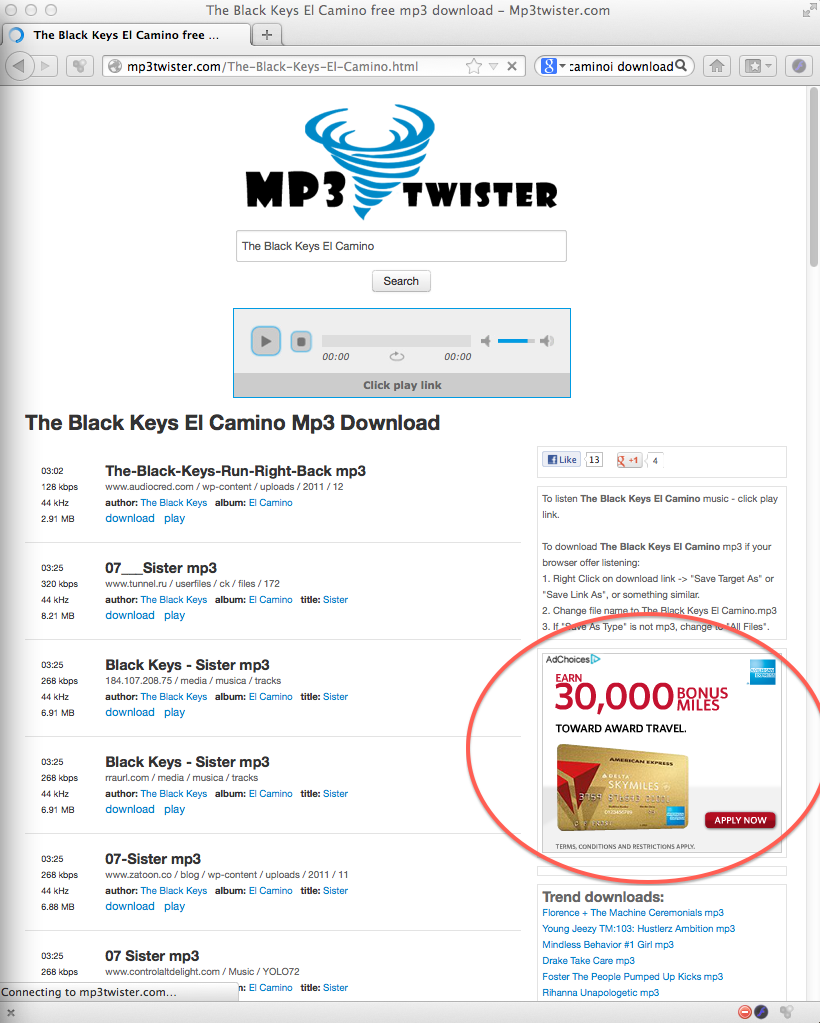
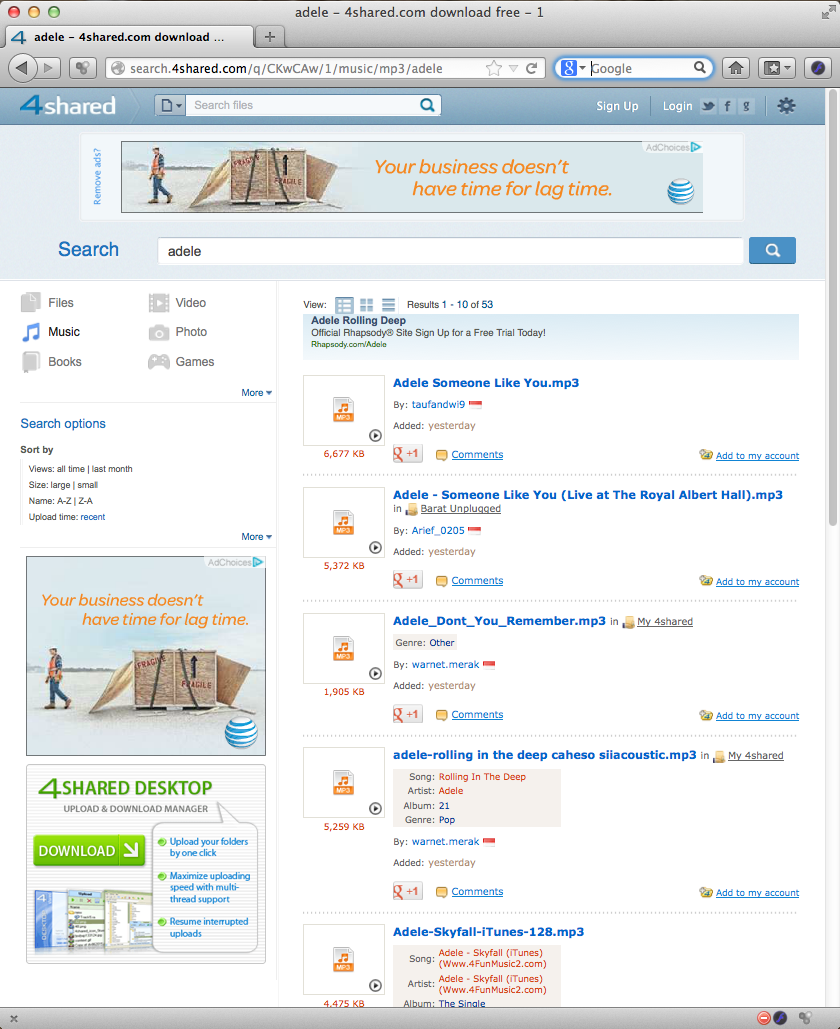
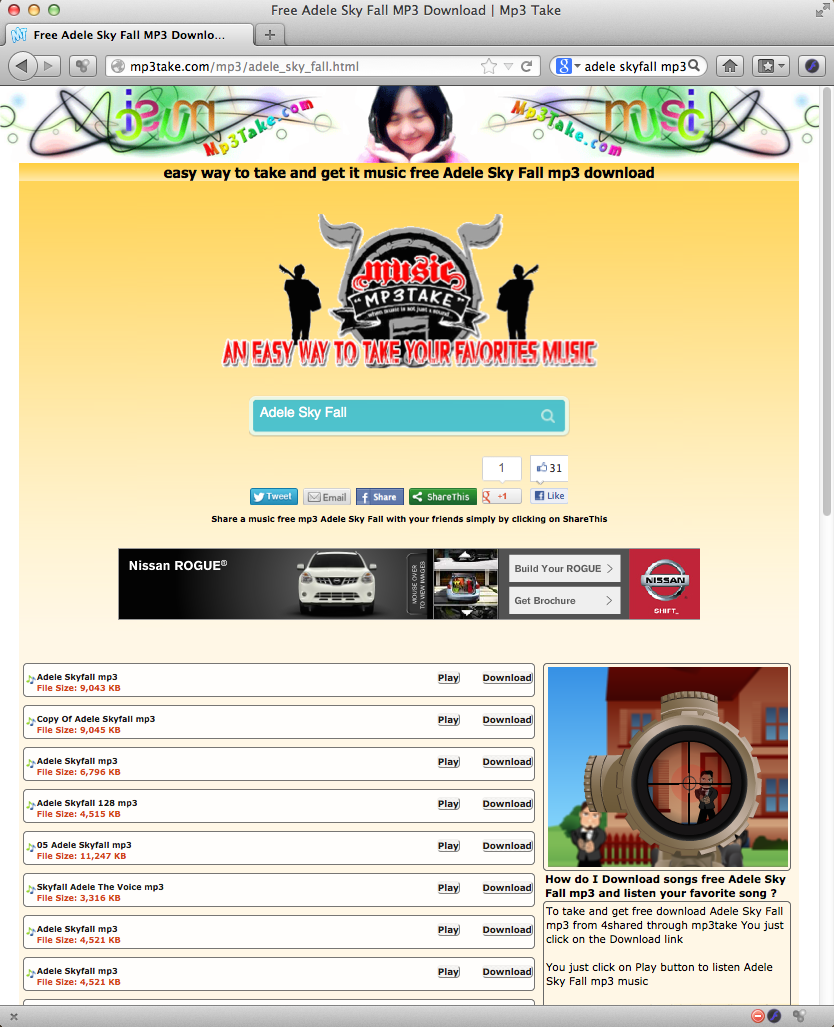
The Black Keys have been very vocal about their opposition to the payment and revenue models of new streaming services like Spotify, but we wonder how the band will feel when seeing their music generating ad revenue for commercial level infringing websites like Filestube, Mp3 Twister, Share Beast and Mp3 Boo all as from a simple Google Search.

We also wonder if any of these brands will be advertising during the Grammy Awards for which the band is nominated for Best Album. These are major brands such as American Express, Delta Airlines, Dish Network, Nissan and M&Ms. All of whom we’ve seen running television advertising campaigns for their products and services.

Here’s a quick look at a random sampling of sites from searching Google. This is despite what might be hundreds or more likely thousands of delisted links from legitimate DMCA notices. Mind Boggling…

American Express Delta Airlines Card on Mp3 Twister
AT&T on Mp3 Twister
Dish Network on Mp3 Twister
M&M’s (Mars) on Share Beast
Nissan on Mp3 Boo
Movie 43 (Relativity Media) on Mp3 Boo
Exposed Webcams on FilesTube

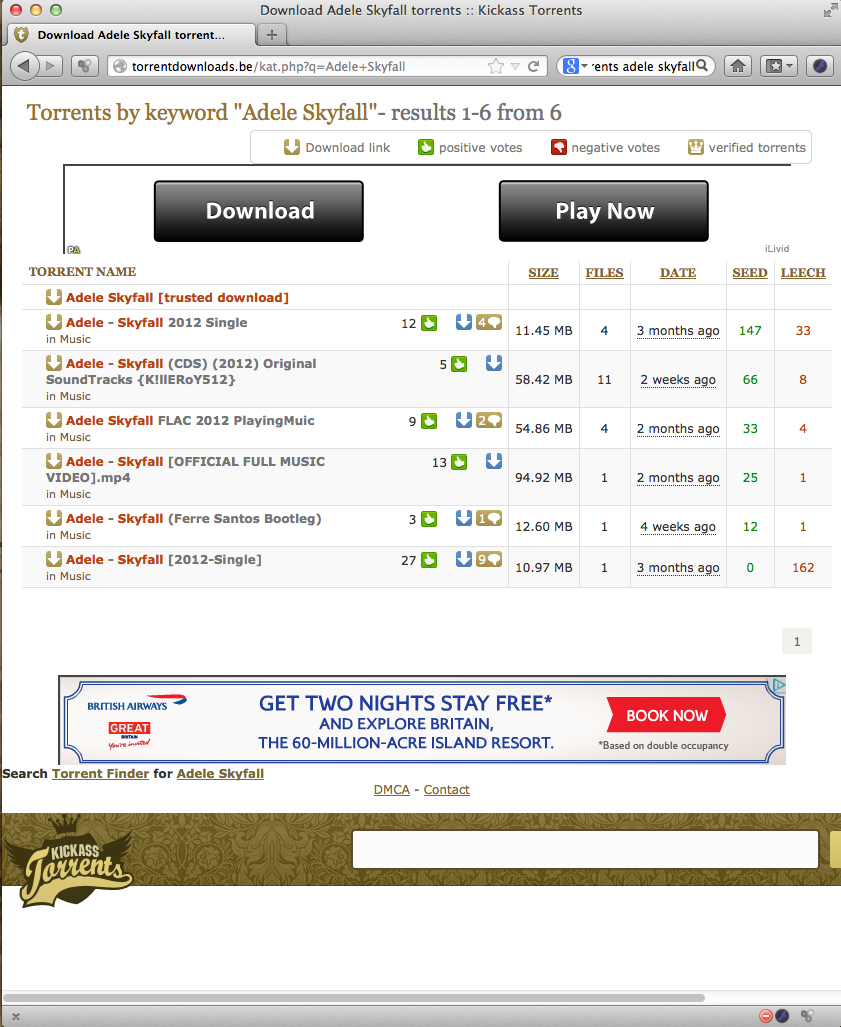
googleblackkeystorrents

Despite the amount of delisted links, presumably to the largest infringers, the pirate bay can still top the search results listed. Also interesting is that the reach of the ad networks seems to go very deep into a long tail of very dispersed infringing sites like Mp3 twister. It appears that as brands and agencies are learning of their ads appearing on infringing and illegal sites, the ads are starting to migrate down stream to perhaps previously less visited sites.

bk_mp3twisterAMEXDELTA

bk_mp3twisterATT

bk_mp3twisterDISH

bk_sharebeastMMS

bk_mp3booNISSAN

bk_mp3booMovie43

What is disturbing about the ad above for Movie 43 on Mp3 Boo is that it is for a film by Relativity Media, a Hollywood film production and distribution company. It’s entirely possible if we looked for this film it may already be leaked and pirated, and if not, most certainly will be within hours on the day it is theatrically released.

bk_filestuneEXPOSEDWEBCAMS

Also of interest in this batch are the porn site ads on FilesTube. Isn’t this some kind of public safety issue that minors under 18 years of age who are visiting these infringing sites to get free music illegally are being exposed to pornographers showing girls who are barely legal themselves at just 18 years old?

Is this really acceptable to our representatives on Capital Hill?

Kim Dotcom’s “End Of Piracy”, that was easy…

In the anticipation of the announcement of the new Mega launch, Pat Pilcher at The New Zealand Herald wrote an article titled “Kim Dotcom on Ending Piracy” in which the journalist listed Mr.Dotcom’s five steps to ending piracy. Pilcher writes,

As ironic as that may sound, Kim Dotcom’s logic is inescapably robust. Here’s what his end to piracy manifesto says:

1. Create great stuff
2. Make it easy to buy
3. Same day worldwide release
4. Fair price
5. Works on any device

Looking at what Kim is saying, the 5 points seem pretty obvious, although each could quickly get bogged down once Hollywood gets involved.

So let’s look at these one by one.

1. Create Great Stuff
Well, that’s a no brainer. The content industries create the most prized and sought after “stuff” in the world including films such as Avatar, The Avengers, and The Dark Night Rises as well as franchises like Iron Man, Transformers, Harry Potter and others. Music artists include the likes of Adele, The Black Keys, Taylor Swift, The Beatles and countless others. Making great stuff has never been a problem.

2. Make It Easy To Buy
Another no brainer. Perhaps a decade plus ago this might have been an argument, but not today. There are over 500 legal and licensed music services alone. For the film industry there are services like Netflix, Vudu and Cinemanow as well as other direct to home video on demand providers that give consumers more access to more content across more platforms than at any time in history.

3. Same Day World Wide Release
For music this is more less the standard now and is also more and more common for feature film releases as well. This is a common practice for the largest and most anticipated releases of music and films, the “stuff” that is the most aggressively pirated. For smaller indie releases this may not always be possible but than again I’m not sure that the problem we are combating is in Nigeria on indie rock albums and movies that are more or less film festival darlings.

4. Fair price
Done. Netflix is $7.99 a month for unlimited access to it’s entire library of films and tv shows. Spotify is $9.99 for unlimited access to it’s entire library which consist of probably 95% of every known recording in print. Add to this the cost of a song download is 99 cents. Less than the cost of a candy bar. Renting a movie from a video on demand service ranges from 3.99 to 5.99. Price is no longer an issue and has not been for years.

5. Works on Any Device
Music is DRM free and has been for at least half a decade. Streaming Services such as Netflix and Spotify are also available on every major platform including not only Mac and PC computers, but also mobile devices such as smart phones and tablets by a variety of manufacturers. Additionally most new video game consoles and blu-ray players also include many of these same apps.

So there you have it, the end of piracy. Even Pat Pilcher at The New Zealand Herald agrees a referring to a similar response from the New Zealand record industry. He writes,

Well there it is, RIANZ’s response in full. I can’t argue with much that they’ve said, as they’ve pretty much complied with most of Kim’s 5 points.

So Kim Dotcom’s five suggestions have been fulfilled and yet, I don’t think we’ll see an end to piracy anytime soon. There is still one thing piracy offers that legal, licensed and legitimate services do not, and that is compensation to the artists, musicians, filmmakers and creators which requires that consumers actually do pay the fair price asked.

It’s all pretty simple and by Kim Dotcom’s own suggestions and admission it’s pretty clear where the problem is from here on out, and it’s not in his five suggestions…

And, of course, let us not forget this classic… Kim Dotcom Parody Video Appears on YouTube

Obama Inauguration and White House IP Policy via IPEC, Victoria Espinel

As we’ve written before much of the big internet, anti-copyright blogosphere seems to live in a persistent state of denial regarding The Copyright Policy Reality Gap. We applaud not only President Obama’s support for better protection of Copyright and IP, but also Vice President Biden and we look forward to the next four years of progress for creators rights.

“What’s more, we’re going to aggressively protect our intellectual property.  Our single greatest asset is the innovation and the ingenuity and creativity of the American people.  It is essential to our prosperity and it will only become more so in this century.  But it’s only a competitive advantage if our companies know that someone else can’t just steal that idea and duplicate it with cheaper inputs and labor. ” – President Barack Obama

“…piracy is theft. Clean and simple. It’s smash and grab. It ain’t no different than smashing a window at Tiffany’s and grabbing [merchandise].” – Vice President Joe Biden

In his first term President Obama appointed Victoria Espinel to the position of US Intellectual Property Enforcement Coordinator, which was created during the Bush administration in 2008. Intellectual Property Enforcement is a bi-partisan issue that reaches across all sectors of the United States economic interest.

Intellectual property are the ideas behind inventions, the artistry that goes into books and music, and the logos of companies whose brands we have come to trust.   My job is to help protect the ideas and creativity of the American public.  One of the reasons that I care about this is because I believe it is enormously important that the United States remain a global leader in these forms of innovation – and part of how we do that is by appropriately protecting our intellectual property.  Our intellectual property represents the hard work, creativity, resourcefulness, investment and ingenuity of the American public.  Infringement of intellectual property can hurt our economy and can undermine U.S. jobs.

To learn more about the work being done, you can go here:

http://www.whitehouse.gov/omb/intellectualproperty/spotlight

Artists, photographers, authors, illustrators, filmmakers and creators of all types who rely upon the protection of their copyrights and intellectual property are encouraged to also express their gratitude and appreciation to one of our best and dedicated champions on Capital Hill.

We encourage and suggest that all creators email their support of the great work done by Victoria Espinel and the Office of the U.S. Intellectual Property Enforcement Coordinator at:

intellectualproperty@omb.eop.gov

Artists Rights Watch – Sunday Jan 20, 2013

Grab the coffee!

Recent Posts:
* Well this is Embarrassing, a Tunecore Ad on 4Shared…
* Don’t Get IRFA’d: Westergren’s Fake “Tour Support”
* Golden Globe Winner Adele Exploited by American Express, AT&T, British Airways, Target and Nissan

From Around The Web:

COPYRIGHT ALLIANCE:
* The Silver Lining of the SOPA Debate

ADLAND:
* Youtube and Google have money problems

GRAPHIC LEFT OVERS:
* Creatives Stunning Revolt Against Big Bad Business

As best I can determine, none of the creators of these images were asked to participate in a program that paid them peanuts (a one time payment of $12) and gives away their work hundreds of thousands of times. This is a great deal for Google and its users and a complete disaster for the photographers who participate against their will.

“D-Day” (Deactivation Day) is set for February 2nd and a growing number of contributors are pledging to deactivate their portfolios or pull large numbers of images until the one million image mark is met.

MICROSTOCK POSTS:
* Photographers plan to remove images from iStockphoto

THE CURTIS AGENCY:
* More Horror Stories from the Digital Book Bazaar

I have often written that piracy is the biggest threat to the e-book business. (visit Pirate Central). This is a good instance why. – Richard Curtis

DIGITAL MUSIC NEWS:
* Study: A Majority of Americans Would Support Moderate Piracy Enforcement…

MEDIABISTRO:
* How to Stop Piracy: Carnegie Mellon Professor Michael Smith at DBW

“The shutdown of Megaupload caused a statistically significant increase in digital sales,” he said, comparing numbers between countries with high Megaupload usage to countries with low Megaupload usage.

LAS VEGAS REVIEW JOURNAL:
* At adult expo, fans hunt autographs while pros battle piracy

PHILSTAR.COM:
* TFC Japan all-out in its anti-piracy campaign

“We have an office here that provides em- ployment as it serves the community it is in. We are grateful that the new anti-piracy laws in Japan recognize the ‘sensur- round’ value of the busi- ness that we bring and the empowering impact of the content that we deliver to our target audience,” says Olives.

“There are naysayers who said that piracy is an unwinnable war,” narrates Lopez. “But we believed that piracy should be treated like a disease that needs to be eliminated. You always start effective disease preven- tion through mass information. People need to know what the disease is and what it does. And you need partners who share the same faith in the cause. We found one in OMB chairman Ronnie Ricketts.”

SE TIMES.COM:
* Balkans need better intellectual property protection

“Potential investors are not much interested to invest in a country where intellectual rights are not protected,” Blagojevic said, adding that infringement of these rights has caused substantial losses to Serbia’s economy.

Citing International Data Corporation statistics, Blagojevic said the value of pirated software in Serbia in 2011 was estimated at nearly 87 million euros.

“If the piracy rate would be dropped 10 percent, the state budget revenues could increase $20 million [14.9 million euros] and some 10,000 jobs could be opened, primarily in the IT industry,” Blagojevic said.

AD AGE:
* If Pandora Can’t Monetize Mobile, Can Anyone?

MUSIC TECH POLICY:
* What’s all this then? Google’s “Ad Cops” Are Missing the Point
* How the Rate Court Cottage Industry is Leading to the Destruction of Collective Licensing
* Brand Sponsored Piracy and Award Shows: British Airways Delivers the ultimate insult to Adele

TECH CRUNCH:
* Keen On… Incubus: Limousines, Feeling Dirty and Being Kicked In The Balls (TCTV)

HYPEBOT:
* Ted Cohen On Music Tech And The Music Industry [INTERVIEW]

Do you still favor subscription over advertising-based music services?

Yes, I do. I don’t think that the advertising model so far has proved to be sustainable. I think that we have undervalued subscription. I am paying $150 a month for cable. I watch 20 or 30 hours of TV a week. I probably listen to 50 to 60 hours of music a week. I’d argue with you that music is worth more than $10 a month subscription service.

The labels were so concerned about (piracy)—and I was there at the time—that we had to come up with a price that was just a little bit more than free to convince people that they should pay. So far, we have not been able to raise the price. I think that music is worth at least $20 or $25 a month.

THE PRECURSOR:
* The Google Lobby Defines Big Internet’s Policy Agenda

READ WRITE:
* Is Kim Dotcom’s New Site, Mega, The Wild West Of Piracy?

UPDATE FROM THE CES “PRO-ARTIST” PANEL:

CES Panel Moderator and CNET writer Declan McCullagh discloses artists and creators representatives were not actually invited despite CES claiming they were. As we reported, the panel was comprised of anti-artist and anti-copyright publicly acknowledged Google paid shills.

MARIA BUSTILLOS:
* Yes and No (Lessig, Swartz and Society)

Here it comes again!

Music Technology Policy

Not surprisingly, Tim Westergren is rallying the troops at the Consumer Electronics Show–the locus of those just like him who want to enrich themselves from commoditizing music.   Remember, Westergren is the founder and public face of Pandora–and has been cashing in to the tune of $1,000,000 a month as he sells off his founders stock in the public markets.

So now the LA Times is reporting that Westergren is offering the Web 2.0 version of “tour support”:

[Westergren] talked about Internet radio as a means to generate income for performing artists (who don’t get paid at all by over-the-air stations) and insights. In particular, he touted Pandora’s ability to help artists figure out where to tour and promote their live shows to a receptive audience.

The key, Westergren said, is in the feedback Pandora users give on songs. The site allows listeners to give a thumbs up to songs they’d…

View original post 816 more words

Golden Globe Winner Adele Exploited by American Express, AT&T, British Airways, Target and Nissan

On Sunday January 13th, Adele won the Golden Globe for the Best Song In a Motion Picture for her song “Skyfall” in the latest James Bond film of the same name. So we thought we’d take a look and see which brands are advertising on both the Golden Globes Awards Show and also on the pirate sites giving away the song that had just won the award.

It’s interesting to note who doesn’t show up on pirate sites as well. For example we’ve seen no ads by L’Oreal (as yet) on pirate sites. L’Oreal had a very strong presence running ads during the Golden Globes, as did Target (who unfortunately also shows up frequently on pirate sites).

Here’s what we found in just a few minutes… this is like shooting fish in a barrel. Who will advertise on the Academy Awards and Grammys who is also funding piracy? We wonder…

AdeleTargetMp3Ape

AdeleAT&T4shared

adeleamex4shared

adeleBristishAirmp3crow

AdeleKATbritAir

AdeleNissonmp3take

British Airways is interesting in this batch. Adele is British. James Bond is British. Have to wonder how smart these ad networks are getting in their targeting of consumers based on interests and other relational values.

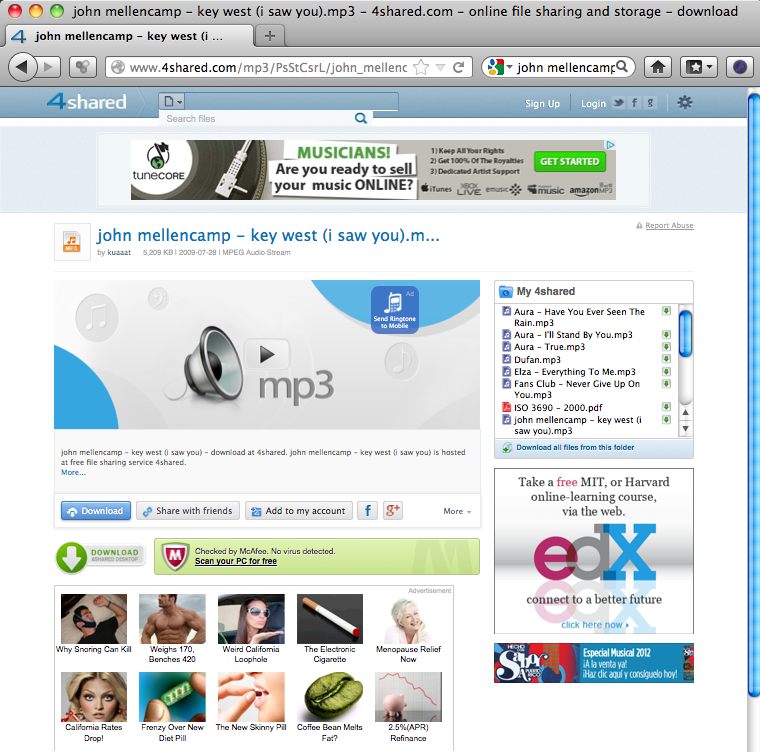
Well this is Embarrassing, a Tunecore Ad on 4Shared…

When doing random searches on illegal and infringing sites, you never know whose ads might pop up… Artists pay Tunecore to distribute their albums and music on paid platforms, and Tunecore pay’s pirate site 4Shared to give the artists music away for free…

MellencampTUNECORE

Read John Mellencamp’s excellent editorial on The Huffington Post,

Why is thievery allowed to continue on the Internet? And why do people think it’s so impossible to correct? Right after radio was invented, they played music and sold advertising. Then it dawned on some: “Hey, they’re playing our music, and they’re selling advertising on our backs; we should get paid.” So performing rights organizations like ASCAP and BMI were established with the express intention of protecting the intellectual property of artists who create it.

Artists Rights Watch – Sunday Jan 13, 2013

Grab the coffee!

Recent Posts:
* The Copyright Policy Reality Gap
* Free Culture’s Epic Fail – If Free is Working, Why Fight Copyright?
* Reading Between The Lines Google Tells The Truth On Ad Supported Piracy
* “Maintain Choice For Everyone” Vint Cerf On Internet (and Google) Regulation #2013CES
* The Return of Orphan Works: Trojan Horse: Orphan Works and the War on Authors by Brad Holland, Part 5 (Conclusion)
* CES Fart Club aka The Slaptastic “Pro-Artist Copyright Policy Panel” features Anti-Copyright Advocates and Google Named Shills #2013CES

FROM AROUND THE WEB

THE HUFFINGTON POST:
* Verizon Copyright Alert System Would Throttle Internet Speeds Of Repeat Online Pirates
* Copyright Alert System: How ISPs Will ‘Break Your Internet’ If They Catch You Pirating

THE ILLUSION OF MORE:
* Paying Attention to the Echo Chamber at CES Copyright Panel Discussion

I think it’s safe to say that, before we were on the Internet, before everything could become sharable data, that nobody would rationally have argued that selling bootleg CDs out of a car trunk would be an act protected by free speech. That being the case, the philosophical/legal question is, “What’s really changed?”

POP UP PIRATES:
* Youtube Allows Pirate “Partners” to Profit From Illegal Movie Uploads
* R.I.P. myArtCinema2 (A.K.A. YouTube Pirate)

BRITISH JOURNAL OF PHOTOGRAPHY:
* Photography industry shows mass opposition to government copyright changes

More than 70 organisations representing photographers, agencies and picture libraries – from Associated Press, Getty Images, Magnum Photos to the Press Association, Reuters and Tate – have joined forces, urging Parliament to vote against proposed changes to UK copyright law, BJP can exclusively reveal

CURTIS AGENCY – PUBLISHING IN THE 21st CENTURY:
* Curtis Agency, E-Reads Deploy Program to Neutralize Pirates
* Long Before E-Book Revolution, War for Control of E-Rights Was Lost

DIGITAL MUSIC NEWS:
* Levi’s Was First. Now, Several Major Brands Want to Pull Their Pirate Site Advertising…
* Spotify Is Now Deploying 6 Different Types of Cookies…
* It’s Official: Vinyl Sets Another Sales Record In 2012…

VOX INDIE:
* Consumer Electronics Show’s Copyright Panel – Certain Artists Need Not Apply

BILLBOARD
* Album Sales Down in 2012, But Digital Shows a Healthy Boost

Digital-track sales enjoyed 5.1% growth to 1.34 billion units and thanks to that robust performance, album sales plus TEA (track equivalent albums whereby 10 tracks equal one album), only declined 1.8% for the year.

TORRENT FREAK:
* RapidShare: Traffic and Piracy Dipped After New Business Model Kicked In
* Verizon’s “Six Strikes” Anti-Piracy Measures Unveiled

COPYRIGHT ALLIANCE:
* Copyright and the 113th Congress

“Maintain Choice For Everyone” Vint Cerf On Internet (and Google) Regulation #2013CES

Vint Cerf the man credited with being a co-creator of the internet spoke at CES today and was asked about internet regulation by and audience member. What is interesting about Cerf’s response is that it echoes the sentiments that artists, creators and rights holders have been arguing are important to have a fair, ethical and sustainable internet for all citizens that does not unfairly favor specific companies are corporate interests.

As reported by Ars Technica, Zero regulation for telcos could endanger neutrality, Internet co-creator says.

One audience member asked Cerf what kind of regulation is necessary to protect consumers from predatory practices on the Internet, and from companies favoring certain kinds of content over others. The audience member mentioned that the question is relevant to Google, Cerf’s employer.

Cerf answered, “With regard to the regulatory practices, what I am after more than anything else is to inhibit anti-competitive behavior. It’s necessary to make sure that people who control underlying resources don’t do so in such a way as to distort the market. If there is a distortion—and you have to demonstrate that if you want to take regulatory action—then… you need to do something about it to maintain choice for everyone and make sure the market is open for competition.”

We pretty much agree with everything Vint is saying above in bold as media piracy facilitated and aided by companies like Google appear to be distorting the market due to a lack of regulation and anti-competitive behavior.

Further more, as much so is our mantra, we find that we could not agree more with Vint’s observation that you need to maintain choice to ensure a fair and competitive market.

We’re encouraged by Mr. Cerf’s comments in that we can clearly see that he truly understands the need for regulated markets so that they can function fairly for all stakeholders. Unfortunately his comments are with respect to broadband access and not a fair and regulated internet that would address the market distortion created by media piracy whereby the choice of where to distribute their work is removed from creators without consent.