Trent Reznor speaks on value of music: “It costs 10 bucks, or go **** yourself. | SPIN

“I know that what we’re doing flies in the face of the Kickstarter Amanda-Palmer-Start-a-Revolution thing, which is fine for her, but I’m not super-comfortable with the idea of Ziggy Stardust shaking his cup for scraps. I’m not saying offering things for free or pay-what-you-can is wrong. I’m saying my personal feeling is that my album’s not a dime. It’s not a buck. I made it as well as I could, and it costs 10 bucks, or go fuck yourself.”

READ THE FULL INTERVIEW AT SPIN:
http://www.spin.com/featured/trent-reznor-upward-spiral-nine-inch-nails-spin-cover-september-2013/

PRE ORDER THE ALBUM ON ITUNES NOW:
https://itunes.apple.com/us/album/hesitation-marks/id655150305

University Of Georgia Music Business “Undesirable”Lyric Website Study

Lyric searches drive huge traffic on the web.  They may not be quite as popular as “Lady Gaga Download”  and other similar searches but they are right up there.

There are lots of licensed sites and as usual lots of what appears to be unlicensed sites.  Almost all of these sites have major brand advertising.

Many of you may not realize this but I’m also on the faculty of The University of Georgia.  I teach in the Music Business Program.  I spent considerable time this summer studying these sites as part of my official research duties. It’s part of a bigger project whereby I’m studying and cataloguing many of the “lesser known” kinds of copyright infringing websites.

Here is a short paper listing this months top 50 “undesirable” lyric websites as well as my methodology and further comments. It is my hope that brands and advertising agencies will consult this list when planning advertising campaigns. Suggestions are truly welcome.

You may download/view  it here:

UGA Music Business Undesirable Lyric Website List*

If you don’t want to download it and read the whole thing (I’m talking to you generation tl/dr) here are the Top 50 “undesirable” lyric websites.  (If for some reason you believe your website was mistakenly included in the list follow instructions in the paper. )

(Ranked by search result rankings.)

Top 50 Undesirable Lyric Websites.

(This list has been corrected.  7 sites from original list turned out to have been licensed. Thanks to Andrew Stess at LyricsFind for doing deep dive into this over a holiday weekend).

Rank Website Final score Major brands

1

http://www.songlyrics.com

7.445

yes

2

http://www.lyricsmania.com

6.18

yes

3

http://www.stlyrics.com

6.055

yes

4

http://www.lyricsreg.com

4.485

yes

5

http://www.lyricstime.com

4.435

yes

6

http://www.lyricsdepot.com

4.395

yes

7

http://www.elyricsworld.com

4.33

yes

8

http://www.songonlyrics.com

4.285

yes

9

http://www.lyricstranslate.com

4.13

yes

10

http://www.karaoke-lyrics.net

3.89

yes

11

http://www.lyrics.astraweb.com

3.325

yes

12

http://www.kovideo.net

3.13

yes

13

http://www.oldielyrics.com

2.93

yes

14

http://www.poemhunter.com

2.825

yes

15

http://www.maxilyrics.com

2.675

no

16

http://www.lyricsboy.com

2.54

yes

17

http://www.anysonglyrics.com

2.27

yes

18

http://www.lyricsmansion.com

2.185

yes

19

http://www.absolutelyrics.com

2.11

yes

20

http://www.videokeman.com

2.105

no

21

http://www.digitaldreamdoor.com

2.055

yes

22

http://www.musicloversgroup.com

1.94

no

23

http://www.urbanlyrics.com

1.915

yes

24

http://www.asklyrics.com

1.895

yes

25

http://www.bmusiclyrics.com

1.885

yes

26

http://www.nomorelyrics.net

1.865

yes

27

http://www.plyrics.com

1.855

yes

28

http://www.lyricsforsong.net

1.805

yes

29

http://www.hotnewsonglyrics.co

1.795

yes

30

http://www.hitslyrics.com

1.73

yes

31

http://www.sasslantis.ee

1.705

yes

32

http://www.lyricspinas.com

1.68

no

33

http://www.cowboylyrics.com

1.655

yes

34

http://www.guitaretab.com

1.62

yes

35

http://www.songtextemania.com

1.54

yes

36

http://www.lyrics59.com

1.5

yes

37

http://www.golyr.de

1.495

yes

38

http://www.lyricsera.com

1.49

yes

39

http://www.justsomelyrics.com

1.47

yes

40

http://www.allthelyrics.com

1.44

yes

41

http://www.6lyrics.com

1.365

yes

42

http://www.lyricsfeast.com

1.33

no

43

http://www.hiplyrics.com

1.32

yes

44

http://www.lyricsprint.com

1.265

yes

45

http://www.paroles-musique.com

1.25

yes

46

http://www.muzikum.eu

1.235

no

47

http://www.alivelyrics.com

1.13

yes

48

http://www.lyrster.com

1.13

yes

49

http://www.guitarparty.com

1.115

yes

50

http://www.azchords.com

1.095

yes

*songmeanings.Net was mistakenly included in first list.  This was a typo we compared it to songmeanings.com. 

** Over the weekend we were notified that these sites are also licensed:

http://www.musicsonglyrics.com

http://www.songmeanings.net

http://www.lyriczz.com

http://www.lyricsondemand.com

http://www.tabs.ultimate-guitar.com

http://www.lyricsg.com

http://www.songfacts.com

May I humbly suggest that Lyric sites begin putting a notice on their sites clearly explaining which organizations and publishing companies have licensed them.   At least until we manage to create a master list.

*update 10/22/2013  new list: UGA Music Business Undesirable Lyric Website List Oct 22nd 2013

Google and YouTube want “Transparency and Openess” except when it applies to Google and YouTube!

Censorship anyone? Hmmmmm…

Because information wants to be free, as long as it’s your information. Which brings us to this: YouTube is now threatening to completely sever its relationship with digital distributor ONErpm, thanks to some ‘over-sharing’ of information in a recent guest post on Digital Music News. According to ONErpm founder Emmanuel Zunz, YouTube is unhappy that certain payout details and percentages were disclosed, with a complete blacklisting being threatened.

According to ONErpm, YouTube has demanded that the entire guest post – here – be ripped down, which would obliterate nearly 100 comments and the knowledgebase that comes with that (not to mention the detailed information in the post itself).

“Yt is threatening to cancel our agreement,” Zunz emailed. “It’s a very serious issue for us.”

READ THE FULL STORY HERE AT DIGITAL MUSIC NEWS:
YouTube Demands the Removal of a Digital Music News Guest Post…

The idea that Google is an open and transparent company is simply laughable to anyone who has actually dealt with the company and given Google’s monopoly over video search, when it makes threats about cutting someone off from YouTube, those threats are amplified with what is called a “force multiplier” in some circles (or an “A-hole multiplier” in others).  An amplification that varies directly with the effectiveness of YouTube’s monopoly over online search, a monopoly perfected for years by Google subsidizing YouTube with profits from its other monopoly businesses.

READ THE FULL STORY AT MUSIC TECH POLICY:
More Stupid New Boss Tricks: Google’s YouTube Artist Relations Debacle

RELATED:
So Much For Innovation, YouTuber’s Meet The New Boss…

21st Century Piracy: The Demise of the Music Industry | THE WIP

EDM artist Victoria Aitken speaks out.

The Internet pirates have made me, and thousands of other musicians, walk the plank. We now have to swim in shark-infested waters where the big fish gobble up our dues and the pirates laugh their way to the bank.

I believe this basic injustice must be remedied – Internet pirates are white-collar criminals. They should pay the royalties they have stolen or be answerable to the law, like looters, burglars, and fraudsters.

READ THE FULL STORY AT THE WIP:
http://thewip.net/contributors/2013/08/music_industry_killed_by_pirat.html

RELATED:
Google, Advertising, Money and Piracy. A History of Wrongdoing Exposed.

Why Copyright is a Right and Fair Use is a Privilege | Law Theories

In this post, I’ll explain why copyright opponents have it exactly backwards when they claim that copyright is a privilege and fair use is a right. At the outset, I note that these terms can have various, nontechnical meanings that possibly overlap. For example, Black’s Law Dictionary defines “right” to mean, inter alia, a “privilege,” and it defines “privilege” to mean, inter alia, a “right.”2 But copyright opponents are not using these terms interchangeably; they are using them in contradistinction to each other. In other words, they are saying that right and privilege are mutually exclusive terms. It’s this technical usage of these terms that I’ll address.

READ THE FULL STORY AT LAW THEORIES:
Why Copyright is a Right and Fair Use is a Privilege

How Will Musicians Survive In the Spotify Era? | The New Yorker

Sasha Frere-Jones, Dave Allen, Jace Clayton, and Damon Krukowski discuss how (mildly) popular musicians are going to survive.

Last month, Damon Krukowski and I discussed Spotify, the public exit of Nigel Godrich and Thom Yorke from that platform, and the various challenges facing musicians who do or don’t want to participate in similar streaming services. Toward the end of the discussion, Damon and I both hinted at the freedom of going free, the moments when giving your music away is more profitable—in the long run—than letting another company sell it inefficiently and unprofitably. Damon expanded on his position in a subsequent article for Pitchfork, but neither of us was advocating that musicians play and record for free, in all scenarios, all the time: nothing of the sort. So before I hand this discussion over to a new panel, one clarification.

My band, Ui, released a clutch of records through Southern Records. These albums are no longer available on Spotify because, according to Southern, the costs of administrating the relationship were not covered by the microscopic amount of revenue generated. I believed them then, and believe them even more now.

READ THE FULL STORY:
http://www.newyorker.com/online/blogs/sashafrerejones/2013/08/how-will-musicians-survive-in-the-spotify-era.html

Stop short-changing songwriters | The Hill

Web streaming is quickly becoming the preferred method for listening to music in this country. And Pandora, with more than 70 million active listeners and about a 70 percent market share, is by far the nation’s most popular service.

That’s why we’re deeply troubled by the pitifully low royalty Pandora pays to songwriters, composers and music publishers for the rights to stream their creative works online.It makes sense that one of Pandora’s core input costs should be royalties paid to the creators of the music they stream.

But right now, Pandora only pays about 4 percent of their annual revenue in performance rights royalties to songwriters, composers and music publishers.

READ THE FULL STORY AT THE HILL:
http://thehill.com/opinion/op-ed/314531-stop-short-changing-songwriters

Does Sirius and “Piped in” Airline Music Lead to More Music “Discovery” than Pandora? PT 2

After one get’s past the debate about whether webcasting and streaming pay artists fairly, you find there is a more complicated question.  How much of webcasting and streaming is “discovery”  and how much is just plain old consumption.  Listening to familiar tracks we already know.  This is not an academic question.  This fact can be taken into consideration by Copyright Royalty Board judges when they set the rates for webcasting. (Yes believe it or not in the year 2013 the prices to webcast songs and music are set by the US government!!).

Clearly all forms of broadcasting and webcasting are a little of both consumption and discovery (or promotion).   But the Webcasters have been arguing that they are better suited for “discovery” and thus are giving unknown artists and listeners something of value.  That argue they are better for music “discovery” than traditional broadcasters. Is that really true?

Yesterday I took my top 5 bonafide radio hits from the 80’s and 90s and subtracted their spins from each service then I looked at the percentage of spins “left” on each service.  The idea being the more a service plays the non hits the more likely listeners are discovering music.  I found something surprising.   Sirius XM and “Piped in” Airline Radio played more deep tracks or non-hits  than any other format.  Thus listeners were more likely to discover songs they didn’t know on these two services.  At least from my catalogue.

Following up with yesterdays post.  I’m digging deeper into my catalogue and subtracting spins for the minor hits, regional hits and tracks that otherwise garnered significant popularity from other sources.

Yesterday I subtracted spins for just the Top 5 tracks.

Low, Teen Angst, Get Off This, Take The Skinheads Bowling, Eurotrash Girl.

We will now subtract the spins for an additional 10 tracks.

All these tracks garnered significant radio promotion and sales through the years.

Eye of Fatima pt 1*  (Minor National  Rock/Modern Rock success)

Happy Birthday to Me*  (Minor national alternative paly, Minor recurrent play).

Turn On Tune In Drop Out With Me.  (#13 AAA radio.  Minor format.  Featured in Californication.)

Sweet Thistle Pie* (Mid-Atlantic, Chicago,  South Florida, Texas regional)

Good Guys And Bad Guys* (MTV Specialty and College Radio)

Big Dipper ( Coastal Carolinas regional).

Cracker Soul (Virginia, Carolinas and Chicago regional).

Turquoise Jewelry* (KROQ Los Angeles only)

I See The Light  ( Indie 103.1 Los Angeles Only. Daily airplay for nearly 3 years because DJ Steve Jones of Sex Pistols just decided to play the shit out of it on his popular afternoon show!)

Yalla Yalla  (Armed Forces Radio, mildly viral YouTube remix.)

* Promotional CD or Vinyl serviced to radio. 

This is not subjective.  These tracks were selected after looking at various royalty statements and airplay reports.  These are the top 15 tracks that still generate significant spins and individual sales.  There are certain tracks that were worked as singles like “I Hate My Generation” that generated a brief period of airplay but have never sustained spins.   Nor have they sustained individual sales over the long term.  These tracks are not included.  As further evidence please note that the aggregator of web simulcasts Live 365 pretty much agrees that these are the top 15 tracks.  See last screenshot.

Now the question is “Who plays the largest percentage of my catalogue outside the Top 15 tracks”

Airlines 39.27% broadcast
Sirius XM 28.57% broadcast
College Radio 25.02% broadcast
Pandora Radio 17.28% webcast
Live 365 16.91% webcast/broadcast
Rhapsody Radio (not on demand) 10.19% webcast
Terrestrial UK 8.81% broadcast/webcast?
Terrestrial US 1.07% broadcast

So for music discovery your best bet is a little air travel!  Followed by Sirius and then College Radio.  To be fair Pandora moves up a notch and it’s relative percentage of songs in the “tail” of my catalogue hardly changes.  This seems to argue that at least 17% of the time Pandora seems to be true music discovery.  It’s not just playing what the crowd says is already popular.  Again that 17% is nothing to sneeze at.  This suggests  that at least some significant portion of the time Pandora is playing you some artists or songs you would have likely never encountered.   That is encouraging.

Tomorrow let’s look at the On-Demand streaming stats.

Live 365 shows 13 of the 15 tracks in it’s top 25.
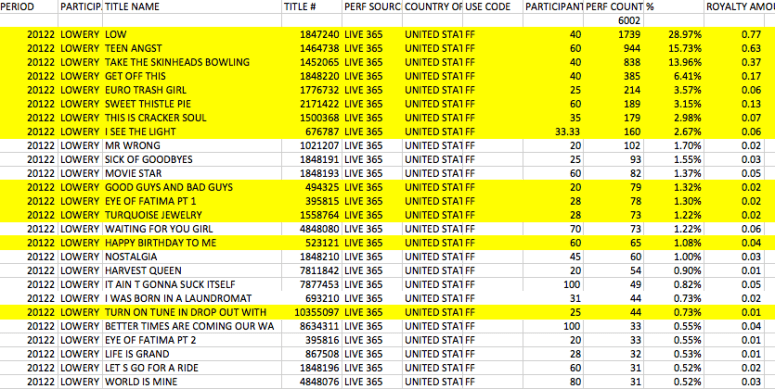
13 of tracks in top 25

Does Sirius and “Piped in” Airline Music Lead to More Music “Discovery” than Pandora?

Readers of this blog know that there is a raging debate over the rates that artists are paid by Streaming and Webcasting services.    But underpinning that debate is the notion that certain webcasting services and streaming services help people discover new music and are thus giving something of value back to the artist.  It occurred to me that I have a big enough song catalogue that we could actually look at the question try to measure if these services lead people to new music or just sort of spin what is most popular and familiar.

So in my own catalogue there are 5 songs that were genuine radio hits on multiple radio formats.  At least here in the US.   As individual tracks they also tend to be in my top ten sellers. They were also released commercially as singles.    They are:

Low

Teen Angst

Get Off This

Take The Skinheads Bowling

Eurotrash Girl

(Pictures of Matchstick Men is a Status Quo cover and I don’t get granular statements for that track).

There are also another dozen tracks that were minor hits, regional hits,  or garnered significant but fleeting radio play.  I deal with these and “On-Demand” services in a subsequent posts.

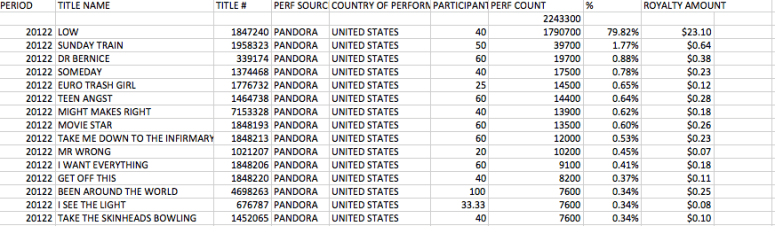
So the question I attempted to answer is  “What percentage of spins on these service are NOT the top 5 hits?”   This is not necessarily the only way to look at the question.  This is perhaps the bluntest of measurements.  However it is interesting to actually look at the data rather than just make unverified claims.   (For balance I’ve also asked a friendly yet sometimes adversarial fellow blogger to look at my raw data and ask the question differently.)

Here are the somewhat surprising results.

Percentage of spins that are NOT my top 5 hits.  Webcasters and Broadcasters only.   On Demand Streaming services like Spotify or Rdio are not considered.  

Sirius XM 46.13% broadcast
Airline Radio 46.02% broadcast
College Radio 32.15% broadcast
Live 365 31.36% webcast/broadcast
Pandora 18.18% webcast
Rhapsody radio 16.02% webcast
Terrestrial UK 8.90% broadcast/webcast?
Terrestrial Radio US 3.47% broadcast

Here are the big surprises.   Sirius XM although relatively few spins, tends to play more stuff out in the “long tail” of my catalogue than every other source.  And Airlines?  how did that happen?

Pandora which loudly boasts of it’s music genome project ends up in the middle of the pack.  Further 4 out of 5 spins on Pandora are for “Low” my biggest hit.  The only other service that spins Low as much is US terrestrial (85% of all spins).   However there is one caveat with Pandora.  The other 20% of the time the spins are more evenly distributed throughout my catalogue.  At least relatively speaking.   I mean the number two played track is an obscure outtake  from Kerosene Hat “Sunday Train.”  I assume that is the music genome at work.  So 20% of the time Pandora acts as claimed as a music discovery service.  At least with my catalogue.  Second caveat.  This is just within my catalogue.  It’s entirely possible that in aggregate Pandora as claims plays more indie music and artists out in “the tail” of popularity.

Percentage of Spins that are the track  “Low.”  Webcaster and Broadcasters. 

Terrestrial Radio US 85.26% broadcast
Pandora 79.82% webcast
Rhapsody Radio 63.75% webcast
Terrestrial Radio UK 39.56% broadcast/webcast?
Live 365 28.97% webcast/broadcast
Airline Radio 25.09% broadcast
College Radio 24.99% broadcast
Sirius XM 24.96% broadcast

About 20% of the time Pandora seems to really play some obscure tracks. Kudos!

Pandora plays

Lou Reed and Dead Kennedys Go Public Against Ad Funded Piracy with Facebook Posts

We’d just like to say a very big thank you to both Lou Reed and the Dead Kennedys who publicly posted to Facebook this week our posts showing how they are being exploited by major brands and big tech internet advertising corporations.

LOU REED FACEBOOK POST:
https://www.facebook.com/LouReed/posts/10151804045145953

DEAD KENNEDYS FACEBOOK POST:
https://www.facebook.com/deadkennedys/posts/10151784946510638

In the recent weeks we’ve heard from Aimee Mann, Pink Floyd, Thom Yorke, Blake Morgan, Lou Reed and the Dead Kennedys on various issues negatively effecting artists in the “digital economy.”

These artists have presented their concerns ranging from Spotify royalty rates, Pandora’s dishonest attempts to cut  their currently mandated rates by 85% and of course Ad Funded Piracy which pays artists absolutely nothing.

In each of the cases addressed above artists are speaking out against the exploitative practices of corporate interests destroying the ability of professional musicians to maintain sustainable careers.

Change happens when artists speak up and speak out.