
Record Labels Invest $4.5 Billion Annually In Artists… Pirates, $0… Any Questions?

So record labels invest in the careers of artists about $4.5 Billion annually in A&R and Marketing. Meanwhile, there are 200,000 infringing sites exploiting artists work and paying them nothing that we can see from the looks of the Google transparency report.

To be precise at the time of the writing of this post there are 281,340 infringing sites on the report with the #1 offender having received over 7.5 Million DMCA takedown notices! Seriously, 7.5 Million… and Google can’t determine that this is a site “dedicated or primarily used for infringement.” Wow.

FIRST DISCLAIMER:

Now look, we don’t always like record labels, but when we do, it’s because they are actually paying artists and investing capital into developing careers (hello Trent Reznor returning to a major label). Ninety percent of new releases financed by labels don’t recoup or break even, but the bands still gain the marketing and PR benefit from the labels investment after the deal ends (hello Thom Yorke and Radiohead).

SECOND DISCLAIMER:

Any wrong doing should be unacceptable. We’ve heard far to many stories of artists being exploited by record labels, publishers, managers, booking agents, concert promoters and a wide range of those offering services from radio promotion to independent PR and marketing. If anything, the internet has added to this list a whole new group of opportunists including the ad tech industry, pirate sites, cyber lockers and more.

So yes, any wrong doing against artists and creators should be unacceptable, even if it happens online.

So here’s some quick notes from the report published by the IFPI:

* Record companies’ total investment in A&R and marketing tops US$4.5 billion annually according to IFPI’s Investing in Music report

* Labels have maintained A&R spending at US$2.7 billion, representing 16 per cent of global recorded music revenues, despite the economic recession

* US$1 million to break a new artist in major markets

* More than 70 per cent of unsigned artists would like a recording contract according to two new surveys

Record companies remain the primary investors in artists, maintaining A&R spend despite declining overall revenues in recent years. Labels spent US$2.7 billion in 2011, only marginally down on 2008 (US$2.8 billion), despite an overall decline of 16 per cent in the trade value of the industry globally over the same period. Revenues invested in A&R increased from 15 to 16 per cent of industry turnover between 2008 and 2011.

Music companies invest a greater proportion of their global revenues in A&R than most other sectors do in research and development (R&D). Comparisons show music industry investment exceeding that of industries including software and computing (9.6%) and the pharmaceutical and biotech sector (15.3%). The comparisons are based on the European Commission’s 2011 EU Industrial R&D Investment Scoreboard.

Two new surveys, conducted in the UK and Germany in 2012, show more than 70 per cent of unsigned acts want a record deal, with marketing leading the perceived benefits of record company support.

Ok, then you have this… those who pay nothing, invest nothing, and pocket everything for themselves… this is the future you want? When artists complain about tiny payments from Spotify it’s important to note the reason why they can get away with paying so little, is because of all of those who pay nothing at all.
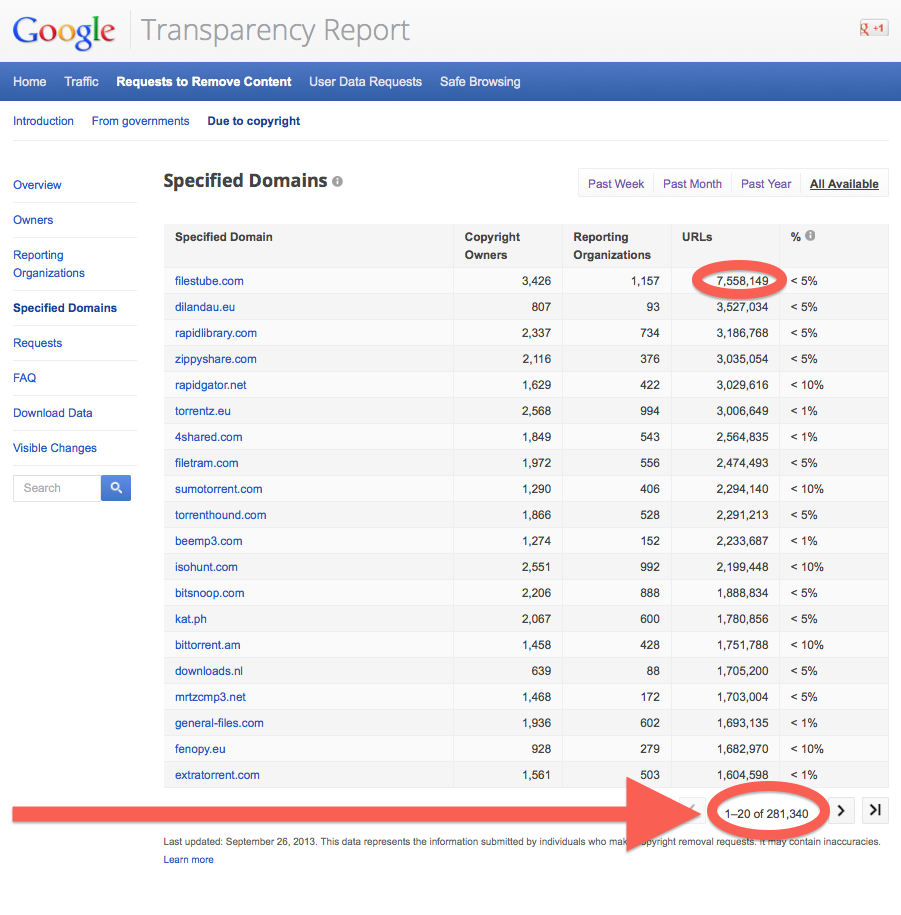
200kinfringingsitesAnd most of this is financed by Fortune 500 Companies flowing money through online ad networks like Google and others. The situation has even gained the attention of The White House, although we’ll see what good it does.

So if you want to get paid, focus on removing the bad actors from the marketplace and restoring fairness. Our hope has always been that the internet would in fact create a new middle class of professional musicians, by the means of their own choice. Unfortunately what we’ve seen is just more exploitation.

Hotfile’s Loss Will be Indie Filmmakers’ Gain | Vox Indie

Ellen Seidler at Vox Indie takes a detailed look at how the recent decision in the Hot File case will effect indie filmmakers and other creators.

MPAA victory against Hotfile is a victory shared by all content creators hurt by online piracy

The best news in the fight against online piracy since Megaupload’s demise came yesterday as the MPAA annouced a big victory in their copyright infringement lawsuit against Hotfile, a cloud-based cyberlocker website known to harbor pirated movies, music, books and more. Though specific details of the court decision won’t be released for another two weeks, the judge issued a summary judgement in favor of the plaintiffs.

READ THE FULL POST AT VOX INDIE:
http://voxindie.org/hotfile-loses-copyright-infringement-case#sthash.WB0oxGhx.dpuf

Music Piracy – An Artist’s Opinion | Sara Tiemogo

Music piracy is stealing. And it does hurt the musician. Over the past decade, we have gradually shifted from physical distribution to digital distribution with the advancement of mp3 players, specifically the advancements of Apple and it’s “iProducts”. Digital distribution now accounts for more than 52% of the music industry in the US.

But there was a time during the shift when people had difficulty placing “value” on a digital product, with tangible products being of more value. This is what led people to believe that they aren’t really “stealing”, because a file can be duplicated an infinite number of times and not “cost” the musician anything. But it does cost us.

READ THE FULL POST HERE:
http://saratiemogo.com/blog/music-piracy-an-artists-opinion/

Getting the Government Out of Songwriting: Voluntary Licenses Should Replace Consent Decrees or Compulsory Licenses

This is an absolute MUST READ for all songwriters.

Music Technology Policy

[Editor Charlie sez, this article originally appeared in the Huffington Post.]

Chairman Bob Goodlatte (R-VA) is holding a useful series of thought provoking hearings before the House Subcommittee on Courts, Intellectual Property and the Internet reviewing the current state of the U.S. Copyright Act. The most recent hearing in this series was on September 18, entitled “The Role of Voluntary Agreements in the U.S. Intellectual Property System“.

This is a very important subject to songwriters. It is not widely known that songwriters are highly regulated by the government through two primary mechanisms — the ASCAP and BMI consent decrees dating from the middle of the last century and the compulsory mechanical license dating from 1909. The Congress should consider abandoning both in favor of voluntary licenses.

Terminate the ASCAP and BMI Consent Decrees

ASCAP and BMI each grant blanket licenses for the exclusive right to publicly perform…

View original post 626 more words

How piracy is Hurting Indie Artists | ABS-CBN News

REDWOOD CITY, Calif. – Jackie Chavez has been trying to make it big as a singer and musician for five years now. It hasn’t been easy.

“It’s tough when you’re just doing it independently and you don’t have connections. You rely on pure talent. It’s really hard,” she mused.

Chavez released her self-titled album in the Philippines in 2011, and she’s trying to do the same in the U.S. For now, she earns her money through gigs. But she said selling her songs online through iTunes and Amazon has been especially challenging, because of piracy.

“As artists, we put our dedication and hardwork to create music. It’s so sad that they’re just going to copy it. They’re just going to pirate it,” she added.

READ THE FULL STORY HERE:
http://www.abs-cbnnews.com/global-filipino/09/23/13/special-report-how-piracy-hurting-indie-artists

Google attacked by MPs over failure to curb music and film piracy | The Guardian UK

Company accused of ‘derisory’ attempts to stop many illegal downloads amid concerns over level of influence in coalition

Google will be criticised by MPs for making “derisory” attempts to curb music and film piracy and using its “perceived power and influence” at the heart of David Cameron’s government to shore up its position.

The Commons culture, media and sport select committee accused the search engine of offering the thinnest of excuses to avoid taking action against widespread piracy, a problem that the committee claimed is costing the creative industries millions of pounds in lost revenue a year.

Tory MP John Whittingdale, the chairman of the committee, said his fellow MPs were “unimpressed by Google’s continued failure to stop directing consumers to illegal, copyright infringing material on the flimsy excuse that some of the sites may also host some legal content. The continuing promotion of illegal content through search engines is simply unacceptable, and efforts to stop it have so far been derisory.”

READ THE FULL STORY HERE:
http://www.theguardian.com/technology/2013/sep/26/google-mps-music-film-piracy

Kim Dotcom slammed as ‘chubby Che Guevara’ at music body the BPI’s annual general meeting | The Gaurdian UK

We’ve recently posted about the number of artists speaking out about being exploited by internet corporations. Here are some recent rumblings from across the pond…

Former Longpigs star and current co-CEO of Featured Artists Coalition Crispin Hunt calls for labels to reveal Megaupload mogul ‘as the self-interested privateer that he is’

“No artist with anything worth saying wants to live in a medieval world of cottage industry that Kim Dotcom and co prescribe, retraining as a plumber in the day and making bedroom albums, uploaded to an ocean of mediocrity along with the 10,000 other works of genius uploaded to SoundCloud every day, eking a living from selling CDs and t-shirts at poorly-attended gigs, peopled by an audience of well-wishing friends, who all crowdfunded their mates’ albums, exhausted at the choice of 30 gigs a night to see in Norwich alone, and bored by the endless tours of ageing dads on stage who would much rather be settled down watching Later with the kids than donning Paul Weller-style Indie Man Hair and flogging around the toilets of Britain in a splitter, whilst some kid rips the life-work of their youth from HulkShare because he wants to spend his money on Gran Turismo 25.”

READ THE FULL STORY AT THE GUARDIAN UK:
http://www.theguardian.com/technology/2013/sep/04/kim-dotcom-crispin-hunt-piracy-bpi

If YouTube is the New College Radio, Can YouTube Keep the Hate Group Playlists?

Music Technology Policy

Google is making a big push to get colleges and universities to take their various Google Apps for Education

For “free”, of course.  And we all know who the product is on a “free” Google app, right?

The product is you.

These education apps appear to link the user to Google’s entire suite of products, including YouTube.  And of course as soon as you leave the education environment and go to say YouTube, what happens to the privacy policy and terms of use?  It grows up to the same privacy policy that applies to everyone inside or outside of the Education environment.  And in the case of Google’s case study clients, the New York State K-12 Schools, the Maine Township High School District and the Edmonton Public Schools (in Edmonton, Canada), that includes grades K-12, not just college-age adults.


And there’s the real story behind the “free” education…

View original post 526 more words

Franz Ferdinand call on David Cameron for Help | The Independnet UK

Franz Ferdinand’s 2004 debut album sold 3.6 million copies worldwide, including 1.27 million in the UK alone. Their fourth release, Right Thoughts, Right Words, Right Action, although critically well-received entered the charts at number 6, selling fewer than 10,000 copies. The decline is in line with a global slump in album sales over the past seven years, which has particularly afflicted guitar bands.

Kapranos added: “I saw an old photograph where all the women were working in a factory pressing up copies of Rubber Soul and putting them into sleeves. (The image of workers producing The Beatles’ album was taken at EMI’s Hayes pressing plaint in 1965). This music industry in the UK in the past has supported so many people’s careers and livelihoods. Nowadays it feels like people don’t give a s***. That’s not cool.”

READ THE FULL STORY AT:
http://www.independent.co.uk/arts-entertainment/music/news/do-you-want-to-save-the-music-industry-franz-ferdinand-call-on-david-cameron-for-help-8809231.html