Artists For An Ethical and Sustainable Internet #StopArtistExploitation
Author: Dr. David C Lowery
Platinum selling singer songwriter for the bands Cracker and Camper Van Beethoven; platinum selling producer; founder of pitch-a-tent records; founder Sound of Music Studios; platinum selling music publisher; angel investor; digital skeptic; college lecturer and founder of the University of Georgia Terry College Artists' Rights Symposium.
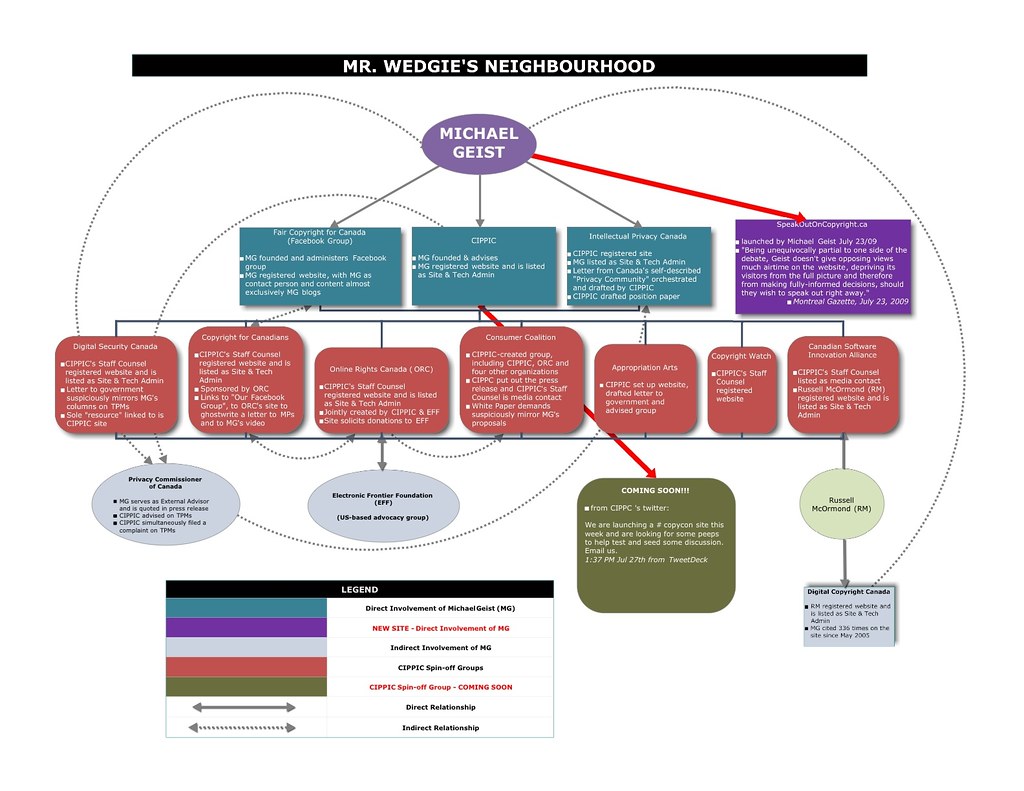
What’s that? …. There are no tanks?…. Oh….So Canada’s most “internet famous” copyright law professor Michael “Neville Chamberlain” Geist is simply selling out Canadian artists for no apparent reason?!? And the beneficiaries of his tortured interpretation of facts and data is predictably the US Silicon Valley monopolies that indirectly benefit from the massively infringing pirate website operations? (And never mind kiddie porn sites, that’s another blog post, we’ll get to that shortly.)
This is especially funny since Geist doesn’t appear to discourage blog comments expressing anti-American jingoism. If only his supporters took the time to follow the money. Geist’s home base is the Samuelson-Glushko Canadian Internet Policy and Public Interest Clinic at the University of Ottowa. You can think of Samuelson-Glushko as the Koch brothers of Silicon Valley. The sole purpose of Samuelson-Glushko clinics appears to be as a policy washing machine for Silicon Valley interests. Money comes in one side and out pops “academic papers” and “research” that seems to always neatly supports the public policy positions of US based internet monopolists. And weakens the rights of Canadian copyright holders.
Remember Geist is no crank law professor at some no name school out in the prairies. Geist is at the University of Ottawa where he holds the Canada Research Chair in Internet and E-commerce Law.
Read more about Geist here and ask yourself “Who is this guy really advocating for?” And also what’s up with his mysterious Lawbytes loan out company?
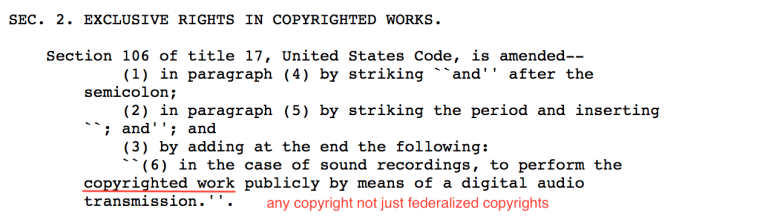
The 1976 copyright act federalized copyrights for post 1972 sound recordings. Sound recordings made pre-1972 were covered and remain covered by state copyright laws. The 1976 act did not strip the works of copyright protection. Several years ago digital broadcasters and non-interactive streaming services all decided (simultaneously) that the Digital Performance Right in Sound Recordings Act of 1995 did not apply to works copyrighted before1972. And ever since these services have tried to avoid paying performers who had the misfortune to record before 1972. This is often referred to as a” loophole.” But I have always maintained that there is no loophole. The DPRA did not specify that the sound recordings be protected by federal copyright to receive digital performance royalties. Just copyright. State copyright for instance. Look it up if you don’t believe me.
Further in order to maintain this legal stance, you have to believe that the members of congress that drafted and passed the DPRA specifically intended to deny digital royalties to the likes of Duke Ellington, Aretha Franklin, The Allman Brothers, Ray Charles, Willie Nelson, and Captain Beefheart to name just a few. Nowhere in the congressional record is this reflected. Nowhere. It’s a complete fiction. Yet the increasingly lazy and myopic federal courts can’t be counted on to look at the record or even the text of the act. Therefore a wide range of musicians, unions and industry trade groups have come together to try to fix this problem. This is an easy fix. This act makes it explicit that this applies to pre-1972 recordings. It’s simple matter of fairness. Everyone loves fairness. It’s like kittens.Who could possibly be against kittens? I mean aside from Lofgren and Sensenbrenner Let’s get this done.
Below is the press release from…
Historic Coalition of 213 Musical Artists Calls on Congress to Pass CLASSICS Act,
Fix the “Pre-1972” Loophole for Legacy Artists
Music Organizations Press Congress to Consolidate
Widely Backed Music Licensing Reforms Into Single Bill
WASHINGTON, February 13, 2018 — An unprecedented coalition of 213 musical artists, supported by eight leading music organizations, called upon the U.S. Congress to pass the CLASSICS Act, bipartisan legislation pending in both the House and Senate to address one of copyright law’s most glaring loopholes.
In a two-page advertisement that will appear in Wednesday’s Politico, the artists state:
Digital radio makes billions of dollars a year from airplay of music made before Feb. 15, 1972. Yet, because of an ambiguity in state and federal copyright laws, artists and copyright owners who created that music receive nothing for the use of their work. The CLASSICS Act (H.R. 3301 / S. 2393) would correct this inequity and finally ensure that musicians and vocalists who made those timeless songs finally get their due. We urge Congress to pass the CLASSICS Act and other pro-artist reforms quickly.
The advertisement marks the start of a robust advocacy campaign by artists and music community leaders A2IM, American Federation of Musicians, Content Creators Coalition, musicFIRST Coalition, Recording Academy, Recording Industry Association of America, SAG-AFTRA and SoundExchange.
The ad can be viewedhere.
The CLASSICS Act is an essential component of a package of music licensing reforms supported by the organizations that includes additional critical reforms such as the Music Modernization Act (H.R. 4706 / S. 2334), the AMP Act (H.R. 881) and the establishment of market-based rate standards. In the coming weeks, music community leaders anticipate the House Judiciary Committee will commence formal consideration of the music licensing reform legislation with the goal of consolidating the key reforms into a single bill.
Meanwhile in Canada…another unaccountable law professor, Michael Geist appears to be running interference for U.S. Tech Firms as Canada considers home grown anti-piracy legislation. Fortunately Chris Castle at Music Tech Policy (and others) have done some excellent reporting on the Geist over the years. We are gonna rerun a few of these articles over the next few weeks so that it is clear to Canadian artists the ethical and intellectual makeup of this fellow. Lets start with the mysterious no bid government contracts he received for even more mysterious work. From 2010:
If you follow what passes for intellectual property policy “debate” online, you will no doubt have heard the anti-copyright amen chorus warming up about the lack of public consultation in the negotiation of the Anticounterfeiting Trade Agreement, or ACTA.
This wringing of hands and wailing of the amici has particular resonance amongst non-governmental organizations, their advisors, their academic rock stars and breathless acolytes. The non-governmental organizations and academics, most prominently the very well funded Michael Geist, advisor to the US-backed Samuelson-Glushko Canadian Internet Policy and Public Interest Clinic, the Alcan of IP, who most frequently attach themselves to the negotiation of international copyright treaties originating in Geneva are particularly incensed.
These “NGOs” complain that the public is insufficiently consulted by—governmental organizations. In other words, the NGOs (self-appointed, frequently astroturf groups with shadowy funding) are complaining that the representatives of the public are insufficiently representative. Only the NGOs and professoriate…
We are pleased to see that the conversations between Rick Carnes (SGA) and Rep Doug Collins that began at University of Georgia Artists Rights Symposium has resulted in improvement to the representation of songwriters on the board proposed in the Music Modernization Act. Press release from SGA follows.
SONGWRITERS GUILD OF AMERICA ANNOUNCES THAT NEGOTIATED CHANGES TO MUSIC MODERNIZATION ACT ENABLE ENDORSEMENT OF BILL’S PASSAGEW
Music Publishing Industry Support for Small Claims Act Also Secured
WASHINGTON — The Songwriters Guild of America, the largest and longest-established music creator advocacy organization in the United States, today announced it has negotiated changes to the pending Music Modernization Act (HR 4706)that will enable it to support passage of the legislation. Among the agreed-upon amendments to the bill are:
the doubling of songwriter and composer representation on the board of directors of the Mechanical Licensing Collective established by the Act;
the re-alignment of an Unclaimed Royalties Oversight Committee that will now have a 50/50 music creator and music publisher balance; and
clarifications to the payments sections that will make it easier for music creators to get the full benefits of their negotiated publishing agreements as applied to the distribution of what the bill refers to as “unclaimed” funds by music publishers.
As part of the discussions leading to changes in the Music Modernization Act, the US music publisher community has also pledged to lend its full support on Capitol Hill to SGA’s efforts to secure quick passage of the pending Copyright Alternative in Small-Claims Enforcement (CASE) Act of 2017 (HR 3945). CASE will provide music creators with a much needed, opt-in alternative to expensive, full blown copyright infringement actions against unlicensed users of their music.
Speaking on behalf of SGA, multi-platinum songwriter and organization president, Rick Carnes, noted that, “the benefits of the pending Modernization law, with the changes SGA has successfully sought, have made the current bill deserving of our support. We continue to applaud the efforts of those members of the music creator and music publishing communities seeking further improvements and clarifications that would make the proposed legislation even more advantageous to American songwriters, composers and independent publishers. Still, the bill as it now stands would — on balance — benefit those creators we are sworn to protect significantly more than no bill at all. Our two-word mission statement is to ‘protect songwriters.’ After more than six months of hard work alongside our colleagues in the independent music creator community through Music Creators North America (MCNA), SGA feels, individually, that it succeeded insofar as possible in carrying out our mission.”
Under the agreed-upon changes, the Mechanical Licensing Collective board will now have four professional songwriter/composer voting members and ten voting music publishers. The Unclaimed Royalty Oversight Committee, whose role will be to oversee issues concerning ownership and distribution of so-called “unclaimed” royalties, will now have evenly balanced, “five and five” representation among ten voting members. As to clarifications regarding payment of music creator royalties received from the Collective by music publishers, the bill is now clearer in spelling out that such royalties are to be distributed on a title-by-title basis to songwriters under the percentages set forth in their publishing agreements. In other words, a songwriter or composer operating under an agreement that gives such creator the benefit of a 90%/10% split with its music publisher will have that same split applied in the distribution of “unclaimed” royalties that have been matched under the usage formula set forth in the legislation.
Other benefits of the legislation include establishment of a system that:
is likely to substantially improve royalty payment compliance by digital distributors of music on a going-forward basis;
changes in royalty rate determination formulas that will benefit both music creators and their copyright administrators; and
the promotion of greater fairness for US performing rights societies in their negotiations with users.
“Among SGA’s important roles following the bill’s enactment,” continued Carnes, “will be to assist the songwriter and composer community in making sure that every music creator receives the full benefits intended under the Act. That includes publication of materials designed to inform and remind creators, in consultation with their legal and financial representatives, how best to ensure the maximum, accurate receipt of all royalties to which they are entitled.” Carnes also pledged that SGA will be in the forefront of efforts, along with its fellow MCNA music creator groups, to ensure that experienced, knowledgeable and — above all — independently-minded songwriters and composers are tapped to serve as board members of the Collective.
SGA, established in 1931, is the largest and longest-established advocacy organization run solely by and for songwriters and composers in North America. In addition to its role as a legislative advocate, SGA provides copyright administrative services and other informational and representation services to its national US membership upon request
Chris Castle has some excellent analysis of the ALI copyright restatement project as well as some other recent ALI restatements. Hew writes:
However, there appears to be a trend at the ALI to trade on the “Restatement” series to provide a vehicle through which those who control the pen in drafting new versions of old Restatements and new Restatements on new topics can try to change the law to what the drafter thinks it ought to be rather than a tool for practitioners to quickly learn what the “black letter law” is. This is a way to make an end run around the democratic process to deny voters and their elected representatives their proper role. What’s different is the potential for the moral hazard of astroturfing making it more important than ever to know who is behind the pen.
Who ever thought that the American Law Institute–of all places–would become the center of a corruption scandal over–of all things–its “Restatement of the Law” series. Chances are good that MTP readers outside of the legal profession have no bloody idea what a “Restatement” is and will sleep well in that knowledge deficit. But for lawyers (particularly litigators), the Restatement series has had some passing value.
However, there appears to be a trend at the ALI to trade on the “Restatement” series brand value to provide a vehicle through which those who control the pen in drafting both new versions of old Restatements and new Restatements on new topics can try to change the law to what the drafter thinks it ought to be–rather than a tool for practitioners to quickly learn what the “black letter law” is. This is a way to make an end run around the democratic…
Christopher J. Sprigman a New York University Law School professor is leading the American Law Institute’s dubious “Restatement of Copyright” project, a project the Acting Register of Copyrights called an attempt to establish a “pseudo copyright act” while simultaneously representing Spotify in the Bluewater v Spotify copyright infringement case.
Pure hubris. How is it the American Law Institute doesn’t see the appearance of impropriety? The process is clearly rigged against creators. I can only conclude the leadership at American Law Institute is corrupt or incompetent. David F. Levi along with the entire board should resign.
One of three Google funded papers co-authored by Sprigman which were published after he began working as the “impartial” reporter on the American Law Institutes Copyright Restatement project.
Silicon Valley corporations and anti copyright ideologues are unhappy that there is even a shred of copyright protection left for artists. They have not been able to completely eliminate copyright through congress or the courts so a small highly ideological group have embarked on a dubious “restatement” project to create what the US Register of Copyrights calls a “pseudo copyright act.” This is an end run around the legislative and judicial branch.
The vehicle is an American Law Institute Restatement of Copyright. In the past the American Law Institute has issued restatements when there were conflicting state laws or matters of “common law.” Never before has the ALI issued a restatement when there is a federal statute that spells out the law. After all the statute is the statute. Who is the ALI to tell judges what the statute says?
The damage comes to artists because it will at best create confusion on copyright in courtrooms. At worst the project will further tilt rulings towards Google and other Silicon Valley firms that infringe upon our works with impunity. Like they really need any more money.
The whole thing is rigged. According to the Google Transparency Project the leader of the restatement Christopher J. Sprigman has been taking funding from Google to write research papers since at least 2011. And he has apparently been receiving funding while working on this project (see screenshots above).
You also may recognize the name because he is Spotify’s lawyer in the Bluewater v. Spotify case. Yes, the same joker that has argued there is no such thing as a streaming mechanical royalty. This despite the fact the federal Copyright Royalty Board just set the new royalty rate. WTF right? This is the “impartial” reporter the American Law Institute put in charge of the copyright restatement project.
The ALI should end this project now. It stinks of corruption and cronyism. It’s an embarrassment. David F. Levi the president of The American Law Institute has been made aware of the problems with this project and has done nothing about it. He should resign for allowing this academic fraud to take place on his watch.
We have obtained a copy of the letter that Acting Register of Copyrights Karyn Temple Claggett sent to David F Levi, Dean of Duke University Law and President of the American Law Institute. On Jan 16th she clearly warned Levi that the project will mislead judges. Why is Levi still pursuing this? Is misleading judges the point of the project? If one reads the original letter between project leader Christopher J Sprigman and the ALI director, it seems like that is more or less the intent from the beginning. Levi is a former federal jurist.
Claggett states
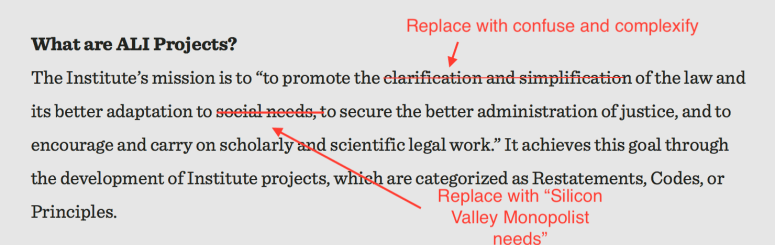
“Ultimately, as thoughtful and ambitious as it may be, the Restatement project appears to create a pseudo-version of the Copyright Act that does not mirror the law precisely as Congress enacted it and one that will quickly become outdated as Congress amends it or the courts clarify it. As a result, the attorney or judge who relies on it will often be misled. That outcome would not serve the ALI’s mission “to promote the clarification and simplification of the law.” For these reasons, we again urge the ALI to reconsider the project as a whole.”
Move over Chris Harrison, looks like The American Law Institute President David F Levi may be 2018’s Artist Enemy #1. Don’t fret Chris, it’s only January you still have 11 months to make a comeback. (Photo hosted and served from Duke University Law School website.)
Artist Enemy #1 title is only given when an individual or group is engaged in activity that will do irreparable harm to the rights of artists. In this case it is David F Levi President of the American Law Institute that has captured my attention. Under the leadership of David F Levi the American Law Institute is engaged in a dubious “restatement”project to create what the US Register of Copyrights calls a “pseudo version of the copyright act.”
In all seriousness, this is very hard for me to write. David F Levi is a widely regarded former federal jurist. He is also the highly respected dean of the Duke University School of Law. It saddens me to have to point out he bears ultimate responsibility for what appears to be a full blown academic scandal at the American Law Institute. A scandal that may forever damage the ALI (and Levi’s) reputation for impartiality.
My father was a career NCO in the US Air Force. I grew up on military bases all over the world. If there is one thing that those experiences (and my father) taught me is that real leadership demands one accept responsibility for failures that occur on one’s watch. In my experience most Americans also feel the same. For intuitively it makes sense: You don’t get the perks of leadership without accepting the responsibilities and downsides as well. I’ll admit in my own life I have often failed to live up to the demands of this credo. It is extraordinarily difficult. That’s why I hate to point a finger. But it is also because of my own experience with my own failures I feel like I have some insight here. And I’m not optimistic that the ALI’s Levi will show true leadership and accept the responsibility that comes with leadership. Why? I see all the telltale signs of the covering up a problem rather than fully addressing it. At the time of publication, the only action from ALI is a vague statement about reorganization of the project at the heart of the scandal. Further as far as I can tell, it was only posted on a page buried deep in ALI website. This is not how anyone with half a brain (or heart) does damage control. This is the kind of thing that otherwise good people do because they think no one has really noticed yet, and maybe, just maybe, they can avoid the difficult process of taking responsibility.
The Trichordist has convened a group of artists for “The Honest Restatement of American Law Institute Principles Project.” Above are some suggested amendments to current principles.
So what is the scandal?
If you really want to understand just how crazy this scandal is, you should read one or more of the following:
These documents go back almost 3 years. Many of these complaints were made directly to the ALI. It is unfathomable that Levi would not be aware of these complaints. This is why I feel Levi bears full responsibility for this dubious project. And it is a dubious project, with more than a whiff of corruption surrounding it.
If you don’t want to read these documents, I’ll do my best to explain it here. However I am not a lawyer.
The scandal concerns the ALI’s so-called Restatement of Copyright Project. This project has a multitude of problems. But basically early reports show it is an attempt to stand up a tech industry friendly extra-legal alternative to the copyright act. Pardon the use of this term, but frankly, it is an exercise in “fake lawmaking.”
Further it is a bizarre and puzzling project for the staid ALI, as it goes against their very principles. It attempts to “restate” and reinterpret statutory law something it has generally sought to avoid. Why? Well as most law students know this is something only the congress and (sometimes) the courts have power to do. It goes against ALI principles because instead of clarifying matters the ALI seems to want to muddy the waters by presenting a competing version of the copyright act.
Yes, in the past the ALI has issued “Restatements” but these genuinely clarify matters. As a result Judges routinely consult these restatements for help. (Many judges are political appointees and not really…er…uh.. well versed in the law). But there is a crucial difference between those “restatements” and this one. Until now, the restatements have concerned non-statutory “common law,” conflicting state laws, international law, treaties etc. My understanding is that past projects were well intentioned attempts to clarify “effective” existing law from a number of widely dispersed sources. Not law contained in a single statute with a couple of minor amendments. The ALI has never before offered what is essentially alternate reality legal fiction that (according to early reports) will contradict existing law and federal jurisprudence.
Okay. That’s the gist of the scandal. Well except for the next part…
The biggest (and completely avoidable) problem is that the restatement project leader is Christopher J. Sprigman. This is where Levi has really failed as a leader of the ALI. One would be hard pressed to find a less impartial choice to mediate between big tech and artists. Sprigman is Spotify’s lawyer in the Bluewater v Spotify case. Does Levi not know this? But hang on cause it gets worse. In documents filed with the court in the Bluewater case Sprigman argues that Spotify is not copying and distributing songs and thus doesn’t owe a mechanical royalty. This is far outside the mainstream of legal thought, and is at odds with the facts. Sprigman is either completely unaware of the nature of the services Spotify provides or he is going beyond advocating for his client and purposely misleading the court. Either way this is troubling.
Let’s look at the undisputed facts:
1) Until late 2014 Spotify operated using P2P technology which necessitates the copying and distributing of millions of music files. Files downloaded onto users computers were cached and subsequently “streamed” to other devices and user accounts. They admit it. They were proud of it as it saved them server costs.
2) Spotify allows users to make playlists available offline. This necessitates distributing and copying works. This sort of use is no different than the “limited download” described in federal copyright regulations and according to same regulations require a mechanical licenses. Spotify calls it a download on their own website seemingly contradicting Sprigman statements to the court suggesting Spotify doesn’t allow users to download music.
3) The federal government sets a rate for streaming mechanical royalties via the Copyright Royalty Board. A Jan 26th 2018 ruling just set a new rate for this streaming mechanical royalty. Why on earth would the Copyright Royalty Board set a royalty for something that need not be paid according to Sprigman? Clearly he’s outside the mainstream.
5) Spotify and its agents have sent songwriters (like myself) thousands if not millions of “notices of intent” to obtain a compulsory mechanical licenses for use of songs on its service. Was the intention expressed in these notices (sent through the US mail) not accurate? Is Sprigman not aware of this practice?
6) Spotify has filed millions of “address unknown” notices of intent to obtain a compulsory mechanical license to the US Copyright office. Why would it make such statements to a federal agency if it did not believe it needed a compulsory mechanical license? Again is Sprigman not aware of this practice?
Finally Sprigman started the ALI project by declaring:
“Yet, by most accounts, copyright law is in a bad state, and has been for some time now. Among the public at large, and especially among young people, the law is widely disliked”
WTF? It’s a statute. If it’s so unpopular then get Congress to change the law. No one voted for the ALI. The ALI has no power to make law. The current statute is what is. It is an limited exclusive right given to individuals. We don’t do twitter polls on individual rights. It is also quite confounding to have to remind the ALI that individual rights are always unpopular with the public and “young people.” At least until their rights are violated. Then they are enormously popular. Most of the public and especially “young people” would prefer beer be free. At least until it’s their beer that gets given away for free. Does “unpopularity” of rights of individuals in certain quarters seem like a starting point from which an honest legal scholar would start? No it doesn’t and David F Levi (if he’s paying attention) should know this. Read the letter Sprigman wrote to the ALI to launch the project. It is appalling. In it he admits to launching this project because he thinks congress is not going to make the changes he and his cronies think should be made to copyright law. He freely admits it is an end run around the legislative process and courts. I quote from the letter:
“In sum, Congress is unlikely to proceed any time soon with copyright reform. As a consequence, it falls to the federal courts to attempt to improve the fit between a mid-20th century copyright law and 21st century digital technologies. Fortunately, the current copyright law is open-texted enough that its coherence and effectiveness could be advanced significantly via common law development. Unfortunately, however, aside from a few notable exceptions, there is a relatively low level of interest or expertise in copyright law among federal judges.
In light of these facts, I think it’s plain that a Restatement of Copyright Law – at least if undertaken with the object of assisting the courts and mindful always of copyright’s constitutional mandate to promote progress – could be enormously influential, both in shaping the law that we have, and, perhaps, the reformed law that in the long term we will almost certainly need.”
This is not a guy that intends to faithfully interpret the statute and recent jurisprudence. No way.
Sprigman and Google.
Let’s go back to Sprigman’s statement about the law being unpopular with certain demographics. If you replace the phrase “public and young people” with “internet companies” I think we get much closer to the truth. IMHO Sprigman wants to make copyright law more friendly for his benefactors. Hear me out.
Sprigman appears in the Google Academics Inc database. According to this report he received money from Google to write/cowrite five papers that (lo and behold) mostly supported positions favorable to Google. It is not illegal for him (or anyone else) to take money from Google (or any other company) for academic work. It should be disclosed. But it’s not illegal. The problem is that he appears to have taken some of that funding after he started this project. As far as I can tell the ALI does not disclose this important fact anywhere. I highly doubt they disclosed this to their membership. The only reason anyone knows about this is the Above The Law article referenced above.
It’s worth noting that the dude is seriously defensive about Google funding. Like numbered-tweet-storm defensive about this fact. When I mentioned the Google connection in a tweet last week he launched a numbered-tweet-storm at me, which ended hilariously with him demanding his money back on a show I performed in 1987. Something I did in 2018 requires me to reverse a transaction in 1987 that somehow retroactively became unsatisfactory? He’s a time traveller. His DJ name should be DJ Ex Post Facto. We should jam. We’ll get that guy who rapped the middle part of the big Soup Dragons hit.
What are the odds he performs the same sort of time traveling while restating/remixing copyright?
I would assume Sprigman is particularly sensitive about the Google thing because it makes him appear less than impartial. But this is a problem of his own making. I’m not impartial on copyright. And I don’t pretend to be. I also don’t try to anoint myself as the final arbiter on copyright in the US. Sprigman seems to lack basic common sense, that little voice that says “don’t pretend to be impartial on issue when you are not.” Most lawyers have enough common sense to not try to lead an ALI “restatement” of copyright when there is even a hint of impropriety. For it tends to ruin careers. This lack of common sense alone should disqualify him to lead this project.
RIP American Law Institute 1923-2018
But what really saddens me is that I have to report to artists once again: another prestigious American institution appears to have taken the side of powerful Silicon Valley monopolists against artists. The fix is in. The current oligarchy at ALI, a clique of lawyers from a handful of elite academic institutions seem to be living in a bubble in which sycophants from those same academic institutions, sing their praises assuring the they are building a gleaming city on a hill, a beacon of hope and fairness for all. What a joke. In fact they are helping prop up a powerful and decadent group of crony capitalists, the likes of which we have not seen since the robber barons. This sounds like a joke, but it’s an open question whether our republic will even survive the predations of these powerful billionaires as many are openly hostile to the notion of democracy and the nation state.
This is the side the ALI willingly chose to take. Shameful.
The question now: Are there any decent and conscientious men or women in positions of power in business, government or academia that will ever stand up for the little guy again? Who in position of power or authority has the guts to argue for the middle class songwriter, performer, photographer, filmmaker or author against the billionaires of Silicon Valley and their legal enablers? Does anyone even have the minimal amount of backbone required to go against the grain and oppose their old law school chums. Isn’t there at least one decent lawyer out there tired of the current climate of law douchebaggery? Legal scholarship which seems to exist only to celebrate the successful exploiting of loopholes and generally helping the parasitic class get away with crap?
Where is our Joseph Welch? The Defense Department lawyer who finally stood up to the bully McCarthy? Where is that lawyer who will finally ask on behalf of artists “Have you no sense of decency sir, at long last? Have you left no sense of decency?”
Maybe David F Levi is simply unaware of the scandal that has occurred on his watch and maybe he will turn out to be our Joseph Welch. But I’m not holding my breath.
************************************************
FURTHER NOTES ON CHRISTOPHER J SPRIGMAN
*************************************************
To support my contention that Sprigman came to this study with an agenda and thus should not be leading this project, I’ve provided a further reading list:
—was lead counsel with Lessig in Kahle v. Ashcroft (later v. Gonzales) in 2006 https://en.wikisource.org/wiki/Kahle_v._Gonzales which unsuccessfully challenged the “opt out” provisions of eliminating the renewal requirement under the 1992 Copyright Renewal Act.
–Member of Pamela Samuelson’s “Copyright Principles” project and co-authored its paper that also advocated registration (see Sec. IIIA of paper, “Reinvigorating Copyright Registration”)
–Has written five academic papers funded by Google on copyright issues, including three against moral rights attribution. In addition, he filed comments in Copyright Office moral rights study that incorporated concepts in Google-funded papers and cited to one of them without disclosing Google’s funding in his Copyright Office filing. (https://www.regulations.gov/document?D=COLC-2017-0003-0019)





 The Trichordist
You must be logged in to post a comment.