
The CRB should sanction capricious delays that keep songwriters from getting paid.
When Did Noah Build the Ark? Will there be sanctions for absurd delays at the Copyright Royalty Board? — Music Technology Policy
Author: Trichordist Editor
Trichordist Editor
Must Read by @ebakerwhite: TikTok Parent ByteDance Planned To Use TikTok To Monitor The Physical Location Of Specific American Citizens — Artist Rights Watch
[Well, here it is. Two years ago we warned everyone who would listen that TikTok were apparatchiks for the Chinese Communist Party–by law in China because of the CCP’s civil-military fusion–“If Google is the Joe Camel of data, then TikTok is the Joe Camel of intelligence.” We did panels warning about TikTok including the CEO’s struggle session and the CCP constitution–facts, you know. Tim Ingham warned that on top of everything else, the deals suck. And then there’s Twinkletoes, who is in our view a walking, talking Foreign Agent Registration Act violation.
Emily Baker White warns of the harms from TIkTok we identified 2 years ago coming home to roost.
[According to Emily Baker White writing in Forbes:]
China-based team at TikTok’s parent company, ByteDance, planned to use the TikTok app to monitor the personal location of some specific American citizens, according to materials reviewed by Forbes.
The team behind the monitoring project — ByteDance’s Internal Audit and Risk Control department — is led by Beijing-based executive Song Ye, who reports to ByteDance cofounder and CEO Rubo Liang.
The team primarily conducts investigations into potential misconduct by current and former ByteDance employees. But in at least two cases, the Internal Audit team also planned to collect TikTok data about the location of a U.S. citizen who had never had an employment relationship with the company, the materials show. It is unclear from the materials whether data about these Americans was actually collected; however, the plan was for a Beijing-based ByteDance team to obtain location data from U.S. users’ devices.
Will the Copyright Royalty Board approve Big Tech’s attempted cover-up?
By Chris Castle
[This MusicTechPolicy post appeared on Hypebot]
There’s an old saying among sailors that water always wins. Sunlight does, too. It may take a while, but time reveals all things in the cold light of dawn. So when you are free riding on huge blocks of aged government cheese like the digital music services do with the compulsory mechanical license, the question you should ask yourself is why hide from the sunlight? It just makes songwriters even more suspicious.
This melodrama just played out at the Copyright Royalty Board with the frozen mechanicals proceeding. Right on cue, the digital services and their legions of lawyers proved they hadn’t learned a damn thing from that exercise. They turned right around and tried to jam a secret deal through the Copyright Royalty Board on the streaming mechanicals piece of Phonorecords IV.
To their great credit, the labels handled frozen physical mechanicals quite differently. They voluntarily disclosed the side deal they made with virtually no redactions and certainly didn’t try to file it “under seal” like the services did. Filing “under seal” hides the major moving parts of a voluntary settlement from the world’s songwriters. Songwriters, of course, are the ones most affected by the settlement–which the services want the CRB to approve–some might say “rubber stamp”–and make law.
To fully appreciate the absolute lunacy of the services attempt at filing the purported settlement document under seal, you have to remember that the Copyright Royalty Judges spilled considerable ink in the frozen mechanicals piece of Phonorecords IV telling those participants how important transparency was when they rejected the initial Subpart B settlement.
This happened mere weeks ago in the SAME PHONORECORDS IV PROCEEDING.
Were the services expecting the Judges to say “Just kidding”? What in the world were they thinking? Realize that filing the settlement–which IF ACCEPTED is then published by the Judges for public comment under the applicable rules established long ago by Congress–is quite different than filing confidential commercial information. You might expect redactions or filings under seal, “attorneys eyes only,” etc., in direct written statements, expert testimony or the other reams of paper all designed to help the Judges guess what rate a willing buyer would pay a willing seller. That rate to be applied to the world under a compulsory license which precludes willing buyers and willing sellers, thank you Franz Kafka.
When you file the settlement, that document is the end product of all those tens of millions of dollars in legal fees that buy houses in the Hamptons and Martha’s Vinyard as well as send children to prep school, college and graduate school. Not the songwriters’ children, mind you, oh no.
The final settlement is, in fact, the one document that should NEVER be redacted or secret. How else will the public–who may not get a vote but does get their say–even know what it is the law is based on assuming the Judges approve the otherwise secret deal. It’s asking the Judges to tell the public, the Copyright Office, their colleagues in the appeals courts and ultimately the Congress, sorry, our version of the law is based on secret information.
Does that even scan? I mean, seriously, what kind of buffoons come up with this stuff? Of course the Judges will question the bona fides and provenance of the settlement. Do you think any other federal agency could get away with actually doing this? The lawlessness of the very idea is breathtaking and demonstrates conclusively in my view that these services like Google are the most dangerous corporations in the world. The one thing that gives solace after this display of arrogance is that some of them may get broken up before they render too many mechanical royalty accounting statements.
To their credit, after receiving the very thin initial filing the Judges instructed the services to do better–to be kind. The Judges issued an order that stated:
The Judges now ORDER the Settling Parties to certify, no later than five days from the date of this order, that the Motion and the Proposed Regulations annexed to the Motion represent the full agreement of the Settling Parties, i.e., that there are no other related agrements and no other clauses. If such other agreements or clauses exist, the Settling Parties shall file them no later than five days from the date of this order.
Just a tip to any younger lawyers reading this post–you really, really, really do not want to be on the receiving end of this kind of order.
Reading between the lines (and not very far) the Judges are telling the parties to come clean. Either “certify” to the Judges “that there are no other related agreements and no other clauses” or produce them. This use of the term “certify” means all the lawyers promise to the Judges as officers of the court that their clients have come clean, or alternatively file the actual documents.
That produced the absurd filing under seal, and that then produced the blowback that led to the filing of the unsealed and unreacted documents. But–wait, there’s more.
Take a close look at what the Judges asked for and what they received. The Judges asked for certification “that there are no other related agrements and no other clauses. If such other agreements or clauses exist, the Settling Parties shall file them no later than five days from the date of this order.”
What the Judges received is described in the purportedly responsive filing by the services:
The Settling Participants [aka the insiders] have provided all of the settlement documentsand, with this public filing, every interested party can fully evaluate and comment upon the settlement. The Settling Participants thus believe that the Judges have everything necessary to “publish the settlement in the Federal Register for notice and comment from those bound by the terms, rates, or other determination set by the” Settlement Agreement, as required under 37 C.F.R. 351.2(b)(2). The Settling Participants respectfully request that the Judges inform them if there is any further information that they require.
Notice that the Judges asked for evidence of the “full agreement of the Settling Parties”, meaning all side deals or other vigorish exchanged between the parties including the DSPs that control vast riches larger than most countries and are super-conflicted with the publishers due to their joint venture investment in the MLC quango.
The response is limited to “the settlement documents” and then cites to what the services no doubt think they can argue limits their disclosure obligations to what is necessary to “publish the settlement”. And then the services have the brass to add “The Settling Participants respectfully request that the Judges inform them if there is any further information that they require.” Just how are the Judges supposed to know if the services complied with the order? Is this candor?
It must also be noted that Google and the NMPA have “lodged” certain documents relating to YouTube’s direct agreements which they claim are not related to the settlement to be published for public comment. These documents are, of course, secret:
[And] are not part of the settlement agreement or understanding of the settling participants concerning the subject matter of the settlement agreement, and do not supersede any part of the settlement agreement with respect to the settling participants’ proposed Phonorecords IV rates and terms. Further, the letter agreements do not change or modify application of the terms to be codified at 37 C.F.R. 385 Subparts C and D, including as they apply to any participant. Rather, the letter agreements simply concern Google’s current allocation practices to avoid the double payment of royalties arising from YouTube’s having entered into direct agreements with certain music publishers while simultaneously operating under the Section 115 statutory license.
You’ll note that there are a number of declarative statements that lets the hoi polloi know that the Data Lords and Kings of the Internet Realms have determined some information involving their royalties is none of their concern. How do you know that you shouldn’t worry your pretty little head about some things? Because the Data Lords tell you so. And now, back to sleep you Epsilons.
So you see that despite the statements in the group filing to the CRB that the “Settling Participants” (i.e., the insiders) claim to have provided all of the settlement documents required by the Judges, Google turns right around and “lodges” this separate filing of still other documents that they think might be related documents with some bearing on the settlement that should be disclosed to the public but they apparently will not be disclosing without a fight. How do we know this? Because they pretty much say so:
Because the letter agreements are subject to confidentiality restrictions and have each only been disclosed to their individual signatories, each such music publisher having an extant direct license agreement with Google, Google and NMPA are lodging the letter agreements directly with the Copyright Royalty Judges, who may then make a determination as to whether the letter agreements are relevant and what, if anything, should be disclosed notwithstanding the confidentiality restrictions in each of the letter agreements.
Ah yes, the old “nondisclosure” clause. You couldn’t ask for a better example of how NDAs are used to hide information from songwriters about their own money.
The Judges noted when rejecting the similar initial frozen mechanical regulations that:
Parties have an undeniable right of contract. The Judges, however, are not required to adopt the terms of any contract, particularly when the contract at issue relates in part, albeit by reference, to additional unknown terms that indicate additional unrevealed consideration passing between the parties, which consideration might have an impact on effective royalty rates.
So there’s that.
What this all boils down to is that the richest and most dangerous corporations in commercial history are accustomed to algorithmically duping consumers, vendors and even governments in the dark and getting away with it. The question is, if you believe that sunlight always wins, do they still want to hide as long as they can and then look stupid, or do they want to come clean to begin with and be honest brokers.
As Willie Stark famously said in All the King’s Men, “Time reveals all things, I trust it so.”
@jemaswad: Senators Introduce American Music Fairness Act, Which Would Require Radio to Pay Royalties to Musicians [thanks to Senators @MarshaBlackburn and @AlexPadilla4CA] #IRespectMusic
[Introducing AMFA in the Senate is a huge thing and a major win by MusicFirst over the evil NAB and their $50 handshake. The bipartisan legislation has to pass both Senate and House to become law.]
Since the dawn of radio, the United States has been and remains the only major country in the world where terrestrial radio pays no royalties to performers or recorded-music copyright owners of the songs it plays — a situation that is largely due to the powerful radio lobby’s influence in Congress. While the more than 8,300 AM and FM stations across the country pay royalties to songwriters and publishers, they have never paid performers or copyright holders, although streaming services and satellite radio do.
On Thursday morning, Senators Alex Padilla (D-Calif.) and Marsha Blackburn (R-Tenn.) introduced the bipartisan American Music Fairness Act, which aims to rectify that situation by “ensur[ing] artists and music creators receive fair compensation for the use of their songs on AM/FM radio. This legislation will bring corporate radio broadcasters up-to-speed with all other music streaming platforms, which already pay artists for their music.”
Do Songwriters Want the Cheese or to Escape the Trap in Phonorecords IV?

Here it is. The US economic data is undeniably leading to a stagflationary outlook reminiscent of the 1970s. If you don’t have first hand knowledge of the inflation that started under Nixon and Arthur Burns, burned through Ford and Carter and finally came to rest with Federal Reserve Chair Paul Volker and President Ronald Reagan that ultimately resolved in the low inflation that began trending downward in 1983, trust me; it was awful.
This is why it is insane–if not actually cruel–to force songwriters to take a fixed five year mechanical rate with no downside inflation protection in the form of a cost-of-living adjustment. What is bizarre is that this just happened in the streaming mechanical for the Phonorecords IV proceeding, in case you didn’t hear it over the sound of the backslapping.
It appears that songwriters will get the cost of living adjustment (or “COLA”) on the physical mechanical side–you know, the one the smart people told us was unimportant–but failed to get it on the streaming mechanical side which the smart people tell us is critical to the continuation of life as we know it. Even though it certainly looks more likely than not that growth of the money supply and government debt produces the rocket fuel for the inflation that took 1200 points off of the DJIA in one day. 1970s all over again, including James Taylor crooning “Fire and Rain.”
But economists are beginning to remind us that what makes anyone think the 1970s is the worst it can get? There’s a tendency to think of 1970s stagflation as a downside boundary. It’s not. It just happens to be the worst sustained economic times in living memory as the Depression-era Greatest Generation settles into the silence of old age. However, there’s nothing magical about the 1970s.
As it stands today, over 40 countries already have an inflation rate in the double digits, America is a debtor nation, Wall Street has sold a huge number of jobs off shore, productivity growth is lower than the 1970s and we’ve gone along with the central banks’ zero interest rate policies in the years since the 2008 crash. The piper must be paid for the Lehman Bros. of this world leading us all over the cliff in the great recession, even though the central banks’ easy money policy has delayed that payback. All of these are reasons why there must be a cost of living adjustment in any government imposed statutory rate that takes away bargaining rights. But wait, there’s more.
When Federal Reserve Chair Jay Powell changed the Fed’s inflation targeting (remember “transitory inflation”?), he blew an opportunity to start fixing the real problem. But no more. The chickens are coming home to roost with increases in interest rates and yet-to-materialize promise of quantitative tightening. Now that Mr. Powell was reconfirmed for another term.
If there’s even a chance—any chance—that 1970s style stagflation and depression-level demand destruction may be the best we can hope for, anyone setting a wage control like the statutory mechanical royalty rate simply cannot order that rate for five years and fail to take into account the potential for a coming inflation spike even if the smart people sign a suicide pact. Yet this is exactly what just happened with the settlement of the streaming mechanical rates for Phonorecords IV at the Copyright Royalty Board.
Admittedly, the Copyright Royalty Judges are boxed in given the preference for voluntary settlements baked into the Copyright Act. That gives the smart people far too much credit and fails miserably to allow the Judges to do what judges do—bring contemplative thought to the problem. This is what judges do, it is not what lobbyists and their lawyers do. But unless the public raises the failure to include a cost of living adjustment in comments, so far there’s little basis for the Judges to correct the defective settlement.
It is essential that the Judges are allowed to do their job outside the hurley burley of the commercial relationship with the biggest corporations in history whose lawyers are hell-bent on conducting a scorched earth litigation campaign to crush songwriters. This is especially true of Google, Amazon and Spotify who have demonstrated truly vile behavior during the entire proceeding, a bully-fest beyond category.
George Johnson hit upon a potential solution in his recent comment. If one applies the COLA to the royalty pool after the mind-numbing “greater than/lesser of formula” created by those seeking full employment for lobbyists, lawyers and accountants, that’s actually a pretty elegant solution. I would quibble a little bit with the idea and apply the COLA as an uplift to the actual royalty statement so that the royalty recipients could see how that uplift was arrived at (which in theory would make them less likely to audit the MLC). That “show your work” approach would allow the payee to see how the MLC got there and make it easier to audit upstream for obvious mistakes.
It will also make it easier for the Judges to add the COLA because the building blocks of the calculation won’t change from the voluntary settlement (TCC, revenue share, etc.).
If songwriters are forced to stay in the confines of the statutory license trap, at least a COLA keeps the cheese from melting before their eyes. Plus they’re not required to guess today what the cost of food at home, shelter and gasoline will be five or six years from now.
The Judges would also have the opportunity to bring the services into a new era of fairness and wipe out the bullying of process as punishment that we all had to endure through two different proceedings.
Remember, as you have probably read or realized yourselves, all the US needs is one more good exogenous roundhouse shock to the economy (such as the world abandoning petrodollars for a basket of currency such as the ruble, the renminbi and the real to pick a few out of thin air), and we are in serious economic straights with hyperinflation as the real bugaboo.
Remember also that the US bonds pay interest at less than the inflation rate.
The decline of the dollar as the premier world reserve currency will put a stop to that interest/inflation spread practically overnight. The US government will not be able to borrow from a seemingly bottomless pit of lenders paying US dollars for US bonds at any price for the stability and transferability. What happens then? Probably interest rates will increase–a lot–to make it worth the lender’s money. Which means the debt service will take up an even bigger chunk of the US budget which will give us less to spend on the “Cross of Iron” weaponry that got us into the petrodollar business in the first place. And so it goes.
Songwriters may not be able to do anything tangible to stop cataclysmic economic events, but they can demand at least a bare minimum of downside protection through a COLA.
You may say, why so cynical? I’m not altogether cynical, I hope that I’m just cynical enough. The numbers don’t lie. If you know anyone who was a child during the Great Depression, or is the child of that person, ask them what it was like.
The overarching point is why would you want to take a chance and bet it all on the smart people?
The cheese or the trap. Which will you have?
Streaming Mechanical Complexity Begets Complexity Begets Legal Fees
Remember how the physical mechanical increased from 9.1¢ to 12¢? And it applies to each record sold? If a songwriter got a cut and the artist sold 100 records, the songwriter got $12. That’s $12 today, next month, six months from now. You could plan. You could complain about a statement to the record company. If the record company wanted you to write more songs for their artists, they’d listen and might even fix an error on your statement. Remember: On records and downloads, the record companies pay.
But what about streaming? The record companies don’t pay on streaming, Big Tech pays. The biggest corporations in the world pay: Spotify, Amazon, Apple, Google, Pandora, and their dozens of lawyers. Artist Rights Watch posted a series of Tweets that shows excerpts from the proposed regulations to calculate streaming royalties–and remember this is the one that we’re told is the important one, the one that dozens of lawyers spend millions in legal fees to come up with. It reads kind of like a drunk you can smell a block away but who sits down next do you and asks how do they look for three days?
The first think you realize is that unlike the 12¢ rate for physical, there’s no way anyone call tell a songwriter how much they’re going to make today or next year on a per play. They can’t even tell you how much you’re going to make today for a burger next Tuesday. Or Wednesday. Or Thursday. But one thing you definitely know is that the lawyers are going to make bank writing this crap, appealing this crap, renegotiating this crap. This section here is a big part of what the fight is all about, can you believe it? This is what the Big Boys and Girls think is important and you can understand why. It puts more legal fees on the table and you know who eventually pays for the legal fees one way or another? Take a look in the mirror.
And understand this: If you get a royalty statement for streaming royalties, take a look at the per-stream rate! It usually starts three or four or even five zeros to the right of the decimal place. It’s even worse than the recording royalty. And DIMA wants us to fight among ourselves against the record companies after all this?
David Brooks and @knopps Give The Other Side of Dynamic Pricing: Big Tech Scalpers
What we don’t like about dynamic pricing is that it’s necessary because of free riding scalpers and the artists get blamed.
Bruce Springsteen fans had a rough introduction to the world of dynamic ticket pricing Wednesday (July 20), as many logged into Ticketmaster’s Verified Fan platform to buy tickets for his upcoming tour with the E Street Band and experienced sticker shock at the cost of the best seats.
Those prices – which climbed into the thousands of dollars, as widely reported – represented about 1 percent of the tickets listed on the Ticketmaster Verified Fan sale, but they became a sore point for fans who felt that they no longer had a shot at great seats after years of loyalty to the Boss.
By selling high-priced platinum tickets, Ticketmaster argues, the company can prevent the best seats from being bought and resold by scalpers. That money can instead go to Springsteen. However, this only works when the tickets cost enough to prevent scalpers from making a profit.
Sources tell Billboard that early numbers show that less than 10 percent of tickets sold for the five concerts that went on sale Wednesday ended up on the secondary market – lower than average – and that despite complaints about four-figure prices, only 1 percent of tickets were above $1,000.
Judge Rejects Spotify’s Privilegium Regale Theory, Ek Must Be Deposed Under Oath
Judge Trauger rejected Spotify’s theory of privilegium regale that would have protected Daniel Ek from being deposed in the Eight Mile Style case against Spotify and the Harry Fox Agency. His Danielness will now have to submit to deposition testimony under oath in the case that seeks to show Spotify failed to comply with their Title I of the Music Modernization Act as drafted by Spotify’s lobbyists and the regulations overseen by Spotify’s head DC government relations person.
The Judge ruled that Spotify was pushing a theory that the relevant rules applicable to the deposition should be more deferential to high level executives. As a matter of law. That hasn’t been true since Magna Carta. (In 1215 for those reading along at home.)
Oopsie.
Needless to say but I’ll say it, it will be an absolute side splitter if Spotify ends up losing the safe harbor they drafted into US Copyright Law to protect themselves from songwriters seeking justice. And then there’s the HFA issue–you know, the ones that are backend for the MLC that can’t match $500,000,000 of other people’s money.
Stay tuned kids.
@davidclowery is back at the Supreme Court, this time with added Attorneys General
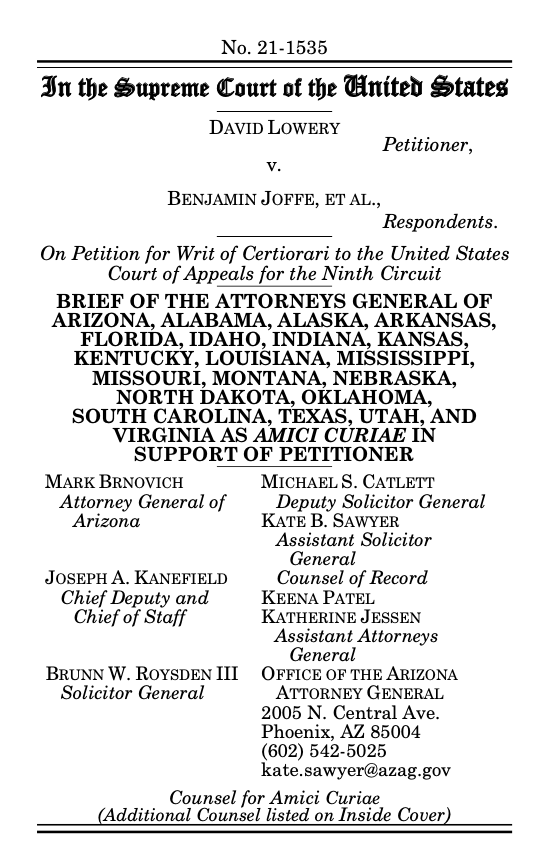
David is petitioning the Supreme Court of the United States to stop Google’s cy pres payola system of class action settlements. This is David’s third trip to the Supreme Court. This time, 21 state attorneys general agree. Read their friend of the court brief here. The Court has not granted a hearing yet, but we’ll be keeping an eye on it.
More to come on this topic.
Must See Documentary: The Way the Music Died: Why You Should #DitchSpotify
Big thanks to Jon at Camden Live for posting about this really important documentary about the deep, down and dirty effects of Spotify on music, musicians and the creative process.
It’s always been a hard road for musicians to make money from their songs. Nonetheless, selling tons of singles and albums was at least a target and something bands could dream about. Of course, there were many ways the labels could work the sales figures to get their shares out first, and only then the bands might see something. Despite the conflict between the often industrial-strength labels and the upcoming artists, there was at least hope that money was flowing back to the content creators. Now though in the age of streaming music, the connection between making music and making a living is profoundly broken.
This schism is the subject matter for Lightbringer Production’s documentary film “The Way The Music Died” featuring insights from musicians and industry pros, including Mishkin Fitzgerald from Birdeatsbaby. The film probes the spirit of artists determined to keep writing songs in the face of the meager payouts from the giant and ever-growing music stream service Spotify. Find out why this is ripping-out the heart and soul of new music.


You must be logged in to post a comment.