How Copyright Encourages Creativity and Opportunity in Hollywood

The Trichordist

We hear a lot from the copyleft and opponents of Artist’s Rights that copyright stifles creativity, but this is simply not true. We’re not going to go down the tired road of the arguments about remixing, which can be read in this excellent article at Copyhype titled, “Remix Without Romance.

The truth is, the best ecosystem for creativity is the one where all stakeholders are compensated. This is why in the early 90s sample clearance statutes were defined, and as a result we’ve seen some of the most innovative music, in the history of recorded music. This creativity has been achieved legally by creating fair and balanced policy. Historically, that is how policy evolves, such as it did with phonographs and radio — when both were getting off the ground, the law eventually recognized that artists have a right to be compensated, and both eventually flourished, also benefiting all…

View original post 928 more words

“Fifteen years of utter bollocks”: how a generation’s freeloading has starved creativity | New Statesman

Arguments for digital piracy are drivel – it’s high time we steered away from this cultural cliff, argues author Chris Ruen.

Piracy may feel like victimless “free culture” to the user, but they are in fact participating in a digital black market. It’s not about information wanting to be free, but rather it’s about exploitative black marketeers and willfully blind tech companies wanting to get rich. They are simply capitalising on loopholes in the regulatory framework. In this sense, mass digital piracy is a symptom of underdevelopment. It’s the Internet Third World, with outdoor markets hawking counterfeit goods and purveyors bribing the local cops to look the other way.

Tech companies will go on skimming profits off the top of this black market until enlightened governments cooperate to squeeze out these illicit profiteers in an effective and transparent manner. As Google’s own Chief Economist Hal Varian has written, “all that is required is the political will to enforce intellectual property rights”.

READ THE FULL STORY AT THE NEW STATESMAN:
http://www.newstatesman.com/culture/2014/07/fifteen-years-utter-bollocks-how-generation-s-freeloading-has-starved-creativity

Here’s How Piracy Hurts Indie Film | IndieWire

The fact is: pirate sites don’t discriminate based on a movie’s budget. As long as they can generate revenue from advertising and credit card payments—while giving away your stolen content for free—pirate site operators have little reason to care if a film starts with an investment of $10,000 or $200 million. Whether you’re employed by a major studio or a do-it-yourself creator, if you’re involved in the making of TV or film, it’s safe to assume that piracy takes a big cut out of your business.

We know piracy won’t go away altogether, and we won’t always agree on the best way to go about disrupting it. But we can agree on a vision for a digital future that better serves audiences and artists alike, and that future depends on reducing piracy.

READ THE FULL POST AT INDIEWIRE:
http://www.indiewire.com/article/guest-post-heres-how-piracy-hurts-indie-film-20140711

Some cold analysis of the YouTube-Indie labels story, and some long term reflections | Wildcat Blog

So what’s going on with Google, YouTube and Indie labels?

There’s been so much fuss, indies tearing their hair, lawyers trying to tone it down: I try to sum up the whole thing here for your delight and delectation.

Alright, this is not a music law blog. It is, however, a blog where law and music meet. So, here we go. If you don’t know the ante-fact, have a read here or here.

And there’s also this update that Google may be revising its position now.

Why is the contract so bad? Wait, is it really bad?

READ THE FULL POST AT WILDCAT BLOG:
http://blog.thewildcat.co.uk/post/91151130569/some-cold-analysis-of-the-youtube-indie-labels-story

Aiding and Infringing : iPad Music Apps – A New Low

HypeBot Reports : Apple Removes Music Download Apps From iTunes
http://hypebot.com/hypebot/2014/06/apple-removes-music-download-apps-from-itunes-1.html

The Trichordist

Advertisers need to capture the mobile market. The problem is the functionality of the some of the most frequented websites by the coveted youth demographic is disabled on iDevices (the inability to download content to the idevice). In other words, there is no draw to pirate websites (and to the advertising they serve) if the infringing music is no longer accessible. Worry no more, there’s an APP for that… note the top grossing and most popular music apps for the ipad…

IMG_0001

IMG_0002

IMG_0003

IMG_0004

adsforGAMES

lovebuddy

And uhm… let’s not worry that ads for Adult Services are being targeted to minors…

View original post

Pan Handling For A Career in Music | Guest Post By Dustin Mitchell of Katagory V

Recently, my band Katagory V created a crowdsourcing campaign to finance the release of our latest album, which had been completed (recorded, mixed, and mastered) over three years ago.  As much as Silicon Valley seems to laud this as “the way” to finance a musician’s work, I personally was very resistant to it for a long time.  This was more of a moral issue for myself than one of not wanting to “get with the times”, as we artists are so often accused of.  Recently, however, it became far more than a moral problem; it became a political one, too.

Don’t get me wrong.  I think the whole crowdsourcing concept is brilliant.  It’s a fantastic way to kick-start your craft if you have no capital to work with and arejust getting started as a band, filmmaker, writer, etc.  It is something I wish had existed when I started my musical endeavor years ago.  However, the more I look at it concerning my own band which has existed for 15 years, I feel like we are essentially panhandling. It is one thing, in my opinion, to use this to “kickstart” your dream career, it is another creature all together when you rely on it as your sole source of income to maintain it.

With that said, let’s not mince words here and just call it what it really is — crowdsourcing is panhandling on the internet.  I can’t be the only person that sees it this way…or am I?  I was raised to believe that hard work and perseverance gets rewarded, and when you reap these rewards, you do so with absolute humility.  Panhandling completely negates what I was taught. Granted, people who contribute get “perks” or a finished product IF…if it succeeds.  However, it is still asking for money for something that doesn’t actually exist yet.  Money for a promise: this is where my moral compass just spins out of control. Are we asking consumers, our fans, to become investors now?

The part that goes beyond my moral problems with this is that we are not crowdsourcing our unreleased album to get our career started, rebooted, as a noble cause, or even to try and break away from the whole record label cycle.  We are doing it because after three years, we have no other choice.  Labels are reluctant to take risks or give advances, consumers are using streaming or free options, both of which obviously pay us nothing, and we don’t have any more capital ourselves to fund it.  Nothing is more frustrating or humiliating than doing something that you find absolutely immoral AND politically backwards, yet knowing that you HAVE to do it as a means to an end.  There is no Plan B or C; this is the ONLY plan left.  It’s very ironic, but one of the songs we had written for this unreleased album, “I Am Change,” lyrically and inadvertently prophesied this very situation.

When I told the members of my band that I was going forward with this panhandling scheme, I insisted that our campaign bio had to explain to our fans WHY we were doing it.  Unlike most artists doing these funding projects, I wanted it spelled out in big bold letterson the front page of the campaign, that thanks to the “new boss,” we had no choice but to have our fans directly fund our work.  Otherwise, this album would never be released.

There are several paragraphs in our campaign explaining what has happened in the music business in the last decade, why our “middle-class” band had been forced at gunpoint to climb aboard the express train to “poverty,” and why we are now holding out our hands, begging for spare change.  By laying out the truth and thus risking the possibility of being viewed as sniveling and whiny, we may be pushing our potential contributors away.

Why would these potential contributors be turned off?  Because NO ONE likes cry-baby musicians.  They literally tune them right out.  Music consumers don’t want to hear our problems.  They just stuff cotton in their ears and mouse click over to the next free meal.  And you know what?  I don’t care…it’s already been three years.  I can wait another three, ten, or even twenty years if it means standing my ground on how I feel about the digital age and how we as artists are being bent over the proverbial barrel more than ever in the history of the music business.

The band was surprisingly supportive of this idea to add this segment to the campaign.  I had been preaching this possible doomsday scenario to them (and anyone else who would listen) as far back as 2007.  I always knew it was going to get worse before it got better when we started recording this album back in 2010; I just never imagined it would get THIS bad with no real resolution in sight.  I can’t help but wonder if this is the end of days for music.

Our fans (and others looking to contribute) need to know the truth.  Of course we want people to contribute; we want this album out there just as much as our fans do, or else we wouldn’t have resorted to creating a panhandling campaign!  If it doesn’t work, this album is going to go back on the shelf indefinitely.  Even if people don’t contribute and they walk away from it with a little education and a better understanding of how things work (or don’t work) in the world of music today, I will personally feel a little better about having to resort to this fundraising tactic.  I can only hope we don’t ever have to take this route again.

The financial ecosystem in which our band had worked under for over a decade has been eradicated.  It’s as if we are living out that John Carpenter movie, “They Live.”  The music industry isn’t even an industry anymore; they/we are the puppets of this new boss.  We put in thousands of dollars of our own money into this album thinking that things would get better, that someone would find this miracle “new business model” that would restore the balance to the force, and that we would at least see a return that would pay back our expenses.  This has yet to happen and, sadly, probably never will.  So now, after three years of waiting for the other shoe to drop, we decided to stop bruising our backsides from sitting on the fence, swallow our pride, and fund our music by turning our band into a PBS pledge drive.  I never in my wildest dreams thought I would be panhandling for my career in music.

Never.

Dustin Mitchell
Bassist/songwriter – Katagory V
website: http://www.katagory5.com

EFF’s John Perry Barlow is Wrong, says Google’s Chief Economist

just in case you missed it the fist time around…

The Trichordist

What Artificial Scarcity?

John Perry Barlow is the outspoken EFF co-founder who wrote the sophomoric and nonsensical manifesto for the internet. Much of Barlow’s principal talking points regarding his complete disregard for the protection of artists rights in the digital age centers around the idea that “property” especially of the intellectual kind should not exist on the internet.

“Your legal concepts of property, expression, identity, movement, and context do not apply to us. They are all based on matter, and there is no matter here.”- John Perry Barlow

The fact that this is posted on the EFF website should be at the very least alarming, if not completely absurd for a policy group to display publicly as part of its mission.

There is much talk online by freehadist’s that digital bits are worthless and the cost of a copy is zero, therefore all content online has a near zero marginal…

View original post 478 more words

2.5 Million P2P Users Worldwide Illegally Shared The Top 60 Video Game Titles | Digital Journal

It’s not just music…

“With most of these games being $20 and $50 or more to download, the loss of revenue from this amount of piracy is huge,” said Kyle Reed, Co-Founder and COO, CEG TEK. “There’s been a lot of debate about whether or not piracy is really an issue for the massively successful video game business, but if publishers like Electronic Arts are losing nearly $30M a day in potential revenue on 13 of their hottest titles, that’s something to be concerned about.”

READ THE FULL STORY AT DIGITAL JOURNAL:
http://www.digitaljournal.com/pr/1983503

Songwriter’s Pie Anyone? | Shelly Peiken @ HuffPo

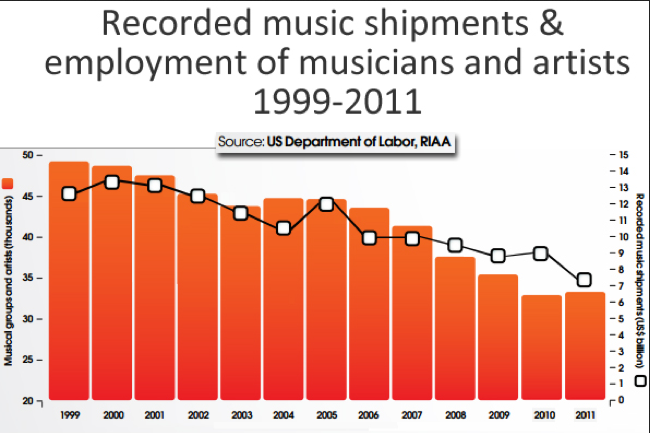
Financially, it’s less and less possible for a songwriter to make a decent living. I know of a few who have contributed to hit songs that are still having trouble paying their rent. I can’t help but wonder about the aspiring up and comer with big dreams and empty pockets, pockets that might still be pretty bare even after their dream comes true. Some reason that if they get their name on a few big hits it will open the door to bigger and better opportunities. They may be right about that but it remains to be seen whether the resulting royalties will allow them to make a down payment or put their kids through college.

READ THE FULL POST AT THE HUFFINGTON POST:
http://www.huffingtonpost.com/shelly-peiken/songwriting-hollywood-music-industry_b_5509579.html

Artists Take To The Streets to Protest Google/YouTube in NYC | NY Times

Last week, the dispute spilled out into the streets of New York. On Saturday afternoon, a few dozen supporters of the Content Creators Coalition, an artists’ advocacy group, picketed Google’s office in Chelsea, playing New Orleans-style marches on horns and carrying signs like “Economic justice in the digital domain” and “What YouTube pays? Nothing.”

Marc Ribot, a guitarist who has played with stars like Tom Waits and Elvis Costello, summarized how the larger conflict over streaming revenue affected artists’ careers.

“If we can’t make enough from digital media to pay for the record that we’ve just made,” Mr. Ribot said, “then we can’t make another one.”

READ THE FULL STORY AT THE NEW YORK TIMES:
http://www.nytimes.com/2014/06/25/business/media/small-music-labels-see-youtube-battle-as-part-of-war-for-revenue.html