Slate’s Anti Copyright rant sounds like a letter from your psycho ex. | AdLand.Tv

The rationale by Silicon Valley that we already have the DMCA and it’s working just fine– seems positively Right Wing in its rabid belief system of law. Conservatives say much the same thing about guns. “We don’t need new laws, we need to enforce the existing ones.” It amusing to me that this backward sentiment is the same. Really though, it’s neither left nor right wing. It’s just pure cynicism by people who think we’re stupid.

To blame Hollywood copyright lobbyists for trying to influence law when google does the exact same thing is either ignorant or hypocritical. And to ignore the fact it isn’t just “Hollywood Copyright Lobbyists” but entire countries that are reacting to what they see is Big Tech run rampant, suggests once again the narrative is being controlled in Big Tech’s favor.

No surprise, really. The blog post was written by Marvin Ammori. He is a lawyer and Future Tense Fellow at New America. New America Foundation is a nonprofit and (ha-ha) nonpartisan public policy institute. Wanna guess who chairs the board of directors? Eric Schmidt, executive chairman of google.

READ THE FULL STORY:
http://adland.tv/adnews/slates-anti-copyright-rant-sounds-letter-your-psycho-ex/256965859#KdyGl5zIdACdgSvs.99

Victims of IP theft need better protection By Reps. Judy Chu and Tom Marino | The Hill

Stopping IP theft should not be this difficult, or so costly, to the individual artist, who is ultimately the victim.

In the first six months of 2013, the largest search engine received more than 100 million DMCA takedown notices. The numbers are staggering, but don’t reflect the reality that most indie and small creators struggle to keep up with issuing notices and have simply given up trying to prevent illegal profiting from their work. Independent artists cannot afford employing an entire legal department to monitor the unauthorized use of their content on a daily basis.

And the profits are staggering — a recent study by the Digital Citizens Alliance estimates that the top 596 pirate sites raked in $227 million in advertising revenues last year. These sites had a profit margin of between 80 and 94 percent. Content thieves rely on stealing the rights-protected work of others and distributing on low-cost sites. It’s a low-risk, high-reward business.

This week, the House Judiciary subcommittee on Intellectual Property will examine the “Notice and Takedown” process, and to us, it is clear that a very hard look is necessary.

READ THE FULL STORY AT THE HILL:
http://thehill.com/opinion/op-ed/200630-victims-of-ip-theft-need-better-protection

Update: Beastie Boys Settle with Goldieblox: More grace than Goldieblox deserved

Music Technology Policy

“Put all your eggs in one basket, and then WATCH that basket.”

From Pudd’nhead Wilson and Other Tales by Mark Twain

At the intersection of “Too Cute By Half” and “Stupid Stanford Tricks,” we find Silicon Valley darlings, Goldieblox.  What do they teach them at Stanford, anyway?

In a gracious–and supremely undeserved–act of kindness, the Beastie Boys agreed to dismiss the lawsuit (Goldieblox Dismissal) that Goldieblox brought against them.  If I had to guess, I would guess that the paying party was probably not just Goldieblox, but that’s because I always thought that Goldieblox was engaged in marketing by lawsuit and got extraordinarily bad advice.

The unanswered questions in this case are many, but I think they’ll just have to go into that mysteries of life pile unless Goldieblox just cannot keep it buttoned and there’s a better than 50/50 chance of that.

First, what did Intuit…

View original post 669 more words

#SXSW REWIND : Venture Capitalist Admits Artists Can Not Make A Living Streaming

The grand irony here is that the panel which asked the question “”Will Artists Make Money on Big Music Platforms?” not only reported that artists could not, but also suggested that artists needed to focus on selling concert tickets and merchandise. You know, things artists did BEFORE the internet.

We admire the honesty of Hany Nada, Managing Partner GGV Capital who bluntly and glibly admitted during the SXSW Panel “Will Artists Make Money on Big Music Platforms?” that he believed that they would not be able to do so. He also added that he the point of digital streaming platforms such as Pandora, Spotify, and others was promotion to help the artists tour, sell t-shirts and offer other non-digitally distributable “experiences” to fans (why is this sounding more and more like prostitution?).

At least Mr.Nada is honest, which is refreshing given that the man has more integrity than most of the executives at that streaming services who claim the problem of royalties is one of scale and not sustainability. Mr. Nada (ironically named in this context) may be well intentioned and honest but he is also grossly misguided.

Mr. Nada’s statement and philosophy that streaming sites should be viewed by artists as a promotional platform more so than a financial one are an admission of the failure of these unprofitable start ups to serve musicans. As such, let artists decide if there is a value proposition in these companies that benefits the artist and allow them to opt out. Not every album should be on streaming services. Not every artist should be on streaming services. And if streaming is nothing more than promotion with little value proposition, than artists need to rethink their relationships and strategies regarding those businesses.

To be fair, it’s not just Mr.Nada who has promoted this philosophy. It appears that many of the music streaming company executives on panels at SXSW alternate between two talking points. First is that these services will support musicians when they scale (which we can find no evidence of). And second, when pressed on the first point, that streaming platforms offer promotional value for artists to make money in other ways. Oddly, other than “t-shirts and touring” no one seems to have any idea how to translate an artists participation on streaming services into a sustainable revenue stream.

In almost every way streaming companies represent the worst of both the old boss and the new boss.

So here’s the take away, which was put forth by a series of questions from the floor that largely went unanswered.

1) If artists can’t be expected to make a living from streaming music why should streaming executives make a living from streaming businesses at the artists expense? These are essentially, artists subsidized corporations.

2) As artist’s are bringing the audience to the platform, why should the platform profit, but not the artists? Test this theory, No Music = No Business. Done.

3) Artists have been able to sell t-shirts and tour long before the internet and without streaming platforms, but streaming platforms can’t exists without the artists music. Again, No Music = No Business. Done.

4) Given that the streaming music thought leaders believe that the”new revenue model’s” for musicians are “touring and t-shirts” when are the streaming company executives going on tour to sell t-shirts to support their businesses? We find it odd that the executives running companies that are not profitable are giving business advice to musicians.

Sons of Anarchy Creator Kurt Sutter Responds to Google Shill Marvin Ammori, and boy is it good!

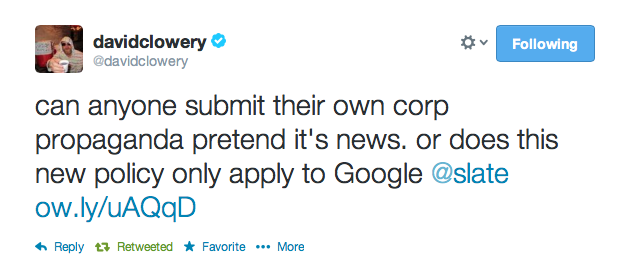
So Google shill Marvin Ammori wrote an Asperger’s ridden anti-copyright, anti-artist tirade on Slate. Of course in doing so Marvin failed to represent his past and current affiliations to Google. Slate, to their credit amended the rant with the following:

Update, March 11, 2014: Disclosure: The author represented Google and other companies fighting SOPA/PIPA in 2011 and 2012. He currently represents Google and other companies on several issues, including copyright reform. These views are his own.

googlepropagandaasnews

Of course, this isn’t the first time that those with a political agenda haven’t disclosed their affiliations. Who can forget Timothy B. Lee’s Epic Fail in the Washington Post on Piracy?

And so, we present the brilliant rebuttal to Google’s disingenuous attack on the rights of individual creators and artists by Kurt Sutter.

Not-So-Zen and the Art of Voluntary Agreements
Google’s anti-copyright stance is just a way to devalue content. That’s bad for artists and bad for consumers. By Kurt Sutter

It’s so absurd that Google is still presenting itself as the lovable geek who’s the friend of the young everyman. Don’t kid yourself, kids: Google is the establishment. It is a multibillion-dollar information portal that makes dough off of every click on its page and every data byte it streams. Do you really think Google gives a shit about free speech or your inalienable right to access unfettered content? Nope. You’re just another revenue resource Google can access to create more traffic and more data streams. Unfortunately, those streams are now pristine, digital ones of our work, which all flow into a huge watershed of semi-dirty cash. If you want to know more about how this works, just Google the word “parasite.” And if you think I’m exaggerating, ask yourself why Google spends tens of millions of dollars each year to hire lawyers and lobbyists (like Marv) whose sole purpose is to erode creative copyright laws.

Do they do this because they hate artists? No. They do it because they love money.

READ THE FULL STORY AT SLATE:
http://www.slate.com/articles/technology/technology/2014/03/sons_of_anarchy_creator_kurt_sutter_google_s_copyright_stance_is_bad_for.html

RELATED:

Google, Advertising, Money and Piracy. A History of Wrongdoing Exposed.|Trichordist

Why Google Really is Evil | Fox Business News

Google and Trichordist to debate piracy profits in London | Music Week

New Adventures in Copyright Enforcement @SXSW #SXSW

Friday, March 14 | 2:00PM – 3:00PM
New Adventures in Copyright Enforcement
Austin Convention Center | Room 17B | 500 E Cesar Chavez St

lthough debates about how to protect copyright online might seem so 2010, they certainly haven’t abated. The current conversations aren’t as contentious as the SOPA skirmishes, but that doesn’t necessarily mean consensus. Current attempts to address piracy are taking place outside of Congress, and include efforts to establish “best practices” between stakeholders. From the recently-minted Copyright Alert System to voluntary agreements meant to curb unauthorized activity within ad networks and payment processors, new experiments in rights protection abound. What’s the thinking behind the various approaches? What does a “win” look like, and what are the parameters for oversight? How can artists get involved?

MMODERATOR
Casey Rae
Interim Exec Dir – Future of Music Coalition

Sherwin Siy
VP, Legal Affairs- Public Knowledge

Jill Lesser
Exec Dir- Center For Copyright Information

David Lowery
Musician/Internet Content Provider – Cracker

TODAY AT #SXSW : Love the Art, Fcuk the Artist: The Re-emerging Artist Rights Movement! #SXSW

Thursday, March 13 | 3:30PM – 4:30PM
Austin Convention Center | Room 12AB | 500 E Cesar Chavez St

http://schedule.sxsw.com/2014/events/event_MP990775

Business gets harder and harder for recording artists and songwriters. Problems have developed with labels, publishers, fans, online distribution services like Spotify, major ISPs like Google, and Internet radio networks like Pandora. They also endure antagonistic courts, ineffective laws, and government indifference. As a result, their property interest has been significantly devalued and their rights abridged. Recently some recording artists and songwriters have started to criticize and push back against this new status quo.

MODERATOR
Jay Rosenthal
SVP & General Counsel – National Music Publishers’ Association

Eric Hilton
Thievery Corporation

David Zierler
Pres – INgrooves

Lee Miller
Pres – Nashville Songwriters Association International

David Lowery
Musician/Internet Content Provider – Cracker