We have heard quite a bit about how “100,000 people have signed a White House petition!” which prompts action from the White House on a particular issue. The implication is that the White House petition was established by an American and the response to it is reflective of the will of the people. Meaning the American people, because it’s the American President who is being called on. Democracy in action, right?
This emphasis on “American” is not jingoism on our part–it’s the clear implication of the petition process and is the unstated assumption of everyone discussing these petitions, and particularly of the supporters of the issue being “voted on”. For example, Mr. Derek Khanna says he started a White House petition to “unlock” cell phones–got to love those “moral panic” narratives–and then the White House says they will support US legislation and presto chango Senator Wyden (remember him from IRFA?) and Rep. Eshoo (from Palo Alto, home to…guess who) have introduced “unlocking” legislation to make it so. Very symmetrical. Very. Almost like they planned it that way.
But how did this all start? A White House petition that was signed by 100,000 “people”. So you would have thought that there would be some controls at the White House petition site to make sure that all this activity didn’t get started based on a false assumption–that someone had checked to see if the signers of the petition were in fact the citizens over whom the legislation will prevail.
e-petitions are an easy, personal way for you to influence government and Parliament in the UK. You can create an e-petition about anything that the government is responsible for and if it gets at least 100,000 signatures, it will be considered for debate in the House of Commons. You can find more information about how the House of Commons deals with e-petitions on the Backbench Business Committee website This link opens in a new window
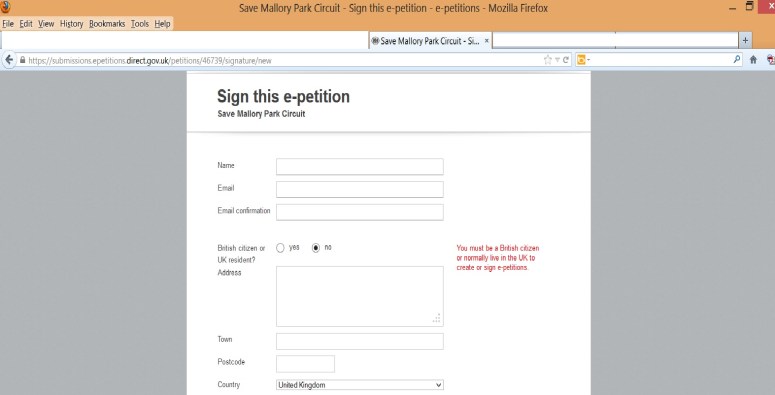
So you think, “Great, I’d like to get in on that!” Maybe you can get the House of Commons to debate making July 4th a national holiday in the UK! So you sign up to sign an ePetition to make the UK government do back flips on your command (and 100,000 of your favorite sock puppets). Ah, not so fast. The Brits did run an empire, after all. You are confronted with this sign in:
So you must be a British citizen or resident in order to sign the e-Petitions.
That actually makes sense, doesn’t it? If a government is going to establish a petition method, shouldn’t it be limited to the people who are going to have to live under the laws it might be used to create? We were also struck by the far, far lower vote tallies in the active UK petitions compared to the US. Could there be a connection?
This all makes sense to us and also, more importantly, to the UK government. If US residents or citizens want to express their views about something in the UK, there are plenty of casual polls they can game…sorry…vote in. They don’t need access to the right to petition the UK government. Seems like we fought a war about that once.
The White House Petition
So having established that the UK government sensibly blocks (or at least tries to block) non-residents and non-citizens from petitioning the UK government, we expected to find the same controls present in the White House petition site. Not at all.
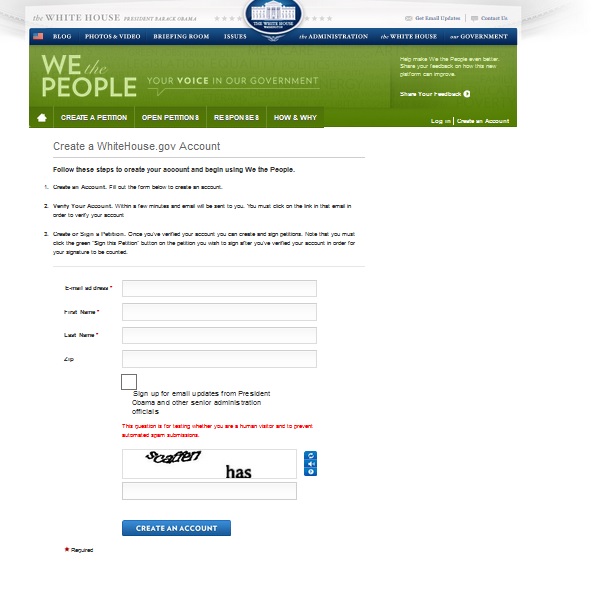
You do have to sign up for an account and give your email and name–a zip code is optional. So just as a test, we signed up for an account and instead of giving a US zip code, gave the UK postal code for the Houses of Parliament in London. That’ll surely get us rejected by the White House, right? The UK uses letters and numbers, not related in any way to a zip code.
So when you try to sign up, you are told to put in name and email and the optional zip code.
And here’s what happened when we signed up and got a White House petition account using the UK postal code:
We found this incredible, so asked friends in the UK and in Canada to try to sign up to vote for the Macho Man, fully expecting that their IP addresses would be geoblocked. Nope–both were able to sign up and both were able to vote for Randy Savage and used UK and Canadian postal codes to do so.
A really thoughtful and candid speech by Music Canada’s Graham Henderson at the Canadian Club of Toronto. He’s speaking on the importance of music to the Canadian economy, but everything he says could apply to any country.
Greg Sandoval is one of the great reporters on tech and music. While I don’t always agree with him, I think he’s fair and one thing I know for sure–he is old school when it comes to getting facts and sources right. So when Sandoval says Spotify is going back to the well to drive down artist royalties even further, you better believe that I believe him.
About 70 percent of Spotify’s revenues pays music-licensing fees while another 20 percent covers customer acquisition, these sources said. That leaves 10 percent to pay all of the company’s other costs, including its much praised technology platform. Insiders have told The Verge that this cost structure zeroes out Spotify’s profits.
So brace yourself–Spotify is about to do a Pandora-style argument about how artists should take even less because Spotify’s “profits” are consumed by royalties. (And…
MTP readers no doubt saw the coverage on last month’s installment of the USC-Annenberg Innovation Lab transparency report that identified ad networks that facilitated IP theft. Now we see that this month’s report names brands. You can read all about it here.
Here’s a sample of the top brands driving brand sponsored piracy and theft from artists:
There are lots of people who have had lots of questions about Gmail, Google’s “free” email service. You know, “free”–as in you give them your data and they sell it to advertisers to push ads to you in your emails based on–what exactly?
I haven’t met anyone who doesn’t believe that the ads get to your email by scanning your emails for keywords. And therein lies the rub for doctors, lawyers and–world governments. What does Google say about this? Well, they don’t say they monetize your “information” (meaning your email correspondence). They also don’t say that they read your mail, or at least not exactly.
Here’s what they say (or what they said today in response to criticism from Microsoft) according to Politico’s Morning Tech:
“‘Advertising keeps Google and many of the websites and services Google offers free of charge. We work hard to make sure that ads are…
Remember when we asked you to comment on the Copyright Office rulemaking for compulsory (or “statutory”) mechanical licenses? We’ll be posting some of the comments that did go up on the Copyright Office site starting with this one from Chris Castle at MusicTechPolicy
Alice’s Adventures in Wonderland, by Lewis Carroll
The following are my initial comments to the current proposed rulemaking at the Copyright Office that would, in my view, give digital streaming services a pass on transparency and accountability for their extraordinarily low royalty payments. The reporting on the ridiculously low royalty payments from services like Spotify assume one key fact that is not in evidence–that the royalty, however low, is calculated correctly.
Given the extraordinary sloppiness in the compulsory licensing system and the prohibition in the Copyright Act against songwriters and artists being able to audit statutory mechanical royalty payments, I have to agree with National Music Publishers Association President and CEO David Israelite (quoted again below): “It’s almost as if you had a tax system where there were no penalties if you didn’t file your taxes.” First they take away the songwriter’s right to…
Not surprisingly, Tim Westergren is rallying the troops at the Consumer Electronics Show–the locus of those just like him who want to enrich themselves from commoditizing music. Remember, Westergren is the founder and public face of Pandora–and has been cashing in to the tune of $1,000,000 a month as he sells off his founders stock in the public markets.
So now the LA Times is reporting that Westergren is offering the Web 2.0 version of “tour support”:
[Westergren] talked about Internet radio as a means to generate income for performing artists (who don’t get paid at all by over-the-air stations) and insights. In particular, he touted Pandora’s ability to help artists figure out where to tour and promote their live shows to a receptive audience.
The key, Westergren said, is in the feedback Pandora users give on songs. The site allows listeners to give a thumbs up to songs they’d…
The tenth rule of the ethics of rules and means is that you do what you can with what you have and clothe [“reform”] in moral arguments. …the essence of Lenin’s speeches during this period was “They have the guns and therefore we are for peace and for reformation through the ballot. When we have the guns then it will be through the bullet.” And it was. — Rules for Radicals, pp.36-37
Two events this week told the story that will unfold in the new Congress–Google’s complete gelding of the FTC and the panel of “copyright reformers” at CES moderated by a Google spouse and including several prominent members of the Google Shill List After watching this display of raw corporate power that might even have given pause to the robber barons of the industrial age, Alinsky’s advice rang truer than ever. Except now the bullets could be made in a 3D printer for assembly according to instructions on the Pirate Bay. Let’s be clear–the revolution will be anonymized.
The Pinkertons are back, but this time they have PhDs.
We are pleased to be able to serialize an excellent article about the recent history of one campaign in the war on authors–the “orphan works” movement in the U.S. written by the distinguished illustrator, Brad Holland. This concluding installment leads us to the barricades on an effort to counteract a lobbying effort that will be quite different in 2013. Google now has a standing army of lobbyists that’s the largest the world has ever seen–not just in the US but also in most countries around the world. Make no mistake–they are out for your property and they mean to take it.
The article demonstrates what a small group of independent artists are able to accomplish in the face of the lobbying might of Big Tech, especially Google. They got organized, believed in their cause and never gave up. We suggest that you pay particular attention to the role played by Google Shill Lister Public Knowledge–they never left and will be back. Expect them. During the time the orphan works bills were being worked in Washington, we have heard from artist advocates that they suspected that Google was pulling the strings despite the continual denials. Now we have the benefit of the disclosures in the Oracle v. Google case (also known as the “Google shill list“) we know that Google has acknowledged contributing to Public Knowledge “for years”.
This is what the Illustrators Partnership was up against–as we have seen demonstrated as recently as last week at the FTC, a well-oiled lobbying machine with an essentially limitless budget dedicated to victory at all costs for a major media company, including destroying the rights of individual artists. And they are proud of themselves. This takes the “creepy line” to a whole new level way beyond anything the worst record company would have tried.
We encourage our music and film industry readers to make common cause with the illustrators and photographers who will likely be most harmed by this specious legislation backed by Google the last two times it appeared in the Congress. Because orphan works or something worse will be coming in the new Congress–the money won’t just be from Google this time, it will include Facebook and other members of the Big Tech oligarchy (or what Eric Schmidt calls the “Gang of Four”). Take for example, the Facebook Structured Stories class action settlement that is about to pay millions to some of these same Google Shill Listers. To what end?
One reason we are serializing Brad’s article is to help you develop awareness of the situation, so that if we are right and legislation is introduced (whether it is orphan works, “fair use” Google style, or other legislation that undermines creators), you’ll be able to take action quickly. Given what we know of Google’s cozy relationship with the FTC, we may well be entirely on our own.
Conclusion: Trojan Horse: Orphan Works and the War on Authors, by Brad Holland
The War on Authors
The first – indeed the only – effort to assess the economic impact the Orphan Works bill would have on real-life business affairs came August 8, 2008 when the Office of Advocacy of the US Small Business Administration conducted an Orphan Works Roundtable at the Salmagundi Club in New York City. 77 The participants included artists, writers, photographers, songwriters, musicians, performers, and small business owners. All of us stressed that the Orphan Works Act would harm our businesses in two major ways: first, by acting as a compulsory license on business transactions that properly should be conducted as voluntary agreements; and second, by acting as an unfunded mandate requiring small business owners to bear a cost in time and money that would make compliance virtually impossible, while at the same time forcing us to subsidize the business models of large Internet enterprises. As David Rhodes, President of the School of Visual Arts said:
“[S]ince the expense of registering works [with commercial databases] will be born by the creative community, the expense of copyright protection will be socialized while the profit of creative endeavors will be privatized.”78
The individuals who participated in this Roundtable represented hundreds of years of professional experience in all aspects of the creative arts. Yet to Public Knowledge, we were simply a fringe group motivated by irrational fears. In her May 29 speech, PK’s President had condemned visual artists for the “FUD – fear, uncertainty and doubt,” that she said we were spreading about the bill. Portraying us as feckless demagogues, perversely determined to keep our work from the public, even at the expense of being paid “reasonable” fees for its use, she suggested our real goal was to lurk under the bridge of copyright law like trolls and pounce on hapless infringers to extract the maximum financial penalties from them in infringement lawsuits:
“By preferring to lock down culture, even if it means getting paid, these small copyright holders are no less copyright maximalists than the large corporate copyright holders that Public Knowledge has been battling for the past six years.” 79
The acknowledgement that advocates of the Orphan Works bill had been trying to defeat “small copyright holders” was – at long last – at least a breakthrough in transparency.
The “populist reformers” of the Copy Left (their own name for themselves) have long tried to brand themselves champions of the People bravely battling the copyright Goliaths of Big Business to unlock the treasury of the Commons and usher in a New Age of collective creativity among the masses. Having established this as their premise, it was no doubt inconvenient to be seen waging a public war against an entire class of small rights holders whose work they had hoped to present as a generous gift to the public. Yet the fact that they did begs the key question of the Orphan Works story: Who exactly are the “large corporate copyright holders” Ms. Sohn says they’ve had to fight?
• Not Publishers; they supported the Orphan Works bill;80 in fact some have acknowledged that its passage would justify their demands that authors sign all-rights contracts.81
• Not large stock houses; they supported the bill too; it would allow them to harvest “orphans,” “transform” them into “derivative works” and copyright the “derivatives” as their own commercial product.
• Not Google and Microsoft; they too supported the bill and Google said it planned to use millions of the works the bill would orphan.
• And not corporations such as the Copyright Clearance Center; it lobbied for the House version of the bill and was promoted [by the Graphic Artists Guild] as the commercial “Dark Archive” with which infringers could register their intent to infringe work.82
So if it wasn’t large corporate interests that opposed the bill, who is it that the “reformers” were actually battling? The evidence of the Orphan Works fight has made that clear: authors.
A Seismic Shift
The War on Authors isn’t new. Dickens, Victor Hugo and others were vilified for promoting copyright law more than a hundred years ago. What’s new is a technology that tips the scales against authors. As attorney Bruce Lehman, former Commissioner of the US Patent Office told the Association of Medical Illustrators at the Mayo Clinic in 2000:
“[W]e are on the verge of a seismic shift – comparable to radio in the 1920’s – that is the Internet. The Internet has the capacity to seize images and send them around the world in digital form so they can be produced with original quality. Now, that is a scary thing if you can’t control your rights. But if you can, it may be an opportunity.”83
Visual artists opposed the Orphan Works Act because it would impose a radically new business model on the licensing of our property. It would let giant image banks access our commercial inventory and metadata and enter our commercial markets as clearinghouses to compete with us for our own clients. I can think of no other field where small business owners can be pressured by the government to supply potential competitors with their content, business data and client contact information – all at their own expense.
Google and other large database, advertising and search engine companies clearly have a major financial stake in the weakening of copyright law through new legislation. The Orphan Works Act, if it should ever be enacted, would solve the problem that has vexed so many start-up Internet companies: how to make money by giving away free content. By opening the door to potentially billions of “permitted” infringements of protected copyrights, this legislation would allow big Internet companies to create entirely new business models by licensing content they don’t have to pay for — through the digitizing, archiving and monetizing of the intellectual property of ordinary citizens. If this legislation were to pass, its consequences would be far-reaching, long lasting, perhaps irreversible, and would strike at the heart of art itself.
Legislation By Misdirection
Reviewing the evidence, it seems compelling to conclude that the orphan works legislation presented to Congress was not what it was purported to be, but was intended rather to deliver commercial opportunities to large Internet interests while furthering the ideological agenda of legal scholars committed to expanding the public domain by stripping creators, small businesses and ordinary citizens of their intellectual property rights.
This raises fundamental questions not only about this legislation, but also about the process that spawned it and saw it nearly passed by misdirection and backroom deals. In light of the world’s ongoing financial crisis, is it wise for Congress to concentrate our nation’s copyright wealth in the hands of a few corporate databases? The contents of these databases would be more valuable than secure banking information; so why should small business owners and ordinary citizens be compelled to subsidize their start-ups? Why should we place our own assets at risk in the event of corporate failure, mismanagement or corruption? Under copyright law, no author can be compelled to publish his or her work; so by what right of eminent domain can Congress give strangers the right to publish our work without our knowledge, consent or payment? By what mandate do legal scholars, lobbyists, and civil servants presume the right to require small business owners to change their business models? Last but not least: why should Congress pass legislation that has been presented to it as something other than what it is?
“The Plural of Anecdote is Not Data”
From the beginning of the Orphan Works crusade, lawyers, lobbyists and big Internet firms have all sought to justify the rights grab that would follow by asserting that creative work has little or no meaningful value to its owners. Yet what’s striking about these assertions is that they’ve never been backed up by evidence.
The legal case for Orphan Works “reform” has been based solely on anecdotal assertions by lawyers, CEOs and legal scholars, the very people whose disciplines ordinarily require them to substantiate claims with evidence. Yet rather than document their own assertions, they’ve tried instead to burden rightsholders with the task of proving that our work isn’t worthless.
In 2006, for example, Rebecca Tushnet, a lawyer and professor of law at Georgetown University Law Center, denigrated our testimony that the work in an artist’s inventory has residual value. She called such claims “anecdotal,” and commented “the plural of anecdote is not data.” 84 Indeed it’s not, as we’ve pointed out about the self-serving statements of orphan works advocates.
But in fact artists do have data to document the value of our work: tax returns, contracts, invoices to clients. All these prove that our work is an ongoing source of income for us. Under current copyright law, we’re not required to document the day-to-day value of each and every picture in our inventory – nor should we ever have to. This is just common sense. As we all know, the value of any particular work of art is never static. Like gold, John Lennon’s guitars or Teddy Bears once owned by Elvis, the value of any property, especially non-essential property, fluctuates. One day a drawing may be worth nothing because there’s no client who wants to use it. The next it may be worth thousands of dollars to a client who does.
Contrary to the claim that “[t]he vast majority of copyrighted works have little or no economic value soon after their creation or publication,” some works may in fact have little or no value until years after their creation. Just ask the estate of Vincent Van Gogh.
Against a Culture of Appropriation
On March 24, 2005 Cynthia Turner and I authored a four-page paper to the Copyright Office’s Orphan Works study. In it, we argued that artists’ work once published retains residual value and may even increase in value with the rise of an artists’ reputation. We explained why “free speech is not restricted by protecting orphaned works,” why “archival preservation is not hampered by copyright protections,” and why stripping “orphaned” works of protection would both threaten an author’s integrity and favor the business interests of corporate giants over that of individual creators.
Our paper, submitted on behalf of the Illustrators’ Partnership, was endorsed by 42 national and international arts organizations and signed by nearly 2,000 individual working artists from across the spectrum of the graphic arts. Yet despite this testament from working artists, speaking with one voice about their own business experience and the value of their work, our statement was never once referenced in the 127 pages of the Orphan Works study. Instead the authors of the study, citing their 215 letters, asserted that our business models had to be changed because there was no way for users to find us.
Our letter can still be read on the Copyright Office website 85 In our summation, we cited our reasons for opposing this particular vision of copyright “reform.”
“The ‘Free Culture’ argument is at odds with the principle of tangible expression, which is the only aspect of the creative process protected by copyright law. By arguing that creative work is only a ‘remix’ of the work of others, the critics of copyright ignore the factors of experience, personal development and individual vision that are embodied in any author’s tangible expression of an idea. The computer and internet, as well as Photoshop, stock and royalty-free content have all made it possible for many people to become content providers by ‘sampling’ the work of others. But the demands of this ‘new modality’ for free and easy access to usable work should not induce lawmakers to legislate as if creativity can be adequately defined by the ‘remix’ model. There is a difference between the alchemy of new creation and the assembling of ‘found work.’ Legal protections for this difference have been built up over centuries and once eroded, would be painful and costly to recover.
“The Internet has created a culture of appropriation; and immediate global access to artistic works has facilitated piracy, unintentional infringement and plagiary. But instant and unrestricted access to work should not be construed as a necessity just because technology has made it a possibility. That an artist’s work now can be instantly transmitted around the world without the artist’s permission or control does not justify a user’s ‘right’ to take the work. And if inability to trace a work to its author becomes the justification for creating such a ‘right,’ who and what will define the inability to trace the work?
“The ‘orphaned’ works currently under consideration by the Copyright Office include the work of many artists now in the prime of their careers. To remove copyright protection from this work has the potential to undermine the important public policy behind copyright: To promote the creation and dissemination of culture by rewarding incentive. Rescinding guaranteed protection from copyrighted works will do more harm than good to the creative community and by extension, to the public good.”86
Afterward
Following the failure of the first Orphan Works bill to pass in 2006, but at a time when experts still predicted its swift passage in the 110th Congress, two of the bill’s key authors left public service to enter the employ of corporations that had supported the bill or which hoped to profit from its passage.
In January 2007, Jule L. Sigall, principal author of the Copyright Office’s Report on Orphan Works – who later stated that artists, like cats, needed to have their food moved – left the Copyright Office to become Associate General Counsel for Copyright in the Legal & Corporate Affairs department of Microsoft.87Nine months earlier, on April 6, 2006 Thomas C. Rubin, Associate General Counsel for Microsoft had testified on his company’s behalf in favor of the Orphan Works Act.88Mr. Sigall had been at the Copyright Office for three years,89and like Professor Peter Jaszi, taught law (in his case as an Adjunct Professor) at the George Washington University Law School.90
Also in 2006, another key player in the Orphan Works story left government service. Since 2005, attorney Joe Keeley had served as Intellectual Property Counsel to the House Subcommittee that wrote the bill. In his own words, he “was the lead staffer on the orphan works issue responsible for drafting the language and arranging the hearings.”91At the end of 2006, he left that position and after a year in the Office of General Counsel of the US Copyright Office, he joined the law firm of Arent Fox, where he became a registered lobbyist for the Copyright Clearance Center.92The Copyright Clearance Center (CCC) is the organization which in 2008 the Graphic Artists Guild recommended as a trusted entity to serve as the Dark Archive at which infringers could register their intent to infringe copyrighted work. CCC is a Salem, Massachusetts-based corporation that issues licenses for the reprographic republication of books and articles in print. In 2009, CCC’s revenues exceeded $200 million.93 CCC is unique among the world’s Reprographic Rights Organizations in that it has consistently failed or refused to recognize visual artists as authors who deserve to be paid for the republication of their contributions to the collective works CCC licenses.
Gigi B. Sohn: “The Orphan Works Act of 2008: Copyright Reform Takes Its First Steps,” Presented to the Center for Intellectual Property 8th Annual Intellectual Property Symposium, University of Maryland University College, May 29, 2008 http://www.publicknowledge.org/node/1594
The Illustrators’ Partnership Orphan Works Blog, March 29, 2006: “Allan R. Adler, a lawyer and lobbyist for the Association of American Publishers, said the copyright office’s recommendation regarding compensation to copyright owners is precisely what his group wanted.” Quoted from the Chronicle of Higher Education, February 2, 2006 http://ipaorphanworks.blogspot.com/2006_03_01_archive.html
Paul Sleven, Holtzbrinck Publishers, U.S. Copyright Office Transcript of Orphan Works Roundtable, July 27, 2005 at page 88: “I think whatever else the harm that may come to artists from inequitable bargaining power with large publishers, if the artist has signed the rights away to a Conde Nast or a Time-Warner…it is much, much less likely to be an orphaned work…because everyone knows where to find Conde Nast and Time.” http://www.copyright.gov/orphan/transcript/0727LOC.PDF
Unpublished letter from Graphic Artist Guild lobbyist Megan E. Gray to Shanna Winters, Chief Counsel, Office of Representative Howard Berman, Chairman, Subcommittee on Courts, the Internet, and Intellectual Property; Committee on the Judiciary; United States House of Representatives May 21, 2008: In the letter, Ms. Gray proposes (page 3) that the Copyright Clearance Center would be an appropriate repository for “Notice of Use” filings by infringers, noting that such filings need not be burdensome on infringers, requiring them to submit merely their names and addresses and allowing them to attach multiple visual works of art to a single notice of intent to infringe.
The Holland-Turner paper was cited as a source in one of the most authoritative scholarly articles published on this subject. On August 30, 2008, just days before Congress reconvened for its final legislative session, prominent legal scholar Jane Ginsburg of the Columbia Law School published Recent Developments in US Copyright Law: Part I – “Orphan” Works.In her paper, Professor Ginsburg raised many critical questions about the merits of the Orphan Works Act. Among these, she noted that certain provisions might violate Article 9.2 of the Berne Convention, which prohibits prejudicial exceptions to an author’s exclusive right of copyright. She also stated that the preclusion of injunctive relief with respect to derivative works would appear to force authors to tolerate “even derivative uses they find offensive or that distort their works.” She added that this “has economic consequences as well,” depriving the author of the right “to grant exclusive derivative work rights to a third party. The bill thus potentially devalues the derivative work right.” (Page 10)On page 5, Professor Ginsburg noted: “The ‘progress of knowledge’ to which US copyright aspires is achieved not only by putting works into circulation, but also by fostering conditions conducive to creativity.” http://lsr.nellco.org/cgi/viewcontent.cgi?article=1044&context=columbia_pllt
“Register of Copyrights Announces Appointment of Associate Register for Policy and International Affairs,” News from the Library of Congress, January 29, 2003 http://www.loc.gov/today/pr/2003/03-017.html
Orphan Works.net “Following the Progress of Orphan Works Legislation” This is a website started by Mr. Keeley following his departure from government service. http://www.orphanworks.net/
Brad Holland is a self taught artist and writer whose work has appeared in Time, Vanity Fair, The New Yorker, Playboy, Rolling Stone, the New York Times and many other national and international publications. His paintings have been exhibited in museums around the world, including one-man exhibitions at the Musée des Beaux-Arts, Clermont-Ferrand, France; the Museum of American Illustration, New York City and the Torino Atrium, Turin, Italy. His satire of the art business, “Express Yourself, It’s Later Than You Think,” first published in The Atlantic Monthly, has been widely republished, both in print and on the Internet. In 2005 he was elected to the Society of Illustrators Hall of Fame.
“During a career that has stretched over three decades,” wrote Steven Heller in Print Magazine, October 2002, “Brad Holland has changed the way illustration is perceived and practiced. By the late ’60s he had helped transform a profession of renderers into one of conceivers, challenging editors and art directors to let him create images that complemented rather than mimicked texts.” In 2000, the editors of the artists’ directory RSVP voted Holland “the one artist, who in our opinion, has had the single greatest impact on the illustration field during the last twenty five years.” Holland has won more awards presented by the New York Society of Illustrators than any other artist in its long history. The American illustrator Mark English has called him “the most important illustrator in America today.”
In the last decade, Holland has become an outspoken advocate for artists’ rights and is a founder of the Illustrators’ Partnership of America. In 2005, he represented artists at the Orphan Works Roundtables held by the US Copyright Office; in 2006, he testified before the Intellectual Property Subcommittees of both the US House and Senate, and in 2008 he and medical illustrator Cynthia Turner led the opposition to the Orphan Works Act of 2008. It was through their lobbying efforts that the US Small Business Administration acted to conduct its own Orphan Works Roundtable at the Salmagundi Club in New York City, August 8, 2008.
Holland is featured in the documentary, “Citizen 3.0 Copyright, Creativity and Contemporary Culture,” available at www.kinobserver.com and his article, “First Things About Secondary Rights,” published by The Columbia Journal of Law and the Arts is available at weblog.ipcentral.info/holland_ColumbiaLaw.pdf
Nothing says “Internet Freedom” like getting away with it, and in case you missed it, Google got away with it again at the Federal Trade Commission yesterday. According to press reports (see “Google Pressed Hard Behind the Scenes to Convince Regulators” in the New York Times, Did Google Buy Its Way Out of Trouble with the Feds? in The Atlantic Wire, and “How Google Beat the Feds” in Politico), Google appears to have effectively captured the U.S. Federal Trade Commission the old fashioned way–they bought it. And given how well Google controls the press, if the press is writing a story about Google’s crony capitalism, it’s because Google wants that story told and we can assume that they want that story told because they are proud of it.
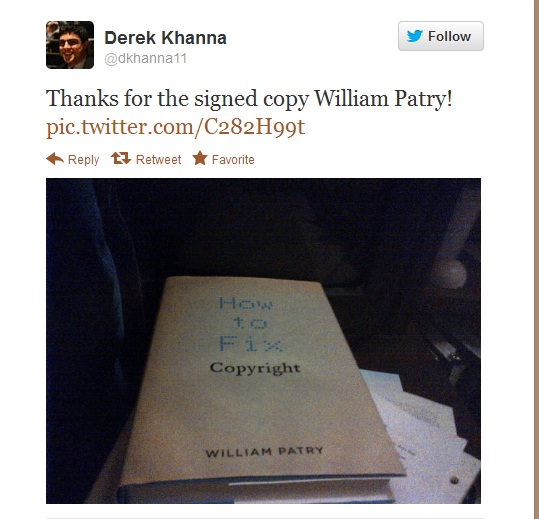
According to Politico’s Tony Romm, “[Google] even consulted with [which usually means ‘paid’] the late Robert Bork and The Heritage Foundation and met with senators like John Kerry to make its case. In other words, these traditional outsiders worked the system from the inside.” The Heritage Foundation, eh? We wonder if the Heritage Foundation also got a signed copy of William Patry’s book? (Patry is one of the senior copyright lawyers at Google.) One of Patry’s punters proudly posted this pretty picture of an autographed copy of the book apparently received as a gift from Mr. Patry:
From my perspective, I think one of the biggest problems for the music industry and the cultural industries generally is the bewildering attitudethat we seem to be getting from the Government about its ambivalence towards the benefit of copyright. It seems to me that Governments for some time, but especially this Government, have bought the line that intellectual property is a barrier to growth, and that simply is a lie. It is not true. That line has been bought by some very important and influential politicians in this country and I do not understand it. We have an asset that is very valid, that has been built up over 100 years-the theatre, the music, the films, the TV. It would be madness to create an atmosphere where that is at risk-absolute craziness.
I work with various businesses, I am involved with fundraising to license various forms of entertainment generally and I am also involved with start-ups from my own business and help them. The business community and the finance community always say to me, “Yes, but Government hates copyright. They are going to bring in all sorts of laws that are going to make it easier for Google to steal your music that they already steal, so why should we invest?”and that is a story I get every month of every year. It is this bewildering ambivalence, if not outright hostility, towards copyright that comes from the powers that be in this country and it is very, very damaging.
Oh, and one thing that Mr. Heath was too polite to mention is that Rachel Whetstone, Google’s global head of communications and public policy is married to Tory political consultant Steve Hilton, and the power couple were godparents to the late son of David Cameron. That would be Prime Minister David Cameron. The UK Prime Minister. A Tory–actually, the Tory–for whom Steve Hilton was employed. (See “Power Couple Behind the New Tory Throne“.) This fact (that we suppose was known so very well to all present at Mr. Heath’s panel that it need not be mentioned) may help to explain the “bewildering attitude” of the UK Government (by which he means the “Government”, i.e., the Parliamentary coalition that Mr. Cameron leads).
This pattern should sound familiar to Americans.
Orphan works legislation is just one of those ways that it will make it easier for Google to steal our life’s work, whether you are a songwriter, photographer, illustrator, artist, musician, singer, director, actor, screenwriter, or best boy.
We are pleased to be able to serialize an excellent article about the history of the “orphan works” movement in the U.S. written by the distinguished illustrator, Brad Holland. We encourage readers to make common cause with the illustrators and photographers who will likely be most harmed by this specious legislation backed by Google the last two times it appeared in the Congress. The article first appeared in the Journal of Biocommunication in 2010 and is used by permission of the author.
One reason we are serializing Brad’s article is to help you develop awareness of the situation, so that if we are right and legislation is introduced (whether it is orphan works, “fair use” Google style, or other legislation that undermines creators), you’ll be able to take action quickly. Given what we know of Google’s cozy relationship with the FTC, we may well be entirely on our own.
Part 4: Trojan Horse: Orphan Works and the War on Authors, by Brad Holland
The Gospel of the Commons
The premise that intellectual property should not be treated as real property is the gospel of the anti-copyright movement. Its chief apostle has been Lawrence Lessig, currently a Harvard Law School professor, formerly of Stanford and founder of Stanford’s Center for Internet and Society. Lessig also co-founded Creative Commons. Gigi Sohn of Public Knowledge has called Lessig “the first populist copyright reformer,” adding he “made the existence of organizations like Public Knowledge possible.”49
In books such as Free Culture and Remix, Lessig has argued that copyright law is a tool of the corporate power structure, enabling large media corporations to “lock down culture” and thwart the creativity of ordinary citizens by suspending the sword of infringement litigation over the heads of anyone who wants to “incorporate existing material” into their own creations. Creative Commons routinely celebrates music remixers, collage makers, and film and print publishers who seek to profit by republishing with impunity the copyrighted works of others. Implying that all creativity is a remix of the work of others, Lessig argues that the principle of ownership embodied in current copyright law compels ordinary citizens to create only at their own peril: “Under the existing system of copyright law,” he writes, “there’s no easy way to be a legal creator.”50 Contributors to Lessig’s wiki have spelled out why they believe the unauthorized use of others’ intellectual property should not necessarily be regarded as theft:
“The owner of physical property can clearly be deprived of the use of their [sic] property by the act of confiscation. But no such deprivation occurs when a work enters the public domain. The previous copyright holder can still publish their [sic] works, or market them more effectively…”51
This of course is nonsense. One can hardly market one’s work effectively – or perhaps even market it at all – if potential clients can access the same work for nothing from the public domain. Lessig has said he wants to create a culture of “[u]ser-generated content, spreading in businesses in extraordinarily valuable ways…celebrating amateur culture. By which I don’t mean amateurish culture, I mean culture where people produce for the love of what they’re doing and not for the money.”52
Money, however, appears to come in handy when you’re a “populist copyright reformer” crusading for a change in the law. In November 2006, for example, Lessig was pleased to accept a pledge of $2 million from Google to his Center for Internet and Society at Stanford University. According to the Online Wall Street Journal, “[t]he money will help fund a project at the center dedicated to help preserve the public’s legal right to ‘fair use’ of copyrighted material. It also intends to pursue legal cases relating to the topic.”53
“Aine Donovan, executive director of the Ethics Institute at Dartmouth College, says Stanford shouldn’t have accepted the Google gift because it is too narrowly tailored to benefit Google’s corporate interests. ‘It might as well be the Google Center,’ she says.”54
Lessig, of course, assured the Journal that the gift wouldn’t affect his scholarship, adding that his views on copyright “don’t always agree with Google’s,” and anyway, “there was no ‘quid pro quo.’”55
Lessig’s Gospel of the Commons is merely the fin that breaks the surface of the Free Culture/Orphan Works debate. Beneath the waterline lurks a gathering body of hostile dogma that copyrights are a “public resource” given as “subsidies” or “bribes” to feckless artists in order for work “to be gotten out of them.” Contributors to Lessig’s blog have routinely called copyrights restrictive “monopolies,” impositions on the freedom of others to create, and “a burden which the public ends up shouldering.” One acolyte writes that “[a]uthors should simply not have that much control over their published works,” while another says “the majority of [authors] would probably be better off with the welfare checks.”56
It would be hard to call such expressions scholarly opinions. Prejudice would be a better word. Yet these are merely examples of the reckless bias Lessig has ginned up throughout the world with his evangelical insistence that all creativity comes from the “Commons” and is everywhere being “strangled” by the outdated concept that individual creators have proprietary rights to the work they create. 57
In 2008, Lessig demurred from endorsing the Orphan Works bill, arguing instead that the length of copyright should be reduced to 14 years across the board. 58 This was a proposal he had spelled out two years earlier, March 6, 2006 in a nine-page letter to Congresswoman Zoe Lofgren of the House Judiciary Subcommittee. His logic was yet another undocumented assertion that works of art are generally of no lasting value to their creators:
“A presumptive 14 year term far exceeds the time during which the vast majority of work earns any commercial return at all…Thus, under this rule, any work less than 15 years old would be governed by the existing copyright rules…In the fifteenth year after a domestic work has been published and for every ten years afterwards, the copyright owner must take steps to maintain the copyright.” (Emphasis added.)59
Those steps would include the re-registering, every ten years, of each and every individual work with privately managed registries. All other works would fall automatically into the public domain, just as Creative Commons had recommended to the Copyright Office in its proposal “Reform(alizing) Copyright.”
Orphan Works: “Half a Loaf”
It’s hard to imagine how a panel of legal scholars could successfully convince lawmakers to re-write copyright law by lecturing them on “Derridean propositions” of “intertextuality” and “the inherent instability of meaning.” It’s even less likely they’d succeed by insisting that US law be re-written to reflect a post-Marxist analysis of private property. In Supreme Court cases such as Eldred v. Ashcroft, 60 Lessig and others have failed to bring about a judicial reinterpretation of existing law. Presumably this is why the authors of the Orphan Works Act chose to concoct and promote the myth of a market failure so pervasive that only the transfer of the world’s copyright wealth into the hands of a few corporate databases could correct it. In May of 2008, it looked as if that strategy would soon pan out for them.
Anticipating the imminent passage of the Orphan Works Act, Free Culture advocates had already begun to celebrate their achievement when as James V. DeLong of the Convergence Law Institute reminded them, there was still much work to be done. Calling the Orphan Works bill just “half a loaf,” he hinted at the new legislation the “Copy Left” would have to tackle next:
“These possibly-orphan, sort-of-orphan, and gray literature works simply cannot be made available if the digitizers are required to make one-by-one judgments and seek permission before copying. If they are to be retrieved in useful form, then sooner or later Google, Amazon, Microsoft, and some others must be permitted to digitize on a massive scale.”61
While Mr. DeLong acknowledged that the new reverse copyright law should not deprive intellectual property owners of their “legitimate rights,” 62 he reaffirmed the Copy Left’s fundamental premise that intellectual property owners should not be allowed to have legitimate rights except in situations where they’ve registered their works with commercial databases:
“At some point, some kind of grand grandfathering proceeding will probably be required, a window in which holders of existing rights must reaffirm them or lose them.” (Emphasis added.) 63
These admonitions however, like predictions of the bill’s imminent passage, were premature.
A Public Knowledge Postmortem
“Orphan works relief was vigorously opposed by visual artists…And while we have thought some of their concerns misguided, they did a fine job of organizing and getting their voices heard.”64
That was the rueful analysis from Gigi Sohn of Public Knowledge October 6, 2008, as she conducted a postmortem on her blog to explain how the Orphan Works bill had ultimately failed to pass. Throughout the summer of 2008 the bill, which in the spring had appeared to be a slam dunk, had become one of the 10 most controversial pieces of legislation facing Congress. Congressional observers still predicted that its passage was inevitable. Yet by September, with only a month left to go before adjournment, the Senate was reduced to passing its version of the bill only by using the controversial practice of “hotlining” it. 65Hotlining is a legislative end-run that allows a bill’s sponsors to pass it without subjecting it to testimony, debate or a vote.66This inspired Public Knowledge to lobby for similar tactics to be used in the House:
“The best option [Sohn wrote] was to put it on the ‘suspension calendar,’ which is the place largely non-controversial legislation gets put so that it will get passed quickly. There can be no amendments to bills placed on the suspension calendar.”67
Until the very last minute, Sohn acknowledged, she and others “were on the phone imploring the [House leadership] to move the bill” in this underhanded fashion. Yet in the end, “it was to no avail.” On October 3, 2008 Congress adjourned without passing the Orphan Works Act. “Time had run out.”68 Surveying the wreckage, Sohn nonetheless found a bright spot. Some “positive things,” she said, had “come out of the process.” 69 Ignoring the fact that 85 creators organizations had joined the Illustrators’ Partnership in opposing the bill; 70ignoring the more than 167,000 opposition letters that had been sent to lawmakers from the Illustrators’ Partnership website; 71and ignoring the adverse testimony of freelance creators at a Small Business Administration Roundtable two months earlier (see below), Ms. Sohn chose instead to praise the one graphic arts group72 that had supported the House version of the bill and had spent $200,000 lobbying for its passage.73
Calling officers of the Graphic Artists Guild “enlightened,” Sohn vowed that the Orphan Works Act would be back “next year,” and inexplicably, she tried to portray GAG’s support for it as proof that the world’s artists had finally learned their lesson:
“[V]isual artists, graphic designers and textile manufacturers who opposed orphan works relief now understand that they must change their business models.” (Emphasis added.)74
And with that backhanded praise for GAG, Public Knowledge finally laid its cards on the table.
Beware of Lawyers Bearing Gifts
In the beginning, the sponsors of the Orphan Works Act had all argued that the amendment was merely a minor adjustment to copyright law to let libraries and museums digitize their collections of old works. In 2006, during the bill’s first incarnation, its sponsors were so certain of swift passage that Public Knowledge even argued against imposing a “reasonable fee” on infringers. “That approach,” Ms. Sohn wrote, “keeps the orphans in the orphanage.”75 Yet by May 2008, realizing that artists were waging a persuasive fight to protect their rights, Public Knowledge adopted a different public relations strategy. Casting her new argument in terms that suggested infringement is the normal means by which clients procure work from contributors, Ms. Sohn portrayed the bill as a boon to artists: “The purpose of the legislation [she wrote] is to match users with copyright holders and get the latter paid”:
“If a copyright holder reappears after a user has done a diligent search, then the copyright holder is entitled to reasonable compensation. This is compensation that the copyright holder would likely never have obtained without orphan works relief, because the user would not have risked paying the huge damages provided by copyright law.” (Italics added.) 76
Of course, infringement would only become an everyday means of doing business if this legislation were to pass. Yet watching it fail for the second time in three years, PK’s President dropped the pose of benefactor to artists, admitting petulantly that the real purpose of the law was to force artists to change their business models. In doing so, she merely echoed Professor Jaszi’s 1994 declaration that creators of the future “may not need the long, intense protection afforded by conventional copyright – no matter how much they would like to have it.”
66. Critics of hotlining say “that lawmakers are essentially signing off on legislation neither they nor their staff have ever read.”
“In order for a bill to be hotlined, the Senate Majority Leader and Minority Leader must agree to pass it by unanimous consent, without a roll-call vote. The two leaders then inform Members of this agreement using special hotlines installed in each office and give Members a specified amount of time to object – in some cases as little as 15 minutes. If no objection is registered, the bill is passed.” (Italics added.) – Roll Call, Sept 17, 2007
In other words, a Senate bill can pass by “unanimous consent” even if some Senators don’t know about it.http://tinyurl.com/3p8x2u
72. Posting by Graphic Artists Guild, October 1, 2008, 4:18 pm: “URGENT: Contact your Representative to oppose [Senate Bill] S. 2913 Either the House version of Orphan Works legislation, H.R. 5889, or the Senate version will become law. There are no other possible outcomes. The Guild continues to support Rep. Berman’s House bill. The Graphic Artists Guild is urging all members and other artists to support H.R. 5889” (Emphasis added.) http://allthingscopyright.com/?p=54 (formerly Orphan Works News – http://orphanworksnews.com/)
Posting by Graphic Artists Guild, September 9th, 2008, 7:40 am: “A Message from the President” “The artistic community just has to get real about this Orphan Works scare… The Guild has promoted the ‘Notice of Use’ provision… and that’s why the Guild can and does support the House version of the Bill…” http://allthingscopyright.com/?p=44#more-44
75. Art Brodsky, “Public Knowledge Praises Orphan Works Report, Wants More Certainty,” Public Knowledge, February 1, 2006, Quoted at “Orphan Works Legislation: Responses to Proposal,” Source Watch, Page last modified July 1, 2008 at 21:04 http://www.sourcewatch.org/index.php?%20title=Orphan_works_legislation


 And here’s what happened when we signed up and got a White House petition account using the UK postal code:
 The Trichordist
You must be logged in to post a comment.