
Let’s Get Real About Kim Dotcom: The Indictment Clearly Alleges Felony Copyright Infringement | CPIP

Essential reading on the Kim Dotcom extradition case happening now.

Conclusion

As the Megaupload saga evolves, we’ll surely hear many more claims about the legal and moral implications of the case. Lessig is not the first, and he will certainly not be the last, to argue that Dotcom and his co-defendants should not be punished for their behavior. Nonetheless, it is important to keep in mind what allegedly happened here: Dotcom and his co-defendants made millions of dollars through the rampant theft and dissemination of countless artists’ and creators’ copyrighted works. For the sake of these artists and creators, who worked hard to produce the works that were unmercifully stolen, let us hope that Dotcom and his co-defendants are held accountable for their crimes.

READ THE FULL POST AT CPIP:
http://cpip.gmu.edu/2015/09/22/lets-get-real-about-kim-dotcom-the-indictment-clearly-alleges-felony-copyright-infringement/


A Tale of Two Pirates? Daniel Ek (uTorrent) and Kim Dotcom (Megaupload)

Lessig Defends Dotcom as Extradition Hearing Begins | Copyhype

Required reading regarding Larry Lessig’s pitch to help Kim Dotcom…

The second thing about Lessig’s declaration that jumps out is an apparent contradiction between Lessig and Dotcom’s defense team regarding the applicability of the DMCA safe harbors to Megaupload.

In the white paper, Dotcom’s defense team says

Even if the U.S. government’s wishful expansion of the criminal copyright law into the realm of secondary infringement were tenable (which it is not), Megaupload is shielded from criminal liability by specific “safe harbor” provisions in the Digital Millennium Copyright Act (DMCA), included in the law to protect companies like Megaupload that make efforts to remove infringing material in response to “take-down” notices issued by copyright holders

But in his declaration, Lessig asserts “The DMCA is only a defense in the civil context”. The reversal is notable.

READ THE FULL POST AT COPYHYPE:
http://www.copyhype.com/2015/09/lessig-defends-dotcom-as-extradition-hearing-begins/


Larry Lessig is Wrong, and should “Get Over It”

Why the ‘Dancing Baby’ copyright case is just hi-tech victim shaming | The Register UK

Lenz is best thought of as a tactic in a larger strategy. Another victim-shaming tactic, used to confuse and intimidate individuals so they don’t claim their rights, is a Google-funded project called Chilling Effects. We can define “victim shaming” as where the process of seeking justice punishes the victim more than it hurts the perpetrator, and it relies on the fear of unknown reprisals.

Both Lenz and Chilling Effects have the same goal: to make you think twice about asserting your ownership of your own digital stuff. The Utopia envisaged by Silicon Valley’s current oligarchs does not have individual ownership of bits in it.

READ THE FULL STORY AT THE REGISTER UK:
http://www.theregister.co.uk/2015/09/17/dancing_baby_victim_shaming/


“I Ain’t Gonna Work On Google’s Farm No More” | Creators are Forced Labor* On The Ad-Funded Piracy Fields Of The Advertnet

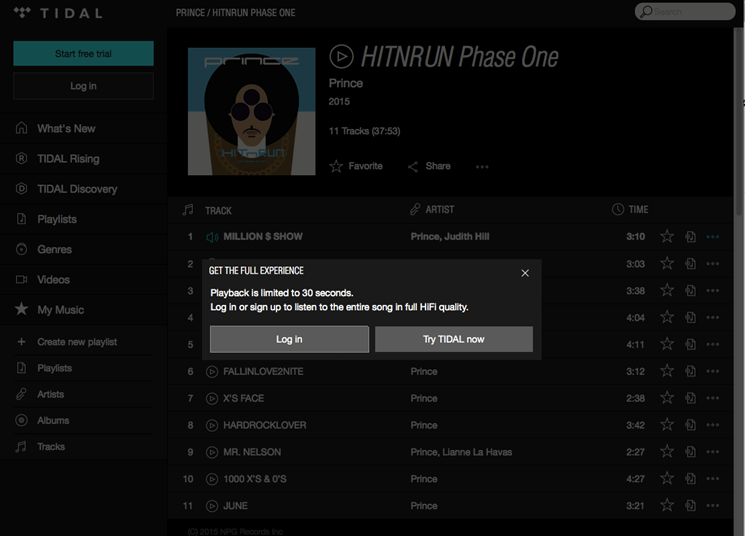
So Prince released his new album today Exclusively on TIDAL… how long will that last before it’s on YouTube?

Today Prince released his new album “HITNRUN Phase One” exclusively on TIDAL. The real question is, how long will it be before the album in part or in whole is on YouTube and every other pirate site in the world?

image001

You can listen to :30 of each song at the link below without signing up for the service.
http://listen.tidal.com/album/50767183

Music Tech Policy detailed why we can’t have nice things in the post “The Great Disappointment: Tidal Highlights YouTube’s Moral Hazard for All the World to See”.

Part of Tidal’s business model relies on artists being able to grant exclusives.  The concept of an exclusive requires property rights that are respected by other platforms in the channel.

Imagine if Showtime began showing rips of Game of Thrones day and date with its HBO release.  Forget that HBO would sue them and win.  The actors, screenwriters, producers and the vast below the line personnel would think twice about working for Showtime in the future.

And that’s exactly what should happen to YouTube.

Beyonce released “Die With You” on Tidal as an exclusive.  Everyone at YouTube knows that it was intended to be an exclusive just like everyone at YouTube knows that YouTube could keep the track from being uploaded to YouTube if YouTube wanted to do that.

YouTube has worked hard at getting the world to accept the concept of “user generated content” as some kind of great cultural event–even, when like “Die With You”, there isn’t anything particularly “user generated” about it, unless you call a one-to-one rip of Beyonce’s track that was distributed in clear violation of Beyonce’s rights “user generated”.

READ THE FULL POST AT MUSIC TECH POLICY:
https://musictechpolicy.wordpress.com/2015/04/07/tidal-highlights-youtubes-moral-hazard-for-all-the-world-to-see/

Spotify Per Play Rates Continue to Drop (.00408) … More Free Users = Less Money Per Stream #gettherateright

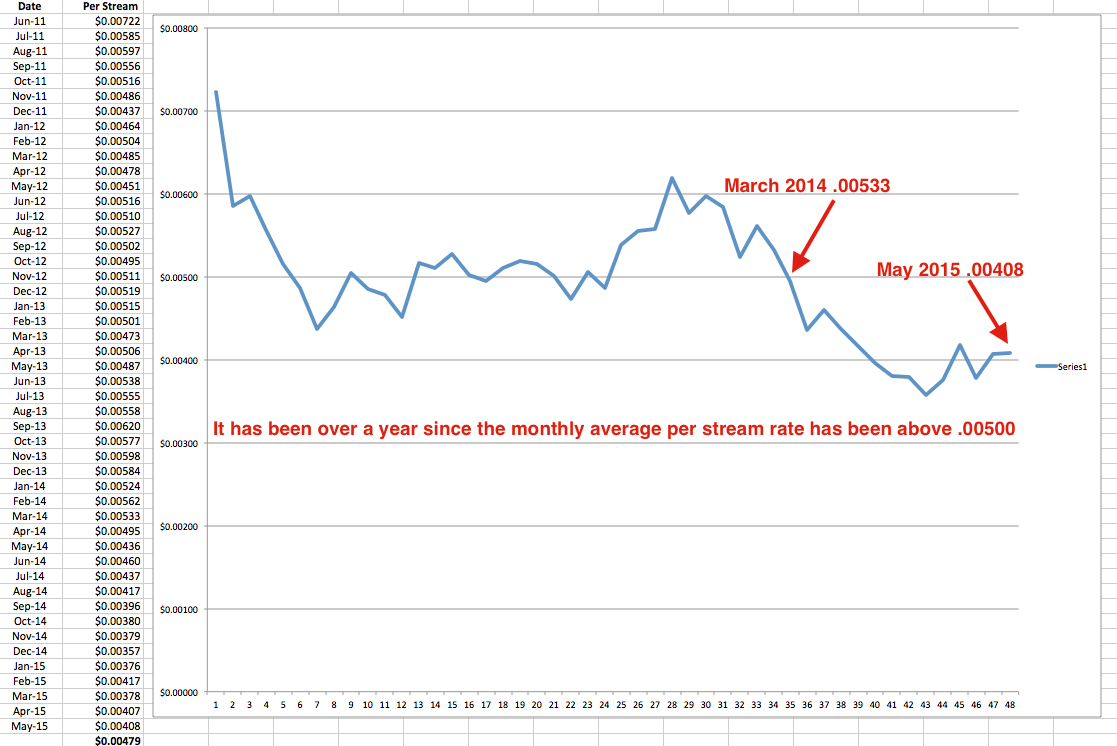
Down, down, down it goes, where it stops nobody knows… The monthly average rate per play on Spotify is currently .00408 for master rights holders.

PerStreamAvg_Jun11_July15

48 Months of Spotify Streaming Rates from Jun 2011 thru May 2015 on an indie label catalog of over 1,500 songs with over 10m plays.

Spotify rates per spin appear to have peaked and are now on a steady decline over time.

Per stream rates are dropping because the amount of revenue is not keeping pace with the  number of streams. There are several possible causes:

1) Advertising rates are falling as more “supply” (the number of streams) come on line and the market saturates.

2) The proportion of  lower paying “free streams”  is growing faster than the proportion of higher paying “paid streams.”

3) All of the above.

This confirms our long held suspicion that as a flat price “freemium” subscription service  scales the price per stream will drop.  As the service reaches “scale” the pool of streaming revenue becomes a fixed amount.  The pie can’t get any larger and adding more streams only cuts the pie into smaller pieces!

The data above is aggregated. In all cases the total amount of revenue is divided by the total number of the streams per service  (ex: $4,080 / 1,000,000 = .00408 per stream). Multiple tiers and pricing structures are all summed together and divided to create an averaged, single rate per play.

So, About That ‘NY Times Magazine’ Piece on “The Creative Apocalypse That Wasn’t”… | Flavorwire

Bold claims are certainly welcome at The New York Times Magazine, and last weekend, it floated a doozy. In the feature story “The Creative Apocalypse That Wasn’t,” author Steven Johnson insists that widespread concerns over easy access to free stuff in the digital age was all Henny-Penny-the-sky-is-falling; according to Johnson, “creative careers are thriving,” a point he argues by ignoring pundits (including yours truly), experts, and anecdotal evidence, instead focusing on the inarguable evidence of Data Journalism. In doing so, Johnson vastly inflates the conclusions of such number-crunching—and (particularly in the case of our reporting) frequently misses the point of the arguments he’s refuting.

READ THE FULL STORY AT FLAVORWIRE:
http://flavorwire.com/534772/so-about-that-ny-times-magazine-piece-on-the-creative-apocalypse-that-wasnt/


Are Creators Really Thriving in the Digital Age? Doesn’t Look Like It | Robert Levine @ Billboard

“Free Ride” author Robert Levine takes on Steven Johnson’s stats and conclusions…

In this weekend’s New York Times Magazine, author Steven Johnson wrote a piece, “The Creative Apocalypse That Wasn’t,” which ventured to examine the state of creative business in the digital age. Johnson conclusion was that it’s thriving. I have strong feelings on this topic, since I wrote a book that makes the opposite argument. I’d very much like Johnson to be right, since the health of the creative business strongly correlates with my ability to put food on the table. But although I think he’s a smart writer — we worked together, briefly, years ago — I think he’s looking at wrong information in the wrong way. He ends up oversimplifying a complicated subject to make a contrarian point.

Johnson’s premise is that the best way to assess the health of the creative businesses isn’t to look at falling sales or struggling companies but how actual creators themselves are faring. It’s a smart, refreshing approach. But his evidence that creators are thriving is far flimsier than it looks.

READ THE FULL STORY AT BILLBOARD:
http://www.billboard.com/articles/business/6677568/are-creators-really-thriving-in-the-digital-age-doesnt-look-like-it

NY Times Gets It Wrong on Musician Stats | Stats Chat

The NY Times get’s it wrong. Stats Chats takes on the numbers:

The larger category, “Musicians and Singers”, has been declining.  The smaller category, “Music Directors and Composers” was going up slowly, then had a dramatic three-year, straight-line increase, then decreased a bit.

Going  into the Technical Notes for the estimates (eg, 2009), we see

May 2009 estimates are based on responses from six semiannual panels collected over a 3-year period

That means the three-year increase of 5000 jobs/year is probably a one-off increase of 15,000 jobs. Either the number of “Music Directors and Composers” more than doubled in 2009, or more likely there was a change in definitions or sampling approach.


READ THE FULL STORY AT STATS CHAT:
http://www.statschat.org.nz/2015/08/22/changing-who-you-count/

Streaming Music is Ripping You Off | Sharky Laguna via Medium

A worthy read from Sharky Laguna on how streaming music has disconnected fans from bands.

You Are Worthless

Imagine a hypothetical artist on a streaming service. Which do you think that artist would rather have: 10,000 fans who stream a song once, or one fan who streams it 10,001 times? Seems obvious, right? 10,000 fans is much better than one fan! But the Big Pool method, which only cares about the number of clicks, says the single person is worth more!
Ass-Backwards

This is bad for the artist, but astoundingly it’s even worse for streaming services: if each subscriber is paying $10 a month then those 10,000 subscribers would generate $1.2M in annual revenue, while the single user only generates a measly $120. Clearly the services benefit from getting more subscribers, not more streams, so why are they incentivizing streams and ignoring subscribers?

READ THE FULL POST AT MEDIUM:
https://medium.com/cuepoint/streaming-music-is-ripping-you-off-61dc501e7f94