T Bone Burnett vs. Silicon Valley: ‘We Should Go Up There With Pitchforks and Torches’ | THR

The entire infrastructure that supported the world of music for a century has been dismantled, and in its place we’ve got these little things, these little handheld devices. The worldwide web was supposed to give everybody access and democratize everything. It was supposed to create a level field and increase the middle class and everybody had more access and more information. But now anybody can say anything and nobody cares. This is the problem of ubiquitous data.

And what’s happened in reality is that the power’s been consolidated in very, very few companies, and the middle class of musicians really has just been wiped out. I mean, the Internet has been an honest-to-God con.

READ THE FULL STORY AT THE HOLLYWOOD REPORTER:
http://m.hollywoodreporter.com/earshot/t-bone-burnett-silicon-valley-652114

Do these companies really want their products promoted aside “Free Find and F**k” ads? | Vox Indie

Ads for Adidas, Acura, Bertolli, Crest, Charmin, Domino’s, Ford, Geico, Hellmann’s, Lowe’s, Panera, Papermate, PG&E, Post and more share space with sex ads.

Ad Industry Best Practices?

The ad industry and ad service providers have made a show of agreeing to voluntary “best practices” agreements to fight ad-sponsored piracy,  but despite their talk and White House support, not much has changed.  Take a look at the graphic below…What kind of  industry “best practices” do these ad placements represent?

READ THE FULL POST AT VOX INDIE:
http://voxindie.org/#sthash.vEKTxQ2V.dpuf

Breaking Bad Creator : “Piracy Is A Problem… We All Need To Eat and Get Paid”

In a recent BBC interview Breaking Bad’s creator Vince Gilligan has been quoted talking about the effect of internet piracy on the show.

Piracy is “ultimately a problem and will continue to be a problem going forward,” Gilligan said. “Because we all need to eat. We all need to get paid.”

It’s been reported that the show’s final episode was illegally downloaded over 500,000 times in 12 hours of the first pirated copy turning up on piracy and torrent sites. Many have seized on Gilligan’s remark that piracy helped the popularity of the show.  That’s highly unlikely as those seeking the illegal copies, were seeking them as demand for the show grew from conventional marketing. These people were opposed to paying for the show from the many outlets where the episodes were legally available like Netflix and Itunes. Gilligan clearly understand the impact…

“The downside is a lot of folks who worked on the show would have made more money, myself included, if all those downloads had been legal.”

Many piracy apologists and proponents are quick to suggest (incorrectly) that not every illegal download represent a lost sale, but we disagree and here’s why. Looking at the links below you can quickly see that the piracy sites are monetizing the access and availability of the illegal downloads with advertising. Additionally some sites even charge greatly discounted transactional fees via dubious payment processors.

Simply put, piracy is about infringement as a business model. Every illegal download generates revenue for the pirate sites and ad tech companies, none of which is “shared” with the creators.

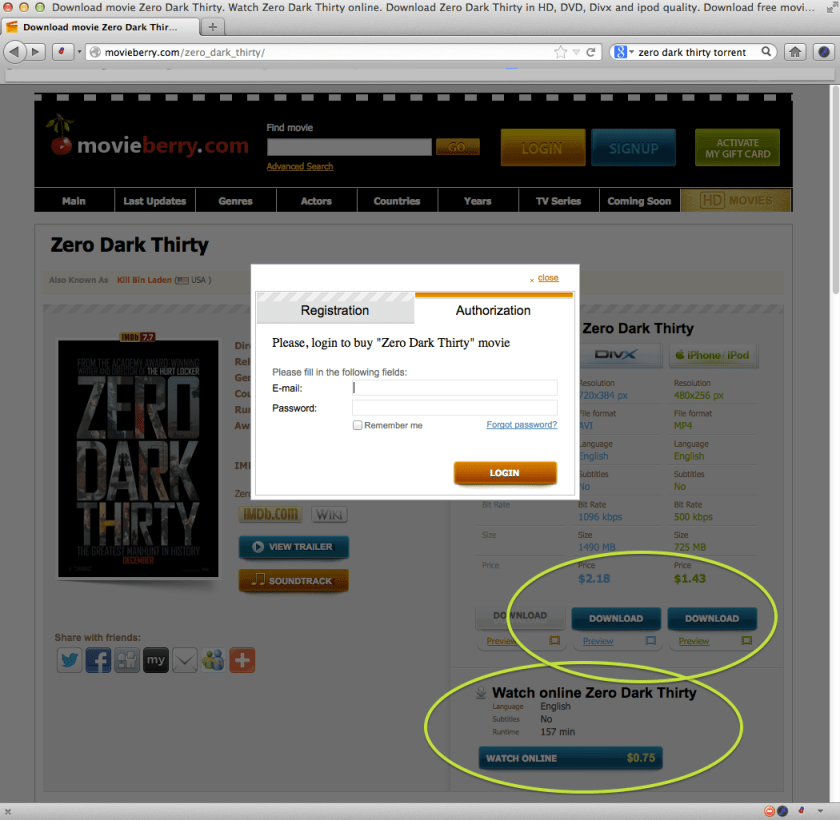
Zero Dark Thirty, Best Picture Academy Award Nominee, Exploited by AT&T, Verizon, MetroPCS, Nissan, H&R Block, British Airways, Progresso, and more…

USC Studies How Online Piracy Profits from Advertising Revenues

Some great work has been done this year by Jonathan Taplin and the USC Annenberg Innovation Lab in studying the relationship between online ad networks and media piracy for profit.

Large Pirate sites distribute illegal content and continue to steal trademarked, copyrighted content and siphon millions of dollars away from the creative community, making it much harder for artists to make a living. We do not believe that government regulation alone is the answer to the Piracy problem, but rather that the self-regulation of major sectors like the online advertising industry could make it harder for the “Kim Dotcom’s” of the world to unfairly exploit artists.

A fantastic round up of media coverage from the universities research can be found here:
http://www.annenberglab.com/category/tags/ad-transparency-report

BitTorrent 99% Infringing, 100% Disinformation… now with Ads.

We’ve reported before on BitTorrent’s claim that they are “not designed for piracy” despite multiple studies and research finding over 99% infringing content being distributed using it.

The latest comes to us from AdLand.tv who are offering commentary on BitTorrent’s recent move into outdoor advertising that first appeared in Gizmodo.

The opening of Gizmodo’s article reads thusly:

“Torrenting” is kind of a dirty word. It makes you think piracy, doesn’t it? Well it shouldn’t. Torrenting isn’t illegal. It’s not even morally ambiguous. It’s just a way to send data, and it’s awesome.

Yes. That’s right. Keep telling yourself that. Guns don’t kill people. People do. It’s not the syringe, it’s the heroin. It’s not the file sharing platform enabling copyright infringement; its the millions of users using the site to infringe.

Baa, baa, baa, Sheeple.

As usual the folks at AdLand have a wonderful way of exploring the ad campaign by BitTorrent.

“The internet should be regulated people-powered.”

What other industry do you know that has near zero regulation except Big Tech? We have Alcohol, Tobacco and Firearms (ATF) the Environmental Protection Agency, the Food And Drug Administration, and the Occupational Safety and Health Administration (OSHA) to name a few of the regulators. Big Tech doesn’t even police itself because if it did, it would be losing money by the truck load. This isn’t even up for debate.

People-powered, my ass. In the immortal words of our dear president, we didn’t build that. Someone else did. They built the internet, the websites, the software. The search engines. The email programs. Just as someone else created the content you’re helping yourself to for free. Don’t fall for this “people-powered” bullshit at all. The artists and musicians (you know– the people) do not make money off torrent sites from the ‘exposure.’ This has been reported on ad nauseam. The only people who have the power are the Big Tech companies getting rich off of content they don’t own.

READ THE FULL POST AT ADLAND.TV:
http://adland.tv/node/156095#sJh2zH6EcHXqaxFB.99

Google’s Fallacious Piracy Self-Study (Part 1) | Music Tech Policy

The Context

Even if you discount the moral hazard involved with funding a study of yourself, the Google survey of Google’s involvement with piracy is a breathtaking document. I would suggest that the self-study rests on a number of core principles for Google’s business:

1. Nothing to See Here, Move Along: First and foremost is Google’s deep and abiding desire to deflect criticism in the press, avoid civil lawsuits and settle criminal investigations. It has both succeeded and failed at all three. The fact that a company tries to avoid these things is not special; the degree to which Google tries to manage them is quite special.

The self-study is itself an exercise in all three and supports the most important public perception that Google draws on daily to succeed in its consumer facing business: Sympathetic trust. To paraphrase an old California pol, you know all the bad they’ve done, but you like them anyway.

This magical thinking only lasts for so long. Whether its Eric Schmidt’s New York soundproof man-cave from which no scream can emerge, doing a favor for journalist Tom Brokaw by providing a private jet for a Silicon Valley speaking engagement with jet fuel subsidized by the American taxpayer, siphoning piles of data to the National Security Agency under circumstances the average citizen will probably never learn the details of, or paying a $500,000,000 fine for violating the Controlled Substances Act for indiscriminately promoting the sale of prescription drugs (e.g., to addicts and kids), the press and the public is starting to wake up to the game.

And not just the game, but the magnitude of the game. As a senior chief once said, sorry pal, the BS filter is full.

Read The Full Post At Music Tech Policy:
http://musictechpolicy.wordpress.com/2013/09/21/googles-fallacious-piracy-self-study-part-1/

“It’s Madness” Radiohead producer Nigel Godrich on LSE Piracy Report

We’re not sure how The London School Of Economics (LSE) could get something so basic so wrong as to suggest that because a some contemporary major label and heritage artists may be making more money from live shows (arena concert grosses) that somehow basic artists rights are not important for protection.

The New Music Express reports that Radiohead producer Nigel Godrich get’s it right in response the the LSE’s shortsighted misunderstanding about artists revenue streams.

“T-shirts and tickets are nothing to do with ‘copyright and creation’, which is the supposed subject of this document.

I hope the government sees how ridiculous this document seems to people who make records.

The authors are ‘pro piracy’ and they wish to influence the UK government’s upcoming review of digital copyright law.

It’s madness.”

Indeed.

It appears that the LSE report would be suggesting that artists never should have been paid royalties from the distribution of recorded music because there have always been other ways to make money from music.

If one were to truly let this logic sink in, it would appear that the LSE is making a general argument against all copyright because the distribution of copyrighted works is only a loss leader to live performances, synchronization fees or endorsement deals. This is of course absurd on every level.

This lopsided logic from LSE seems to favor illegally operating internet corporations distributing music without consent or licenses. We know that there is a lot of money being made in the illegal distribution of music online and the LSE’s report seems aligned with the economic interests of those who knowingly exploit artists for profit.

We expect better from such a respected institution then to ignore the economic interests by companies and corporations that are profiting illegally from advertising supported music piracy.

Perhaps it’s this report in DigiDay (parent company The Economist) that says it best.

Visit the top torrent search engines, and you’ll find ad calls from Yahoo, Google, Turn, Zedo, RocketFuel, AdRoll, CPX Interactive and others.

According to AppNexus CEO Brian O’Kelley, it’s an easy problem to fix, but ad companies are attracted by the revenue torrent sites can generate for them. Kelley said his company refuses to serve ads to torrent sites and other sites facilitating the distribution of pirated content. It’s easy to do technically, he said, but others refuse to do it.

“We want everyone to technically stop their customers from advertising on these sites, but there’s a financial incentive to keep doing so,” he said. “Companies that aren’t taking a stand against this are making a lot of money.”

Thankfully Jonathan Taplin and the USC Annenberg Innovation Lab did some fantastic work earlier this year researching and studying how Ad Networks profit from piracy.

RELATED:

Over 50 Major Brands Supporting Music Piracy, It’s Big Business!

Grand Theft Auto V : How Profits Soar when Piracy Is Managed.

Both the PS3 and the XBOX 360 have anti-piracy and digital rights management mechanisms in place that lock out users who are detected to have loaded cracked or unauthorized versions of the games.

It’s no wonder then that Grand Theft Auto 5 is the fastest selling entertainment product to reach one billion dollars in gross revenue. In just three days the game that took over $250 million dollars and years to produce had set a new record.

This is what we should all be looking at. This is the kind of wild imagination, innovation and investment that is possible when piracy is managed into acceptable levels. Of course we know there may be people who find functional work-a-rounds, but they are largely the exception, not the rule, and the numbers pretty much prove it.

What is interesting about the release of GTA V is that it looks more like the release of an iphone than a new album or movie. In other words, it is a digital entertainment release with the same potential of sales as a piece of hardware (or pre-internet piracy entertainment products).

This alone illustrates the possibilities for the size and scope of the digital entertainment market with adequate (not perfect) anti-piracy measures in place. You’ll also note that the #2 and #3 fastest selling products are also console video games which employ the same anti-piracy mechanisms.

With an estimated production/marketing budget of $265 million, GTA V is not only the most expensive video game of all time, but also more expensive than most of today’s Hollywood blockbusters. Considering this, it seems only fair to compare GTA’s commercial success to that of Hollywood movies.

READ THE FULL STORY AT STATISTICA:
http://www.statista.com/topics/868/video-games/chart/1501/most-successful-entertainment-products/

David Lowery in The New York Times | Defining and Demanding a Musician’s Fair Shake in the Internet Age

The New York Times business reporter Ben Sisario profiles David Lowery on the artists rights in the Copyfight. Maybe advocacy is the new radio?

The issue has become hot as technology companies like Pandora and Google have replaced major record labels as the villains of choice for industry critics. Recently, Thom Yorke of Radiohead caused a stir by removing some of his music from Spotify and saying that the service would hurt new artists.

To his detractors, Mr. Lowery is a divisive ranter who pines for a lost, pre-Internet economy. But his knowledge of legal and technological minutiae — he is a lecturer at the University of Georgia’s music business program — make his arguments hard to dismiss.

“He’s telling his personal story and standing up to the big corporations who claim to support songwriters, even as they work to undermine our rights behind the scenes,” said Paul Williams, the songwriter and president of Ascap. “He hasn’t flinched, and I think that’s given courage to other artists.”

READ THE FULL STORY HERE AT THE NEW YORK TIMES:
http://www.nytimes.com/2013/10/01/business/media/defining-and-demanding-a-musicians-fair-shake-in-the-internet-age.html?_r=0

Record Labels Invest $4.5 Billion Annually In Artists… Pirates, $0… Any Questions?

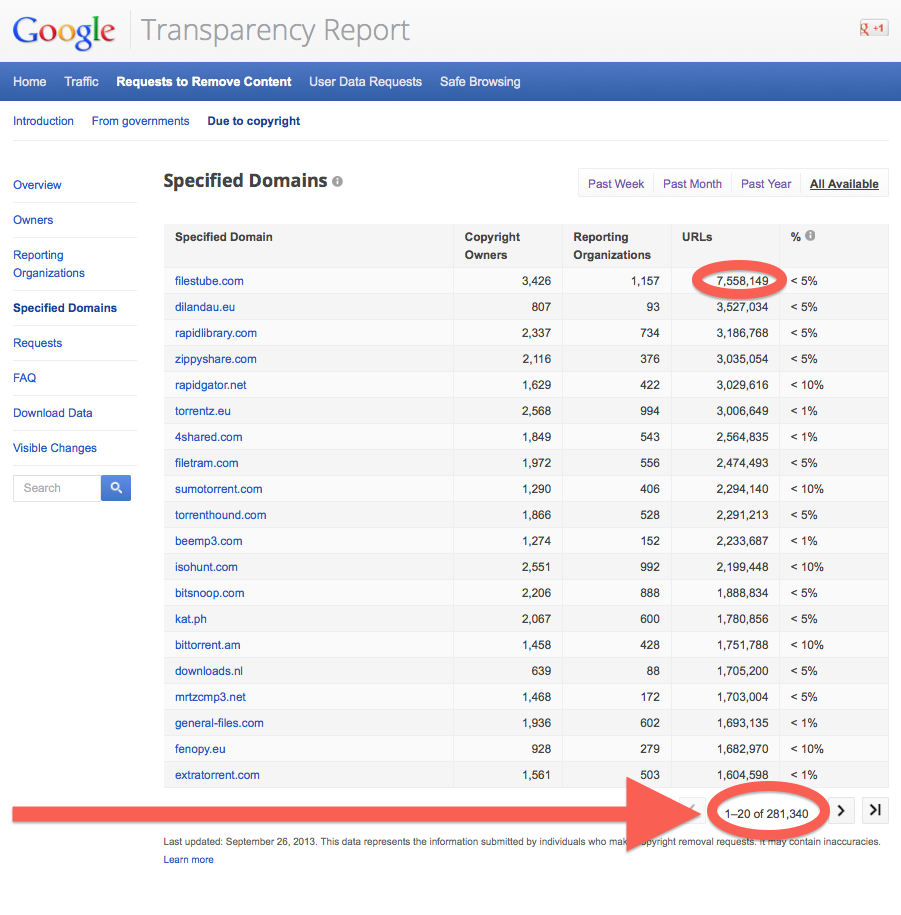
So record labels invest in the careers of artists about $4.5 Billion annually in A&R and Marketing. Meanwhile, there are 200,000 infringing sites exploiting artists work and paying them nothing that we can see from the looks of the Google transparency report.

To be precise at the time of the writing of this post there are 281,340 infringing sites on the report with the #1 offender having received over 7.5 Million DMCA takedown notices! Seriously, 7.5 Million… and Google can’t determine that this is a site “dedicated or primarily used for infringement.” Wow.

FIRST DISCLAIMER:

Now look, we don’t always like record labels, but when we do, it’s because they are actually paying artists and investing capital into developing careers (hello Trent Reznor returning to a major label). Ninety percent of new releases financed by labels don’t recoup or break even, but the bands still gain the marketing and PR benefit from the labels investment after the deal ends (hello Thom Yorke and Radiohead).

SECOND DISCLAIMER:

Any wrong doing should be unacceptable. We’ve heard far to many stories of artists being exploited by record labels, publishers, managers, booking agents, concert promoters and a wide range of those offering services from radio promotion to independent PR and marketing. If anything, the internet has added to this list a whole new group of opportunists including the ad tech industry, pirate sites, cyber lockers and more.

So yes, any wrong doing against artists and creators should be unacceptable, even if it happens online.

So here’s some quick notes from the report published by the IFPI:

* Record companies’ total investment in A&R and marketing tops US$4.5 billion annually according to IFPI’s Investing in Music report

* Labels have maintained A&R spending at US$2.7 billion, representing 16 per cent of global recorded music revenues, despite the economic recession

* US$1 million to break a new artist in major markets

* More than 70 per cent of unsigned artists would like a recording contract according to two new surveys

Record companies remain the primary investors in artists, maintaining A&R spend despite declining overall revenues in recent years. Labels spent US$2.7 billion in 2011, only marginally down on 2008 (US$2.8 billion), despite an overall decline of 16 per cent in the trade value of the industry globally over the same period. Revenues invested in A&R increased from 15 to 16 per cent of industry turnover between 2008 and 2011.

Music companies invest a greater proportion of their global revenues in A&R than most other sectors do in research and development (R&D). Comparisons show music industry investment exceeding that of industries including software and computing (9.6%) and the pharmaceutical and biotech sector (15.3%). The comparisons are based on the European Commission’s 2011 EU Industrial R&D Investment Scoreboard.

Two new surveys, conducted in the UK and Germany in 2012, show more than 70 per cent of unsigned acts want a record deal, with marketing leading the perceived benefits of record company support.

Ok, then you have this… those who pay nothing, invest nothing, and pocket everything for themselves… this is the future you want? When artists complain about tiny payments from Spotify it’s important to note the reason why they can get away with paying so little, is because of all of those who pay nothing at all.
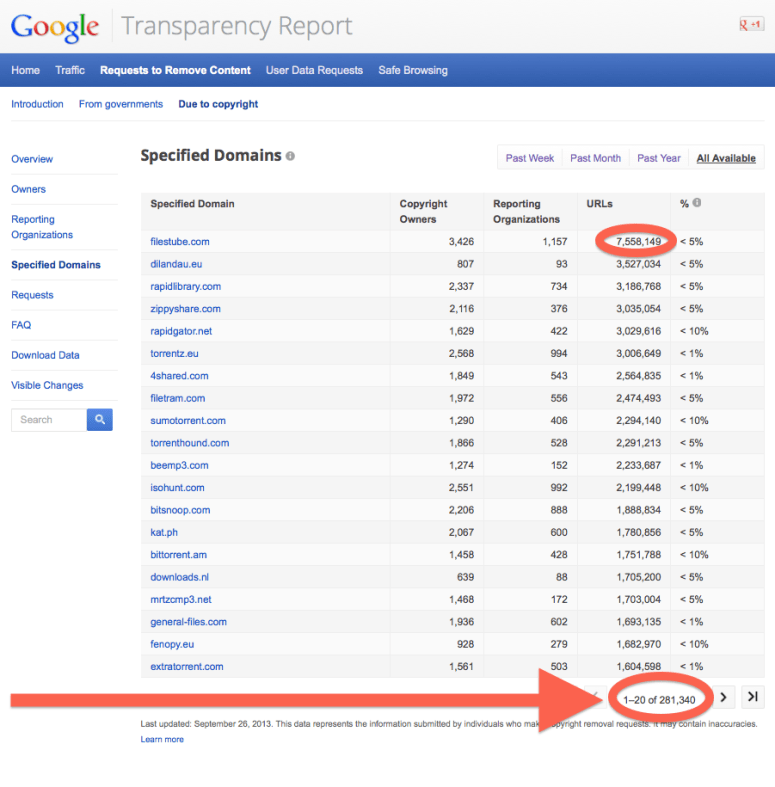
200kinfringingsitesAnd most of this is financed by Fortune 500 Companies flowing money through online ad networks like Google and others. The situation has even gained the attention of The White House, although we’ll see what good it does.

So if you want to get paid, focus on removing the bad actors from the marketplace and restoring fairness. Our hope has always been that the internet would in fact create a new middle class of professional musicians, by the means of their own choice. Unfortunately what we’ve seen is just more exploitation.