Press Release: Universal and YouTube Announce AI Music Principles Consistent with Human Artistry Campaign and Artist Advisors

NEW YORK, Aug. 21, 2023 /PRNewswire/ — Today YouTube published a first ever set of AI music principles and launched the YouTube Music AI Incubator, kicking off with artists, songwriters and producers from Universal Music Group. YouTube’s three fundamental AI music principles are rooted in its commitment to collaborate with the music industry alongside bold and responsible innovation in the space. 

YouTube CEO, Neal Mohan, shared the platform’s AI music principles and his vision for how the framework will enhance creative expression while also protecting artists on the platform. The principles include:

  • Principle #1: AI is here, and we will embrace it responsibly together with our music partners. As generative AI unlocks ambitious new forms of creativity, YouTube and our partners across the music industry agree to build on our long collaborative history and responsibly embrace this rapidly advancing field.  Our goal is to partner with the music industry to empower creativity in a way that enhances our joint pursuit of responsible innovation. 
  • Principle #2: AI is ushering in a new age of creative expression, but it must include appropriate protections and unlock opportunities for music partners who decide to participate. We’re continuing our strong track record of protecting the creative work of artists on YouTube. We’ve made massive investments over the years in the systems that help balance the interests of copyright holders with those of the creative community on YouTube.
  • Principle #3: We’ve built an industry-leading trust and safety organization and content policies. We will scale those to meet the challenges of AI. We spent years investing in the policies and trust and safety teams that help protect the YouTube community, and we’re also applying these safeguards to AI-generated content. Generative AI systems may amplify current challenges like trademark and copyright abuse, misinformation, spam, and more. But AI can also be used to identify this sort of content, and we’ll continue to invest in the AI-powered technology that helps us protect our community of viewers, creators, artists and songwriters–from Content ID to policies and detection and enforcement systems that keep our platform safe behind the scenes. And we commit to scaling this work even further. 

In a rare guest YouTube blog Universal Music Group Chairman and CEO, Sir Lucian Grainge – who helped shape the principles – shared his vision for an artist centric approach to generative AI and how partnering with YouTube would best position the music industry for success as this technology continues to develop. Excerpts from the blog post include: 

  • “Our challenge and opportunity as an industry is to establish effective tools, incentives and rewards – as well as rules of the road – that enable us to limit AI’s potential downside while promoting its promising upside. If we strike the right balance, I believe AI will amplify human imagination and enrich musical creativity in extraordinary new ways.”
  • “Our enduring faith in human creativity is the bedrock of Universal Music Group’s collaboration with YouTube on the future of AI. Central to our collective vision is taking steps to build a safe, responsible and profitable ecosystem of music and video—one where artists and songwriters have the ability to maintain their creative integrity, their power to choose, and to be compensated fairly.”
  • “Today, our partnership is building on that foundation with a shared commitment to lead responsibly, as outlined in YouTube’s AI principles, where Artificial Intelligence is built to empower human creativity, and not the other way around.  AI will never replace human creativity because it will always lack the essential spark that drives the most talented artists to do their best work, which is intention. From Mozart to The Beatles to Taylor Swift, genius is never random.” 

Today’s announcement also introduced YouTube’s AI Music Incubator, a program that will bring together some of today’s most innovative artists, songwriters, and producers to help inform YouTube’s approach to generative AI in music. The incubator will kick off with a genre-spanning cohort of creatives from Universal Music Group, that includes Anitta, Björn Ulvaeus, d4vd, Don Was, Juanes, Louis Bell, Max Richter, Rodney Jerkins, Rosanne Cash, Ryan Tedder, Yo Gotti, and the Estate of Frank Sinatra, amongst others. 

  • Björn Ulvaeus shares: “While some may find my decision controversial, I’ve joined this group with an open mind and purely out of curiosity about how an AI model works and what it could be capable of in a creative process. I believe that the more I understand, the better equipped I’ll be to advocate for and to help protect the rights of my fellow human creators.”
  • Juanes shares: “Music is fundamental to the human experience – culturally and personally. For artists, our music is part of who we are. Given music’s role, artists must play a central role in helping to shape the future of this technology.  I’m looking forward to working with Google and YouTube as part of this influential group of UMG artists to assure that AI develops responsibly as a tool to empower artists and that it is used respectfully and ethically in ways that amplify human musical expression for generations to come.”
  • Max Richter shares: “Like every new technology, AI brings with it opportunities, but it also raises profound challenges for the creative community. The tech world and the music distribution ecosystem are quickly evolving to embrace this transformative technology and, unless artists are part of this process, there is no way to ensure that our interests will be taken into account. We have to be in this conversation, or our voices won’t be heard. Therefore, I’m very happy to be part of the “artist incubator” which will allow me to advocate for the interests of the creative community in the applications of AI to music and music distribution.” 

Neal Mohan Blog : https://blog.youtube/inside-youtube/partnering-with-the-music-industry-on-ai/
Sir Lucian Grainge Guest Blog: https://blog.youtube/news-and-events/an-artist-centric-approach-to-ai-innovation/
@tinadaunt: Universal Music Exec Jeff Harleston Calls On Senate to Regulate AI: ‘Ensure Creators Are Respected and Protected’

Companies using artificial intelligence software are shamelessly ripping off artists from film and music, and it will get worse if not regulated, members of the entertainment industry told U.S. Senators at a hearing Wednesday.

“AI in the service of artists and creativity can be a very, very good thing,” executive vice president of business and legal affairs for Universal Music Group Jeffrey Harleston said. “But AI that uses or worse yet appropriates the work of these artists, their name, their image, their likeness, their voice, without authorization, without consent, simply is not a good thing. Congress needs to establish rules that ensure creators are respected and protected.”

Read the post on The Wrap

Jeff Harleston also said in his statement:

Long before an AI-generated recording imitating Drake and The Weeknd – both Universal Music artists – went viral and captured the attention of press and policymakers, UMG has been thinking about artificial intelligence. One of our companies, Ingrooves, has three patents in AI to assist with marketing independent artists. And AI has long been used as a tool in the studio: For example, Apple Logic Pro X to generate drum tracks, or Captain Plugins to generate chord progressions. We also use AI regularly as a tool to assist in creating Dolby Atmos immersive audio music. It’s a great technology when employed responsibly – and one that we and our artists use. 

However, we are before you today because generative AI is raising fundamental issues of responsibility in the creative industries and copyright space. Each day, troubling examples emerge. We know some generative AI engines have been trained on our copyrighted library of recordings and lyrics, image generators have been trained on our copyrighted cover art, and music generators have been trained on our copyrighted music, all without authorization. 

We have a robust digital music marketplace, and UMG has hundreds of legitimate partners who’ve worked with us to bring music to fans in a myriad of ways. Those companies and services properly obtained the rights they need to operate from UMG, or from the associated record labels and publishers. So, it’s unfathomable to think AI companies and developers think the rules and laws that apply to other companies and developers don’t apply to them. 

Read Jeff’s full statement here

@tinadaunt: Universal Music Exec Jeff Harleston Calls On Senate to Regulate AI: ‘Ensure Creators Are Respected and Protected’


Companies using artificial intelligence software are shamelessly ripping off artists from film and music, and it will get worse if not regulated, members of the entertainment industry told U.S. Senators at a hearing Wednesday.

“AI in the service of artists and creativity can be a very, very good thing,” executive vice president of business and legal affairs for Universal Music Group Jeffrey Harleston said. “But AI that uses or worse yet appropriates the work of these artists, their name, their image, their likeness, their voice, without authorization, without consent, simply is not a good thing. Congress needs to establish rules that ensure creators are respected and protected.”

Read the post on The Wrap

Jeff also said in his statement:

Long before an AI-generated recording imitating Drake and The Weeknd – both Universal Music artists – went viral and captured the attention of press and policymakers, UMG has been thinking about artificial intelligence. One of our companies, Ingrooves, has three patents in AI to assist with marketing independent artists. And AI has long been used as a tool in the studio: For example, Apple Logic Pro X to generate drum tracks, or Captain Plugins to generate chord progressions. We also use AI regularly as a tool to assist in creating Dolby Atmos immersive audio music. It’s a great technology when employed responsibly – and one that we and our artists use. 

However, we are before you today because generative AI is raising fundamental issues of responsibility in the creative industries and copyright space. Each day, troubling examples emerge. We know some generative AI engines have been trained on our copyrighted library of recordings and lyrics, image generators have been trained on our copyrighted cover art, and music generators have been trained on our copyrighted music, all without authorization. 

We have a robust digital music marketplace, and UMG has hundreds of legitimate partners who’ve worked with us to bring music to fans in a myriad of ways. Those companies and services properly obtained the rights they need to operate from UMG, or from the associated record labels and publishers. So, it’s unfathomable to think AI companies and developers think the rules and laws that apply to other companies and developers don’t apply to them. 

Read Jeff’s full statement here

Science Journal Nature Bars AI Generated Illustrations

Well that was only a matter of time.  Nature, one of the leading scientific journals in the world, has announced that it will not allow the use of generative AI images or video. (Thanks to Cynthia Turner for the catch.). 

I must say that the journal’s rationale for rejecting this latest stop in Silicon Valley’s newest bubble is a pretty concise statement of the criminality of the bubble riders:

Why are we disallowing the use of generative AI in visual content? Ultimately, it is a question of integrity. The process of publishing — as far as both science and art are concerned — is underpinned by a shared commitment to integrity. That includes transparency. As researchers, editors and publishers, we all need to know the sources of data and images, so that these can be verified as accurate and true. Existing generative AI tools do not provide access to their sources so that such verification can happen.

Then there’s attribution: when existing work is used or cited, it must be attributed. This is a core principle of science and art, and generative AI tools do not conform to this expectation. (Not to mention the Universal Declaration of Human Rights (article 27(2)) among other human rights instruments.)

Consent and permission are also factors. These must be obtained if, for example, people are being identified or the intellectual property of artists and illustrators is involved. Again, common applications of generative AI fail these tests.

Generative AI systems are being trained on images for which no efforts have been made to identify the source. Copyright-protected works are routinely being used to train generative AI without appropriate permissions. In some cases, privacy is also being violated — for example, when generative AI systems create what look like photographs or videos of people without their consent. In addition to privacy concerns, the ease with which these ‘deepfakes’ can be created is accelerating the spread of false information.

So that about sums it up. I would add that what Silicon Valley likes is the free-riding profit that is built in to failing to honor each of Nature’s objections aka what economists and tort lawyers call negative externalities.

@justinebateman wants to see AI contract terms in actor agreements and music folk should be checking, too

Chris Castle says: If you are seeing contract language that allows the other side to use your name, image, likeness, voice, etc., take a close look at the rights granted. It may not be that obvious. Like all other configuration changes in the past, artists, producers and songwriters need to look at their existing agreements and see how old language will be interpreted to cover AI.

Example: Label will have (i) exclusive record artwork merchandising rights; and (ii) exclusive rights to sell merchandise embodying three (3) exclusive designs per contract period, alone and in conjunction with Artist’s names and approved pictures, likenesses and other identifications, subject to Artist’s approval with respect to such matters as product design and manufacturing.

“in conjunction with”, “other identifications” and “approval with respect to such matters as” each take on new meaning.

Example: Artist acknowledges that Label is the exclusive owner of all rights of copyright in Masters and Records embodying the results and proceeds of Artist’s recording services made pursuant to the Recording Agreement or during its term, including the exclusive right to copyright same as “sound recordings” in the name of Label, to renew and extend such copyrights (and all rights in and thereto are hereby assigned to Label), and to exercise all rights of the copyright proprietor thereunder as provided in the Recording Agreement.

Recordings “made pursuant to the Recording Agreement or during its term” could mean AI works.

Example: As used in this agreement, “Other Entertainment Services” shall mean any and all entertainment industry activity that are not otherwise provided for in this recording agreement, including, without limitation, the following: (a) the exploitation in any and all media of the name(s) likeness(es), visual representations, biographical material and/or logo(s) of or relating to Artist or any member of Artist (all of the intellectual properties relating to Artist referred to above are sometimes referred to herein collectively and individually as “Artist Properties”), either alone or in conjunction with other elements, including without limitation merchandise for sale at the site(s) of any and all live concert engagements performed by Artist or any member of Artist, premiums such as products which bear a third party’s trademarks or logos together with Artist Properties, tie-ins, “bounceback” merchandising, and fan club merchandise, whether or not in connection with Master Recordings, including, without limitation, exploitation by any Person other than Label of any rights granted in this recording agreement; (b) endorsements, special marketing arrangements, sponsorships (including tour sponsorships), strategic partnerships or other business relationships with third parties; (c) live performance engagements as a musician, vocalist and/or performer by the Artist or any member of Artist in all media, including but not limited to musical performances on tour, in concerts, on television broadcast or cable casts (including pay-per-view telecasts), radio, “webcast” and all other means.

Press Release: Human Artistry Campaign Launches, Announces Artificial Intelligence Principles to Sustain Artists

40+ groups representing artists, performers, writers, athletes & more launch campaign for AI that supports human creativity and accomplishment

WASHINGTON, DC / AUSTIN, TX (March 16, 2023) – A broad coalition announced the launch of the Human Artistry Campaign to ensure artificial intelligence technologies are developed and used in ways that support human culture and artistry – and not ways that replace or erode it. With more than 40 members including major unions, trade associations, and policy experts representing individual creators and rightsholders from across the entire tapestry of creative endeavor, the Human Artistry Campaign is positioned to be a leading voice in the rapidly unfolding debate over the costs and benefits of different forms of AI.

The group outlined principles advocating AI best practices, emphasizing respect for artists, their work, and their personas; transparency; and adherence to existing law including copyright and intellectual property. 

The campaign urges supporters to sign a petition to advance these fundamental principles.

The launch was announced at SXSW in Austin today at an event featuring voice actor and prolific songwriter Dan Navarro, GRAMMY-nominated singer-songwriter Jessy Wilson and UT Austin professor and immersive technology expert Erin Reilly – and moderated by Rob Levine, Billboard’s Deputy Editorial Director.

Core Principles for Artificial Intelligence Applications in Support of Human Creativity and Accomplishments

  1. Technology has long empowered human expression, and AI will be no different.

For generations, various technologies have been used successfully to support human creativity. Take music, for example… From piano rolls to amplification to guitar pedals to synthesizers to drum machines to digital audio workstations, beat libraries and stems and beyond, musical creators have long used technology to express their visions through different voices, instruments, and devices. AI already is and will increasingly play that role as a tool to assist the creative process, allowing for a wider range of people to express themselves creatively. 

Moreover, AI has many valuable uses outside of the creative process itself, including those that amplify fan connections, hone personalized recommendations, identify content quickly and accurately, assist with scheduling, automate and enhance efficient payment systems – and more. We embrace these technological advances. 

  • Human-created works will continue to play an essential role in our lives. 

Creative works shape our identity, values, and worldview. People relate most deeply to works that embody the lived experience, perceptions, and attitudes of others. Only humans can create and fully realize works written, recorded, created, or performed with such specific meaning. Art cannot exist independent of human culture.

  • Use of copyrighted works, and use of the voices and likenesses of professional performers, requires authorization, licensing, and compliance with all relevant state and federal laws.

We fully recognize the immense potential of AI to push the boundaries for knowledge and scientific progress. However, as with predecessor technologies, the use of copyrighted works requires permission from the copyright owner. AI must be subject to free-market licensing for the use of works in the development and training of AI models. Creators and copyright owners must retain exclusive control over determining how their content is used. AI developers must ensure any content used for training purposes is approved and licensed from the copyright owner, including content previously used by any pre-trained AIs they may adopt. Additionally, performers’ and athletes’ voices and likenesses must only be used with their consent and fair market compensation for specific uses.

  • Governments should not create new copyright or other IP exemptions that allow AI developers to exploit creators without permission or compensation.

AI must not receive exemptions from copyright law or other intellectual property laws and must comply with core principles of fair market competition and compensation. Creating special shortcuts or legal loopholes for AI would harm creative livelihoods, damage creators’ brands, and limit incentives to create and invest in new works.

  • Copyright should only protect the unique value of human intellectual creativity.

Copyright protection exists to help incentivize and reward human creativity, skill, labor, and judgment -not output solely created and generated by machines. Human creators, whether they use traditional tools or express their creativity using computers, are the foundation of the creative industries and we must ensure that human creators are paid for their work.  

  • Trustworthiness and transparency are essential to the success of AI and protection of creators. 

Complete recordkeeping of copyrighted works, performances, and likenesses, including the way in which they were used to develop and train any AI system, is essential. Algorithmic transparency and clear identification of a work’s provenance are foundational to AI trustworthiness. Stakeholders should work collaboratively to develop standards for technologies that identify the input used to create AI-generated output. In addition to obtaining appropriate licenses, content generated solely by AI should be labeled describing all inputs and methodology used to create it — informing consumer choices, and protecting creators and rightsholders. 

  • Creators’ interests must be represented in policymaking. 

Policymakers must consider the interests of human creators when crafting policy around AI. Creators live on the forefront of, and are building and inspiring, evolutions in technology and as such need a seat at the table in any conversations regarding legislation, regulation, or government priorities regarding AI that would impact their creativity and the way it affects their industry and livelihood.

About the Human Artistry Campaign: The Human Artistry Campaign was launched at SXSW 2023 for open dialogue and guidance from the united creative community in shaping the AI debate. Visit HumanArtistryCampaign.com to join.

Members include: AFL-CIO; American Association of Independent Music; American Federation of Musicians; Americana Music Association; American Photographic Artists; Artist Rights Alliance; Artist Rights Watch; ASCAP; Association of American Publishers; Authors Guild; Black Music Action Coalition; BPI; Christian Music Trade Association; Church Music Publishers Association; Concept Art Association; Department of Professional Employees, AFL-CIO; European Composer and Songwriter Alliance; Folk Alliance International; Future of Music Coalition; Georgia Music Partners; Global Music Rights; Gospel Music Association; Graphic Artists Guild; IFPI; International Federation of Actors; #IRespectMusic; Living Legends Foundation; MLB Players Association; Music Artists Coalition; Music Managers Forum – US; Music Tech Policy; Music Workers Alliance; National Music Publishers’ Association; News Media Alliance; NFL Players Association; NHL Players’ Association; Professional Photographers of America; Recording Academy; Recording Industry Association of America; Rhythm & Blues Foundation; SAG-AFTRA; SESAC, Songwriters of North America; SoundExchange and The Trichordist.

***

www.HumanArtistryCampaign.com

contact@humanartistrycampaign.com

National Association of Voice Actors: AI/Synthetic Voice Rider–Don’t lose your voice forever

[Chris Castle says: It’s like the antichrist without the morals. Voice over actors are being attacked by purveyors of artificial intelligence so that the actor’s voices can be re-used without consent or compensation even if they didn’t consent or at least didn’t object. Not only that, but voices can be used to train AI to speak in a completely different context. This is way worse that Netflix composer buyouts.

Check your name/image/likeness clauses folks–voice actors will not be the only ones caught up in the AI hellscape.]

AN OPEN LETTER FROM NAVA AND THE VOCAL VARIANTS TO THE VOICE OVER COMMUNITY

AI or Synthetic Voices are on the rise. We’re a group of concerned voiceactors working with union and non-union performers alike to make sure we don’t lose our voices forever by signing away our rights to various companies. Long story short, any contract that allows a producer to use your voice forever in all known media (and any new media developed in the future) across the universe is one we want to avoid. 

So we have put together some things we can all do to avoid the decimation of our industry.

Read the post on NAVA Voices site and stay in touch with your unions.

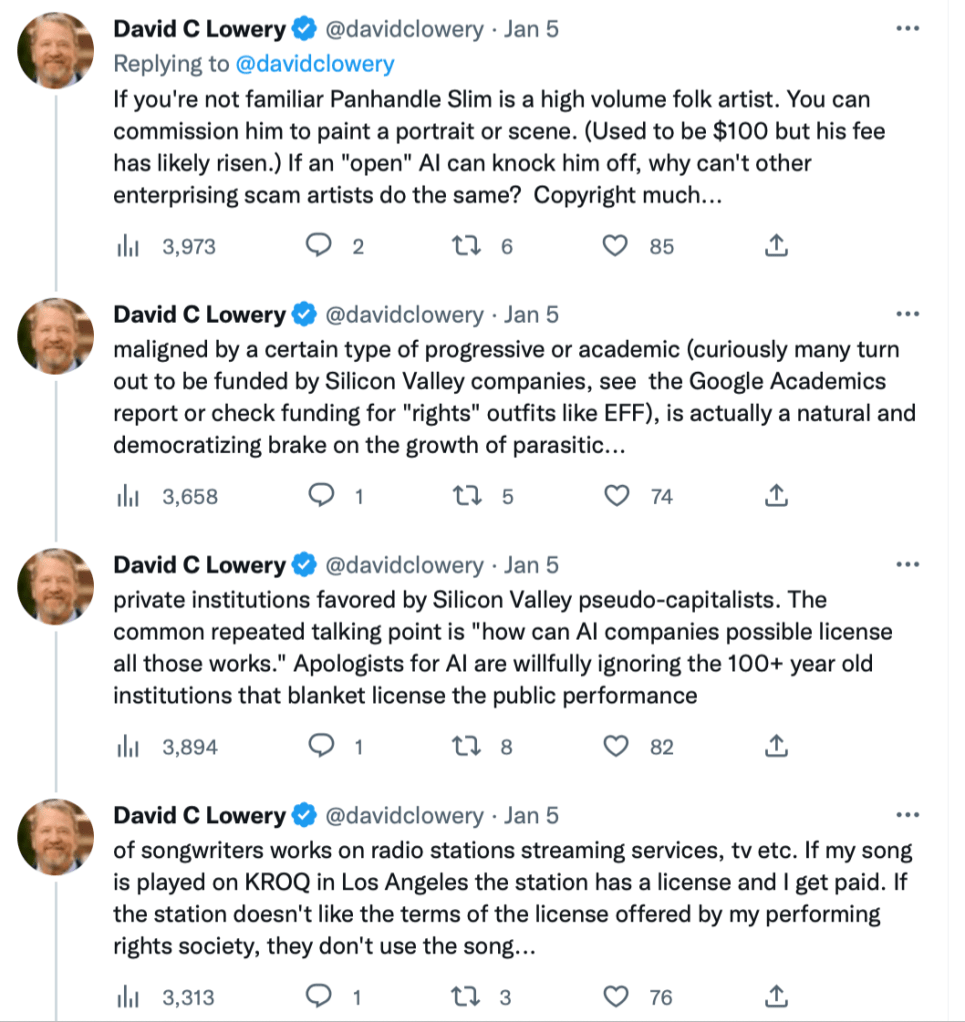
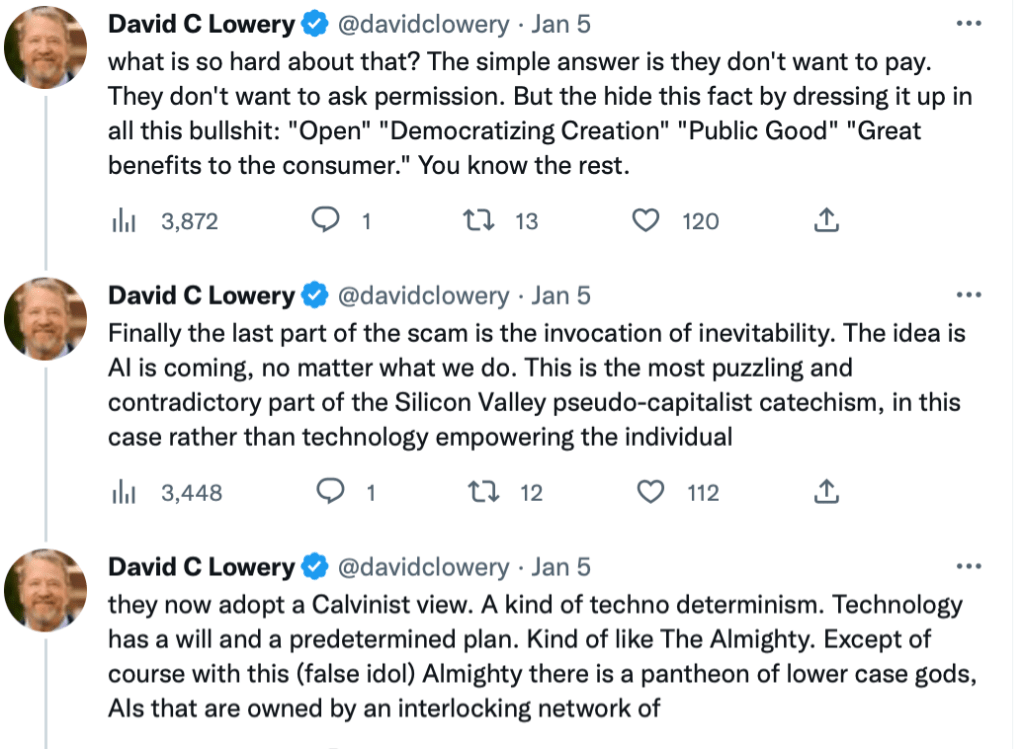
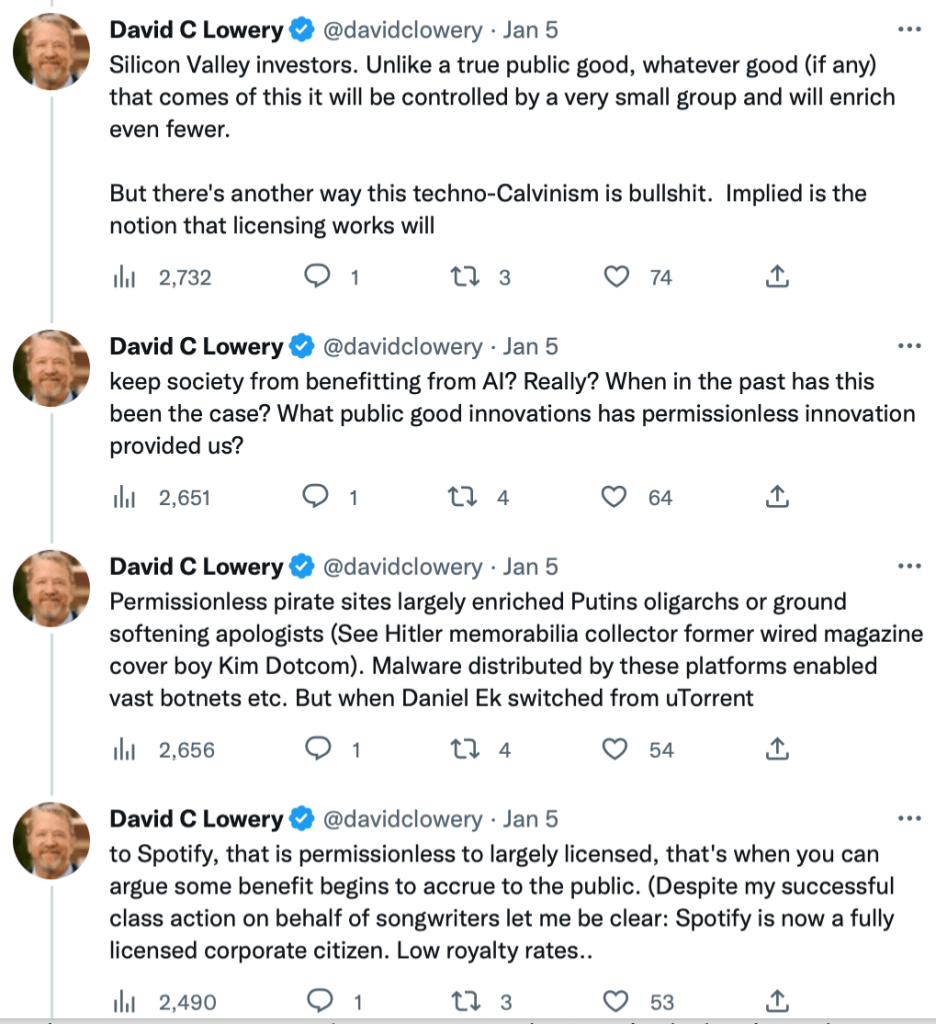
@davidclowery: Silicon Valley’s Loophole Arbitrage on Display Yet Again with OpenAI