This study showing the negative economic effects of safe harbors is great timing as we are reviewing multiple brand new safe harbors proposed to great fanfare in the Music Modernization Act that protect Spotify. More on this to come as we review the welcome study by economist Stan Liebowitz, Ashbel Smith Professor of Economics at the University of Texas at Dallas.
PRESS RELEASE
Paris, France – February 27th, 2018 – Copyright “safe harbour” rules, drawn up a quarter of a century ago to help nurture early online commerce, are today distorting the digital market, profiting tech giants and leading to significant underpayment of copyright owners, a new US economic study says.
“Economic Analysis of Safe Harbour Provisions”, by Ashbel Smith Professor Stan Liebowitz of the University of Texas at Dallas, is the most detailed economic examination to date of how copyright owners have been damaged by so-called “safe harbour” rules in copyright law.
The economic study has been commissioned by CISAC, the International Confederation of Societies of Authors and Composers. CISAC is the world’s leading network of authors’ societies, with 239 member societies in 121 countries together representing over 4 million creators of music, audiovisual, drama, literature and visual art.
Commenting on the study published today, CISAC Director General Gadi Oron said: “This study shows that copyright safe harbours, designed for a 20th century internet, urgently need re-examining in the 21st century. Instead of shielding internet companies that merely offer storage facilities, as was their original purpose, safe harbours are today being used to shield tech giants from rewarding creators for their work [like the eminent domain sections in MMA that take away rights to sue infringers retroactively]. This is not a problem that can be solved by industry alone – it is a responsibility for governments that care about the cultural and creative sector. Creators deserve 21st century laws that ensure fair payment for their work, not laws that cause the value of their works to be siphoned away to global tech companies. Technology has evolved, and the law should evolve with it”.
Professor Liebowitz is a leading author, researcher and academic in the economics of intellectual property, networks and new technologies. Among the findings of his study are the following:
Because of the safe harbours, User Upload Content services such as YouTube have “an inefficient and unfair advantage” when they negotiate rates for permission to use copyrighted works on their sites.
As a result, UUCs either do not pay for copyright permissions or, if they pay something, they pay less than the market rate.
Other online services (such as subscription services, e.g. Spotify and Apple Music) are at a competitive disadvantage when competing with UUC platforms. These services generate lower revenues and have a reduced user base, because of the distorting impact of safe harbours.
As a net result, because of the distorting knock-on effect of safe harbours on the wider market for creative content, copyright owners are seeing reduced copyright payments from both UUC and other services. These reductions would appear to be “very substantial”.
You’ve probably heard about the “mass NOI” problem resulting from the Copyright Office allowing Big Tech to profit from a loophole in the Copyright Act. The loophole permits digital music services to get away with what would otherwise be both infringement and nonpayment of royalties under yet another safe harbor, this time from 1976.
Remember that under U.S. law, unless the service has a direct license with the copyright owner, a digital service can rely on the government’s compulsory license by sending a “notice of intention” (or “NOI”) to the copyright owner. One could argue that those are mutually exclusive end states, so keep that in mind. As anyone who has done song research knows, there are a number of reliable places to look for a song copyright owner, starting with the performing rights societies like ASCAP and BMI that provide a free lookup service on their websites.
But…you can’t find what you don’t look for. Enter the loophole. The Copyright Act says that if you can’t find contact information for the song copyright owner in the Copyright Office’s public records, then you can send your NOI to the Copyright Office instead of to the copyright owner. Then you are deemed to have a compulsory license after that service date. The problems is that while the government might have thought in 1976 when the section was enacted that they had to tie up that loose end by referencing the Copyright Office, they probably did not realize that they were also requiring a look up in what was to become arguably the least reliable source of song information. Not to mention that updating the Copyright Office records is done at a waddling pace.
Oh and one more thing–if the service sends the address unknown notice to the Copyright Office, they don’t have to pay royalties until the copyright owner becomes identifiable in the public records of the Copyright Office, which may be never. (I have an article in the American Bar Association Entertainment & Sports Lawyer periodical on this for those who want more information.)
The way the loophole works is that if a song has not been registered in the Copyright Office (which is not required) then the service can say that the address of the copyright owner is “unknown,” even if the service has actual knowledge of the copyright owner’s contact. See the loophole? Even if they know who you are and how to reach you, they can say they don’t know if you haven’t registered your copyright–which you are not required to do unless you’re planning on suing. In addition to actual knowledge, there’s also the argument that a reasonable person could have found the song copyright owner if, for example, that song is in the Billboard Hot 100’s Top 5.
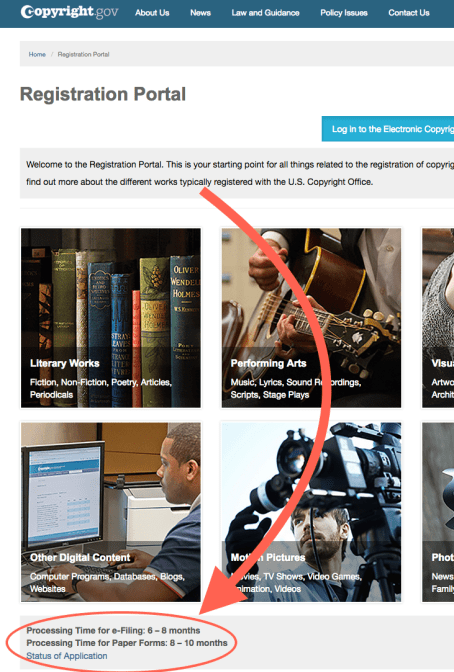
If you’ve ever tried to register a copyright, you know how long the Copyright Office can take to get you a conformed copy of your registration–months. Why? Because they appropriately give your registration the once over to make sure that you filled it out correctly and giving that attention takes time. Anywhere from six to ten months in fact.
The large print giveth and the small print taketh away….
Unfortunately, the Copyright Office does not give the same degree of attention to address unknown filings. In fact, as far as I can tell, they give no attention at all to address unknown filings.
Historically, there were a handful of these “address unknown” filings. But all of a sudden after independent songwriters and publishers started suing Spotify, millions of “address unknown” filing started appearing at the Copyright Office in April 2016. There are now over 60,000,000 of these notices on file that have been posted. That means that there are 60,000,000 free licenses in effect.
When the Copyright Office started getting these filings, they began posting them in huge compressed files. So if Amazon filed an address unknown NOI, it would appear to be one or a few NOIs, but each one of those NOIs had an Excel spreadsheet attached that had tens of thousands of songs on it in most cases.
Given that the Copyright Office chose to post the NOIs in this manner, it was essentially impossible for a songwriter or even most music publishers to search all of the NOIs to see if their songs were included or included incorrectly. This creates an obvious and forseeable problem for anyone wanting to check if their songs were incorrectly included in a mass NOI.
Since the Copyright Office wasn’t checking and since they made it virtually impossible for anyone else to check, it is likely that there are many incorrectly filed “address unknown” NOIs, which means that there are likely an equally massive number of infringements as those compulsory licenses would be invalid. Of course, services would argue that if their compulsory license fails, they have an implied license since they notified song copyright owners of their usage through the address unknown NOI at the Copyright Office and nobody caught them. Notwithstanding the fact that the Copyright Office chose the least transparent way to make the information available to the public. So is the address unknown NOI good notice to the world if the world can read it?
How bad is this? If there is even a 1% error rate, that is 60,000 songs. Seems like a lot to me, and I would bet that the error rate is a lot higher than 1%–courtesy of the U.S. government.
Remember this started in April 2016. No one has lifted a finger to fix it since then, but the Music Modernization Act has a new safe harbor that sweeps all these NOIs into the new blanket license without anyone ever checking to see if they were filed correctly. Given the other safe harbor–I know, the MMA has so many safe harbors for Big Tech that it’s hard to keep them straight–that protects infringers from suits for statutory damages filed after January 1, 2018, it is unlikely that anyone will ever pay the piper for this massive and industry wide screw up. A good reason for all mass NOI filings to be excluded from the MMA’s litigation safe harbor.
Or in the words of Judge Patel, “You created this monster, you fix it.”
A good place to start fixing it is by indexing all of the Copyright Office mass NOI filings and making that searchable database available to the public. There are a number of companies that indexed the address unknown filings but SoundExchange recently launched theirs. The SX Works NOI Lookup is free to use and very fast. Here’s a video describing the service.
I tried running a few queries on it to see what showed up using the top five songs from the Billboard “Hot 100” singles chart starting January 1, 2018, a date that will live in infamy.
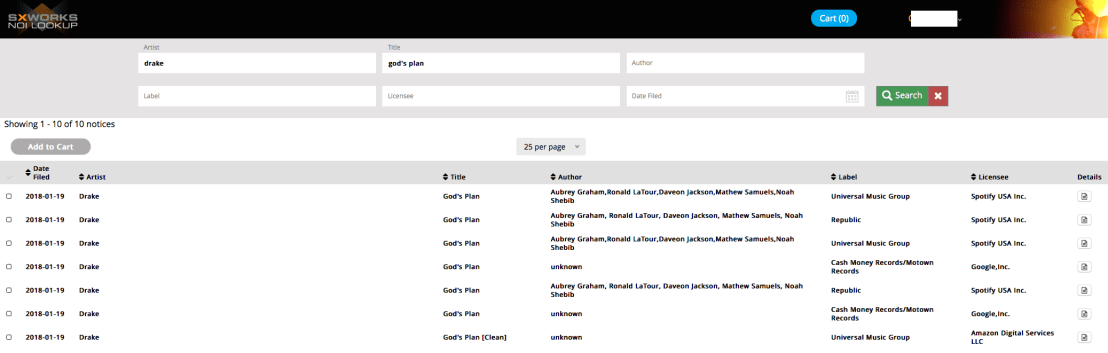
Here’s what I found. First, we have “God’s Plan” by Drake. Remember, if the song is in the NOI lookup, the service is claiming they can’t find the song owner.
Notice that Spotify has four separate NOIs filed for “God’s Plan” and each one lists that song’s writers. Notice that Google and Amazon list the writers as “unknown”. Here’s a little speculation–the reason that both Google and Amazon list the writers as “unknown” is probably because they each got the same new release feed on the record side and did not take advantage of the songwriter information provided by the label. Or they did no matching work–notwithstanding that Google owns Content ID which very likely has all of the song ownership information already inputted for them.
Spotify on the other hand does have the songwriter information, so either they were given it by the label and passed it through or they got it from another source. It seems unlikely that they had all the songwriter information and none of the publisher information. It must be said that the labels are under no obligation to provide any publishing information much less clear the rights. This is the deal Spotify (and all the other services) made–repeatedly. So the labels can’t be blamed for the lack of songwriter or song owner information.
Here’s the NOI look up for Ed Sheeran’s “Perfect”:
Again, Spotify tends to have the writer information and Google and Amazon rely on “unknown” for a top 5 record (that also went #1). But it’s “address unknown” for all of their NOIs.
You may be wondering how it is that these writers aren’t getting paid for huge numbers of streams. I wondered that, too. But–remember that there are two ways for services to license songs: voluntary direct licenses and compulsory. Here’s some speculation: the top songs are written by songwriters who very likely have publishing deals with major publishers and major publishers very likely have direct deals with Spotify, Google, Amazon, etc. So these services don’t need to send “address unknown” NOIs in order to get a compulsory license. They already have a voluntary direct license and they probably paid a pretty penny to get it.
And notice–Apple is nowhere to be seen in these mass NOI filings.
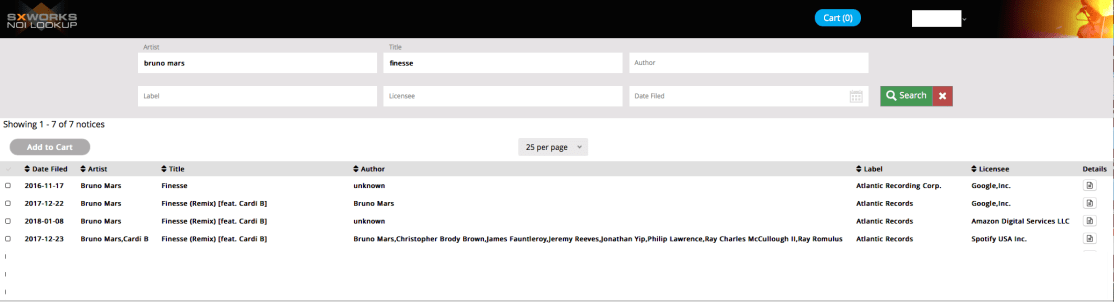
How about Bruno Mars’ “Finesse”. Yep, address unknown:
This is getting to be a pattern, right? “Finesse” has been a top 5 single for weeks. How could they not know who to license from? At least Google lists “Bruno Mars” as the writer–good guess for the biggest search company in the known universe. Think they looked it up in Content ID? And as we saw before, Spotify lists all the writers. But no copyright owners, I guess.
So why would these Big Tech companies want to have both a compulsory license and a voluntary license? Maybe so they will be covered with a royalty free license if the voluntary license should expire for some reason?
Is it really correct for services to be able to burden the Copyright Office with these mass filings for songs that are already subject to a voluntary license? Which gives them actual knowledge of the song copyright owner?
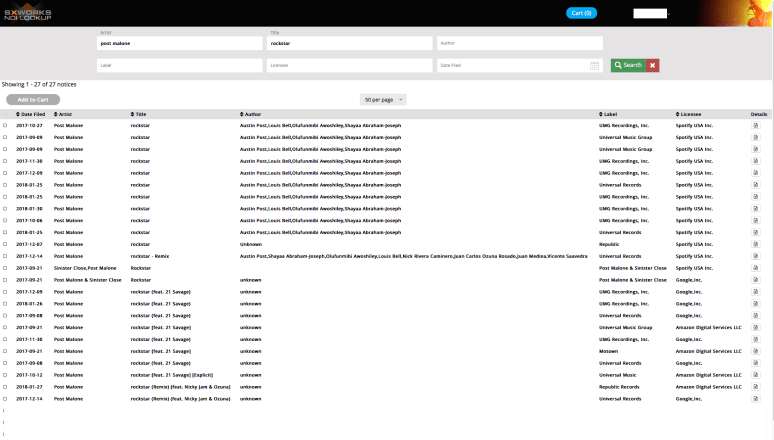
Here’s “Rockstar” by Post Malone. Apparently, the biggest corporations in the world have no idea who owns the song.
No idea who owns “No Limit” by G-Eazy either, although both Google and Spotify know the writers.
Or Lil Pump’s “Gucci Gang”….
Or Camila Cabella’s “Havana”….
although it’s quite easy to find in ASCAP’s database….
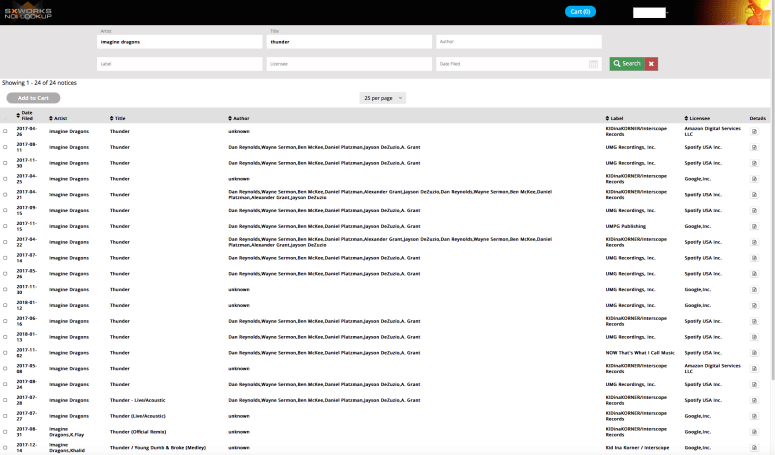
And no joy on Imagine Dragons, either:
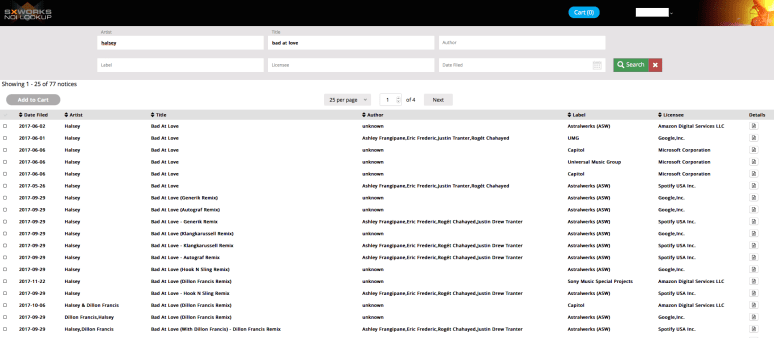
Or Halsey’s “Bad at Love”
So let’s get this straight. None of Google, Amazon, Spotify, or iHeart could find any of the copyright owners of any of the songs in the Top 5 for the last 7 weeks. Or are they sending “address unknown” NOIs as a matter of policy for all songs recorded in the tracks delivered to them by labels including songs already available to them under a voluntary license? Which is more likely?
In the latter case, this gives them a back up compulsory license that will continue if their voluntary license should ever expire. Or if they allow it to expire.
Are they really relying on these fake compulsory licenses and not paying royalties or accounting on songs licensed under a voluntary license? Seems hard to believe? This shortfall might be a bit hard to catch, although if you have a writer in the top 5 it does seem like something you should know and act on if you’re getting stiffed.
Or are the services paying under the voluntary licenses and just stiffing every songwriter who is outside of a voluntary license? And are they doing so retroactively for songs delivered prior to April 2016?
Now that the SX Works NOI look up is available, it really brings home the absurdity of the mass NOIs. Not to mention the absurdity of the fact that no one in Congress does anything to stop it and that Big Tech has bootstrapped this absurdity into the Music Modernization Act.
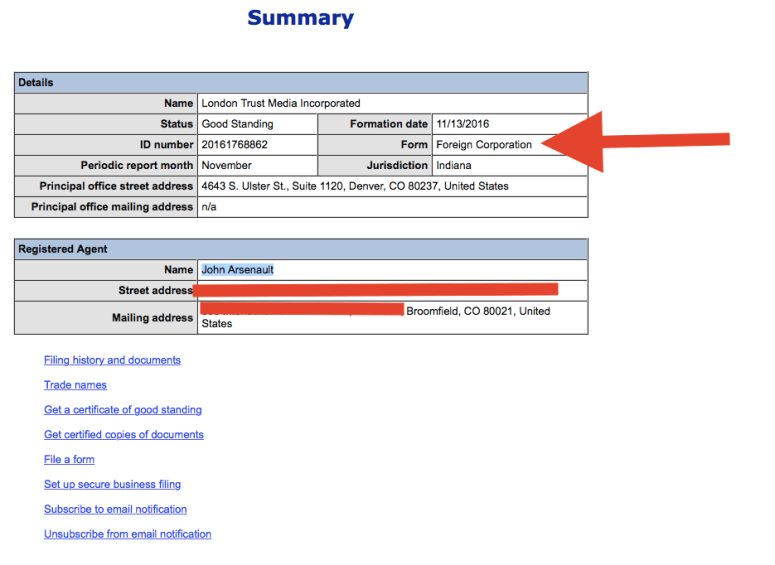
UPDATED John Arsenault called and we spoke about the registration of Corporations in Colorado. Mr Arsenault says this simply indicates the corporation is from another state but now doing business in Colorado. We are not experts on Colorado corporate registrations and we defer to Mr Arsenault and appreciate the clarification on this matter for us. As a result we have updated the blog to focus only on the implications for US Non-profits and electioneering. We leave screenshots above to simply illustrate what we are correcting.
Anybody who has been in the fight for Artists Rights knows that one of our biggest enemies is the astroturf group Fight for the Future. We’ve been following them for some time and have covered FFTF funding from the mysterious London Trust Media. What we didn’t realize until yesterday is that that London Trust Mediais apparently registered as a foreign corporation.
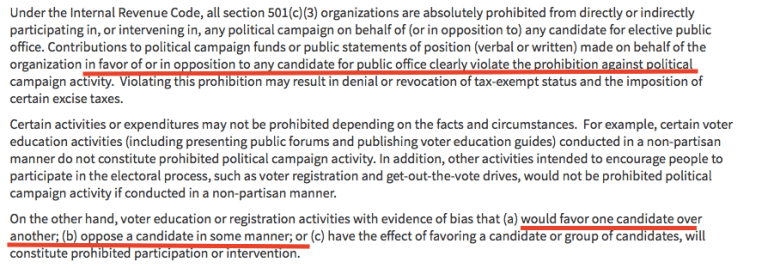
Here is the paragraph from the IRS concerning Non-profits
I am not an attorney but this would seem to make many of the activities Fight For the Future has been involved in illegal under FEC IRS regulations. In particular a communication urging a vote against a particular candidate is off limits. Here is just one example:
Lets be clear here, Fight For The Future opposed TPP NOT because they were worried about American jobs or environmental regulations. They opposed TPP because it did not force our trading partners to weaken copyright protections for artists!!!! Regardless, this sort of position against specific candidates would seem to violate paragraphs IRS rules on non-profits. This could also would seem to put their Massachusetts non-profit status in doubt. (FACT: in an email dated May 26th 2016 I pointed out the apparent non-profit violation to Fight For The Future’s accountant and FFTF board members, yet, Fight For The Future continues to claim they are a compliant non-profit. See addendum for correspondence.)
If you’d like to help take the bad guys down I suggest you:
Write the FEC and complain about activities of this foreign corporation funding activity that urged voters not to vote for specific candidates. Ask them to investigate. They are the experts! Warning the Federal Elections Commision does not make it easy to complain about this activity. Imagine that! Refer them to this blog. This is the best I can do https://www.fec.gov/legal-resources/enforcement/complaints-process/ Updated: Don’t do this it is not FEC but matter but IRS matter. As Mr Arsenault notes LTM is within it’s rights to donate to FFTF.
Complain to the Massachusetts Secretary of the Commonwealth. Again they don’t make it easy. What you want to do is make sure they realize you are complaining about Center For Rights in Action (This is the real name of Fight For The Future). The issue is electioneering and opposing candidates. Main Number:Toll Free: 1-800-392-6090 (within Massachusetts only)Telephone: 617-727-7030 TTY: 617-878-3889 Fax: 617-742-4528 E-mail: cis@sec.state.ma.us
+++++++++++++++++++++++++++++++++++++++++
Here is the correspondence with their CPA indicating that on May 26 2016 I made them aware of the violations.
Mr Alario:
I hope this finds you well. I have some questions about Fight For The Future Education Fund. As a public charity they have certain obligations and responsibilities under the law.
First:
I’m looking at the FFTF Education Fund website right now and the financials link redirects to link for Center For Media Rights 990 IRS form.
Although I’m sure this was just a mistake as the two organizations have intertwined management and web resources, it is a legal requirement that you make available to the public the 990 IRS form for FFTFEF, including the Schedule B. Please send me a copy or kindly tell me where I can find it on the web?
Second:
I’m concerned that FFTF Education Fund appears to have violated some IRS rules for public charities.
Political Campaign Intervention
“Contributions to political campaign funds or public statements of position made on behalf of the organization in favor of or in opposition to any candidate for public office clearly violate the prohibition against political campaign activity. Violation of this prohibition may result in revocation of tax-exempt status and/or imposition of certain excise taxes.”
IRS Compliance Guide
for 501(c)(3) Public Charities
Lobbying Activity
“A public charity is not permitted to engage in substantial legislative activity (commonly referred to as lobbying). An organization will be regarded as attempting to influence legislation if it contacts, or urges the public to contact, members or employees of a legislative body for purposes of proposing, supporting or opposing legislation, or advocates the adoption or rejection of legislation.-
Let’s just get right to the point shall we? TorrentFreak is not a semi-biased news source that reports sympathetically on piracy. If you accept the framework of academic policy washing laid out in Merchants of Doubt, TorrentFreak operates as a public policy arm of Google and other commercial interests that profit from piracy. Multiple sources report that Ernesto Van Der Zar is Lennart Renkema PhD. Renkema is also the co-author of “Copy Culture in U.S. and Germany.” It was funded with a grant from Google.
But that’s nothing. It gets much uglier if you dig deeper. Shall we?
More disturbing is Renkema’s links to London Trust Media. LTM operates a VPN under the brand name Private Internet Access. Private Internet Access is a VPN that touts itself as bittorrent friendly. In other words instead of paying musicians for their work you just pay Private Internet Access and they hide your identity. In this way LTM/PIA profits from piracy while sharing nothing with the artist. Ernesto/Renkema admits PIA is Torrentfreak’s main sponsor. Ernesto/Renkema clearly financially benefits from this sponsorship. Torrentfreak also writes glowing reviews of PIAs service. A deep search of the web shows no other employment for Renkema. Rick Falkvinge is also a writer at Torrentfreak. Until we exposed it Rick Falkvinge (yes the guy who suggested child pornography be legalized) was listed as the Chief Privacy Officer at Private Internet Access. As a result one could plausibly argue that Torrentfreak is really just an arm of Private Internet Access/London Trust Media.
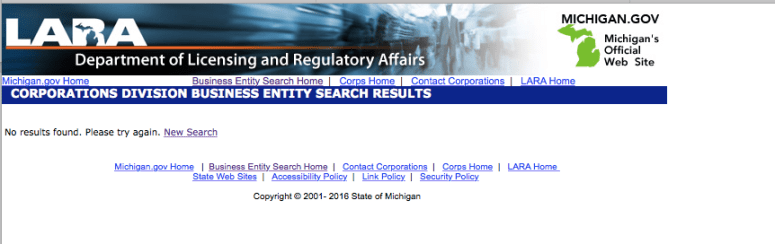
So let’s take a closer look at Private Internet Access/London Trust Media. Official 2014 tax documents show an address in a mini industrial park in Michigan. Yet in 2016 Michigan Department of Licensing and Regulatory Affairs had no such company registered in the state of Michigan. This would seem to be a violation of state law. Back in 2016 we did some research on other companies listed as doing business at that address:
World Fertility Experts an offshore fertility clinic.
Flip it Friday a $50 dollar a month online course on how to flip houses.
My Diploma: Sure. Seems perfectly legit.
GS Media Looks to be a penny stock promoter. Again no business records in Michigan state database. They come up in this interesting article here
So think about it folks. Is Torrentfreak really what it claims to be? Is Lennart Renkema simply a reporter? Or is he part of a bigger profit oriented endeavor?
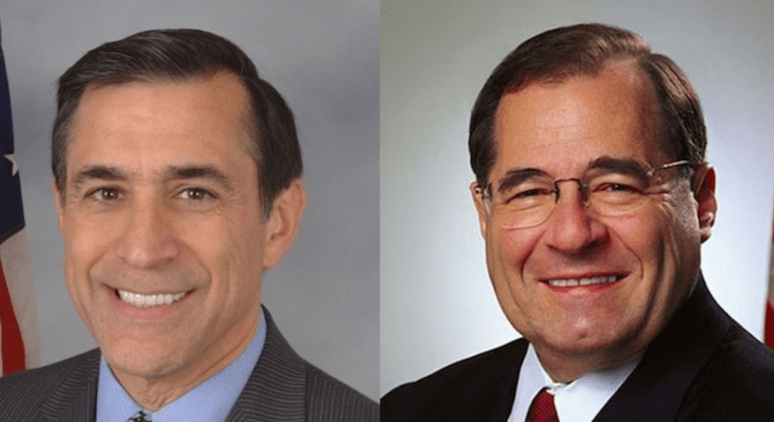
Issa (R-CA) and Nadler (D-NY) sponsored the Classics Act in the house.
Artists that had the misfortune to record before 1972 do not get royalties for the public performance of their recordings on satellite and non-interactive streaming services. This so-called loophole is simply a creation of federal courts (Ninth & Second) and apparent collusion by digital services (DOJ antitrust: Agreeing to fix a price at $0 is still price fixing).
The Classics Act is designed to fix this loophole. This fix has long been championed by Rep Nadler (D-NY) and Rep Issa (R-CA). It’s a simple matter of fairness and equal treatment under the law. There is no way in hell that the legislators who enacted The Digital Performance Right in Sound Recordings Act of 1995 (DPRA) intended to leave out pre-1972 performers. Why has this persisted so long?
Artists owe a debt of gratitude to Nadler and Issa for relentlessly pushing this bill forward. Also Pandora, SoundExchange and other groups like Music First, the Internet Association, the GRAMMYs, Screen Actors Guild‐American Federation of Television and Radio Artists, American Federation of Musicians, the Content Creators Coalition, the Future of Music Coalition, Fare Play, the Rhythm and Blues Foundation, and the Living Legends Foundation deserve their fair share of the credit.
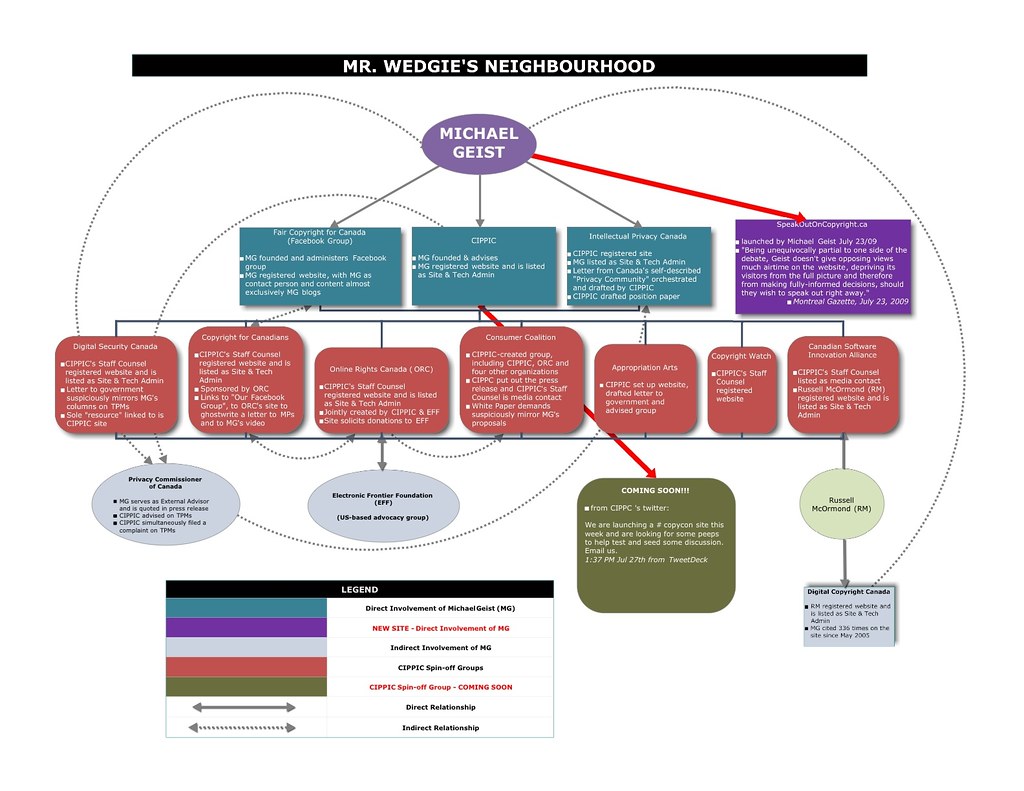
What’s that? …. There are no tanks?…. Oh….So Canada’s most “internet famous” copyright law professor Michael “Neville Chamberlain” Geist is simply selling out Canadian artists for no apparent reason?!? And the beneficiaries of his tortured interpretation of facts and data is predictably the US Silicon Valley monopolies that indirectly benefit from the massively infringing pirate website operations? (And never mind kiddie porn sites, that’s another blog post, we’ll get to that shortly.)
This is especially funny since Geist doesn’t appear to discourage blog comments expressing anti-American jingoism. If only his supporters took the time to follow the money. Geist’s home base is the Samuelson-Glushko Canadian Internet Policy and Public Interest Clinic at the University of Ottowa. You can think of Samuelson-Glushko as the Koch brothers of Silicon Valley. The sole purpose of Samuelson-Glushko clinics appears to be as a policy washing machine for Silicon Valley interests. Money comes in one side and out pops “academic papers” and “research” that seems to always neatly supports the public policy positions of US based internet monopolists. And weakens the rights of Canadian copyright holders.
Remember Geist is no crank law professor at some no name school out in the prairies. Geist is at the University of Ottawa where he holds the Canada Research Chair in Internet and E-commerce Law.
Read more about Geist here and ask yourself “Who is this guy really advocating for?” And also what’s up with his mysterious Lawbytes loan out company?
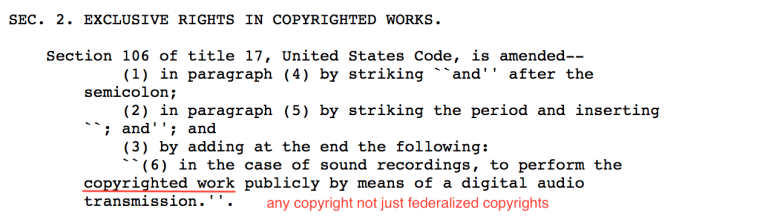
The 1976 copyright act federalized copyrights for post 1972 sound recordings. Sound recordings made pre-1972 were covered and remain covered by state copyright laws. The 1976 act did not strip the works of copyright protection. Several years ago digital broadcasters and non-interactive streaming services all decided (simultaneously) that the Digital Performance Right in Sound Recordings Act of 1995 did not apply to works copyrighted before1972. And ever since these services have tried to avoid paying performers who had the misfortune to record before 1972. This is often referred to as a” loophole.” But I have always maintained that there is no loophole. The DPRA did not specify that the sound recordings be protected by federal copyright to receive digital performance royalties. Just copyright. State copyright for instance. Look it up if you don’t believe me.
Further in order to maintain this legal stance, you have to believe that the members of congress that drafted and passed the DPRA specifically intended to deny digital royalties to the likes of Duke Ellington, Aretha Franklin, The Allman Brothers, Ray Charles, Willie Nelson, and Captain Beefheart to name just a few. Nowhere in the congressional record is this reflected. Nowhere. It’s a complete fiction. Yet the increasingly lazy and myopic federal courts can’t be counted on to look at the record or even the text of the act. Therefore a wide range of musicians, unions and industry trade groups have come together to try to fix this problem. This is an easy fix. This act makes it explicit that this applies to pre-1972 recordings. It’s simple matter of fairness. Everyone loves fairness. It’s like kittens.Who could possibly be against kittens? I mean aside from Lofgren and Sensenbrenner Let’s get this done.
Below is the press release from…
Historic Coalition of 213 Musical Artists Calls on Congress to Pass CLASSICS Act,
Fix the “Pre-1972” Loophole for Legacy Artists
Music Organizations Press Congress to Consolidate
Widely Backed Music Licensing Reforms Into Single Bill
WASHINGTON, February 13, 2018 — An unprecedented coalition of 213 musical artists, supported by eight leading music organizations, called upon the U.S. Congress to pass the CLASSICS Act, bipartisan legislation pending in both the House and Senate to address one of copyright law’s most glaring loopholes.
In a two-page advertisement that will appear in Wednesday’s Politico, the artists state:
Digital radio makes billions of dollars a year from airplay of music made before Feb. 15, 1972. Yet, because of an ambiguity in state and federal copyright laws, artists and copyright owners who created that music receive nothing for the use of their work. The CLASSICS Act (H.R. 3301 / S. 2393) would correct this inequity and finally ensure that musicians and vocalists who made those timeless songs finally get their due. We urge Congress to pass the CLASSICS Act and other pro-artist reforms quickly.
The advertisement marks the start of a robust advocacy campaign by artists and music community leaders A2IM, American Federation of Musicians, Content Creators Coalition, musicFIRST Coalition, Recording Academy, Recording Industry Association of America, SAG-AFTRA and SoundExchange.
The ad can be viewedhere.
The CLASSICS Act is an essential component of a package of music licensing reforms supported by the organizations that includes additional critical reforms such as the Music Modernization Act (H.R. 4706 / S. 2334), the AMP Act (H.R. 881) and the establishment of market-based rate standards. In the coming weeks, music community leaders anticipate the House Judiciary Committee will commence formal consideration of the music licensing reform legislation with the goal of consolidating the key reforms into a single bill.
Meanwhile in Canada…another unaccountable law professor, Michael Geist appears to be running interference for U.S. Tech Firms as Canada considers home grown anti-piracy legislation. Fortunately Chris Castle at Music Tech Policy (and others) have done some excellent reporting on the Geist over the years. We are gonna rerun a few of these articles over the next few weeks so that it is clear to Canadian artists the ethical and intellectual makeup of this fellow. Lets start with the mysterious no bid government contracts he received for even more mysterious work. From 2010:
If you follow what passes for intellectual property policy “debate” online, you will no doubt have heard the anti-copyright amen chorus warming up about the lack of public consultation in the negotiation of the Anticounterfeiting Trade Agreement, or ACTA.
This wringing of hands and wailing of the amici has particular resonance amongst non-governmental organizations, their advisors, their academic rock stars and breathless acolytes. The non-governmental organizations and academics, most prominently the very well funded Michael Geist, advisor to the US-backed Samuelson-Glushko Canadian Internet Policy and Public Interest Clinic, the Alcan of IP, who most frequently attach themselves to the negotiation of international copyright treaties originating in Geneva are particularly incensed.
These “NGOs” complain that the public is insufficiently consulted by—governmental organizations. In other words, the NGOs (self-appointed, frequently astroturf groups with shadowy funding) are complaining that the representatives of the public are insufficiently representative. Only the NGOs and professoriate…
We are pleased to see that the conversations between Rick Carnes (SGA) and Rep Doug Collins that began at University of Georgia Artists Rights Symposium has resulted in improvement to the representation of songwriters on the board proposed in the Music Modernization Act. Press release from SGA follows.
SONGWRITERS GUILD OF AMERICA ANNOUNCES THAT NEGOTIATED CHANGES TO MUSIC MODERNIZATION ACT ENABLE ENDORSEMENT OF BILL’S PASSAGEW
Music Publishing Industry Support for Small Claims Act Also Secured
WASHINGTON — The Songwriters Guild of America, the largest and longest-established music creator advocacy organization in the United States, today announced it has negotiated changes to the pending Music Modernization Act (HR 4706)that will enable it to support passage of the legislation. Among the agreed-upon amendments to the bill are:
the doubling of songwriter and composer representation on the board of directors of the Mechanical Licensing Collective established by the Act;
the re-alignment of an Unclaimed Royalties Oversight Committee that will now have a 50/50 music creator and music publisher balance; and
clarifications to the payments sections that will make it easier for music creators to get the full benefits of their negotiated publishing agreements as applied to the distribution of what the bill refers to as “unclaimed” funds by music publishers.
As part of the discussions leading to changes in the Music Modernization Act, the US music publisher community has also pledged to lend its full support on Capitol Hill to SGA’s efforts to secure quick passage of the pending Copyright Alternative in Small-Claims Enforcement (CASE) Act of 2017 (HR 3945). CASE will provide music creators with a much needed, opt-in alternative to expensive, full blown copyright infringement actions against unlicensed users of their music.
Speaking on behalf of SGA, multi-platinum songwriter and organization president, Rick Carnes, noted that, “the benefits of the pending Modernization law, with the changes SGA has successfully sought, have made the current bill deserving of our support. We continue to applaud the efforts of those members of the music creator and music publishing communities seeking further improvements and clarifications that would make the proposed legislation even more advantageous to American songwriters, composers and independent publishers. Still, the bill as it now stands would — on balance — benefit those creators we are sworn to protect significantly more than no bill at all. Our two-word mission statement is to ‘protect songwriters.’ After more than six months of hard work alongside our colleagues in the independent music creator community through Music Creators North America (MCNA), SGA feels, individually, that it succeeded insofar as possible in carrying out our mission.”
Under the agreed-upon changes, the Mechanical Licensing Collective board will now have four professional songwriter/composer voting members and ten voting music publishers. The Unclaimed Royalty Oversight Committee, whose role will be to oversee issues concerning ownership and distribution of so-called “unclaimed” royalties, will now have evenly balanced, “five and five” representation among ten voting members. As to clarifications regarding payment of music creator royalties received from the Collective by music publishers, the bill is now clearer in spelling out that such royalties are to be distributed on a title-by-title basis to songwriters under the percentages set forth in their publishing agreements. In other words, a songwriter or composer operating under an agreement that gives such creator the benefit of a 90%/10% split with its music publisher will have that same split applied in the distribution of “unclaimed” royalties that have been matched under the usage formula set forth in the legislation.
Other benefits of the legislation include establishment of a system that:
is likely to substantially improve royalty payment compliance by digital distributors of music on a going-forward basis;
changes in royalty rate determination formulas that will benefit both music creators and their copyright administrators; and
the promotion of greater fairness for US performing rights societies in their negotiations with users.
“Among SGA’s important roles following the bill’s enactment,” continued Carnes, “will be to assist the songwriter and composer community in making sure that every music creator receives the full benefits intended under the Act. That includes publication of materials designed to inform and remind creators, in consultation with their legal and financial representatives, how best to ensure the maximum, accurate receipt of all royalties to which they are entitled.” Carnes also pledged that SGA will be in the forefront of efforts, along with its fellow MCNA music creator groups, to ensure that experienced, knowledgeable and — above all — independently-minded songwriters and composers are tapped to serve as board members of the Collective.
SGA, established in 1931, is the largest and longest-established advocacy organization run solely by and for songwriters and composers in North America. In addition to its role as a legislative advocate, SGA provides copyright administrative services and other informational and representation services to its national US membership upon request







 Lets be clear here, Fight For The Future opposed TPP NOT because they were worried about American jobs or environmental regulations. They opposed TPP because it did not force our trading partners to weaken copyright protections for artists!!!! Regardless, this sort of position against specific candidates would seem to violate paragraphs IRS rules on non-profits. This could also would seem to put their Massachusetts non-profit status in doubt. (FACT: in an email dated May 26th 2016 I pointed out the apparent non-profit violation to Fight For The Future’s







 The Trichordist
You must be logged in to post a comment.