Here’s a deep dive on the so-called Transparency in Music Licensing and Ownership Act. As we have detailed the last two days, the “transparency” and “small business” aspects are a smoke screen to hide the abolishment of certain long held rights by songwriters, in order to favor large digital and broadcasting monopolies. Think about it. In this day and age the government (a Republican no less) is intervening in the marketplace to help some of the largest companies on the planet.
“[Government] interference is but the first link of a long chain of repetitions, every subsequent interference being naturally produced by the effects of the preceding.”
James Madison, The Federalist Papers No. 44
There is a bill in Congress backed by the mega lobbying juggernaut called the MIC Coalition that would force songwriters and artists to “register” with the government in order to protect their rights from the biggest corporations in the world. Failing to do so would take away the stick of statutory damages and an award of attorneys fees to songwriters or artists who are victorious in copyright infringement litigation. Statutory damages and attorneys’ fees are the only real protection that the government gives these creators–the smallest of small businesses.
Why? Because the government does virtually nothing to protect the rights of artists. If it weren’t for statutory damages and attorneys’ fees there would be nothing…
Yesterday we detailed one of the main problems with the so-called “Transparency in Music Licensing and Ownership Act” or as Artist Rights Watch termed it “The Shiv Act.” The bill would take away from songwriters legal remedies like attorney’s fees and statutory damages. Thus making it virtually impossible for individual songwriters and small publishers to sue websites and digital services that use their works without licenses. This bill is Robin Hood in reverse.
Today we look at why the whole call for transparency is utter bullshit.
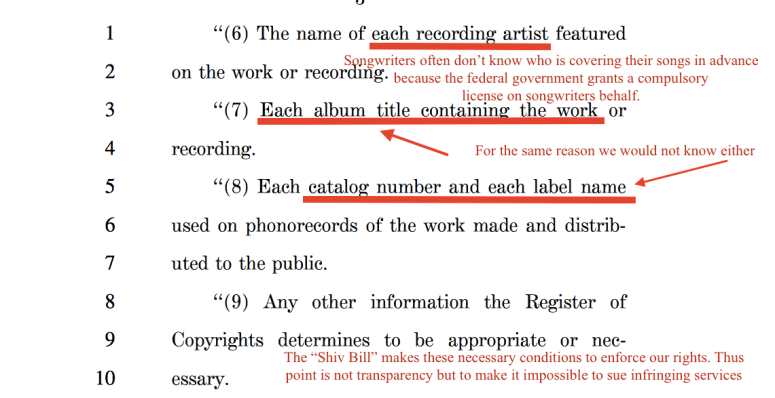
The proposed “transparent” database is really just a new impossible-to-mount bureaucratic hurdle to prevent songwriters from ever exercising their rights. Transparency is not the point. It requires songwriters to provide information on cover tracks recorded by other performers the moment these covers are released to the public, or otherwise they lose rights.
The problem is federal compulsory licenses grant streaming services and cover artists’ automatic licenses. Songwriters almost never know these recordings exist until long after they are released. THIS IS THEREFORE AN IMPOSSIBLE TASK! See screenshots above.
But here is where the bill is particular cruel. If a songwriter does not report information on a single cover, the way the bill is written, the songwriter then loses their rights for EVERY recording. I don’t think this is an accident. This actually creates a mechanism for depriving every songwriter of legal fees and statutory damages, on every song ever written. Just record a song and upload it to a streaming service. This is the ultimate poison pill for songwriters’ rights.
Technically digital services are supposed to send a “notice of intent” to songwriters to let them know that their songs are being used. But the terrible new Librarian of Congress has also been allowing digital services to exploit a loophole that allows Amazon, Google, Spotify and others to file an “address unknown” notice with the copyright office. These notices are then “published” by uploading (sometimes enormous) zip files with hundreds of thousands of sound recordings. Further although these files appear to be “zipx” files they aren’t your normal run of the mill zipx files as they seem to require a sophisticated decompression program in order to read them. If the purpose is to serve notice to the public that compulsory licenses have been granted, this is a complete failure.
Further in the previous decade 2006-2016 less than 6,000 of these notices were ever filed. Since March of 2016 digital services have filed over 45 million of these notices. Many of these notices are for easily recognized songs written and performed by artists like The Beach Boys and Sting. A simple search of the web provides proper contact information. PaperChain.io an Australian company estimates that as a result of these sorts shenanigans there are over $2.5 billion in unpaid royalties world wide.
Billion.
Irrelevant to this post, but where is that investigation?
Maybe it is time to dust off those old “private attorneys general” statutes. L
Sen Jim Sensenbrenner (R-WI), longtime antagonist of songwriters, has just introduced a bill he calls he calls “The Transparency in Music Licensing and Ownership Act.” Complete doublespeak. While yes, there is something in the bill about empowering a panel, to study the potential for building a database of songs and owners, to one day maybe assist in licensing song, lets be absolutely clear that’s not what this bill is about. Look at the details. It’s plain as day. This bill is an attempt to take away the only thing that guarantees songwriters eventually get paid: The threat of a lawsuit. Most copyright infringement cases are heard in federal court. In my experience you need a minimum of a quarter of million dollars to mount a case against an infringing corporate entity. This section of the bill eliminates the legal fees and statutory damages. Even if songwriters prevail in the case. While major publishers may still be able to afford to litigate theses cases under these onerous circumstances , (and for complex reasons that’s a big maybe) individual songwriters and small music publishers will never be able to afford to sue again.
You don’t have to be an expert in game theory to see where this ends up. This bill makes it cost effective for services to infringe songwriters copyrights on a mass scale. Something they are already doing! Niche and indie songwriters will be particularly hard hit. This bill will increase the number of unlicensed tracks and increase the size of the “black box” pools of unpaid royalties. This is less transparency not more. Thus it is truly doublespeak.
(You also have to wonder that since this bill is pushed by an alliance of companies with significant infringement problems that it isn’t effectively a conspiracy to cover up past illegal activities.)
Make no mistake, this bill ensures that many many songwriters will never receive their royalties, providing an enormous subsidy to Google, Amazon, Spotify, etc. This has nothing to do with transparency in licensing. This is just more tricky lawyering from Google and their fellow travelers.
(BTW we predicted that something like this bill was coming months ago. Why is it that what is essentially the Scooby Doo gang doing the heavy lifting for the entire music industry?”)
Longtime PRO opponent Rep. Sensenbrenner introduced a bill entitled “The Transparency in Music Licensing and Ownership Act“, a piece of work that is Dickensian in its cruelty, bringing a whole new meaning to either “newspeak” or “draconian,” take your pick. It’s rare that the Congress can accomplish the hat trick of an interference with private contracts, an unconstitutional taking and an international trade treaty violation all in one bill. But I guess practice makes perfect. And since the MIC Coalition gave the bill a rousing cheer followed by a heaping serving of astroturf, we should not be surprised. (Read the bill here.)
While this legislation currently applies only to songs and sound recordings, other creators should not feel that they’ve dodged a bullet. I hear that the House Judiciary Committee staff is planning on closing the loop and making all copyright categories subject to the same “register or lose it” approach favored by Lessig, Samuelson and their fellow travelers. If you thought that we are in an era of the triumph of property rights, that must be a different Congress you’re thinking of.
The bill perpetuates the myth of the “global rights database” that no one who understands the complexities believes will ever be created. It sounds logical, right? We have county recorders for real estate, the DMV for cars, why not a database for music?
That is an 11th century idea being welded onto a 21st century problem, the Domesday Book meets a unicorn. The problem isn’t knowing who owns a particular work which evidently is either what they believe or want you to believe.
The problem is that the users don’t want to seek permission or beg forgiveness, either. They want to get away with it. This bill demonstrates that unassailable fact in colors bold as the Google logo.
Think about it–by the time you finish reading this post, 1000 songs will be written and 500 songs will be recorded somewhere out there in the world. Or more. (Not to mention photographs taken, paintings painted, chapters written and so on.)
Do you think that songwriters around the world are thinking, now I know what lets do, let’s rush to go register that new song in the U.S. Copyright Office–in the database, the registration section, the recordation section? Otherwise, I’ll never be able to afford the lawyer to sue Spotify if they don’t pay me. I don’t think they’re thinking that at all and are about to fall into the MIC Association’s trap for the unwary. Why the MIC Coalition? We’ll come back to them.
MIC Coalition Members
In a nutshell, the bill requires the extraordinarily heavy burden of requiring all songwriters and recording artists (or their publishers or labels)–all, as in the entire world seeking to sue in the U.S., not just the US writers–to register numerous fields of data in a yet to be created database if they plan on suing for statutory damages:
[I]n an action brought under this title for infringement of the exclusive right to perform publicly, reproduce, or distribute a nondramatic musical work or sound recording, the remedies available to a copyright owner [ANY copyright owner] that has failed to provide or maintain the information [required] shall be limited to…(A) an order requiring the infringer to pay to the copyright owner actual damages for the public performance, reproduction, or distribution of the infringed work; and…(B) injunctive relief to prevent or restrain any infringement alleged in the civil action.
That means if you haven’t undertaken the formality of registering in this new database, then the user has no exposure to statutory damages and will not have to pay the victorious songwriter or artists attorneys’ fees. And this new safe harbor applies apparently even if that songwriter or artist has filed a copyright registration under existing law.
There is nothing in the bill that actually requires the protected class to actually look up anything in this new database, or actually be in compliance with existing statutory licenses (such as the webcasting or simulcasting licenses).
So who is in the new protected class entitled to the Nanny State’s protection from those collusive and pesky songwriters and artists? Let’s look at the victimology of the “ENTITLEMENT” paragraph.
Well, actually, there’s no “ENTITLEMENT” paragraph for the entitled, it’s actually called “APPLICABILITY” (see “newspeak”, WAR IS PEACE, etc.). The connected class includes five different categories of cronies.
First, the defined term “An establishment” gets the new even safer harbor. “Establishment” is a defined term in the Copyright Act (in Sec. 101 for those reading along at home):
An “establishment” is a store, shop, or any similar place of business open to the general public for the primary purpose of selling goods or services in which the majority of the gross square feet of space that is nonresidential is used for that purpose, and in which nondramatic musical works are performed publicly.
Like the members of this organization, the National Retail Federation:
Then another defined term “A food service or drinking establishment”. Kind of like these people:
That is, the National Restaurant Association, the American Hotel and Lodging Association (aka those who put their kids through college thanks to SXSW) and their suppliers, the American Beer, Wine and Spirits Retailers.
Next, “A terrestrial broadcast station licensed as such by the Federal Communications Commission”. I guess that would include the National Association of Broadcasters, iHeart, Salem and Cox (which of course raises the question of whether this entitlement also applies to Cox’s Internet group), kind of like these people:
Don’t forget “An entity operating under one of the statutory licenses described in section 112, 114 [webcasting and simulcasting], or 115 [mechanical licenses].” Note–not that the statutory license applies to the particular song or sound recording in the way it is used that is the subject of the lawsuit, just that the entity is operating some part of its business under one of those licenses regardless of whether the service that is the subject of the lawsuit operates under one of these licenses or not. (Pandora’s on-demand service compared to webcasting, for example, could be out of compliance with its sound recording licenses but claim the safe harbor because it is “operating under” one or more of the statutory webcasting license in the radio service or the statutory mechanical licenses for songs.)
It appears that would include these people:
and don’t forget these people who are DiMA members and need the government’s protection from songwriters and artists:
And then I guess you could throw the Consumer Technology Association and CCIA in there, too.
So I think that’s everyone, right?
Last but not least there’s this group as “belt and suspenders”:
An entity performing publicly, reproducing, or distributing musical works or sound recordings in good faith as demonstrated by evidence such as [i.e., but not limited to] a license agreement in good standing with a performing rights society or other entity authorized to license the use of musical works or sound recordings.
Note: The license need not be for the musical works or sound recordings for which the “entity” is being sued, just any license for any musical works or sound recordings.
There are loopholes in the bill that you could drive a fleet of Street View cars through, so you have to assume that the loopholes will be hacked given who is involved. Don’t let anyone tell you “oh that’s just legislative language, we can fix that.” The whole thing has to be voted down.
Let’s call this bill what it is: Crony capitalism, the triumph of the connected class. The Domesday Book writ large.
It’s some of the biggest companies in the world deciding that they don’t want to hear from songwriters or artists anymore.
Google’s MIC Coalition is at it again. As predicted, the MIC Coalition is bringing orphan works through the back door with a new bill introduced in the dead of night under the misleading title ” Transparency in Music Licensing Ownership Act” or as we call it, The Shiv Act.
Breaking! Congressmen Nadler and Issa introduce bill to fix loophole on pre-1972 recordings. Legacy artists will finally get digital royalties. Also Pandora has lent their support to the bill. Thanks to all who worked so hard on this but especially Blake Morgan!
WASHINGTON, D.C. — Today, Ranking Member Jerrold Nadler (D-NY) and Chairman Darrell Issa (R-CA) of the House Judiciary Subcommittee for Courts, Intellectual Property and the Internet introduced bipartisan legislation to close a long-standing gap in federal copyright law. The Compensating Legacy Artists for their Songs, Service, and Important Contributions to Society Act (the CLASSICS Act), H.R. 3301, resolves uncertainty over the copyright protections afforded to sound recordings made before 1972 by bringing these recordings into the federal copyright system and ensuring that digital transmissions of both pre- and post-1972 recordings are treated uniformly.
The CLASSICS Act serves as an update to the “pre-72 treatment” of the Fair Play Fair Pay Act – a broader music licensing bill introduced by Chairman Issa and Ranking Member Nadler earlier this Congress – and represents a broad consensus from a variety of stakeholders across the music landscape.
WASHINGTON, D.C. — Today, Ranking Member Jerrold Nadler (D-NY) and Chairman Darrell Issa (R-CA) of the House Judiciary Subcommittee for Courts, Intellectual Property and the Internet introduced bipartisan legislation to close a long-standing gap in federal copyright law. The Compensating Legacy Artists for their Songs, Service, and Important Contributions to Society Act (the CLASSICS Act), H.R. 3301, resolves uncertainty over the copyright protections afforded to sound recordings made before 1972 by bringing these recordings into the federal copyright system and ensuring that digital transmissions of both pre- and post-1972 recordings are treated uniformly.
The CLASSICS Act serves as an update to the “pre-72 treatment” of the Fair Play Fair Pay Act – a broader music licensing bill introduced by Chairman Issa and Ranking Member Nadler earlier this Congress – and represents a broad consensus from a variety of stakeholders across the music landscape.
Congressman Jerrold Nadler: “For years, we have been working to ensure royalty payments for artists who recorded many of our great musical classics before 1972. The Fair Play Fair Pay Act set down a clear marker on the need to resolve the dispute over pre-72 music, as we worked toward a long-term solution that benefits multiple stakeholders. The bill we are introducing today updates this Pre-72 provision, once and for all guaranteeing royalty payments for our great legacy artists while providing certainty for digital music services. Hopefully, this new measure will serve as an example of the consensus that can be reached between the creators and distributors of music as we work to comprehensively update our music licensing laws. Many of these older musicians are past their working years and have no other way to make ends meet. I’m thankful to the supporters of this bill for recognizing that pre-72 recordings have value and that those who create it should be paid regardless of their age.”
Congressman Darrell Issa: “This an important and overdue fix to the law that will help settle years of litigation and restore some equity to this inexplicable gap in our copyright system. It makes no sense that some of the most iconic artists of our time are left without the same federal copyright protections afforded to their modern counterparts. This bill is the product of a great deal of work to build consensus across party lines and varying interests all-over the music and entertainment landscapes on how to best resolve this long-standing problem. I’m very proud of the work we’ve done here. It will go a long way helping bring music licensing laws into the twenty-first century.”
The bill is introduced with the support of stakeholders across the music and entertainment industry including American Association of Independent Music, the Recording Industry Association of America, Pandora, musicFIRST, the Internet Association, the GRAMMYs, SoundExchange, Screen Actors Guild‐American Federation of Television and Radio Artists, American Federation of Musicians, the Content Creators Coalition, the Future of Music Coalition, the Rhythm and Blues Foundation, and the Living Legends Foundation. The bill is also supported by several noted artists, many of whom spoke out in support of the CLASSICS Act.
In addition to Chairman Issa and Ranking Member Nadler, Representatives John Conyers (D-MI), Marsha Blackburn (R-TN), Tom Rooney (R-FL), and Ted Deutch (D-FL) joined as original co-sponsors to the legislation.
BACKGROUND INFORMATION AND ADDITIONAL RESOURCES:
Congress made sound recordings eligible for federal copyright protection with the Sound Recording Amendment of 1971, but the law as passed only applied to works created on or after February 15, 1972. Sound recordings made before 1972 were excluded from federal copyright protection
This gap has meant that different recordings made before 1972 have been subject to an inconsistent patchwork of different laws, creating significant uncertainty for rights holders music creators, and distributors, including digital streaming services, who wish to be able to fairly compensate artists and utilize these recordings.
The differing treatment of pre and post 1972 was an inexplicable and arbitrary oversight on the part of Congress. The U.S. Copyright Office has expressed their bewilderment with the decision, writing in their recent report on federal copyright protections for pre-1972 sound recordings that “Congress did not articulate grounds for leaving pre-1972 sound recordings outside the federal scheme and there is very little information as to why it did so.”
This gap has meant that updates to copyright law and new protections extended to sound recordings under the Copyright Act of 1976 and the Digital Millennium Copyright Act have excluded pre-1972 recordings. The most significant of these being the ‘safe harbor’ provisions for online piracy and ‘compulsory licenses’ made available for internet and satellite radio streaming.
Quotes of praise for the CLASSICS Act:
“This is a great step forward for legacy artists. Thank you to Representatives Issa and Nadler for recognizing that music made before 1972 is just as important and valued as post-1972 music.” — Mary Wilson, The Supremes
“I am overjoyed and extraordinarily grateful for Congressmen Issa and Nadler’s bipartisan relentless efforts to correct an inequality in the law that discriminates against myself and my peers– the legacy artists who recorded our hit records prior to 1972. It is has been unfair and outrageous that the artists, such as myself, who recorded some of our country’s most iconic music, have been forced to resort to lawsuits in order to get paid for the commercial use of their recordings. It is phenomenal that finally there is light shining at the end of this very long tunnel we’ve been looking at for so long. Knowing there is a consensus agreement to resolve any portion of this outrageous problem makes me proud and furthers my hope that I will still be alive to see the other issues Reps. Nadler and Issa have championed in the Fair Play Fair Pay Act come to similar positive bipartisan resolution and conclusion.” — Sam Moore
“I have found so much inspiration in the songs of the past, the songs I grew up with. The least – the very least – I could do is show them respect and honor them by urging Congress to fix the law so that they can get paid by digital radio. That’s why this bill is so important.” — Melissa Etheridge
“Every artist making music today stands on the musical shoulders of those who came before them. I would not be doing what I do if it weren’t for the heritage acts I grew up listening to, idolizing and trying to emulate. The fact that these amazing artists are not getting compensated for their indelible work and profound influence is simply unfathomable to me, and must be fixed. I am grateful to the sponsors of this bill for finally trying to even the scales, as there is no future in music without honoring the past.” — Dave Koz
“It’s a travesty that artists who shaped our creative minds and inspired us to want to play music in the first place are not being acknowledged and compensated for the music they gave us. I’m hopeful this important legislation will address this issue for all time.” — Carlene Carter, Singer-Songwriter, Daughter of country music legends June Carter Cash and Carl Smith, stepdaughter of Johnny Cash, and granddaughter of “Mother” Maybelle Carter of the original historic Carter Family
“The fact U.S., copyright protection does not apply sound recordings made prior to February 15, 1972 makes absolutely no sense. Early rockers like me and my peers are on heavy rotation these days on popular oldies channels and on digital radio services. And unlike many other platforms, we’re not compensated for it. How is that fair? It’s our music that attracting listeners and thus we should be paid. I’m grateful for the leadership of Reps. Issa and Nadler and their efforts to fix this enormous injustice with this important bill.” — Steve Cropper, legendary guitarist, songwriter and producer
The Spotify “fake artist” scandal that broke last week has been a real head scratcher. Did they really save that much money? I mean they paid billions out to rights holders, but NYTimes puts the “savings” on fake songs at $3 million dollars? Was it worth it? Especially considering the public relations damage it does to the brand.
Certainly the most likely explanation is that this is just a bonehead move, a crony favor for a fellow Swedish music tech company that appears to represent most of these songs.
But we should consider two alternate theories:
The lower songwriter royalties paid on these tracks may end up as evidence of “free market” rates before the Copyright Royalty Board that sets rates for songwriters. Yes,songwriter royalty rates in US are not just set, they are capped by the US government! The CRB is bound to consider free market rates. If they consider these rigged rates as free market ALL songwriters would get lower royalties. While this may seem like a “bankshot” this exact scenario has played out twice before. The most recent was when the indie label licensing group Merlin, cut a deal with non-interactive streamers. This deal guaranteed a lower rate for more spins for Merlin licensed tracks. A kind of reverse payola. This effectively lowered the per spin rate, non-interactive broadcasters then took this deal to the CRB as evidence and the CRB used it to lower rates. This likely cost rights holders: $1 billion dollars in lost royalties.
This could be used in exactly the same way.
The second theory is a little harder to explain, but basically songwriter spin rates, vary from month to month. They are capped by the federal government at 10.5% of streaming service revenue. And the formula per spin is simply 10.5% of rev divided by the total number of spins, pro-rated based on popularity of a song. So if you somehow increase the number of spins using “fake” tracks wouldn’t you reduce royalties across the board by a small but significant amount?
Digital services have accelerated the questionable use of the “address unknown” loophole in the copyright act. Check this out. Amazon has now sent notices for 24 million tracks in a period of 15 months. Between 2010 to 2015 the copyright office was only sent 4800 such notices. Is Amazon even trying to find the composers? I’m not an attorney but I don’t understand how this isn’t fraud.
We get an update this week on the total “address unknown” mass NOIs filed with the Copyright Office for the royalty-free windfall loophole. This time we have to thank our our friends at Paperchain in Sydney for doing the work of decompressing the massive numbers of unsearchable compressed files posted on the Copyright Office website. As you can see, there’s been an increase of approximately 70% since January 2017. (For background, see my article.)
As you can see, Amazon is still far and away the leader in this latest loophole designed to stiff songwriters, followed closely by Google. However, Spotify is moving on up. Spotify does get extra points for starting late in March 2017, but they are catching up fast filing over 5,000,000 as of last month.
To put this in context–the Copyright Office as recently as September 2015 posted these “address unknown” NOIs in a single…
We get an update this week on the total “address unknown” mass NOIs filed with the Copyright Office for the royalty-free windfall loophole. This time we have to thank our our friends at Paperchain in Sydney for doing the work of decompressing the massive numbers of unsearchable compressed files posted on the Copyright Office website. As you can see, there’s been an increase of approximately 70% since January 2017. (For background, see my article.)
As you can see, Amazon is still far and away the leader in this latest loophole designed to stiff songwriters, followed closely by Google. However, Spotify is moving on up. Spotify does get extra points for starting late in March 2017, but they are catching up fast filing over 5,000,000 as of last month.
To put this in context–the Copyright Office as recently as September 2015 posted these “address unknown” NOIs in a single searchable PDF. However, the Copyright Office apparently changed the practice abruptly in early 2016 once the Big Tech hammer came down. Based on the last PDF I could find, the total number of “address unknown” NOIs filed with the copyright office from January 2010 to September 2015 or so was approximately 4,800.
Compare that approximately 4,800 in five years to approximately 45 million in 18 months.
Notable in its absence: Apple Music has not filed a single address unknown NOI. Somehow Apple seems satisfied with their licensing practice based on an absence of a single NOI.

 Yesterday






 The Trichordist
You must be logged in to post a comment.