4 Questions For @ZephyrTeachout: Jack and Lydia DeJohnette Letter

By The Time We Get To Woodstock….

This Tuesday, Zephyr Teachout, director of the anti-artist FFTF (Fight For The Future)’s 501c3, is running in the Democratic primary in NY’s 19th congressional district (Hudson Valley, including Woodstock)

Although Teachout  is running as a progressive, and is indeed progressive on many issues, the FFTF is about as regressive on artists rights/copyright as possible.

See:

http://m.registerstar.com/opinion/letters_to_the_editor/article_d6f609cc-34a4-11e6-927b-0bd4ad13e953.html?mode=jqm

https://thetrichordist.com/2016/05/24/progressive-candidates-fail-artists-zephyr-teachout-ny-19-vs-woodstock-ny/

https://thetrichordist.com/2016/04/02/fight-for-the-future-of-corporate-astroturf-ripping-off-creators/

After unsuccessfully trying to get Teachout to clarify  her relation to the anti-artist positions of FFTF,  NY based “Musicians Action group” [MA.g] activists sounded the alarm through a mass emailing to  Hudson Valley musicians:

“Many of us are democrats who share Teachout’s progressive views on many issues. But creators’ families are Working Families, too, and copyright is how we get paid.  So we’re asking Zephyr Teachout: Which Side Are You On?”. The email asked everyone  to send  Teachout 4 questions (see below).

According to MA.g spokesperson Marc Ribot, “the response from musicians/creators has been extremely positive.

Legendary Jazz drummer and Hudson Valley resident Jack DeJohnette copied us on the letter he and his wife Lydia sent Teachout, along with MA.g’s 4 questions.   We think Jack and Lydia’s eloquent letter speaks for MANY,  in Hudson Valley and beyond.”

Jack and Lydia DeJohnette Letter to Teachout

Dear Ms Teachout,

My wife and I have been following you since your run for governor with interest.  We are progressives and along with the rest of us are disturbed by a lot of what we perceive as self-serving politicians who seem to have forgotten who puts them in office and who they should be serving. 

You have impressed us on many issues, however, the attached letter speaks to issues that are directly impacting our lives as artists.

The Hudson Valley has according to Mike Hein,county executive,  the largest group of artists per capita in the USA living in it.  My wife and I have lived here over 40 years and raised our family here.  It disturbs me that someone who seems to be running in support of the people is not further tuned in to the needs of us artists, who ultimately might be your constituents.

Since downloads and YouTube started my  recorded music royalties have declined by over 90%, I am all over YouTube, everyone but me gets an income from this.

The internet has virtually destroyed my royalty income, from radio to illegal downloads.  I am not a famous rock star who can get heavy duty lawyers fighting for me.  I am a jazz musician, we have never been represented in the ‘big picture’, our sales are considered paltry by the industry. 

Technology is in advance of regulations, our only hope is that our politicians take up the cause for us and work to bring in legislation that protects us, we hope you will become that champion.  If you support us in this issue, we will consider supporting you further.  Please respond to the four questions posed in the attachment.

I am a senior now and at one time in the past I had expected to retire with some royalty income as a back up, unfortunately that is no longer. As the corporations behind the music industry are getting bigger and bigger.

We look forward to hearing from you,

Sincerely,

Jack & Lydia DeJohnette

Four Questions for Zephyr Teachout Candidate US House of Representatives Democratic Primary NY-19

  1. Do you personally support the anti-artist, anti-copyright agenda of Fight For The Future, where you served as Director of the Education Fund? If so, please explain why you hold that position. If not, please explain how your views differ from the messages of that organization.


  1. Do you recognize that mass, online copyright infringement causes direct harm to people like me? As my prospective representative, will you fight for my ability to support myself and my family with my creative work?


  1. You’re running on a message that is very important to democrats – holding corporations accountable and getting big money out of politics.  Can you say without equivocation that Fight For The Future reflects these values?


  1. Do you support Jerrold Nadler’s Fair Play Fair Pay bill, which would bring the US into conformity with the rest of the free industrialized world by paying artists for the commercial, terrestrial radio broadcast of their work (and put tens of millions in foreign royalties now being withheld due to the lack of US reciprocity into the pockets of US working artists)?

Spotify IPO Watch: Brexit’s Bubble Bursting Bang — Artist Rights Watch

Right now I see no reason to think there is any likelihood that those trend lines will change direction for the frothy bubble in the markets that I think is a necessary condition for a Spotify IPO (or even a real unicorn like Uber). How long? Weeks and weeks for sure and probably months and months, well into 2017.

via Spotify IPO Watch: Brexit’s Bubble Bursting Bang — Artist Rights Watch

Fixing the Legacy DMCA by Contract — MUSIC • TECHNOLOGY • POLICY

Labels made deals with @YouTube out of desperation. It’s pennies & whack-a-mole. How can labels renew YT deals with so much artist pressure? — Irving Azoff (@irvingazoff) June 22, 2016

Irving Azoff asks the right question of the labels that are in renegotiations with YouTube to extend their licenses:  Given the global unity against Google’s business practices, how can labels close new deals without using that negotiation to fix the DMCA abuse problems that everyone knows are unique to Google?

via Fixing the Legacy DMCA by Contract — MUSIC • TECHNOLOGY • POLICY

@theblakemorgan: Courage Deserves Support: Vote for Rep. Jerry Nadler on June 28 in NY-10 — Artist Rights Watch

Congressman Jerry Nadler’s leadership and courage on behalf of American music makers is unmatched in Congress. He was the first member of Congress I was ever invited to meet with. He was the first Representative to stand with ‪#‎IRespectMusic‬. He’s co-authored (with Republican Rep. Marsha Blackburn) the ‪#‎FairPlayFairPayAct‬ to ensure that music makers get paid fairly for radio play.

via @theblakemorgan: Courage Deserves Support: Vote for Rep. Jerry Nadler on June 28 in NY-10 — Artist Rights Watch

@mattpinfield: KFOG Interviews David Lowery on Artist Letter Against DMCA Shakedown — Artist Rights Watch — MUSIC • TECHNOLOGY • POLICY

Lowery: “The DMCA is an AOL law in a Snapchat world.” KFOG’s Matt Pinfield interviews David Lowery on air about the 180 artists joining the grassroots to oppose the DMCA. via @mattpinfield: KFOG Interviews David Lowery on Artist Letter Against DMCA Shakedown — Artist Rights Watch

via @mattpinfield: KFOG Interviews David Lowery on Artist Letter Against DMCA Shakedown — Artist Rights Watch — MUSIC • TECHNOLOGY • POLICY

What Lawsuit? How Much is Spotify Paying For @BerkleeCollege @WBUR @NPRmusic OMI Smokescreen?

Let me be honest. The Trichordist has succeeded in raising awareness of artists rights issues in the digital world not because we are particularly gifted.  The secret to our success is that those arrayed against us, particularly those allied with the digital music services, keep serving up our talking points on a silver platter.  I’m not sure if this is arrogance, hubris or sheer ineptitude but it keeps happening.

Case in point is the so-called Open Music Initiative (OMI).   While this seemed to me to be a carefully crafted PR response to the songwriter class-action lawsuits, I couldn’t just come out and say that.

Fortunately the participants in the OMI made the connection for me.   NPR and their local affiliate WBUR are participants in the Open Music Initiative and they published this super helpful article on their website:

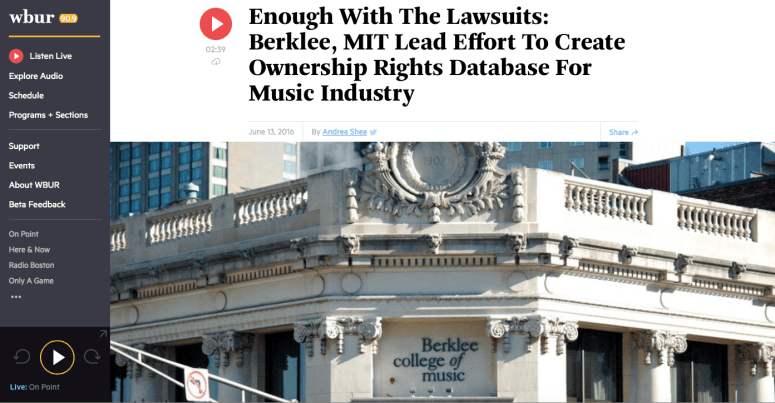
Enough With The Lawsuits: Berklee, MIT Lead Effort To Create Ownership Rights Database For Music Industry

Thank you.

So this is just what we suspected it to be all along, cynical counter-programming to burnish the public image of an industry that has been the target of a host of class-action lawsuits. Largely because these companies blatantly violated a host of federal laws by failing to license and pay songwriters.   And BTW I’m not just talking about copyright law here.   If I was a Spotify shareholder I would take a close look at those Spotify financial statements. (What are the EU rules for reporting contingent liabilities like potential lawsuits?)

Actually counter-programming is too nice of a term.  If the WBUR article is any indication, expect the OMI to propagate falsehoods and propaganda that mislead the public and potential songwriter class members as to the nature of their rights.  Look at this whopper by Berklee’s Panos Panay:

“It’s one of the few industries that I know where you can use something and it’s OK to not really know who to pay,” he said with a laugh. “Well we don’t think that that should be acceptable.”

Actually it’s not ok to use a song without knowing who to pay.  The law is very clear on this matter, hence the class action lawsuits.  This statement has the potential to mislead putative class members, specifically by making them think that their rights have not been violated.  This is a very troubling statement since Spotify is somehow sponsoring this initiative.

Of course this could also be sheer ignorance on the part of Panay. He may really think that you can use music without “knowing who to pay.”  As we demonstrated last summer Berklee’s academic scholarship on copyright and music licensing is quite shoddy:

https://thetrichordist.com/2015/08/08/100-dollar-prize-be-first-to-illustrate-all-the-flaws-in-this-berkleecollege-of-music-chart/

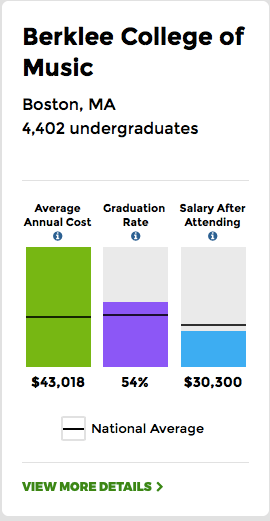
This may explain why a Berklee College of Music student pays $43k a year but typically earns less than a high school graduate after attending.  That’s right attending Berklee College is negatively correlated with future earnings!

Screen Shot 2016-06-22 at 10.27.53 AM

More on Berklee statistics here:

https://collegescorecard.ed.gov/search/?name=Berklee%20College&sort=advantage:desc

and here:

https://thetrichordist.com/2015/07/23/us-dept-education-transparency-report-on-berklee-college-of-music/

If Berklee College, NPR, WBUR and Spotify are truly serious about streaming transparency first order of business should be publishing a list of the “unmatched,” unpaid and unlicensed songs.  They won’t.  Because this is an elaborate corporate smokescreen.


A Reply To @WBUR on Open Music Initiative and Songwriter Lawsuits

Screen Shot 2016-06-21 at 11.34.03 AM

WBUR Public Radio in Boston recently published this highly misleading and shoddy piece of journalism.  This is yet another example of public radio being captured and co-opted by corporate interests, and downplaying the rights of songwriters and musicians.

Someone sent us this article by Boston’s NPR affiliate WBUR.  I was quite surprised to see WBUR repeating wholesale misinformation on the Open Music Initiative.

http://www.wbur.org/artery/2016/06/13/berklee-mit-music-rights-database

Here is the comment I left on their website:


Your title is funny. None of this would be happening without the class action lawsuits. 2 years ago in copyright office filings streaming services including Spotify were openly admitting they lacked procedures and technology to pay songwriters. A decade ago the then Attorney General of NY Elliot Spitzer nailed labels for “unmatched and unpaid” songwriter royalties. YouTube has come under fire for relying on a misinterpretation of “safe harbor” protections and is monetizing massive amounts of unlicensed “content” uploaded by their users. These are not “white knights” coming to the aid of songwriters and musicians, this is a cross-industry ass covering excercise. The parties involved had years to fix this problem. Your piece fails to note these facts. WBUR should be ashamed of their shoddy reporting. And Berklee should be held accountable for taking tuition money from aspiring musicians and songwriters ($30k+ a year) while simultaneously providing political cover for practices that make it difficult for graduates to pay back their loans.

While I welcome the efforts of the OMI, it should be properly portrayed.  Streaming services, YouTube and yes even the record labels have failed to follow the law on licensing and royalty payments.

I happen to agree with WBUR on one small point:  Class action lawsuits are not the ideal remedy, as they are expensive and place the burden on the victims.  This problem is so big,  and the malfeasance has gone on for so long,  it is really a job for the Department of Justice.