
Just an FYI for all you Trichordist readers. Yours truly will be performing at the Creative Upstarts Make Your Mark Party. Hope to see
If you want to come RSVP here.
Just an FYI for all you Trichordist readers. Yours truly will be performing at the Creative Upstarts Make Your Mark Party. Hope to see
If you want to come RSVP here.
You think Performers have it bad with streaming/webcasting services? Check out my performance royalties as a songwriter. This is why we must end the Government mandates that force us to license our songs to these services at below market rates. It’s a subsidy to multi-billion dollar Silicon Valley companies.
This is all songwriters on the song. Not just my share. My share is 1/5-1/2 of this total. varies by song.
This is total that all the songwriters earned on my 200+ published songs. If streaming is the future? It does not include professional songwriters. This can not stand.
| Summary | Spins | $ | Per Spin in Cents!!! |
| YouTube | 551,275 | $30.57 | 0.00555 |
| Pandora | 1,499,396 | $67.20 | 0.00448 |
| Spotify | 400,955 | $113.92 | 0.02841 |
| Rhapsody | 61,235 | $30.14 | 0.04923 |
| All other internet services | 1,000,915 | $15.96 | 0.00159 |
Thursday, March 13 | 3:30PM – 4:30PM
Austin Convention Center | Room 12AB | 500 E Cesar Chavez Sthttp://schedule.sxsw.com/2014/events/event_MP990775
Business gets harder and harder for recording artists and songwriters. Problems have developed with labels, publishers, fans, online distribution services like Spotify, major ISPs like Google, and Internet radio networks like Pandora. They also endure antagonistic courts, ineffective laws, and government indifference. As a result, their property interest has been significantly devalued and their rights abridged. Recently some recording artists and songwriters have started to criticize and push back against this new status quo.
MODERATOR
Jay Rosenthal
SVP & General Counsel – National Music Publishers’ AssociationEric Hilton
Thievery CorporationDavid Zierler
Pres – INgroovesLee Miller
Pres – Nashville Songwriters Association InternationalDavid Lowery
Musician/Internet Content Provider – Cracker

Medianet Statement reporting Beats and MOG plays.
This is the first of a series of posts in which I will highlight what appears to be statistical anomalies in the reporting of streaming and webcasting income to songwriters and performers.
Here is my songwriter statement from Medianet for plays on the Beats/MOG streaming service for Jan 2014. Yes MEDIANET the same company that Aimee Mann successfully sued for distributing her songs without permission. Now for the moment I’m not going to focus on whether Medianet is properly involved in this transaction. No I don’t have a direct deal with this company however they could have been hired by the streaming service(s) to pay royalties. Another possibility is the company may be involved by requesting a compulsory license (although I can’t find in my records a legally required NOI from the company!)
For right now I just want to point out that the plays Medianet and/or Beats are reporting are statistically unlikely. Very Unlikely.
This statement purports that the ONLY TWO songs that were streamed were two songs from Camper Van Beethoven’s 2013 album La Costa Perdida.
Come Down the Coast is reported to have been spun a total of 24 times.
You’ve got to Roll is reported to have been spun a total of 380 times.
If you know anything about the Camper Van Beethoven oeuvre these are not like our…er… um… biggest hits? Sure Pictures of Matchstick Men is a cover of a Status Quo song so that wouldn’t be on my statement and Take The Skinheads Bowling is administered by Wixen so I don’t get the statement directly. So I can’t compare this to my two biggest singles. But even without knowing the spins on those two singles these reported plays seem unlikely. There are many many more singles and fan favorites that have historically garnered many spins.
Digging deeper, Come Down The Cost and You’ve Got To Roll weren’t singles, licensed for commercials, placed in soundtracks, they were likely to be listened to in album sequence. As a result if you look at any songwriters catalog you will see that track 1 (in this case Come Down the Coast) is always spun more often than track 3 (in this case You Got To Roll). Further all my other statements from this time period do not show You Got To Roll being spun more than Come Down the Coast.
Finally it’s highly unlikely that these were the only two Camper Van Beethoven Music songs spun on the service.
This leaves us with 3 possible outcomes.
1. The statement is correct and there has been a drastic change in the popularity of Camper Van Beethoven tracks after 30+ years.
2. Beats Music and/or Medianet are not properly tracking on demand spins.
3. Beats Music and/or Medianet are just making up these statements out of thin air.
I’m not a lawyer but as a civilian it seems the last two possibilities imply varying degrees of fraud.
I encourage other songwriters to examine their statements from Medianet, Beats (also their wholly owned subsidiary MOG). If other songwriters are seeing these same anomalies we need to do something about this.
Also I call upon Beats “Artists Advocate” Dave Allen and CEO Ian Rogers to publicly explain what Beats reported to Medianet? After all Beats music promised to share their data with artists!
So why don’t I audit these companies? Well? Funny story.
As a songwriter the US Government bars me from auditing these streaming companies if they requested a compulsory license. Read that again. The US Government gives these Corporations a right to use my songs without asking my permission but as an individual I am barred from auditing them! So even if they are making this shit up I have no way of finding out. Chilling.

 ]
]
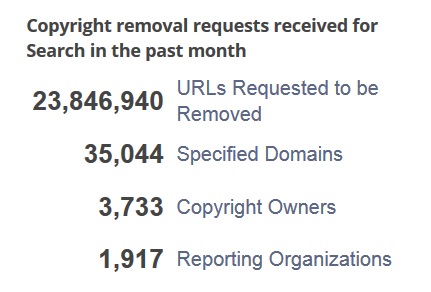
[Ed. Charlie says: This was a preamble to the 2011 posting of Chris Castle’s 2006 article “The DMCA Is Not An Alibi”. Google recently published its 2011 “Transparency Report” which has a couple interesting facts regarding takedown notices it received. Despite the $500,000,000 forfeiture by Google when it was caught in seven different sting operations profiting from the sale of controlled substances online, there is only one reference to takedown notices relating to drugs in the report–from South Korea. “[A] request from the Korean Food and Drug Administration (KFDA) resulted in the removal of 441 ads that violated KFDA regulations.” And the only country in the world where Google received a “content removal notice” that…
View original post 1,061 more words
There has been considerable discussion about how the DMCA notice and takedown procedures are “broken.” We don’t think that this is quite true—the procedures are manipulated, misunderstood and abused on a grand scale. That doesn’t mean that the notice and takedown procedure is “broken” any more than the laws against burglary, theft and tax evasion are “broken.” No statute can control unethical behavior by those who use the law as a flimsy excuse to get away with bad behavior.
Many Internet companies have interpreted the DMCA to permit bad behavior until the victim of the bad behavior notified the bad actor that they were behaving badly—each time they behaved badly. This “catch me if you can” interpretation of the DMCA was not at all what the Congress had in mind. We would go further and suggest that not only was it not what the Congress had in mind, it also wasn’t what…
View original post 1,165 more words
Thanks to Music Tech Policy for alerting us to this post from The Association of Independent Music Publishers:
Apparently, some internet users interpret the DMCA “safe harbor,” which is designed to strike a balance between copyright and technology, as something quite different, a “license” to post anything you like, even if you know it is infringing, unless and until the copyright owner complains.
The distinction may seem small, but it may represent how the general public regards copyright on the internet. Instead of avoiding infringement and respecting copyright, the concept of the “DMCA License” is that you don’t have to respect copyright. Do what you like, and at the worst the copyright owner might force your ISP to remove the material.
There is no such thing as a “DMCA License” because under the DMCA, copyright owners are not in any way consenting to unauthorized use. They are simply trying to…
View original post 22 more words
[Congressional Bills 113th Congress]
[From the U.S. Government Printing Office]
[H.R. 4079 Introduced in House (IH)] 113th CONGRESS 2d Session H. R. 4079 To amend title 17, United States Code, to ensure fairness in the establishment of certain rates and fees under sections 114 and 115 of such title, and for other purposes. _______________________________________________________________________ IN THE HOUSE OF REPRESENTATIVES February 25, 2014 Mr. Collins of Georgia (for himself and Mrs. Blackburn) introduced the following bill; which was referred to the Committee on the Judiciary _______________________________________________________________________ A BILL To amend title 17, United States Code, to ensure fairness in the establishment of certain rates and fees under sections 114 and 115 of such title, and for other purposes. Be it enacted by the Senate and House of Representatives of the United States of America in Congress assembled, SECTION 1. SHORT TITLE. This Act may be cited as the ``Songwriter Equity…
View original post 493 more words

Photo BitTorrent. Parody, Commentary and Criticism by Trichordist Staff. This would be a hilarious Kickstarter project, right? Imagine this billboard along the 101 after you come off the Bay Bridge into San Francisco.
San Francisco is known as a bastion of liberalism and progressive politics. It’s also home to many strident libertarian advocates of free speech and an open and robust internet. That is why we find it appalling that the San Francisco based BitTorrent operates a development facility in Belarus or as we like to call it “Little North Korea.” We have to assume that the coders who work at this facility–like all residents of Belarus–do not enjoy anything like what the international community would consider to be meaningful civil rights. Belarus’ Internet and media are severely censored. There have been mysterious deaths of journalists and by any measure Belarus is one of the most repressive regimes in the world. The Belarus Government has gone so far as to ban clapping in public. I’m not kidding.
Here is a recent job listing confirming the existence of the development facility.
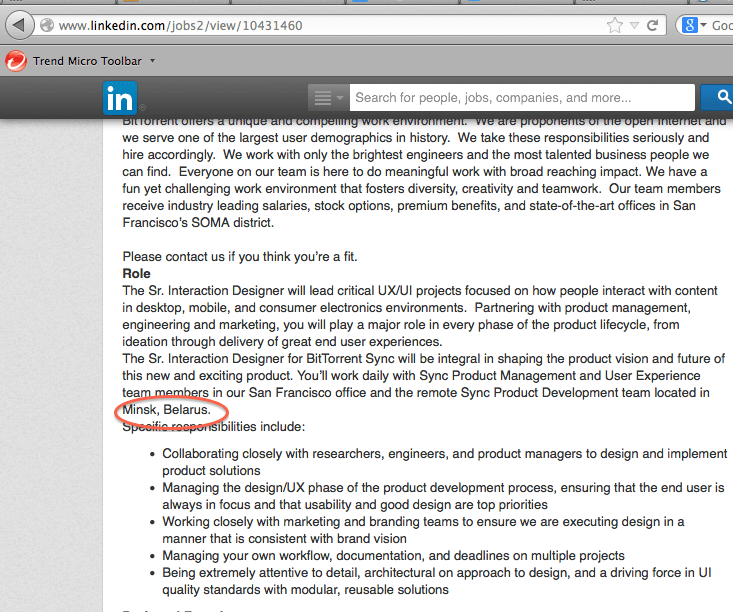
This is sheer hypocrisy coming from a company that spent a small fortune putting up billboards that said things like
BitTorrent should be ashamed of its behavior. Further, I think that BitTorrent’s Matt Mason–who has recently conducted an apparent public messaging push to “legitimize” BitTorrent–should explain to artists why BitTorrent indirectly supports such a repressive regime. Finally, everyone should check to see if their pension funds invest in the venture capital funds that back BitTorrent and consider whether this matches your ethical and political sensibilities. According to BitTorrent’s website these are their main investors:
DAG https://www.dagventures.com/
Read more about oppression in Belarus.
http://www.theguardian.com/world/2012/oct/07/belarus-inside-europes-last-dictatorship
http://www.rferl.org/content/uzbekistan_iran_belarus_media_censors/24567209.html
Songwriters, composers and music publishers earn royalty income through two separate rights: the right to publicly perform their music works, and the right to make reproductions of those works and distribute those reproductions.
However, two outdated portions of the Copyright Act, Section 114(i) and Section 115, prevent songwriters and composers from receiving royalty rates that reflect fair market value for the use of their intellectual property. This has created inequity in the marketplace that harms America’s songwriters, composers and music publishers in the digital age. Now is the time to fix it.
READ THE FULL POST AT ASCAP:
http://www.ascap.com/playback/2014/02/action/songwriter-equity-act.aspx


You must be logged in to post a comment.