Class Act: Amanda Palmer.

Amanda Palmer is a class act. On Wednesday she announced that she will pay ALL the musicians on her tour. This was after some withering criticism from fans, other musicians, journalists -and yes blogs like this- arguing that she was obligated to pay all the musicians on her stage. To her credit she sat down with her band and reasoned her way to the correct and equitable solution. Bravo. This returns her to form as the reigning queen of DIY and fan empowered rock.

But there is more to this story. Too often we forget as musicians that we need to stick together, that we need to fight not just for our own rights but the rights of other musicians. We are all in this together. This is how things like unions are supposed to work.

We celebrate the power of the internet to inform and empower musicians in cases such as these. This is how positive change happens. Well done everyone, this is what musician empowerment is about.

Pandora, Please Stop discrimination against Musicians!

Below is a letter from Tim Westergren, Founder of Pandora (NASDAQ: P) urging consumers to help him discriminate against musicians by attempting to reduce his royalty obligations.

This letter is highly misleading. Pandora is not Radio!! Pandora is a near-on demand streaming service.  Having a subscription to Pandora is like virtually owning every album on earth. (This is complex and we try to talk it through on a high level later in this post.) Pandora should and does pay higher royalties than XM radio for that reason!  It is completely manipulative of Mr. Westergren to compare his royalties to radio royalties.  Shame on him.  Shame on him for trying to get his subscribers to manipulate our government into screwing musicians. I am sad to see that Pandora has come to this:

Just another Silicon Valley firm who can’t make their business model work asking for a bailout from the US government and Musicians.  -David Lowery

We all love Pandora, we love that it pays on time and is honest in its approach and it provides a great platform for independent music. In fact, we’ve seen some estimates that 30% of Pandora’s spins are independent music.

Here’s what the lawyer for the webcasters said about the statutory webcasting rates at the time of the last settlement (and he never mentions artists, by the way):

In sum, while far from a perfect deal that webcasters would have selected on their own, this deal does provide another option for webcasters with substantial advantages in many area to those that qualify for treatment under this deal. While no doubt the fight will continue over the standards that should be used to determine royalties in future proceedings, so that parties don’t need to enter into these after-the-fact settlements [which is not happening now because the 2009 deal is in place until 2015] when one party has a substantial bargaining advantage with a favorable decision already in hand, SoundExchange [including the artist unions] should be credited for agreeing to reach this deal when there was no compulsion that they do so. This deal presents certainty for many webcasters – eliminating further litigation and negotiation costs while setting rates at which a class of webcasters can go on with their operations.

But what’s happening now ain’t personal, it’s just business. Pandora apparently doesn’t like paying artists a fair royalty–at a rate that Pandora negotiated and was all happy with a few years ago–and now is lobbying in Washington to use their political influence to force artists to take lower rates. Pandora compares itself to Sirius:

Consider this: last year Pandora generated $274MM of gross revenue, and paid $136MM of performance royalties — approximately 50 percent of the total revenue. In the same year, SiriusXM, on revenues of $2.7B paid $205M in royalties, or 7.5 percent. Radio delivered over cable television pays 15 percent of revenue. Radio delivered over the FM/AM spectrum pays nothing to performers.

This is, unfortunately, slight of hand–SiriusXM is primarily a subscription service and Pandora is primarily an ad supported service. Apples and oranges aside from low artist royalties–we have issues with Sirius, too, but that’s another story. The fact that over the air radio pays nothing is not exactly something to be proud of as we will spin out a bit in this post. But here’s the point we think is important: If Pandora wants to compare apples to apples and feels it is unfairly penalized by the rate setting procedure, it ain’t exactly like they weren’t represented in the past or now.

If Pandora would like artist support for some changes that would help them be more profitable going forward without reducing rates to artists, then all they have to do is ask and if what they want really is fair, they’d probably get artist support. But we didn’t hear that ask and we don’t see that proposal. What we see is the typical Big Tech Washington cronyism that artists simply can’t compete with.

You’re going to hear a lot of talk about “fairness” and “stifling innovation” as Pandora spends big lobbying bucks to grease the skids for the Congress to set price controls in its favor. Just remember–Pandora gets those big lobbying bucks from a wildly successful initial public offering of the company’s stock. And the reason Pandora had a wildly successful IPO is because they make a great product that is 100% dependent on your music. No music, no Pandora.

This is why the musicians union president recently called out Pandora founder Tim Westergren about this end run around artists

Of course, this technological innovation moves much faster than the laws out of Washington, which still treat each radio platform a little differently. That means some radio platforms, like Pandora, compensate artists when they play their recordings, while regular over-the-air “terrestrial” radio stations don’t pay musicians a dime for playing those same recordings.

That’s not fair to musicians that depend on those performance royalties to put bread on the table. And it’s not fair to expect some radio companies to pay while others get a free pass.

It sounds like Pandora never picked up the phone to discuss their beef with either the musicians union or the singers union (now SAG-AFTRA). This was a major oopsie for Pandora founder and Chief Strategy Officer Tim Westergren, an ex-record producer .

Unlike American Federation of Musicians President Ray Hair, Westergren ain’t elected and he only represents Pandora–even though Time Magazine says Tim is one of the 100 most influential people in the world. So it seems that when you have that kind of influence, you don’t need to call a mere elected union president whose members supply your company with its only product, but whose members had their bargaining rights taken away by the compulsory webcasting license. No strikes–just the way they like it in the Valley.

This is important because Pandora now wants to reduce their already low rates royalty rates to even lower rates. This is just like when Sirius and their PR machine wanted you to focus on how bad things were for Sirius Radio a few years ago when Sirius got a 50% off deal on their royalties. Now Sirius and their lobbyists and lawyers want you to ignore that Sirius suddenly has an extra $1,000,000,000 in cash–that’s right, a BILLION IN CASH. When the bad times came, the artists gave Sirius a deal. Sirius has no intention of returning the favor in the good times. We applaud their success, but where is the love?

The joke is that things are so bad for Pandora, they just went public. So don’t expect any love from Pandora, either.

Because just like Sirius, Pandora doesn’t answer to the artists for their 100% dependence on music.

Pandora answers to Wall Street, which is to be expected for a public company.

So we say to Tim Westergren, we love you, man, but face facts–you are The Man 2.0. Don’t fool yourself into thinking that Time Magazine knows anything about the music business. It’s really OK, we get you, we’re used to dealing with The Old Boss and The New Boss.

You made your choice, so just be honest about who you are when you are moving the goal posts.

Pandora’s Backstory

You’ve probably heard how difficult it is for “innovators” to license music because the major labels ask for big up front payments. This can be confusing because different types of music services qualify for different types of licenses. Here’s where Pandora, Sirius and lots of other Internet radio and satellite music services get a real advantage over other types of competing digital music services. (Digital radio licensing is a complex area, so we’re going to give you the high points and stay out the weeds.)

Back in 1995, the U.S. Congress effectively took away the artist’s and record company’s right to negotiate private deals with Internet radio when Congress established the limited public performance right for sound recordings. Due to a quirk of US law, recording artists were never paid for radio play unlike songwriters. The US Congress partly changed that in 1995.

So quick—how many of you thought all these years that the artists got paid when a song was played on over the air radio? (Call it “broadcast radio” to distinguish it from Internet and satellite radio, call those “digital radio”.)

Well, you’d all be wrong. Except for digital radio. (The most important difference between a Spotify-type service and Pandora is that Spotify allows you to choose which tracks you want to listen to (“on demand” or “interactive” and less like broadcast radio) and Pandora and Sirius “choose” them for you–“non-interactive” and more like broadcast radio.  There’s also a bunch of other government mandated restrictions called the “sound recording performance compliment”–too much to go into here.  Although we would argue that Pandora’s music genome allows it to be “near-on demand” but that’s another story.)

The compulsory license for digital radio does not cover broadcast radio or on-demand services. So far, artists have not been able to move that needle to include broadcast, although we’ve tried. Hard. Going up against the broadcast radio lobby is like going up against Google—limitless lobbying budgets, tremendous political influence, control over a significant portion of the dissemination of news. There is, after all, a radio station in every Congressional district. And most of all, an unbridled willingness to crush anyone who gets in their way. Like artists, for example.

This is a good time to mention a key fact—almost every other country in the world requires broadcasters to pay artists for performances on both broadcast and digital radio. (“Almost” because North Korea and China don’t.) So it is American broadcasters who get out of paying the artists, including American artists. This is why the broadcasters (including digital radio like Pandora) don’t like the Internet radio rates.

Even so, the digital radio royalty and statutory license have actually worked, which is more than you can say for the DMCA. What that means is that no one can refuse to license for digital radio and the royalty rates are set by the government. More on that later.

These SoundExchange royalties are split 50/50 between the sound recording owners on one hand and the featured artists, session vocalists and session musicians on the other. And—if the royalties are paid through SoundExchange (the non-profit that collects and administers the compulsory license), the artist money is paid directly to the artists on a nonrecoupment basis, meaning that the artists keep 100% of their digital radio royalty regardless of whether they are recouped under their record deals, current or historical. (Remember, SoundExchange receives royalties at many different rates, takes out some administration fees and then splits the money 50/50.  This is too complicated to go into here, but take a look at the SoundExchange website for more information.)

Spotify, for example, had to license recordings and songs piecemeal because Spotify’s on-demand service doesn’t qualify for the digital radio royalty. That’s why it took so long for them to launch in the US. (Although Spotify launched a side-by-side statutory digital radio service at the end of 2011 as a companion to their on-demand service.)

Pandora has leveraged this government-mandated compulsory license to get its business going. Unlike Spotify, all Pandora had to do to get its content licensed was send a notice to the Copyright Office and to SoundExchange, get blanket licenses for the songs and they were in business. No piecemeal negotiations with anybody, no advances to anybody, just send the notice, build their technology and get going. Artists get paid, labels get paid, innovators can form companies without paying any advances.

Of course, Pandora lead the charge in 2009 against the digital radio royalty rates. But they paid up when they got the deal they wanted. Or the deal that they wanted long enough for the company to bring to market an initial public offering of its stock.

Now they want a different deal.

And as the Bard sayeth, therein lies the rub.

This Time, It’s About Money. Period.

Remember—Pandora has great technology, superior technology even. Pandora is a highly innovative and music driven company. We love Pandora. But because it is music driven it has one product—music.

Pandora last negotiated licensing rates for the music they profit from in 2009. That was a long and painful process. We heard sanctimony from Pandora’s Tim Westergren at every turn about how Pandora was going to go out of business if they couldn’t get cheap licensing rates on music.

A lot of people said privately that they’d like to know where it was written that Pandora was guaranteed the right to stay in business when musicians weren’t. But Pandora looked like a promising investment, so artists invested in the company the way artists usually invest—do the same work for less money. Pandora got a special deal on royalties and they stayed in business.

That 2009 deal comes to an end in 2015 and new rates are now being litigated.   (The current “pureplay” webcaster rate for nonsubscription services that we understand Pandora qualifies for is a formula, the greater of 25% of US gross revenues or a per-play rate of $0.00110 ($0.0020 for subscription/bundled services like Pandora), going to $0.00120 in 2013, $0.00130 in 2014 and $0.00140 in 2015.  (Subscription/bundled services are a little higher per play rates.) Maybe–things are so good that Pandora may be about to shift into the 25% of gross revenues part of the formula and that’s the beef?)

Now Pandora are back again with the same song—they want to pay even less. So what happened? They must be having a really hard time like last time, right? Scraping by?

No, actually what happened between 2009 and now was that the company “went public” in 2011 with a billion dollar-plus valuation, the dream of every Silicon Valley entrepreneur. The founders and their VCs cashed out. We’re happy for them and glad to see a stand-alone digital music service trading on the New York Stock Exchange.

Westergren is apparently not as rich as Daniel Ek (the 10th richest man in the music business), but surely he got a nice payday when Pandora went public (which we think he totally deserved for years and years of hard work, by the way). Pandora has a market cap roughly that of a major label. But now that it’s public, Pandora has to make its revenue numbers to keep Wall Street happy. So there’s a couple different ways they can do that.

One way is to throw all their resources at growing their revenues. That’s what most people will do.

The other way is to decrease their costs. Like their royalty costs, for example. It is simple math: Every dollar that Pandora pays in royalties is a dollar less for Wall Street. The fastest way for Pandora to increase its profits—and theoretically its stock price–is to pay lower royalties to artists.

And when you look around the Pandora board meeting, there’s a face at the table to oppose cutting every cost item–except one.

This will be familiar to artists—it’s the same fight that artists are having with Spotify. And just like Spotify, we don’t see Pandora coming to the artists and offering to pay a bonus to everyone who gave them a deal on royalties so that Pandora could be successful and go public.

For years we’ve heard from Westergren about how artists should aspire to be middle class, to make a good middle class living, don’t expect too much, be happy with what you have. Lowering expectations.

Meet the new boss.

Pandora’s Box

Now we know why. The other shoe is dropping now, and Pandora’s true agenda is becoming obvious. Rather than devote themselves to growing their revenues to satisfy Wall Street, instead they want to spend their resources on lobbying the government to force artists to accept lower rates knowing that the artists on whom they depend cannot compete with lobbying dollars of their own.

The Greek name “Pandora” translates into she who received gifts from all. And boy does that ever fit this company.

Here’s the deal—Pandora gets the gift of certainty in licensing, certainty in rates and low startup licensing costs. This gift allows them to devote their resources to innovating delivery and discovery of music which they have done masterfully.

What do they give back for this gift? We don’t get equity in their company, so when they went public, we got nothing while they joined the Valley elite. (Just like artists won’t get anything when Spotify goes public.)

And now Pandora wants even more gifts. And they want to use their public company political clout to force artists to accept less so Pandora’s shareholders can get more.

And yes, it is a zero sum game and yes it is that simple. Pandora keeps Wall Street happy while they get rich from our gifts and now they take their riches to lobby the Congress to pay them even more of our money.

So at the end of the day there is very likely going to be another Big Tech driven SOPA-style hissy fit over digital radio rates. And remember, it was Pandora that originated the hissy-fit technique that Google perfected with SOPA so expect that threat just any day now from one of the Most Influential People in the Known Universe.

But this time—don’t let them fool you into thinking that somehow they are doing this to protect the “middle class artist” or “innovation”.

Because they are not.

This time it’s just about money and we won’t get fooled again.

____________

Updated 9/22/12 to include clarification on “near on-demand”, SoundExchange splits, Pureplay rates and Oxenford quote.

Google Pro-Artist Policy Changes Challenge Allegations of “Net Censorship”

In the latest in a series of practices Google removes “Pirate Bay” from auto complete. There is a saying that the journey of a thousand miles begins with but one step, and Google has begun to take that journey. These moves should be celebrated by artists, musicians and creators – however we’d suggest some cautious optimism given Google’s history of appearances over actual meaningful change. None the less, this recent move can’t be seen as anything less than positive.

In addition to this latest change, Google has:

1) Created a (relatively) easy to use web form for de-listing up to 10,000 infringing links from Google Search in just one DMCA notice.

2) Begun to drop the rankings of sites identified as predominantly dedicated to infringing activity (as determined by the volume of accurate DMCA notices for de-listing).

3) Providing Content Management System (CMS) tools to individual artists, musicians, filmmakers and creators on YouTube.

The most important thing to take away from all of this is that these policies reinforce what we have always said, reducing online piracy is a question of will not capability. As Google implements more of these policies the shallow talking points of the freehadists become more diminished. Online piracy is about free beer, not free speech and we applaud Google for these early and hopefully meaningful baby steps towards an Ethical and Sustainable Internet for all citizens. And uhm, no Torrent Freak, it’s not censorship… let the screaming begin…

###

Originally posted in the Weekly Update for September 16th

Occupy Amanda Palmer?

Unless you’ve  been living in a cave on a some remote South Pacific island, by now you’ve heard that Amanda Palmer created quite a controversy when she announced that she was asking for string and brass section “volunteers” to work for her on many of the dates on her tour.  Ms. Palmer became an even bigger celebrity this last year when she did a Kickstarter for this album and tour and raised $1.2 million dollars. A full million dollars more than she needed for the project.

For the last week, I’ve tried to avoid joining the anti-Amanda Palmer internet pile-on that has captivated many in the music business and tech world. Why? For one simple reason. I believe in the artist’s right to monetize their songs and performances in any way they see fit.

If Ms. Palmer had told her Kickstarter fans that she intended to record her entire new album in one take with one microphone into an iPad, post it on the internet and pocket the 1.2 million dollars that is her right. (Well, hers and the IRS’s.) Yes even a punk cabaret singer deeply involved in the Occupy Wall Street movement has the right to get rich from her art and music. It’s nobody else’s business. Yes, that may clash with her public profile, and her fans can also choose to not support her if they think this is somehow hypocritical. But she has no obligation to give away all her earned riches–or gifts for that matter. Further, she has no obligation to be transparent about her finances, as she is a private individual. Although I understand why publicly asking for money on Kickstarter may change that for many artists. I stay out of this part of the debate, cause it seems to be mostly about  the million dollars and whether Amanda Palmer has the right to make a comfortable living in privacy. Of course she does.

However, I do agree with the criticisms of others on nearly every other count.

This appears to be the blog post that started the whole controversy, Amy Vaillancourt-Sal of Classical Revolution Portland:

My friends and I are looking to bring back the respect that  musicians deserve. As a personnel manager for my branch at Classical  Revolution, I’ve been working towards assuring that my musicians are  compensated for their talents and hard work. So, looking back at your  ultra successful kickstarter and your request… Here you are, and you’ve  raised over $1 million for your tour and album release. Here we are as  musicians on foodstamps, maxing out their credit cards to keep the  lights on, are hoping that we have enough money to pay next months rent,  and have instruments that are in need of repair, need to be replaced,  and even need to be insured. We are looking at you now and your request  for musicians to come play with you for free, and most of us have even  fallen in love with you and your music, and how do you think we’ll  respond? We’re f*&king perplexed, agitated and disheartened, to put  it mildly! What would you say to you if you were in our shoes? I have a  pretty good guess…

The naive ones will say “sign me up!” I most certainly had that as  my first response. But in looking at the whole picture, this time you’re  coming across as the 1% looking to exploit us. I’m guessing this is not  the impression you were going for. If this is the case, please respect  the musicians who are giving you their time and specialized skills. We  would love to play for you! Please do the right thing, Amanda. This all seems so contrary to your vision.

The  future of music is musicians being compensated for their specialized  skills and the beauty and difference that their craft brings to the world! We all know you can  certainly afford it…

Ms. Palmer then somewhat defensively responded:

your concern reminds me of the complaints i’ve seen from musicians who insist that i’m “devaluing” their own recordings by giving my music away for free and encouraging people to pay what they want for it (which is how i just released my new record). i get the impression that they see me as a force of evil who is miseducating the public to think that “music should be free.”

here’s what i think about all that, and it also applies to this paid/non-paid musician kerfuffle:

YOU HAVE TO LET ARTISTS MAKE THEIR OWN DECISIONS ABOUT HOW THEY SHARE THEIR TALENT AND TIME.

especially in this day and age, it’s becoming more and more essential that artists allow each other space to figure out their own systems.

the minute YOU make black and white rules about how other artists should value their own art and time, you disempower them.

The thing is–Amy never said she was trying to make rules. She’s not the employer. We’re not talking about sitting in, or a jam. Ms. Palmer is an employer and she does make the rules on her stage. Other musicians–like Amy and me–don’t have to like her rules. We are free, however, to point out that this employer does not pay fair wages. This is a collective bargaining/workers rights issue. Nothing more. Please don’t try to make musicians feel that questioning the ethics of a rock star employer is somehow violating the rock star’s human rights. That’s disingenuous.

Justin Colletti also made some good points…..

Is it  noble to support musicians only with “exposure”? Exposure for what? So  that they might be selected to play the next cash-rich tour for free as well?  Or are we talking about the kind of “exposure” that musicians will be  subject to when they can’t pay their rent?

Let’s not make  false equivalencies in this debate. It’s important to remember that  we’re not talking about a friend of Ms. Palmer’s jumping up on stage to  play a guitar solo or sing backup on a song. Rather, we’re  talking about working or aspiring musicians who are expected to send in an audition tape, learn the material in advance, arrive punctually for a high-pressure rehearsal, and then arrive punctually again for a  high-profile performance in which they will be an essential part of the emotional and aesthetic  impact of many of the songs.

This kind of work deserves  compensation — even if its just a token sum from an artist who cannot  afford to pay a more traditional rate….

Palmer is paying her promotional team and her management team  handsomely, but not the musicians? In doing this, she is becoming the  very thing that she has told us she is railing against.

If a concert stands to make no money at all, or if it does stand to make money but the proceeds are  meant to go to a humanitarian cause, then playing for free can be a very noble thing to do. But it’s important to remember that Amanda Palmer is not a  charity. She is now running a significant for-profit entertainment business. And she’s doing a very savvy job of it. Other entertainment entrepreneurs would be well-advised to learn a lot from her. But not this.

I sympathize with Ms. Palmer. I understand how she found herself in this situation. It looks like over the last three years her shows have averaged about 600 paid attendance each night. An artist is lucky to receive a $6,000 dollar performance fee on that kind of attendance. If you consider the fact that a 8 person string and brass section costs money–my guess is close to $2,300-$3,500 a night in fees (based on local AFM scale) you can understand why she was reluctant to spend that kind of money.  She would still have to pay all her other expenses out of what is left.  I personally would not spend that kind of money (instead I would use backing tracks rather than ask people to play for free), but that’s her choice.

But now that Ms Palmer is playing for more than 1200 people a night and her shows are grossing between 30-60k a night, most reasonable people would agree that Ms Palmer would and should pay ALL her musicians. Just as this petition at Change dot Org  suggests:

Amanda Palmer: Pay ALL the Musicians that Perform On Your Tour

It appears that Ms Palmer has very conservative financial instincts she probably learned by years of down and dirty touring. I get that. Her  mistake is she didn’t realize that her financial situation has changed, and many of the old rationales are not there anymore. Once there is profit it should be shared equitably.  She simply failed to adjust to her new success. If Ms. Palmer is able to adjust her thinking and accept that she is now an employer in the 1% of musicians and pay all her musicians, we should all move on.  Until then I am adding my voice to those asking her to fairly compensate all her musicians.

Weekly Recap Sunday September 16, 2012

Grab the coffee!

Recent Posts:
* Safe Harbor Not Loophole: Five Things We Could Do Right Now to Make the DMCA Notice and Takedown Work Better

Beck’s new album, you provide the labor!
Beck is a genius in choosing to release his new album as sheet music only. The implications of this gesture touch upon many of the current issues that musicians face from respect for their labor to addressing the illegal exploitation of their work and internet piracy. Critics of the story in Forbes by Will Burns don’t get it. Yes, Beck did not invent sheet music. And, we all know that sheet music can be pirated as easily as the music itself, if not more so. But the implications here are greater in the commentary of the act itself. If you want to hear the music from Beck’s new album you can either 1) invest your own labor and play/record it yourself and/or 2) you can buy a ticket to see him on tour. The irony of this gesture is lost on most. We often hear from critics that musicians pine for a return to the 90’s, an age of the past prior to the internet when things were different. What is truly astounding is that those same critics want to return artists and musicians to the 90s themselves… the 1890s. Beck’s unique and thoughtful commentary on our times is an acknowledgement of the current reality for musicians. You can pre-order his new album [here].

Google Pro-Artist Policy Changes Challenge Allegations of “Net Censorship”
In the latest in a series of practices Google removes “Pirate Bay” from auto complete. There is a saying that the journey of a thousand miles begins with but one step, and Google has begun to take that journey. These moves should be celebrated by artists, musicians and creators – however we’d suggest some cautious optimism given Google’s history of appearances over actual meaningful change. None the less, this recent move can’t be seen as anything less than positive.

In addition to this latest change, Google has:

1) Created a (relatively) easy to use web form for de-listing up 10,000 infringing links from Google Search in just one DMCA notice.

2) Begun to drop the rankings of sites identified as predominantly dedicated to infringing activity (as determined by the volume of accurate DMCA notices for de-listing).

3) Providing Content Management System (CMS) tools to individual artists, musicians, filmmakers and creators on YouTube.

The most important thing to take away from all of this is that these policies reinforce what we have always said, reducing online piracy is a question of will not capability. As Google implements more of these policies the shallow talking points of the freehadists become more diminished. Online piracy is about free beer, not free speech and we applaud Google for these early and hopefully meaningful baby steps towards an Ethical and Sustainable Internet for all citizens. And uhm, no Torrent Freak, it’s not censorship… let the screaming begin…

The other side of “Disruptive Technology” and “Permissionless Innovation”
Perhaps we’d be indulging in a little to much of wearing a tin foil hat as to suggest that the YouTube glitch effecting Michelle Obama’s DNC speech was somehow calculated, but you never know, right? We find it amusing that when “Disruptive Technology” and “Permissionless Innovation” are employeed to protect the rights of artists the amount of outrage there is to “control the machines.” But aren’t these the same machine and bots that we’ve been told repeatedly over the past decade can not be controlled by humans? That they are too complex to be managed? Well, funny how the shoe in on the other foot. The truth is pretty simple, the YouTube Content Management System flags content that has been claimed by rights holders. No doubt someone between Google, The DNC and YouTube could have easily preemptively waived those claims prior to broadcast. As with all the alleged complexities of the technological age of the internet the simplest answer is usually the most accurate one, human error, not rouge machines.

But it’s only Bits? The carbon footprint of free…
Unfortunately all of that allegedly free music could have a larger carbon footprint than CDs. Although this article from Paid Content specifically comments on streaming content, there is a large carbon footprint across the entire digital ecosystem. Anyone who thinks that Media Piracy has almost no cost isn’t paying the electric bills or maintenance costs to keep a server farm up and running. These costs specifically illustrate how the exploitation economy works. The internet does not operate on fairy dust, it does in fact require capital. We’ve heard it said, denial is not just a river in Egypt. There’s even a carbon footprint to spam. So the next time someone mentions that the internet is a post-scarcity economy, they might want to rethink that… and review this piece from Harper’s on “Google’s Addiction to Cheap Electricity.”

And finally, check out the Arts & Labs Podcast with David Lowery.

Safe Harbor Not Loophole: Five Things We Could Do Right Now to Make the DMCA Notice and Takedown Work Better

By Chris Castle

There has been considerable discussion about how the DMCA notice and takedown procedures are “broken.”  We don’t think that this is quite true—the procedures are manipulated, misunderstood and abused on a grand scale.  That doesn’t mean that the notice and takedown procedure is “broken” any more than the laws against burglary, theft and tax evasion are “broken.”  No statute can control unethical behavior by those who use the law as a flimsy excuse to get away with bad behavior.

Many Internet companies have interpreted the DMCA to permit bad behavior until the victim of the bad behavior notified the bad actor that they were behaving badly—each time they behaved badly.  This “catch me if you can” interpretation of the DMCA was not at all what the Congress had in mind.  We would go further and suggest that not only was it not what the Congress had in mind, it also wasn’t what the participants in the discussions and negotiations and drafting of the statute had in mind, either.

A review of the history suggests that the true purpose of the DMCA notice and takedown procedure was to provide a little latitude to reasonable actors acting reasonably.  There is nothing—nothing—in the legislative history that suggested that key legislative leaders were ever thinking that any one company would receive a million notices in a year, much less a million notices in a week, week after week after week. (Google recently announced that it receives a million notices a week for search alone.)  [Editor note:  Since we first published this post in 2012, Google now receives more like FIVE MILLION NOTICES A WEEK!]

What is in the history is that the purpose of the DMCA was to provide a relatively low cost alternative to litigation for both creators and Internet companies when creators spot an unauthorized use of their work which should be a rare occurrence—and we think should be accorded a little latitude if reasonable people are acting reasonably.  That’s what a safe harbor is for—and the DMCA was intended to create a safe harbor, not a loophole.

There is also a threshold qualification to getting the safe harbor in the first place: The site operators shouldn’t actually know or have reason to know that there is infringement occurring on their premises.  If they find that some users are repeat infringers, the site needs to take them off.  Sounds fair, right?

Actual knowledge is the kind of thing that was documented in the Viacom v. YouTube and Isohunt discovery.  Having reason to know is called “red flag” knowledge, that you have so many indications that infringement is going on that it’s like someone is waiving a red flag in your face that anyone could see.  Like if you got a million notices a week that infringing was going on.

Another problem is that we have heard that some companies take the position that in countries where there is no safe harbor, they “deem” US law to apply.  Aside from the obvious cultural arrogance, if you ask the local courts and lawmakers, we seriously doubt they would be so accepting of US law, so let’s not deem that US law applies.  Also known as “pretending” that US law applies.

With this in mind, here are five things that could be done today to preserve the good in the DMCA without having to open up the legislation in a negotiation between artists and Big Tech—a process we think would lead to an extraordinarily mismatched negotiation given the tens—soon to be hundreds–of millions that Big Tech is spending on lobbying in the US alone.  These would apply as appropriate to any of the various companies that take advantage of the DMCA safe harbors.

1.  Stop Playing Games with Red Flag Knowledge:  If you receive a million DMCA notices a week, you look pretty stupid if you deny you have actual knowledge, and you seem incapable of sequential thought if you deny you have red flag knowledge that infringing is occurring.  A more plausible explanation of this extraordinary burden that such a system places on the economy is that the system is defective, like an exploding gas tank.

Just like a car with an exploding gas tank, the car may do a lot of good and may be useful to consumers.  But not with that gas tank.  That gas tank has to go.  And one reason it has to go is that the car with the exploding gas tank creates an unacceptable level of risk and harm to innocent people who randomly come in its path.

What search companies should do when they consistently receive thousands of notices for a particular site is block that site from search results, not just push them down in search results and continue referring customers to them.  The burden would then shift to that blocked site to prove that all those millions of DMCA notices were wrong—even though Google has acknowledged that 97% are accurate.

The reality is that these sites will slither off into the Internet to find something else to do.

2.  Block the File, not the Link to the File:  The point of the DMCA was to stop the infringement, that is, block the infringing material, not to stop one link to the infringement.  It has been interpreted by many, if not all, offending sites or search engines to require a link by link notice, or to require that artists litigate each link to a final nonappealable judgment before the link can be disabled, much less the file can be deleted.

This is a ridiculous interpretation of the law and is solely designed to allow the site to profit from infringement for as long as possible in the hopes that the less-well heeled will simply give up.

Google is particularly well-suited to discover blocked files due to its ContentID system on YouTube.  [Editor Note:  In the years since this post was originally published, it has come to light that Google crawls the hash for most if not all infringing files.  By blocking the hash, a single notice could take down a multiple number of infringing files.  Between the fingerprint or the hash, Google could easily block infringing copies whether the copies appear on YouTube or in the wild on the Internet.]  This is not a burdensome task.

3.  Don’t Treat Sites that Haven’t Registered a DMCA Agent as Though They are Entitled to the Safe Harbor:   You don’t get DMCA protection if you haven’t registered a DMCA agent with the Copyright Office.  This costs about $150.  Other countries have similar laws.  Don’t act as if a site that hasn’t even registered an agent (as a threshold step to claiming the safe harbor) is the same as one that has.  If search engines and ISPs act as if sites like Hotfile are entitled to the safe harbor without going through the required steps, this only protects the bad guys and trivializes the proper safe harbor protection for legitimate actors (like those same search engines and ISPs).

4.  Don’t Support Automatic Reposting:  Don’t support automatic reposting of links you disabled under a DMCA notice.  This turns the entire process on its head because as soon as an artist goes through the expense of taking down an infringing link, the web site allows the link to be reposted automatically and then requires the artist to send the notice all over again.  This is not only outside the intent of the law, it is sadistic.  Another reason why major offenders need to be blocked from search results by search engines that want to be in the business mainstream.

5.  Issue Google-Style Public Transparency Reports:  Google’s “transparency report” is commendable and provides useful information as far as it goes.  Note that the millions of notices Google reports it has received are just from the “premium” web tools it provides to heavy users.  Imagine what the numbers would look like if it included notices that were sent manually and included all Google properties.

If each major search engine prepared these public transparency reports, it would be possible to prepare a list of websites that were major offenders based on the number of accurate DMCA notices received.  That way, the Department of Justice could have better information on which to determine where to allocate its prosecutorial resources.

Since Google is so interested in letting the world know about the DMCA notices it receives by releasing them through Chilling Effects, surely Google will not object to organizing this part of the world’s information as well.

U2 Exploited by United Airlines, Jet Blue, HP, State Farm, Westin, Urban Outfitters, Sprint, AT&T, Amazon, Disney Resorts, Crate and Barrel

We completely agree with what Bono said in USA Today,

“…somebody should fight for fellow artists, because this is madness. Music has become tap water, a utility, where for me it’s a sacred thing, so I’m a little offended. The Internet has emasculated rather than liberated artists…”

We couldn’t agree more and we’ve been happy to see more artists speaking out publicly.

The situation is effecting artists at all levels like Aimee Mann, Neko Case, Talib Kweli, Ben Gibbard and Death Cab For Cutie, Jared Leto and 30 Seconds to Mars, Neil Young and Tom Waits to name just a few. These artists represent a wide spectrum of diversity and all are effected by the illegal exploitation of their work.

Let’s be clear about this. It’s about money. A lot of advertising money supporting the people ripping off artists to further their own wealth. Brands hire advertising agencies. Advertising agencies hire ad networks. Ad networks pay infringing and illegally operating sites, many of which are based outside of the USA.

Bono, here’s your haul for one nights research… Someone should have a talking to these brands and ad networks, will you join us on Madison Avenue?

* United Airlines x2 on h33t
* United Airlines on mp3 bear
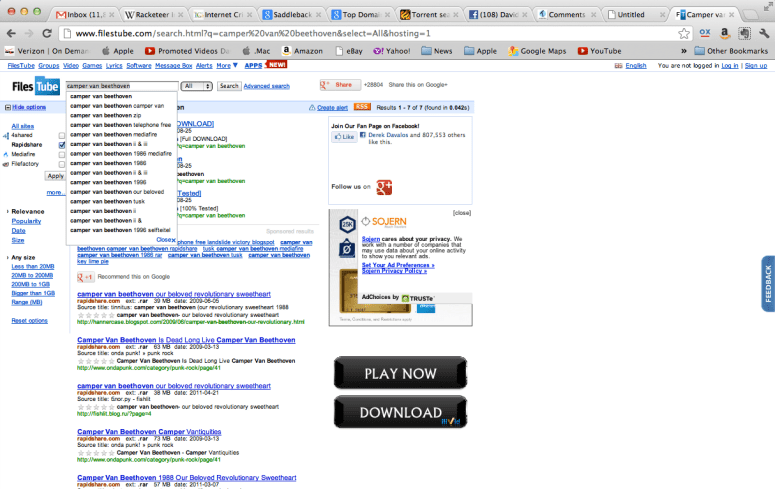
* United Airlines on FilesTube
* Jet Blue and Kayak on h33t
* Hewlett Packard and State Farm on mp3skull
* Westin Hotels on 4shared
* Westin Hotels on mp3raid
* Urban Outfitters on mp3skull
* Sheraton Hotels on mp3skull
* Century 21 on 4shared
* Alaska Airlines on torrent reactor
* State Farm on torrent reactor
* Sprint on torrrent reactor
* Sheraton Hotels on 4shared
* Hewlett Packard x2 on filestube
* Hewlett Packard and State Farm on mp3skull
* Hewlett Packard on h33t
* Rejuvenation on filestube
* Disney Resorts on torrent reactor
* Crate & Barrel on Files Tube
* Charter Cable on mp3 raid
* AT&T on mp3skull
* Amazon on 4shared

U2 Exploited by @UnitedAirlines, @JetBlue, @HP, @StateFarm, @Westin, @UrbanOutfitters, @sprint, @ATT, @amazon, @Disneyland, @CrateandBarrel

The Trichordist + Facebook = FarePlay
https://www.facebook.com/FarePlay
Join Us!

The Trichordist Blogroll – Labor Day 2012

On this Labor Day, we’d like to thank everyone donating their labor and love to the issues concerning artists rights. Be sure to drop by each of these excellent sites to get insight and opinion from many different perspectives about the issues important to artists and creators online. Each of the blogs below is worthy of your attention.