
While several pieces of music legislation have been introduced in the Senate, there is not a single comprehensive package yet. We are encouraging our Senate allies to bring these many issues together into a single, comprehensive Music Modernization Act, like the bill passed in the House.
Category: artist rights
Frog Gives Scorpion Ride: Is DiMA Trying To Strip MMA of Pre-1972 and AMP Protections in Senate?l

Artists give Digital Media Association (DiMA) ride from House to Senate (illustration Mīrzā Raḥīm 1847 public domain).
Wikipedia summarizes the fable of the Scorpion and the Frog as follows:
A scorpion asks a frog to carry it across a river. The frog hesitates, afraid of being stung, but the scorpion argues that if it did so, they would both drown. Considering this, the frog agrees, but midway across the river the scorpion does indeed sting the frog, dooming them both. When the frog asks the scorpion why, the scorpion replies that it was in its nature to do so.
Something similar appears to be happening as MMA moves to the Senate. The part of the scorpion is (naturally) being played by DiMA (Spotify, YouTube, Google, Amazon, Apple etc).
As you may have heard the Music Modernization Act passed the house 415-0 vote. Unprecedented. The show of unanimous support was largely the result of a grand compromise that gave everyone something. Songwriters, publishers, PROs, performers, labels, producers and digital services all will see some benefits from the bill.
The Music Modernization Act achieves this consensus by combining three separate bills:
- Original Music Modernization Act which reforms how compositions are licensed in the digital realm and rates are set. Championed by publishers, streaming services and many songwriter groups.
- Classics Act: Fixes pre-1972 “loophole” that has allowed digital services like Google, Pandora and Sirius argue they do not have to pay performers that had the misfortune to record before 1972. Championed by performers, labels and some digital services.
- AMP act: Allows producer and mixer royalties to be paid directly from SoundExchange. Currently most producers and mixers have to wait for labels to process digital public performance royalties (if they get them at all). Championed by National Recording Academy (Grammys), mixers and producers.
Something for everyone. This is how compromises work.
DiMA represents digital streaming services and policy is heavily dominated by Google and Spotify.
Now it appears that through the use of proxies and two-faced lobbying DiMA is trying to abrogate the entire compromise by stripping out the Pre-1972 and producer/mixer protections. There is a little inside baseball that must be explained here. Public Knowledge is an astroturf organization that appears to uniformly represent the interests of Silicon Valley. As one former employee remarked to me in 2012 “policy is 100% Google.” This is evidently true, just look at their policy positions.
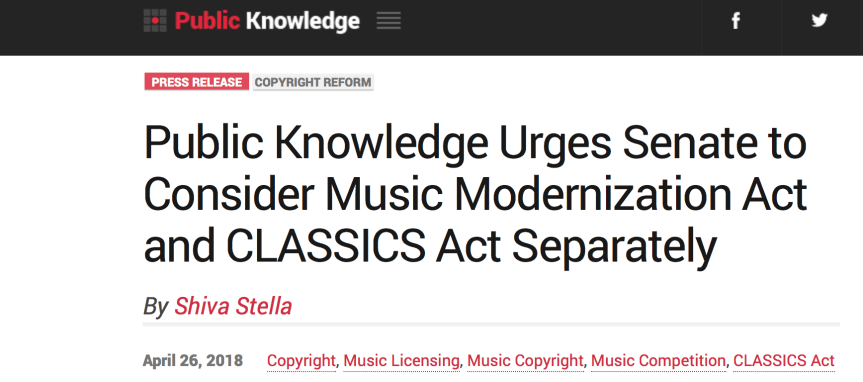
Curiously the day after the full MMA passed the house Public Knowledge posted this story advocating stripping out pre-1972 protections from the act:
Public Knowledge Urges Senate to Consider Music Modernization Act and CLASSICS Act Separately
Now pay attention. Think there is no connection other than the Google funding?
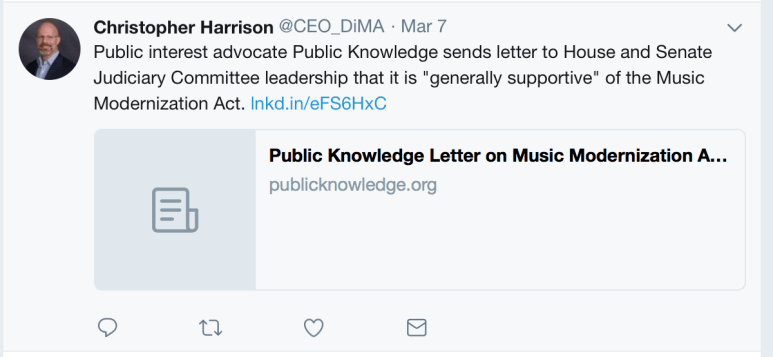
Here is the CEO of DiMA seven weeks earlier (March 7th) retweeting Public Knowledge letter which advocates stripping out elements of MMA that protect pre-1972 performers. This is not his personal account. This is the official @CEO-DiMA account. This is while Christopher Harrison and DiMA are supposedly singing Kumbaya with performers and rights holders.
Centruroides vittatus
On top of that we see are told by reliable sources that the US Representative from Google -oops I mean Mountain View (Zoe Lofgren) was poised to offer an amendment that would have effectively stripped the MMA of the Pre-1972 protections. At the last minute she dropped her amendment. We now see why. There was a plan afoot to strip it out in the Senate.
This clearly was the plan all along:
- Get all rights holders and services together on a compromise bill in the House.
- Strip out crucial elements of compromise in Senate and pass a bill that favors digital services.
If this looks like the SESTA House/Senate shenanigans it’s because it is largely the same companies and lobbyists on digital side.
Now that DiMA has been exposed our hope is that those that represent songwriters, performers, producers, labels and publishers direct the same opprobrium at DiMA that they directed towards dissenting rightsholders before the compromise came together.
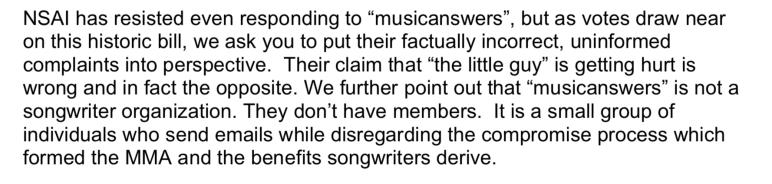
We’re not sure but we think the above paragraph might be an excerpt from an alternate-reality sci-fi novel based on Lavrenty Beria’s diary.
New Antitrust Chief’s Comments (Positively) Complicate Songwriter Calculus on MMA

Is Assistant Attorney General Antitrust Makan Delrahim songwriters’ new best friend?
Other than Chris Castle at MusicTechPolicy no one in music business seems to have noticed that the Makan Delrahim the new DOJ antitrust chief is suggesting ending many (if not all) so-called “consent decrees.” Consent decrees are a kind of regulatory supervision imposed by the DOJ in lieu of prosecuting firms for anti-competitive behavior. These decrees were originally intended to be temporary. The ASCAP decree was “temporarily” put into effect in 1941. Over the years many have evolved into permanent regulatory structures that are likely unconstitutional (they are in effect pseudo legislation).
I have spent considerable time in the last two weeks reading Delrahim’s comments and writings on anti-competition law. I think the odds are better than even that Delrahim will end the songwriter consent decrees. I say this because he has long held views against the “regulatory” consent decree approach and prefers “structural remedies” to anticompetitive practices. Second Delrahim specifically cited the ASCAP consent decree as an example of “bad” anti-competition regulation and noted how much the music licensing landscape has changed. Third, Delrahim seems to have quietly let the 100% licensing requirement for PROs die. Finally, my understanding is he could end the consent decrees with a stroke of his pen. Odds look good, but I could be wrong.
How badly do the Consent Decrees Distort Income?
Your average workaday songwriter is usually unaware that these consent decrees negatively impact the rates for public performance royalties (BMI and ASCAP royalties). The royalty rates imposed by the consent decrees push down royalties across the board. The ultimate absurdity is the resultant performance rates we songwriters receive from YouTube.

As an example, second quarter June 2017 my 40% ownership in the song “Low” earned me performance royalties of $30.78 cents for 589,553 YouTube streams. For a 4:36 second song that is over 5 years of music. So if you listened to music for 5 years straight 24 hours a day on YouTube the performance royalty to all songwriters would be $76.95. Since no one listens to music 24 hours a day this is clearly decades of music. YouTube is able to exact this usurious royalty rate, because they can simply threaten to not pay it and tie songwriters up (no pay) for years in the DOJ “consent decree” regulatory process. This is essentially what Pandora did a number of years ago. Surprise surprise, this tends to depress the market value of songs.
What happens without the Consent Decrees?
It is not entirely predictable. But if you look at the current rates imposed by BMI/ASCAP antitrust rate courts for digital services it is hard to imagine that they would stay this low. The current system effectively acts as a cap on songwriter pay. More importantly without the consent decrees BMI and ASCAP would be allowed to offer additional services. For instance they could offer not just performance licenses but also “streaming mechanical” licenses. Right now they can not. While independent songwriters and publishers have had no problem getting paid their performance royalties from streaming services via BMI and ASCAP virtually every independent has had problems collecting the streaming mechanical. (Hence the class action lawsuits.)
SESAC, the one songwriter PRO not subject to the consent decrees, is able to offer streaming mechanical licenses as well, via its subsidiary HFA. While HFA has had its share of problems, this approach ultimately could be a much more efficient solution for digital services as well as songwriters.
Is Ending the Consent Decrees for Songwriter Organizations a Radical Proposal?
No. Nothing like the consent decrees for songwriters exist in the rest of the world. In fact the opposite is the norm. Generally songwriters are usually granted exceptions from anti-competition laws. Many countries allow for performing rights organizations to license streaming mechanicals thus making licensing easier for digital services, songwriters and publishers alike. Here in the US the Nashville Songwriters Association International and PROs themselves have argued for ending or at least modifying the consent decrees in the manner described.
From the US Copyright Office Music Licensing Report (2015):
There appears to be broad agreement among stakeholders that PROs and other licensing entities should be able to bundle performance rights with reproduction and distribution rights, and potentially other rights, to meet the needs of modern music services. NSAI, for example, opined that “[t]he most efficient path to digital service providers obtaining necessary licenses would be to allow the PRO’s to license and collect mechanical royalties.”
And in 2014 comment to the Copyright Office Spotify itself entertained the idea of PROs issuing mechanical licenses:
“A licensing regime in which public performance rights and mechanical reproduction rights could be obtained from a single source or pursuant to a single license is an interesting idea and could in theory lead to efficiencies.”
James Duffet-Smith Spotify’s then head of licensing ultimately failed to endorse the concept, but clearly his musings indicate it was not “off the table.”
Ending the Consent Decrees Would be Pro-competitive.
A rational phase out of the consent decrees would be pro-competitive. There are already four PROs in the US. The only thing that has kept them from competing more effectively on price and services, is that every time the two PROs not under consent decrees (SESAC and GMR) try to innovate licenses or get higher rates for songwriters they are invariably threatened with consent decrees. Think about it: every time there is a pro-competitive variation in prices or licenses the threat of consent decrees tamps down competition and aligns prices and license terms. The consent decrees are objectively perverse incentives that limit competition. Also it should be kept in mind that, major music publishers and large independents already license both performance rights and mechanical royalty rights. There is no lack of competition on the songwriter/rights holder side. Other than a bogus “pre-crime” rationale there is no need for consent decrees to ensure competition.
PROs are Efficient Because they License Repertoires not Individual Songs
Often missed in the debate over mechanical streaming rights and PROS, is that fundamentally performing rights organizations have an efficiency built in. They provide music users and digital services with access to every song in a songwriter’s catalogue. Old songs, brand new songs and the songs yet to be written. There is not a need for a service to update their licenses for each new song. For instance a BMI licenses give a service access to all BMI writers songs (and fractional songs) past, present and future.
What Does this Have to do with the Music Modernization Act?
The main rationale of the MMA is that songwriters “trade” with digital services some future (possible but not guaranteed) improvements in how performance rights are calculated, and in exchange songwriters grant immunity from lawsuits to streaming services. Now,if the consent decrees go away, there is no “trade” here. Songwriters get nothing. Publishers do however still get access to the inevitable “blackbox” created in the time between passage of the law and launch of the collective to distribute mechanicals. Sadly, this I suspect is a motivation for some publishers.
Second the MMA has been “shopped” by publishing and songwriter elites under what now appears to be a false pretense: that the consent decrees will never go away. This is probably not true. It strikes me that songwriter organizations, publishers and PROs failed to do their homework on Delrahim. If you eliminate the consent decrees why would ASCAP or BMI need the MMA? Especially if you consider that there is nothing stopping the MMA’s proposed “Mechanical Licensing Collective” could just as easily issue performance licenses. That is the proposed mechanical licensing collective could swallow ASCAP and BMI. Also what’s the point in SESAC having the Harry Fox Agency? How does that compete with the new quango created by the MMA? Beware of any claim from the PROs that on balance the consent decrees help songwriters. They do not. They are a net negative and the fiduciary responsibility of the PROs require them to communicate this accurately to their songwriters. (And yes we will be watching.)
Third the MMA proposes a vast new bureaucracy that would less efficiently (song by song not by repertoires) duplicate what ASCAP and BMI already do. How is it possibly more efficient to do anything twice and the second time less efficiently? One set of licenses for the performance rights by repertoire and then song by song licenses for the mechanical licenses. I’d love to see an economist look at the MMA/consent decree interaction. Perhaps we can borrow one of Delrahim’s economists? After all he has explicitly stated that economic analyses will influence his consent decree decisions going forward.
Simplify the Music Modernization Act
With this in mind I suggest that the way forward is to simplify the Music Modernization Act. The most contentious, expensive (and longest) part of the Music Modernization Act is the proposed Mechanical Licensing Collective and associated database. I have long contended you can’t create an accurate ownership database of all songs. A list of “all songs” is a dynamic list with thousands of songs being added every day. Publishing catalogue ownership also often changes hands. However it is possible to make a list of “exceptions.”
Instead of a list of “everything” the logical approach is to make a much much smaller list of songwriters/publishers that wish to withhold streaming mechanicals from the PROs. The Music Modernization Act could be simplified to this:
- Explicitly end the consent decrees for publishers
- Allow PROs to issue mechanical licenses
- If a songwriter or publisher does not wish the PRO to administer the mechanical right they must explicitly make this known by joining the “opt out” list. This would be machine readable. It would include information on how to license the song.
- If a songwriter or publisher fails to join the opt out list, the digital services and music users may then fall back on the PRO license to pay mechanicals. This guarantees responsible services immunity from lawsuits.
You can see my original compromise proposal here:
Professor Michael Geist’s Fingerprints are on Bogus Human Rights Claim Against Canada.
Yesterday I published an article detailing the Human Rights complaint against Canada by David Kaye a so-called “UN Rapporteur for Freedom of expression.” While citizens of authoritarian governments worldwide are subject to restraints on freedom of expression, Professor David Kaye decided the four alarm fire for freedom of expression is a rather modest proposal to block pirate websites under Canadian national law. This is similar to laws that are in place in at least 20 other (democratic) countries.
The important of my article is that I noticed that the UN Human Rights Special Rapporteur had engaged in a deceptive sleight of hand. He claimed his analysis was based on existing international, national, and regional law. But upon drilling down we noticed he was actually referencing aspirational agreements by mostly technology company funded astroturf groups. Of particular concern was his reliance on The Right To Share and The Manila principles. These two documents do not hold the force of law and the Rapporteurs reliance on these documents for his complaint against Canada is dishonest, deceptive and possibly illegal. These documents are the international treaty equivalents of “Fake News.” Hence “bogus.”
Read more here: https://thetrichordist.com/2018/04/01/gone-phishing-un-official-uses-lookalike-website-in-attempt-to-block-anti-piracy-law/
Today while perusing comments I discovered that the (federally funded) Canadian Research Chair Michael Geist, may be in on the whole deception. Look at this curious comment in Geist’s submission to the CRTC on the website blocking proposal:

Spooky. It’s almost as if Geist knew the UN Special Rapporteur was gonna file a complaint. A complaint that also happens to cite aspirational non-legally binding documents that appear to be co-authored by Geist.
Academic freedom is one thing. Participating in a conspiracy to mislead the CRTC is another. I suggest that those investigating this manner, use freedom of information laws to look for communications between Geist and the the UN Rapporteur.
Gone Phishing: UN “Official” Uses Lookalike Website in Attempt to Block Anti-Piracy Law
David Kaye’s Fancy stationery.
David Kaye is a professor of law at University of California Irvine. He is also some sort of low grade UN Human rights official. He has fancy stationery with an address in Switzerland that says so. Isn’t that precious.
This UN title and fancy stationery apparently allows him to treat our closest ally and neighbor to north like they have some kind of hick country bumpkin government. You see, he sent a letter (on behalf of the UN?) which accuses Canada (of all countries) violating human rights by simply considering an anti-piracy law! Of course our fearless low grade UN official has probably sent many many sternly worded letters to real authoritarians as well. I just can’t seem to find them.
The law in question is a rather non-controversial law. The proposed statute is very similar to those that have been successfully applied in at least half a dozen vibrant European democracies. Did Kaye send Germany or UK similar letters? No. I wonder why that is? MaybeBecause those countries copyright authorities aren’t gonna put up with nonsense like this from freelancing low grade UN official that is 4 years into a 3 year term? Looks like Kaye just thought he could get away with it with Canada. Get away with it? Yes. All dishonesty explicitly intended. Essentially the letter by David Kaye is just a phishing scam that relies on the Canadian Government mistaking a bootleg UN lookalike website for the real thing. Because Kaye thinks Canada is stupid? Because Kaye’s buddy, Micheal Geist, Canada’s great petty copyright “expert” put him up to it? It should be noted that Geist has demonstrated a penchant for ghost writing. But I digress.
Follow along closely. This story will blow your mind.
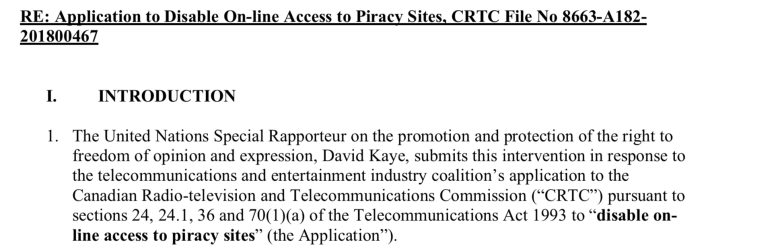
The letter starts out nice.

He notes that he will apply an analysis based on international, national and regional law. As well as jurisprudence (judicial opinions). Sounds great! Can’t wait!
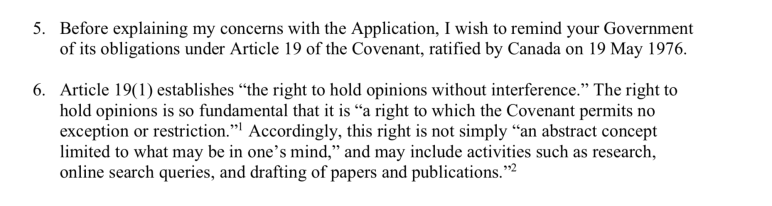
Mr Kaye then references UN article 19 which concerns freedom of expression. This is the covenant with which Canada must comply. But I’m not familiar with this second part. Hmm. Oh! I see, if you follow the footnote that second part is simply another paper by Mr Kayes. So that would be his opinion. It’s not actually in article 19. But that’s maybe okay. Maybe Canada should comply because Mr Kaye does have UN stationery! Even though at the outset he declared his analysis was gonna stick to law and jurisprudence. Seems interesting, let’s give him the benefit of the doubt. So please Professor Kaye, tell us more!
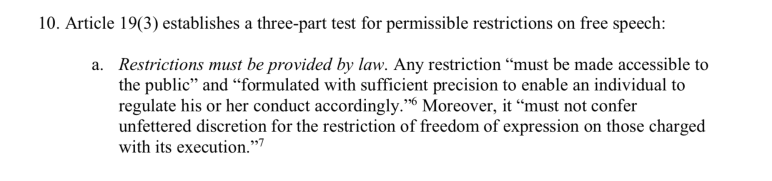
Mr Kaye returns to quoting from the actual UN document (article 19) since this is the rationale for his intervention into Canadian copyright policy. But three paragraphs later he wanders away from article 19 again.
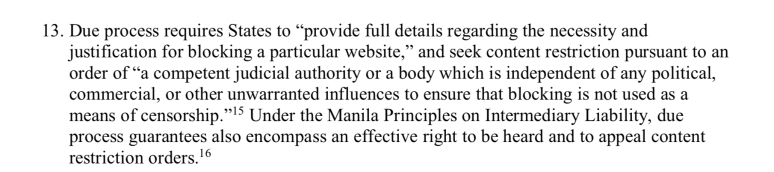
Manila Principles? Oh, so this must be a related international treaty to which Canada is a signatory. Hmm can’t find Canada listed as a signatory. And It doesn’t seem to have anything to do with the UN. As far as I can tell the Philippines isn’t even a signatory? NO COUNTRY IS A SIGNATORY! This is just a document written by the Google funded astroturf group EFF. A significant portion of the mostly obscure signatories have ties to Open Society, Google, are just fake or no longer in existence (see screenshot below).

“Cosby Sweater EU Bahn Mi.” The Heliopolis Institute is one of the signatories to the Manila Principles. This is their “about” page. And yes that is a stock photo!
But again I digress. Where were we…
The point is, this analysis is no longer based on international, national, or regional law. Nor is it based on actual jurisprudence. So what is this?
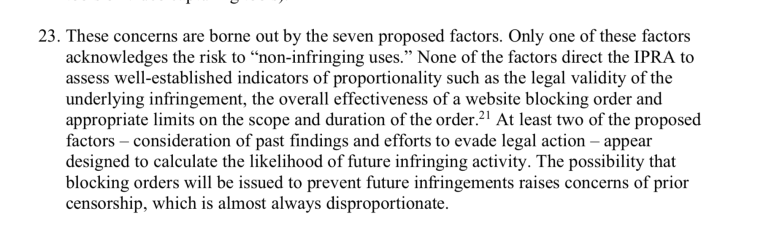

Okay, phew! Now we are back to Article 19. Look at the footnote! Yay! For a minute there I thought David Kaye was committing an academic sleight of hand. This is the real UN document.
Wow. So it really looks like Canada’s proposed law violates Article 19, specifically The Right to Share Principle 9. And what does principle 9 of Article 19, The Right To Share say:
Website blocking on grounds of copyright protection should be considered a disproportionate restriction on freedom of expression because of associated risks of over-blocking and the general lack of effectiveness of this measure.
Wow Canada really screwed up here. They can’t enact these restriction on piracy websites or they violate the UN covenant.
JUST KIDDING!
David Kaye must think all Canadians are idiots. That last reference (Article 19 The Right to Share) is to a website that from start-to -finish is designed to make you think it has something to do with the UN article 19, but is completely unrelated. In this sense it is a fraud. A UN article 19 lookalike. Look at the document. You could be forgiven if you thought this was a real subsection of the UN article 19. But fortunately the “Right to Share” nor it’s principles are endorsed by the UN. Because basically we artists would have no copyright protections, and that would actually for real violate UN Human Rights covenants.
So how did we get here? This doesn’t seem to be an accident. Someone went to a lot of trouble to create the fake Manila Principles treaty and the Right to Share document on the Article 19 dot org website.
It is ridiculous to think a UN Human Rights Rapporteur and an esteemed UC Professor doesn’t realize that this website and document is likely to be confused with a real UN document. And why shouldn’t they be confused? He is a UN official (however low grade) citing a document that has an URL, title and design that would make it seem like it is a UN document. Of course your average person is likely to be confused by this.
This kind of deception has got to be illegal. If not in the US. Then in Canada where the document is filed. For he tells an untruth when he says he’s sticking to international, national and regional law. I would argue he has attempted to “phish” the Canadian government with misleading documents. If this were anything else it would be wire/mail fraud. I suggest at the very least the Canadian government make a complaint to the UN Human Rights Council, his academic institution (UC Irvine and throw in the California State Bar as well (ethics).
Or better yet, just call him to testify in Canada. Ask him about the misleading little footnote to the fake article 19. Also FOIA his UCI communications with Geist. See if there is anything there. That would be interesting.
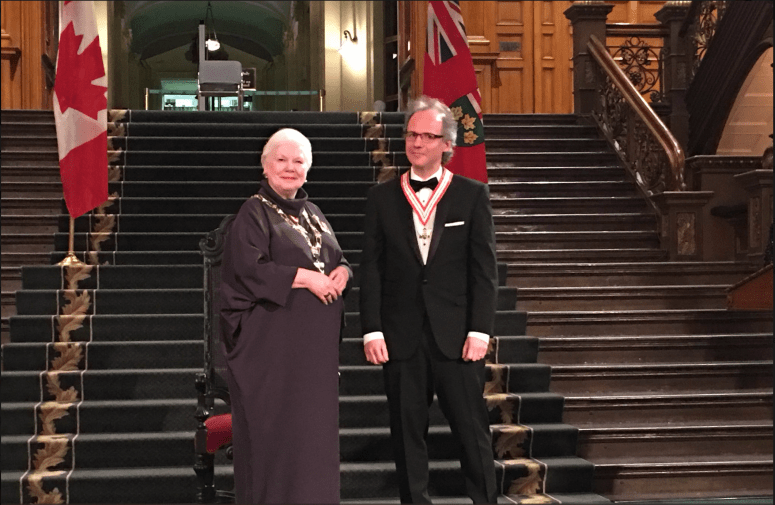
Michael Geist being awarded The Order of Ontario for “Most Petty Copyright Expert” after he petulantly had his university library cancel subscription to a publication with which he took offense.
Photo via Official twitter account of the Ontario Ministry of Citizenship & Immigration focused on Citizenship.
Closer to home/Ottawa. Canada’s “Most Petty Copyright Expert” Michael Geist appears to be in on the whole racket. He appears to be co-author of the fake Article 19 The Right to Share which is the at the heart of the fraud. And he seems to be lending the disgraceful David Kaye support on this issue (twitter and elsewhere).
Nice to see US and Canada working together again, even if the main result is negative for both country’s artists and creators. Whatever is good for Google and Silicon Valley must be good for the rest of us. Right?
++++++++++++++++++++++++++++++++++++++++++++++
(Editor note: standard footnote formatting rules give away the fact that someone somewhere wanted the public to be confused by the title. Someone choose to list Article 19 the organization, as the Author and didn’t italicize. This is permissible. But this ends up giving it the same formatting it would have if it were law or treaty and The Right To Share a article or subsection of the treaty.)
Did you hear the one about Bono?
Bono, you know the singer in U2. Also a venture capitalist.
Anyway this is a joke that has been floating around the music business since probably the early 1990s. There are a dozens of versions of it. I have no idea who originally came up with the joke. But here’s the version told to me by the late Don Smith:
An old 60’s hippy bass player is performing his usual Sunday afternoon gig at the local hippy coffee house outside of Santa Rosa in Mendocino County. They are right in the middle of “Going Up Country” in the style of Canned Heat when he collapses from a heart attack and dies. The bass player having lived a good life wakes up at Heaven’s gate and is greeted by St. Peter. As St. Peter is giving him a sort of orientation walk around, the bass player notices that there is a band playing somewhere. The bass player interrupts St Peter and asks “is that a live band playing.” St. Peter says “I was about to get to that” St Peter motions the bass player to follow him. He leads him down a narrow gap between two clouds into what is apparently Heaven’s night club. On stage he sees Jimmy Hendrix plugging in his guitar and Keith Moon tuning up a drumset. St. Peter motions the bass player towards the bass rig. The bass player can hardly believe his eyes. He gets onstage picks up what appears to be his 1972 P-bass and plugs it into his mint condition Acoustic 360A with a reverse 18″ cab. Hendrix launches into Purple Haze and the bass player, now ecstatic, joins in. After a few more songs George Harrison comes up on stage and they play “My Sweet Lord” and “While My Guitar Gently Weeps.” Janis Joplin jumps up and for a final song they all break into a blistering rendition of “Piece of my Heart.” The band is about to leave, when Bono suddenly rushes up on stage Even though the musicians were all clearly about to take a break he cajoles everyone into staying. Bono and the band proceed to limp their way through “Beautiful Day” and “Vertigo,” Hendrix and Moon seem to have never even heard the songs and the whole thing ends with an embarassing smattering of polite applause. The bass player while casing his bass and putting his cords away notices St. Peter standing next to him. “What did you think?” St. Peter asks. The bass player says “It was great…but” pauses and after looking carefully around turns back to St Peter, “What’s up with Bono? I didn’t even know he was dead?” St. Peter laughs and says “That’s not Bono! That’s God. He just thinks he’s Bono.”
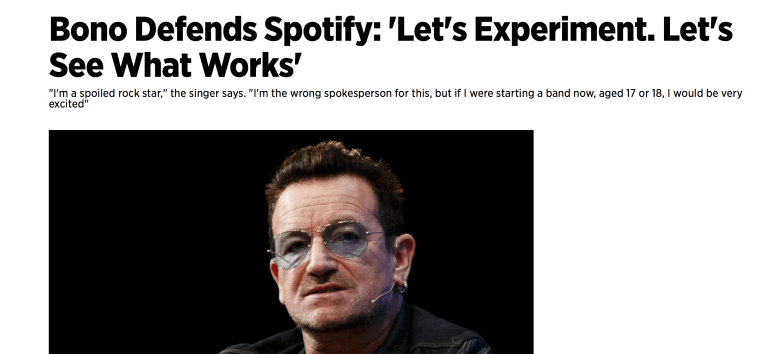
Here’s some screenshots that seem to tell a little story about Taylor Swift, Bono, Spotify and extremely powerful Wall Street private equity firms.

2014
2014

2014

2015

2016
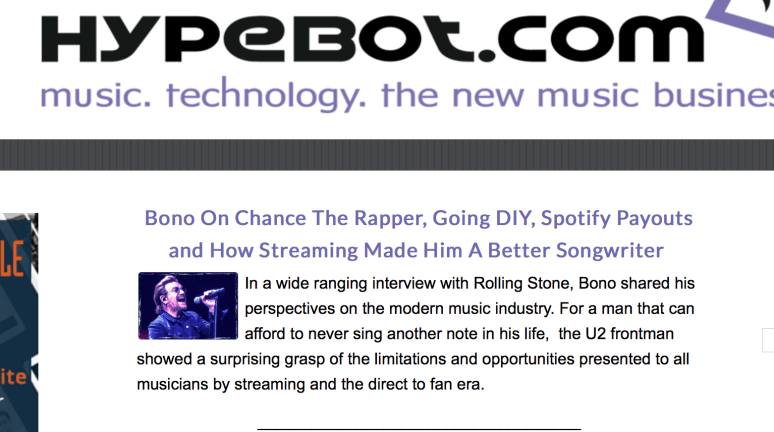

Jan 2018

Feb 2018
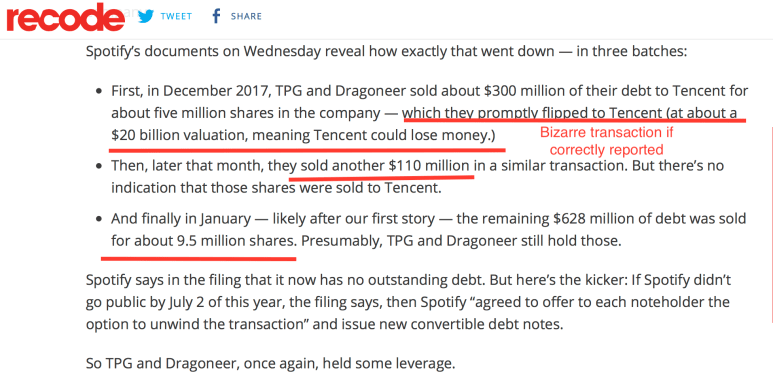
Feb 2018
Spotify Is Deeply Integrated With Facebook: How Safe is Your Streaming Data?

Spotify is stalking you (advertising campaign image by Spotify)
The public has woken up to the fact that Facebook is a spying and privacy violating machine. Governments in half a dozen countries have announced some sort of investigation into the company. What most people don’t realize is that Facebook is not unique. Virtually every free digital app is spying on you and sharing that data with 3rd parties. This includes the music streaming service Spotify.
However Spotify is unique. More than most other services Spotify and the Facebook platform are heavily integrated. When you sign up for Spotify from a web browser, you are encouraged to sign up using your Facebook login so they can associate your account with your profile. To illustrate just how integrated the companies are when I was offered a free premium account by Spotify (a sort of peace offering) somehow linking it to my email address reactivated my deleted Facebook account! I am not kidding.
And over the years many other people have complained about the tight integration between Facebook and Spotify. Particularly bothersome to many folks is that they often ended up sharing playlists, or songs they didn’t really intend to share.
There are probably two reasons for this. The first is probably relatively harmless. Major Facebook and Spotify shareholders overlap. Most notable are funds connected to Sean Parker (of Napster fame) and U2’s Bono (Elevation Partners and TPG). But less famous names and funds share investments in the company.
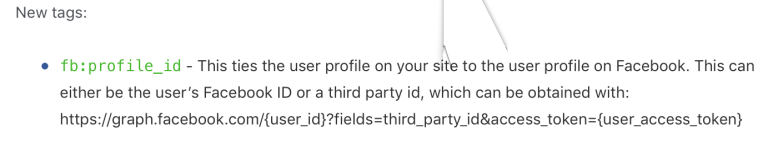
Screenshot from Facebook Open Music Graph Developers Page.
But the more important reason they are so tightly integrated is to harvest data. Folks who think Spotify is just a music platform are mistaken. The overwhelming number of streams on Spotify are on the ad supported tier. It is here that Spotify trades OUR songs for YOUR Data. And much of this data goes straight into the Facebook data mining machine. As far as I can tell this has been going since Spotify first launched in the US.
Most people are sophisticated enough to understand the difference between a public and private post. We live in a relatively free country where political dissent is tolerated; religious persecution is largely unknown and people do not need to hide their sexual preferences from the police. But in some countries if certain private information becomes public you could die.
That is why I don’t understand why Spotify for Brands would brag about data harvesting of this kind:
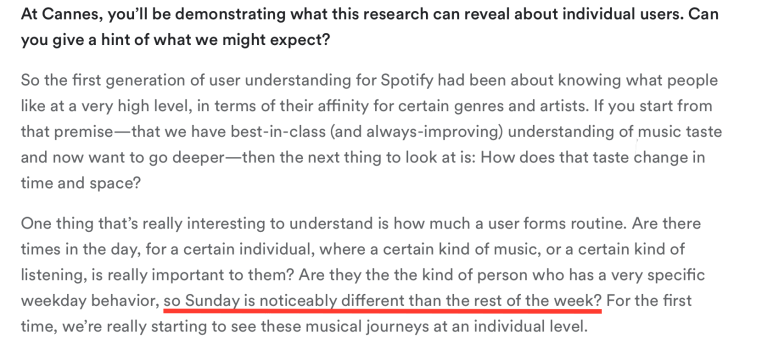
Paging Chairman Xi, you’ve got some “cultists.”
Or perhaps worse? What about countries that punish/criminalize anything but super normative heterosexuality?

(From advertising campaign image by Spotify)
Latest Draft of the Music Modernization Act
FYI everyone. Latest draft of the Music Modernization Act is available here.
The 2nd Draft of Music Modernization Act 3/22/18 was released publicly today. We are reviewing and will post comments in the coming days.
The first thing I noticed is that the tragic demonstration of the raw lobbying power of Big Tech: The litigation reach back safe harbor seems to still be in there which is designed to deny due process and other Constitutional protections to songwriters whose works are infringed prior to the enactment of the Music Modernization Act.
Plus the one-sided board of directors is still the inverse of the publisher/songwriter control in other countries, 70% publishers and 30% songwriters.
Can Blocking Ads Help Artists? Should Artists Encourage Fans to Block Ads?
I posted this article in 2015. But it is perhaps more relevant today. Ad supported streaming services rely on packaging and selling user’s personal information. Ad supported streaming underpays artists. Artists and consumers interests are completely aligned.
Subscription services pay artists better and don’t need to compromise consumer privacy. #DeleteTheFreeTier
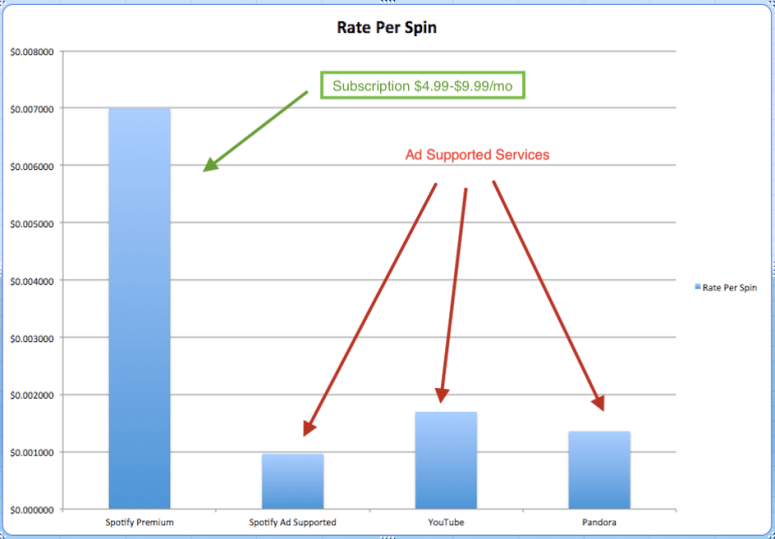
Rates are “all in” at source. Calculations based on royalty statements from a catalogue of 1500 titles 2014. Exception is Pandora which was calculated from 2nd quarter 2015 statements (higher than 2014).
In the fight for fair pay artists are not at war with the Internet or really even the streaming services, we are at war with the online advertising industry. As we have demonstrated time and time again, subscription (paid) music streaming services pay at least 7 times the rate that the free services pay. When you see artists (like myself) post absurdly low royalty payments it’s usually from one of the services that is predominately ad supported. Above is a chart that illustrates this nicely.
So for artists the solution seems easy: get rid of ad-supported free tiers. The problem is that in order to do away with these ad-supported tiers we have to fight not…
View original post 1,839 more words
@musictechsolve: How to Fix The Music Modernization Act’s Flawed “Audit” Clause — Music Tech Solutions
By Chris Castle (crosspost from MusicTech.Solutions)
Доверяй, но проверяй
The famous old Russian proverb reminds us to trust but verify. That’s been the story in the record business since the cylindrical disc. All the “modernization” in the world will not soothe songwriter’s genetic suspicion of their accounting statements.
The collective to be established by the Music Modernization Act (“MMA”) undertakes the obligation to handle other people’s money. It quickly follows that those whose money the collective handles need to be able to verify their royalty payments from time to time. This has been an absolutely standard part of every royalty-based agreement in the music business for a good 50 years if not longer.
But like every aspect of the MMA, one has to always remember that while all songwriters may be equal, some songwriters are more equal than others. The MMA creates a two tier system–those who opt out of the compulsory blanket license by the mutual agreement of a rights owner and a digital service in the form of a voluntary agreement and those who do not. Those who do not have this opt-out right appear to receive payment directly from the collective instead of directly from the service–adding another set of hands and transaction costs. (It must be said that this group receiving payment under the compulsory blanket license will presumably also include those who currently have a voluntary license with digital services that is not renewed it in future.)
The collective undertakes the responsibility of accounting should anticipate concerns of songwriters regarding verifying the accuracy of the statements and payments it renders. However, the MMA provides no supervisory oversight and in my view has a rather punitive black box clause that allows “unmatched” royalties to be paid on a market share basis to publishers, and then on to their lucky songwriters pro rata. This suggests that everyone who is in that lucky songwriter’s chain, like managers, business managers and lawyers working on a percentage basis may also get a share of these black box distributions in compensation.
So on the face of it, the MMA creates a relatively large category of people who have an economic interest in the black box. You can be cynical and think that they have an interest in the black box being as large as possible (meaning the accounting controls are as weak as possible), or you can agree with five-time Grammy winner Maria Schneider that if the “lucky” songwriters actually knew that they were being paid with money that belonged to the “unlucky” songwriters, they would be angry about that unfairness. Emphasis on the “actually knew”.
Or you could say, let’s not go either direction–let’s set up transparency and controls so that the incentives are properly aligned to create the smallest black box possible. No publisher needs the writer-relations headache of suspicious minds, and the collective should do what it can to be above reproach. Here are a couple solutions to increase the trust level: Add oversight of the collective by the Office of the Inspector General (as a quasi-governmental organand at least designated by the Copyright Office and operating under the control of the Copyright Office, and also tighten up the audit clauses in the MMA to treat songwriters auditing the collective the same as the collective is treated by the digital services.
The Inspector General
One way to make sure that the collective–a quasi governmental organization in my view–is run honestly is to make it subject to oversight review by one of the U.S. Government’s many Inspectors General. Rick Carnes of the Songwriters Guild of America suggested this to Rep. Doug Collins at the University of Georgia Artist Rights Symposium in a question from the floor.
For example, the Library of Congress (currently where the Copyright Office is housed) has an Inspector General. Since the Copyright Office has a lot to do with the creation and periodic review of the collective, they could save themselves a bunch of Freedom of Information Act requests from angry songwriters by having an Inspector General review the collective annually (or better yet, in real time).
My understanding is that giving an IG jurisdiction over the collective will require some enabling legislation, but I think it’s something well worth looking into. It would give the songwriters of the world a true-blue fiduciary to represent their interests as well as comfort that they had a line of appeal with some teeth short of expensive litigation.
Audits
The Inspector General is not in the current draft of the MMA, but audits are–both audits of the collective by songwriters and audits by the collective of digital music services. We’ll focus on audits of the collective in this post. It should be said that under the current compulsory license now in effect (i.e., pre-MMA), songwriters get no audit right, so the fact that there is an audit right at all is an incremental improvement.
Unfortunately, the MMA’s audit right still keeps songwriters away from auditing the right party–the digital services–and keeps that upstream data away from them. Plus, all audits under MMA appear to be subject to confidential treatment. I don’t think there’s a good reason to keep these secret. If a smart auditor finds a flaw in the collective’s accounting systems, that flaw should be disclosed and there should be an automatic true up of everyone affected.
But first, let’s realize what an “audit” actually is. It is a term of art in the music business and really means a “royalty compliance examination” which is solely focused on making sure that statements and payments rendered conform to the contract concerned, or in this case, the statutory requirements of the compulsory blanket license.
(It also must be said that as Maria notes, the MMA specifically exempts the collective from any responsibility for incompetent royalty accounting other than “gross negligence”, which usually means blatant indifference to a legal duty or something along those lines–assuming the collective’s board or employees actually have a legal duty to account correctly which it may not.)
The person conducting a royalty audit is typically not a certified public accountant as there is nothing about conducting this examination that requires a knowledge of Generally Accepted Accounting Principles (“GAAP”), financial accounting, or Sarbannes Oxley compliance. It is, in fact, quite rare for a royalty audit to be conducted by a CPA, and I’ve even had lawyers conduct an audit because the analysis involved is mostly that of contractual, or statutory, interpretation. Analysis of music industry-specific contracts is typically not part of the training of CPAs. So even if an auditor is a CPA, the skills needed to conduct the audit are typically learned through on the job training.
What is very common, however, is for someone on the receiving end of the audit to try to require the auditor be a CPA, arguably to increase the cost of the audit on the person owed money. CPAs often bill at higher rates than do royalty auditors, which creates a disincentive for audits. What is also common is for lawyers to think that every time they draft a clause about anyone conducting anything having to do with accounting, that they need to limit the person doing that examination to a CPA, because…well, because… This is what I call stupid lawyer tricks, and the CPA requirement is something that is routinely negotiated away in record deals and publishing deals if you have an ounce of leverage.
Here’s the preamble of the MMA’s audit clause for audits of the collective:’
A copyright owner entitled to receive payments of royalties for covered activities from the mechanical licensing collective may, individually or with other copyright owners, conduct an audit of the mechanical licensing collective to verify the accuracy of royalty payments and distributions by the mechanical licensing collective to such copyright owner
Remember–copyright owners under the compulsory are not allowed to audit the service, although the collective may audit the service. (And, of course, voluntary agreements are governed by their terms regarding audits and are not subject to the compulsory.)
Limiting the audit right to “copyright owners entitled to receive payments” means that if songwriters have an administration or co-publishing agreement, they will probably not be able to conduct an audit of the collective (even if their administrator or co-publisher is a board member of the collective). Because the audit is limited to “verifying the accuracy” of prior payments, the audit of the collective will not be able to look “upstream” to the service making the payment and may not be able to look at payments made to the collective, just the payments by the collective.
The audit shall be conducted by a qualified auditor, who shall perform the audit during the ordinary course of business by examining the books, records and systems of the mechanical licensing collective, as well as underlying data, according to generally accepted auditing standards and subject to applicable confidentiality requirements prescribed by the Register of Copyrights…
Sounds good, right? A “qualified auditor” is a defined term, however:
QUALIFIED AUDITOR.—The term ‘qualified auditor’ means an independent, certified public accountant with experience performing music royalty audits.
Again, I don’t think that the auditor needs to be both a CPA and have experience. Experience is enough. For example, if the auditor has performed audits for members of the collective’s board of directors, perhaps that would be enough.
The qualified auditor shall determine the accuracy of royalty payments, including whether an underpayment or overpayment of royalties was made by the mechanical licensing collective to the auditing copyright owner(s); provided, however, that before providing a final audit report to such copyright owner(s), the qualified auditor shall provide a tentative draft of the report to the mechanical licensing collective and allow the mechanical licensing collective a reasonable opportunity to respond to the findings, including by clarifying issues and correcting factual errors.
This clause is a problem. First, the auditor is hired–and has a professional duty–to find underpayments of royalties. That’s what they look for. The auditor does not have a duty to do the collective’s work for it and find overpayments. The auditor is not hired to find overpayments, they are hired to find underpayments.
The collective should hire its own accountants to review its royalty statements, and it surely will do so if it gets an audit notice. Otherwise the US Government is placing a heavy burden on the auditor and the copyright owners to look for overpayments as though the auditor played the role of a public financial accounting firm looking for accuracy on behalf of stockholders.
Plus, the requirement to force that auditor to give the collective the audit report before giving it to the people who hired that auditor is a bit much. Fair enough to meet and confer at the work paper stage to make sure there weren’t inaccuracies in the analysis, but that should not place any prohibition on whether the auditor’s own client can see the report first.
If this is really the role that the Government wants the auditor to play, then by all means let’s make any miscalculations by the collective available to the public and publish them in the Federal Register. Let’s not have the auditor’s findings subject to any confidential treatment. If that brings down a host of other audits or a need to restate millions of royalty payments, then so be it. Because we are not just looking for underpayments we are searching for the truth, right?
I don’t think so. And the next part of the audit clause shows why:
The auditing copyright owner(s) shall bear the cost of the audit. In case of an underpayment to the copyright owner(s), the mechanical licensing collective shall pay the amounts of any such underpayment to the auditing copyright owner(s), as appropriate. In case of an overpayment by the mechanical licensing collective, the mechanical licensing collective may debit the accounts of the auditing copyright owner(s) for such overpaid amounts, or such owner(s) shall refund overpaid amounts to the mechanical licensing collective, as appropriate.
Like so many other parts of the MMA, this is essentially an “ad terrorem” clause, or a right coupled with a penalty if it is exercised. What I think this means is that regardless of how much the underpayment might be–including both a material and nonmaterial amount–the songwriter bears 100% of the cost of the audit. The songwriter’s auditor has to look for overpayments (and bill their client for that extra review), and if the auditor finds any, the auditor has to report the overpayment. The songwriter then not only has to repay that amount (whatever “as appropriate” means), but also pay for the expense of finding it.
Compare this to the rights of the collective when auditing a digital music service:
The mechanical licensing collective shall pay the cost of the audit, unless the qualified auditor determines that there was an underpayment by the digital music provider of 10 percent or more, in which case the digital music provider shall bear the reasonable costs of the audit, in addition to paying the amount of any underpayment to the mechanical licensing collective. In case of an overpayment by the digital music provider, the mechanical licensing collective shall provide a credit to the digital music provider.
So what’s good for the goose is not good for the gander. When the collective is auditing upstream, the collective gets the benefit of that standard underpayment penalty. That means that the service has to pay for the cost of the audit if the underpayment exceeds a fixed percentage, in this case 10%. If there is an overpayment, the collective never has to repay the overpayment, just credit the account with an offsetting amount.
There should be no obligation on the part of the songwriter to have to find overpayments and if an overpayment is found in the normal course, it should simply be credited (which is the effect of the collective’s audit clause on songwriters downstream).
Songwriters should get the same underpayment protection on audit costs that the collective enjoys.
Appointing an Inspector General and cleaning up the audit clause would certainly make the MMA more fair for songwriters than it currently is.


You must be logged in to post a comment.