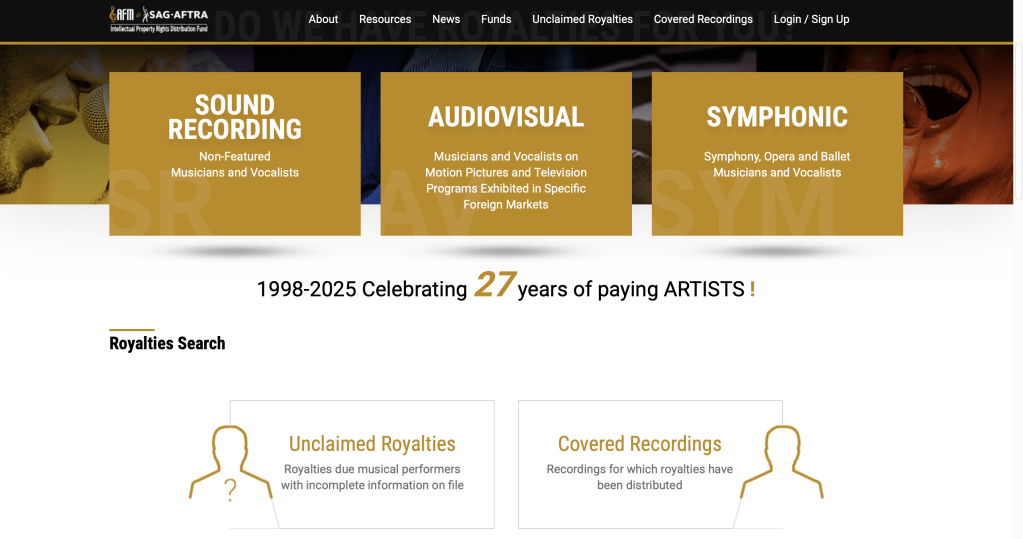
Remember, 5% of 100% of SoundExchange royalties are paid to the AFM/SAG-AFRA Intellectual Property Rights Distribution Fund. The Fund in turn pays a share of that royalty payment to the nonfeatured musician and vocalist performers. You need to check if the Fund is holding any royalties for you through their searchable index here.
The Artist Rights Watch podcast returns for another season! This week’s episode features AI Legislation, A View from Europe: Helienne Lindvall, President of the European Composer and Songwriter Alliance (ECSA) and ARI Director Chris Castle in conversation regarding current issues for creators regarding the EU AI Act and the UK Text and Data Mining legislation. Download it here or subscribe wherever you get your audio podcasts.
New Survey for Songwriters: We are surveying songwriters about whether they want to form a certified union. Please fill out our short Survey Monkey confidential survey here! Thanks!
One day shortly after the sale to PolyGram, I got a call from Cheryl Engels with a problem she needed help with. Cheryl at the time was A&M’s post-production director in mastering. Among other things Cheryl supervised our audio assets storage room (which was mostly tape assets at the time) and also supervised mastering of new releases for other labels and artists such as U2.
Cheryl had received a call from some putz in PolyGram Special Markets demanding our best quality masters be shipped to some place in New Jersey to be made into yet another stupid compilation record to be sold as God knows what kind of tchotchke. In other words, our recordings were going to be used for the sole purpose of commoditizing music and being yet another place outside of A&M where our artist’s recordings could be purchased.
Cheryl had told this putz that he didn’t need our precious masters and that she’d be happy to run him off a DAT for his one track. So why was she calling me? Because of what he said next: “We’re the parent and you’re the child and the child doesn’t tell the parent what to do.”
I said just leave this with me. I called the guy and said, “Hi, my name is Chris Castle. You don’t know me but I’m calling to explain to you why you’re not getting what you want, Mr. SVP of Bullshit. So first thing, I’ve been to your tape storage facility—are you going to store our masters by the broken water pipe or the space heaters? Near the open window or in the car park? And when would we get our tape back?”
After some back and forth, he accepted that this time it was different at least with A&M. He apparently thought that Cheryl had been difficult with him. I explained to him that he just needed to learn how things were done. I explained to him that in Cheryl’s area the way things were done was the way Cheryl wanted them to be done—because she was correct. I suggested to him that it worked for Herb Alpert, Bono, Sting and many other top artists and mastering engineers so maybe it could work for him, too. And more importantly for him at that moment, it worked for me and I was backing Cheryl 100% with no daylight.
In signing off, I said, “and by the way, if we have a “parent” at A&M, his name is Jerry Moss and I’d be happy to transfer you to him right now if you have any questions.”
And as they say, that was that. Another thing about Cheryl was that she kept track of the tape library which means that she knew where all of the original rolls and rolls and rolls of audio tape were that included outtakes, rough mixes, etc., etc., that are created as part of making a record, especially a high profile record.
Even with Cheryl Engels TLC, the media eventually wear out, whether it’s sticky shed syndrome for magnetic tape, or other degrading phenomenon for hard drives.
Steve Harvey writing in Mix Magazine has a very serious wakeup call coming our way:
[F]or the past 25 or more years, the music industry has been focused on its magnetic tape archives, and on the remediation, digitization and migration of assets to more accessible, reliable storage. Hard drives also became a focus of the industry during that period, ever since the emergence of the first DAWs in the late 1980s. But unlike tape, surely, all you need to do, decades later, is connect a drive and open the files. Well, not necessarily. And Iron Mountain would like to alert the music industry at large to the fact that, even though you may have followed recommended best practices at the time, those archived drives may now be no more easily playable than a 40-year-old reel of Ampex 456 tape.
This is why post production directors like Cheryl Engels were so insistent about quality control for the last 30 years. The problem came up when we were working on a lot of 5.1 mixes in the 2002 era and it’s coming up again with immersive as Steve Harvey points out. It will keep coming up as new mixing techniques required going back to the original multitracks. And 5.1 emulation is not the same as true 5.1.
Read Steve Harvey’s article—it’s very important to prepare for hard drive hell. Thankfully, Iron Mountain has some techniques up the sleeve to help, but trust me we are way past baking tapes in a hard drive reality. For unlike a magnetic recording that at least might allow one pass over the tape heads to transfer it to a new storage medium, hard drives may end up just being bricks. Assuming that tape wasn’t stored under a dripping water pipe in a basement, parents and children being what they are.
[This is a must-read, deeply researched, long form article about how Big Tech–mostly OpenAI, Google and Microsoft–are abrogating consumers trust and their promises to creators in a mad, greedy, frothing rush to some unknown payoff with AI. The Dot Bomb boom is dwarfed by the AI gold rush, but this article is a road map to just how bad it really is and how debased these people really are. Thanks to the destruction of the newsroom, only a handful of news outlets can deliver work of this quality, but thankfully the New York Times is still standing. How long is another story.]
OpenAI, Google and Meta ignored corporate policies, altered their own rules and discussed skirting copyright law as they sought online information to train their newest artificial intelligence systems….
OpenAI researchers created a speech recognition tool called Whisper. It could transcribe the audio from YouTube videos, yielding new conversational text that would make an A.I. system smarter.
Some OpenAI employees discussed how such a move might go against YouTube’s rules, three people with knowledge of the conversations said. YouTube, which is owned by Google, prohibits use of its videos for applications that are “independent” of the video platform.
Ultimately, an OpenAI team transcribed more than one million hours of YouTube videos, the people said….
Like OpenAI, Google transcribed YouTube videos to harvest text for its A.I. models, five people with knowledge of the company’s practices said. That potentially violated the copyrights to the videos, which belong to their creators.
Last year, Google also broadened its terms of service. One motivation for the change, according to members of the company’s privacy team and an internal message viewed by The Times, was to allow Google to be able to tap publicly available Google Docs, restaurant reviews on Google Maps and other online material for more of its A.I. products.
The companies’ actions illustrate how online information — news stories, fictional works, message board posts, Wikipedia articles, computer programs, photos, podcasts and movie clips — has increasingly become the lifeblood of the booming A.I. industry.
Companies using artificial intelligence software are shamelessly ripping off artists from film and music, and it will get worse if not regulated, members of the entertainment industry told U.S. Senators at a hearing Wednesday.
“AI in the service of artists and creativity can be a very, very good thing,” executive vice president of business and legal affairs for Universal Music Group Jeffrey Harleston said. “But AI that uses or worse yet appropriates the work of these artists, their name, their image, their likeness, their voice, without authorization, without consent, simply is not a good thing. Congress needs to establish rules that ensure creators are respected and protected.”
Long before an AI-generated recording imitating Drake and The Weeknd – both Universal Music artists – went viral and captured the attention of press and policymakers, UMG has been thinking about artificial intelligence. One of our companies, Ingrooves, has three patents in AI to assist with marketing independent artists. And AI has long been used as a tool in the studio: For example, Apple Logic Pro X to generate drum tracks, or Captain Plugins to generate chord progressions. We also use AI regularly as a tool to assist in creating Dolby Atmos immersive audio music. It’s a great technology when employed responsibly – and one that we and our artists use.
However, we are before you today because generative AI is raising fundamental issues of responsibility in the creative industries and copyright space. Each day, troubling examples emerge. We know some generative AI engines have been trained on our copyrighted library of recordings and lyrics, image generators have been trained on our copyrighted cover art, and music generators have been trained on our copyrighted music, all without authorization.
We have a robust digital music marketplace, and UMG has hundreds of legitimate partners who’ve worked with us to bring music to fans in a myriad of ways. Those companies and services properly obtained the rights they need to operate from UMG, or from the associated record labels and publishers. So, it’s unfathomable to think AI companies and developers think the rules and laws that apply to other companies and developers don’t apply to them.
The US is still the only Western democracy that stiffs artists on royalty payments for radio airplay. Let’s fix that!
[Editor Charlie sez: Anyone who tells you that artists can’t pass legislation to get fair pay for radio play is either a charlatan or full of shit and they are not on our side of the football.]
U.S. Senators Marsha Blackburn (R-Tenn.) and Alex Padilla (D-Calif.), along with Senators Thom Tillis (R-N.C.) and Dianne Feinstein (D-Calif.), introduced the bipartisan American Music Fairness Act to ensure artists and music creators receive fair compensation for the use of their songs on AM/FM radio. This legislation will bring corporate radio broadcasters in line with all other music streaming platforms, which already pay artists for their music.
Congressmen Darrell Issa (R-Calif.) and Jerry Nadler (D-N.Y.) led the legislation in the U.S. House of Representatives.
“From Beale Street to Music Row to the hills of East Tennessee, Tennessee’s songwriters and artists have undeniably made their mark,” said Senator Blackburn. “However, while digital music platforms compensate music performers and copyright holders for playing their songs, AM/FM radio stations only pay songwriters for the music they broadcast. This legislation takes a long overdue step toward leveling the music industry playing field and ensuring creators are fairly compensated for their work.”
“California’s artists play a pivotal role in enriching and diversifying our country’s music scene, but for too long, our laws have unfairly denied them the right to receive fair compensation for their hard work and talent on AM/FM radio broadcasts,” said Senator Padilla. “As we celebrate the accomplishments of our musical artists at the Grammy Awards in Los Angeles this weekend, we must commit to treating them with the dignity and respect they deserve for the music that they produce and that we enjoy every day.”
“Protecting one’s intellectual property is the signature right of every American who dares to invent. Every artist who first picked up a drumstick, sang to their mirror, or wrote lyrics from the heart did so because they had a dream and wanted to share it with the world. I look forward to working with stakeholders and colleagues to achieve this overdue reform,” said Congressman Issa.
“The United States is an outlier in the world for not requiring broadcast radio to pay artists when playing their music, while requiring satellite and internet radio to pay,” said Chairman Nadler. “This is unfair to both artists and music providers. I’m proud to sponsor the American Music Fairness Act which would finally correct this injustice. This is what music creators want and deserve.”
“It’s clear that the movement for music fairness continues to gain momentum, bringing us closer than ever before to ending Big Radio’s ability to deny artists the fair pay they deserve. This week’s House and Senate introductions of the American Music Fairness Act is evidence of that. We thank Senators Padilla and Blackburn and Representatives Issa and Nadler for their leadership in the effort to secure economic justice for our nation’s music artists and creators, and look forward to working together to drive continued progress in the coming months,”said Congressman Joe Crowley, Chairman of musicFIRST.
“Music creators have been forced to give away their work for far too long. It is time for Congress to demonstrate that they stand behind the hard-working Americans that provide the music we all love by finally passing the American Music Fairness Act. This bill has the broad support of artists, labels, small broadcasters, unions, and others because it strikes a fair balance by respecting creators for their work and protecting truly local broadcasters. No more excuses, no more waiting in line for their turn. Music creators demand the economic justice AMFA provides,” said Michael Huppe, President and CEO of SoundExchange.
“As we prepare to focus our attention on celebrating music this weekend at the GRAMMY Awards, the Recording Academy also renews its commitment to ensuring music creators are always compensated fairly for their work. We applaud Reps. Issa, Nadler, McClintock, and Lieu and Senators Padilla, Blackburn, Feinstein, and Tillis for reintroducing the American Music Fairness Act and look forward to working with them to build on the historic progress we made last year on this important legislation,” said Harvey Mason jr., CEO of the Recording Academy.
“The American Music Fairness Act is practical compromise legislation that has already passed the House Judiciary Committee with bipartisan support last Congress. It takes a smart, calibrated approach towards solving a decades old problem in the radio industry. When enacted into law, AMFA will ensure recording artists and copyright owners are paid fairly for recorded music regardless of the technology used to broadcast it while carefully protecting small and noncommercial stations to preserve truly local radio our communities depend upon,” said Mitch Glazier, Chairman and CEO of the Recording Industry Association of America.
“For far too long, our broken and unfair system has let AM/FM radio stations — many of which are owned by just a few massive media corporations — get away with refusing to pay artists when they play their music. While these big corporate broadcast companies gobble up billions upon billions in advertising dollars, the session and background musicians, whose work makes all of it possible, receive no compensation whatsoever for their creations. It’s time to right this wrong, and the American Music Fairness Act aims to do just that. It’s vital that Congress protects the livelihoods of those who create the music we know and love,” said Ray Hair, International President of the American Federation of Musicians.
“I want to thank Congressman Jerry Nadler, Congressman Darrell Issa, Senator Alex Padilla and Senator Marsha Blackburn for their leadership on this crucial legislation. When you consider the billions of dollars the big radio corporations generate in revenue and profits, it’s shocking that recording artists, vocalists and musicians don’t receive a penny when their work is played on AM/FM radio. Since when do workers in America get exploited without pay? This is an unfair and egregious loophole especially since both streaming and digital services pay for the use of artists’ work. AM/FM radio has had a free ride for decades and it’s time to put a stop to it! I urge Congress to fix this outdated practice by passing the American Music Fairness Act,” said Fran Drescher, President of SAG-AFTRA.
“We are grateful that our champions are making it crystal clear that the fight for fairness continues in this new Congress. By reintroducing the American Music Fairness Act, Senators Blackburn and Padilla, along with Representatives Issa, Nadler, McClintock, and Lieu, as defenders of property rights and supporters of artistic expression, have put the mega broadcasting conglomerates on notice that it is time to erase their stain on America’s history,” said Dr. Richard James Burgess, President and CEO of the American Association of Independent Music.
Currently, the United States is the only democratic country in the world in which artists are not compensated for the use of their music on AM/FM radio. By requiring broadcast radio corporations to pay performance royalties to creators for AM/FM radio plays, the American Music Fairness Act would close an antiquated loophole that has allowed corporate broadcasters to forgo compensating artists for the use of their music for decades.
In recognition of the important role of locally owned radio stations in communities across the U.S., the American Music Fairness Act also includes strong protections for small, college, and non-commercial stations.
The American Music Fairness Act will positively impact artists and the music industry at large by:
Requiring terrestrial radio broadcasters to pay royalties to American music creators when they play their songs.
Protecting small and local stations who qualify for exemptions — specifically those that fall under $1.5 million in annual revenue and whose parent companies fall under less than $10 million in annual revenue overall — by allowing them to play unlimited music for less than $500 annually.
Creating a fair global market that ensures foreign countries pay U.S. artists for the use of their songs overseas.
The American Music Fairness Act is endorsed by: the AFL-CIO, the American Association of Independent Music (A2IM), the American Federation of Musicians, the Recording Academy, the Recording Industry Association of America (RIAA), SAG-AFTRA and SoundExchange.
[Well, here it is. Two years ago we warned everyone who would listen that TikTok were apparatchiks for the Chinese Communist Party–by law in China because of the CCP’s civil-military fusion–“If Google is the Joe Camel of data, then TikTok is the Joe Camel of intelligence.” We did panels warning about TikTok including the CEO’s struggle session and the CCP constitution–facts, you know. Tim Ingham warned that on top of everything else, the deals suck. And then there’s Twinkletoes, who is in our view a walking, talking Foreign Agent Registration Act violation.
Emily Baker White warns of the harms from TIkTok we identified 2 years ago coming home to roost.
[According to Emily Baker White writing in Forbes:]
China-based team at TikTok’s parent company, ByteDance, planned to use the TikTok app to monitor the personal location of some specific American citizens, according to materials reviewed by Forbes.
The team behind the monitoring project — ByteDance’s Internal Audit and Risk Control department — is led by Beijing-based executive Song Ye, who reports to ByteDance cofounder and CEO Rubo Liang.
The team primarily conducts investigations into potential misconduct by current and former ByteDance employees. But in at least two cases, the Internal Audit team also planned to collect TikTok data about the location of a U.S. citizen who had never had an employment relationship with the company, the materials show. It is unclear from the materials whether data about these Americans was actually collected; however, the plan was for a Beijing-based ByteDance team to obtain location data from U.S. users’ devices.
I started to write this post in the pre-Neil Young era and I almost feel like I could stop with the title. But there’s a lot more to it, so let’s look at the many ways Spotify is a fail on the Social part of ESG.
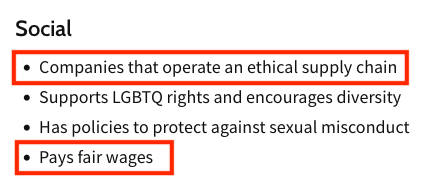
Before Spotify’s Joe Rogan problem, Spotify had both an ethical supply chain problem and a “fair wage” problem on the music side of its business, which for this post we will limit to fair compensation to its ultimate vendors being artists and songwriters. In fact, Spotify is an example to music-tech entrepreneurs of how not to conduct their business.
Treatment of Songwriters
On the songwriter side of the house, let’s not fall into the mudslinging that is going on over the appeal by Spotify (among others) of the Copyright Royalty Board’s ruling in the mechanical royalty rate setting proceeding known as Phonorecords III. Yes, it’s true that streaming screws songwriters even worse that artists, but not only because Spotify exercised its right of appeal of the Phonorecords III case that was pending during the extensive negotiations of Title I of the Music Modernization Act. (Title I is the whole debacle of the Mechanical Licensing Collective scam and the retroactive copyright infringement safe harbor currently being litigated on Constitutional grounds.)
The main reason that Spotify had the right to appeal available to it after passing the MMA was because the negotiators of Title I didn’t get all of the services to give up their appeal right (called a “waiver”) as a condition of getting the substantial giveaways in the MMA. A waiver would have been entirely appropriate given all the goodies that songwriters gave away in the MMA. When did Noah build the Ark? Before the rain. The negotiators might have gotten that message if they had opened the negotiations to a broader group, but they didn’t so now they’ve got the hot potato no matter how much whinging they do.
Having said that, you will notice that Apple took pity on this egregious oversight and did not appeal the Phonorecords III ruling. You don’t always have to take advantage of your vendor’s negotiating failures, particularly when you are printing money and when being generous would help your vendor keep providing songs. And Mom always told me not to mock the afflicted. Plus it’s good business–take Walmart as an example. Walmart drives a hard bargain, but they leave the vendor enough margin to keep making goods, otherwise the vendor will go under soon or run a business solely to service debt only to go under later. And realize that the decision to be generous is pretty much entirely up to Walmart. Spotify could do the same.
Is being cheap unethical? Is leveraging stupidity unethical? Is trying to recover the costs of the MLC by heavily litigating streaming mechanicals unethical (or unexpected)? Maybe. A great man once said failing to be generous is the most expensive mistake you’ll ever make. So yes, I do think it is unethical although that’s a debatable point. Spotify has not made themselves many friends by taking that course. But what is not debatable is Spotify’s unethical treatment of artists.
Treatment of Artists
The entire streaming royalty model confirms what I call “Ek’s Law” which is related to “Moore’s Law”. Instead of chip speed doubling every 18 months in Moore’s Law, royalties are cut in half every 18 months with Ek’s Law. This reduction over time is an inherent part of the algebra of the streaming business model as I’ve discussed in detail in Arithmetic on the Internet as well as the study I co-authored with Dr. Claudio Feijoo for the World Intellectual Property Organization. These writings have caused a good deal of discussion along with the work of Sharky Laguana about the “Big Pool” or what’s come to be called the “market centric” royalty model.
Dissatisfaction with the market centric model has led to a discussion of the “user-centric” model as an alternative so that fans don’t pay for music they don’t listen to. But it’s also possible that there is no solution to the streaming model because everybody whose getting rich (essentially all Spotify employees and owners of big catalogs) has no intention of changing anything voluntarily.
It would be easy to say “fair is where we end up” and write off Ek’s Law as just a function of the free market. But the market centric model was designed to reward a small number of artists and big catalog owners without letting consumers know what was happening to the money they thought they spent to support the music they loved. As Glenn Peoples wrote last year (Fare Play: Could SoundCloud’s User-Centric Streaming Payouts Catch On?,
When Spotify first negotiated its initial licensing deals with labels in the late 2000s, both sides focused more on how much money the service would take in than the best way to divide it. The idea they settled on, which divides artist payouts based on the overall popularity of recordings, regardless of how they map to individuals’ listening habits, was ‘the simplest system to put together at the time,’ recalls Thomas Hesse, a former Sony Music executive who was involved in those conversations.
In other words, the market centric model was designed behind closed doors and then presented to the world’s artists and musicians as a take it or leave it with an overhyped helping of FOMO.
As we wrote in the WIPO study, the market centric model excludes nonfeatured musicians altogether. These studio musicians and vocalists are cut out of the Spotify streaming riches made off their backs except in two countries and then only because their unions fought like dogs to enforce national laws that require streaming platforms to pay nonfeatured performers.
The other Spotify problem is its global dominance and imposition of largely Anglo-American repertoire in other countries. The company does this for one big reason–they tell a growth story to Wall Street to juice their stock price. In fact, Daniel Ek just did this last week on his Groundhog Day earnings call with stock analysts. For example he said:
The number one thing that we’re stretched for at the moment is more inventory. And that’s why you see us introducing things such as fan and other things. And then long-term with a little bit more horizon, it’s obviously international.
Both user-centric and market-centric are focused on allocating a theoretical revenue “pie” which is so tiny for any one artist (or songwriter) who is not in the top 1 or 5 percent this week that it’s obvious the entire model is bankrupt until it includes the value that makes Daniel Ek into a digital munitions investor–the stock.
Debt and Stock Buybacks
Spotify has taken on substantial levels of debt for a company that makes a profit so infrequently you can say Spotify is unprofitable–which it is on a fully diluted basis in any event. According to its most recent balance sheet, Spotify owes approximately $1.3 billion in long term–secured–debt.
You might ask how a company that has never made a profit qualifies to borrow $1.3 billion and you’d have a point there. But understand this: If Spotify should ever go bankrupt, which in their case would probably be a reorganization bankruptcy, those lenders are going to stand in the secured creditors line and they will get paid in full or nearly in full well before Spotify meets any of its obligations to artists, songwriters, labels and music publishers, aka unsecured creditors.
Did Title I of the Music Modernization Act take care of this exposure for songwriters who are forced to license but have virtually no recourse if the licensee fails to pay and goes bankrupt? Apparently not–but then the lobbyists would say if they’d insisted on actual protection and reform there would have been no bill (pka no bonus).
Right. Because “modernization” (whatever that means).
But to our question here–is it ethical for a company that is totally dependent on creator output to be able to take on debt that pushes the royalties owed to those creators to the back of the bankruptcy lines? I think the answer is no.
Spotify has also engaged in a practice that has become increasingly popular in the era of zero interest rates (or lower bound rates anyway) and quantitative easing: stock buy backs.
Stock buy backs were illegal until the Securities and Exchange Commission changed the law in 1982 with the safe harbor Rule 10b-18. (A prime example of unelected bureaucrats creating major changes in the economy, but that’s a story for another day.)
Stock buy backs are when a company uses the shareholders money to buy outstanding shares of their company and reduce the number of shares trading (aka “the float”). Stock buy backs can be accomplished a few ways such as through a tender offer (a public announcement that the company will buy back x shares at $y for z period of time); open market purchases on the exchange; or buying the shares through direct negotiations, usually with holders of larger blocks of stock.
A stock buyback is basically a secondary offering in reverse — instead of selling new shares of stock to the public to put more cash on the corporate balance sheet, a cash-rich company expends some of its own funds on buying shares of stock from the public.
Why do companies buy back their own stock? To juice their financials by artificially increasing earnings per share.
Spotify has announced two different repurchase programs since going public according to their annual report for 12/31/21:
Share Repurchase Program On August 20, 2021, [Spotify] announced that the board of directors [controlled by Daniel Ek] had approved a program to repurchase up to $1.0 billion of the Company’s ordinary shares. Repurchases of up to 10,000,000 of the Company’s ordinary shares were authorized at the Company’s general meeting of shareholders on April 21, 2021. The repurchase program will expire on April 21, 2026. The timing and actual number of shares repurchased depends on a variety of factors, including price, general business and market conditions, and alternative investment opportunities. The repurchase program is executed consistent with the Company’s capital allocation strategy of prioritizing investment to grow the business over the long term. The repurchase program does not obligate the Company to acquire any particular amount of ordinary shares, and the repurchase program may be suspended or discontinued at any time at the Company’s discretion. The Company uses current cash and cash equivalents and the cash flow it generates from operations to fund the share repurchase program.
The authorization of the previous share repurchase program, announced on November 5, 2018, expired on April 21, 2021. The total aggregate amount of repurchased shares under that program was 4,366,427 for a total of approximately $572 million.
Is it ethical to take a billion dollars and buy back shares to juice the stock price while fighting over royalties every chance they get and crying poor? I think not.
Eight states (Massachusetts, Florida, California, New Jersey, Vermont, Kentucky, Nebraska, and Tennessee) just recently announced their investigations into TikTok, which settled an Illinois privacy lawsuit for $92 million in 2021. The coordinated scrutiny arrives as TikTok – which has been described as “legitimate spyware” – remains extremely popular, reportedly boasting north of three billion downloads and more traffic than Google.
Furthermore, TikTok’s userbase reportedly skews young, and higher-ups have capitalized upon the platform’s prominence within demographics that are relatively difficult for companies to reach.




 The Trichordist
You must be logged in to post a comment.