Philip Pullman: illegal downloading is ‘moral squalor’ | The Guardian UK

Bestselling author says web piracy is akin to ‘reaching into someone’s pocket and taking their wallet’

Illegal downloading is a kind of “moral squalor” and theft as much as reaching in to someone’s pocket and stealing their wallet is theft, the author Philip Pullman will say this week.

In an article for Index on Censorship, Pullman, who is president of the Society of Authors, makes a robust defence of copyright laws. He is withering about internet users who think it is OK to download music or books without paying for them.

“The technical brilliance is so dazzling that people can’t see the moral squalor of what they’re doing,” he writes. “It is outrageous that anyone can steal an artist’s work and get away with it. It is theft, as surely as reaching into someone’s pocket and taking their wallet is theft.”

His article comes after music industry leaders met David Cameron in Downing Street last Thursday where the issue of web piracy was discussed.

READ THE FULL STORY HERE:
http://www.theguardian.com/books/2013/sep/15/philip-pullman-illegal-downloading-theft

Real Censorship | nycRUEN

During the protests against the Stop Online Piracy Act (SOPA), critics of the legislation portrayed its process of identifying foreign black market domains and then blocking them from gaining easy profits from, and access to, the US online audience, as “censorship” — full stop.

It bothers me that representatives from Google or the EFF, Reddit, etc. are so quick to lump in the attempt to protect artists rights with the political censorship of China or Iran. It is entitlement of the privileged at its worst and demonstrates to me how desperate some people are to excuse freeloading by any means necessary. But, the wonders of technology simply do not excuse clear cases of exploitation.

READ THE FULL POST AT nycRUEN:
http://nycruen.wordpress.com/2013/10/21/real-censorship/

YouTube’s Copyright Problem | Plagiarism Today

Bottom Line

If YouTube is going to be more than a destination for watching content and a key part of where producers and others go to post their content, it needs to solve its copyright problem, meaning that it is both a place original expression can thrive and a place pirated and infringing content is kept at bay.

While ContentID and YouTube’s rules have done a decent job in the majority of cases, it doesn’t really feel as if YouTube is building on stable ground in either direction.

YouTube has to do more to both protect fair use and legitimate commentary/criticism while doing more to prevent illegal material from taking home on the service. Those two ideas are not in opposition to one another, though many would let you believe they are.

READ THE FULL STORY AT PLAGIARISM TODAY:
http://www.plagiarismtoday.com/2013/10/23/youtubes-copyright-problem/

Help for New Musicians Chasing Cash | BBC UK

With digital downloads, falling album sales and rampant piracy, what’s it like trying to establish yourself as a new performer in today’s troubled music industry?

Well, in the words of one UK music business professional: “It’s like trying to create a hurricane by running around a field in circles.”

Artists can no longer depend on labels to finance their projects and invest in building their careers. Long demonized, it appears the true value of investment capital, expertise and contracts are coming into focus for today’s new artists.

In her guide – entitled Easy Money? – Ms Harris identifies six main sources of money for music projects:

  • grants
  • friends and family
  • crowdfunding
  • sponsorship
  • debt
  • investment

She says that during her 15 years in the music industry, it has “moved from an internal funding model to having to go to external sources” for cash to kick-start projects.

Normally, she says, musicians are looking for about £5,000 to £10,000 to fund a specific project, such as a record or live appearances.

READ THE FULL STORY HERE AT THE BBC UK:
http://www.bbc.co.uk/news/business-24249918

Slaves of the Internet, Unite! | The New York Times

A familiar figure in one’s 20s is the club owner or event promoter who explains to your band that they won’t be paying you in money, man, because you’re getting paid in the far more valuable currency of exposure. This same figure reappears over the years, like the devil, in different guises — with shorter hair, a better suit — as the editor of a Web site or magazine, dismissing the issue of payment as an irrelevant quibble and impressing upon you how many hits they get per day, how many eyeballs, what great exposure it’ll offer. “Artist Dies of Exposure” goes the rueful joke.

READ THE FULL STORY AT THE NEW YORK TIMES:
http://www.nytimes.com/2013/10/27/opinion/sunday/slaves-of-the-internet-unite.html?pagewanted=1&_r=1

Swedish Artists Are Now Threatening Legal Action Over Streaming Royalties… | DMN

The origin of the outrage is telling: Sweden is widely regarded as a model country for streaming and access, thanks to massive adoption and recovering recording revenues. The threatened suits suggest that not everyone is celebrating or, more importantly, enjoying the early spoils.

Regardless of the locale, the issue comes ahead of very difficult juncture for Spotify. Mega-artists like Thom Yorke continue to raise uncomfortable questions about paltry payouts, but more perilous questions are dangling on the financial side. Recent financial figures show an unsustainable level of cash burn at Spotify, and potentially serious problems attracting more capital as a result. And after burning through hundreds of millions of dollars, Spotify is getting dangerously close to depleting its funding tranche.

READ THE FULL STORY AT DIGITAL MUSIC NEWS:
http://www.digitalmusicnews.com/permalink/2013/10/25/swedishartists

Do these companies really want their products promoted aside “Free Find and F**k” ads? | Vox Indie

Ads for Adidas, Acura, Bertolli, Crest, Charmin, Domino’s, Ford, Geico, Hellmann’s, Lowe’s, Panera, Papermate, PG&E, Post and more share space with sex ads.

Ad Industry Best Practices?

The ad industry and ad service providers have made a show of agreeing to voluntary “best practices” agreements to fight ad-sponsored piracy,  but despite their talk and White House support, not much has changed.  Take a look at the graphic below…What kind of  industry “best practices” do these ad placements represent?

READ THE FULL POST AT VOX INDIE:
http://voxindie.org/#sthash.vEKTxQ2V.dpuf

New Study Shows Up to 96% of Megaupload Files Are Infringing

A new study from North Eastern University is getting some attention and it’s interesting how some people are spinning the numbers, so we decided to take a look.

“For Megaupload (MU) the researchers found that 31% of all uploads were infringing, while 4.3% of uploads were clearly legitimate. This means that with an estimated 250 million uploads, 10.75 million uploads were non-infringing. For the remaining 65% the copyrighted status was either unknown, or the raters couldn’t reach consensus.” – Torrent Freak

Simple Math : 31% + 65% = 96%

Breaking Bad Creator : “Piracy Is A Problem… We All Need To Eat and Get Paid”

In a recent BBC interview Breaking Bad’s creator Vince Gilligan has been quoted talking about the effect of internet piracy on the show.

Piracy is “ultimately a problem and will continue to be a problem going forward,” Gilligan said. “Because we all need to eat. We all need to get paid.”

It’s been reported that the show’s final episode was illegally downloaded over 500,000 times in 12 hours of the first pirated copy turning up on piracy and torrent sites. Many have seized on Gilligan’s remark that piracy helped the popularity of the show.  That’s highly unlikely as those seeking the illegal copies, were seeking them as demand for the show grew from conventional marketing. These people were opposed to paying for the show from the many outlets where the episodes were legally available like Netflix and Itunes. Gilligan clearly understand the impact…

“The downside is a lot of folks who worked on the show would have made more money, myself included, if all those downloads had been legal.”

Many piracy apologists and proponents are quick to suggest (incorrectly) that not every illegal download represent a lost sale, but we disagree and here’s why. Looking at the links below you can quickly see that the piracy sites are monetizing the access and availability of the illegal downloads with advertising. Additionally some sites even charge greatly discounted transactional fees via dubious payment processors.

Simply put, piracy is about infringement as a business model. Every illegal download generates revenue for the pirate sites and ad tech companies, none of which is “shared” with the creators.

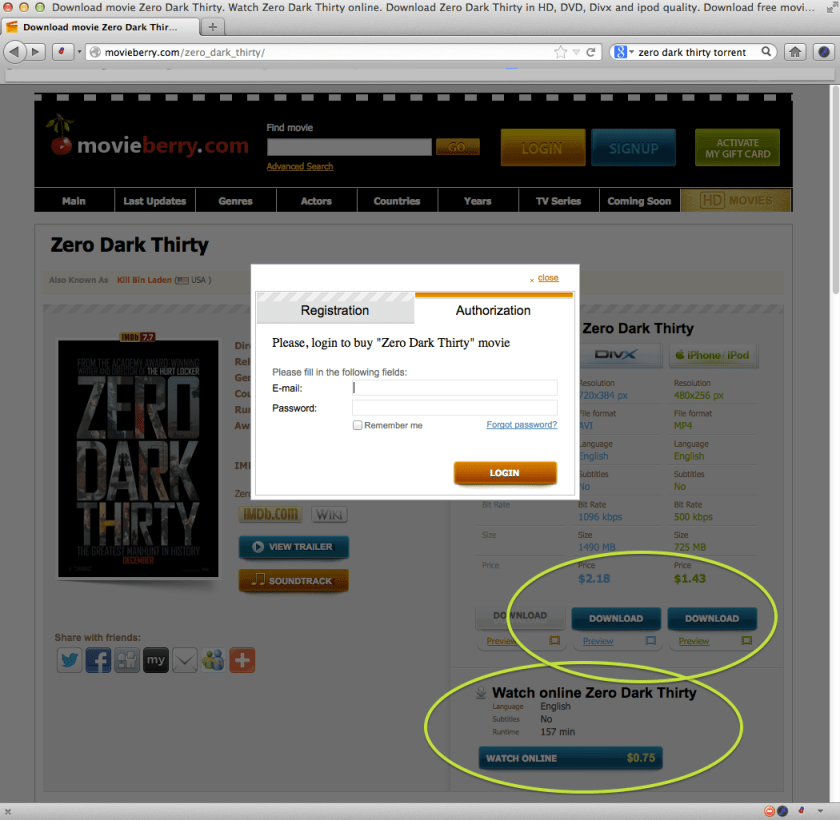
Zero Dark Thirty, Best Picture Academy Award Nominee, Exploited by AT&T, Verizon, MetroPCS, Nissan, H&R Block, British Airways, Progresso, and more…

Spoof Ad Campaign Responds to BitTorrent’s Recent Billboards

The BitTorrent Billboard advertising campaign story has taken an interesting turn spawning a satirical response spoof banner ad campaign appearing on sites such as Grooveshark, Mashable, MediaFire and Rollingstone.com. The banner ads read “All your content are belong to us” and “Instead of paying artists, we spent money on banners.”

Clicking on the faux ad banners lands on the site RightTheMusic.Org that presents internet piracy fun facts such as “Worldwide, 432.0m unique internet users explicitly sought infringing content during January 2013” and provides an additional click through the source of the quote.

AS REPORTED ON AT TORRENT FREAK:
http://torrentfreak.com/angry-artists-attack-bittorrent-with-spoofed-billboards-131018/

AS REPORTED ON AT SOFTPEDIA:
http://news.softpedia.com/news/BitTorrent-Banners-Trigger-Spoof-Campaign-from-Angry-Artists-392769.shtml

AS REPORTED ON AT ADLAND:
http://adland.tv/node/156152#Zrk6olusqTDT7IBX.99