Digital Media Association (DiMA) Always Against Musicians

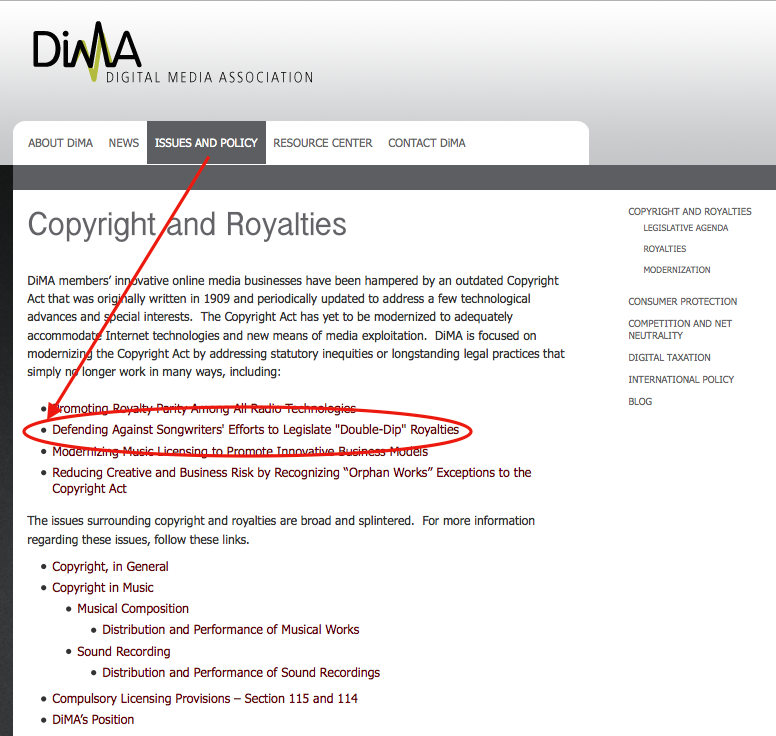
Who is DiMA? Glad you asked, the Digital Media Association. Why do we care? Well, because they are actively working against artists rights. How do we know? Three words… “Defending Against Songwriters”. Yes, DiMA is dedicated to “Defending Against Songwriters” because, you know songwriters are a force that businesses need to defend themselves against.

Wow, really? Seriously? Ok, check it out…

DimaDoubleDipSongwriters

But lets take a look below where current DiMA policy positions are directly in opposition to artists and songwriters rights.

DiMA supports Pandora buying a terrestrial radio station in an effort to lower the royalties Pandora will pay to songwriters.

DiMA is opposed to the Fair Play, Fair Pay Act that would pay performers a terrestrial radio broadcast royalty.

DiMA is opposed to The Songwriter Equity act that would allow songwriters the ability to negotiate fair market rates for their work.

DimaPOlicyAgainstArtists

Who would work with DiMA that wasn’t forced to via statutory rates and rate courts?


5 Seriously Dumb Myths About Copyright the Media Should Stop Repeating | John Degen @ Medium

Please read John Degen’s 5 Seriously Dumb Myths About Copyright the Media Should Stop Repeating at the link below.

There you have it. I hope this quick list has helped my friends and colleagues in the media who may be hurrying to file a story on World Book and Copyright Day. Here’s a final, simple, rule of thumb for writing about copyright.

If you want to understand how a working artist feels about copyright, talk to an actual working artist.

The last time I checked, ivory-tower legal-theory departments and digital-utopian advocacy groups were not the best places to look for actual working artists.

READ THE FULL POST AT MEDIUM:
https://medium.com/@jkdegen/5-seriously-dumb-myths-about-copyright-the-media-should-stop-repeating-a92e934f12a4

Wondering Sound: “David Lowery Has Become Most Important Spokesperson for Artists Rights In Digital Era”

‘In the last three years, David Lowery has become perhaps most the important and ardent spokesperson for artist rights in the digital era. Who is he?’

Balanced, funny and in depth profile of fellow Trichordist writer David Lowery.  Must read.

READ THE FULL STORY AT WONDERING SOUND:
http://www.wonderingsound.com/feature/david-lowery-digital-music-cracker-interview/

All Three Pirate Bay Founders Now in Jail | Billboard

One of the founders of popular file-sharing website The Pirate Bay has been arrested under an Interpol warrant as he was crossing into Thailand from Laos, police said Tuesday. Hans Fredrik Lennart Neij, who uses the alias TiAMO, was detained Monday by Thai immigration police at a checkpoint in Thailand’s Nong Khai province, about 500 kilometers (310 miles) northeast of Bangkok.

READ THE FULL STORY AT BILLBOARD:
http://www.billboard.com/articles/business/6304466/pirate-bay-founders-jail-hans-fredrik-lennart-neij


RELATED:

A Tale of Two Pirates? Daniel Ek (uTorrent) and Kim Dotcom (Megaupload)

Kim Dotcom declares he is ‘broke’ because of legal fight | BBC

Kim Dotcom, the founder of the seized file-sharing site Megaupload, has declared himself “broke”.

The entrepreneur said he had spent $10m (£6.4m) on legal costs since being arrested in New Zealand in 2012 and accused of internet piracy.

Mr Dotcom had employed a local law firm to fight the US’s attempt to extradite him, but his defence team stepped down a fortnight ago without explaining why.

READ THE FULL STORY AT THE BBC:
http://www.bbc.com/news/technology-30209067

RELATED:

A Tale of Two Pirates? Daniel Ek (uTorrent) and Kim Dotcom (Megaupload)

Copyright Critics Don’t Quite Get Artists | The Illusion Of More

A must read from David Newhoff for all creators with many points, well made.

Further, if it is true that a copyright-free future could shrink the pool of producers to those already financially secure (as predicted above), this suggests that all of the non-remunerative benefits of copyright might be of even greater value to those authors still willing and able to produce. And in the absence of those rights, we could easily see a reduction not only in the number of producers, but also in the number of works produced by that elite few. In a practical example, imagine the trustafarian artist working in the most altruistic manner, producing wonderful works solely to be experienced; he doesn’t care about money, but he does have to accept that McDonald’s can use his work to sell hamburgers, which betrays everything he is expressing. It is not farfetched to imagine the artist in this example will withhold works from public view, even if he continues to produce for his own pleasure.

READ THE WHOLE POST AT:
http://illusionofmore.com/copyright-critics-dont-get-artists/

When Iggy Pop can’t live off his art, what chance do the rest have? | The Globe and Mail

But a new reality has tripped him up and it’s the same one shafting artists all across the world: Namely, that everyone wants to listen, and no one wants to pay. This week, Iggy gave a lecture for the British Broadcasting Corp. called Free Music in a Capitalist Society. Artists have always been ripped off by corporations, he said; now the public is in on the free ride, too: “The cat is out of the bag and the new electronic devices, which estrange people from their morals, also make it easier to steal music than to pay for it.”

To keep skinny body and maverick soul together, Iggy’s become a DJ, a car-insurance pitchman and a fashion model. If he had to live off royalties, he said, he’d have to “tend bars between sets.” As I listened to his enthusiastic stoner Midwestern drawl, I thought: If Iggy Pop can’t make it, what message does that send to all the baby Iggys out there? In a society where worth is judged by price, for better or worse, what are you saying to someone when you won’t pay for the thing he’s crafted?

READ THE FULL STORY AT:
http://www.theglobeandmail.com/globe-debate/when-iggy-pop-cant-live-off-his-art-what-chance-do-the-rest-have/article21154663/

DMCA “Takedown” Notices: Why “Takedown” Should Become “Take Down and Stay Down” and Why It’s Good for Everyone | Nova Edu

We reported on this earlier this year and it’s great to see other voices stepping up!

by Stephen Carlisle

In other words, Google’s not going to do anything unless Google gets a slice of the profit. When asked, shouldn’t search engines have an affirmative duty to prevent the reposting of materials, she responded that it would be “impractical to enforce and it would chill online speech.” 19 This answer begs the question: since when is the repeated posting of “blatantly infringing” material online protected speech? To quote the Supreme Court of the United States, the First Amendment “securely protects the freedom to make—or decline to make—one’s own speech; it bears less heavily when speakers assert the right to make other people’s speeches.” 20 According to the RIAA, they have sent more than two million takedown requests to Google about the website mp3skull. Despite this, mp3skull continues to top Google’s search results for “artist+songname+download.” 21 Whose speech is being chilled here?

READ THE FULL STORY AT:
http://copyright.nova.edu/dmca-takedown-notices/

RELATED:

DMCA “Take Down and Stay Down” Is The Logical Solution to a Flawed Loophole [VIDEO]


https://vimeo.com/94514834

Sons of Anarchy’s Kurt Sutter Is A Rock Star for Creators Rights

We love Kurt Sutter’s unapologetic response to Google and Silicon Valley’s assault on creators. Below are links to Kurt’s two editorials that are essential reading for all creators to understand what the “internet economy” means for artists of all disciplines.

Kurt Sutter Attacks Google: Stop Profiting from Piracy (Guest Column) | Variety

Google is in the process of systematically destroying our artistic future, and more importantly, the future of our children and grandchildren. They’re spending tens of millions of dollars each year on eroding creative copyright laws. I believe that if the creative community doesn’t intervene now, and by now, I mean, fucking now — we will be bound to a multigenerational clusterfuck that will take 40 to 50 years to unravel.

The last time this happened was in the 1950s, when the tobacco industry spent millions to hide the truth, and convince everyone that smoking cigarettes wasn’t really dangerous to your health.

Earlier this year, Kurt took to writing a response in Slate to an editorial by Google Lobbyist Marvin Ammori (which lead to a later editorial disclosure of Mr. Ammori’s relationships).

Not-So-Zen and the Art of Voluntary Agreements | Slate

Every writer, producer, actor, musician, director, tech wizard, and fine artist working today needs to be aware of what this all means for our future—we will lose the ability to protect and profit from our own work. Every kid out there who aspires to be an actor or musician or artist: This is your future that’s at stake. More importantly, everyone who enjoys quality entertainment: This impacts you most of all. Content excellence cannot sustain itself if it loses its capacity to reward the talent that creates it. Consider this clunky analogy: If your local car dealership started selling your favorite luxury car for $1,000, then $100, then started giving it away, what do you think would happen to the quality of that vehicle? Before long, the manufacturer would be forced to let go of the skilled laborer, the artisan, and the craftsman, and eventually cut back on everything in the production process. And before long, that fabulous, high-end car you so enjoyed will be a sheet of warped plywood on top of two rusty cans.

Yep, it’s cheap, and it’s shit.

Among the arguments that Kurt brings to light are the use of Merchants Of Doubt tactics by Silicon Valley interests, the mechanics employed by Google and YouTube detailed by The Digital Citizens Alliance and the ability for creatives of all disciplines to join Creative Future for a unified voice against these forces of exploitation.