Is The New Internet Association Really Just A Pro-Corporate Version Of The Pirate Party? No It’s a Transparent Ploy by Google To Curry Favor With Congressional Republicans.

I’m just reading through some related documents for the “new” Internet Association.  It has really struck me that it is very similar to the Pirate Party. Except  it’s views are even more extreme than the Pirate Party.

Here is an example. PP Germany only supports non-commercial filesharing.  But in the Internet Association’s view there should be no enforcement action on any copyright infringement including commercial exploitation. In fact they are gonna defend those breaking the law!  The reason? Apparently enforcing property rights will break the internet. Cause remember the Internet did actually break after Kim Dotcom was locked up. Didn’t it? Sorry I wasn’t paying attention.

From this we can only assume that the Internet Association will soon be rushing down to Florida to defend  Hotfile from the Internet Breaking Forces of Copyright.  I mean there are already lawyers who work Google’s interests in other cases down there defending Hotfile.  And the other big tech  funded astroturf group Public Knowledge is already sending Prof James Boyle to defend the  arms dealers-oops I mean  cyberlocker businessmen  from this terrible threat to free speech and/or the arming of child soldiers.  You remember Public Knowledge from the Google Shill List, right?

Seriously, this press release is one of the funniest things I’ve read since I read the FSF’s hospitality rider for Richard Stallman.  These serial violators of online privacy are now going to be defending our privacy online?!!  I almost wet myself again typing that last sentence.

These sort of shenanigans are making me like the Pirate Party. Yes you heard that right.  At least the Pirate Party are only deluded idealists. Like 70’s revolutionary  maoist college professors in berets with pictures of Che Guevara dreaming of a perfect classless society.    There is some collectivist idealism underlying their hope that freely sharing (aka redistributing) all cultural goods will lead to some imagined utopia. They are totally wrong but  they are at least  (mostly) sincere  in their beliefs.  And as far as I know not many of them are getting rich advocating pirate policies.

However the Internet Association is nothing like that.  On one hand it’s nothing remarkable : craven opportunists and political operatives  cashing in on some recent political clusterjam™ (SOPA).  But on the other hand it’s a remarkably brazen maneuver  even by Washington standards. As Jane Hamsher carefully explains at Firedoglake.com , this is simply a  ham-fisted and amazingly transparent attempt  by tech industry-especially Google- to curry favor with Congressional Republicans, and in particular Rep. Upton.

Basically Google, Amazon et al already have Net Coalition, EFF, Public Knowledge, Tech Freedom, Fight For The Future,  Internet Defense League, Pirate Freedom, Tech Pirate Freedom, Pirate Knowledge, ex-KGB Freedom Pirates, Belarus Institute For Credit Card Fraud, Electronic Failed State Coalition, Moldovan SPCA, Russian Brides  Foundation and  Offshore Pharmacy Coalition  lobbying for their interests in Washington.   So why do they need yet another lobby shop in Washington?

Because they really really pissed off some powerful Republicans in the Anti-SOPA fight.  They now need to build a “Republican friendly” version of the same organizations they already fund.

To quote Walter in the  TV version of the Big Lebowski:

“Do you see what happens, Larry? Do you see what happens when you find a stranger in the alps?”

This is what happens Larry:

You have to spend millions of dollars building yet another fake organization, this one fronted by a Republican. All this to  make Congressman Lamar Smith forget you put those  billboards in front of his office during the SOPA fight.  You really think that’s gonna work? Can I have some of what you are smoking?

I say if you  have this much money to spend on the vote of one Republican congressman you  don’t need any help from Washington! And speaking of The Big Lebowski ,  I would  love to see the Congressman get all Walter Sobchak on your ass.

Occupy Amanda Palmer?

Unless you’ve  been living in a cave on a some remote South Pacific island, by now you’ve heard that Amanda Palmer created quite a controversy when she announced that she was asking for string and brass section “volunteers” to work for her on many of the dates on her tour.  Ms. Palmer became an even bigger celebrity this last year when she did a Kickstarter for this album and tour and raised $1.2 million dollars. A full million dollars more than she needed for the project.

For the last week, I’ve tried to avoid joining the anti-Amanda Palmer internet pile-on that has captivated many in the music business and tech world. Why? For one simple reason. I believe in the artist’s right to monetize their songs and performances in any way they see fit.

If Ms. Palmer had told her Kickstarter fans that she intended to record her entire new album in one take with one microphone into an iPad, post it on the internet and pocket the 1.2 million dollars that is her right. (Well, hers and the IRS’s.) Yes even a punk cabaret singer deeply involved in the Occupy Wall Street movement has the right to get rich from her art and music. It’s nobody else’s business. Yes, that may clash with her public profile, and her fans can also choose to not support her if they think this is somehow hypocritical. But she has no obligation to give away all her earned riches–or gifts for that matter. Further, she has no obligation to be transparent about her finances, as she is a private individual. Although I understand why publicly asking for money on Kickstarter may change that for many artists. I stay out of this part of the debate, cause it seems to be mostly about  the million dollars and whether Amanda Palmer has the right to make a comfortable living in privacy. Of course she does.

However, I do agree with the criticisms of others on nearly every other count.

This appears to be the blog post that started the whole controversy, Amy Vaillancourt-Sal of Classical Revolution Portland:

My friends and I are looking to bring back the respect that  musicians deserve. As a personnel manager for my branch at Classical  Revolution, I’ve been working towards assuring that my musicians are  compensated for their talents and hard work. So, looking back at your  ultra successful kickstarter and your request… Here you are, and you’ve  raised over $1 million for your tour and album release. Here we are as  musicians on foodstamps, maxing out their credit cards to keep the  lights on, are hoping that we have enough money to pay next months rent,  and have instruments that are in need of repair, need to be replaced,  and even need to be insured. We are looking at you now and your request  for musicians to come play with you for free, and most of us have even  fallen in love with you and your music, and how do you think we’ll  respond? We’re f*&king perplexed, agitated and disheartened, to put  it mildly! What would you say to you if you were in our shoes? I have a  pretty good guess…

The naive ones will say “sign me up!” I most certainly had that as  my first response. But in looking at the whole picture, this time you’re  coming across as the 1% looking to exploit us. I’m guessing this is not  the impression you were going for. If this is the case, please respect  the musicians who are giving you their time and specialized skills. We  would love to play for you! Please do the right thing, Amanda. This all seems so contrary to your vision.

The  future of music is musicians being compensated for their specialized  skills and the beauty and difference that their craft brings to the world! We all know you can  certainly afford it…

Ms. Palmer then somewhat defensively responded:

your concern reminds me of the complaints i’ve seen from musicians who insist that i’m “devaluing” their own recordings by giving my music away for free and encouraging people to pay what they want for it (which is how i just released my new record). i get the impression that they see me as a force of evil who is miseducating the public to think that “music should be free.”

here’s what i think about all that, and it also applies to this paid/non-paid musician kerfuffle:

YOU HAVE TO LET ARTISTS MAKE THEIR OWN DECISIONS ABOUT HOW THEY SHARE THEIR TALENT AND TIME.

especially in this day and age, it’s becoming more and more essential that artists allow each other space to figure out their own systems.

the minute YOU make black and white rules about how other artists should value their own art and time, you disempower them.

The thing is–Amy never said she was trying to make rules. She’s not the employer. We’re not talking about sitting in, or a jam. Ms. Palmer is an employer and she does make the rules on her stage. Other musicians–like Amy and me–don’t have to like her rules. We are free, however, to point out that this employer does not pay fair wages. This is a collective bargaining/workers rights issue. Nothing more. Please don’t try to make musicians feel that questioning the ethics of a rock star employer is somehow violating the rock star’s human rights. That’s disingenuous.

Justin Colletti also made some good points…..

Is it  noble to support musicians only with “exposure”? Exposure for what? So  that they might be selected to play the next cash-rich tour for free as well?  Or are we talking about the kind of “exposure” that musicians will be  subject to when they can’t pay their rent?

Let’s not make  false equivalencies in this debate. It’s important to remember that  we’re not talking about a friend of Ms. Palmer’s jumping up on stage to  play a guitar solo or sing backup on a song. Rather, we’re  talking about working or aspiring musicians who are expected to send in an audition tape, learn the material in advance, arrive punctually for a high-pressure rehearsal, and then arrive punctually again for a  high-profile performance in which they will be an essential part of the emotional and aesthetic  impact of many of the songs.

This kind of work deserves  compensation — even if its just a token sum from an artist who cannot  afford to pay a more traditional rate….

Palmer is paying her promotional team and her management team  handsomely, but not the musicians? In doing this, she is becoming the  very thing that she has told us she is railing against.

If a concert stands to make no money at all, or if it does stand to make money but the proceeds are  meant to go to a humanitarian cause, then playing for free can be a very noble thing to do. But it’s important to remember that Amanda Palmer is not a  charity. She is now running a significant for-profit entertainment business. And she’s doing a very savvy job of it. Other entertainment entrepreneurs would be well-advised to learn a lot from her. But not this.

I sympathize with Ms. Palmer. I understand how she found herself in this situation. It looks like over the last three years her shows have averaged about 600 paid attendance each night. An artist is lucky to receive a $6,000 dollar performance fee on that kind of attendance. If you consider the fact that a 8 person string and brass section costs money–my guess is close to $2,300-$3,500 a night in fees (based on local AFM scale) you can understand why she was reluctant to spend that kind of money.  She would still have to pay all her other expenses out of what is left.  I personally would not spend that kind of money (instead I would use backing tracks rather than ask people to play for free), but that’s her choice.

But now that Ms Palmer is playing for more than 1200 people a night and her shows are grossing between 30-60k a night, most reasonable people would agree that Ms Palmer would and should pay ALL her musicians. Just as this petition at Change dot Org  suggests:

Amanda Palmer: Pay ALL the Musicians that Perform On Your Tour

It appears that Ms Palmer has very conservative financial instincts she probably learned by years of down and dirty touring. I get that. Her  mistake is she didn’t realize that her financial situation has changed, and many of the old rationales are not there anymore. Once there is profit it should be shared equitably.  She simply failed to adjust to her new success. If Ms. Palmer is able to adjust her thinking and accept that she is now an employer in the 1% of musicians and pay all her musicians, we should all move on.  Until then I am adding my voice to those asking her to fairly compensate all her musicians.

Uh Toyota… didn’t you get the memo? Why are you advertising on unauthorized sites that exploit my music?

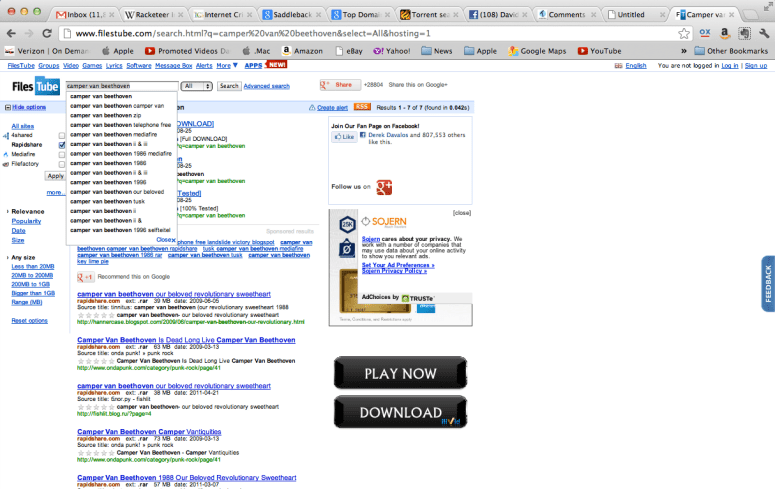
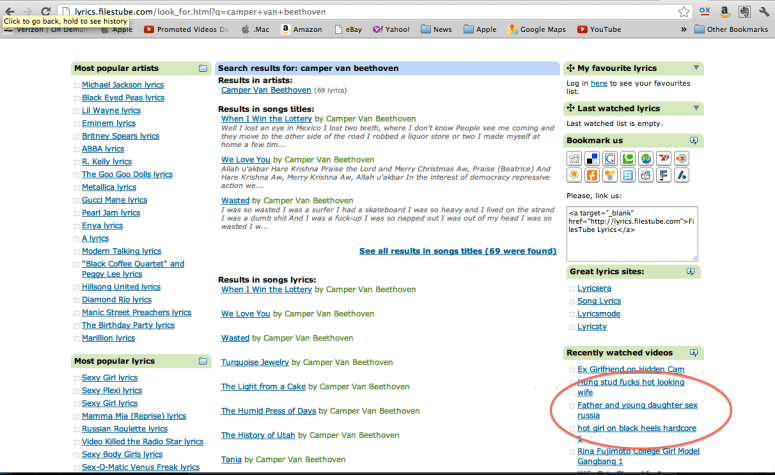
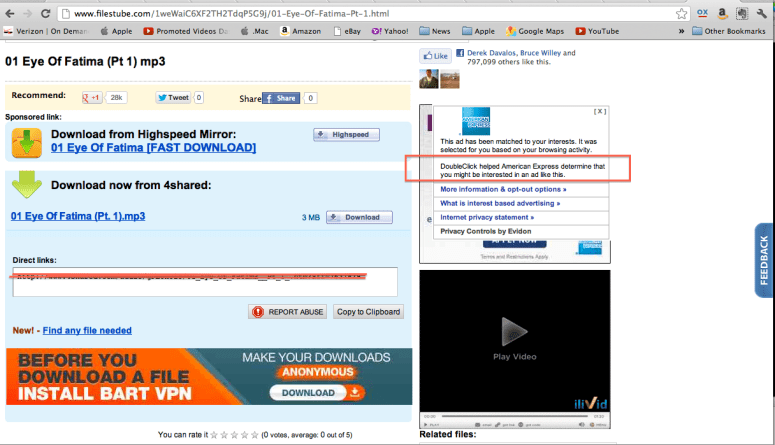
We recently ran a story about American Express advertising on Filestube, the site that infringes my copyrights while suggesting porno links next to my brand.  The American Express ad was served by Google’s DoubleClick ad network presumably at the behest of Ogilvy & Mather.

Yesterday a Google spokesperson told us that they had disabled “self serve” advertising for this site.  We weren’t really sure if that meant no more DoubleClick on FilesTube, or if it was some kind of semantic dodge. We’ve had a bunch of those dodging semantics on this issue.  However we monitored FilesTube yesterday and we see no sign of DoubleClick.   We applaud Google for taking this action!

Now not to look a gift horse in the mouth but we’d  love to see Google disable advertising for all those sites that they know are infringing copyright. The ones they mentioned in this handy press release. See it seems a little disingenuous to lower these sites rankings but at the same time to continue doing advertising business with them?  (And yes we are already monitoring advertising on these sites!!)

American Express is another matter. We have not heard back from American Express.  We’d love to hear what American Express has to say about their company helping to finance copyright infringement–not just mine, but all of the artists. We’d love to know how that happened and if they intend to continue advertising on these sites. Cause it doesn’t seem like a very good idea for an iconic American Brand.

Now  I’ve lost my handy pocket version of the RICO statute. People are always borrowing it!  But I’m almost certain that it says something about making plans to profit from copyright infringement as a RICO “predicate”.  I’m no lawyer but if I were a big company like American Express I wouldn’t want to get anywhere near a website  that even had the potential to get wrapped up in a RICO investigation.  Especially one based in Moldova.

Today FilesTube looks like a wasteland of QuiBid ads, MacKeeper popups and click shoot ads.  Pretty low grade.  Seems like it’s not just American Express which got the memo.

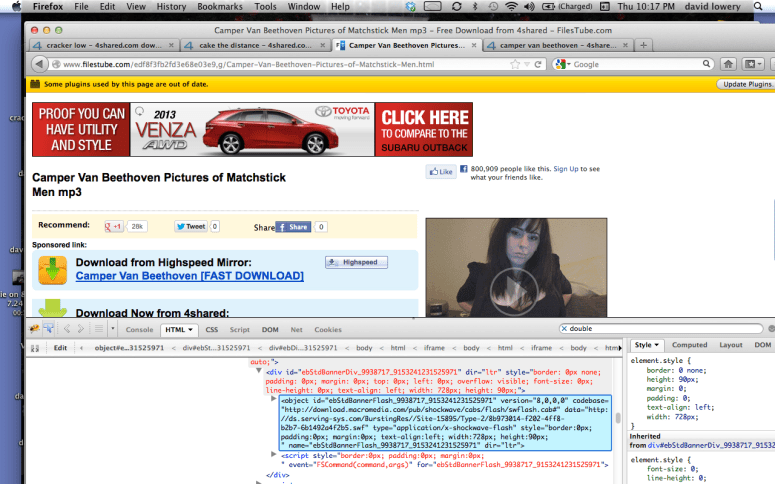
Toyota however did not get the memo!   So now it’s Toyota’s turn to answer the question?  Why  are you  advertising on this site?

Dear American Express: Stop advertising on sites that illegally exploit my music.

Dear American Express:

I write you today to ask why your ads are appearing on top rogue sites such as http://www.filestube.com? Sites like these are for-profit enterprise level organizations often with ties to organized crime. Sites like these appear to profit by illegally exploiting artists copyrights and monetizing their web traffic through advertising. Yes, advertising bought and paid for by American Express.

This is not an obscure site. Its Alexa ranking shows that it is one of the most popular websites in the world. I realize that you probably did not intend to have your ads appear on this site. However, I still hold you accountable for not properly auditing your advertising agency  Olgilvy & Mather  and your ad network DoubleClick. It should be noted that this site also links to some pretty prurient, possibly illegal videos; it’s entirely possible that I won’t be the only one holding you accountable.

I’m told that advertising agencies often hire companies to verify that their clients’ ads are being served to the approved websites. I am here to tell you that from what I have seen, these services are incompetent or worse. We have plenty of screenshots and source code showing major brands that surely use these services, advertising on illegal sites. (We’d be glad to share some of these screenshots and source code with you.)

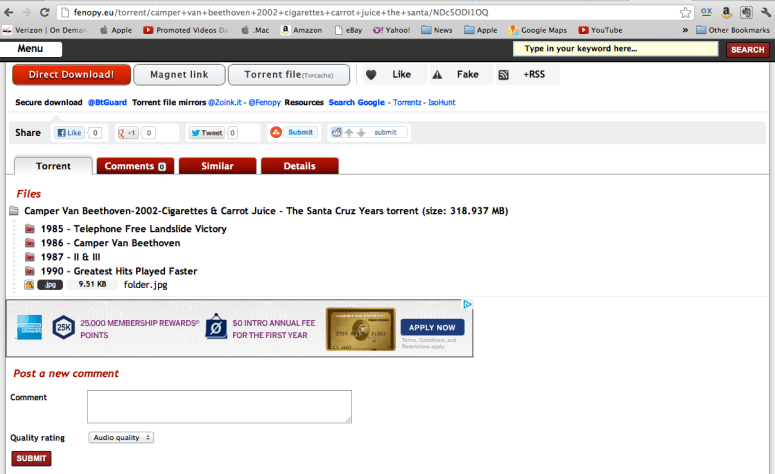
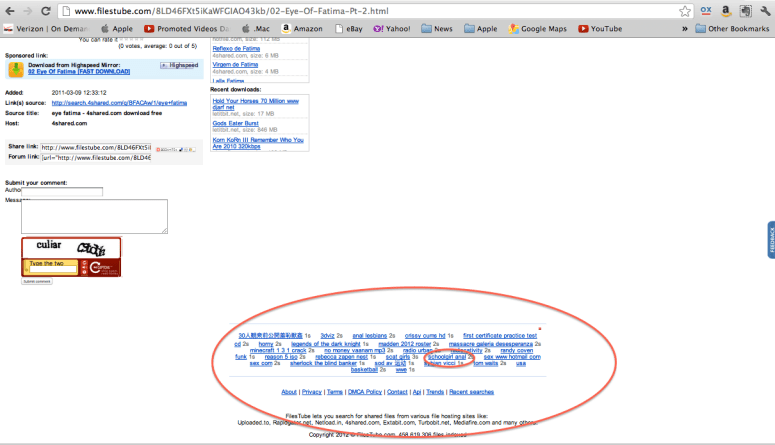
Here are screenshots that show an American Express advertisement on http://www.filestube.com apparently served by DoubleClick. This isn’t abstract to me–this page is a link to an illegal download of one of my songs. You should also note some of the other “suggested” searches on this same site are for some pretty nasty stuff.  I don’t like having my brand seen in these places and I’m sure you don’t either.

I suggest you do something I can’t do–audit everyone involved in this process . What’s the worse thing that could happen? Your brand not appearing on sketchy sites next to links to pornography?

Now that’s priceless.

Second Nyan Cat Award Goes To The Fake Thomas Jefferson And His Copyleft Creators

This Nyan Cat awards are given for outstanding achievement in disinformation, web myths and general web based idiocy.  

One of the biggest and most important urban myths that the Copyleft loves to propagate is the one about Thomas Jefferson and copyright. Several times now I’ve had the following Jefferson quote thrown at me when I refer to the founding fathers and the constitutional foundation of copyright.

If nature has made any one thing less susceptible than all others of exclusive property, it is the action of the thinking power called an idea, which an individual may exclusively possess as long as he keeps it to himself; but the moment it is divulged, it forces itself into the possession of every one, and the receiver cannot dispossess himself of it. Its peculiar character, too, is that no one possesses the less, because every other possesses the whole of it. He who receives an idea from me, receives instruction himself without lessening mine; as he who lights his taper at mine, receives light without darkening me. – Thomas Jefferson. Letter to Isaac McPherson 1813. 

Wow! It really sounds like Jefferson was the founding member of the Copyleft! This is very similar to the arguments made against copyright by people like Electronic Frontier Foundation’s John Perry Barlow.

The first problem with this? JEFFERSON WAS NOT TALKING ABOUT COPYRIGHT. He was talking about patents and inventions. A very specific one at that. All one has to do to verify this is to  read the two paragraph immediately preceding this quote.  Patents and Copyright are two very different things. Patents protect inventions. Copyright protects expression.  I can not express how important it is that there is a distinction between these two very different kinds of intellectual property.

The second problem with this? When you put this quote back in context you see that Jefferson is not even arguing against patents.  Among other things he seems to be quibbling about whether patents should extend beyond the lifetime of the inventor. If Jefferson was opposed to the entire idea of Intellectual Property (as many in the tech blogosphere argue) why would he serve on the US patent board? And why would he approve patents?

Third. Jefferson had little to say about copyright when compared to others. He didn’t have much to do with the copyright laws. Asking Jefferson instead of Madison about copyright is like asking Ringo instead of John Lennon about Strawberry Fields Forever. Wait, I take that back. It’s like asking Charlie Watts instead of John Lennon about Strawberry Fields Forever. Jefferson was The Patent Guy, and he was in France when much of the discussion occurred.

And why is that important? Well when courts interpret the laws and constitution they often read historical texts that shed light on the author’s thoughts at the time. When it comes to copyright it’s unlikely Jefferson would be consulted. More likely Madison and Pinckney would be consulted. Indeed Madison and Pinckney’s views on Copyright are very similar to the laws we have today and naturally how they are interpreted.

Granted one may use Jefferson’s letters and thoughts in an honest discussion about the length of exclusive rights for patents. You could even by analogy have an honest discussion about the length of copyright terms. But to use a single letter by Jefferson to dispute the legal and ethical basis of constitutional notions of copyright is not just revisionist, it’s dishonest. Do I need to remind our readers the role revisionist histories have played in human tragedies?

That is why we at the Trichordist are proud to give our 2nd Nyan Cat award to The Fake Thomas Jefferson and his Creators! 

There are many people that deserve to be credited as contributors to this dangerous revisionist history. But there are too many to thank by name. However we would be remiss in our duties if we didn’t single out three people that deserve special recognition:

John Perry Barlow. This may be the Ur-blog post when it comes to this fantasy.

The Economy of Ideas

Lawrence Lessig.  Here he clearly uses Jefferson’s out of context quote on the length of patents to begin a discussion about all Intellectual Property rights.  Lessig being the Guru of the copyleft, this has had the effect of inserting Jefferson into the middle of the constitutional debate about copyright when he doesn’t belong there.

Jefferson’s Nature

David Post has written a sort of legal alternate reality historical fiction In Search of Jefferson’s Moose: Notes on the State of Cyberspace. A sort of what WWJD (What would Jefferson do) about cyberspace.  Those on the copyleft often refer me back to his writings when the intention of our founding fathers regarding copyright and intellectual property comes into question. Just as The Singularity Myth partially emerged from science fiction, The Fake Thomas Jefferson has been  birthed by writings like this.

For a fascinating and in depth exploration of The Fake Thomas Jefferson I refer you to these two papers by constitutional scholar Terry Hart.

Who Cares What Jefferson Thought about Copyright

Myths from the Birth of US Copyright

The fact these two articles are often viewed as controversial in cyberspace shows us just how far from historical reality the discussion has drifted.

It should also be noted that David Post  responded to Terry Hart’s “Who cares what Jefferson thought about copyright”:

Why Should We Care What Jefferson Thought About Copyright

And Terry Hart then responded:

Response to David Post, re: Jefferson

Finally if you want the real deal on the founding fathers and intellectual property try The Federalist Papers.  Quote from Madison himself:

1. A power “to promote the progress of science and useful arts, by securing, for a limited time, to authors and inventors, the exclusive right to their respective writings and discoveries.”

The utility of this power will scarcely be questioned. The copyright of authors has been solemnly adjudged, in Great Britain, to be a right of common law. The right to useful inventions seems with equal reason to belong to the inventors. The public good fully coincides in both cases with the claims of individuals. The States cannot separately make effectual provisions for either of the cases, and most of them have anticipated the decision of this point, by laws passed at the instance of Congress.

The Bad Science And Greed Behind The “Intellectual Property Inhibiting Innovation” Argument.-Full Post

For some time now the web/technology lobby has been arguing that copyright and other forms of intellectual property rights are stifling innovation.  And if you don’t actually  think about it you might agree.  I mean it sound sort of like the argument against government over regulation. Having to get permission from all those IP owners.  And then having to pay them?  Bad for innovation!

But is this really true?

No. And  the evidence is right in front of us.  Sites that exploit artists by ignoring copyright obligations are not any more innovative or “better” than sites that honor copyright and don’t exploit artists.  You can easily measure this. I’ll show you  how in part two. .  The only reason consumers prefer these sites is because they get the stuff they want without paying for it. And the only way they can do that is by ripping off the artists.  This is not innovation.

Second the Apple App store provides a stunning example of the innovation that occurs when you protect intellectual property.  When you allow content creators to be rewarded for their efforts innovation blooms.  And  remember it’s not just those that create the content that profit from these works. Consumers are richly rewarded with very useful and stable products.    Everyone wins. It’s a net plus for the economy.

With a little more work you can compare the levels of innovation in countries with weak intellectual property protection and copyright protection with countries with robust IP protection.  There’s a reason China did not invent the iPhone, the web browser or search engine.

In fact you could argue that  the very triumph is of western capitalism is due to our decision to reward innovators by protecting IP.  The collectivist soviet union was brought down not so much by our missiles and aircraft  but by our robust economy and snowballing innovation.  They couldn’t compete.

That’s why I find it curious that there are a number of strange academic and “scientific” studies on the horizon attempting to show the opposite.  Call me jaded but I’m pretty sure  the next few months the digital maoists will be up on capitol hill waving their little red “internet freedom” books citing these studies.

http://www8.nationalacademies.org/cp/projectview.aspx?key=49249

This  is one from the National Academy of Sciences that is studying whether copyright inhibits innovation.  Much like Tony Blair telling his ministers “the fix is in” on the Bush administration’s Iraq pre-war intelligence,  I was told by several people  that this study has been “hijacked”  those that want to set us back 400 years by collectivizing intellectual property.  These studies often use private money to help fund and determine who’s on  these “ad hoc” committees,  hence they can be hijacked by commercial interests. And looking at the list of contributors to the study? I’d say the fix is in.*

Click to access w17503.pdf

Here is a study from the amusing  Pop Economist  Joel Waldfogel. Normally I like this guy.  He is arguing the same point but in reverse.   This is a little harder to explain. But basically he is arguing that he can measure the “quality” of music. And since advent of  file-sharing the “quality” has not decreased therefore file-sharing has no effect on musical “innovation”.  Which also implies that  this kind of copyright does not encourage innovation.

Don’t worry about it if you didn’t follow all that.  Just remember you laughed or scoffed when you read “he can measure the quality of music”.   And you should.   No one can measure the quality of music.

To Prof Waldfogel’s credit he has devised an ingenious and very complex way of  seemingly measuring current  music “quality” and comparing it to past music.  The only problem is it does no such thing.  Frankly it doesn’t measure anything.  Further I’m reminded of a phrase normally applied in the financial industry:  Complexity is Fraud.  In this case a needlessly complex formulation leads to false conclusions.

I say needlessly complex, because there are much simpler and concrete ways to measure whether file-sharing is harming musical innovation:  sales,  length of albums,  time between albums,  number of “hits” on each album, ratio of old to new music in films and TV, etc etc.

But regardless even if you could measure “quality” and hence make an argument that not enforcing copyright isn’t harming music “quality”.  This study is totally useless to the broader argument about IP in general. Musicians can (unfortunately) sometimes subsidize production of recorded music with live revenues. Movies studios, actors, directors,  authors, comic book illustrators can not do anything like that.  Beyond the entertainment business what would Apple do  if Foxconn could just make it’s own version iPhone?  Sell t-shirts to recoup their R&D costs?  I believe the copyleft knows that because musicians will make  at least some music regardless of whether they are paid or not,  that some musicians can fall back on live revenues, they have a golden opportunity to argue copyright stifles innovation.  If this sounds totally cynical it because it is totally cynical.  How many digeridiots are out there arguing authors and film directors need to sell t-shirts? well actually there are a few,  but not many.  Everyone knows that won’t work.   The entire copyleft is focused on musicians cause this is the only place they can sort-of-just -barely make the half assed argument.

+++++++++++++++++++++++++++++++++++++++++++++++++++

One of the most common arguments about innovation and copyrights concerns music copyrights.  In particular it is often argued that copyrights are inhibiting innovation in the music tech space.  The idea is that  sites that ignore copyright  like The Pirate Bay provide a much better service than the legitimate music sites. Never mind that these sites out-sleaze the record labels by paying nothing to the artists. Magazines like Forbes hail them as hubs of innovation! “Piracy is a service problem” the magazine states.

Here is Google’s Sergey Brin making the same argument:

“I haven’t tried it for many years but when you go on a pirate website, you choose what you like; it downloads to the device of your choice and it will just work – and then when you have to jump through all these hoops [to buy legitimate content], the walls created are disincentives for people to buy,” he said. **

And yes if you don’t think about it very hard this seems to ring true. Until you actually engage your neurons.

Are file-sharing sites really better than legitimate music sites like iTunes?  Are file sharing sites really hubs of innovation?  Do they really provide consumers with a better service?  I mean you can test this in your own living room.

And we did.  We put the Trichordist interns** to work.  We had a race.  I was to legally download “Poker Face” by Lady Gaga and the interns were supposed to illegally download it.  I beat them both times. The first time using iTunes and my iPhone and the second time using my MacBook and Amazon MP3 store. Both times I had the song in less than one minute and thirty seconds.

We tried the same thing with a much more obscure song.   “Swim” by The Glands.  Again I won handily.  Actually the interns couldn’t even find the album version of “Swim”.  About ten minutes later  they found a legitimate free live version, giving lie to the notion that File-sharing/BitTorrent provides a distribution service for obscure and independent artists.

I was intrigued by the fact that the obscure yet critically acclaimed  Glands were not to be found on the illegal sites.  I started going through my own catalogue and discovered many of the rare Camper Van Beethoven tracks were also not available on bitTorrent or other file-sharing sites.  Time and time again I have heard from people that illegal file-sharing provides fans with access to these obscure and hard to find songs and artists.  Not true.  Yet all these “rare” and hard to find songs were readily available in iTunes.

This is typical of the bad science at the heart of the “copyright stifles innovation” argument.  It is an argument that flies in the face of easily accessible facts.  It is remarkably easy to disprove this argument yet no one seems to challenge this argument.  It’s another one of those quasi-religious beliefs we often find associated with the web.  It is one of the tenets of the religion of the internet. Proponents are given a religious exemption from the facts.

Further Sergey Brin and others are confusing an illegal arbitrage strategy with innovation.  Arbitrage is a strategy whereby a buyer exploits the difference in price of a commodity in two different markets.  In other words the file-sharing sites are exploiting the price difference between the “free”  illegal unlicensed version of the song  and the licensed paid version on iTunes or Amazon. This price difference, this arbitrage, is why file-sharing is profitable.  This is not innovation.  “The wall” brin describes is not the disincentive.  “The wall”  does not exist.  The disincentive is the price. Here Brin is  simply providing  a bullshit rationalization for unethical behavior.

(All proponents of file sharing: If you want music for free, if you feel that artists don’t need to be compensated, be a man about it,  just come out and say it instead of making up these bullshit arguments.)

When Google, as it is wont to do, argues that it is being hamstrung by “Hollywood” and copyrights you have to wonder if they are smoking crack.  Google’s revenue rose 29% last year to 37 billion dollars!  The much less evil Apple saw  iTunes revenue rise to 6 billion in 2011 and is predicting growth of 39% annually.  Spotify isn’t having a problem growing,  so where is the hell is innovation being stifled?  Google TV?   That’s not copyrights stifling innovation that’s just a sucky product.

It also should be also noted that Google suffers from terrible corporate governance and maybe shouldn’t be made the example for all the tech industry.  I feel bad for Google shareholders,  If this company had some “grown-ups” on board it’s possible that someone might have suggested that “declaring war on hollywood” was a bad idea when the very success of Google TV depends on those you are declaring war upon.  Instead Google TV becomes another expensive shareholder boondoggle like the Chrome Book or Driverless Car.  But I digress.

Maybe it’s just me,  but I’m tired of hearing how artists like myself,  how our  constitutional rights to control our own artistic works are inhibiting innovation in the tech world. It’s simply not true. Further Google should stop blaming copyright for their own unforced errors. The tech/web industry has been enormously successful.  How much more money do these guys need?  When your company is  wildly profitable and you are demanding even more ?

“There’s a word for that:  Greed”

+++++++++++++++++++++++++++++++++++++++++++++++

A few months ago I spoke at the SF Music Tech Summit.  My talk was entitled “Meet the new boss, Worse than the old boss?”.  As a bit of hyperbole  I compared the new digital paradigm to the old record label model.  My conclusion was that under the new digital distribution model the artist gets a lower share of recorded music revenue.  And many of the profitable players in the new digital paradigm pay artists nothing.  Zero. Zilch. Nada.  As part of my presentation I was gonna stream  Nyan Cat with the following caption:

“Our Dystopic Future: This is what you get when you don’t pay content creators”

What is Nyan Cat?  If you are under 40 I suppose it needs no explanation.  But if you’re older?  Well Nyan Cat is the Pet Rock™ of the YouTube generation.  A nearly static animation of Nyan cat with an endlessly looped theme song. This version is 10 hours long.   And it has 457 trillion views or something like that.

http://www.youtube.com/watch?v=wZZ7oFKsKzY

I wouldn’t bother making fun of Nyan Cat except for the fact that some on the Copyleft regard Nyan Cat as a great cultural achievement.  I’m not kidding.  As detailed in an earlier Trichordist post  Fight For The Future gives out Nyan Cat awards to people who do “really awesome things for the Internet”  like making sure artists continue to be exploited by for-profit file-sharing sites. ( Right on! Fight for the Power! Way to unstick it to the man!)

Fight for the Future has all the hallmarks of another one of these Astroturf  “internet freedom”  groups but they have a special twist: a teen idol pop group sort of  cuteness.  Their “about” page reads more like it was written for a teenzine than a ”foundation”. They got Justin Bieber on their side! How adorable and teen oriented! So it shouldn’t be a surprise that we get Nyan Cat showing up with Fight for the Future for extra special “cuteness”.

But cute or not we are “sharing” that Nyan Cat Award.  We’re gonna start giving out our own Nyan Cat awards to deserving Digeridiots.  

++++++++++++++++++++++++++++++++

I got in a really tired and  boring argument with someone recently about what the founding fathers intended when they decided to:

promote the Progress of Science and useful Arts, by securing for limited Times to Authors and Inventors the exclusive Right to their respective Writings and Discoveries.

It’s totally clear. There are no subtle distinctions.   The founding fathers believed that people would innovate if they knew they would be rewarded for their innovations.    That’s the purpose of copyrights.

Right now some dumb ass from the copyleft is about to email me a Jefferson quote concerning patents. First of all  Jefferson would say anything after a glass of wine or four.  But more importantly quoting Jefferson instead of Madison on copyright is like asking Ringo instead of John about Strawberry Fields Forever.  Wait it’s worse. Quoting Jefferson instead of Madison on copyright is like asking Charlie Watts about Strawberry Fields Forever.  Again Jefferson was nominally  the patent guy!  But I digress.

The point is this. Copyright and intellectual property have been wildly successful.  And here are some easy quantitative ways to measure it:

Ask people how much they are willing to pay to watch Nyan Cat or any other user generated youtube phenomenon.  Compare that to how much people are willing to pay to watch The Avengers or some other Mega blockbuster forprofit and studiofunded movie. Do this over and over again. Unpaid content will always lose.

Compare the sales of state funded movies with sales of privately funded movies. (quantity)

Compare critical acclaim. Are there any notforprofit movies in the AFI top 100 movies?  (quality)

This seems obvious to everyone right? I mean it’s stupid in this day to have to defend the right of creators to profit from their work? It’s stupid to have to explain that people will innovate if they are rewarded?  That this intelligent  system benefits everyone. right?

So did I wake up this morning in Soviet Virginia?  Why is a moderately successful rock musician having to argue the basic tenets of capitalism with the tech industry?

And why is the very pro capitalist  tech industry arguing against private property rights, one of the basic tenets of modern capitalism?  You know, like the right to sell and own shares of stock?

Especially  since within the Tech sphere you see many current examples of very very strict IP protection encouraging innovation not inhibiting it.

The Apple App store as a closed and protected system ensures  software developers will be rewarded for their efforts.  There is virtually no piracy in the apple app world.  Innovation has blossomed.  Developers, Consumers and the platform creators have all been richly rewarded.

The computer gaming world? The best talent, the most popular games and virtually all the money is in the DRM  (digital rights management) protected ecosystems like Xbox or Playstation.  Microsoft even goes so far as “banning” individual xbox’s from their servers if they detect “cracked” or pirated games.  If in fact copyrights inhibiting innovation why isn’t it hurting  the console gaming companies with their hyper strict DRM?  Shouldn’t their sales an innovation be lower?

Valve software which operates the Steam™ platform and is usually seen by gamers to be less restrictive  than the console gaming companies,  is ultimately just a digital rights management system.  A system for protecting the creators rights to profit from their copyrights.  And once again a highly innovative ecosystem of independent game makers has developed around this platform.

Sometimes the Digeridiots throw Steam into the anti-copyright pro “remix” camp because Steam has a lot of  “free” user generated content.   While it is true that Valve allows users to “mod” their games, make custom maps and host independent servers–Valve decides to let them because they have that choice. The notion that the creators of this user generated content don’t treat it as their IP and attempt to exploit it as their own is belied by a black market of kids buying and selling “admin” privileges for their custom maps and servers.  What are they selling?  Property rights in admin privileges.

The anti-copyright crowd can’t seem to bring themselves to admit that there is something  natural and fair to the notion that idea creators and authors should have the right to control and exploit their own creations.  In order to support their position that copyright laws need to be weakened or eliminated they have to make a non-reality based argument that somehow “the public” is suffering.   First the public is not suffering.  Second as my libertarian friends rightly point out, whenever someone is advocating violating individual rights  in favor of  “group rights” you are usually in a danger zone.  The copyleft is advocating a digital maoism.  A forced collectivization of intellectual property.  The “copyright is harming innovation” putsch  in academia is the first step.


+++++++++++++++++++++++++++++++++++++++++++++++

This is from the home page for Lawrence Lessig’s book “Remix”.

For more than a decade, we’ve been waging a war on our kids in the name of the 20th Century’s model of “copyright law.” In this, the last of his books about copyright, Lawrence Lessig maps both a way back to the 19th century, and to the promise of the 21st. Our past teaches us about the value in “remix.” We need to relearn the lesson. The present teaches us about the potential in a new “hybrid economy” — one where commercial entities leverage value from sharing economies. That future will benefit both commerce and community. If the lawyers could get out of the way, it could be a future we could celebrate.

The academic Lawrence Lessig is the intellectual leader of the Web 2.0/ Hybrid Economy/Remix movement.   Lessig argues that there is a store of value and innovation locked up by “antiquated” copyright laws.  The idea is that if everyone could freely “remix” others work innovation would blossom and great value would be released.  In particular he states that then “commercial entities would leverage value from the sharing economies.”

Or as Stephen Colbert smartly put it to Lessig himself .

Colbert: Well let’s see (laughing)…so the hybrid economy is where everybody else does the work and Flickr makes all the money?

This in a nutshell is the main problem with Lessig’s formulation.  He would weaken copyright so that corporations could make money from artist’s copyrights (and the efforts of the “remixers”) without compensating them!  Does this sound fair to you?

I’ve been challenged before on this exact same statement.  The challenge is always  “but Lessig isn’t against compensating artists and copyrights.” And they point to some statement where Lessig says he “supports” copyright.     But the kind of “copyright” Lessig supposedly supports is quite different from the rules of copyright that the rest of the world has agreed upon for hundreds of years.  It doesn’t really  protect artists from unauthorized exploitation so it’s not really copyright at all. It’s like saying that you like “guacamole” but then you have your own private  recipe for “guacamole” that is actually creme brule but you just you call it “guacamole”.

And it is pretty clear that what he really means by “remix economy” is a system that allows commercial interests to profit from the work of artists, professional and amateur.  There is nothing groovy, idealistic or  progressive about it.  It’s unpaid exploitation for corporate profit.

That is why Lessig takes great care in creating a public face of being against corporate exploitation and for some ill defined cultural eden.   Yet all his theories benefit corporations the most.  Especially YouTube and Google.  After a while, you start to believe that he’s way too clever by half for this to be unintentional.  I believe that he presents himself as friend of artists when he is actually a bitter, bitter foe.   Why would he choose the language he uses? “Hollywood should get over it” or “In support of Piracy”.  He telegraphs his contempt towards those that create art in virtually all his essays and books.  It’s often seems personal.  Maybe it’s like the Saturday Night Live skit  that “explains” Albert Goldman’s hatred of John Lennon. In the skit Goldman was The Beatles trombone player until Lennon fired him.   Was Lessig kicked out of a ska band?  Did  “hollywood” kick his ass in a couple court fights?   Is that what all this is about?

This reminds me of the classic book by Richard Condon and film directed by John Frankenheimer, The Manchurian Candidate.  Lessig is “for copyright” but secretly he is on a secret mission to destroy copyright and impoverish artists. This is why I refer to Lessig as The Manchurian Candidate.    And here is the rather obvious explanation:

Everything that Lessig proposes about the Hybrid/Remix economy is possible right now under the current copyright regimen.  Except for one small item.  The only difference between Lessig’s ideal hybrid economy and the copyright protected creator economy?  In Lessig’s proposed hybrid economy corporations would not have to seek permission of artists to use their work or even compensate them.  That is why he wants to weaken copyright.  (Although I would not support it)  I could understand if he wanted to create a system of collectivized ownership for state controlled exploitation, but he doesn’t want to do that.  He wants to specifically collectivize artist’s works for corporate exploitation.

Of all the digital ink that has been spilt over Lessig’s pseudo-intellectual tropes,  not one writer has noted that Lessig is proposing a solution to a problem that does not exist.  Again why is it left to a moderately successful indie rocker to do the job of serious journalists? Where are the grownups?

 The “remix” economy already exists and is doing just fine.  It’s been around for at least 35 years.  And it did not require us “mapping a way back to the 19th century”

You say, “What the remix economy already exists?!!!”

Yes.  Have you ever heard of Hip Hop?

Hip Hop already has a working system for the permissions  that Lessig says is being inhibited by copyright law—it’s called a sample license.  The one main difference is that sampling licensing in Hip Hop is generally more fair than the corporate exploitation proposed by Lessig.  This is fundamentally because it starts by respecting rights.   The permissions conventions regarding sampling at least try to treat all stakeholders fairly.  Hip Hop is the most popular form of music on the planet.  It has produced great innovation and value. And it has done it while generally respecting artist’s rights and taking the time to get a license. Further–copyright has forced corporations to share the wealth among the independent writers, producers, beat makers and sampled artists.  If we adopted Lessig’s view of copyright,  there would be nothing stopping a giant music conglomerate  from turning themselves into a Web 2.0 “remix” site and start paying the artists nothing!  Yes you read that right, nothing.

Seriously, has anyone ever thought this through?

+++++++++++++++++++++++++++++++++++++++

So if it’s so obvious to everyone that intellectual property encourages innovation instead of inhibiting it  why is the National Academy of Science sponsoring a study on intellectual property and innovation?

Greed. Plain and simple.  Very narrow commercial interests would make more money if we weakened copyright or just completely got rid of IP.  They’d make more money in the short term anyway.  Never mind that the long term effect on the US economy would be disastrous.  These same commercial interests are enormously rich and powerful. They are able to manipulate the political and academic discussions through the money they funnel to political advocacy groups and academic institutions.  Just look at the list of corporate sponsors to this “scientific study” if you don’t believe what I’m saying.

 And besides, should scientific studies have commercial sponsors?  Why don’t we let the oil industry to fund a study on global warming?
Yes it would be fantastic for a very narrow set of commercial companies if they didn’t have to pay anything to movie studios,  television networks, authors or musicians to use their works. Google would be able to make billions by servicing ads to the no-longer illegal file sharing.  Heck they wouldn’t have to play charades with the “mail order brides” (a/k/a Human Trafficking) sites.   Kim Dotcom wouldn’t be in jail and he would be able to buy more yachts and pet giraffes, maybe even a Dornier Alpha Jet.  A little of that money might even trickle out to exotic game breeders and yacht manufacturers, maybe even NASA.

But this is not innovation.  This is stealing from the creators—in one of the most parasitic ways I can think of.

Sadly few people really seem to understand innovation anymore.  Innovation isn’t just the “giant leaps forward”.  Yes the steam engine,  electricity,  the internal combustion engine,  wireless communications and even the Internet were all great innovations.  But much of the innovation that creates wealth and increases productivity are in the tiny improvements or  thousands of small new uses—remember the wah-wah pedal before Jimi Hendrix?  Innovation often atomizes after giant leaps forward.  Thousands of small corollaries to the big innovation are rooted out by small teams and individuals in the shadows of the original breakthrough.   For instance the unsexy project management software industry probably has probably contributed more to our GDP than Facebook.

Much of the handwringing about innovation is really unnecessary. Innovation is still occurring. It is likely accelerating.  The problem is that many in the tech industry are wrongly picturing what innovation looks like.  They are looking for big breakthroughs  like driverless cars or spaceships.  Or they are looking for things that look just like the innovations of the last decade.  Maybe we’ve wrung all the great innovations out of “social”  and web 2.0 websites.  But  it’s likely somewhere someone is creating a little app that is gonna revolutionize police work and save communities billions of dollars a year.  Or something like that.  Innovation is not always sexy.

Or sometimes innovation that creates great wealth is whimsical. Video gaming anyone?  Angry Birds?  It’s somewhere much farther up the hierarchy of needs but still adds great value to our GDP.  Many miss that innovation is occurring in areas that people now regard as luxuries but in a few decades may be seen as necessities.   May I remind you that TV, mobile phones and high speed internet access were all once regarded as luxuries.

 I read a great blog recently by Nicholas Carr on this very subject.  He proposed a Hierarchy of Innovation.  It’s well worth reading and I have to say his blog helped crystalize my thinking on this topic.  (Thanks Nicholas!)

We should be careful when listening to Silicon Valley on innovation.  While they were the most recent source of “giant leaps forward” they may have taken their technological playbook as far as it will go.  Their handwringing about innovation is actually more likely their own existential crisis,  not a problem with innovation in general in this country.    Before we throw out intellectual property-something which has time and time again encouraged innovation -we should consider that this argument is largely coming from Silicon Valley and their Manchurian Candidates.

++++++++++++++++++++++++++++++++++++++++++++++++

Why are we always picking on Google?

They started it.

On the web today there exists an army of foundations, charities, bloggers, fake studies, fake musician advocacy groups, DC lobbyists and manchurian candidates that advocate  the weakening or elimination of all copyright and intellectual property protections.  What do many of them have in common?  (My hunch is all of them.) Direct or indirect funding from Google.  “Indirect” could include foundations funded by Google, or foundations that black box contributions from Google that get washed through a 501(c)(3).

Many people misunderstand something about Google.  “Don’t be evil” is not their corporate slogan.  It’s their corporate reminder.

+++++++++++++++++++++++++++++++++++++++++++++++++++++++++++++++++++++

*The project is sponsored by the National Science Foundation, Institute of Museum and Library Services, Alfred P. Sloan Foundation, Ford Foundation, Google (Tides Foundation), Microsoft Corporation, Intel Corporation, American Chemical Society, Business Software Alliance, Motion Picture Association of America, and the Entertainment Software Association.
** The Trichordist has no interns.  The “interns” consisted of (very hungover) members of the Cracker touring party.

The Bad Science And Greed Behind The “Intellectual Property Inhibiting Innovation” Argument. Part 4

For some time now the web/technology lobby has been arguing that copyright and other forms of intellectual property rights are inhibiting innovation.  And if you don’t actually  think about it you might agree.  I mean it sounds sort of like the argument against government over-regulation. Having to get permission from all those IP owners.  And then having to pay them all?  what a hassle!

But is this really true?

The Hybrid Economy/Remix argument against copyright and how it’s inhibiting innovation.

This is from the home page for Lawrence Lessig’s book “Remix”.

For more than a decade, we’ve been waging a war on our kids in the name of the 20th Century’s model of “copyright law.” In this, the last of his books about copyright, Lawrence Lessig maps both a way back to the 19th century, and to the promise of the 21st. Our past teaches us about the value in “remix.” We need to relearn the lesson. The present teaches us about the potential in a new “hybrid economy” — one where commercial entities leverage value from sharing economies. That future will benefit both commerce and community. If the lawyers could get out of the way, it could be a future we could celebrate.

The academic Lawrence Lessig is the intellectual leader of the Web 2.0/ Hybrid Economy/Remix movement.   Lessig argues that there is a store of value and innovation locked up by “antiquated” copyright laws.  The idea is that if everyone could freely “remix” others work innovation would blossom and great value would be released.  In particular he states that then “commercial entities would leverage value from the sharing economies.”

Or as Stephen Colbert smartly put it to Lessig himself .

Colbert: Well let’s see (laughing)…so the hybrid economy is where everybody else does the work and Flickr makes all the money?

This in a nutshell is the main problem with Lessig’s formulation.  He would weaken copyright so that corporations could make money from artist’s copyrights (and the efforts of the “remixers”) without compensating them!  Does this sound fair to you?

I’ve been challenged before on this exact same statement.  The challenge is always  “but Lessig isn’t against compensating artists and copyrights.” And they point to some statement where Lessig says he “supports” copyright.     But the kind of “copyright” Lessig supposedly supports is quite different from the rules of copyright that the rest of the world has agreed upon for hundreds of years.  It doesn’t really  protect artists from unauthorized exploitation so it’s not really copyright at all. It’s like saying that you like “guacamole” but then you have your own private  recipe for “guacamole” that is actually creme brule but you just you call it “guacamole”.

And it is pretty clear that what he really means by “remix economy” is a system that allows commercial interests to profit from the work of artists, professional and amateur.  There is nothing groovy, idealistic or  progressive about it.  It’s unpaid exploitation for corporate profit.

That is why Lessig takes great care in creating a public face of being against corporate exploitation and for some ill defined cultural eden.   Yet all his theories benefit corporations the most.  Especially YouTube and Google.  After a while, you start to believe that he’s way too clever by half for this to be unintentional.  I believe that he presents himself as friend of artists when he is actually a bitter, bitter foe.   Why would he choose the language he uses? “Hollywood should get over it” or “In support of Piracy”.  He telegraphs his contempt towards those that create art in virtually all his essays and books.  It’s often seems personal.  Maybe it’s like the Saturday Night Live skit  that “explains” Albert Goldman’s hatred of John Lennon. In the skit Goldman was The Beatles trombone player until Lennon fired him.   Was Lessig kicked out of a ska band?  Did  “hollywood” kick his ass in a couple court fights?   Is that what all this is about?

This reminds me of the classic book by Richard Condon and film directed by John Frankenheimer, The Manchurian Candidate.  Lessig is “for copyright” but secretly he is on a secret mission to destroy copyright and impoverish artists. This is why I refer to Lessig as The Manchurian Candidate.    And here is the rather obvious explanation:

Everything that Lessig proposes about the Hybrid/Remix economy is possible right now under the current copyright regimen.  Except for one small item.  The only difference between Lessig’s ideal hybrid economy and the copyright protected creator economy?  In Lessig’s proposed hybrid economy corporations would not have to seek permission of artists to use their work or even compensate them.  That is why he wants to weaken copyright.  (Although I would not support it)  I could understand if he wanted to create a system of collectivized ownership for state controlled exploitation, but he doesn’t want to do that.  He wants to specifically collectivize artist’s works for corporate exploitation.

Of all the digital ink that has been spilt over Lessig’s pseudo-intellectual tropes,  not one writer has noted that Lessig is proposing a solution to a problem that does not exist.  Again why is it left to a moderately successful indie rocker to do the job of serious journalists? Where are the grownups?

 The “remix” economy already exists and is doing just fine.  It’s been around for at least 35 years.  And it did not require us “mapping a way back to the 19th century”

You say, “What the remix economy already exists?!!!”

Yes.  Have you ever heard of Hip Hop?

Hip Hop already has a working system for the permissions  that Lessig says is being inhibited by copyright law—it’s called a sample license.  The one main difference is that sampling licensing in Hip Hop is generally more fair than the corporate exploitation proposed by Lessig.  This is fundamentally because it starts by respecting rights.   The permissions conventions regarding sampling at least try to treat all stakeholders fairly.  Hip Hop is the most popular form of music on the planet.  It has produced great innovation and value. And it has done it while generally respecting artist’s rights and taking the time to get a license. Further–copyright has forced corporations to share the wealth among the independent writers, producers, beat makers and sampled artists.  If we adopted Lessig’s view of copyright,  there would be nothing stopping a giant music conglomerate  from turning themselves into a Web 2.0 “remix” site and start paying the artists nothing!  Yes you read that right, nothing.

Seriously, has anyone ever thought this through?

+++++++++++++++++++++++++++++++++++++++

So if it’s so obvious to everyone that intellectual property by rewarding creators actually encourages innovation instead of inhibiting it  why is the National Academy of Science sponsoring a study on intellectual property and innovation?

Greed. Plain and simple.  Very narrow commercial interests would make more money if we weakened copyright or just plain got rid of IP.  At lest in the short term. Never mind that the long term effect on the US economy would be disastrous.  These same commercial interests are enormously rich and powerful. They are able to manipulate the political and academic discussions through the money they funnel to political advocacy groups and academic institutions.  Just look at the list of corporate sponsors to this “scientific study” if you don’t believe what I’m saying.

And besides, should scientific studies have commercial sponsors?

Yes it would be fantastic for a very narrow set of commercial companies if they didn’t have to pay anything to movie studios,  television networks or musicians to use their works. Google would be able to make billions by servicing ads to the no-longer illegal file sharing.  Heck they wouldn’t have to play charades with the “mail order brides” (a/k/a Human Trafficking) sites.   Kim Dotcom wouldn’t be in jail and he would be able to buy more yachts and pet giraffes, maybe even a Dornier Alpha Jet.  A little of that money might even trickle out to exotic game breeders and yacht manufacturers, maybe even NASA.

But this is not innovation.  This is stealing from the creators—in one of the most parasitic ways I can think of.

Sadly few people really seem to understand innovation anymore.  Innovation isn’t just the “giant leaps forward”.  Yes the steam engine,  electricity,  the internal combustion engine,  wireless communications and even the Internet were all great innovations.  But much of the innovation that creates wealth and increases productivity are in the tiny improvements or  thousands of small new uses—remember the wah-wah pedal before Jimi Hendrix?  Innovation often atomizes after giant leaps forward.  Thousands of small corollaries to the big innovation are rooted out by small teams and individuals in the shadows of the original breakthrough.   For instance the unsexy project management software industry probably has probably contributed more to our GDP than Facebook.

Much of the handwringing about innovation is really unnecessary. Innovation is still occurring. It is likely accelerating.  Many in the tech industry are wrongly picturing what innovation looks like.  They are looking for big breakthroughs  like driverless cars or spaceships.  Or they are looking for things that look just like the innovations of the last decade.  Maybe we’ve wrung all the great innovations out of “social”  and web 2.0 websites.  But  it’s likely somewhere someone is creating a little app that is gonna revolutionize police work and save communities billions of dollars a year.  Or something like that.  Innovation is not always sexy.

Or sometimes innovation that creates great wealth is whimsical. Video gaming anyone?  Angry Birds?  It’s somewhere much farther up the hierarchy of needs but still adds great value to our GDP.  Many miss that innovation is occurring in areas that people now regard as luxuries but in a few decades may be seen as necessities.   May I remind you that TV, mobile phones and high speed internet access were all once regarded as luxuries.

 I read a great blog recently by Nicholas Carr on this very subject.  He proposed a Hierarchy of Innovation.  It’s well worth reading and I have to say his blog helped crystalize my thinking on this topic.  (Thanks Nicholas!)

We should be careful when listening to Silicon Valley on innovation.  While they were the most recent source of “giant leaps forward” they may have taken their technological playbook as far as it will go.  Their handwringing about innovation is actually more likely their own existential crisis,  not a problem with innovation in general in this country.    Before we throw out intellectual property-something which has time and time again encouraged innovation -we should consider that this argument is largely coming from Silicon Valley and their Manchurian Candidates.

The Bad Science And Greed Behind The “Intellectual Property Inhibiting Innovation” Argument. Part 3

For some time now the web/technology lobby has been arguing that copyright and other forms of intellectual property rights are inhibiting innovation.  And if you don’t actually  think about it you might agree.  I mean it sounds sort of like the argument against government over-regulation. Having to get permission from all those IP owners.  And then having to pay them all?  what a hassle!

But is this really true?

No and the Evidence is right in front of us.

A few months ago I spoke at the SF Music Tech Summit.  My talk was entitled “Meet the new boss, Worse than the old boss?”.  As a bit of hyperbole  I compared the new digital paradigm to the old record label model.  My conclusion was that under the new digital distribution model the artist gets a lower share of recorded music revenue.  And many of the profitable players in the new digital paradigm pay artists nothing.  Zero. Zilch. Nada.  As part of my presentation I was gonna stream  Nyan Cat with the following caption:

“Our Dystopic Future: This is what you get when you don’t pay content creators”

What is Nyan Cat?  If you are under 40 I suppose it needs no explanation.  But if you’re older?  Well Nyan Cat is the Pet Rock™ of the YouTube generation.  A nearly static animation of Nyan cat with an endlessly looped theme song. This version is 10 hours long.   And it has 457 trillion views or something like that.

http://www.youtube.com/watch?v=wZZ7oFKsKzY

I wouldn’t bother making fun of Nyan Cat except for the fact that some on the Copyleft regard Nyan Cat as a great cultural achievement.  I’m not kidding.  As detailed in an earlier Trichordist post  Fight For The Future gives out Nyan Cat awards to people who do “really awesome things for the Internet”  like making sure artists continue to be exploited by for-profit file-sharing sites. ( Right on! Fight for the Power! Way to unstick it to the man!)

Fight for the Future has all the hallmarks of another one of these Astroturf  “internet freedom”  groups but they have a special twist: a teen idol pop group sort of  cuteness.  Their “about” page reads more like it was written for a teenzine than a ”foundation”. They got Justin Bieber on their side! How adorable and teen oriented! So it shouldn’t be a surprise that we get Nyan Cat showing up with Fight for the Future for extra special “cuteness”.

But cute or not we are “sharing” that Nyan Cat Award.  We’re gonna start giving out our own Nyan Cat awards to deserving Digeridiots.  

++++++++++++++++++++++++++++++++

I got in a really tired and  boring argument with someone recently about what the founding fathers intended when they decided to:

promote the Progress of Science and useful Arts, by securing for limited Times to Authors and Inventors the exclusive Right to their respective Writings and Discoveries.

It’s totally clear. There are no subtle distinctions.   The founding fathers believed that people would “innovate” if they knew they would be rewarded for their innovations.    That’s the purpose of copyrights.

Right now some dumb ass is about to email me a particular Jefferson quote concerning patents. First of all  Jefferson would say anything after a glass or four of wine.  But more importantly quoting Jefferson instead of Madison on copyright is like asking Ringo instead of John about Strawberry Fields Forever.  Wait it’s worse. Quoting Jefferson instead of Madison on copyright is like asking Charlie Watts about Strawberry Fields forever.  Again Jefferson was the Patent guy!  But I digress.

The point is this. Copyright and intellectual property have been wildly successful.  And here are some easy quantitative ways to measure it:

Ask people how much they are willing to pay to watch Nyan Cat or any other user generated youtube phenomenon.  Compare that to how much people are willing to pay to watch The Avengers or some other Mega blockbuster forprofit and studiofunded movie. Do this over and over again. Unpaid content will lose.

Compare the sales of state funded movies with sales of privately funded movies. (quantity)

Compare critical acclaim. Are there any notforprofit movies in the AFI top 100 movies?  (quality)

This seems obvious to everyone right? I mean it’s stupid in this day to have to defend the right of creators to profit from their work? It’s stupid to have to explain that people will innovate if they are rewarded?  That this intelligent  system benefits everyone. right?  Did I wake up this morning in Soviet Virginia?  Why is a moderately successful rock musician having to argue the basic tenets of capitalism with the tech industry?

And why is the very pro capitalist  tech industry arguing against private property rights, one of the basic tenets of modern capitalism?  You know, like the right to sell and own shares of stock?

Especially  since within the Tech sphere you see many current examples of very very strict IP protection encouraging innovation not inhibiting it.

The Apple App store as a closed and protected system ensures  software developers will be rewarded for their efforts.  There is virtually no piracy in the apple app world.  Innovation has blossomed.  Developers, Consumers and the platform creators have all been richly rewarded.

The computer gaming world? The best talent, the most popular games and virtually all the money is in the DRM  (digital rights management) protected ecosystems like Xbox or Playstation.  Microsoft even goes so far as “banning” individual xbox’s from their servers if they detect “cracked” or pirated games.  If in fact copyrights inhibiting innovation why isn’t it hurting  the console gaming companies with their hyper strict DRM?  Shouldn’t their sales an innovation be lower?

Valve software which operates the Steam™ platform and is usually seen by gamers to be less restrictive  than the console gaming companies,  is ultimately just a digital rights management system.  A system for protecting the creators rights to profit from their copyrights.  And once again a highly innovative ecosystem of independent game makers has developed around this platform.

Sometimes the Digeridiots throw Steam into the anti-copyright pro “remix” camp because Steam has a lot of  “free” user generated content.   While it is true that Valve allows users to “mod” their games, make custom maps and host independent servers–Valve decides to let them because they have that choice. The notion that the creators of this user generated content don’t treat it as their IP and attempt to exploit it as their own is belied by a black market of kids buying and selling “admin” privileges for their custom maps and servers.  What are they selling?  Property rights in admin privileges.

The anti-copyright crowd can’t seem to bring themselves to admit that there is something  natural and fair to the notion that idea creators and authors should have the right to control and exploit their own creations.  In order to support their position that copyright laws need to be weakened or eliminated they have to make a non-reality based argument that somehow “the public” is suffering.   First the public is not suffering.  Second as my libertarian friends rightly point out, whenever someone is advocating violating individual rights  in favor of  “group rights” you are usually in a danger zone.  The copyleft is advocating a digital maoism.  A forced collectivization of intellectual property.  The “copyright is harming innovation” putsch  in academia is the first step.

Why are we always picking on Google?

They started it.

On the web today there exists an army of foundations, charities, bloggers, fake studies, fake musician advocacy groups, DC lobbyists and manchurian candidates that advocate  the weakening or elimination of all copyright and intellectual property protections.  What do many of them have in common?  (My hunch is all of them.) Direct or indirect funding from Google.  “Indirect” could include foundations funded by Google, or foundations that black box contributions from Google that get washed through a 501(c)(3).

Many people misunderstand something about Google.  “Don’t be evil” is not their corporate slogan.  It’s their corporate reminder.

 In part 4  I’ll look at the Web 2.0 proponents  claim that there is a great store of  innovation in “remixing” but copyright is blocking that innovation.  We’ll also talk about an obscure style of music that most web 2.0 proponents  have apparently never heard of.  it’s called Hip Hop.  See where i’m going with this?

The Bad Science And Greed Behind The “Intellectual Property Inhibits Innovation” Argument. Part 2.

For some time now the web/technology lobby has been arguing that copyright and other forms of intellectual property rights are stifling innovation.  And if you don’t actually  think about it you might agree.  I mean it sound sort of like the argument against government over regulation. Having to get permission from all those IP owners.  And then having to pay them…

But is this really true?

No and the Evidence is right in front of us.

Let’s start with the easiest of these dubious claims.

One of the most common arguments about innovation and copyrights concerns music copyrights.  In particular it is often argued that copyrights are inhibiting innovation in the music tech space.  The idea is that  sites that ignore copyright  like The Pirate Bay provide a much better service than the legitimate music sites. Never mind that these sites out-sleaze the record labels by paying nothing to the artists. Magazines like Forbes hail them as hubs of innovation! “Piracy is a service problem” the magazine states.

Here is Google’s Sergey Brin making the same argument:

“I haven’t tried it for many years but when you go on a pirate website, you choose what you like; it downloads to the device of your choice and it will just work – and then when you have to jump through all these hoops [to buy legitimate content], the walls created are disincentives for people to buy,” he said. **

And yes if you don’t think about it very hard this seems to ring true. Until you actually engage your neurons.

Are file-sharing sites really better than legitimate music sites like iTunes?  Are file sharing sites really hubs of innovation?  Do they really provide consumers with a better service?  I mean you can test this in your own living room.

And we did.  We put the Trichordist interns* to work.  We had a race.  I was to legally download “Poker Face” by Lady Gaga and the interns were supposed to illegally download it.  I beat them both times. The first time using iTunes and my iPhone and the second time using my MacBook and Amazon MP3 store. Both times I won the race and both times I had the song in less than one minute and thirty seconds.

We tried the same thing with a much more obscure song.   “Swim” by The Glands.  Again I won handily.  Actually the interns couldn’t even find the album version of “Swim”.  About ten minutes later  they found a legitimate free live version, giving lie to the notion that File-sharing/BitTorrent provides a distribution service for obscure and independent artists.

I was intrigued by the fact that the obscure yet critically acclaimed  Glands were not to be found on the illegal sites.  I started going through my own catalogue and discovered many of the rare Camper Van Beethoven tracks were also not available on bitTorrent or other file-sharing sites.  Time and time again I have heard from people that illegal file-sharing provides fans with access to these obscure and hard to find songs and artists.  Not true.  Yet all these “rare” and hard to find songs were readily available in iTunes.

This is typical of the bad science at the heart of the “copyright stifles innovation” argument.  It is an argument that flies in the face of easily accessible facts.  It is remarkably easy to disprove this argument yet no one seems to challenge this argument.  It’s another one of those quasi-religious beliefs we often find associated with the web.  It is one of the tenets of the religion of the internet. Proponents are given a religious exemption from the facts.

Further Sergey Brin and others are confusing an illegal arbitrage strategy with innovation.  Arbitrage is a strategy whereby a buyer exploits the difference in price of a commodity in two different markets.  In other words the file-sharing sites are exploiting the price difference between the “free”  illegal unlicensed version of the song  and the licensed paid version on iTunes or Amazon. This price difference, this arbitrage, is why file-sharing is profitable.  This is not innovation.  “The wall” brin describes is not the disincentive.  “The wall”  does not exist.  The disincentive is the price. Here Brin is  simply providing  a bullshit rationalization for unethical behavior.

(All proponents of file sharing: If you want music for free, if you feel that artists don’t need to be compensated, be a man about it,  just come out and say it instead of making up these bullshit arguments.)

When Google, as it is wont to do, argues that it is being hamstrung by “Hollywood” and copyrights you have to wonder if they are smoking crack.  Google’s revenue rose 29% last year to 37 billion dollars!  The much less evil Apple saw  iTunes revenue rise to 6 billion in 2011 and is predicting growth of 39% annually.  Spotify isn’t having a problem growing,  so where is the hell is innovation being stifled?  Google TV?   That’s not copyrights stifling innovation that’s just a sucky product.

It also should be also noted that Google suffers from terrible corporate governance and maybe shouldn’t be made the example for all the tech industry.  I feel bad for Google shareholders,  If this company had some “grown-ups” on board it’s possible that someone might have suggested that “declaring war on hollywood” was a bad idea when the very success of Google TV depends on those you are declaring war upon.  Instead Google TV becomes another expensive shareholder boondoggle like the Chrome Book or Driverless Car.  But I digress.

Maybe it’s just me,  but I’m tired of hearing how artists like myself,  how our  constitutional rights to control our own artistic works are inhibiting innovation in the tech world. It’s simply not true. Further Google should stop blaming copyright for their own unforced errors. The tech/web industry has been enormously successful.  How much more money do these guys need?  When your company is  wildly profitable and you are demanding even more ?

“There’s a word for that:  Greed”

+++++++++++++++++++++++++++++++++++++++++++++++

Next up we’ll look at how the DRM protected gaming world encourages innovation. We’ll give out some Nyan Cat Awards of our own. We’ll ask if Jefferson was the Ringo of Founding fathers.  And I’ll very briefly explain why we keep picking on Google.

* Trichordist doesn’t have interns.  I enlisted hungover band and crew members in my experiment.

**Apparently Sergey Brin has not used a legitimate media site since Apple abandoned DRM in 2007 .  He doesn’t consume any media? Or one of the richest men in the world is stealing music and films!  Re-read his statement!

The Bad Science And Greed Behind The “Intellectual Property Stifles Innovation” Argument. Part 1.

For some time now the web/technology lobby has been arguing that copyright and other forms of intellectual property rights are stifling innovation.  And if you don’t actually  think about it you might agree.  I mean it sound sort of like the argument against government over regulation. Having to get permission from all those IP owners.  And then having to pay them?  Bad for innovation!

But is this really true?

No. And  the evidence is right in front of us.  Sites that exploit artists by ignoring copyright obligations are not any more innovative or “better” than sites that honor copyright and don’t exploit artists.  You can easily measure this. I’ll show you  how in part two. .  The only reason consumers prefer these sites is because they get the stuff they want without paying for it. And the only way they can do that is by ripping off the artists.  This is not innovation.

Second the Apple App store provides a stunning example of the innovation that occurs when you protect intellectual property.  When you allow content creators to be rewarded for their efforts innovation blooms.  And  remember it’s not just those that create the content that profit from their works. Consumers are richly rewarded with very useful and stable products.    Everyone wins. It’s a net plus for the economy.

With a little more work you can compare the levels of innovation in countries with weak intellectual property protection and copyright protection with countries with robust IP protection.  There’s a reason China did not invent the iPhone, the web browser or search engine.

In fact you could argue that  the very triumph is of western capitalism is due to our decision to reward innovators by protecting IP.  The collectivist soviet union was brought down not so much by our missiles and aircraft  but by our robust economy and snowballing innovation.  They couldn’t compete.

That’s why I find it curious that there are a number of strange academic and “scientific” studies on the horizon attempting to show the opposite.  Call me jaded but I’m pretty sure  the next few months the digital maoists will be up on capitol hill waving their little red “internet freedom” books citing these studies.

http://www8.nationalacademies.org/cp/projectview.aspx?key=49249

This  is one from the National Academy of Sciences that is studying whether copyright inhibits innovation.  Much like Tony Blair telling his ministers “the fix is in” on the Bush administration’s Iraq pre-war intelligence,  I was told by several people  that this study has been “hijacked”  those that want to set us back 400 years by collectivizing intellectual property.  These studies often use private money to help fund and determine who’s on  these “ad hoc” committees,  hence they can be hijacked by commercial interests. And looking at the list of contributors to the study? I’d say the fix is in.*

Click to access w17503.pdf

Here is a study from the amusing  Pop Economist  Joel Waldfogel. Normally I like this guy.  He is arguing the same point but in reverse.   This is a little harder to explain. But basically he is arguing that he can measure the “quality” of music. And since advent of  file-sharing the “quality” has not decreased therefore file-sharing has no effect on musical “innovation”.  Which also implies that copyright does not encourage innovation.

Don’t worry about it if you didn’t follow all that.  Just remember you laughed or scoffed when you read “he can measure the quality of music”.   And you should.   No one can measure the quality of music.

To Prof Waldfogel’s credit he has devised an ingenious and very complex way of  seemingly measuring current  music “quality” and comparing it to past music.  The only problem is it does no such thing.  Frankly it doesn’t measure anything.  Further I’m reminded of a phrase normally applied in the financial industry:  Complexity is Fraud.  In this case a needlessly complex formulation leads to false conclusions.

I say needlessly complex, because there are much simpler and concrete ways to measure whether file-sharing is harming musical innovation:  sales,  length of albums,  time between albums,  number of “hits” on each album, ratio of old to new music in films and TV, etc etc.

But regardless even if you could measure “quality” and hence make an argument that not enforcing copyright isn’t harming music “quality”.  This study is totally useless to the broader argument about IP in general. Musicians can (unfortunately) sometimes subsidize production of recorded music with live revenues. Movies studios, actors, directors,  authors, comic book illustrators can not do anything like that.  Beyond the entertainment business what would Apple do  if Foxcon could just make it’s own version iPhone?  Sell t-shirts to recoup their R&D costs?  I believe the copyleft knows that because musicians will make  at least some music regardless of whether they are paid,  that some musicians can fall back on live revenues, they have a golden opportunity to argue copyright stifles innovation.  If this sounds totally cynical it because it is totally cynical.  How many digeridiots are out there arguing authors and film directors need to sell t-shirts? well actually there are a few,  but not many.  Everyone knows that won’t work.   The entire copyleft is focused on musicians cause this is the only place they can sort-of-just -barely make the half assed argument.

Tomorrow I’ll start debunking a bunch of the specific  “copyright is inhibiting innovation”  arguments. This should be fun.

++++++++++++++++++++++++++++++++++++++++++