
By David Lowery
(Part 2 of a 5 part series)
What follows is based on my notes and slides from my talk at SF Music Tech Summit. I realize that I’m about to alienate some of my friends that work on the tech side of the music business. These are good well intentioned people who genuinely want to help musicians succeed in the new digital paradigm. But if we are gonna come up with a system to compensate artists fairly in the new digital age we need an honest discussion of what is going on. The tech side of the music business really needs to look at how their actions and policies negatively impact artists, just as they have pointed out the negative effect record company actions have had on artists.
Too often the debate is about pirates vs the RIAA. This is ridiculous because the artists, the 99 percent of the music business are left out of the debate. I’m not advocating going back to the old record label model, to an industry dominated by the big 3 multi-national labels. This is a bit of hyperbole intended to make us all think about this question: Is the new digital distribution paradigm really better for the artist?
Meet the New Boss, Worse than the old boss- David Lowery.
Part 2.

slide 4
When Napster and P2P came along honestly I wasn’t pleased. At best I was ambivalent. I thought that we’d lose sales to large scale sharing but through more efficient distribution systems and disintermediation we artists would net more. So like many other artists I embraced the new paradigm and waited for the flow of revenue to the artists to increase. It never did. In fact everywhere I look the trend seemed to be negative. Less money for touring. Less money for recording. Less money for promotion and publicity. The old days of the evil record labels started to seem less bad. It started to seem downright rosy.
So this talk I’m giving grew out of this bit of hyperbole:
Was the old record label system better?
I mean it didn’t seem like the artists were literally starving and living in their vans like now? I mean even the independent bands seemed able to stay in a hotel every once in a while and being a “Freegan” was a lifestyle choice, not a necessity.
Sadly I think the answer turns out to be yes. Things are worse. This was not really what I was expecting. I’d be very happy to be proved wrong. I mean it’s hard for me to sing the praises of the major labels. I’ve been in legal disputes with two of the three remaining major labels. But sadly I think I’m right. And the reason is quite unexpected. It’s seems the Bad Old Major Record Labels “accidentally” shared too much revenue and capital through their system of advances. Also the labels “accidentally” assumed most of the risk. This is contrasted with the new digital distribution system where some of the biggest players assume almost no risk and share zero capital.
I can see Russia from my house. No really I can.
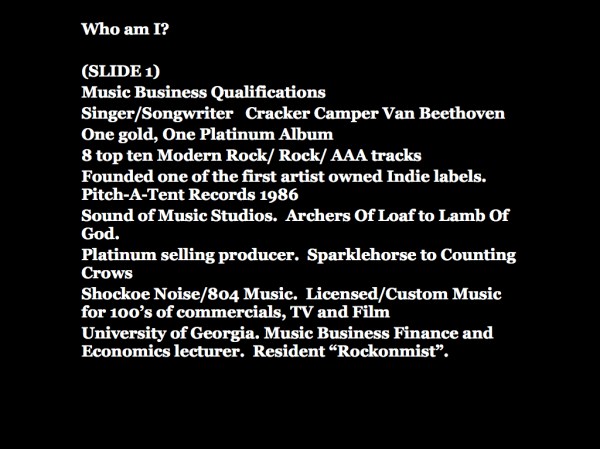
To be clear, when I’m talking about how things are now, I’m not talking about my band and my friend’s bands. I’ve owned a studio complex for 18 years. We’ve recorded everything from hobbyists to Lamb of God. High school punk rockers to octogenarian blues singers. My wife is a concert promoter of some note. She probably books over 300 artists a year. We share an office and from where I write this, I feel like I have a comprehensive view of the music scene in the Southeastern US, if not the entire United States. We live in a city that has one of the highest concentrations of musicians outside of Nashville and Austin.
I generally know what artists are grossing I also have a pretty good idea of what they are netting. If a 4 piece band shows up at the 40 watt club with 2 crew members, beat up old van and they sell 200 tickets? They are probably making about 150 bucks a day each. If a band shows up at my wife’s Atlanta theatre with 2 buses, a truck 10 crew members and an 8 piece band? Well I can tell you they need to sell it out or they (or the promoter) are losing money. Likewise having detailed knowledge of different artists recording budgets and schedules through my studios tells me a lot about how much these artists are expecting to make from sales and touring.
Artists have seen their most important assets collectivized by file-sharing. They no long control the distribution and exploitation of these assets. If this were happening to practically any other group of Americans there would be mass outrage and civil unrest. Other than Ted Nugent and John Popper most musicians are not heavily armed. Hence the lack of armed standoffs.
Without the ability to effectively and fairly exploit their sound recordings the vast middle and lower class, the 99% of the music business has been impoverished.

* There have been a couple serious arguments that if artists received 0.3 – 0.9 cents a song each stream this would be a “sustainable” amount. “All you can eat streaming” services would be able to charge a reasonable rate to the consumer and it would stabilize recorded music revenues or even lift them a little. Also the Spotify question deserves it’s own post cause I’m not sure if artists getting too little money is necessarily Spotify’s fault.
So this is the data I am looking at. It’s all aggregate and most of it is hard data. Those who argue things are better for the artist now usually cite anecdotal cases as evidence, cook the books by excluding data or simply argue that there is no conclusive evidence file sharing has had any effect on recorded music revenues. In other words it’s an unproven theory like global warming, evolution and the roundness of the earth. It’s just a coincidence recorded music revenues dropped 64% since the advent of file sharing.
I think the recording studio data is really important. This is an expense that is common to the independent artist and the label artist (label artists pay for recording out of “their” advance money). Further they can roll in revenue from live performance and other sources into the recording budgets. So you get an expression of the artists entire revenue outlook when you look at the recording process. The fact that artists are spending much less TIME recording can only mean they have less money or expect to make less money. When hundreds of artists of all kinds do this simultaneously it’s hard to argue that artists are making more money.
Improved technology is not the explanation. Technology may have produced some productivity gains, but not in the time consuming tasks of getting sounds, composition and arrangement. Many people who haven’t worked in a studio don’t realize how long it takes just to position microphones and instruments in a room to capture the sounds right. And every drumset, studio, microphone piano, guitar amp and player is a little different. There are no shortcuts.
No matter how good the recording engineer, he/she can’t make the drummer figure out the right beat for the song, what words the singer should sing or the melody of the guitar solo. No, the only explanation for why artists are spending much less time recording is the obvious one. Occam’s razor. Every other explanation adds assumptions.
I’m With Stupid.
“But wait a minute, I keep reading stuff on the internet that says artists are doing much better now? Why do so many people think artists are doing better?”
Let me give you an amusing answer and a serious answer.
The internet is making us stupider. You can make a strong mathematical argument to this effect. The internet is an entertainment medium. It propagates what is entertaining. The internet does a much better job of propagating the wacko-tin-foil-hat way-out-in- the-long-tail untruths than it does propagating the sober accepted scientific facts that live in the head of the curve.
Wacko-tin-foil-hat is way more entertaining especially if it claims to be true. I’m not knocking it cause the entire Camper Van Beethoven oeuvre is based on these kinds of untruths. It’s much more exciting to believe that global warming is a hoax, Obama is a secret Muslim born in Kenya or the RIAA is throwing old ladies in jail for singing happy birthday to their grandchildren in YouTube videos.
Here is a chart that a well intention but hopelessly un-informed friend shared on my facebook page.

If you look at the chart. It is wildly non factual. Yet it’s been shared over 5 thousand times. How many hundreds of thousands of people have absorbed this as fact!
It includes percentages of revenue from record sales going to the agent. Agents only charge fees on live performance.
Former record label (?!)
The studio. Usually paid a flat fee not a percentage of sales.
The manager slice is too large. 15%-20% of net on recorded music not gross as represented here.
But all you really need to know is that it appears this chart was created by a bass player. There is only one bass player joke:
“What do bass players use for birth control?”
“Their personalities.”
The general consensus in the music business is that The Bass Player is the most aggrieved and dissatisfied member of any ensemble. I have many good friends that are bass players and even they will admit there is some truth to this stereotype.
In actuality a much higher share of revenue goes to most artists under a typical record deal. In the 1990‘s typical deals were 15-25% of wholesale. I’m told some superstars got as much as 50%. Add another 70-95 cents for mandatory and statutory “mechanical royalties”. And your “typical’ artist was getting more than 25% of wholesale on physical CDs.
Further mechanical royalties are paid regardless of whether a record is recouped or not. So “downloading a free album” almost always takes 70-95 cents out of the artists pocket, EVEN IF THE ARTIST IS UNRECOUPED!
This negative view of record deals is the result of what I call “the whiner bias.” You only hear about the “bad” record deals. And believe me there were bad deals out there! but most weren’t. But what artist is gonna go out and say “Man my record label is paying me so much money it’s amazingly fair!!”
Also people often confuse artistic conflicts with monetary conflicts. Record labels definitely sought to control artists creatively. But as Morrissey notes
“you could have said no, if you wanted to, you could have said no”
I remember being told to dress in powdered wigs and 18th century clothing for a video. I said no.
Then there is the matter that most record deals end badly. Record deals end when the artist is no longer selling enough albums to justify the deal. The artist is then dropped which leads to a very public falling out. In fact see my song about Virgin Records “It Ain’t Gonna Suck Itself”.
The more serious reason that people think artists are doing much better post napster? There has been a concerted effort by a certain part of the tech blogosphere to paint a rosy picture of the music industry. They have two techniques:
Totally misleading fake studies. Like the Computer and Communications Industry Association’s “The Sky is Rising” Report. First off this was passed around as independent research when it was actually industry lobby generated propaganda. Among the most outrageous obfuscations and bizarre metrics: Including gaming revenue to help disguise recorded music revenue decline, Not mentioning the drop in live music revenues in North America, and creating the bizarre metric of “number of recorded music transactions” instead of using recorded music revenues. Recorded music transactions are up because people buy individual tracks now instead of 1 album of 10 songs. Get it?
There are 14 academic peer reviewed studies that paint quite a different picture. Yet you rarely see these quoted by the digerati.
Anecdotal Examples. Things like Ok Go. Yep that’s a success story. Louis CK Yep success story. But here’s the thing: the music business is like the casino business. You can’t look at one or two players winnings and tell how the casino or ALL the other players are doing. And like a casino the house lets a few people win but overall the game is rigged.
The Future of Music Coalition or as I like to call them the Fooling our Musicians Coalition seems to be the new innovator in this field. Their recent “case studies” seem to be taking it to the next level. They appear to have combined misleadingly titled studies with meaningless anecdotal information.
Example 1.
Are Musicians benefiting from Music Tech?
http://money.futureofmusic.org/are-musicians-benefiting-from-music-tech-sf-musictech-presentation/
Their conclusion is a resounding yes!
But dig into the paper and you find that by “benefiting” they mean things like “being able to keep in touch with fans through Twitter” and being able to use .Zip files. While the .Zip file was a real game changer for musicians, especially banjo players, most people reading the headline and not reading the article would think they were addressing a much more important question:
“Despite the loss of revenue to file sharing has technology allowed the artists to make up the loss of revenue in other ways?.”
We all know that Twitter allows us to talk to our fans already. This has been established. Why did FOMC need to do a study on this? Anytime I read something put out by the FOMC I find myself asking “what exactly was the point of that?”
Example 2.
http://money.futureofmusic.org/case-study-a/
Their “case study” of the veteran 13 year indie rock musician composer showed this particular artist had increasing revenues 2008-2011 (why not 1999-2011 since the artist’s professional career began in 1999?) However the artists identity was not revealed and FOMC refused to release raw data. Further they refused to publish actual total dollars. Instead they only published relative percentages of revenues and expenses. When pressed on these matters on Digital Music News blog, The FOMC study director refused citing “privacy concerns”. Who’s privacy concerns?
And right here is where my tech industry friends will start to hate me.
I call bullshit. I don’t think the FOMC wanted to release the raw data because as clever bloggers deduced it appears this 13 year veteran artist netted less than 34 thousand dollars in his/her best year! (they interpolated this from the percentage assigned to AF of M dues).
“Famous indie rocker only makes 34k a year !” was not a headline they wanted to see in relation to the study.
Why would self proclaimed artist advocates publish such a study?
I don’t really know. But the FOMC is relentlessly praising technology and the technology industry. Fawning might be more accurate. In fact they spend way more time talking about technology issues than they do issues of interest to musicians. Just look at their blog. It’s as if there were an organization called “Friends of Mary Todd Lincoln” but all they did was talk about the theatre.
“Creators must be able to maximize value from their copyrights in a legitimate digital marketplace. We understand the very real problem of intellectual property infringement and its impact on the music ecosystem. We also share the convictions of those who depend on the internet in practically every aspect of their lives and careers that free expression and entrepreneurship are too important to be undermined by overly-broad policy.
“We look forward to working with our many friends in the music and arts communities, as well as those in the innovation sector to find ways to achieve stronger protections for artists while preserving the dynamics of innovation and expression that are the engines of the internet.”–Casey Rae Hunter Dept Director Future of Music Coalition. Statement on Intellectual Property Bills “Reset”.
“Free expression” and “Innovation” are tech speak for being able to use artists songs, sound recordings, films, photos and books without having to license or share any revenue.
And step back for a second. Look at the absurdity of this statement. How the fuck are indie artists making 34k a year, how the fuck are these artists slowing down and preventing Google and other billion dollar companies from innovating?
And why am I pointing this out instead of an organization that claims to represent artists in the digital world?
Maybe if the “Innovation Sector” spent a little less time “innovating” novel legal arbitrages, trying to intimidate struggling indie film makers by posting her DMCA takedown notices on the appropriately named www.chillingeffects.org or wasting shareholder dollars building driverless cars they wouldn’t need the subsidy that the unlicensed use of our music is providing them. But I digress.
And referring to the tech industry as “The Innovation Sector”? I mean is it possible to be more of a bootlicker? This is why I’ve started calling FOMC The Fooling our Musicians Coaliton. Helping musicians does not seem to be at the top of their agenda.
>>>>>>>>>>>>>>>>>>>>>>>>>>>>>>>
Read Part 1
Read Part 3
Tomorrow part 3.

 The Trichordist
You must be logged in to post a comment.