Future of Music Coalition Warns Against Vendor Lock-in in Copyright Office Comments

[The Future of Music Coalition joins the chorus of concern about shenanigans at The MLC, Inc. with special access and treatment of its vendors regarding the “public” database. As others have pointed out, there’s a real question as to whether The MLC, Inc. is actually building its own database or is just building up the data muscle of its vendor the Harry Fox Agency (formerly owned by MLC promoter and nonvoting board member NMPA. The MLC is prohibited by law from licensing other than the narrow window of streaming mechanicals, but HFA is not.]

[I]t’s important that MLC’s chosen vendors not be able to leverage their
status with the MLC to advantage themselves in other business activities not covered under the MMA. If a vendor was able to leverage its status with MLC to the detriment of competitors in other kinds of licensing activity (even informally), that wouldn’t serve competition, consumers, or creators. Additionally, the Office needs to ensure that provisions about database vendors being replaceable are meaningful.

We see no reason to expect that the MLC’s chosen vendors aren’t up to the task, but songwriters and composers need assurance that if a vendor ends up having problems and a change is necessary, that change will really be possible.

The Office can require the MLC to disclose what it is doing to prevent any vendor from being too operationally enmeshed with the MLC that it either enjoys an unfair advantage through that relationship, or that it would be practically impossible for another vendor to step in.

Read the entire post here.

Songwriters Guild and Society of Composers & Lyricists Copyright Office Comments on Database Ownership and Songwriter Credit in Public Database

[The Songwriters Guild of America and the Society of Composers & Lyricists filed a joint comment with the Copyright Office on proposed rules implementing the public database that The MLC, Inc. is charged with stewarding. They raise a host of issues, but also focus on the ownership issue raised by the Alliance of Recorded Music and the songwriter credit issue raised by Kerry Muzzey.]

Ownership of the Musical Works Database

As to the issue of “ownership” of the Musical Works Database, SGA and SCL were gratified by the USCO’s clear statement quoting the MMA that:
[w]hile the mechanical licensing collective must ‘establish and maintain a database containing information relating to musical works,’ the statute and legislative history emphasize that the database is meant to benefit the music industry overall and is not ‘owned’ by the collective itself. Under the statute, if the Copyright Office designates a new entity to be the mechanical licensing collective, the Office must ‘adopt regulations to govern the transfer of licenses, funds, records, data, and administrative responsibilities from the existing mechanical licensing collective to the public, either for free or at marginal cost, pursuant to the MMA.’

Nevertheless, we feel compelled to repeat once again the admonitions voiced by attorney Christian Castle in his recent submission to the USCO concerning practical issues, problems and anomalies that have arisen even prior to the commencement date of MLC public operations concerning the construction of the Musical Works Database:

I believe that The MLC is encouraging songwriters to correct their song data in the HFA database and that no data from HFA has been transferred to The MLC as yet, and may never be. If The MLC is having data corrected and filled out in the HFA database, then the rules applicable to vendor access to the database may not apply because the Congress’s musical works database is not actually being created at The MLC, it’s being created at HFA. Time will tell if I am correct about this, but it does seem that if I am correct, then The MLC and HFA are working together to exploit an imagined loophole in Title I that violates Congressional intent and certainly the spirit of MMA. Respectfully, the Office should find out what is going on.3

SGA and SCL believe that these are important questions of fact that require answers to ensure that data ownership issues are as clearly defined as possible in advance of any conflicts that may arise. Clarifying that (i) all data and corrections made through HFA will be mirrored in the Musical Works Database in real time, and (ii) that being compelled to provide data to HFA under color of authority from Title I does not constitute a license to HFA for any other purpose, will be important steps forward.

As we have also previously stated, the contractual role and authority of HFA (or any other vendor) should be subject to transparent scrutiny by all interested parties, includingthe music creators whose works are the subject of all information that resides in the database. That includes examination of the contractual rights of the vendor in regard to the data flowing through its own systems and/or those of the MLC, the ancillary vendor use rights (if any) of such data during both the pendency and post-expiration/termination periods of such contract(s), and the clarity of rights ownership of data by the MLC and successor iterations of the MLC (including as regards the Musical Works Database). We respectfully call on the USCO to address more robustly these important issues of transparency and data ownership, and ignore unsupported assertions that transparency and scrutiny of vendor relationships will invite inefficiencies as opposed to clarity and competition.

Songwriter and Composer Names in the Public Musical Works Database

As the USCO is aware and has recognized, SGA and SCL have been consistently outspoken concerning the fact that out of all pertinent identifiers for musical compositions, the names of the music creators of a work are among the only constant and unique data points. In all but the rarest of circumstances, such information is never subject to change, and therefore one of the most important and reliable elements necessary for accurate identification and matching of works.

Moreover, the extension of proper credit to human creators as part of this crucially important Musical Works Database –rather than simply limiting identifiers to the names of corporate assignees of rights which are frequently subject to change and termination– is both appropriate and essential to the fulfillment of the ideals and underpinnings of the MMA set forth in Article I, Section 8 of the US Constitution. As that section makes clear, copyright protections are first and foremost meant to serve the interests of the creators and the public, not the corporate entities that serve in an instrumental but secondary role as rights administrators.

We have therefore remained completely at a loss to understand why this crucial category of information was omitted from the MMA as a specifically required identifier (and why the music publishing community for some reason failed to support our efforts to correct that oversight), and are especially thankful that the USCO has put forth a proposed rule

that requires the MLC to include songwriter and composer information in the database. SGA and SCL continue to remain disquieted, however, with the additional qualifier added by the USCO concerning the standard to be applied by the MLC in seeking music creator data: “to the extent reasonably available to the collective.” Such a limited standard serves to diminish the requisite and explicit value of songwriter/composer identifying information.

We respectfully believe that music creator information should be more clearly defined as a mandatory data point required to be pursued for inclusion in the database by the MLC with vigor, and suggest once again that the rulemaking more specifically reflect the imperative nature of this duty. A more appropriate standard would be, in our view: “to the extent available to the collective through its best efforts to secure such data.” The avoidance of creating loopholes that may permit music publishers to omit music creator information from the data they voluntarily provide to the MLC is essential, and the independent community of songwriters and composers continues to seek the assistance of the USCO in this regard.

In respect to the foregoing, we desire to make clear that SGA and SCL also continue to support the rights of those music creators who may wish not to be publicly associated with certain musical works. That is and must continue to be right of any songwriter or composer. We therefore support the proposed rule put forth by the USCO that grants the MLC discretion to allow music creators the option of having songwriter/composer information listed anonymously or pseudonymously. We would, however, prefer that such a regulation be extended into a mandatory direction to the MLC to accept such direction from a music creator.

Read the whole comment here.

Copyright Office Comments by Composer @KerryMuzzey: Include Songwriter Credits in MLC Database

[Kerry Muzzey is an independent classical and film composer and artist rights advocate. In his comment to the Copyright Office on the MLC regulations he asks why songwriter names are not required to be included in the public database currently being stewarded by The MLC, Inc. Including songwriter names in the database seems like a fundamental building block of identifying a song–assuming that’s what you want to do. It would be like SoundExchange reporting not including an artist name in the transaction data. It makes no sense. Yet, it’s an issue as we will see.]

My name is Kerry Muzzey. I am an independent classical and film composer, and am self-published. It is crucial that the MLC database be searchable and completely public-facing, not only by song title but by writer’s name and publishing entity name or by ISWC or BMI/ASCAP IPI/CAE. Independent artists and music publishers must have the ability to search the “black box” of royalty collection, not only for unpaid royalties, but for accrued royalties that appear under a misspelling of an individual’s name, publishing entity, or in the event that a similar song title has resulted in the misattribution of the writer/publisher credit to another writer/publisher or artist. This transparency is essential not only for accurate accounting of royalties for an individual, but also for any works that are co-written, have multiple publishers, and/or whose performance rights are represented by multiple PROs. Any composer, songwriter or music publisher should have the ability to “disambiguate” their works from any other similar- or matching-title works or similar or identical writer names, by a simple error submission/correction process (after completing any necessary verification of identity). 

Read the entire comment here.

The MLC Posts its By Laws

The MLC finally posted its “by-laws” that gives some insight into its operations. For a non-profit like The MLC, Inc., the by laws are essentially the operating rules of the corporation.

Typically, a non profit’s by laws cover issues like the purpose of the organization, the location of offices, the general governing structure, the number of governing members (like the board of directors) and the process for the selection, election and removal of members, terms of service for governing members, qualifications for those serving to govern the organization, methods of conducting business and organizational policy statements, meeting times and dates (usually a minimum of annually), limitations of the organization and its governing body and its fiscal year (for accounting and reporting this has to be a twelve month period).

The MLC’s by laws have all these typical components, but also have an acknowledgement of the oversight role of the Copyright Office and the Librarian of Congress as required by Title I of the Music Modernization Act.

One thing is a bit unusual about The MLC’s by laws given that it was sold to songwriters by the NMPA on the basis that “the services pay for everything” is the broad indemnification clause in Article VIII of the by laws. What this means is that The MLC is going to cover the costs if any “Person” gets sued or criminally prosecuted:

Neither the Members nor any Director of the Collective shall be personally responsible for monetary damages for any action taken, or any failure to take any action, provided however, that this provision shall not eliminate or limit the liability of any Member or Director to the extent that such elimination or limitation of liability is expressly prohibited by applicable law, as in effect at the time of the alleged action or failure to take action by such Member or Director.

The Collective shall indemnify any Person who was or is a party or is threatened to be made a party to any threatened, pending or completed action, suit or proceeding, whether civil, criminal, administrative or investigative by reason of the fact that such Person is or was a Director or Officer of the Collective, or is or was serving any other corporation or any partnership, joint venture, trust or other enterprise, in any capacity at the request of the Collective, [that means HFA] to the fullest extent and in the manner set forth in and permitted by the DGCL, as from time to time in effect. Such right of indemnification shall not be deemed exclusive of any other rights to which such Director or Officer may be entitled apart from the foregoing provisions.

(b) The Collective shall pay expenses (including attorneys’ fees) incurred by a Director or Officer of the Collective referred to in Section 8.4(a) of this Article VIII in defending or appearing as a witness in any civil or criminal action, suit or proceeding described in Section 8.4(a) of this Article VIII in advance of the final disposition of such action, suit or proceeding. The expenses incurred by such Director or Officer shall be paid by the Collective in advance of the final disposition of such action, suit or proceeding only upon receipt of an undertaking by or on behalf of such Director or Officer to repay all amounts advanced if it shall ultimately be determined that the Director or Officer is not entitled to be indemnified by the Collective (which undertaking need not be further secured).

Wonder where that money is going to come from?

#ShowUsTheMoney: Guest Post: @CopyrightOffice Regulates the @MLC_US: Selected Public Comments on MLC Transparency: Chris Castle

[This is an except from Chris Castle‘s June 7 comment to the Copyright Office regarding the transparency of The MLC. You can read the entire comment here. Although The MLC has launched its “Data Quality Initiative” to great fanfare, that DQI process merely confirms how bad the HFA database is since there still is no MLC database as required by law. Since there’s no indication of when The MLC is going to launch and there is a strong indication that nobody in power is doing anything about it (looking at you, Copyright Office), this is a particularly timely excerpt. Remember you heard it here first if your mechanical royalty statements drop to zero once The MLC takes over on January 1. That is 113 days from today and we have yet to seen a thing from The MLC and we have no promise of when we will see anything. Given that there has been zero investigative journalism on this topic from industry outlets aside from “how does The MLC withstand its own awesomeness” the comments that we are serializing are about all you’re going to get in the way of transparency.]

Quality Control of The MLC’s Operations and Platforms

There is an immediate need for The MLC to demonstrate that its systems actually work.  That need will be ongoing, so it would be well for the Office to promulgate regulations requiring a periodic public demonstration of the operability of The MLCs systems, a frequent public disclosure of bugs and bug fixes, and a frequent public disclosure of any missed payments or other glitches.  These matters are appropriate for the transparency of The MLC because if either The MLC or another MLC are not required to disclose these items, no one may ever know there was a problem (but see the discussion of whistleblowers below).

In considering the timing, I would caution the Office against thinking in years rather than weeks.  There is a tendency to think about these things in annual or more time periods.  This will prove to be a mistake given the scale and volume of transactions.  Would you tell Visa it only need to confirm the integrity of its fraud detection systems once every three years?  Or should it be more frequently?  Financial services is a good corollary for streaming mechanicals, with the exception that the royalty payable for each stream starts several decimal places to the right unlike credit card transactions.

There is an immediate need for this transparency.  Recall that MLC executive Richard Thompson said at the Copyright Office panel on unclaimed royalties last December, “[A] lot of the time since July has been spent working very closely with the staff at HFA and ConsenSys, really starting to nail down how all of this is going to work at the, you know, lowest operational level, all of the things that we need to work out.”  (Referencing the July 8, 2019 designation of The MLC as the MLC.) [1]   

Of course, The MLC didn’t announce the selection of HFA and ConsenSys until November 26, 2019[2] and was evidently still interviewing vendors up to that date.  Even so, I’m sure The MLC has been hard at work on developing their platform.

Mr. Thompson also stated at the December 2019 panel:

So our current timeline has the first version of the portal going live late Q2, early Q3, of next year [i.e., 2020]. I emphasize again that is the first version. That will not be functionally complete. It will have the, you know, the first set of functionality that we want to make available to the rightsholder community. So in particular, sort of, being able to look at your catalog, manage your catalog.[3]

Late Q2 to early Q3 is now.  [As of this post, it is the end of Q3 and we still have nothing but Mr. Thompson still has a job.] To my knowledge, The MLC has made nothing available for songwriters to know what is going on at The MLC or how to start registering works. 

Mr. Thompson also stated:

“You know, the first version of the portal doesn’t have statementing on it, because we won’t need statementing until 2021, you know, the first quarter of 2021.”[4]

I would respectfully ask the Office to determine what happens if The MLC is not able to render statements on time.  Presumably the income from streaming mechanicals that had been paid by the services directly to songwriters or music publishers would be transferred over to The MLC as of the License Availability Date (currently January 1, 2021).  If that transfer occurs and The MLC is not then ready for “statementing” (or, presumably, its corollary, “paymenting”) for the billions if not trillions of streaming transactions for all the world’s music in less than a year’s time from today, then streaming mechanical royalties could drop to zero until The MLC could handle both statementing and paymenting.[5]

While Mr. Thompson seems to be focused on the Q1 2021 distribution date for royalties payable in the normal course, the other significant statementing and paymenting date is July 1, 2021 when the first unmatched distribution is to be paid under Title I.  There are also the obvious and expressly stated “public notice of unclaimed royalties” reporting requirements for The MLC’s public facing website listing all unmatched songs (or shares of songs) and publicity efforts for the unmatched.[6]  This provision, too, is glitchy, but  presumably will come into effect soon.  I realize there may be some side deals cut regarding extending that statutory payment date, but it would at least be a confidence building exercise to know that The MLC could make the unmatched payment as of the statutory date if called upon to do so. 

Songwriters have very little visibility into The MLC’s operations except what came out at the Copyright Office panels, for which I am grateful, and also various interviews.  There is little substantive information in the press, and even less on The MLC’s website.  Therefore, it would be very helpful if the Office could require The MLC to demonstrate to the public how its platform is to function.  Such a demonstration might bring helpful suggestions from their peers or the ex-US CMOs that have been operating for decades.

It would also be helpful if the Office promulgated a bright line regulation that told songwriters around the world if the July 1, 2021 goal posts have moved and if so where they have been moved to.  I must say I have somewhat lost the page on this, given former Register Temple’s last testimony to the House Judiciary Committee about who has agreed what on delaying distribution.  This rulemaking would be a great opportunity to tell the world if and how the insiders have decided to change the law.

As the House Judiciary Committee stated:

Testimony provided by Jim Griffin at the June 10, 2014 Committee hearing highlighted the need for more robust metadata to accompany the payment and distribution of music royalties….In an era in which Americans can buy millions of products via an app on their phone based upon the UPC code on the product, the failure of the music industry to develop and maintain a master database has led to significant litigation and underpaid royalties for decades. The Committee believes that this must end so that all artists are paid for their creations and that so-called ‘‘black box’’ revenue is not a drain on the success of the entire industry.[7]

Having accomplished their goal through compulsory legislation, we are all watching the database cadre get to work and looking forward to learning how it is done from their teaching.

Alternatively, as is widely suspected among some songwriters I have spoken to, The MLC might rely on HFA’s statementing and paymenting functionality to limp along by sending necessary but not sufficient statements to HFA publishers or publishers that HFA can match.  This would be, essentially, the same process that got a couple of HFA’s licensing clients sued repeatedly, and ironically led to the Title I safe harbor in the first place. 

Absent proper transparency in the runup to the License Availability Date, any sudden drop in revenue would catch songwriters by surprise.  In the time of the pandemic, such a sudden contraction of income could be even more devastating than usual.[8]

Transparency would help shine sunlight on that problem.  While The MLC may give interviews and appear on panels describing their activities, we should remember the words of the great Bruin John Wooden who cautioned that we should not mistake activity for achievement.  If you practice free throws by yourself all weekend, it doesn’t mean you’ll be a better player with the team at Monday practice—or that the team is any more likely to win when it is game time at Pauley on Saturday.


[1] Transcript, United States Copyright Office Unclaimed Royalties Study Kickoff Symposium (Dec. 6, 2019) at 28 ln 15 hereafter “Kickoff Transcript”.

[2] Tatania Cirisano, Mechanical Licensing Collective Selects Leadership, Partners for Copyright Database, Billboard (November 26, 2019).

[3] Kickoff Transcript at 40 ln 2.

[4] Kickoff Transcript at 40-41.

[5] It is well to note that such a contraction probably would not affect direct licenses or HFA’s modified compulsory licenses.

[6] 17 U.S.C. § 115 (d)(3)(J)(iii).

[7] House Report at 8.

[8] Songwriters are already expecting lower royalties in January 2021 according to BMI’s President and CEO Mike O’Neil: “[We] anticipate an impact in January 2021, when today’s performances and corresponding licensing dollars (2nd quarter 2020) will be reflected in your royalty distributions. While you may see a lower distribution that quarter than you might typically receive under ordinary circumstances, given BMI’s business model, we have the time and ability to plan for this outcome.” A Message from Mike O’Neil, BMI.com (April 7, 2020) available at https://www.bmi.com/news/entry/a-message-from-bmi-president-ceo-mike-oneill-regarding-royalty-payments

Copyright Office Regulates The MLC: Selected Public Comments on the Copyright Office Black Box Study: The DLC Spills the Beans, Part 3

[Read Part 2 here.  This is the last of 3 parts]

The services tell us in their Copyright Office comment that the whole point of the Music Modernization Act was this (largely secret) deal to get them a new retroactive safe harbor so their massive infringement couldn’t be stopped by songwriters.  (That’s their third statutory safe harbor counting DMCA and Section 230.)  What do you think that MMA safe harbor is worth to them to avoid what they call “ruinous litigation”?

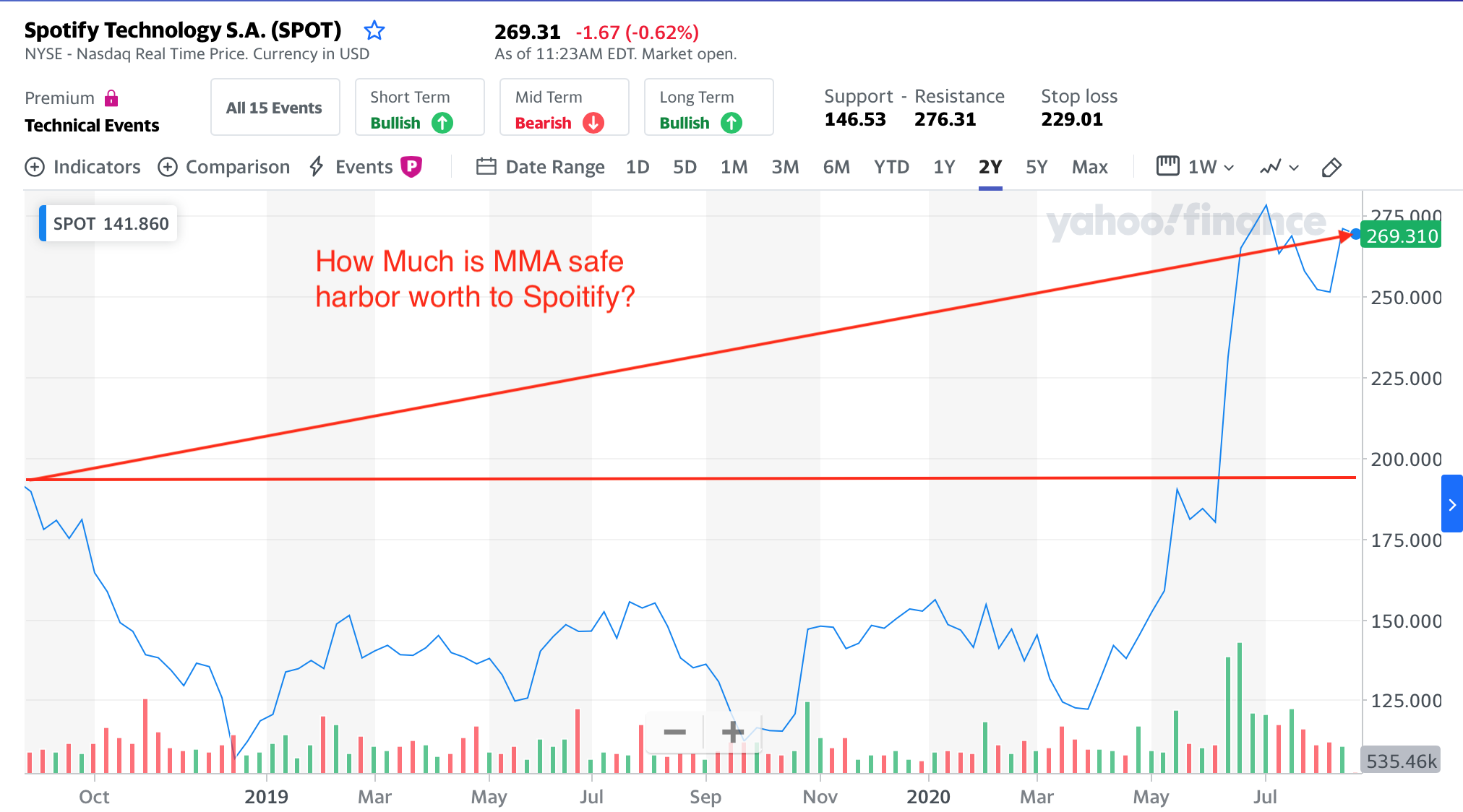
Let’s use Spotify’s market cap as a proxy for the value of the safe harbor–imperfect, yes, but at least it is transparent unlike anything else having to do with Title I of the MMA.

SPOT Safe Harbor Value

Around October of 2018 when the MMA was signed into law, Spotify traded at $189.  A recent closing price for SPOT is $268.  Is it fair to say that the MMA was the rocket fuel that made Daniel Ek a billionaire?  Not entirely.  You can see from the graph that Spotify actually broke through a $190 per share support level to the downside right after the MMA was signed and bounced around below that price for a year or more.

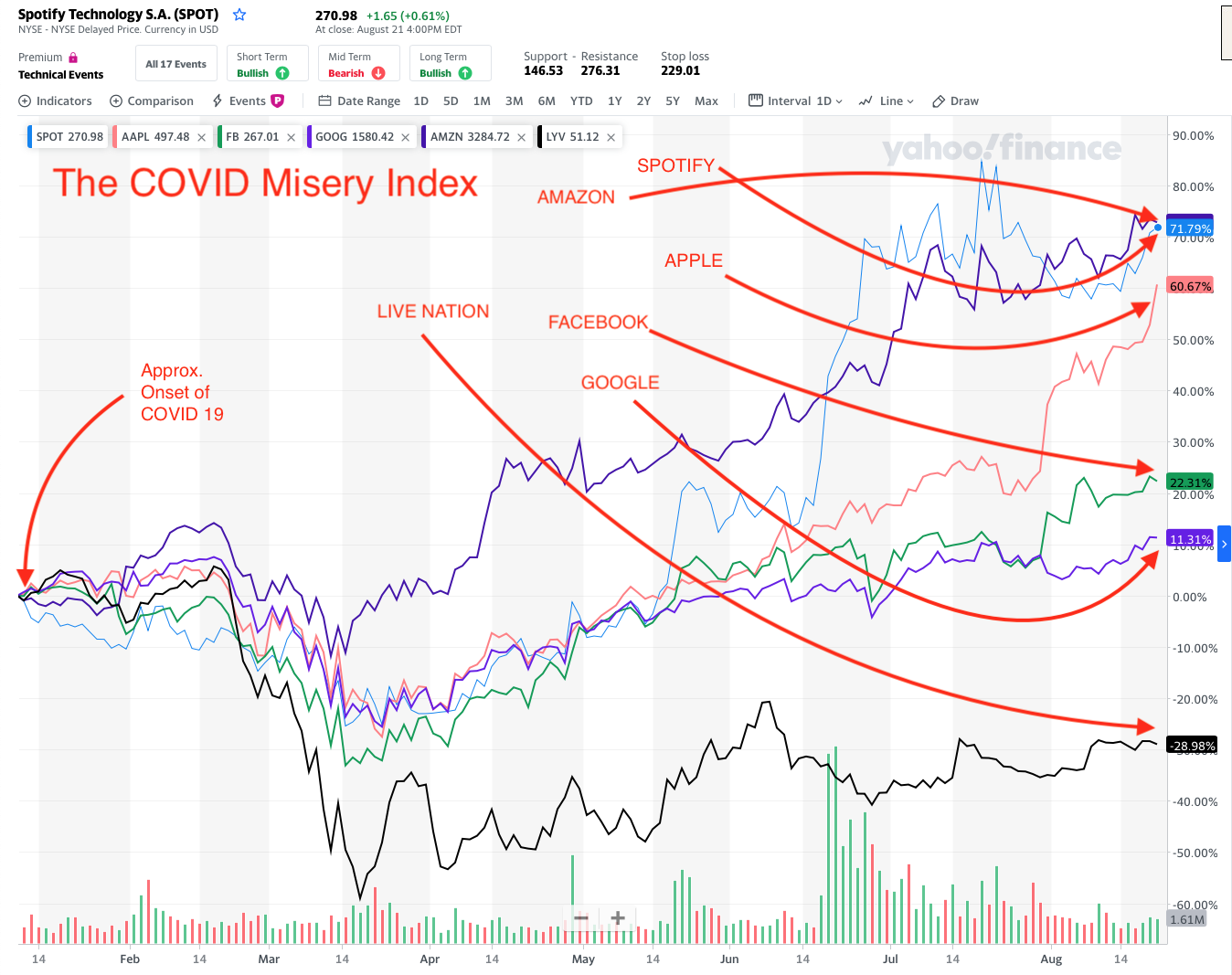
The clear driver of Spotify CEO for Life Daniel Ek’s wealth and profiteering is the COVID virus.  Make no mistake, human misery–not the MMA safe harbor–is what provided the rocket fuel for Spotify’s 2020 growth.  In fact, the same rocket fuel of misery seems to have benefited each of the exploitative cohort as this graph shows using Live Nation as a proxy for the collapse of touring:

COVID MISERY INDEX 8-22-20

So it could be said that the entire “ruinous litigation” argument from the DLC is simply so much bullshit that these companies fed to the MMA negotiators by the plateful.  What is not bullshit, however, is that the one thing the negotiators could have scored that they didn’t is a waiver of the services appeal rights in the Phonorecords III rate setting decision.  This is the appeal that the services recently won when the appeals court handed the negotiators heads to them.  There could also have been a settlement since they seem to like those so much.  The negotiators didn’t do either.  We’ll see how the do-over turns out, but one thing we know is that there will be millions in legal fees that songwriters will have to eat one way or another that could easily have been avoided.

What is also not bullshit is the other side of the MMA transaction:  The loss to songwriters of this heretofore secret deal.

You will note that none of the music services appear to have paid out jack in the way of newly matching the previously “unmatched” in the years since the signing of the MMA. Why?  Because the MMA negotiators did not require any interim payments of matched funds or any public reconciliation of black box to matching efforts.  No, no, the first time the black box gets disclosed publicly is when those funds are paid to the MLC, not to the songwriters who earned the money.  Round and round and round it goes, and where it stops, nobody knows.

If you believe as we do that the services have not lifted a finger to increase their matching efforts (and based on the DLC’s disclosures seem to have already paid out pre-MMA black box on a market share basis), you will better understand why we think this was a colossally terrible deal for songwriters.  You will also understand why this part of it was largely kept secret or downplayed.

The Eight Mile Style complaint against Spotify and the Harry Fox Agency (which is the same Harry Fox Agency that is now going to be handing your royalties for The MLC, how curious) has an informative passage about the timing of this retroactive safe harbor:

In addition, the retroactive elimination of the right to profits attributable to infringement, statutory damages, and attorneys’ fees under the MMA is an unconstitutional denial of substantive and procedural due process, and an unconstitutional taking of Eight Mile’s vested property right, and this Court should so declare.

It is settled law that an infringement claim is a property right that vests in a plaintiff the moment the infringement occurs. The Bill that ultimately became the MMA, written by the NMPA, with input from Spotify, became law in October 2018, but provides retroactively that a plaintiff who did not file an action by December 31, 2017, could lose any right to profits attributable to infringement, statutory damages, and attorneys’ fees if successful in a case against Spotify or other DMPs of interactive streams. On information and belief, the MMA, according to the NMPA’s own announcements, lobbyist spending, and congressional testimony on Capitol Hill, was jointly crafted by members of the NMPA (whose three top markets shares and dues-paying affiliated companies own equity in Spotify) and Spotify, DiMA, and other interactive streaming companies.

They knew what they were doing….

[W]ith the removal of these remedies, it cleared the last hurdle for Spotify to go public, thereby reaping tens of billions of dollars for its equity owners, including the major music companies as mentioned above. The unconstitutional taking of Eight Mile’s and others’ vested property right was not for public use but instead for the private gain of private companies.

The reference to timing on Spotify “going public” means Spotify filing their “DPO” to sell stock on the public markets–the really big money.  That’s relevant to the MMA negotiation because the MMA bill was introduced on December 21, 2017.  Spotify filed a confidential paper with the Securities and Exhange Commission on January 3, 2018 and Spotify’s stock started trading on April 3, 2018.  The MMA allowed them to show the markets that they were doing something about their systemic copyright infringement problem and gave fuel to the specious argument that lawsuits against them were merely opportunistic gotcha lawsuits and not a bellweather for their utter incompetence and cavalier treatment of songwriters.

Why is this timing important?  Because the MMA was filed on December 21.  What happened on December 22?  Congress closed for the holidays and would not reopen until after January 1, 2018.  That meant there would not be an official version of the bill until after January 1, 2018, the deadline to sue before the retroactive safe harbor would eventually take effect.  Various copies leaked, but since the entire music industry was also shut down for the holidays, it was unlikely that any songwriters would see it, particularly because we can’t find that their so-called “representatives” ever brought it up in any public messaging before the January 1 deadline had passed.

Do you think that timing is a coincidence?

As Eight Mile Style tells us:

The proof is in the pudding: Spotify was sued many times prior to December 31, 2017, for similar acts of copyright infringement as alleged herein, but not once since December 31, 2017. This is because the Bill that ultimately became the MMA first publicly leaked shortly before December, 2017, leaving music publishers with little or no time to investigate or file a lawsuit for infringement, even if they somehow became aware of the Bill at that time.

It just happened that Wixen Music Publishing was already on a war footing from opposing the various Spotify settlements and was able to easily pivot to filing its own lawsuit against Spotify before the December 31, 2017 deadline in a move worthy of General Patton at Bastogne.  But Wixen was alone.  No one else probably even knew the deadline was passing or what it meant.

The value of what the “negotiators” gave away cannot realistically be measured for the reason that Eight Mile Style clearly states, which is also the same reason that the retroactive safe harbor is unconstitutional:

The only practical or realistic remedies in these cases is the statutory damage remedy, and profits attributable, together with the ability to receive attorneys’ fees, and the drafters of the MMA knew it. The elimination of these remedies takes away from Eight Mile and others who may be similarly situated any practical or realistic remedy, immunizes complying DMP’s from suit, and should be declared an unconstitutional deprivation of due process and a taking of a vested property right.

So what’s the value that songwriters gave up in the MMA?  Wixen sued for $1.6 billion.  You figure it out.

Copyright Office Regulates The MLC: Selected Public Comments on the Copyright Office Black Box Study: The DLC Spills the Beans, Part I

We once had a mechanical licensing system in the U.S. that worked well enough for songwriters for 100 years.  The problem with the mechanical licensing system wasn’t so much the licensing function it was the royalty rate.  The government held down songwriters for 70 years to a 1909-based royalty rate that for some reason was frozen in time (more on frozen mechanicals here).  But if users failed to license, songwriters could at least sue for statutory damages.

After the Music Modernization Act passed in 2018, they managed to even give away songwriters’ rights to sue.  The songwriter part of the three-part MMA is called “Title I” and that’s the part that gave away the one hammer that songwriters had to be heard when their rights were infringed.  They called it the “limitation on liability” and it was retroactive to January 1, 2018—before the bill was actually passed by Congress and signed into law.

It’s entirely possible that even if you knew about the MMA, you didn’t know about this new safe harbor created by the same uber-rich companies that wrote themselves the DMCA safe harbor that has created the value gap and plagued artists for years and the “Section 230” safe harbor in the “Communications Decency Act” that services use to profit from human trafficking and revenge porn stalkers.  And now there’s the MMA safe harbor.

Only a handful of insiders got to be at the table when they gave away your rights in Title I without your even knowing what they were up to.  Don’t get us wrong, there are great things in the other parts of MMA dealing with closing the pre-72 loophole, some important changes to the rules for ASCAP and BMI with rate courts, and the fix for producers getting a fair share of SoundExchange royalties.  These are all good things.

The part that sucks is Title I that created this new safe harbor give away that will bedevil songwriters for generations to come.

So you may be asking how do we know this?  Since the so-called “negotiations” for the Title I give away happened behind closed doors, how do we even know what happened?  The answer is that we didn’t have the proof because anyone who tried to offer constructive criticism to the “negotiators” for songwriters was menaced, threatened and stabbed in the back.  Nobody was talking about the safe harbor give away.

But now we do have the proof courtesy of the music services representative at the “Digital Licensee Coordinator” who opened the kimono in their recent comments to the Copyright Office about the black box.  (Read the entire DLC comment here.)  Their comments make for quite a read, not only about the so-called “negotiations” by the unrepresentatives of songwriters but also about the run-up to the MMA in the private settlements that nobody sees.

The first issue is that the Copyright Office has proposed some well-meaning regulations to increase the likelihood that the black box will actually get paid to the songwriters who earned the money.  The services seem to be all in a huff about rules applying retroactively when they’ve been using old rules to organize their data.  You know, they don’t like this retroactive thing unless it’s a retroactive expansion of their safe harbor.  Then they like it just fine.

“The DLC emphatically opposes the Office’s proposal to retroactively expand the required reporting of sound recording and musical work information beyond that which is required by the existing regulations in 37 C.F.R. § 210.20. Those regulations were issued in interim form in December 2018, and finalized in March 2019, and unambiguously required collection of reporting information under the existing monthly statement of account regulations in 37 C.F.R. § 210.16. The Office has now proposed, in paragraph (e) of the proposed rule, to change the required reporting elements for the individual tracks, nearly two years after the MMA’s enactment and months before cumulative statements of account are due to be served.”

Sorry, but we think that the richest companies in commercial history, with trillions and trillions of dollars in market capitalization and the most advanced data mining capability in the known universe, can manage to figure out how to pay songwriters in a way that will actually result in songwriters getting paid. The truth is that they are so used to screwing songwriters that they are not going to lift a finger to help beyond the absolute minimum they have to do.

They got their retroactive safe harbor to give away, so don’t come whinging about retroactivity if it makes the distributions more likely to get to the right person, something the services have uniformly failed to do from their founding.

But now it gets interesting.

“It is well-known that—prior to enactment of the MMA—a number of DMPs entered into industry-wide royalty distribution agreements under the auspices of the NMPA, structured to allow all unmatched works to be claimed by their owners and all accrued royalties to be paid out, in what became the model for the MMA. These agreements were designed to, and did, put tens of millions of dollars in statutory royalties in the hands of copyright owners—money that they had been unable to access due to the broken pre-MMA statutory royalty system.”

First of all—“money that they had been unable to access due to the broken pre-MMA statutory royalty system” is utter crap.  The reason that services didn’t pay out is because they didn’t clear the songs but exploited them anyway.  For example, that’s also why Spotify got sued so many times and is still getting sued.  It’s not that the system was broken, it’s that the services didn’t care and handled licensing in an incompetent manner. In case you missed it, that’s what they want to keep doing by extending into the future the same sloppy practices they got sued for in the past.  The only thing new and improved about it is their absurd and undeserved safe harbor.

We don’t know what these “industry-wide royalty distribution agreements” were all about, but one thing we know for sure is that they weren’t “industry-wide” and the NMPA wouldn’t have had the authority to make those deals “industry-wide” in the first place.  “Industry-wide” seems to mean “with the major publishers” or with NMPA members or just plain insiders.  The implication is that “industry-wide” means everyone, which it clearly does not and cannot if you think about it for 30 seconds.

And if the copyright owners were owed a payment with their own money, the only reason that they couldn’t “access” the funds is that the services wouldn’t let them.  When you owe somebody money, you should pay them because you owe them, not act like you’re doing them a favor.

But here it comes:

Congress in the MMA’s limitation on liability provision enacted a compromise among stakeholders’ interests: elimination of the uncertainty of litigation facing DMPs in exchange for the transfer of accrued royalties to the MLC.

In other words, the services sat on the money and refused to pay until they got the MMA safe harbor.  That was the “trade”—do something the services were already required to do in return for something the songwriters were never obligated to do.  The songwriters paid for the safe harbor with their own money.

“As set forth in the relevant statutory provision, in exchange for payment of accrued royalties from “unmatched” usage prior to license availability date (and related reporting), DMPs are protected from the full brunt of copyright damages in any infringement lawsuits based on alleged failures to comply with the requirements of the prior mechanical licensing regime. The provision provides a clean slate for any past failures under the prior licensing regime for those DMPs who pay those back royalties and provide associated reporting. It provides requirements for DMPs that seek to take advantage of the limitation on liability, ensuring that DMPs that pay accrued royalties to the MLC can do so without having to second-guess whether the payment was worth it—that is, whether they qualify for the limitation.

This was the heart of the deal struck by the stakeholders in crafting the MMA: to provide legal certainty for DMPs, through a limitation on liability, in exchange for the transfer of accrued royalties.

Which “stakeholders” were these?  Did they include any of the plaintiffs who were then suing the services?  No.  Did they include anyone who didn’t drink the Kool-Aid?  No.

So let’s be clear—the reason that the services deigned to actually pay money they owed for failing to license properly is because they didn’t want to be sued for screwing up.  They wanted a vig of a new safe harbor, and as the DLC tells us very, very clearly this issue was at the core of the deal you didn’t make for Title I.

More in Part II


Copyright Office Regulates The MLC: Selected Public Comments on the Copyright Office Black Box Study: Zoë Keating

[The Copyright Office is asking for public comments on best practices for dealing with the black box as part of the “Unclaimed Royalties Study” mandated by the Music Modernization Act.  We are posting comments or excerpts from comments that we found interesting starting with comments by our friend Zoë Keating.  You can find other the posted comments here.]

Regarding unclaimed royalties: To facilitate the population of correct metadata going forward, when someone registers a composition or a composition with a sound recording, that information should lead to an automatic registration with the MLC.

Why is it necessary in the first place to register works in so many places? Why can’t I as a self-published composer who owns all my copyrights, register my compositions and my recordings with the copyright office and have that information shared with the MLC for mechanical rights, SoundExchange for digital performing rights and a selected PRO for the performance right?

I am making this comment here in the unclaimed royalty study because as long as this is not facilitated, there will continue to be more unclaimed royalties than there should be. As long as the process remains confusing and opaque to self-published creators, who will rely exclusively on the MLC, there will be gaps in the data. As long as there are gaps in the data, the more likely it is that royalties will go unclaimed.

Rather than spend money on continually educating the public as to where they need to register their information in order to collect a royalty – why not spend the money to automate the process from the inception?

As for the unmatched royalties themselves, I have the following comment:

A database of the unmatched compositions for which there are royalties should be publicly searchable in order to effectively crowd-source and facilitate at least part of the matching process. There are bound to be errors on the DSP reporting side, some of which the copyright owners themselves might be familiar with from reporting errors in the past with other types of royalty databases, and know what to look for.

Also, given that the MLC will be collecting royalties on behalf of foreign songwriters and publishers, I would expect the core MLC database itself and any searchable index of the unmatched database to feature standardized character normalization for search and subsequent matching of diacritics, umlauts, accents etc.

Is The MLC Updating the HFA Database?

The MLC announced an aspirational tool for publishers to confirm whether the MLC’s data is correct for their songs.  Apparently this is planned to be a quality control check for song metadata that The MLC has already acquired. As far as we can tell, the tool doesn’t actually exist yet.

VaporwareHere’s the press release language:

For Music Publishers, Administrators and CMOs: Data Quality Initiative (DQI)
The MLC created the Data Quality Initiative (DQI) to provide a streamlined way for music publishers, administrators and foreign collective management organizations (CMOs) to compare large schedules of their musical works’ data against The MLC’s data. Through the DQI, The MLC will provide participants with reports that highlight the discrepancies between the two sets of data so that they can more easily address those discrepancies and improve the quality of The MLC’s data.

The MLC has begun working directly with a number of music publishers and administrators to on-board them into the initiative. The MLC is also working with software vendors to help them enhance their platforms to enable users of their systems to participate in the initiative. The MLC looks forward to working with other music publishers, administrators, CMOs and software system vendors interested in participating in The MLC’s Data Quality Initiative.

“One of the biggest and most time-consuming challenges for music publishers, administrators and CMOs is checking the accuracy of their musical works’ data,” said Richard Thompson, CIO of The MLC. “We launched the Data Quality Initiative to help those parties increase the efficiency and effectiveness of this process. Participants in the initiative will be able to see where their musical works data does not match The MLC’s data, so that they can then take the necessary corrective action.”

Of course, The MLC has yet to permit songwriters (or anyone for that matter) to register their songs with The MLC at least not publicly.  Neither have they given anyone access to whatever data they actually have ingested–and still won’t with the DQI tools. When you use the DQI tool, you sit outside The MLC’s database and they give you “reports” so you may take “the necessary corrective action”.  At your own expense, of course.  You know, “Play Your Part On Your Dime to Keep Us Relevant.”

So if the goal of the Data Quality Initiative is for “The MLC [to] provide participants with reports that highlight the discrepancies between the two sets of data so that they can more easily address those discrepancies and improve the quality of The MLC’s data” we have to ask how did The MLC come to have any data to check for quality control in the first place?

Chances are pretty good that the source of The MLC’s data set is the Harry Fox Agency–if they’ve even bothered to copy the HFA data into The MLC’s database.  (One reason they send you a “report” is so the source of that report is not disclosed as if it were just the HFA database being queried, it might raise some hackles among songwriters and especially the DLC who is paying millions for the whole show.)

As has been noted, The MLC’s Richard Thompson announced that The MLC was working with HFA since The MLC was first designated by the Copyright Office as the MLC. (even before they announced that HFA was their vendor)  This is the HFA that services Spotify.  Spotify has been sued…ahem…a number of times for failures to license songs in historic litigation that led to their latest get-out-of-jail-free goal-post-moving exercise also known as the Music Modernization Act.  In fact, HFA is currently being sued alongside Spotify by Eminem’s publishers for all sorts of nasty things (which have yet to be proved).  But make no mistake, HFA was picked as best of breed by everyone’s favorite MLC, The MLC.

So what The MLC is really saying here is that they want everyone to take the time to check your own data against the HFA database and then correct it.  And who wants to bet that all those corrections–which could be a vast number of corrections and song-share updates–will end up back at HFA for HFA to use as it chooses (or its Rumblefish affiliate).

Play Your Part for HFA

But wait, there’s more.  Don’t forget:  The reason for this exercise in data cleaning is to “improve the quality of The MLC’s data“.  Why do you care about the quality of The MLC’s data? Very simple.  The government makes you do it.  What could be worse than a compulsory license?  A compulsory license with a safe harbor for massive infringers like Spotify and an industry-wide market share black box controlled by the for-profit companies that most benefit from the market share black box.

So what The MLC is really saying is “play your part” to “improve the quality of The MLC’s data” or we will take your money and there’s sweet F-all that you can do about it.  In the middle of a global pandemic.  The truth doesn’t read quite so well, right?  Oh, and by the way–you get to pay the costs of this data clean up job yourself even though it’s for the benefit of The MLC.  And why are you compelled to cover those costs?

Because they’ll take your compulsory royalties if you don’t.  And given the way these people work, maybe even if you do.  How would you ever know?

But wait, there’s still more.  Remember that the Eminem publisher’s case is about Spotify’s failure to match properly which is a condition of the MMA safe harbor that somebody decided was a good idea for the rest of us.  Let’s say that those publishers are wrong and that the services have actually been matching like crazy to keep their safe harbor (albeit in the background because the sainted MMA does not have any oversight or transparency about matching).

We don’t believe this, of course.  But let’s just say that they’re wrong for argument’s sake.

If The MLC got their data from the services instead of from HFA, then presumably all that matching being done by the biggest tech companies in human history would probably result in a greater match rate than HFA–particularly since HFA has been at the heart of many, many lawsuits against their clients for failing to match.  Let’s face it–many, many publishers have already burned a huge amount of energy fixing Google’s weak Content Management System alone.  Want to bet that CMS has a higher match rate than HFA?

So we don’t think that the song data that is being checked so you can “Play Your Part On Your Dime” is from anywhere but HFA.  We also think that if no one stops them, The MLC will simply hand over all those corrections to HFA for use in its own database for unrelated clients, such as for bundled performance licenses.  And who benefits from that besides HFA?  If you said the publishers with direct deals on services that engage HFA or Rumblefish to handle their licensing,  you probably would not be too far wrong.

Remember this?

Facebook Inc. has engaged HFA’s Rumblefish services to offer to publishers the opportunity to enter into a direct license agreement with Facebook for Facebook, Instagram, Messenger and Oculus. This opportunity is available to all publishers.

This license agreement will grant Facebook Inc. reproduction, display, synchronization, and public performance rights. As an HFA Affiliate you have already authorized HFA to act on behalf of your publisher with respect to licensing offers for the rights mentioned above other than performance, which means we need your written permission to accept this offer on your behalf.

So be sure to fire up that credit card and “Play Your Part”.  And be quick about it.  Your betters are waiting.

Guest Post: MLC Black Box Invasion: Transparency for the “Interim Application of Accrued Royalties”

This post is a version of Chris Castle’s comment in the current Copyright Office rulemaking on the transparency of the MLC

By Chris Castle

Just when you think you understand Title I of the Music Modernization Act, another toad runs out from under a rock.  My nickname for the toad we’re going to talk about today is the “Hoffa Clause,” in honor of the Teamster leader and well-known pension fund raider (played by Al Pacino in The Irishman).

Here it is:

INTERIM APPLICATION OF ACCRUED ROYALTIES.—In the event that the administrative assessment, together with any funding from voluntary contributions as provided in subparagraphs (A) and (B), is inadequate to cover current collective total costs, the collective, with approval of its board of directors, may apply unclaimed accrued royalties on an interim basis to defray such costs, subject to future reimbursement of such royalties from future collections of the assessment.[1]

The Office has a serious public education issue about the hygienically titled “Interim Application” clause.  I have yet to meet a songwriter who is aware of this clause in Title I and it was never publicized in the run up to passing MMA. Many publishers have been so taken aback[2] that they deny the clause is there.  Despite the provision’s rather metaphysical properties, it is there and it says what it says.  How it came to be there is only known to the insiders.  But it’s very specific, so must have been placed there for a reason.

Title I gives The MLC tremendous power over affording itself the benefit of administering other people’s money.[5]  The plain language of this clause essentially says that The MLC can invade the black box and make interest free, nonrecourse loans to itself to apply against certain shortfalls in “collective total costs” when the administrative assessment approved by the Copyright Royalty Judges is “inadequate to cover total collective costs.” Under Title I as drafted, The MLC is solely in a position to control that shortfall and to invade the black box.

Anytime anointed people handle other people’s money, stringent rules apply to that duty.  Or ought to.  Strangely enough, this “Interim Application” provision is not addressed at all in the legislative history or the Conference Report.   So we can only look at the words and try to divine the intention of the lobbyists who wrote the bill.

Plain Meaning

The new rule announces itself as relating to the “application” of “accrued royalties” on an “interim” basis.  The Cambridge Dictionary tells us that “interim” means temporary, such as a temporary solution:  “temporary and intended to be used or accepted until something permanent exists”.  That “something permanent” is the “administrative assessment”–which of course will already exist at the moment of “application”.  So there is a chicken and egg issue with this entire concept from the beginning.

(Remember that the “administrative assessment” is the operating budget and startup costs paid for by the users of the Title I blanket license who may also be the beneficiaries of the Title I safe harbor.  The administrative assessment always exists once it has been set in motion by the Copyright Royalty Judges, which is now in place for the foreseeable future.  The CRJs essentially recently rubber stamped the agreement between The MLC (the biggest publishers, having single-mindedly gotten rid of the independents through legal maneuvering) and the DLC (i.e., the biggest services).)

So what money is available to be tapped through this “interim application”?  “Unclaimed accrued royalties”, which sounds like the black box.  Which is why I call it a “black box invasion.”

It is worth noting that Title I uses the terms “unmatched” and “unclaimed” somewhat interchangeably.  I would point out that it is possible for royalties to be both matched and unclaimed, matched and disputed and unilaterally held by The MLC, as well as unmatched and therefore unclaimed. And remember that just because money is unclaimed does not mean that there was any method in place for it to be claimed.

Realize that the entire Hoffa clause is based on an assumption–that there was a meaningful process in place for songwriters (1) to know that The MLC had decided that their money should be held as accrued but unclaimed and (2) to claim their money.  There is neither present today and there is unlikely to be either available any time soon based on public statements of executives of The MLC.  Without both these processes in place, it seems that it should be important, if not crucial, to preserve the status quo until they are and that the public interest would be served by doing so.

Holding Periods Maketh the Black Box

I suggest that the common interpretation of black box is that it includes a series of royalty payments that may be disputed, matched, unmatched and unclaimed and has been so for a holding period of at least a few years, in this case three years.[3]  That suggests that no invasion may occur under this clause before the passing of three years, and the holding period should run on an item-by-item contributory share basis for each rolling accrual.

But that isn’t really the whole story on the holding periods in the first black box distribution from the DLC to The MLC.  The first distribution is going to be all the black box money ever held by all the DLC members (and any other users of the blanket).  Because the security surrounding this amount is tighter than the nuclear football, it is impossible to say how much will be in the black box.  The Songwriters Guild and Society of Composers and Lyricists (the ones who were maneuvered out of the assessment hearing) have been asking this question for months and no one has responded.

The relevant holding period for the black box is not only the three years that The MLC can hold the money, but the entire holding period from when the black box first “accrued”.  That could be many years longer than the Title I holding period.  There’s a question as to the three-year rule should apply or whether the DLC should be allowed to ignore all those holding periods on top of the three years.  You can see this is a story for another post, but keep that in mind for this post.  I don’t think that sentient beings with the ability to think sequentially can just accept that the relevant holding period is three years–after the black box is transferred to The MLC as though the money had been there all the time.  I don’t think songwriters need a court to tell them that’s just wrong.

What Does Accrued but Unclaimed Even Mean?

The fact that royalties are “accrued but unclaimed” for all or part of a song does not tell the whole story, because “unclaimed” standing alone doesn’t tell the whole story.  The “Interim Application” clause applies to “unclaimed accrued royalties” which could be royalties payable for unmatched contributory shares of songs that The MLC doesn’t know who to pay (therefore unclaimed) as well as matched royalties that have yet to be claimed but for which a payee might be identified with subsequent research.

Which contributory shares of a song that are or are not claimed is a fact determined by a snapshot in a moment of time that could easily change in the next moment.  In fact, accrued royalties being held on disputed songs may also find their way into the black box.[4]  Unfortunately, Title I has yet another drafting glitch because it does not identify that moment in time for purposes of the black box invasion.

Borrowing from Frankie to Pay Big Paulie

There could easily be a situation where the black box is invaded but the future assessment is not made for a year or more, or the future assessment is insufficient to repay Peter for the loan to Paul.  Because an expenditure may be an item of “collective total cost” but may not be reimbursed by “future collections of the assessment” rather than the next collection of the assessment occurring after the interest-free nonrecourse black box invasion, the statutory drafting is glitchy.

Plus, while the CRJs approve the administrative assessments, they have no direct approval right over a black box invasion—although approval over one does imply approval over both to the extent the invasion takes money from an assessment in a proceeding before the CRJs (which would be all assessments).  I’ve almost talked myself into believing that the CRJs actually were intended to approve any black box invasions, at least to the extent the sums are to be included in future assessments or offset prior assessments.  I think we all would be grateful if the Copyright Office could clarify this point.

In any event, it is clear that The MLC is allowed to write itself what amount to limitless[6] interest-free nonrecourse loans against the black box that can only be repaid from the assessment if the DLC approves (or perhaps the CRJs could be persuaded to approve).

The DLC would then be put in a position of declining to approve an increase to cover a black box invasion in the assessment that the DLC had nothing to do with incurring and will not have been informed of based on the plain language of Title I.  Since the current assessment seems to be on a fixed trajectory based on the last assessment settlement, it is likely that any invasion amount might exceed the stipulated assessment.  What happens if the assessment is not available to repay the invasion amount is unclear, even though The MLC is allowed to make the decision before knowing how the loan will be treated?

Required Transparency

The first issue in this cluster must be transparency on the board vote at a minimum.  Because the statute refers to approval by The MLC’s  “board of directors” and because the nonvoting members are part of the board, I have always assumed that such a board vote requires both voting board members and at least the assent of nonvoting members.  Neither does the glitchy language require any particular majority, so the new regulations may be an opportunity for the Copyright Office to require a majority, supermajority or unanimous board vote in regulations.

My preference would be for unanimous because I think taking other people’s money is a controversial act and they should lock arms and all go together.  Unanimity would also require both publishers and songwriters to vote for the loan (as publishers already have a supermajority representation written into the law).  As far as I can tell, we can only go by the plain language of the statute as I have found no legislative history on this provision.

Notice to Songwriters

I also think that regulations should provide that there be some written public statement by The MLC’s chief financial officer to the Copyright Office (or the CRJs) that these funds are being approved by the board for disbursement before the taking.  The CFO should also provide a justification statement.  The MLC board should have to sign up to that statement with full transparency of (1) why there is this compelling need and (2) why that need can only be met this way.  Frankly, it would be best if the funds could not be disbursed until the Register or the Librarian approved the disbursement in all respects.  One would think that the board members would want this sharing of responsibility.

Another option, if possible, would be to require The MLC and the DLC to return to the CRJs and request an increase in the applicable assessment or amendment to The MLC’s budget to cover the black box invasion.

What’s in Your Wallet?  Explain Why There is a Shortfall

There yet another drafting glitch in this section.  The statute fails to ask why a quango like The MLC is in a position that the millions in the Administrative Assessment doesn’t cover the relevant costs in the first place.  The assumption seems to be that there was a spike in the defined “collective total costs”.  As The MLC is in control of how the Administrative Assessment is spent, there may need to be some true up between the authorized budget approved by the CRJs and what was actual spent on a line item basis.

This raises, of course, the question of what kind of items should never be covered by the Administrative Assessment (which, if violated, could cause a shortfall requiring the black box invasion).  Such items might include loans to executives, performance bonuses, excessive travel reimbursements (such as first-class travel or reimbursement for tips in transit), expensive restaurant tabs and alcohol bills, but also items like settlements of harassment claims or related court costs.  Since harassment claims often are subject to nondisclosure agreements, it does not seem appropriate for The MLC to be able to recover such payments from black box invasion.  None of those items should be deductible from the Administrative Assessment and should never be the cause of a black box invasion.

It must also be said that “collective total costs” includes “bad debt.”  This caught my eye.  “Bad debt” is generally defined as a contingency or credit extended (such as to a customer) that is determined to be uncollectable.  Why would a pass-through quango like The MLC which has all of its costs covered by a third party need to be extending credit or loaning money to anyone, certainly not to any employee, board member, or vendor?  Under these circumstances, how would the bad debt be matched according to GAAP?  What controls are there within The MLC to disclose bad debt?  And why should bad debt be able to cause a black box invasion?

A corollary to bad debt is the indebtedness of The MLC itself as a borrower.  Again, given that the collective total costs are underwritten by a third party, why would The MLC need to borrow any money at all?  One could imagine that The MLC might properly have a modest bank credit line for cash flow purposes, but servicing any credit line should not result in a black box invasion, nor should the black box be used as collateral for any loan.

Paying Songwriters Who Claim or Are Matched After the Loan

The other drafting glitch I spotted that I would recommend needs closing up has to do with subsequent matching and paymenting.  What happens if there is a call on the black box invasion funds loaned to The MLC after the loan is made but before it is repaid.  These black box invasion loans should not delay matching and should also not delay payment of royalties matched after the loan is disbursed.

The easiest solution for a call on these loaned funds is to require the board members (or their companies) to cover the required funds, but I really think the Copyright Office needs to address the potential to abuse this tempting power.  Abuse of this power is exactly the kind of thing that could give rise to the very “waste, fraud and abuse” Congress wants the Copyright Office to take into account in the quinquennial review and potential redesignation (discussed above).

Yield Not Unto Temptation:  Detection Leads to Correction

This comment is not intended to be a knock on The MLC.  I am simply noting that any MLC may face the temptations that have certainly been irresistible for many smart people similarly situated in other contexts.  This kind of loan might well be a breach of a fiduciary duty by board members, and certainly would be in other similar situations.

It also must be said anecdotally that there are many songwriters who, perhaps unfairly, think that publishers use black box payments as a slush fund to run their operations with interest-free loans as the hygienically named “interim applications” would be.

The problem is that without the disinfectant of sunlight, there may be no detection to lead to correction.  Who would not prefer to avoid that problem who was able to avoid it?

* * * * * * * * * * * * *

[1] 17 U.S.C. § 115 (d)(7)(C).

[2] I have also discussed this clause off the record in the context of the Dispute Resolution Committee and Unmatched liability safe harbor for The MLC with friends at CMOs outside of the U.S.  When the laughter subsided, they all said that if they did anything like this they’d be fired long before they hit the gross negligence threshold.  “Heads on pikes” was the description.  We must then wonder what the CMOs think of this clause and what in the world they think the Americans are up to.  The Office might want to ask them.

[3] 17 U.S.C. §115 (d)(3)(H)(i).

[4] It appears that royalties held by the Dispute Resolution Committee for disputed works will also be kept in the black box account and presumably would be subject to invasion.  “The dispute resolution committee established under subparagraph (D)(vi) shall establish policies and procedures…that shall include a mechanism to hold disputed funds in accordance with the requirements described in subparagraph (H)(ii) pending resolution of the dispute.”  17 U.S.C. § 115 (d)(3)(K)(ii).  Subparagraph (H)(ii) provides for an “Interest-bearing account.—Accrued royalties for unmatched works (and shares thereof) shall be maintained by the mechanical licensing collective in an interest-bearing account that earns monthly interest….”

[5] Presumably this issue will be addressed in the Copyright Office Unclaimed Royalties Study of best practices on both matched but unclaimed and unmatched royalties.  Even so, this may be a good place to insert a true escrow account for the mandated interest-bearing account for the black box so that the account is held by a third-party bank unrelated to The MLC, the DLC, their board members or their vendors.  There should be specific withdrawal instructions to that third-party bank.  I find it difficult to understand why anyone would oppose such an ethical separation.

[6] The loans are limitless because there is no limitation on the amount in Title I.  The loan could theoretically even exceed the amount of the then-existing black box and be taken from a future accrual.