Time For Silicon Valley To Grow Up And Take Responsibility For Their Online Advertising Business Model.

Time For Silicon Valley To Grow Up And Take Responsibility For Their Online Advertising Business Model.

Whitelist vs Blacklist Advertising.

Last week much of the world was horrified to learn that Facebook was serving ads from major brands on pages devoted to what the Huffington post described as:

horrific rape-oriented Facebook pages… (including) graphic images of gore and horror, beaten children, naked children, women bound and gagged, or thrown down stairs.

The public outcry against the brands and Facebook was overwhelming. Facebook and many brands were forced to apologize and revise policies (let’s see how long this lasts!).  Dove may have suffered long term damage to their brand.

WAM (Women Action Media), feminist Soraya Chemaly and Everyday Sexism should be commended for bringing this issue to light and achieving real change (and the stunning coordination of their campaign should be a lesson to artists advocates).

What we find interesting here at The Trichordist  is that many of our brands were the usual ad-supported piracy suspects.  In particular  Nationwide and American Express.  We have repeatedly called out these companies for advertising on cyberlocker sites that exploit artists and others.  And as we have noted over and over again this is not just about music.  Generally these sites  include links to bestiality, rape, illegal pornography videos as well as music (Urban Outfitters and Lexus advertising against beastiality links.)  We’ve both publicly and privately reached out to many of these advertisers to no avail. www.adland.tv  actually ran an article entitled “American Express Thinks You Might Like Piracy and Child Pornography” after reviewing my research.

Just as Facebook was long aware of these horrific pages, American Express and many other companies have long known their advertising was ending up on these pages. This latest brouhaha shows (as we have noted) they have yet to take effective action.

And we know why.  Total obfuscation by the online advertising ecosystem: in house ad buyer, Madison Avenue advertising agency, online ad network, ad exchanges and possibly complicity by the brands themselves.

We have seen and documented the following responses from the online advertising ecosystem (In fact I just got a refresher course May 28th at Westminster College in London as I participated in a panel discussion  “Follow The Money: Can The Business Of Ad-Funded Piracy Be Throttled?):

Lame Excuse #1.   We can’t control where these ads end up.

Response:  Then why on earth would anyone pay for your product?  Are you  admitting that your product is faulty? Cause I can think of a couple of lucrative class action lawsuits.   We think you can control where the ads end up. You just want the money.

Lame Excuse #2:  We are not the internet’s policeman (most recently by Google at Westminster College London).

Response: This is a “straw man” argument.  No one is asking YOU to be the web’s policeman. We are simply asking you to run your  company ethically and responsibly. Please stop obfuscating.  Sure the police arrest the thieves, but just like pawnshops, Google and the rest of the online advertising ecosystem have a ethical, moral and LEGAL obligation to make sure they are not selling stolen pageviews.  If a pawnshop used this excuse to sell stolen goods they would be shut down and the owners would go to jail.

Lame Excuse #3:  We don’t know who the bad guys are.

Response:   Really? Then who get’s the money for the CPMs  and/or Clicks?  Are you just leaving suitcases of cash in lockers at greyhound stations?  And if you are doesn’t that seem a tad suspicious? Who pays the taxes on these transactions?   If you don’t know you are probably in violation of many tax laws in many countries. And that’s how they put Al Capone in jail. Don’t mess with the tax man.

Lame Excuse #4:  Apple and Coca Cola don’t end up on these sites because they use “White Lists”.   This was the response from Alexandra Scott the UK Public Policy Executive for Internet Advertising Bureau.  This as always was delivered with an undertone of dismissiveness. As if Apple and Coca Cola just “don’t get it!” and should be advertising on shitty file infringing sites next to trojan downloads and Russian bride ads.

Response: Exactly. Whitelists.  They actually vet the websites on which they are advertising. They check to see if these sites are legitimate sites.  Using the pawn shop analogy.  They actually check to see if the goods-in this case pageviews- are stolen.

And this brings us to the fundamental problem with the internet advertising ecosystem.  It’s not the obligation of artists, feminists, anti-human trafficking activists and animal rights groups to tell you where you should not be advertising. It’s your job. Grow up. Quit trying to force us to do your job for you.

Blacklist systems too often put the burden on the victims or advocates for the victims while enabling brand advertising and Madison Ave/Silicon Valley profits at the expenses of others.

Whitelist systems put the burden on those reaping the benefits:  Brands, Madison Ave. Silicon Valley and Publishers.   This is the ethical model.

Note:  whitelists and blacklists are not created by the government.  These lists are designed for a narrow purpose–brands should be able to spend their advertising dollars in a predictable way that results in the brand being able to control the brand’s own speech.  These lists are not designed to block anyone’s speech.

There’s another way to look at this from the brand’s point of view, which may be better than developing “lists” that are either/or lists that put a site in or out or operation.  It is entirely consistent with the brand’s ability to control the integrity of their products and their right to not be defrauded out of advertising money for the brand to put together lists of sites that they want to avoid, or “undesirable” sites as Google’s Theo Bertand said on our panel in London.

Time for the internet advertising ecosystem and their Silicon Valley enablers to learn to act ethically and responsibly.  Companies like Starbucks and Costco have figured it out.  Companies like Walmart that came under criticism for various unethical practices mostly addressed these problems.  What is Silicon Valley’s response?  “Censorship” and “You silly people don’t understand the internet.”

I call bullshit on this argument.  And we “silly people” understand you better than you think.

Silicon Valley is the new wall street.  Sure they have green buildings and make the occasional charitable donations.   But mob bosses were notorious for making donations to the local orphanages and policemen benevolence societies.

Silicon valley doesn’t give a damn how it makes money. It will do anything to make money.  No matter what the moral implications.   It has a fake censorship argument that it uses to mask it’s fundamental amorality and greed.   Entire PR campaigns (including fake paid bloggers and fake public interests groups) are devoted to promoting a techno Nihilism: If you can do it on the internet-no matter how horrific that act may be-stopping someone from doing it is “censorship” and  infringes someone’s “freedom”.

This is the kind of argument a 13 year old wouldn’t even make.  And it’s amazing that the mainstream press never calls them out on this.  Again why is it left to a 50 year old  moderately successful indie rocker to call them out on this bullshit?

Look it’s very simple.

Grown up style freedom:

“My right to swing my fist ends at the tip of the other man’s nose.”

Silicon Valley petulant 13 year old style freedom:

“My right to swing my fist is absolute.  And you’re not the boss of me!”

Silicon Vallley and the rest of the online advertising ecosystem needs to grow up.

YOU MAY ALSO ENJOY READING:

Google, Advertising, Money and Piracy. A History of Wrongdoing Exposed.

ADWEEK : “Ad Industry Takes Major Step to Fight Online Piracy”… Again…

Over 50 Major Brands Supporting Music Piracy, It’s Big Business!

Look who’s Pirating now! University Of Georgia Music Business Program’s Preliminary Study Of Advertising On Copyright Infringing Sites.

DMN : 7 Reasons Why Artists Should Skip a BitTorrent ‘Media Partnership’

Worth repeating here from Digital Music News by Helienne Lindvall.

Lately, BitTorrent, Inc. has made a concerted effort to appear “legit”, courting both artists and their managers.  It’s even managed to become a “tech partner” of the UK Music Managers Forum.  But is partnering with BitTorrent – and its uTorrent client – really a good idea for artists?

READ THE FULL POST HERE AT DIGITAL MUSIC NEWS:
http://www.digitalmusicnews.com/permalink/2013/20130529bittorrentjustsaynoearbud

Quincy Jones talks music, legacy and piracy…

Quincy Jones is a living legend. We find it interesting that despite the common insights of some of the most respected artists, songwriters, performers and producers there are still those who claim musicians are better off in the post-internet world, and that piracy has not negatively effected them. Quincy disagrees, and rightfully so.

Q: How have you adapted over the years to the way the industry has changed?

A: The industry doesn’t change your production – you still do what you believe in. What’s sad is that there is 98 percent music piracy everywhere on the planet. It’s just terrible.

What if these kids (who download music illegally) worked for me for two months and then I said, “I’m not going to pay you.” That’s just not right.

READ THE FULL INTERVIEW HERE:
http://www.accessatlanta.com/weblogs/atlanta-music-scene/2013/may/21/quincy-jones-talks-music-legacy-and-why-he-likes-l/

Jerry Cantrell (Alice In Chains) Talks Music Piracy: You hardly have any control over your own music.

Jerry Cantrell of Alice In Chains talks about another important issue about music piracy that effects both the band and it’s fans, the inability to safely share new material.

But with the advent of the Internet and sharing and shit going everywhere, you can’t do that anymore. We really haven’t been playing anything off the new record that’s not out yet.

We used to play new stuff all of the time. When we were touring ‘Facelift,’ we probably played half of ‘Dirt’ on the end of that tour. It’s a cool thing to be able to do, but you hardly have any control over your own music.

We’d rather wait until you get the best quality version of what we created before you start getting shitty iPhone versions from crappy gigs.

READ THE FULL STORY HERE:
http://www.ultimate-guitar.com/news/general_music_news/jerry_cantrell_talks_music_piracy

BUY THE DEVIL PUT DINOSAURS HERE AT ITUNES:
https://itunes.apple.com/us/album/the-devil-put-dinosaurs-here/id622941441

BitTorrent, “Not Designed For Piracy”… Really? Seriously? 99% Infringing…

Bit Torrent creator Bram Cohen is either one of the most misinformed people on earth, or one of the most intellectually dishonest… and here’s why… Remember this one?

BitTorrent: Bram Cohen Says ‘I commit digital piracy’?

I build systems to disseminate information, commit digital piracy, synthesize drugs, maintain untrusted contacts, purchase anonymously, and secure machines and homes. I release my code and writings freely, and publish all of my ideas early to make them unpatentable.

Uhmmmm…. So why this is surprising?

Only 0.3% of files on BitTorrent confirmed to be legal | Ars Technica

This report echoes similar results out of Princeton that were published earlier this year. Though the top categories were slightly different—Princeton found that movies and TV were the most popular, while music fell behind games/software, pornography, and unclassifiable files—that study found that all of the movie, TV, and music content being shared was indeed infringing.

Overall, Princeton said that 99 percent of the content on BitTorrent was illegal.

Oh and that Princeton Study…

BitTorrent census: about 99% of files copyright infringing | Ars Technica

It has never been a secret that the majority of files being shared over BitTorrent are movies and music that are likely being shared illegally.

But wait there’s more…

Census of Files Available via BitTorrent

Overall, we classified ten of the 1021 files, or approximately 1%, as likely non-infringing, This result should be interpreted with caution, as we may have missed some non-infringing files, and our sample is of files available, not files actually downloaded.

Still, the result suggests strongly that copyright infringement is widespread among BitTorrent users.

Fast forward to 2012…

Keen On… Bram Cohen: Has BitTorrent Killed The Music Industry?

His denial was categorical. Not only did Bram deny any role in shrinking the sale of recorded music, but he actually disputed that the music industry is in decline, claiming “data” showed it to be in a quite healthy state.

Well Bram, you might want to look at this, and this

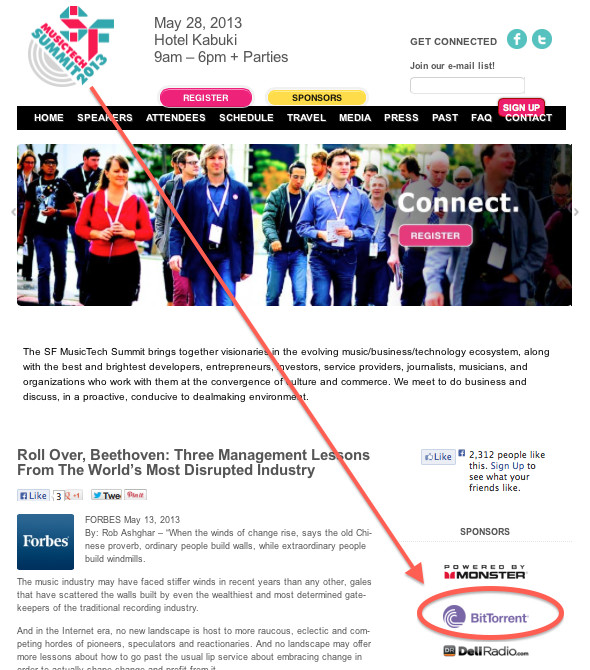
and… as another #SFMusicTech begins BitTorrent is one of the lead sponsors… To be fair, SFMusicTech get’s to run it’s event and do business with whom it chooses. Unfortunately musicians are not given the same choice of having their work “torrented.” So how about a little honesty?

This conversation is really just about consent and compensation. Two very simple fundamental principles that pretty much everyone can agree are the foundations of not just ethical business practices, but also the basis for a fair and just society.

SFmusicTechBitTorrent

Music Tech Policy explores the question, “Can 5 Billion Ads Served a Month Be Wrong”:
MTP : BitTorrent Profits from Piracy By Serving Ads To UTorrent Client

Why I Was Banned From Speaking At San Francisco Music Tech #SFMUSICTECH

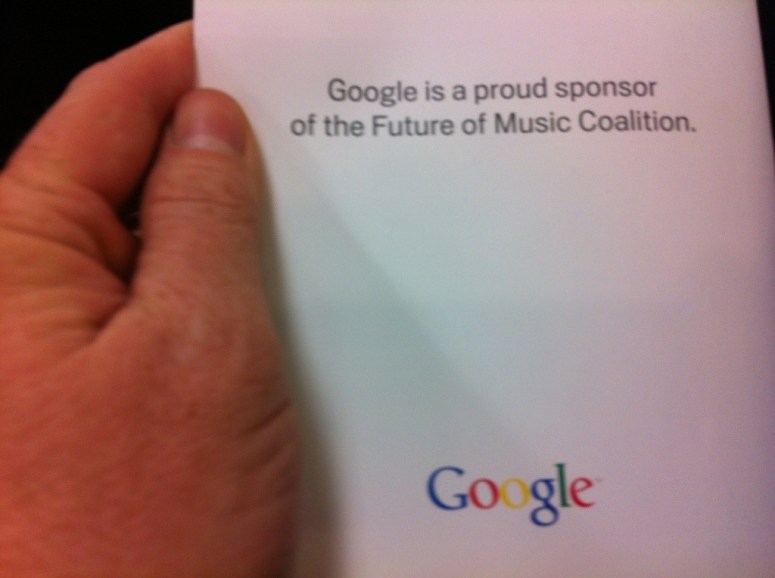
this photo says it all

“This says It all”

I was supposed to speak at the SF Music Tech Summit Feb 19th 2013.   A few days before my scheduled appearance I received a call from  SF Music Tech and Fututre of Music Coalition co-founder Brian Zisk explaining that I would not be allowed to speak because I tweeted/blogged the above picture with the following caption “this says it all.”   Further he noted that “certain sponsors” would not “appreciate” me speaking at this event.

I love the hypocrisy of the Silicon Valley. They are all for free speech until they aren’t.

The fundamental American right is Free Speech. SF Music Tech (and Silicon Valley in general) do not really respect this right. Especially when it begins to interfere with their bottom line.

So what do you say we just end the charade? SF Music Tech Summit is biased against creators/musicians and their rights. It’s a pro-tech industry event.  It’s held in the Kabuki Hotel in San Francisco.  Because it is a giant Kabuki.

Three times a year  you find Tech Industry “entrepreneurs” who’ve never turned a profit “debate” un-elected artists rights advocates who as it turns out work for opaque 501C  foundations and organizations  that are funded by technology companies like Google.

If it’s not clear I’m talking about you, Future of Music Coalition and Cash Music.  Sorry guys/gals you had your chance to do the right thing and  speak out publicly against me being banned and you didn’t.  That makes you at best quislings and at worst shills.

SF Music Tech and Brian Zisk have every right to do whatever they want with their #SFMUSICTECH summit but I just ask them to stop pretending it reperesents anything other than the technologists that wish to exploit artists.

Have a good SF Music Tech.  I’ll be off touring the UK.

Two Sincere Questions for The Future Of Music Coalition #SFMUSICTECH

We notice that Future of Music Coalition has submitted testimony to congress asking that they “represent” artists in the Copyright Reform process begun by Congress.

So since they’ve  volunteered to represent us.  We feel it only fair that they answer these two questions:

1. Who selects your advocacy positions?  
AFM, AFTRA, NARAS, Nashville Songwriters Assn, and ASCAP all have democratically elected boards who set the organizations’ positions.  Do you have members who vote for leadership?  If not, who is making those decisions?

2. Who funds your organization?
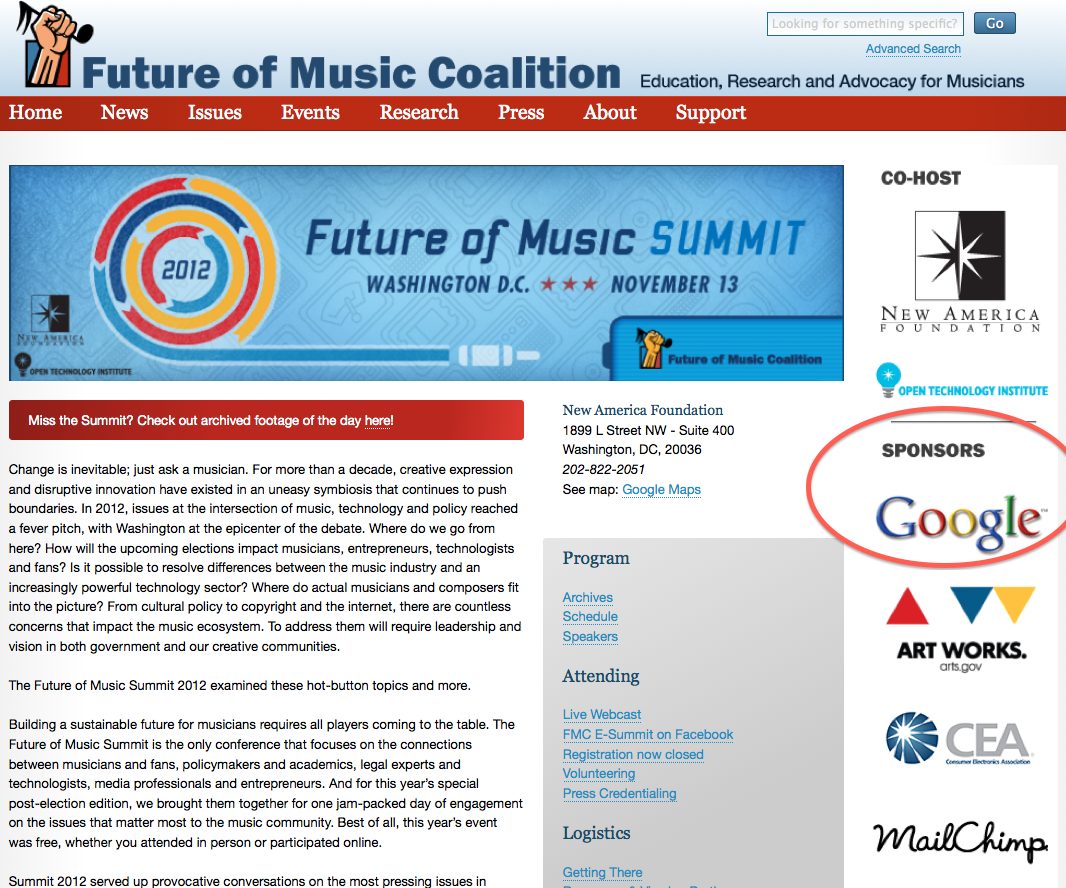
Google is listed as your first sponsor of your primary event.
http://futureofmusic.org/events/future-music-summit-2012

How much money do you get from Google?  Do you think you should be taking funding from a source many artists believe to be opposed to their interests?

FOMC Spondors

Loser Generated Content – The Exploitation Economy Explained

Essential reading by Soren Mork Petersen, “Loser Generated Content: From Participation to Exploitation.”

Abstract
In this article [1] some of the critical aspects of Web 2.0 are mapped in relation to labor and the production of user generated content. For many years the Internet was considered an apt technology for subversion of capitalism by the Italian post–Marxists.

What we have witnessed, however, is that the Internet functions as a double–edged sword; the infrastructure does foster democracy, participation, joy, creativity and sometimes creates zones of piracy. But, at the same time, it has become evident how this same infrastructure also enables companies easily to piggyback on user generated content.

Different historical and contemporary examples are provided to map how the architecture of participation sometimes turns into an architecture of exploitation.

READ THE FULL PAPER HERE:
http://journals.uic.edu/ojs/index.php/fm/article/view/2141/1948

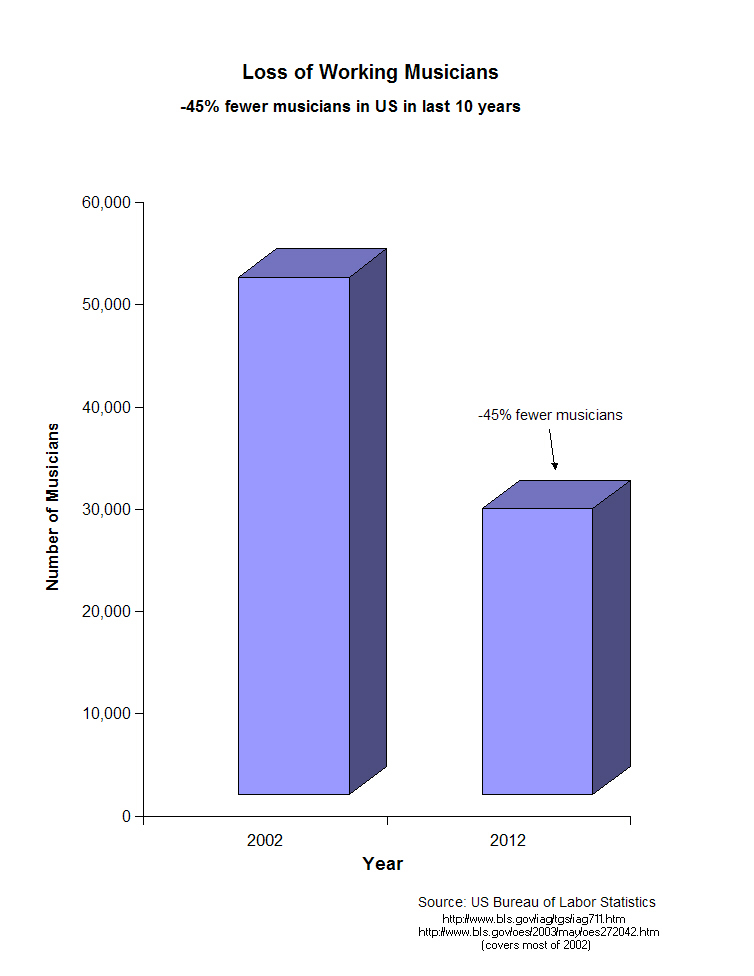
45% Fewer Professional Working Musicians Since 2002

The numbers are simple and staggering. The internet has not empowered musicians, it has exploited them.

-45% fewer working musicians-2

Of course there will always be people to nit pick the numbers, to argue and quibble about the Bureau Of Labor Statistics (BLS) methodology. It may be impossible to estimate the exact effect of unethical internet exploitation, but the trend is definite.

Those who debate the exact numbers are using that to delay action. Their job is similar to the commentators and ‘scientists’ funded by oil companies’ to deny global warming or say it needs “more study.”

The Bureau Of Labor Statistics is an agnostic government agency, not the RIAA.

It is also important to note that these cuts are made from the bottom up, not the top down. It is the struggling and middle class musician that gets hurt first. The difference between “making a living, making music” or not is represented in these numbers.

We should also like to point out that while musicians are making less money, those in Silicon Valley are making more money. Jaron Lanier says that “the internet destroyed the middle class” and we can see for ourselves that through the systematic process of removing the cost of labor from their offerings the elite few, are making more money, while everyone else is doing more of the work.

The New Ruling Class of Silicon Valley and Their Exploitation Economy

The Daily Beast published a must read on the new ruling class and the transfer of wealth in the economy, America’s New Oligarchs—Fwd.us and Silicon Valley’s Shady 1 Percenters. Of particular interest was one sentence in this paragraph,

Perversely, the small number of jobs—mostly clustered in Silicon Valley—created by tech companies has helped its moguls avoid public scrutiny. Google employs 50,000, Facebook 4,600, and Twitter less than 1,000 domestic workers. In contrast, GM employs 200,000, Ford 164,000, and Exxon over 100,000. Put another way, Google, with a market cap of $215 billion, is about five times larger than GM yet has just one fourth as many workers.

This is an equation that defines inequality: more and more wealth concentrated in fewer hands and benefiting fewer workers.

Here is the operative sentence from the paragraph above with one word added…

Google, with a market cap of $215 billion, is about five times larger than GM yet has just one fourth as many [PAID] workers.

It occurs to us in the new exploitation economy of loser generated content that many people are “working” for Google and other tech companies supplying endless hours of consumer created content from Facebook posts to Instagram photos. That’s just the stuff that people are willing to give away by consent (although we don’t know how much privacy they are actually consenting to give up in the process).

But the larger truth is even more scary. Google and other internet businesses profit greatly by avoiding paying for the cost of the goods they are monetizing (primarily by advertising). YouTube is a company built on infringement and theft as a business model.

In other words, it’s a lot easier to make money when you don’t have to pay for the labor or fixed costs of developing and producing a product. You know products like music, film, books, software, etc.

Obviously if all of these creators and producers were paid fairly in the value chain to which their work is creating revenue, than there would be less profit for the distributor. What we have now is a distribution mechanism that profits without paying the creative producers. Which is exactly how a company like Google can earn such extraordinary wealth, essentially through stolen labor.

Read the whole story here at The Daily Beast:

http://www.thedailybeast.com/articles/2013/05/14/america-s-new-oligarchs-fwd-us-and-silicon-valley-s-shady-1-percenters.html