Sign the @musiciansunion (AFM) Letter: Friends don’t let friends get IRFA’d!

If you’ve been following the growing opposition to IRFA, the Internet Radio Fairness Act (aka the “Pandora Shakedown Act”), you won’t be surprised to know that Pandora has now enlisted the Über National Association of Broadcasters to help them screw musicians.  (NASDAQ: P)

You’ll remember the NAB–they are the ones who led the dirty tricks campaign against the Performance Rights Act that would have really leveled the playing field by paying American musicians and singers for the same rights that every other country pays them for when records are played on the radio.

So it’s not surprising to see Pandora lining up the lobbying muscle and huge political donations of the dreaded NAB, one of the few trade associations that has a news outlet in every Congressional district.

Do we just have to take it and get bullied?  Not without fighting back.

Here’s a start, a few things you can do:

First–make sure you and your band are registered to vote.  Can I Vote? is a good place to start if you’re not.  If you’re going to be on the road on election day, be sure you find out about early voting or getting an absentee ballot.

You can look up your representative at Tweet Congress and tweet them to vote against IRFA.

You can follow us on Twitter and search for #opposeirfa, then you can decide if you want to retweet our tweets or RTs to Members of Congress, especially members of the House and Senate Judiciary Committees, or

You can use the letter to Congress interface that the American Federation of Musicians has put together for you.  The link will lead you to an interface to enter your zip code to find out who your representatives are, then it pulls up an editable suggested form letter.  You can either use that letter or write your own using the web page.

And remember–friends don’t let friends get IRFA’d!

Weekly Recap & Links Sunday Sep 30, 2012

Grab the Coffee!

Trichordist Recently Posted:
Why are Internet Freedom Fighters always fighting against the Internet Freedom of Artists?
Is The New Internet Association Really Just A Pro-Corporate Version Of The Pirate Party? No It’s a Transparent Ploy by Google To Curry Favor With Congressional Republicans.
Artists Utilize Power of Internet to Get Paid 
Ad Sponsored Piracy Gains Attention and Awareness in Europe
Is it The Pirate Party, or The Pirate Lobby?
Mythbusters, Why Internet Pirates Will Not Win (and should just get over it)
Class Act: Amanda Palmer.
Pandora, Please Stop discrimination against Musicians!
So much for Post-Scarcity, unless Electricity is free?
Google Pro-Artist Policy Changes Challenge Allegations of “Net Censorship”

From Around the Web:

FastCompany:
* Samsung Muscles In On New Territory – Providing Digital Content

VoxIndie via NPR:
* via NPR-How Much do Artists Make on Youtube?
* YouTube Shares Ad Revenue With Musicians, But Does It Add Up?

CopyHype:
* Friday’s Endnotes 09/28/12

Digital Music News:
* Spotify Is Almost Profitable in Europe?
* Deadmou5 witholding latest album from Spotify
* Gee, That’s Funny: Grooveshark Has the Entire deadmau5 Album…

Torrent Freak:
* Canadian Government Learns about the rogue nature of Ad Networks
* Six Strikes Cooperative ISP/Content Initiative coming soon?
* More pirate convictions, this time Jail and 1.1m Euros Fine

Ethical Fan:
* Comcast May Owe Content Owners $1.6B A Year Or More

Music-Tech-Policy:
* Not So Stoopid After All: Firedoglake Reports that Google Pulls Utoopi App
* Updated: A New Twist on Artist Consent Provisions: Protect Your Right to Say No to @mcdonalds ads on pirate sites
* The Wall of Shame Diaspora Jumps the Pond: UK Authors Speak Out on Brand-Supported Piracy

Copyright Alliance:
* Internet Freedom and Protection of Authorship: A Winning Ticket

Why are Internet Freedom Fighters always fighting against the Internet Freedom of Artists?

We’re always a little amazed when site like Hypebot takes up the fight for internet freedom, as long as that freedom does not include artists rights. Recently the site has confused the difference between a $20 settlement for illegal downloadingversus a $9,250 per song judgement for copyright infringement.

It seems to us, that getting off the hook for $20 per song is a pretty good deal. Should a person downloading also be found to be uploading and distributing (you know, infringing copyright) than they might want to think twice before pushing back too hard or they could end up like Joel Tenenbaum and Jammie Thomas. Both of whom were found guilty of copyright infringement by a Jury of their peers and awarded damages upheld by the courts.

It’s troubling when sites that state they are trying to help musicians are actually making arguments to support the people who exploit artists and rip them off, but not the artists themselves.

Artists Utilize Power of Internet to Get Paid – Community Activism moves the needle for Artists Rights.

We’ve already posted how pleased we are that Amanda Palmer is a class act and did the right thing by recognizing her error in not wanting to pay her local pick-up musicians. The part of this story that really excites us however is that the creative community came together to effect positive change. No part of this story involved the RIAA or the MPAA. No part of this story involved an evil record label (unless you include Palmer as the Label). This story was very simply about artists expressing sadness and anger at the continued exploitation of their labor. The swift movement started with one letter, in a single blog post by Amy Vallincourt-Sals of Classical Revolution Portland.

The most important take away here is that many artists added their voices to this discussion for fair compensation, even if they were not directly effected. It’s time for more artists and creators to learn from this experience and support each other as a community. As we posted last week, many artists are being affected by an attempt from internet corporations to weasel out of paying royalties to artists on sites like Pandora.

Now artists are faced with the intentionally mistitled “Internet Radio Fairness Act” which is designed to be a transfer of wealth from artists to internet companies in a wall street style bail out attempt to prop up their failing business models on the backs of artists. We hope that all artists and creators see this as a community issue and not one that just effects musicians.

We’re excited to see the community of creators, artists, and musicians recognizing that we are all in this together, and when we work together we can create positive change as witnessed by Amanda Palmer rethinking her position this past week on paying her musicians.

Pandora, Please Stop discrimination against Musicians!

Below is a letter from Tim Westergren, Founder of Pandora (NASDAQ: P) urging consumers to help him discriminate against musicians by attempting to reduce his royalty obligations.
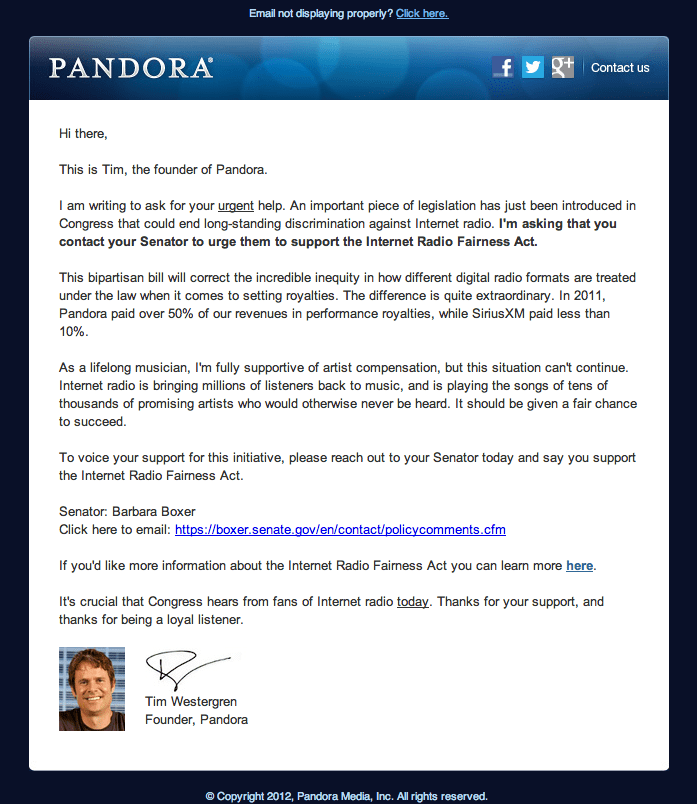
This letter is highly misleading. Pandora is not Radio!! Pandora is a near-on demand streaming service.  Having a subscription to Pandora is like virtually owning every album on earth. (This is complex and we try to talk it through on a high level later in this post.) Pandora should and does pay higher royalties than XM radio for that reason!  It is completely manipulative of Mr. Westergren to compare his royalties to radio royalties.  Shame on him.  Shame on him for trying to get his subscribers to manipulate our government into screwing musicians. I am sad to see that Pandora has come to this:

Just another Silicon Valley firm who can’t make their business model work asking for a bailout from the US government and Musicians.  -David Lowery

We all love Pandora, we love that it pays on time and is honest in its approach and it provides a great platform for independent music. In fact, we’ve seen some estimates that 30% of Pandora’s spins are independent music.

Here’s what the lawyer for the webcasters said about the statutory webcasting rates at the time of the last settlement (and he never mentions artists, by the way):

In sum, while far from a perfect deal that webcasters would have selected on their own, this deal does provide another option for webcasters with substantial advantages in many area to those that qualify for treatment under this deal. While no doubt the fight will continue over the standards that should be used to determine royalties in future proceedings, so that parties don’t need to enter into these after-the-fact settlements [which is not happening now because the 2009 deal is in place until 2015] when one party has a substantial bargaining advantage with a favorable decision already in hand, SoundExchange [including the artist unions] should be credited for agreeing to reach this deal when there was no compulsion that they do so. This deal presents certainty for many webcasters – eliminating further litigation and negotiation costs while setting rates at which a class of webcasters can go on with their operations.

But what’s happening now ain’t personal, it’s just business. Pandora apparently doesn’t like paying artists a fair royalty–at a rate that Pandora negotiated and was all happy with a few years ago–and now is lobbying in Washington to use their political influence to force artists to take lower rates. Pandora compares itself to Sirius:

Consider this: last year Pandora generated $274MM of gross revenue, and paid $136MM of performance royalties — approximately 50 percent of the total revenue. In the same year, SiriusXM, on revenues of $2.7B paid $205M in royalties, or 7.5 percent. Radio delivered over cable television pays 15 percent of revenue. Radio delivered over the FM/AM spectrum pays nothing to performers.

This is, unfortunately, slight of hand–SiriusXM is primarily a subscription service and Pandora is primarily an ad supported service. Apples and oranges aside from low artist royalties–we have issues with Sirius, too, but that’s another story. The fact that over the air radio pays nothing is not exactly something to be proud of as we will spin out a bit in this post. But here’s the point we think is important: If Pandora wants to compare apples to apples and feels it is unfairly penalized by the rate setting procedure, it ain’t exactly like they weren’t represented in the past or now.

If Pandora would like artist support for some changes that would help them be more profitable going forward without reducing rates to artists, then all they have to do is ask and if what they want really is fair, they’d probably get artist support. But we didn’t hear that ask and we don’t see that proposal. What we see is the typical Big Tech Washington cronyism that artists simply can’t compete with.

You’re going to hear a lot of talk about “fairness” and “stifling innovation” as Pandora spends big lobbying bucks to grease the skids for the Congress to set price controls in its favor. Just remember–Pandora gets those big lobbying bucks from a wildly successful initial public offering of the company’s stock. And the reason Pandora had a wildly successful IPO is because they make a great product that is 100% dependent on your music. No music, no Pandora.

This is why the musicians union president recently called out Pandora founder Tim Westergren about this end run around artists

Of course, this technological innovation moves much faster than the laws out of Washington, which still treat each radio platform a little differently. That means some radio platforms, like Pandora, compensate artists when they play their recordings, while regular over-the-air “terrestrial” radio stations don’t pay musicians a dime for playing those same recordings.

That’s not fair to musicians that depend on those performance royalties to put bread on the table. And it’s not fair to expect some radio companies to pay while others get a free pass.

It sounds like Pandora never picked up the phone to discuss their beef with either the musicians union or the singers union (now SAG-AFTRA). This was a major oopsie for Pandora founder and Chief Strategy Officer Tim Westergren, an ex-record producer .

Unlike American Federation of Musicians President Ray Hair, Westergren ain’t elected and he only represents Pandora–even though Time Magazine says Tim is one of the 100 most influential people in the world. So it seems that when you have that kind of influence, you don’t need to call a mere elected union president whose members supply your company with its only product, but whose members had their bargaining rights taken away by the compulsory webcasting license. No strikes–just the way they like it in the Valley.

This is important because Pandora now wants to reduce their already low rates royalty rates to even lower rates. This is just like when Sirius and their PR machine wanted you to focus on how bad things were for Sirius Radio a few years ago when Sirius got a 50% off deal on their royalties. Now Sirius and their lobbyists and lawyers want you to ignore that Sirius suddenly has an extra $1,000,000,000 in cash–that’s right, a BILLION IN CASH. When the bad times came, the artists gave Sirius a deal. Sirius has no intention of returning the favor in the good times. We applaud their success, but where is the love?

The joke is that things are so bad for Pandora, they just went public. So don’t expect any love from Pandora, either.

Because just like Sirius, Pandora doesn’t answer to the artists for their 100% dependence on music.

Pandora answers to Wall Street, which is to be expected for a public company.

So we say to Tim Westergren, we love you, man, but face facts–you are The Man 2.0. Don’t fool yourself into thinking that Time Magazine knows anything about the music business. It’s really OK, we get you, we’re used to dealing with The Old Boss and The New Boss.

You made your choice, so just be honest about who you are when you are moving the goal posts.

Pandora’s Backstory

You’ve probably heard how difficult it is for “innovators” to license music because the major labels ask for big up front payments. This can be confusing because different types of music services qualify for different types of licenses. Here’s where Pandora, Sirius and lots of other Internet radio and satellite music services get a real advantage over other types of competing digital music services. (Digital radio licensing is a complex area, so we’re going to give you the high points and stay out the weeds.)

Back in 1995, the U.S. Congress effectively took away the artist’s and record company’s right to negotiate private deals with Internet radio when Congress established the limited public performance right for sound recordings. Due to a quirk of US law, recording artists were never paid for radio play unlike songwriters. The US Congress partly changed that in 1995.

So quick—how many of you thought all these years that the artists got paid when a song was played on over the air radio? (Call it “broadcast radio” to distinguish it from Internet and satellite radio, call those “digital radio”.)

Well, you’d all be wrong. Except for digital radio. (The most important difference between a Spotify-type service and Pandora is that Spotify allows you to choose which tracks you want to listen to (“on demand” or “interactive” and less like broadcast radio) and Pandora and Sirius “choose” them for you–“non-interactive” and more like broadcast radio.  There’s also a bunch of other government mandated restrictions called the “sound recording performance compliment”–too much to go into here.  Although we would argue that Pandora’s music genome allows it to be “near-on demand” but that’s another story.)

The compulsory license for digital radio does not cover broadcast radio or on-demand services. So far, artists have not been able to move that needle to include broadcast, although we’ve tried. Hard. Going up against the broadcast radio lobby is like going up against Google—limitless lobbying budgets, tremendous political influence, control over a significant portion of the dissemination of news. There is, after all, a radio station in every Congressional district. And most of all, an unbridled willingness to crush anyone who gets in their way. Like artists, for example.

This is a good time to mention a key fact—almost every other country in the world requires broadcasters to pay artists for performances on both broadcast and digital radio. (“Almost” because North Korea and China don’t.) So it is American broadcasters who get out of paying the artists, including American artists. This is why the broadcasters (including digital radio like Pandora) don’t like the Internet radio rates.

Even so, the digital radio royalty and statutory license have actually worked, which is more than you can say for the DMCA. What that means is that no one can refuse to license for digital radio and the royalty rates are set by the government. More on that later.

These SoundExchange royalties are split 50/50 between the sound recording owners on one hand and the featured artists, session vocalists and session musicians on the other. And—if the royalties are paid through SoundExchange (the non-profit that collects and administers the compulsory license), the artist money is paid directly to the artists on a nonrecoupment basis, meaning that the artists keep 100% of their digital radio royalty regardless of whether they are recouped under their record deals, current or historical. (Remember, SoundExchange receives royalties at many different rates, takes out some administration fees and then splits the money 50/50.  This is too complicated to go into here, but take a look at the SoundExchange website for more information.)

Spotify, for example, had to license recordings and songs piecemeal because Spotify’s on-demand service doesn’t qualify for the digital radio royalty. That’s why it took so long for them to launch in the US. (Although Spotify launched a side-by-side statutory digital radio service at the end of 2011 as a companion to their on-demand service.)

Pandora has leveraged this government-mandated compulsory license to get its business going. Unlike Spotify, all Pandora had to do to get its content licensed was send a notice to the Copyright Office and to SoundExchange, get blanket licenses for the songs and they were in business. No piecemeal negotiations with anybody, no advances to anybody, just send the notice, build their technology and get going. Artists get paid, labels get paid, innovators can form companies without paying any advances.

Of course, Pandora lead the charge in 2009 against the digital radio royalty rates. But they paid up when they got the deal they wanted. Or the deal that they wanted long enough for the company to bring to market an initial public offering of its stock.

Now they want a different deal.

And as the Bard sayeth, therein lies the rub.

This Time, It’s About Money. Period.

Remember—Pandora has great technology, superior technology even. Pandora is a highly innovative and music driven company. We love Pandora. But because it is music driven it has one product—music.

Pandora last negotiated licensing rates for the music they profit from in 2009. That was a long and painful process. We heard sanctimony from Pandora’s Tim Westergren at every turn about how Pandora was going to go out of business if they couldn’t get cheap licensing rates on music.

A lot of people said privately that they’d like to know where it was written that Pandora was guaranteed the right to stay in business when musicians weren’t. But Pandora looked like a promising investment, so artists invested in the company the way artists usually invest—do the same work for less money. Pandora got a special deal on royalties and they stayed in business.

That 2009 deal comes to an end in 2015 and new rates are now being litigated.   (The current “pureplay” webcaster rate for nonsubscription services that we understand Pandora qualifies for is a formula, the greater of 25% of US gross revenues or a per-play rate of $0.00110 ($0.0020 for subscription/bundled services like Pandora), going to $0.00120 in 2013, $0.00130 in 2014 and $0.00140 in 2015.  (Subscription/bundled services are a little higher per play rates.) Maybe–things are so good that Pandora may be about to shift into the 25% of gross revenues part of the formula and that’s the beef?)

Now Pandora are back again with the same song—they want to pay even less. So what happened? They must be having a really hard time like last time, right? Scraping by?

No, actually what happened between 2009 and now was that the company “went public” in 2011 with a billion dollar-plus valuation, the dream of every Silicon Valley entrepreneur. The founders and their VCs cashed out. We’re happy for them and glad to see a stand-alone digital music service trading on the New York Stock Exchange.

Westergren is apparently not as rich as Daniel Ek (the 10th richest man in the music business), but surely he got a nice payday when Pandora went public (which we think he totally deserved for years and years of hard work, by the way). Pandora has a market cap roughly that of a major label. But now that it’s public, Pandora has to make its revenue numbers to keep Wall Street happy. So there’s a couple different ways they can do that.

One way is to throw all their resources at growing their revenues. That’s what most people will do.

The other way is to decrease their costs. Like their royalty costs, for example. It is simple math: Every dollar that Pandora pays in royalties is a dollar less for Wall Street. The fastest way for Pandora to increase its profits—and theoretically its stock price–is to pay lower royalties to artists.

And when you look around the Pandora board meeting, there’s a face at the table to oppose cutting every cost item–except one.

This will be familiar to artists—it’s the same fight that artists are having with Spotify. And just like Spotify, we don’t see Pandora coming to the artists and offering to pay a bonus to everyone who gave them a deal on royalties so that Pandora could be successful and go public.

For years we’ve heard from Westergren about how artists should aspire to be middle class, to make a good middle class living, don’t expect too much, be happy with what you have. Lowering expectations.

Meet the new boss.

Pandora’s Box

Now we know why. The other shoe is dropping now, and Pandora’s true agenda is becoming obvious. Rather than devote themselves to growing their revenues to satisfy Wall Street, instead they want to spend their resources on lobbying the government to force artists to accept lower rates knowing that the artists on whom they depend cannot compete with lobbying dollars of their own.

The Greek name “Pandora” translates into she who received gifts from all. And boy does that ever fit this company.

Here’s the deal—Pandora gets the gift of certainty in licensing, certainty in rates and low startup licensing costs. This gift allows them to devote their resources to innovating delivery and discovery of music which they have done masterfully.

What do they give back for this gift? We don’t get equity in their company, so when they went public, we got nothing while they joined the Valley elite. (Just like artists won’t get anything when Spotify goes public.)

And now Pandora wants even more gifts. And they want to use their public company political clout to force artists to accept less so Pandora’s shareholders can get more.

And yes, it is a zero sum game and yes it is that simple. Pandora keeps Wall Street happy while they get rich from our gifts and now they take their riches to lobby the Congress to pay them even more of our money.

So at the end of the day there is very likely going to be another Big Tech driven SOPA-style hissy fit over digital radio rates. And remember, it was Pandora that originated the hissy-fit technique that Google perfected with SOPA so expect that threat just any day now from one of the Most Influential People in the Known Universe.

But this time—don’t let them fool you into thinking that somehow they are doing this to protect the “middle class artist” or “innovation”.

Because they are not.

This time it’s just about money and we won’t get fooled again.

____________

Updated 9/22/12 to include clarification on “near on-demand”, SoundExchange splits, Pureplay rates and Oxenford quote.


Principles for an Ethical and Sustainable Internet

Technology may change but principles do not. A society that encourages the creative spirit is rare in history and worth defending. The internet and digital technology have opened up many new opportunities for artists, but it has also opened up new opportunities for those who wish to exploit those artists.

We offer for discussion a set of principles as a guide for companies and policy makers to keep in mind. It is our hope that these principles will help build a sustainable online creative ecosystem, one that benefits creators, innovators, and the general public alike.

1. FAIR AND ETHICAL LABOR PRACTICES: RESPECT WORKERS’ RIGHTS
A fair and ethical internet is built on the respect and protection of the rights of individuals to determine who benefits from their labor and creations.

Since the rise of digital utopians in the 1990s, we’ve unfortunately seen many very old arguments surface as to why the economic benefits of a few big companies should be valued over the labor rights of many. This problem is what drives workers to organize to protect their labor and demand fair compensation. Not only are artist rights protected by the US Constitution, artist rights are also internationally recognized as human rights protected by many international treaties, including the Universal Declaration of Human Rights. Unfortunately, however, there are those who seek to capture the value of artist rights profit only for themselves by systematically violating these rights for commercial gain.

A free and open internet works best without overbearing regulation, but it will not work at all without protection for fundamental rights of working people.

2. CONSENT IS THE FOUNDATION OF CIVILIZATION: RESPECT ARTISTS’ INTEGRITY
Your right to swing your fist stops at the end of my nose. Your rights end where mine begin.

Rights secured by the Constitution are intended to protect the individual from hostile majority forces and the tyranny of the mob, particularly the corporate mob. This is especially true regarding copyright, which is itself a vehicle of the right of free expression for individuals, and protected by the Constitution.

Everyone understands the value of individual privacy in the digital age. The essence of the artist’s control over the integrity of their work is not that different. Individual consent should be required for a corporation to profit from taking any creative work (just like individual consent is required for taking personal information) because the creative work goes to the artist’s personhood. Protecting an individual’s right to their personhood and the protection of their free expression are building blocks in the foundation of civilization.

3. PROTECT INDIVIDUAL FREEDOM OF EXPRESSION: DON’T TRIVIALIZE CENSORSHIP
Freedom of speech requires freedom of expression. Copyright protects free expression. Together, they ensure a robust marketplace of ideas that advances truth, knowledge, and culture.

Let’s get this straight. Censorship is intolerable. You don’t have to look very far to see artists being censored by governments — there are many historical examples . No one understands this more than the scores of individual artists, musicians, painters, writers, poets, filmmakers and creators of all disciplines who have actually (and literally) have been persecuted, disappeared or assassinated for their views all over the world. Sadly, many confuse the actual freedom of expression with the mistaken idea that preventing the illegal exploitation of that very expression is the same thing. It’s not.

The copying and distribution of those expressions without the creators permission is simply exploitation without consent or compensation. Would you think that a car thief is being censored when they are prosecuted for stealing your car or a bank robber is being censored when they are prosecuted for stealing your money? Don’t trivialize “censorship”.

4. FAIR COMPENSATION: IF YOU DON’T LIKE IT, DON’T BUY IT
In any value chain where the individual creator’s work is exploited, the creator must be compensated.

Most fair and reasonable people embrace “Fair Trade” products to support and encourage fair compensation of labor. Unions have fought long hard-won battles for the protection of labor rights. As a society we recognize the individual’s right to fair compensation of labor as a fundamental cornerstone to an ethical and healthy society. The internet is inhabited by as many different varied participants as the physical world, and the respect for human labor should not be devalued simply because technology makes it possible to be unethical.

It’s very simple–the answer if you don’t like an artist’s work is not to steal it–just don’t buy it. They’ll get the message.

5. MUTUAL RESPECT: IT’S ABOUT GETTING IT RIGHT, NOT GETTING AWAY WITH IT
Mutual respect for the diversity of all online citizens is the cornerstone of a healthy and robust community.

The mutual respect granted by intellectual property rights allows individual creators the freedom to determine what permissions they wish to grant and at what price. No one has to pay that price, but the creator is entitled to set it. Denying these freedoms to creators because the mob or a public company wants to overrun a musician, author, illustrator or photographer violates the very protections against mob rule that the Constitution is intended to secure. Sadly, this is largely how individual rights are viewed today by some online corporate interests.

6. PARASITIC EXPLOITATION IS NOT INNOVATION: FREE AND OPEN SHOULD BE FAIR AND HONEST
The illegal exploitation of individuals for commercial gain is not innovation, it is techno-thuggery and cyberbullying.

We see many companies on the internet illegally exploiting the work, labor, innovation and creations of others simply because they can get away with it. We’re often told that innovation requires the unauthorized exploitation of creators in some kind of technological determinism that rejects the innovation of creators because it“scales”. That is just another way of using “convenience” as an excuse for theft. Any business that requires the illegal exploitation of individuals to be profitable is not a business but rather is a parasitic engine of oppression.

7. SUSTAINABLE INNOVATION SOLVES PROBLEMS: FAIR NOT FAKE
Sustainable innovation is best represented by solving problems, not creating them by adding intentional opaque layers of obfuscation.

The organized and deliberate complexity of some online ad networks, pirate site operations, and other businesses creates an impenetrable black box to protect illicit money flows and give the participants plausible deniability. Then we are told to “follow the money” through advertising networks, down a rabbit hole to a maze followed by another rabbit hole. That’s not innovation. It is old school wire fraud. This should not be a badge of honor for the online community but rather a point of embarrassment that the Internet—one of the greatest technological achievements of all time–is trivialized by making it nothing more than a safe house for many illegitimate businesses profiting at the expense of honest citizens.

8. COMMON GOALS, BEST PRACTICES AND SOLUTIONS:
There are centuries of mutual ground between creators, commerce and rights holders. Let’s not throw this away.

Let’s not set a goal of building a large database for clearances of all copyrights and do nothing until it is operational. That solution almost guarantees that there won’t be many new works to put in that database. Such a database has never existed and is incredibly complex. A transparent rights clearinghouse is a possible solution, but the lack of one it is definitely not an excuse for bad behavior.

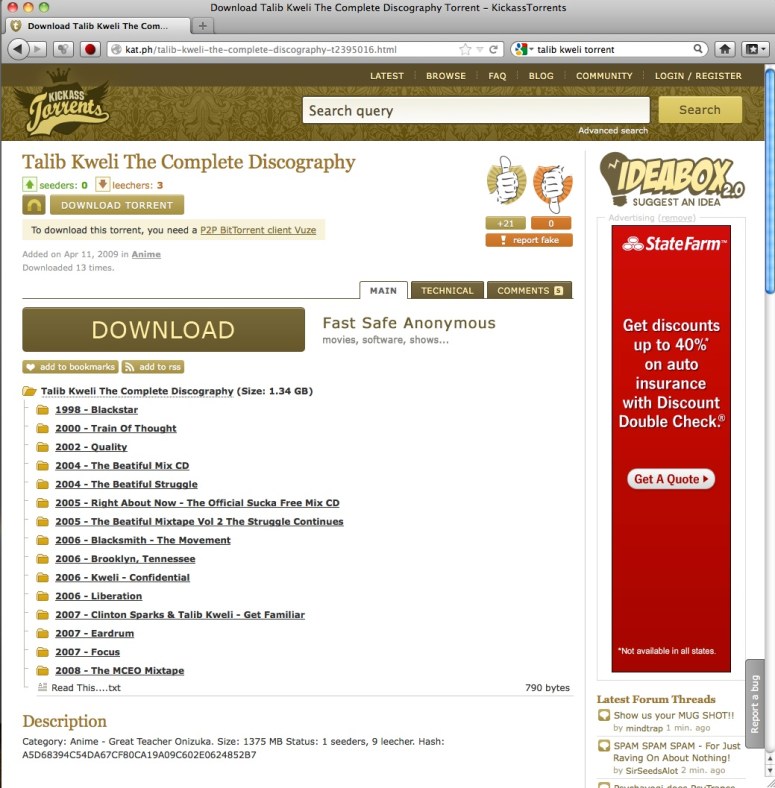
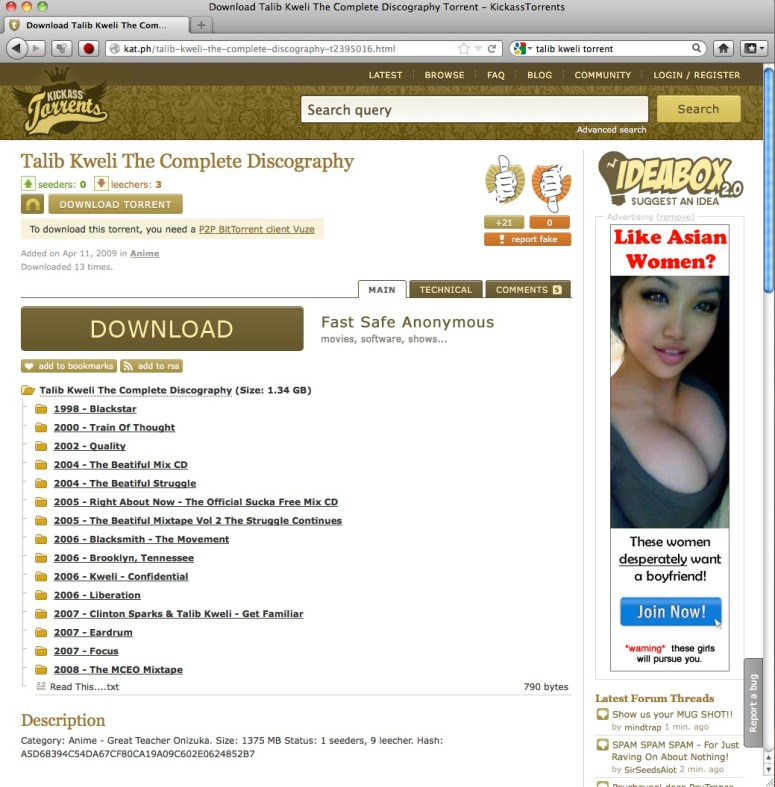
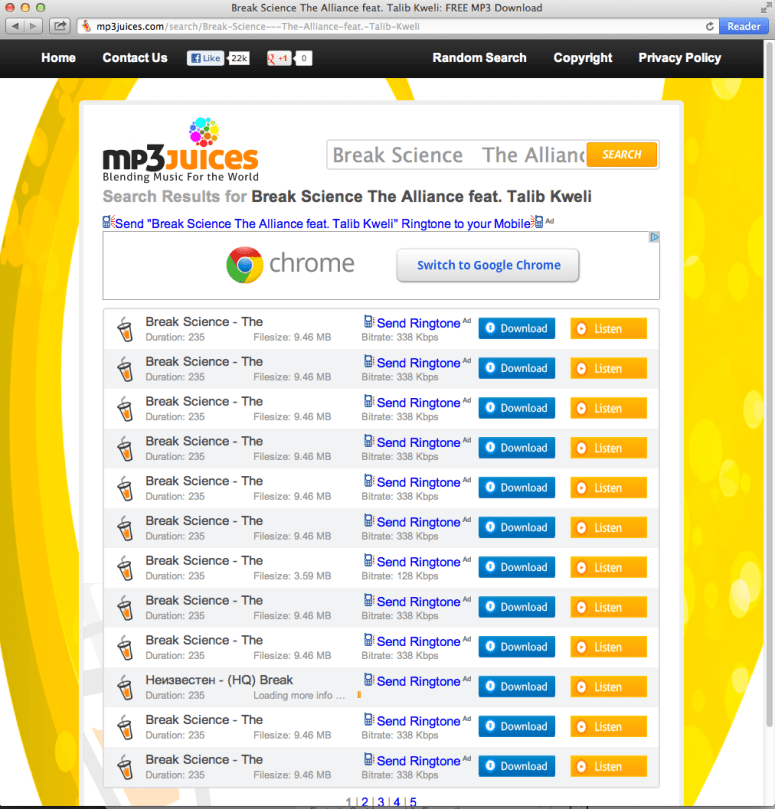
Talib Kweli Exploited by State Farm Insurance, Neiman Marcus, Ferguson/Kohler, The Ad Council, Google, Ad Choices and Desk Top Strippers

Still think that the illegal exploitation of artists work is about freedom and sharing? From the looks of the screen shots below it’s about mass scale, enterprise level ad laundering with money originating on Madison Avenue. Or, in the case of Neiman Marcus maybe 5th Avenue?

These are major brands and corporations like State Farm Insurance, Neiman Marcus, Ferguson, Kohler, Register.com, Google and even the Ad Council who are aiding in the exploitation of, and profiting from the infringement of the artists work.

Yes Google we’re following the money and it leads back to these major brands and companies (like Google).

We’re not sure how Talib Kweli feels about all this, but maybe we’ll tweet him to find out.Earlier this summer we noticed Talib retweeted the “Letter To Emily.”

Talib Kweli Greene ‏@TalibKweli
RT @SLondonChicinFL: EXCELLENT must read for anyone who has downloaded music illegally http://tinyurl.com/7rqlppb

of course one of the greatest irony’s of pirate culture is protecting their IP while profiting from everyone else’s…

Copyrights and Trademarks
All contents of this Web site are: Copyright © 1999-2012 MP3Juices or its suppliers. All rights reserved. The MP3Juices logo, trademarks and other marks that appear throughout this Web site, its affiliates or third party trademark owners, and are protected by U.S. and international trademark laws. You are prohibited from using any of the marks appearing throughout this Web site without express written consent from the respective trademark owner, except as permitted by applicable laws.

SXSW Panels for Artists Rights – Show Your Support @ SXSW Panel Picker

Please show your support to advance the conversation for Artists Rights by voting for these two panels being considered for this year’s SXSW. We hope to see you in Austin. Deadline for voting is Friday August 31st.

###

MUSIC: “Who’s Ripping Me Off Now”
http://panelpicker.sxsw.com/vote/3736

Description

In June, a blog post by musician David Lowery set off a firestorm. Written to an intern at NPR who admitted to not having paid for the 11,000 tracks in her collection, the post generated more than a million views in just one week and numerous media stories.

In its wake, musicians, fans and the industry were all re-evaluating long held beliefs. Who is “the man” today? Can the Internet be both innovative and ethical? Who speaks for the artists? And what obligation does the fan have to his or her favorite artists (if any).

Join David Lowery, Cake’s John McCrea and experts from music and tech policy as they try to answer these timely and controversial questions.

Questions Answered

1. Is the new boss (tech) worse than the old boss (labels)?

2. What policy changes need to be considered to make the internet fairer for music creators

3. Can artists make a living without making money from recordings?

4. Who’s profiting from Spotify?

5. What obligation does the music fan have (if any) to the music creator?

###

INTERACTIVE: “Innovative, Open, Ethical & Sustainable Internet”
http://panelpicker.sxsw.com/vote/6170

Description

Everyone agrees the internet needs to be Open and encourage Innovation, but does it have to be “permissionless innovation” as some are proposing? The internet and digital technology have opened up many new opportunities for artists, but it has also opened up new opportunities for those who wish to exploit those artists.

This panel asks the difficult questions about the balance of rights of all citizens, including the rights of the individual citizens who are themselves both creators and consumers participating in both sides of the debate. The reality of contemporary online content distribution is that a blind eye has been turned to enterprise level, mass scale, for profit, businesses who are not including creators participation in the monetization of the value chain. This is both unethical and in the long term unsustainable.

This panel will explore mutually beneficial solutions for all stakeholders WITHOUT the need for new or additional legislation to do so.

Questions Answered

1. Why is premissionless innovation necessary? Consent is the cornerstone of civilization. How do we find the balance in the rights of all citizens to BOTH privacy and protection of individual rights such as copyright? Perhaps through the use of a master rights registry or database would make it possible to not require case by case “permission” but still have rights granted by consent.

2. Why isn’t there a way to create online indie record stores that specialize in specific genres superserving those consumers (death metal for example)? Rights Holders need to work with developers to create an easy “One Stop” rights licensing solution to encourage competition and innovation without cumbersome requirements. Ideally there would be an online equivalent to old school “One Stops” who sold records to indie stores before they developed credit lines with the distros directly. SNOCAP?

3. Why does there seem to be so much confusion between the what is the actual freedom of expression and wanting to illegally exploit that very expression? Ice-T’s “Cop Killer” or 2Live Crew’s “Me So Horny” are actual artistic expressions protected by the Constitution. The illegal coping and distribution of those expressions without the creators permission is simply exploitation without consent or compensation to the artists themselves.

4. The mutual respect granted by intellectual property rights allows individual creators the freedom to determine what permissions they wish to grant and at what price. No one has to pay that price, but the creator is entitled to set it.

5. Why are consumers willing to pay more for Fair Trade coffee but not willing to pay for music, movies and other content? Public attitudes about creators rights are not aligned with the reality of most people struggling to sustain professional creative careers. All this begs the question, if the internet is working for musicians, why are less musicians working professionally now than prior to the internet. The promise of empowerment has failed.

###

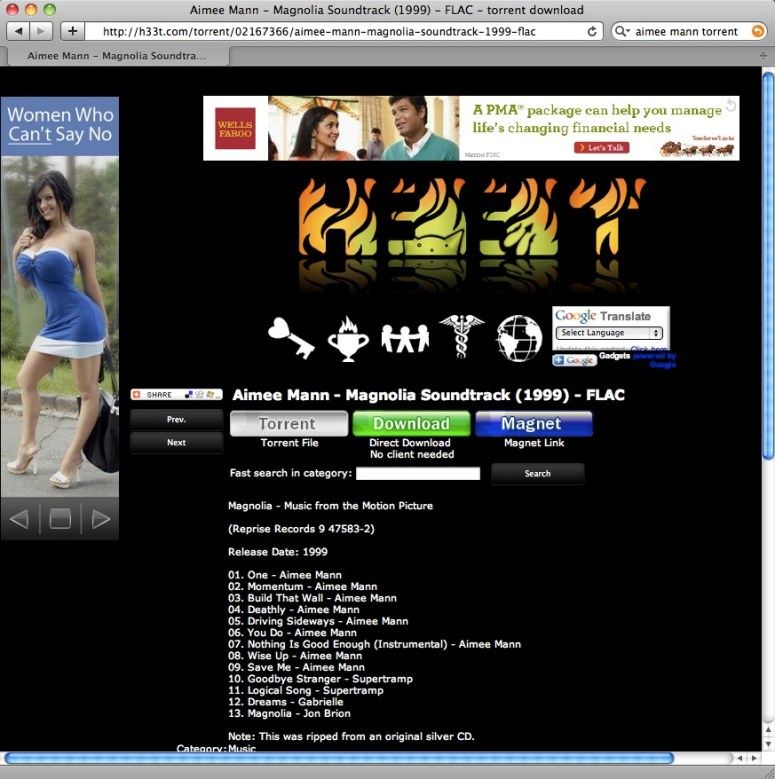
Aimee Mann Exploited by Russian Brides, Wells Fargo Bank and Nationwide Insurance

When an artist signs a contract with a record label and publishing company there is a customary clause that governs how the artists music can be used in association with brands, marketing and the context of commercial placements including films and television shows. This provision grants the artist authority and control over how they are represented to the world and often coincides with the artists personal values (such as political campaign uses).  These concepts track the laws against misappropriation of the artist’s right of publicity and laws against falsely implied endorsements.  Not to mention the moral rights of artists.

The online exploitation of artists work, beyond the obvious illegal distribution of their work without permission or compensation now extends into brands leveraging the appeal of the artist to promote their product or service (like banking or insurance). In the examples below both Wells Fargo Bank and Nationwide Insurance are specifically benefiting from gaining direct access to fans of Aimee Mann. Unfortunately Aimee is not consulted, has not been given rights of approval, and last but not least, is not being compensation for the value her brand brings to these companies.

But it get’s worse. We’ve been reading a lot about how human trafficking has become a real problem online. We don’t know that the sites specifically advertising on The Pirate Bay are operating illegally, but they are most likely not the type of advertiser or service that we could imagine an artist such as Aimee Mann supporting.

So to add insult to injury, not only do brands run roughshod over artists’ rights to compensation for the consumption of their work, but they also ignore the artists’ right to control how they are represented to their peers and to the public.  Major brands literally trade off the artist’s name by associating their products with the artist. And the worst of it is, there are businesses that may be profiting from human trafficking and also using the artists name and work to promote that human suffering.

Isn’t it about time that everyone stopped playing games and start holding those bad actors responsible and accountable–beginning with the brands and advertising networks that make it possible?

Who Speaks For The Internet? Do Artists have No Voice Online?

Does the internet speak for Artists? This doesn’t appear to the case. Who is the internet anyway?

We’re always kinda amazed when a singular entity or point of view “speaks for the internet” as if there is no social, economic, geographic or political diversity. Is the “Internet’ a demographic onto it’s own, and if so, what defines that demographic? Which begs the question, does “the internet” speak for you (as an artist, as an individual)? Though this entry is somewhat cute, it is also disturbing to see “the internet” as a single block with a Borg like hive mind… TechDirt reports:
http://www.techdirt.com/articles/20120718/18350719751/internet-wins-again-writer-gets-rapper-pitbull-exiled-to-alaskan-walmart.shtml

In another example we find it amusing when any ONE group alleges to speak for the internet. In the latest of what appears to be another round of Tech Funded astro turf and sock puppet groups enter the “Internet Association.” Why are we not surprised that Google, Facebook, Amazon and Ebay lead the list of members whose mandate is to represent “the interests of Internet companies.” Oh, ok, I get it now… the internet is a business and those who speak “for the internet” are really speaking for “corporate interests.” Phew, I’m glad we’re clear about that now… read on at Digital Media Wire:
http://www.dmwmedia.com/news/2012/07/26/new-advocacy-group-speaks-on-behalf-of-the-internet

What do you think? Does the tech lobby own the voice of the internet? Does no one but the internet and tech lobby have a say in the future of our online and digital lives?

Let us know what you think.