CopyLike.Org – Pay Creators Like You Pay Everyone Else

Check out this great organization:
http://copylike.org/
https://www.facebook.com/copylike

It looks like you don’t want to pay
for us to create stuff you like.
Why do you pay everyone else?

Some people think there’s no harm in making illegal copies,
and the price of copies of our work should be zero.

They think only big companies love copyright, using it to do
evil things. That’s only part of the truth.

Copyright begins with the creator. It’s the only weapon
we have to force big companies to negotiate with us, instead of
just ripping us off.

You gave all your money to phone companies, internet service
providers, laptop manufacturers and enormous breweries.

There’s nothing left for us.

Defend Copyright.
It’s All We Have Left.
COPYLIKE.ORG

[ THE 101 ] [NEW BOSS / OLD BOSS ] [ARTISTS KNOW THEY ENEMY] [WALL OF SHAME]

CopyLike.Org – Evil Corporations, We Don’t Like Them!

Check out this Organization:
http://copylike.org/
https://www.facebook.com/copylike

We know that there are
evil corporations in the world.
We don’t like them.

With copyright laws, we get to decide who can use our work,
and how much that have to pay for it.

If we want, we can give it away for free to our favourite charity,
or as a gift to our fans and supporters.

If a company wants our music, we can tell them yes or no.
If they steal it, we can take them to court.

That’s one of the reasons we like copyright.

Defend Copyright.
It’s All We Have Left.
COPYLIKE.ORG

Musicians POV: Songwriters: How to find yourselves on pirate lyric sites and what to do about it

We’ve all heard about Bit Torrent sites like the Pirate Bay, Isohunt, Megavideos.  One kind of site we haven’t heard much about is lyric sites.  These are often large websites with heavy traffic that are text based and advertising supported.

How do you find these sites?  One good way is to search for yourself and your song title on Google.  Google will helpfully deliver you the top illegal lyric sites so you can move right along.  Or you could set up a Google alert for your songs and Google will deliver directly to you the information that they know about already.  Nice and neat package.

Let’s take Lyrics007.com for example.  This is an illegal site that has the lyrics from 1,000s of songs, allows users to create ringtones for “free” (or so they say, we haven’t clicked on those links because who knows what might happen), and lyrics.com is ad supported.

So search for your song in the search box and see if it comes back.  Even if you are not a rock star, you will probably be in the database if you have ever released your lyrics online (like on your own website for example).  When you find your songs, you will notice that your song lyric will be surrounded by advertising.  In the case of Lyrics007.com, it looks like Google has an exclusive on serving advertising to the site, because advertising for Google Play, Google’s music service that had a hard time launching because the music community believed that Google profits from piracy.

You’ll also see a variety of Google ads (hover over the ad and you will see a web address for the ad which will have the name “google” or “doubleclick” in the URL–Google owns Doublclick thanks to the antitrust authoritites).  There will also be ads for “AdChoices” which is also a Google adserving company.  These ads are generating revenue for the ad publisher (Lyrics007) and for Google.  Presumably also for the advertiser, such as McDonalds, Warped Tour and H2O Festival that we saw.

You can find out who is the registrant of the site by searching the WHOIS database at a registry, such as Network Solutions http://www.networksolutions.com/whois-search/lyrics007.com:

The site is registered to HICHINA ZHICHENG TECHNOLOGY LTD.  In China.  But Lyrics007 is in the top 2500 websites in the US according to Alexa.

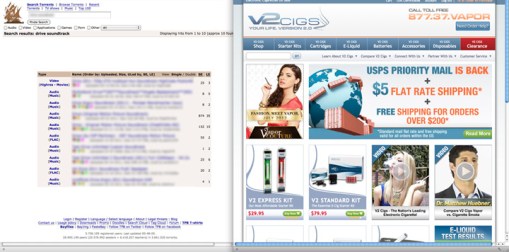
So what can you do about this?  Not much.  One thing you can do is take a screen capture of your lyrics and email it to us for the Wall of Shame and we will keep others abreast of what you are finding.  Make sure you get the ads included in the screen shot, but be careful what you click on.

We are particularly interested in screen captures of advertising by big brands (like McDonalds below).  Email them to us and we will post the best ones!

Like this:

Or this:

[ JOHN PERRY BARLOW ] [ HUMAN RIGHTS OF ARTISTS ] [ INFRINGEMENT IS THEFT ]

Artist Exploitation Calculator – Internet Edition

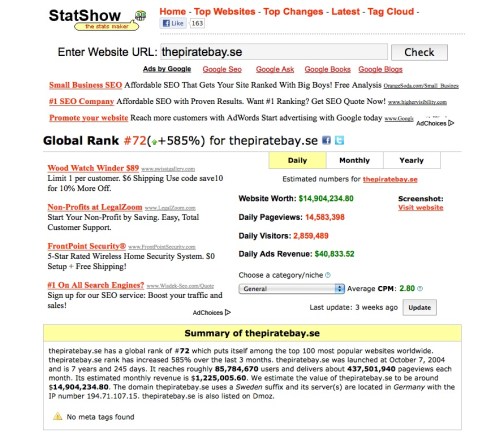
If there is any doubt left in anyone’s mind about the Exploitation Economy ripping off artists, this fantastic website shows the estimated revenue generated for commercial businesses on the backs of artists and creators without paying the artists a single penny.

Stat Show:
http://www.statshow.com/

The Pirate Bay – $14 Million Dollars Annually Estimated
http://www.statshow.com/thepiratebay.se

4 Shared – $11 Million Dollars Annually Estimated
http://www.statshow.com/4shared.com

Iso Hunt – $4 Million Dollars Annually Estimated
http://www.statshow.com/isohunt.com

And that’s just the tip of the iceberg, we also recommend reading:

Artists, Know They Enemy:
https://thetrichordist.wordpress.com/2012/06/05/artists-know-thy-enemy/

Ethical Fan – Wall Off Shame:
http://ethicalfan.com/2012/04/wall-of-shame-april-2012/

[ WHY ARENT MORE MUSICIANS WORKING ] [ ARTISTS FOR AN ETHICAL INTERNET ]
[ THE SKY IS RISING : MAGIC BEAVER EDITION ] [SF GATE BLUNDERS PIRACY FACTS ]
[ THE 101 ] [NEW BOSS / OLD BOSS ] [ SPOTIFY ] [GROOVESHARK ] [ LARRY LESSIG ]
[ JOHN PERRY BARLOW ] [ HUMAN RIGHTS OF ARTISTS ] [ INFRINGEMENT IS THEFT ]

Artists, Know Thy Enemy – Who’s Ripping You Off and How…

Musicians have been getting the short end of the stick for a long time. There are no shortage of stories about the wrong doings of managers, booking agents, etc and of course record labels.

But today we find ourselves in a battle with an enemy few of us understand. If we were to believe the writings and ramblings of the tech blogosphere, than they would have us believe that our enemy is our fans. This is simply not true.

The enemy are the for profit businesses making money from our recordings and songwriting illegally. Let’s be clear about this, our battle is with businesses ripping us off by illegally exploiting our work for profit. This is not about our fans. It is about commercial companies in the businesses of profiting from our work, paying us nothing and then telling us to blame our fans. That is the ultimate in cowardice and dishonesty.

Who are these companies? You know some of them, the ones that have been prosecuted and are no longer operating, Napster, Limewire, Grokster and Kazaa to name a few. Some have been convicted of operating illegally and are running from the law, switching servers to jurisdictions outside the reach of justice, such as The Pirate Bay. And, there are other still others who have yet to go to trial like Megaupload who alone made a billion for it’s owner Kim Dotcom who paid artists nothing, nadda, zero, zilch, zippo…

Our friends over at Ethical Fan recently published a Wall of Shame showing not only the sites who are profiting, but also who is paying for the advertising. This is no different than your music being used in a TV Commercial by AT&T, Time Warner, Verizon, State Farm Insurance, etc. Virtually all of these Artist Exploitation sites such as The Pirate Bay, Demonoid, Iso Hunt and others are operating for profit. Again, this is not about fans sharing, this is about illegally operating businesses making millions (and more likely Billions collectively) of dollars a year from the exploitation of artists work and not sharing any of the revenue with artists.

To the uninitiated, it might seem odd that what seems like a simple question of right or wrong is even being debated, but these sites that exploit artists are supported and promoted by faux civil liberty groups opposed to protecting creators rights — and internet giants are happy to throw their support behind them. Together, they have crafted a narrative of creator rights as quaint and outdated, offering artists a brave new online world where they can throw off the shackles of labels (or publishers, or studios, etc.) and give away their work to find fame and fortune. However, after a decade of half baked ideas, faulty business models, and outright lies, we know this is simply untrue. If the internet is working for musicians, why aren’t more musicians working professionally?

We may not always be fans of record labels, but at least the labels negotiate contracts, pay advances, market and promote artists, and are contractually accountable for wrong doing. However, the Artist Exploitation sites who are operating illegally and completely above the law are making 100% of the money from work created by musicians and artists. We would love to see the day when these sites license music legally, governed by fairly negotiated contracts.

Being able to collect 100% of the money from exploiting the work of artists is no doubt profitable when these companies don’t have to share any of that money with the artists themselves. This is expressly why copyright exists, specifically to protect artists and musicians from corporate interests who would illegally exploit the artist for profit. This is why record labels, publishing companies as well as the producers of films and television must negotiate with artists for the use of their work. And the artist has the free agency to decline. The artist has no such enforceable rights online today in the Exploitation Economy.

In other words, artists, creators and musicians have become road kill on the information super highway.

Opponents of the enforcement of Artists Rights online often cite what a powerful tool the internet is for distributing music cheaply. We are encouraged by many new and promising services to musicians that are being developed. But is absolutely false to assert that an artist’s work must be exploited illegally for the artists to enjoy the benefits of the internet.

Nothing is stopping any artist from sharing or giving away their work online through legitimate sites such as Soundcloud and Bandcamp.  Artists have the full right and capability to distribute their work freely, and by choice without having to be exploited illegally to the benefit and profit of an exploitative  company or corporation.

This is not about being for, or against technology or the internet, this is about being opposed to illegally operating businesses on the internet exploiting artists for commercial gain. It’s really just that simple. 

Those attacking Artists Rights also want you to believe that if you want to be paid you must be against technology and for censorship. Nothing could be more wrong. The internet is a amazing tool and most musicians we know are also early adopters of new technology (especially of the musical variety!). More so, it was artists and record labels who have historically fought against censorship and for freedom of expression. No where was this been more evident than in the 90’s battles against the PMRC in regards to record labeling with “Explicit Lyrics” stickers. Many artists have been on the front line of the battle for freedom of expression such as ICE-T, Jane’s Addiction and many others.

Let’s be clear, there is a difference between protecting the right to the freedom of expression, and profiting from the illegal exploitation of that expression itself.

In other words, artists and musicians are champions of freedom of expression and new technology. The only question that we ask is, is the use of the technology legal and does it respect artists rights as expressed in copyright. Copyright serves as the foundation that enables an artist the free agency to make the choices for themselves that are meaningful to them. Without the enforcement of copyright artists are bullied into forced collectivism by the new gate keepers who control the access to distribution revenues of music exploited illegally.

An economy built on the illegal exploitation of artists, is very simply an Exploitation Economy.

Any wrong doing of illegally operating businesses ripping off artists and illegally exploiting their work should be held accountable, even if they are on the internet.

Musicians POV : 1,000 True Fans (an answer)

by Robert Rich
(re-posted by permission, copyright in the author)

1000 True Fans (an answer)

A few days ago, I got a question from Kevin Kelly (founding editor of Wired Magazine) asking me to give some real-world insight upon his theory that an internet-age artist can survive with around 1,000 “True Fans.” Stephen Hill from Hearts of Space had suggested that Kevin should contact Steve Roach and me because we each have been surviving in a likewise manor for a rather long time. I decided to write a long and carefully worded answer, speaking as close to the truth as I could. I recommend you read the original article that I’m responding to, if this interests you. It’s at http://www.kk.org/thetechnium/archives/2008/03/1000_true_fans.php<http://www.kk.org/thetechnium/archives/2008/03/1000_true_fans.php>

Get ready for a long diatribe that might involve you, if you listen to my music. I’m exposing some rather private stuff about real-life finances and the life of a full-time artist. I feel that the only way to communicate these ideas uses naked truth:

=====

Dear Kevin,

I agree strongly with your basic thesis, that artists can survive on the cusp of the long tail by nurturing the help of dedicated fans; but perhaps I can modulate your welcome optimism with a light dose of realism, tempered by some personal reflections.

I have operated on a premise similar to yours for almost 30 years now, before the internet made the idea more feasible. I wanted to make the sort of uncompromising quiet introspective music that moved me deeply when I first heard others do it back in the mid ’70′s. Because of the lingering aftermath of the popularization of psychedelic culture, certain memes leaked out from the avant garde into pop culture, and publishers from the old model were willing to try marketing experimental art-forms to the mainstream. Thus, into the mind of a suburban adolescent growing up in Silicon Valley, merged the unlikely combination of European space-music, minimalism, baroque, world music and industrial/punk, most of which received the benefits of worldwide distribution and marketing – even though we all considered it “underground” at the time.

That means, I grew up as a benefactor of the old system, before demographic marketing analysis helped to cripple the spread of radical thought across subcultural boundaries. I realized from this leakage of experimental culture into the mainstream, that I wanted to be an artist like the ones that moved me deeply. I wanted to speak my personal truth, regardless of the cost. I wanted to serve the role of a modern shaman, while embracing the complexities and ironies of our modern world.

When one sets a course like this, one quickly ponders the financial realities of obscurity. I remember telling myself when I was about 15, “If I can move one person deeply, that’s better than entertaining thousands of people but leaving nothing meaningful behind.” That’s the long tail talking. I suppose when you multiply this idea by a thousand, you have your thesis.

I began self-publishing my music in 1981, struggling to get paid from slippery distributors, trying to keep track of all the shops where I had my albums on consignment. I was relieved over the years when a couple small labels showed interest in helping me, and I could avail myself of their infrastructure. I think I benefitted immensely from this exposure, through labels like Hearts of Space and smaller ones in Europe. I feel in retrospect like I snuck in under the collapsing framework of independent distribution, at a time where small companies could cast a medium-sized fishing net, to catch the interest of listeners who would otherwise never have known they liked this type of music.

If it weren’t for that brief window of exposure, I doubt I would have my “1,000 True Fans” and I would probably have kept my day job. If I hadn’t also developed skills in audio engineering and mastering, I would be hungry indeed. If it weren’t for the expansion of the internet and new means of distribution and promotion, I would have given up a long time ago. In this sense, I agree wholeheartedly that new technologies have opened the door for artists like me to survive. But it’s a constant struggle.

The sort of artist who survives at the long tail is the sort who would be happy doing nothing else, who willingly sacrifices security and comfort for the chance to communicate something meaningful, hoping to catch the attention of those few in the world who seek what they also find meaningful. It’s a somewhat solitary existence, a bit like a lighthouse keeper throwing a beam out into the darkness, in faith that this action might help someone unseen.

Now in my mid-forties, I still drive myself around the country for a few months every year or so, playing small concerts that range in audience from 30 to 300 people. I’m my own booking agent, my own manager, my own contract attorney, my own driver, my own roadie. I sleep on people’s couches, or occasionally enjoy the luxuries of Motel 6.

In your article you quote the term “microcelebrities” which rings ironically true to me. I suppose I experience a bit of that, when some of the 600 people whom I see on tour come up to me after a show and tell me that my music is very important to them, that it saved their life, that they can’t imagine why I’m not performing in posh 3,000 seat theaters rather than this art gallery or that planetarium or library.

In reality the life of a “microcelebrity” resembles more the fate of Sisyphus, whose boulder rolls back down the mountain every time he reaches the summit. After every tour I feel exhausted but empowered by the thought that a few people really care a lot about this music. Yet, a few months later all is quiet again and CD/download sales slow down again. If I take the time to concentrate for a year on what I hope to be a breakthrough album, that time of silence widens out into a gaping hole and interest seems to fade. When I finally do release something that I feel to be a bold new direction, I manage only to sell it to the same 1,000 True Fans. The boulder sits back at the bottom of the mountain and it’s time to start rolling it up again.

So let’s look a bit at the finances. If I can make about $5-$10 per download or directly sold CD, and I sell 1000, I clear a maximum of $10,000 for that year’s effort. That’s not a living. Let’s say, after 20 concerts I net about $10,000 for three to four months worth of full time effort. That’s not a living.

In my case I’m lucky. I can can augment that paltry income through some of the added benefits of “microcelebrity” including licensing fees for sample clearance and film use rights, sound design libraries, and supplemental income from studio mastering and engineering fees. So, I make about as much money as our local garbage man; and I don’t smell as bad after a day of work. (Note that if copyright laws vanished then much of that trickle of supplemental income would dry up, so you might imagine I have mixed feelings about both sides of the free-information debate.)

Thanks to the internet, I am making more money now, selling directly to 1000 True Fans, than I was during the days on Hearts of Space selling 20,000 – 50,000 copies. But had I not benefited from the immense promotional effort that it took for HOS to sell those albums, I probably wouldn’t be surviving today as a full time artist.

A further caveat: it’s easy to get trapped into the expectations of these True Fans, and with such a tenuous income stream, an artist risks poverty by pushing too far beyond the boundaries of style or preconceptions. I suppose I have a bit of a reputation for being one of those divergent – perhaps unpredictable – artists, and from that perspective I see a bit of a Catch 22 between ignoring those expectations or pandering to them. If we play to the same 1000 people, and keep doing the same basic thing, eventually the Fans become sated and don’t feel a need to purchase this year’s model, when it’s almost identical to last year’s but in a slightly different shade of black. Yet when the Fans’ Favorite Artist starts pushing past the comfort zone of what made them True Fans to begin with, they are just as likely to move their attention onwards within the box that makes them comfortable. Damned if you do or don’t.

I don’t want to be a tadpole in a shrinking puddle. When the audience is so small, one consequence of specialization is extinction. I’ll try to explain.

Evolutionary biology shows us one metaphor for this trap of stylistic boundaries, in terms of species diversity and inbreeding (ref. E.O. Wilson). When a species sub-population becomes isolated, its traits start to diverge from the larger group to eventually form a new species. Yet under these conditions of isolation, genetic diversity can decrease and the new environmentally specialized group becomes more easily threatened by environmental changes. The larger the population, the less risk it faces of inbreeding. If that population stays connected to the main group of its species, it has the least chance of overspecialization and the most chance for survival in multiple environments.

This metaphor becomes relevant to Artists and True Fans because our culture can get obsessed with ideas of style and demographic. When an artist relies on such intense personal commitment from such a small population of Fans, it’s like an animal that relies solely upon the fruit of one tree to survive. This is a recipe for extinction. Distinctions between demographics resemble mountain ranges set up to divide one population from another. I prefer a world where no barriers exist between audiences as they define themselves and the art they love. I want a world of mutts and cross-polinators. I would feel more comfortable if I thought I had a broader base of people interested in my work, not just preaching to the choir.

Indeed the internet is a tool that allows artists to broaden their audience, and allows individuals in the audience to broaden their tastes, to explore new styles, to seek that which surprises them – if they want surprise, that is. The internet can also give us tools more narrowly to target specific demographics and to strengthen those assumptions that prevent acceptance of new ideas, nudging people towards algorithmically determined tastes or styles. Companies can use demographic models and track people’s search patterns to pander to their initial tastes and to strengthen those tastes, rather than broaden their horizons. This problem doesn’t lie within the technology of the internet, but within the realities of capitalism and human psychology.

Like most technologies, the internet is morally neutral and we can better use its powers to assist the broadening of artistic expression, to assist minority artists to make a better living by communicating directly with their audience, to create tools that help people discover the surprising and iconoclastic, rather than to reinforce only that which supports their existing inclinations. Starving artists will probably remain starving, although perhaps with new tools to dig themselves a humble shelter; and as in the past, some of these artists will use those tools to build sand castles or works of great art.

Robert Rich,

===

Specific answers to original questions:

Q: Specifically, if you think you have a following of “true fans”, how big is that following?

A: About 600 “true fans” and 2000 seriously following listeners… and an unknown halo of others on the outer fringe. My database has about 4,000 names but I only hear from most of these people every few years. Occasionally someone new shows up and buys everything I ever made. It’s not a simple answer. For example I know I have at least 500+ serious fans in Russia who never paid me for anything, because they get it all as bootlegs. My 4 or 5 “True Fans” in Russia inform me of these things. Many “fans” don’t feel compelled to pay for the art that moves them, or perhaps they cannot pay because of economic circumstances or the inverse laws of convenience.

Q: What percentage of your annual revenue comes from them?

A: About 30% give or take

Q: Could you estimate how much a typical “true fan” spends on you in a year?

A: $14-40 depending on the number of releases I put out

Q: Are you taking advantage of new production/distribution technologies?

A: Yes, always or whenever possible within my means and schedule.

Q: If so, how is that affecting the type and quantity of what you offer your fans?

A: More stuff, lower quality, lower price. Not a direction that interests me. There is already too much crap out there, I don’t want to contribute to the informational rubbish heap.

Q: How has it affected your relationship with your “true fans”‘ and your “true fan” count?

A: Incoming number of new “fans” roughly matches attrition, perhaps. I am certainly able to communicate more directly with each individual, but that also means I have less time in the day to actually create new art (half the day doing email is not unusual.) Digital distribution seems to lower perceived value and desirability. Ease of access reduces any sense that it’s special or personal. Compressed audio quality and lack of physical artwork create the sense of a lowering in collectible value. I try hard to counteract these forces with high quality audio and informing listeners about the importance of the source… but people don’t always think about the details.

Before I sign off …. A passing thought about “freedom of information” as it relates to the “Gift Economy”: When information is free, always question what the information provider has to gain from its consumption. William S. Burroughs’ rants on Material’s Hallucination Engine (Words of Advice for Young People): “Beware the whore who says she doesn’t want money. To hell she doesn’t want money. She wants MORE money. Lot’s more money.” Just an ironic word of caution that the gift economy is funded in large part by advertising!

Yet, on a kinder note, I know that many internet developments, and many artistic efforts, are driven by a sense of duty or perhaps a need to help push the world forward into a better place (knowing of course that the military funded ARPAnet, so tools for killing people can also play a productive role.) I embrace and welcome any communal and life-affirming sentiment and consider myself part of it. I just try not to be naive about the stuff I see out there masquerading as something other than advertising.

Much Respect – Robert Rich

[Editor’s Note : this was originally posted by Robert on his blog on April 18, 2008]

###

[ THE 101 ] [NEW BOSS / OLD BOSS ] [ SPOTIFY ] [GROOVESHARK ] [ LARRY LESSIG ]
[ JOHN PERRY BARLOW ] [ HUMAN RIGHTS OF ARTISTS ] [ INFRINGEMENT IS THEFT ]
[ THE SKY IS RISING : MAGIC BEAVER EDITION ] [SF GATE BLUNDERS PIRACY FACTS ]
[ WHY ARENT MORE MUSICIANS WORKING ] [ ARTISTS FOR AN ETHICAL INTERNET ]

Musicians POV : Are You Worthy?

By Doña Oxford
(re-post by permission, copyright in the author)

I have been a professional working musician since I was 16. I’ve been fortunate enough to have played with legends such as Keith Richards, Bob Weir, Levon Helm, Buddy Guy, Albert Lee and many more on every level: arenas, festivals, even dive bars. This is how I make my living, gig to gig, paycheck to paycheck. I’ve spent countless hours and serious money investing in my education and skill.And I’m getting really tired of giving away my art for free.

Its expected. We as artists are expected to give away free downloads, free CDs, free videos. We even pay the nightclubs to play for a crappy 40-minute time slot, all under the guise of “exposure” or “promotion.” It’s bullshit. When has an A&R rep ever showed up at your gig?

Just last week, a local blues band asked me to play on their album for free, as a marketing tool to get better-paying gigs. So I’m expected to spend my gas, my time, wear and tear on my car, my ideas and my hard-earned skill in the hopes of your band getting a few paying gigs on which you might hire me?

This is my living. I don’t work at the donut shop or as a temp at an office. I’m not a weekend warrior. I make music. I have rent and bills, overheads and employees, just like the record companies and club owners do.

In 1970, the average band made $400 a gig in a local bar. Today in 2012, it’s even less. We are one of the only sections of American society whose income has not increased with inflation. It’s appalling.

And yet top record labels, managers and agents all complain that they’re losing money and want to raise their fees. Some are charging the artist 35 to 50 percent for representation. Labels are now taking a cut of tee-shirt and non-album-related merchandise — money that isn’t theirs. And I’m so tired of hearing big companies whine because they say they are losing money. The artist is and always has been, throughout time, the lowest paid. Yet… remember… without the artist, they have no product to sell.

In 1999, everyone laughed at Metallica for going against the new Napster concept of file sharing. And look where it has got us. Why should the consumer buy music when they can get it free from YouTube? Why should the consumer buy your entire album when they can buy one track for 99 cents. Of which, if you are lucky or savvy, you may get a whopping 30 cents.

And now everyone is up in arms over the SOPA and PIPA laws. They are so afraid they will lose access to their beloved internet and their freedom of speech.

Let me tell you something: Michaelangelo, Dalton Trumbo, Eugene O’Neill, Reinaldo Arenas… none of them had websites and yet these artists found a way to get their expression out to the people. It’s all a facade.

Don’t get me wrong, I oppose the SOPA law because it is quite dangerous the way it is written. However, I am thrilled that it opens up the anti-piracy conversation. And so what if someone actually had to pay another artist for the use of their work in order to put their self-serving bullshit video up on YouTube? That artist deserves to be paid.

The “Occupy” movement is all about casting light on corporate greed. But what about the greed in all of us? It has become so commonplace that we expect to get everything for free. Especially if it’s art-related. Free music, free movies, free TV (don’t have to watch commercials now with DVR). My momma used to say, who will buy the cow if they can get the milk for free?

By expecting everything for free, we have devalued ourselves. We have bartered ourselves down to the lowest common denominator. We have increased the amount of crap we now have to wade through in order to find the gems. We have lowered our standards and the quality of our art has suffered. Lip-synching, auto tune, horrible lyrics, reality TV, bad sequels, etc. Every Joe Schmo is in the game now. So we have to compete against crap for no money and false opportunity.

Bill Cosby once said, “Mediocre people are very, very dangerous when they get together. There’s one thing they are not mediocre about and that is fighting off people who are superior. They bring standards down and make it appear that you’ve really got to be a genius to be mediocre.” Thank you, Mr. Cosby.

We are the artists. We are the free thinkers. We are the creators. We are the innovators.

Doesn’t that deserve respect? How about self respect? I know times are tough and it’s hard to say “no” to what looks like an opportunity. But how much are we really gaining in the long run?

Artists need to know their worth. We need to start demanding that we get paid for our talents. We need stronger unions, anti-piracy laws and maybe something as simple as integrity. We need to support our fellow artists instead of asking them to do us a favor. And we need to feel worthy enough to say, “No, I deserve better. I am worthy.”

###

[ THE 101 ] [NEW BOSS / OLD BOSS ] [ SPOTIFY ] [GROOVESHARK ] [ LARRY LESSIG ]
[ JOHN PERRY BARLOW ] [ HUMAN RIGHTS OF ARTISTS ] [ INFRINGEMENT IS THEFT ]
[ THE SKY IS RISING : MAGIC BEAVER EDITION ] [SF GATE BLUNDERS PIRACY FACTS ]
[ WHY ARENT MORE MUSICIANS WORKING ] [ ARTISTS FOR AN ETHICAL INTERNET ]

If the Internet is working for Musicians, Why aren’t more Musicians Working Professionally?

We keep hearing from web/tech gurus about how empowered artists are in the internet age, but yet, the numbers just don’t add up. It’s also ironic that tech bloggers like to promote the idea of  “touring and t-shirts” as a solution to the difficulties musicians are having online. But it really sounds to us, more like an admission that there is no money for artists online in the Exploitation Economy to develop new and sustainable professional creative careers.

This is why, an ethical internet for all citizens is so important. Sometimes, the facts are just so simple…

Ted Cohen: Breaking Through The Noise | | midemblogmidemblog

“The Internet was supposed to be the ultimate leveler, great music would be able to find its audience, the ‘big label’ gatekeepers would no longer control access to the masses.

It hasn’t exactly played out that way. According to my friend, Tommy Silverman/Tommy Boy Records and the co-founder of the New Music Seminar recently told me that he did the math and only 228 artists broke 10,000 units for the first time last year out of 105,000 albums.

That’s 2.17% but only 15 of those did it without the help of a real label.

That’s not very encouraging to the other ninety-eight percent. While tens of thousand of artists are self-releasing their music, their ability to get noticed in a meaningful way is stifled by the sheer volume of music that is arriving daily at iTunes, Amazon, Spotify, MySpace Music, Yahoo, Rhapsody, Pandora, iHeart and others. Ten years ago, there were roughly twenty-five thousand album releases a year.

In 2009, it is estimated that there will be over one hundred thousand albums put into digital distribution. That’s roughly a million new tracks a year, four million minutes of music, or almost three thousand days-worth of song. But, maybe, if I listen really, really fast, I could….nope!”

The numbers below are equally sobering. Not only did the volume of sales drop from 2009 to 2010, but also the number of new releases also dropped. Many promoting the exploitation of artists are also proposing that the new lower barriers for access to distribution will increase creative output, but that also appears to be false.

Business Matters: 75,000 Albums Released In U.S. In 2010 — Down 22% From 2009 | Billboard.biz

75,000 Albums Released In U.S. In 2010 — Down 22% From 2009

Not only were fewer albums released, but the weakest sellers took up a smaller share of new release sales. The 60,000 titles that sold from 1 to 100 units represented 0.7% of all sales from titles released in 2010. In 2009, 0.9% of sales came from the 80,000 titles that sold from 1 to 100 units.

So there were quite a few new albums that sold fewer than ten units.

Put another way, the 60,000 new releases that sold 100 or fewer units averaged just 13.3 units per title.

The statistics above do not support the assertion of the tech blogosphere that the internet has created more opportunities for professional creative careers, or expanded a working middle class of musicians. It’s actually very much so the opposite of their claim.

It’s clear from the numbers above (and continued below) that the democratization of production and distribution has not democratized talent. The most exploited music, is not surprisingly, the most popular. These are the artists and titles which are also developed and promoted by traditional media outlets.

Here’s another interesting stat reported by Digital Music News. Does this look like the empowerment of a new creative middle class to you?

99.9% of Tunecore Artists Make Less Than Minimum Wage…

99.875% – or nearly all – of Tunecore artists are making less than minimum wage through the platform, based on revenue figures recently shared by the company.

Despite this fact, some tech bloggers can’t even understand how the simplest mechanisms function in the recorded music business. In an attempt to discredit some of the reports above one tech blog let lose with this gem below, alleging that because Tunecore and CDBaby releases are not reported directly to Soundscan their releases are not counted in Soundscan stats creating a massive unreported pool of revenue being ignored by the industry.

TuneCore does not report results to Nielsen Soundscan and it puts out a hell of a lot of releases. Similarly, CDBaby/Disc Makers points out that Soundscan doesn’t count its releases either — which number around 50,000.

The problem with the above is not understanding that Tunecore and CDBaby can’t report to Soundscan, because Soundscan collects the data from the point of sale such as Itunes, Amazon, etc. So in fact, all Tunecore and CDBaby releases and sales are actually cataloged and reported by Soundscan afterall. So much for all that unreported sales and revenue.

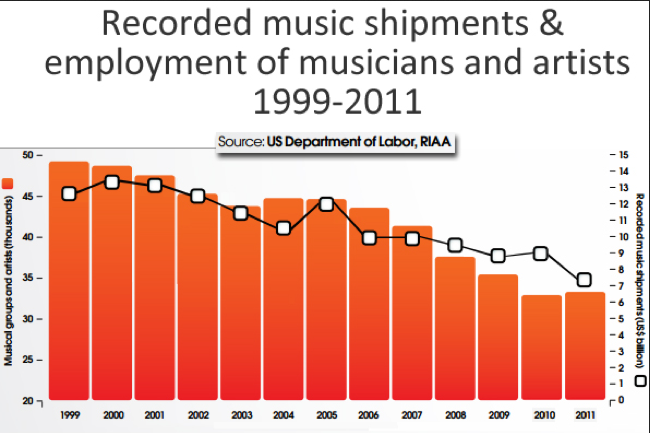
But of all the numbers, this one is the bottom line. Salon recently reported stats from the Bureau of Labor Statistics that number of working professionals in the music industry are suffering a catastrophic decline. If these numbers were reported by any other industry it would make national headlines:

No Sympathy for the Creative Class

“Musical groups and artists” plummeted by 45.3 percent between August 2002 and August of 2011.”

This is also graphically represented here at Digital Music News:

musiciansindecline


All of this gave us pause when we saw a report given by The Future Of Music Coalition (FOMC) in Digital Music News that artists earnings are benefiting from digital technologies? How? As opposed to what? I can see that some digital technologies may be helping artists, but “overall” is simply, statistically, not true given the information above. So it trouble’s us to see statements like the one below made in public by the organization’s Kristin Thomson at SF Music Tech in February of 2012.

 “Overall, digital technologies seem to be having a positive impact on musicians’ earnings capacity”

Really? Maybe it’s not surprising that FOMC is also aligned with Public Knowledge who held a joint workshop to help musicians understand that, “Copyright law is changing rapidly in the face of new technologies.” The only problem is, copyright law is not actually “changing rapidly,” but it appears that Public Knowledge would like it too! Make no mistake about it, Public Knowledge is advocating for less artists rights and protections.

So the real truth is this; if the internet is working for musicians, why aren’t more musicians working professionally?

###

Robin Gibb Remembered 1949 – 2012

It is with great sadness that we report on the passing of Robin Gibb who in his later years was a strong and vocal champion of Artists Rights serving as the President of the International Confederation of Societies of Authors and Composers (CISAC) for the past five years.

Robin served as the President of CISAC, acting as the voice of three million creators around the world as the leader of the members of CISAC’s 232 authors’ societies in 121 countries. Following a first term as president, Robin was unanimously re-elected for an additional three-year mandate in June 2010.

Below is his impassioned closing speech from the World Copyright Summit in 2009 in which he said, “I’m proud to be President of CISAC, and I will keep on fighting for creators’ rights as long as I can draw breath.”

More here:
Robin Gibb Website
CISAC.org