
Meet The New Boss, Worse Than The Old Boss? Part 1.

By David Lowery

Part 1 of a 5 part post

(Copyright in the author, used by permission)

What follows is based on my notes and slides from my talk at SF Music Tech Summit.  I realize that I’m about to alienate some of my friends that work on the tech side of the music business.  These are good well intentioned people who genuinely want to help musicians succeed in the new digital paradigm. But if we are gonna come up with a system to compensate artists fairly in the new digital age we need an honest discussion of what is going on.  The tech side of the music business really needs to look at how their actions and policies negatively impact artists,  just as they have pointed out the negative effect record company actions have had on artists.

Too often the debate has been  pirates vs the RIAA.  This is ridiculous because the artists, the 99 percent of the music business are left out of the debate.  I’m not advocating going back to the old record label model,  to an industry dominated by the big three multi-national  labels.  This is a bit of hyperbole intended to make us all think about this question:  Is the new digital  model better for the artist?

Meet the New Boss, Worse than the old boss

Introduction

I was like all of you.  I believed in the promise of the Internet to liberate, empower and even enrich artists.  I still do but I’m less sure of it than I once was.  I come here because I want to start a dialogue.  I feel that what we artists were promised has not really panned out.  Yes in many ways we have more freedom.  Artistically this is certainly true.  But the music business never transformed into the vibrant marketplace where small stakeholders could compete with multinational conglomerates on an even playing field.

In the last few years it’s become apparent the music business, which was once dominated by six large and powerful music conglomerates, MTV, Clear Channel and a handful of other companies, is now dominated by a smaller set of larger even more powerful tech conglomerates.  And their hold on the business seems to be getting stronger.

On one hand it doesn’t bother me because the “new boss” doesn’t really tell me what kind of songs to write or who should mix my record. But on the other hand I’m a little disturbed at how dependent I am on these tech behemoths to pursue my craft.  In fact it is nigh impossible for me to pursue my craft without enriching Apple, Amazon, Facebook and Google.   Further the new boss through it’s surrogates like Electronic Frontier Foundation  seems to be waging a cynical PR campaign that equates the unauthorized use of other people’s property (artist’s songs) with freedom.   A sort of Cyber –Bolshevik campaign of mass collectivization for the good of the state…er .. I mean Internet.   I say cynical because when it comes to their intellectual property, software patents for instance, these same companies fight tooth and nail.

Meet the new boss, he wants to collectivize your songs!

The other problem? I’ve been expecting for years now to see aggregate revenue flowing to artist increase.  Disintermediation promised us this.  It hasn’t happened.   Everywhere I look artists seem to be working more for less money.  And every time I come across aggregate data that is positive it turns out to have a black cloud inside.  Example: Touring revenues up since 1999. Because more bands are touring, staying on the road longer and playing for fewer people.  Surely you all can see Malthusian trajectory?
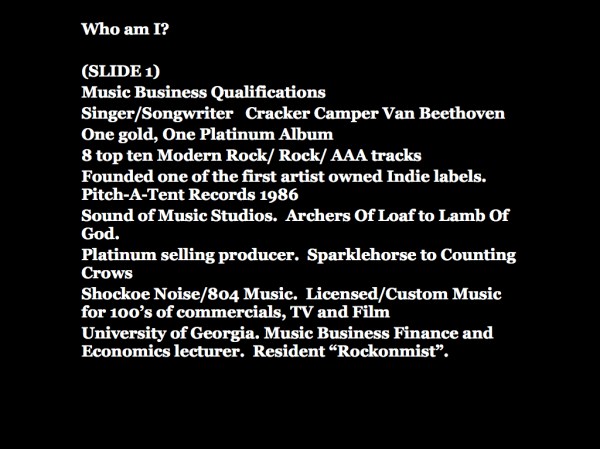
SLIDE 1
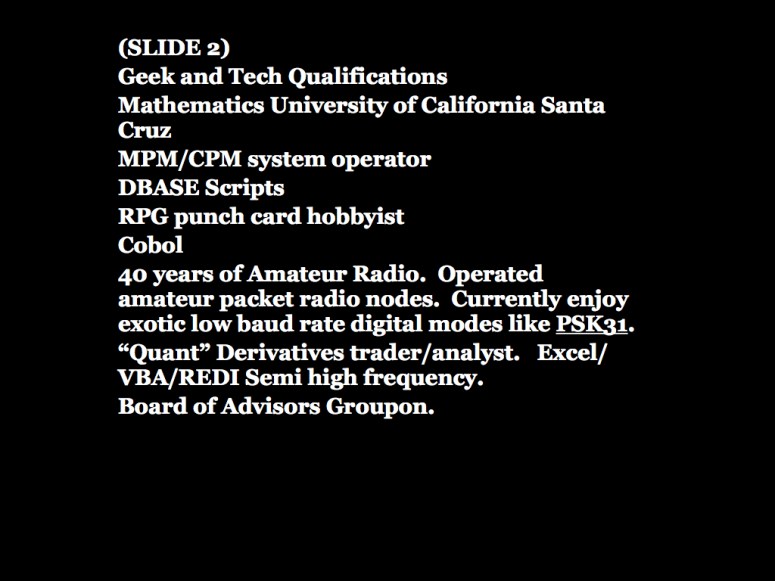
I realize that some of you may not know much about me or even who I am. I like to think that I am uniquely qualified as an artist, entrepreneur and geek.  I was trained as a mathematician. My first job after I graduated involved being the systems operator for an MPM OS system and I wrote a lot of DBASE IV scripts.  I had a fascination with the old RPG punch card programming language.  I am deeply involved in the digital amateur radio world.   You can sometimes find me operating PSK31 on 20 meters. I spent some time in Chicago near the CME. I worked as a “Quant” doing some semi high frequency trading.  While there I became involved with a company called www.thepoint.com which evolved into  www.groupon.com.

I can out geek most of you.

++++++++++++++++++++++++++++++++++++

My company is faster than your company.

Musicians are constantly derided by the Digerati.  It’s usually after someone like myself suggest that if other people are profiting from distributing an artist’s work (Kim Dotcom, Mediafire, Megavideo, Mp3tunes,) they should share some of their proceeds with the artists.  At this point the Digerati then proceed to call us “dinosaurs”, “know nothings” or worse.  Suddenly your Facebook page is filled with angry comments from their followers that seem to all be unsuccessful Canadian hip hop artists who proclaim:

“We are gonna turn you into Lars Ulrich  and bitch your band sucks anyway”.

(At the risk of getting the Canadian non-lethal equivalent of a  “cap in my ass” I have to say:  I am so scared!)

The most virulent of these folks are almost always unsuccessful musicians. It fascinates me.  I can only surmise that part of their anger seems tied to the hatred of the record companies that rejected them.  Successful even marginally successful musicians are often viewed as some kind of traitors.   A special kind of hatred is reserved for these apostates. The file sharing/ cyber locker industry has figured  this out and purposely stokes stokes them with a faux populism.    I would say it’s juvenile but it’s really more medieval.  That’s why I call them Freehadists. People like me are actually looking out for these young musician’s rights.  I am trying to keep the new boss from screwing them.  They dont’ realize they are doing the work of  The Man.  But I digress.

Despite the tech lobby’s portrayal of musician as luddites or doddering old hippie, musicians, especially independent musicians are often the early adopters of technology.  We are always a couple years ahead of the “straight” business world when it comes to technology.  As an example we perfected “social marketing” before it even had a name.  We were outsourcing and insourcing services for our highly flexible virtual companies  when Windows 3.0 was state of the art.

When it comes to the web, we not only understand the consumer side of the Internet we understand the producer/supplier side as well.  And like any producer or supplier we want to be compensated.  The reason the Digerati are so fixated on “what the consumer wants” is simply because most of them have only experienced the web as consumers.

“The consumer wants music to be free”  they shout as they pound their tiny fists on their Skovby tables.

The consumer also wants cars to be free.  And beer.  Especially beer.  But any market involves a buyer and a seller.  A consumer and a producer.  If GM can’t afford to give away their product for free it ain’t gonna happen.  No matter what the consumer wants. (See my note on “digeridiots”)

Often overlooked by Digerati, is the glaringly obvious fact that musicians and bands have long been a part of the new economy.  We’ve been a web-enabled business since 1992.  We’ve been a web-based business since Napster. Virtually every interaction that an artist and a fan have is web based.  Even live concerts are web-enabled.  The artist and the fan communicate about the upcoming concert through Twitter, Facebook events or traditional email.  Recording has long been web enabled.  We might all get together in the same spot to record basic tracks, but oftentimes overdubs and even mixing happens remotely, exchanging files and notes via the web.

So please forgive us if we roll our eyes at the Digerati who tell us we need to “embrace the web”, “work the new digital ecosystem” or come up with a “new model”.  It’s a little like your great aunt seeing you at thanksgiving dinner and telling you something like:

“You should make some T-shirts for your band and sell them on tour”.

You politely smile and try not to roll your eyes.

Actually that’s the number one “new model” that the Digerati suggest.  Sell T-shirts at your shows to make money! This despite the fact it’s not new.  Bands have been selling t-shirts at live shows since the early 1970s. Recording albums to sell a few t-shirts is a terrible way to make money.  Thanks for the advice but no thanks.  Plus t-shirts are just as bootlegable as music.

“Information wants to be free. Information also wants to be expensive”-Stewart Brand

Everyone knows there a second half to his quote? Right? Cause I usually only see the first sentence bandied about in technology circles.

Sound recordings are information.  Sound recordings are not cheap to make.  The technology is not the expensive part of making songs and sound recordings. It hasn’t been since the late 1980s.  Many in the tech community blindly assume that recording budgets have gone down because the technology is less expensive and provides greater productivity.  With absolutely no facts to back up their argument I often hear:

“Well artists are making less money but recording costs are lower, so the artists are doing okay”.

In other words technology has lowered your revenues in the form of unlicensed file-sharing on an industrial scale but that’s okay because Digidesign (the makers of Pro-Tools™)  has given back some cost savings.  As if Kim Dotcom and Digidesign share the same bank account.  These people believe in technology like it is a religion.  The lord Technology Industry taketh, and The Lord Technology Industry giveth back.

The data I have from recording studios says something different.  Recording budgets are lower because artists spend dramatically less time recording.  They just don’t have the money.

Recording budgets didn’t start shrinking until after the advent of file-sharing. 2002 ish. While most of the improvements in technology and gains in productivity occurred in the early 1990s.  By 1996 the home studio/pro studio production chain was firmly in place.  Pro studios used for “tracking” and “mixing.”  Home or project studios used for overdubs and editing.    If lower recording budgets were caused by improvements in technology they should have started shrinking 10 years earlier.

Sound recordings are very labor intensive.   If you want to make good ones you are relying on highly skilled labor.  The cost of sound recordings is largely dependent on labor costs.  Technological advances have little effect on recording cost.

This is the main problem with the technologists contention recordings should be free. They seem to think that the only people who work on recordings are the touring performers themselves.    Artists still have to pay for that highly skilled labor.

Is the  mix engineer gonna follow us around on tour hawking HIS T-shirts to the audience?

SLIDE 3

Nevertheless, I’m what you might call a “Freemiumnista”.  I was a Freemiumnista before there was an Internet.  I get that not all interactions between fans and artists should be monetized.  I get that you can give away something and make more money in the long run.  Virtually every live show we’ve ever played is available free on archive.org.  Even before the internet we’ve encouraged and organized tape trees and later CD burn trees for distributing our live shows   And we spend a lot of time trying to get people to buy our studio albums as well.

Unlike a lot of the Digerati I have walked the walk.  I still do.

I’ve embraced many of the things that those on the tech side of the music business want musicians to embrace.  But what many of you forget is that IT IS MY CHOICE whether I choose to give away my songs or sell them.  IT IS MY CHOICE how and where to distribute my songs.  IT IS MY CHOICE to decide which websites get to exploit my songs.   Like it or not, the right to control one’s intellectual property (like songs) is a constitutional right.  It is also part of every international human rights agreement. Technology company funded blogs that think there should be no song copyrights are actually advocating violating my constitutional and human rights!

Many in the digital music industry rightfully condemn the past exploitation of artists by record labels.  But at the same time they seem to be doing the same thing.  Trying to bully artists into giving up their rights so that companies like MegaUpload or YouTube can make money is  the same thing.

With exploitative record contracts The Old Boss tried  to take your songs a dozen at a time and pay you pennies.  The New Boss wants to take ALL of your songs,  past present and future and pay you nothing.

I’ll make technologists a deal, I’ll give up my song copyrights if you give up your software patents.  Software patents are even less unique than your typical song.   So this should be easy right?

Talk the Talk.  Walk the Walk.

http://www.huffingtonpost.com/2011/08/15/google-motorola-mobility_n_927670.html

http://www.huffingtonpost.com/2012/03/12/yahoo-sues-facebook-patent_n_1340032.html

<<<<<<<<<<<<<<<<<<<<<<<<<<<<<<<<<<<<

Read Part 2.

Read Part 3

Musicians POV: Occupy Artist Rights – Full Post

By Chris Whitten

(Copyright in the author, used by permission, all rights reserved)

I’m an independent, self-employed musician.  It’s a risky business. You’re only as good as your last record or gig. There are few long term contracts, no sick leave, no holiday entitlements and nothing in the way of protection against bullying in the workplace, sexual discrimination, or unfair dismissal. Yes, it’s largely a labour of love, with some degree of personal satisfaction, and if you’re one of the lucky ones, some financial reward.

To co-opt the slogan of the recent Occupy movement, we are the 99%.  The 99% of professional musicians who have more in common with ordinary workers than the rock stars portrayed by the media, frittering away their millions like 24-hour party people.

For the last couple of years I’ve been following the piracy debate, especially online. Contrary to what is often claimed, I feel the ‘free music’ movement has succeeded in shouting down the view from actual content creators. Much of the commentary is dominated by technology journalists, or tech industry watchers, but relatively little has been contributed by creative people working in the music industry. Many musicians, especially the young, up-and-coming ones, have stayed out of the debate, leaving music fans not much option but to accept one or two myths and misrepresentations as fact.

The political musician is a thing of the past, it seems. Maybe recent generations of artists are rebelling against their parents who went to Woodstock or Live Aid? What is sure is that musicians understand they need to be liked in order to survive. You build a fanbase, which in turn provides the all-important bums on seats needed to fund the next tour or album recording. So the last thing you want to do is alienate that fanbase. Heck, who wants to be the next Lars Ulrich? Still getting a public kicking eleven years after Metallica triumphed over Napster. As with many things in life, short term gain is popular while the long game is not. Young musicians who ask fans to pay for their music, sometimes even daring to critisise music pirates, are often derided around the blogs and internet music communities.

Let’s be clear about this: in the relationship between musician and music consumer, the musician has no power. Currently the consumer has all the power. Even if they could admit to themselves that non-payment is wrong, who’s going to readily give up all that free music, movies and television with virtually no chance of ever being caught?

The reader comments section of any blog discussing the issue of music piracy makes for depressing reading – at least for professional musicians. The often repeated threat of “price music fairly or we’ll just take it” is made by people who aren’t prepared to work for free themselves, and couldn’t make ends meet if their weekly paypacket fluctuated wildly dependent on how much their employer felt like paying them each week.

The modern mantra is ‘information is free’. Well we pay for our internet service, don’t we? And music isn’t really information, it’s the product of someone working hard to entertain us. In a capitalist system you don’t get to demand entertainment for free. Someone provides a service, and the consumer decides whether they are willing to buy it or not. After the death of capitalism, when we no longer have to pay for our electricity, we can talk about free music.

Another myth is that the music pirate is somehow righting a wrong visited on artists by the major record labels in past decades. Sadly, musicians survive at least in part by selling records. So what we have is an apparent double punishment. You’ve been ripped off by the labels, and now it’s the music fan’s turn to rip you off. Worse still, with the short careers of many artists, we’re supposedly righting some financial wrong done to The Saints by ripping off Wolfmother.

Music artists are grown up enough to look after themselves. As far back as the late 1970’s with the explosion of independent labels and DIY recording, artists have had plenty of acceptable avenues to distribute their work without relying on corporate labels. The reality which rather sinks this pirate ship is the amount of independent and self-released music that is pirated. Do music pirates download music they want to hear, whatever the source, or do they target major label artists only? I personally know people who have written and recorded their own music, paying for the whole thing themselves, only to find it uploaded against their wishes by someone they don’t know for everyone else to share freely.

I have no doubt there are a few idealists, anti-capitalists and ex-hippies who genuinely believe that by file-sharing they are bringing down the corporate music industry. However, the biggest casualties caught in the crossfire are average musicians. Even if they try to do the right thing by the public, eschewing the major label system, pricing their music fairly, giving some music away, they are pirated as readily as the commercial pop manufactured for mass consumption. When Radiohead offered their ‘pay whatever you want’ download of ‘In Rainbows’ there is evidence many still downloaded the album from popular pirate sites. The clear motive then for most is to obtain any music, any time, without having to pay for it.

So let’s briefly look at a few other, shall we say ‘misunderstandings’….

• The new economy for music is in live performance.

Actually, that was the old economy. You earned a little income from selling records, you might also make a bit from playing live, put it all together and most musicians could earn enough to keep playing. The pirate economy removes income from recordings. So in fact, there is no new way of making money, we’ve just taken one income source away.  In addition, the recording is a product in of itself. It isn’t a promotional tool. After Sgt Peppers was released, The Beatles didn’t tour, and yet we can all still enjoy the music today. I was too young to see Jimi Hendrix in concert, but I have always enjoyed listening to Electric Ladyland. In a country like Australia, you often can’t support artists via their shows without literally going the extra mile. If you live in Darwin, even Albury Wadonga, the only way to see most bands is to travel. International acts just don’t play outside the major Metropolitan centres. The easier way to support artist’s output is to buy the record. Records and shows are two equal products with equal creative value. Recordings capture a moment in time. In recordings from ‘Kind Of Blue’ (Miles Davis) to ‘Smells Like Teen Spirit’ (Nirvana) it’s a moment of magic you can’t replicate in live performance now some of the players are gone. In the end, does anyone suggest actors appear in movies to promote theatre?

• You should play music for love not money.

Yes, but instruments, music lessons and rehearsal spaces don’t come free. And if you want to attain some level of excellence you need to invest a lot of time and money in your music. Besides, why are there all these rules for musicians that don’t apply to anyone else? I’m sure Sam Stosur would play tennis just for grins, but we apparently have no problem with appearance fees and prize money. It’s obvious Tony Abbott would LOVE to be Prime Minister. When he finally achieves that goal should we take away the $260,000 a year he’s enjoyed as opposition leader, pay him nothing and recommend he “have fun”?

If you add the suggestion to play for the love of music, to the suggestion musicians play more shows, the cracks in these theories start to appear. Putting on a show doesn’t come cheap, there are rehearsals, travelling expenses, equipment costs. So are musicians to fund these costs through professional musicianship, or accept the dreaded day job? If like others in society your ambition is to rent or own a home, start a family and provide for your kids, you’ll likely need to get a regular job. The bank manager doesn’t understand “I work only for love”.

The average holiday entitlement in regular employment is four weeks per annum. That hardly meets the demands of modern touring. So the post piracy band would only tour for one month each year, and every band member would have to co-ordinate the same month off. Then work the remaining eleven months without a break. When do they find time to record the album, or shoot the video?

When I toured globally with Dire Straits in 1991, we spent six weeks in Australia alone. You can forget seeing most international acts grace these shores ever again if those acts have to balance the needs of regular employment with their careers in music.

Finally we come to a couple of ‘dog ate my homework’ type excuses.

• Not Every Illegal Download Is a Lost Sale.

Duh…. yeah! That’s right, but it’s amazing how regularly this is brought up in the debate as if it’s the killer argument, the Achilles heel of the professional musician. Never mind the high probability that many illegal downloads represent many lost sales. It’s really not believable to claim all pirated music is binned without being listened to, or if it is listened to and appreciated, the downloader goes on to pay for it. Clearly a reasonable amount of music is pirated because the pirate wants to enjoy the music but isn’t prepared to pay for it. Isn’t prepared to actually support the persons creating the music.

More than three years into a GFC, with Europe facing financial meltdown, 40% youth unemployment in Spain, rock music’s biggest market the USA looking down the barrel of a double dip recession, and most Aussie musicians driving in the slow lane of a three speed economy, you bet every single lost sale counts.

• I Can’t Afford Music

I can’t afford to eat at Aria. Life’s a beeeyach. Obtaining music isn’t a right, it’s one of life’s pleasures. And while we’re talking about life’s pleasures, a take away coffee costs $3 to $4, and lasts as long as it takes to drink. A song costs $2.99 from iTunes, and provides entertainment for years. With the popularity of fast broadband and large data plans, it’s quite obvious many of the same people who claim they can’t afford music, somehow can afford a computer, a Blackberry or iPhone and a $60 a month ADSL2 plan. I think what they mean to say is “I can’t afford music because my entertainment priorities lie elsewhere….. and music is available free”

Music piracy is a wholly negative culture. It takes out, but puts nothing back.                                  When I was a teenager we had a similar view of the mainstream music industry. It was tired, complacent and wasn’t making the records we wanted to hear. Towards the end of the 1970’s like-minded people started forming their own bands, they wrote their own music, promoted their own gigs, made their own records and started their own indie labels. It really did blow the establishment apart…. at least for a few years. Why is it that action for positive change has been replaced by simply robbing music from music makers? I can’t say I understand the excuse that pirates download music because most music is rubbish. Surely some young person somewhere is thinking they’d rather make some amazing new music of their own and make a name for themself, rather than spend all night trawling through torrent sites downloading gigs of garbage.

The final pirate promise is that music will always be there.

Well you can’t really argue with that, but what kind of music will it be? Just as talented school athletes play a variety of sports and eventually decide to concentrate on one, young creative often draw, write and play an instrument to a reasonably high level. Given a choice, teenagers will usually opt to pursue a career where they feel valued, have a decent chance of success, and be rewarded for their hard work. Things are pretty gloomy right now in the music scene, but if we could restore income from record sales, I think we could reward our best and brightest to make great music in the future. With the industry in the doldrums or worse than its current state, the most talented creative minds will choose other avenues to express themselves, avenues that give them some hope of a decent living, put a roof over their head, and a pat on the back from respected peers for a job well done.

That would be the music fan’s loss.

Downloading music for free is a short term gain. The long term damage it’s doing to the broader music community and the message that sends to the grass roots, where the musicians of tomorrow emerge from, should be understood by anyone who enjoys new and exciting music. We need creative risk taking and innovation in music, or else millions of teenagers would still be listening to Doris Day and dancing The Twist. The history of pop music shows us creative risk taking and innovation is carried out in the bedrooms of Manchester, England, the garages of Seattle, the back room of a pub in Melbourne, not in the spotlight glare of a season of X Factor. The mainstream is supported by television and advertising, mainstream artists are offered guest spots on CSI: Miami, or a signature fragrance as part of a cosmetic sponsorship. These aren’t avenues of income a young band from Wagga Wagga can enjoy. So we need to financially support the musicians at the margin, for they are the future of good music.

The final ironic twist is I believe free music is a brief abberration. Everyone but the pirates understand that quality content comes at a price. The internet giants are the new record companies. While music sales have been hammered by illegal downloading, web companies have seized the opportunity to throw desperate musicians a bone in the form of some small income from iTunes, Spotify and the forthcoming ‘cloud’. Most of these services are embryonic, but once they gain some popularity it’ll be in the tech industry’s interests to finally stamp out easily available free music, while encouraging people to access music through paid for services like Spotify and iCloud.

The only difference is that many tech companies have demonstrated they are more ruthless than any record label ever was. Unlike record labels, tech companies aren’t interested in music specifically, the nurturing and development of new artists. They are primarily interested in making money through hardware sales like iPads, or online services like Google and Facebook. They want to supply the most popular, most desirable content, at the lowest price as a way to attract and hold on to loyal customers. Mark Zuckerberg’s recent high profile relaunch of Facebook was centred around the (legal) sharing of music and movies.

It’s in the interest of music fans to financially support the next generation of musicians. The internet corporations demonstrably aren’t, and musicians being normal people, they’ll drift away from music as the daily grind of making innovative music with no reward and no encouragement takesits toll.

Less edgy innovation, but more mainstream commercial pop – that’s the road we are on and that’s bad for music fans.

Rather than online anarchy, a mass exploitation by the many of the few, we the 99% of music consumers need to directly support the 1% of adventurous, young music makers, or we can’t really complain when we end up paying. But we won’t just be paying for our entertainment. We will also be paying in terms of the talent that goes unheard and the groundbreaking music that wont be made. And the ultimate irony is that this time it’s a computer company – not a specialist music company – determining what music we get.

###

[ THE 101 ] [NEW BOSS / OLD BOSS ] [ SPOTIFY ] [GROOVESHARK ] [ LARRY LESSIG ]
[ JOHN PERRY BARLOW ] [ HUMAN RIGHTS OF ARTISTS ] [ INFRINGEMENT IS THEFT ]
[ THE SKY IS RISING : MAGIC BEAVER EDITION ] [SF GATE BLUNDERS PIRACY FACTS ]
[ WHY ARENT MORE MUSICIANS WORKING ] [ ARTISTS FOR AN ETHICAL INTERNET ]

Smells Like Pirate Desperation, The Promo Bay now Elitist Gatekeeper

The Pirate Bay wants to help artists (stop laughing). No, really, they do.  So this begs the question, if The Pirate Bay really wants to help artists why don’t they just pay them? You know the saying, “with friends like these, who needs enemies,” right?

The three month old story of  TBP offering promotion to indie bands made the rounds again this weekend as it launched. The headline reads 5,000+ indie bands sign up for Pirate Bay Promotion, but what’s not clear is how many will actually get that promotion?

This promotion was originally announced on Torrent Freak and TechDirt back in January without much fanfare. I guess there wasn’t much interest. So with just 5,000 bands signed up The Pirate Bay is desperately reseeding the story now and seeking headlines to attract more artists. But the whole thing is really laughable given that by the rules of the promotion, TPB are now the very thing they ridiculed, a gate keeper. Hypocrisy anyone?

“Of course, we can and will not release everything we recieve. We will pick something every now and then from the pool. If we like your submission, and the countries you chose are not already flooded by requests, you will recieve an email when it’s about to start.”

Of course right? Every now and then? Who are you guys, Rolling Stone? I’m curious to see the net effect of this other then exploiting artists yet again for TPB’s own self serving interests. So if they like your stuff and they think it’s worthy of promoting in some third world country, you might just have a chance of having TPB promote you. Uhm, thanks? Here’s an idea, instead of the Promo Bay, why not the Cash Bay? Hmmmm.

So what’s it worth even if they do pick you from the lottery? As of this writing the artist SOSO has gotten about 85,000 views on their YouTube Video with all the views appearing to come from Sweden (according to the publicly posted YouTube analytics and despite that we can see it in the USA). The band’s SoundCloud page is not faring as well with the most played song registering some 4,500 plays.

As much as we applaud any artist getting anything of value out of TPB, and we always respect the artists right to chose what is best for them, this PR stunt just reeks of desperation. I guess it’s not helping that more and more artists are becoming vocal about their rights, like Patrick Carney of the Black Keys and also this fantastic post by Zack Hemsey.

Let us not forget The Pirate Bay has made, and continues to make MILLIONS annually from artists via advertising while providing no compensation to the artists what-so-ever. Nothing, Zero, Zilch, Zippo, Nadda, not a penny.

###

[ THE 101 ] [NEW BOSS / OLD BOSS ] [ SPOTIFY ] [GROOVESHARK ] [ LARRY LESSIG ]
[ JOHN PERRY BARLOW ] [ HUMAN RIGHTS OF ARTISTS ] [ INFRINGEMENT IS THEFT ]
[ THE SKY IS RISING : MAGIC BEAVER EDITION ] [SF GATE BLUNDERS PIRACY FACTS ]
[ WHY ARENT MORE MUSICIANS WORKING ] [ ARTISTS FOR AN ETHICAL INTERNET ]

The Musicians POV: Occupy Artist Rights, Part 3–The attack of the homework eating dogs

[Part 3 of a 3-part post “Occupy Artist Rights”]

By Chris Whitten

Finally we come to a couple of ‘dog ate my homework’ type excuses.

• Not Every Illegal Download Is a Lost Sale.

Duh…. yeah! That’s right, but it’s amazing how regularly this is brought up in the debate as if it’s the killer argument, the Achilles heel of the professional musician. Never mind the high probability that many illegal downloads represent many lost sales. It’s really not believable to claim all pirated music is binned without being listened to, or if it is listened to and appreciated, the downloader goes on to pay for it. Clearly a reasonable amount of music is pirated because the pirate wants to enjoy the music but isn’t prepared to pay for it. Isn’t prepared to actually support the persons creating the music.

More than three years into a GFC, with Europe facing financial meltdown, 40% youth unemployment in Spain, rock music’s biggest market the USA looking down the barrel of a double dip recession, and most Aussie musicians driving in the slow lane of a three speed economy, you bet every single lost sale counts.

• I Can’t Afford Music

I can’t afford to eat at Aria. Life’s a beeeyach. Obtaining music isn’t a right, it’s one of life’s pleasures. And while we’re talking about life’s pleasures, a take away coffee costs $3 to $4, and lasts as long as it takes to drink. A song costs $2.99 from iTunes, and provides entertainment for years. With the popularity of fast broadband and large data plans, it’s quite obvious many of the same people who claim they can’t afford music, somehow can afford a computer, a Blackberry or iPhone and a $60 a month ADSL2 plan. I think what they mean to say is “I can’t afford music because my entertainment priorities lie elsewhere….. and music is available free”

Music piracy is a wholly negative culture. It takes out, but puts nothing back.  When I was a teenager we had a similar view of the mainstream music industry. It was tired, complacent and wasn’t making the records we wanted to hear. Towards the end of the 1970’s like-minded people started forming their own bands, they wrote their own music, promoted their own gigs, made their own records and started their own indie labels. It really did blow the establishment apart…. at least for a few years. Why is it that action for positive change has been replaced by simply robbing music from music makers? I can’t say I understand the excuse that pirates download music because most music is rubbish. Surely some young person somewhere is thinking they’d rather make some amazing new music of their own and make a name for themself, rather than spend all night trawling through torrent sites downloading gigs of garbage.

The final pirate promise is that music will always be there.

Well you can’t really argue with that, but what kind of music will it be? Just as talented school athletes play a variety of sports and eventually decide to concentrate on one, young creative often draw, write and play an instrument to a reasonably high level. Given a choice, teenagers will usually opt to pursue a career where they feel valued, have a decent chance of success, and be rewarded for their hard work. Things are pretty gloomy right now in the music scene, but if we could restore income from record sales, I think we could reward our best and brightest to make great music in the future. With the industry in the doldrums or worse than its current state, the most talented creative minds will choose other avenues to express themselves, avenues that give them some hope of a decent living, put a roof over their head, and a pat on the back from respected peers for a job well done.

That would be the music fan’s loss.

Downloading music for free is a short term gain. The long term damage it’s doing to the broader music community and the message that sends to the grass roots, where the musicians of tomorrow emerge from, should be understood by anyone who enjoys new and exciting music. We need creative risk taking and innovation in music, or else millions of teenagers would still be listening to Doris Day and dancing The Twist. The history of pop music shows us creative risk taking and innovation is carried out in the bedrooms of Manchester, England, the garages of Seattle, the back room of a pub in Melbourne, not in the spotlight glare of a season of X Factor. The mainstream is supported by television and advertising, mainstream artists are offered guest spots on CSI: Miami, or a signature fragrance as part of a cosmetic sponsorship. These aren’t avenues of income a young band from Wagga Wagga can enjoy. So we need to financially support the musicians at the margin, for they are the future of good music.

The final ironic twist is I believe free music is a brief abberration. Everyone but the pirates understand that quality content comes at a price. The internet giants are the new record companies. While music sales have been hammered by illegal downloading, web companies have seized the opportunity to throw desperate musicians a bone in the form of some small income from iTunes, Spotify and the forthcoming ‘cloud’. Most of these services are embryonic, but once they gain some popularity it’ll be in the tech industry’s interests to finally stamp out easily available free music, while encouraging people to access music through paid for services like Spotify and iCloud.

The only difference is that many tech companies have demonstrated they are more ruthless than any record label ever was. Unlike record labels, tech companies aren’t interested in music specifically, the nurturing and development of new artists. They are primarily interested in making money through hardware sales like iPads, or online services like Google and Facebook. They want to supply the most popular, most desirable content, at the lowest price as a way to attract and hold on to loyal customers. Mark Zuckerberg’s recent high profile relaunch of Facebook was centred around the (legal) sharing of music and movies.

It’s in the interest of music fans to financially support the next generation of musicians. The internet corporations demonstrably aren’t, and musicians being normal people, they’ll drift away from music as the daily grind of making innovative music with no reward and no encouragement takesits toll.

Less edgy innovation, but more mainstream commercial pop – that’s the road we are on and that’s bad for music fans.

Rather than online anarchy, a mass exploitation by the many of the few, we the 99% of music consumers need to directly support the 1% of adventurous, young music makers, or we can’t really complain when we end up paying. But we won’t just be paying for our entertainment. We will also be paying in terms of the talent that goes unheard and the groundbreaking music that wont be made. And the ultimate irony is that this time it’s a computer company – not a specialist music company – determining what music we get.

_______________________

See Part 1: “The New Boss is Worse Than the Old Boss

See Part 2: “A Few Misunderstandings

See complete post: “Occupy Artist Rights (Complete)”

The Musican’s POV: Occupy Artist Rights, Part 2–a few misunderstandings

[Part 2 of a 3 part post–“Occupy Artist Rights”]

By Chris Whitten

So let’s briefly look at a few other, shall we say ‘misunderstandings’….

• The new economy for music is in live performance.

Actually, that was the old economy. You earned a little income from selling records, you might also make a bit from playing live, put it all together and most musicians could earn enough to keep playing. The pirate economy removes income from recordings. So in fact, there is no new way of making money, we’ve just taken one income source away.  In addition, the recording is a product in of itself. It isn’t a promotional tool. After Sgt Peppers was released, The Beatles didn’t tour, and yet we can all still enjoy the music today. I was too young to see Jimi Hendrix in concert, but I have always enjoyed listening to Electric Ladyland. In a country like Australia, you often can’t support artists via their shows without literally going the extra mile. If you live in Darwin, even Albury Wadonga, the only way to see most bands is to travel. International acts just don’t play outside the major Metropolitan centres. The easier way to support artist’s output is to buy the record. Records and shows are two equal products with equal creative value. Recordings capture a moment in time. In recordings from ‘Kind Of Blue’ (Miles Davis) to ‘Smells Like Teen Spirit’ (Nirvana) it’s a moment of magic you can’t replicate in live performance now some of the players are gone. In the end, does anyone suggest actors appear in movies to promote theatre?

• You should play music for love not money.

Yes, but instruments, music lessons and rehearsal spaces don’t come free. And if you want to attain some level of excellence you need to invest a lot of time and money in your music. Besides, why are there all these rules for musicians that don’t apply to anyone else? I’m sure Sam Stosur would play tennis just for grins, but we apparently have no problem with appearance fees and prize money. It’s obvious Tony Abbott would LOVE to be Prime Minister. When he finally achieves that goal should we take away the $260,000 a year he’s enjoyed as opposition leader, pay him nothing and recommend he “have fun”?

If you add the suggestion to play for the love of music, to the suggestion musicians play more shows, the cracks in these theories start to appear. Putting on a show doesn’t come cheap, there are rehearsals, travelling expenses, equipment costs. So are musicians to fund these costs through professional musicianship, or accept the dreaded day job? If like others in society your ambition is to rent or own a home, start a family and provide for your kids, you’ll likely need to get a regular job. The bank manager doesn’t understand “I work only for love”.

The average holiday entitlement in regular employment is four weeks per annum. That hardly meets the demands of modern touring. So the post piracy band would only tour for one month each year, and every band member would have to co-ordinate the same month off. Then work the remaining eleven months without a break. When do they find time to record the album, or shoot the video?

When I toured globally with Dire Straits in 1991, we spent six weeks in Australia alone. You can forget seeing most international acts grace these shores ever again if those acts have to balance the needs of regular employment with their careers in music.

_________________

See Part 1 “Occupy Artist Rights

See Part 3 “The Attack of the Homework Eating Dogs

Artists Have Rights, Too

By Maia Davies of Ladies of the Canyon

(Copyright in the author, all rights reserved)

Music is my passion, but it’s my job too. I have poured everything I can offer into it. Through successes and mistakes, I continue learning and working toward my goals, driven by a passion for songwriting, performing and delving deeper into the work of my life.

I am an artist by choice, just as others choose to follow other careers. As creative workers, our rights include the right to be compensated for the goods and services distributed.

Unfortunately, in today’s digital world, this right has somehow been lost when it comes to what I create. if we can agree that all workers should be compensated for their work, how is it that many people can so casually overlook their responsibility to pay for the artist’s work when they download illegally?

Illegal downloading has been a catastrophe for me and for many of my peers. The list of famous Canadian musicians and songwriters whose work fans know and cherish, but who now cannot make a living from their passion, would come as a shock. Illegal downloading has stripped us from our main source of income, and therefore, our livelihood.

In a free market economy, consumers can choose whether or not to purchase a product. But they don’t have the right to take products without permission, and pay nothing in return. I am expected to pay for the goods and services I consume. That’s why I see downloading as nothing less than theft.

I see it as the responsibility of the music industry to inform and educate, but we also need laws to protect our rights – not only to be able to continue creating, but also because it is only fair.

As a Canadian, I come from a great national cultural heritage – one blessed with the likes of Neil Young, Joni Mitchell and Bruce Cockburn. Is this not something worthy of protection and continued investment, to support what makes our country great?

There is lots of amazing new talent in Canada today, alive with the promise of a bright artistic future, capable of stirring Canadians and the world. Let us look to our most recent example of that, my fellow Montrealers Arcade Fire’s win on the global stage at this year’s Grammys. These artists will reward all of us if given the opportunity. At the very least, they deserve fair treatment under law.

Everyone can understand the importance of music and how it makes all of our lives better. Music makes us laugh, and cry, it encourages us, calms and inspires us.

And yet, if we miss the opportunity to ensure that composers and performers are able to make a decent living without fearing uncompensated use of their work, it will compel some of our finest creators to abandon that path, and we will all be the poorer for it: not just Canadians, but people all across the world that listen to our collective creative output of songs.

The Musician’s POV: Occupy Artist Rights, Part 1

By Chris Whitten

[Part 1 of a 3 part post–“Occupy Artist Rights”]

(Copyright in the author, used by permission, all rights reserved)

I’m an independent, self-employed musician.  It’s a risky business. You’re only as good as your last record or gig. There are few long term contracts, no sick leave, no holiday entitlements and nothing in the way of protection against bullying in the workplace, sexual discrimination, or unfair dismissal. Yes, it’s largely a labour of love, with some degree of personal satisfaction, and if you’re one of the lucky ones, some financial reward.

To co-opt the slogan of the recent Occupy movement, we are the 99%.  The 99% of professional musicians who have more in common with ordinary workers than the rock stars portrayed by the media, frittering away their millions like 24-hour party people.

For the last couple of years I’ve been following the piracy debate, especially online. Contrary to what is often claimed, I feel the ‘free music’ movement has succeeded in shouting down the view from actual content creators. Much of the commentary is dominated by technology journalists, or tech industry watchers, but relatively little has been contributed by creative people working in the music industry. Many musicians, especially the young, up-and-coming ones, have stayed out of the debate, leaving music fans not much option but to accept one or two myths and misrepresentations as fact.

The political musician is a thing of the past, it seems. Maybe recent generations of artists are rebelling against their parents who went to Woodstock or Live Aid? What is sure is that musicians understand they need to be liked in order to survive. You build a fanbase, which in turn provides the all-important bums on seats needed to fund the next tour or album recording. So the last thing you want to do is alienate that fanbase. Heck, who wants to be the next Lars Ulrich? Still getting a public kicking eleven years after Metallica triumphed over Napster. As with many things in life, short term gain is popular while the long game is not. Young musicians who ask fans to pay for their music, sometimes even daring to critisise music pirates, are often derided around the blogs and internet music communities.

Let’s be clear about this: in the relationship between musician and music consumer, the musician has no power. Currently the consumer has all the power. Even if they could admit to themselves that non-payment is wrong, who’s going to readily give up all that free music, movies and television with virtually no chance of ever being caught?

The reader comments section of any blog discussing the issue of music piracy makes for depressing reading – at least for professional musicians. The often repeated threat of “price music fairly or we’ll just take it” is made by people who aren’t prepared to work for free themselves, and couldn’t make ends meet if their weekly paypacket fluctuated wildly dependent on how much their employer felt like paying them each week.

The modern mantra is ‘information is free’. Well we pay for our internet service, don’t we? And music isn’t really information, it’s the product of someone working hard to entertain us. In a capitalist system you don’t get to demand entertainment for free. Someone provides a service, and the consumer decides whether they are willing to buy it or not. After the death of capitalism, when we no longer have to pay for our electricity, we can talk about free music.

Another myth is that the music pirate is somehow righting a wrong visited on artists by the major record labels in past decades. Sadly, musicians survive at least in part by selling records. So what we have is an apparent double punishment. You’ve been ripped off by the labels, and now it’s the music fan’s turn to rip you off. Worse still, with the short careers of many artists, we’re supposedly righting some financial wrong done to The Saints by ripping off Wolfmother.

Music artists are grown up enough to look after themselves. As far back as the late 1970’s with the explosion of independent labels and DIY recording, artists have had plenty of acceptable avenues to distribute their work without relying on corporate labels. The reality which rather sinks this pirate ship is the amount of independent and self-released music that is pirated. Do music pirates download music they want to hear, whatever the source, or do they target major label artists only? I personally know people who have written and recorded their own music, paying for the whole thing themselves, only to find it uploaded against their wishes by someone they don’t know for everyone else to share freely.

I have no doubt there are a few idealists, anti-capitalists and ex-hippies who genuinely believe that by file-sharing they are bringing down the corporate music industry. However, the biggest casualties caught in the crossfire are average musicians. Even if they try to do the right thing by the public, eschewing the major label system, pricing their music fairly, giving some music away, they are pirated as readily as the commercial pop manufactured for mass consumption. When Radiohead offered their ‘pay whatever you want’ download of ‘In Rainbows’ there is evidence many still downloaded the album from popular pirate sites. The clear motive then for most is to obtain any music, any time, without having to pay for it.

_____________________

See Part 2: “A Few Misunderstandings

See Part 3: “The Attack of the Homework Eating Dogs