Pirates Won’t Stop Us from Creating, They’ll Stop Us from Sharing…

We recently reblogged a link to Trent Reznor’s interview in Spin Magazine where he stated his current feelings over the value of music as a creator. Below is a comment in response to that article that we felt deserved it’s own post.

Music, like a certain other activity, is usually done for love or money. A lot of pirates nod enthusiastically at this right up until they realize that, if there’s no money in it and a musician has to do it for love … that if I don’t love you, you don’t get any. :-)

They keep missing this part. Yes, musicians will MAKE music no matter what. But we don’t have to share it with anyone other than the people we want to share it with. In order to get into that room, now you need to persuade me you should be there. Before, you could throw money at me, and I’d let you in. Now that there’s no money in it, I need another reason. Be an asshole, and you don’t get in.

Even the threat of not making money will only work on artists for so long. They won’t just hang around and starve. Eventually, they will read the writing on the wall, bow to reality, and simply get other jobs and decouple their artistic output from their financial input. And then they really don’t have to share our music with just anyone.

The pirate kids really aren’t following this thing to its logical conclusion:

1) Decouple money from art. Then,
2) Artists get day jobs and keep them. Hence,
3) We don’t need to share our art with anyone if we don’t want to.

So make me want to.

Oh … and without handing me money, which would have been the simplest way to accomplish that, but that’s not working anymore, is it?

Neither will acting like a tantrum-throwing, entitled brat. :-)

For those in doubt, we can reference Beck who first made available his album “Song Reader” as sheet music, encouraging people to supply their own labor to hear his new songs.

Stop short-changing songwriters | The Hill

Web streaming is quickly becoming the preferred method for listening to music in this country. And Pandora, with more than 70 million active listeners and about a 70 percent market share, is by far the nation’s most popular service.

That’s why we’re deeply troubled by the pitifully low royalty Pandora pays to songwriters, composers and music publishers for the rights to stream their creative works online.It makes sense that one of Pandora’s core input costs should be royalties paid to the creators of the music they stream.

But right now, Pandora only pays about 4 percent of their annual revenue in performance rights royalties to songwriters, composers and music publishers.

READ THE FULL STORY AT THE HILL:
http://thehill.com/opinion/op-ed/314531-stop-short-changing-songwriters

Why Spotify’s Piracy Study Isn’t Cause for Celebration | SPIN | Newswire

Report shows promising signs, but only in the Netherlands…

…According to a Spotify spokesperson, the company doesn’t break down user numbers by individual country, but has 6 million paying subscribers and 24 million users worldwide…

…The report follows news that music sales increased greatly in Sweden, Spotify’s home country, corresponding with the service’s growing popularity there. Which is great news across the pond, but which doesn’t necessarily scale to America’s humungous market. The Netherlands is a country of under 17 million people with 6.8 million residential broadband connections versus the United State’s 313 million population and 82.4 million broadband users…

READ THE FULL STORY AT SPIN.COM:
http://www.spin.com/articles/spotify-piracy-study-festivals-thom-yorke/

Artists Speak Out on Pandora’s Proposed Royalty Rate Cuts

We know that David Lowery’s post here at the Trichordist has re-ignited the debate over Pandora’s latest attempt to reduce royalty rates to songwriters, but David is not alone. During the last attempt by Pandora to screw songwriters and musicians we saw a number of artists speak out, amongst them was respected songwriter, musician and producer Jimmy Jam who testified on Capital Hill.

Here’s a look at some of the other songwriters and artists speaking out from different perspectives.

Songwriter Ellen Shipley in Digitial Music News, “My Song Was Played 3.1 Million Times on Pandora. My Check Was $39…

It is interesting and very disturbing that no one is addressing the SONGWRITER’s situation in this Pandora debacle.

Pandora wishes to REDUCE the amount of royalties that songwriters have already seen CUT in 2005. Let me give you an example of what Pandora is paying in royalties to SONGWRITERS–not the performers, but the people who write the songs–the foundation of the music world—

PANDORA —-“Heaven Is A Place On Earth” (co-written)

accounting period for 3 months—–3,112,300 streams

My Pandora royalty ……………..$39.61

Songwriter, Musician and Indie Label owner Blake Morgan in The Huffington Post, “Tim Westergren Emails Underscore Tension Between Pandora, Artists.

The AFL-CIO, NAACP, Americans for Tax Reform, the American Conservative Union, SoundExchange, and others all oppose this bill, and the supposition that Pandora should pay less to artists and songwriters in order to accomplish higher profitability.

The Songwriters and Musicians of the band Pink Floyd in USA TODAY, “Pink Floyd: Pandora’s Internet radio royalty ripoff.

Of course, this letter doesn’t say anything about an 85% artist pay cut. That would probably turn off most musicians who might consider signing on. All it says about royalties is “We are all fervent advocates for the fair treatment of artists.” And the only hint of Pandora’s real agenda is the innocent sounding line “We are also fervent supporters of internet radio and want more than anything for it to grow.” The petition doesn’t mention that Pandora is pushing the growth of its business directly at the expense of artists’ paychecks.

Even former Pandora employee (and  Camper Van Beethoven band member) Jonathan Segel has written about the situation on his blog, “Pandora Groupthink. (look it up).”

Several of my former workmates at Pandora seem to be drinking the Kool Aid. I’m seeing posts claiming that David Lowery and Pink Floyd are talking ‘trash’. Yes, I worked at Pandora. You can read all about that here. I also play in a band with David Lowery, it’s called Camper Van Beethoven (not the band with the song in question here.) He and I don’t necessarily agree on everything, but I’m totally backing him up on this one.

Let us also not forget that over 125 artists signed a letter to Congress opposing these rate cuts. Here they are again.

Rick Carnes, Eddie Schwartz and Fair Trade Music Project Speaks Out for Silenced Songwriters–Please sign the petition!

Music Technology Policy

The Music Creators North America (spearheading the Fair Trade Music Project) took another step toward defending the rights of creators.

In comments this week Eddie Schwartz of the Songwriters Association of Canada (SAC) and Rick Carnes of the Songwriters Guild of America (SGA) discussed the alarming trend of the recent imprisonment of songwriters throughout the world.

“Freedom of expression is the life blood of all creators. There is a disturbing trend in many parts of the world to snuff out political opposition by denying songwriters the ability
to express themselves through their songs. This is why the Fair Trade Music Project adopted protection of free speech as one of its five principles. Without basic freedom of
expression it’s not just music that suffers… people suffer as well,” said Carnes.

The group’s fifth guiding principle reads, “Music creators must be free to speak, write and communicate without fear of censorship, retaliation…

View original post 221 more words

Pandora is Stiffing Artists by Josh Kear | The Hill

Josh Kear is a songwriter, ASCAP member and Grammy Award-winning songwriter for such artists as Lady Antebellum, Carrie Underwood, and Darius Rucker to name of few. He’s written an excellent post at The Hill about Pandora’s latest attempt to cheat songwriters and musicians of their rightful royalties.

Pandora is another example that The New Boss, Is Worse Than The Old Boss for musicians, songwriters and creators and elitist technocrats seek to enrich themselves on the labor of others. Kear writes,

Savvy readers will note a mere four percent of Pandora’s total revenue is spent on licensing public performance rights from songwriters and composers. That means we make a fraction of a cent every time one of our songs streams on Pandora’s service

READ THE FULL STORY HERE AT THE HILL:

Two Sincere Questions for The Future Of Music Coalition #SFMUSICTECH

We notice that Future of Music Coalition has submitted testimony to congress asking that they “represent” artists in the Copyright Reform process begun by Congress.

So since they’ve  volunteered to represent us.  We feel it only fair that they answer these two questions:

1. Who selects your advocacy positions?  
AFM, AFTRA, NARAS, Nashville Songwriters Assn, and ASCAP all have democratically elected boards who set the organizations’ positions.  Do you have members who vote for leadership?  If not, who is making those decisions?

2. Who funds your organization?
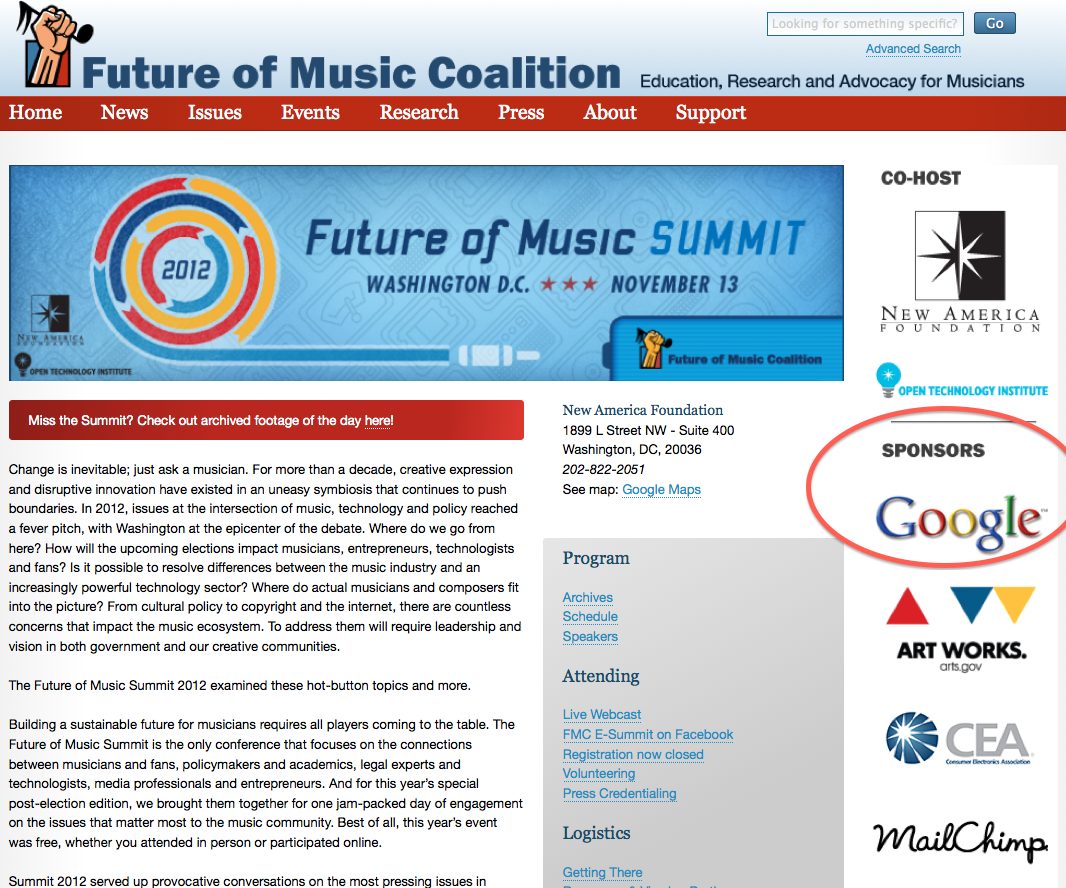
Google is listed as your first sponsor of your primary event.
http://futureofmusic.org/events/future-music-summit-2012

How much money do you get from Google?  Do you think you should be taking funding from a source many artists believe to be opposed to their interests?

FOMC Spondors

Trichordist Bookshelf – Essential Reading for Artists Rights

“WHO OWNS THE FUTURE” by JARON LANIER – BUY AT AMAZON:
http://www.amazon.com/Who-Owns-Future-Jaron-Lanier/dp/1451654960/

The Dazzling New Masterwork from the Prophet of Silicon Valley

Jaron Lanier is the bestselling author of You Are Not a Gadget, the father of virtual reality, and one of the most influential thinkers of our time. For decades, Lanier has drawn on his expertise and experience as a computer scientist, musician, and digital media pioneer to predict the revolutionary ways in which technology is transforming our culture.

Who Owns the Future? is a visionary reckoning with the effects network technologies have had on our economy. Lanier asserts that the rise of digital networks led our economy into recession and decimated the middle class. Now, as technology flattens more and more industries—from media to medicine to manufacturing—we are facing even greater challenges to employment and personal wealth.

But there is an alternative to allowing technology to own our future. In this ambitious and deeply humane book, Lanier charts the path toward a new information economy that will stabilize the middle class and allow it to grow. It is time for ordinary people to be rewarded for what they do and share on the web.

Insightful, original, and provocative, Who Owns the Future? is necessary reading for everyone who lives a part of their lives online.

“FREELOADING” by CHRIS RUEN – BUY AT AMAZON:
http://www.amazon.com/Freeloading-Insatiable-Content-Starves-Creativity/dp/1935928996

“A wonderful book that catches an encouraging shift in the zeitgeist. Ruen’s epiphany regarding the effects of his own piracy and freeloading of the bands he loves was eye opening.” – David Byrne

“Fascinating.” – The Village Voice

“The original slacker’s dream of free everything may have been realized by the Internet-but along with it came the slacker’s nightmare of never getting paid for one’s creativity. Freeloading seeks-and to a large extent succeeds-to wrestle with the collapse of the commons and the possibilities for a renewed social contract.” – Douglas Rushkoff

“Brooklyn’s Chris Ruen is one of the most compelling and forward thinking critics of our current download culture.” – M3 Music Conference, Netherlands

“A book…that promises to contribute greatly to copyright debates.” – Terry Hart, Copyhype

Author Chris Ruen, himself a former dedicated freeloader, came to understand how illegal downloads can threaten an entire artistic community after spending time with successful Brooklyn bands who had yet to make a significant profit on their popular music. The product of innumerable late-night, caffeine-fueled conversations and interviews with contemporary musicians such as Craig Finn of The Hold Steady, Ira Wolf Tuton of Yeasayer, and Kyp Malone of TV on the Radio, Freeloading not only dissects this ongoing battle-casting a critical eye on the famous SOPA protests and the attendant rhetoric-but proposes concise, practical solutions that would provide protection to artists and consumers alike.

“FREE RIDE” by ROBERT LEVINE – BUY AT AMAZON:
http://www.amazon.com/Free-Ride-Parasites-Destroying-Business/dp/0307739775

“A book that should change the debate about the future of culture….With this stylishly written and well-reported manifesto, Levine has become a leading voice on one side of our most hotly contested debate involving law and technology.”
—Jeffrey Rosen, The New York Times Book Review

“Turbo-reported….Free Ride is a timely and impressive book–part guilt trip, part wake-up call, and full of the kind of reporting that could only have been done with a book advance from an Old Media company.”
—Businessweek

“[A] smart, caustic tour of the modern culture industry.”
—Fortune

“Brilliant…A crash course in the existential problems facing the [media].”
—Richard Morrison, The Times

“The most convincing defense of the current predicament of the creative industries that I have read.”
—James Crabtree, Financial Times

“With penetrating analysis and insight, Levine, a former executive editor of Billboard magazine, dissects the current economic climate of the struggling American media companies caught in the powerful fiscal grip of the digital industry…. This incisive book is a start at an informed dialogue.”
—Publishers Weekly

“Can the culture business survive the digital age? That’s the burning question Robert Levine poses in his provocative new book. And his answer is one that will get your blood boiling. Rich with revealing stories and telling tales, Free Ride makes a lucid case that information is actually expensive – and that it’s only the big technology firms profiting most from the work of others that demand information be free.”
—Gary Rivlin, author of Broke, USA

“One of the great issues of the digital age is how people who create content will be able to make a living. Robert Levine’s timely and well-researched book provides a valuable look at how copyright protection was lost on the internet and offers suggestions about how it could be restored.”
—Walter Isaacson, President/CEO of the Aspen Institute and author of Benjamin Franklin

“This book thoroughly documents a wide-spread outbreak of cyber amnesia. Despite libertarian delusions, industries often get Free Rides, especially in their early days, but they eventually give back. Taxpayers build roads, then get hired to build cars. The Internet gives back a lot in exchange for its Free Ride, but one thing it defiantly isn’t giving back is a way for enough people to make a living. No matter how amusing or addictive the Internet becomes, its foundation will crumble unless it starts returning the favors it was given and still depends on.”
—Jaron Lanier, author of You Are Not a Gadget

“Free Ride is a brilliantly written book that exposes the dark side of the Internet. A must read for anyone interested in the horrific undermining of our intellectual culture.”
—Edward Jay Epstein, author of The Big Picture: Money and Power in Hollywood

“Robert Levine deftly dissects the self-serving Orwellian freedom-speak being served up by Silicon Valley’s digital new lords as they amass fortunes devaluing the work of artists, journalists and other old-fashioned ‘content creators.’ Free Ride begs us to remove our blinders and take a hard look down a cultural dead-end road.”
—Fred Goodman, author of Fortune’s Fool: Edgar Bronfman Jr., Warner Music, and an Industry in Crisis

“Without being a Luddite, Levine makes the phony digital media gurus of our day seem as simple-minded as their slogans.”
—Ron Rosenbaum, author of How the End Begins and Explaining Hitler

“YOU ARE NOT A GADGET” by JARON LANIER – BUY AT AMAZON:
http://www.amazon.com/You-Are-Not-Gadget-Manifesto/dp/0307389979

A NATIONAL BESTSELLER

A programmer, musician, and father of virtual reality technology, Jaron Lanier was a pioneer in digital media, and among the first to predict the revolutionary changes it would bring to our commerce and culture. Now, with the Web influencing virtually every aspect of our lives, he offers this provocative critique of how digital design is shaping society, for better and for worse.

Informed by Lanier’s experience and expertise as a computer scientist, You Are Not a Gadget discusses the technical and cultural problems that have unwittingly risen from programming choices—such as the nature of user identity—that were “locked-in” at the birth of digital media and considers what a future based on current design philosophies will bring. With the proliferation of social networks, cloud-based data storage systems, and Web 2.0 designs that elevate the “wisdom” of mobs and computer algorithms over the intelligence and wisdom of individuals, his message has never been more urgent.