@CMU and @billboard Cover the Songwriter Coalition and Opposition to Frozen Mechanicals

Complete Music Update in the UK picked up the story on the songwriter coalition letters to the Copyright Royalty Board that we have previously posted on Trichordist so you can read them in full. Read it here: Songwriter groups urge US Copyright Royalty Board to open submissions on proposed new mechanical royalty rate on discs and downloads. CMU makes this important point:

While the publishers and songwriters are generally of one mind when it comes to the streaming mechanical rates, plenty of organisations representing songwriters in the US and beyond are not happy with what the NMPA and NSAI are proposing regarding the rate for discs and downloads.

That is right on because you don’t have to be against the streaming royalty to be against frozen mechanicals on physical and downloads. Why? What David said:

It also looks like the songwriters coalition and the beginnings of press may have done the trick! Today the NMPA filed their motion to ask the CRB to adopt the frozen mechanicals. Which raises the question of if a willing buyer and a willing seller are the same person, does that equal a free market?

Filing the motion isn’t the end of the story or even the end of the beginning because they failed miserably to take into account the dissatisfaction with the whole idea of a frozen mechanical. AND the motion contains this sentence:

Concurrent with the settlement, the Joint Record Company Participants and NMPA have separately entered into a memorandum of understanding addressing certain negotiated licensing processes and late fee waivers.

That sounds like there’s a separate deal on the actual money. The motion doesn’t attach either the settlement or the side deal (which may be where the money is) just the draft changes to the royalty regulations that freezes the mechanical for the rubes. That kind of defeats the purpose of having a motion for public comment on a deal that the public doesn’t see. (And maybe not even the judges.)

Billboard also covered the songwriter coalition letters to CRB in Songwriter Groups Want Their Voices Heard on CRB Royalty Rate ASAP.

Everyone should appreciate the coalition for apparently prompting the motion (which was expected to have been filed back on May 18 according to the CRB letter). It remains to be seen if the motion is worth commenting on or is just more secret sauce. Maybe the CRB can get the right information on file so that songwriters know what’s going on and know what they are getting bound to.

Coalition of Songwriter Groups Ask CRB “Where’s the Motion?” on Insider Deal for Frozen Mechanicals

MCNA
NORTH AMERICA

May 24, 2021

Via Electronic Delivery

Chief Copyright Royalty Judge Jesse M. Feder
Copyright Royalty Judge David R. Strickler
Copyright Royalty Judge Steve Ruwe
US Copyright Royalty Board
101 Independence Ave SE / P.O. Box 70977
Washington, DC 20024-0977

To Your Honors:

Music Creators North American (MCNA) and its numerous organizational supporters noted below wish to express our sincere thanks for the immediate reply to our letter dated May 17, 2021, which we received from the Copyright Royalty Board on May 18, 2021.  As stated in our prior letter, we have had deep concerns regarding the proposed physical mechanical royalty rate settlement negotiated between the major record labels and their affiliated major music publishers (and the respective trade groups of each), and your assurances that all interested parties –including non-participating songwriters and composers– will have a chance to be heard on this matter prior to its disposition is very much appreciated.

Indeed, as previously noted, independent music creators and music publishers have not to our knowledge ever been contacted, let alone consulted, about a deal that will be binding on us and will ultimately have profound impact on our livelihoods.    Our community of songwriters and composers proudly speaks for itself on such matters, and we very much look forward to presenting our views concerning a “settlement” that in no way could have been negotiated at arm’s length through fair dealing—the process and result that ought to be the goal of all CRB proceedings.

In addition to expressing our appreciation for the opportunity to comment, however, we also write to respectfully seek clarification concerning certain details.  Specifically, in its May 18 response, the CRB stated that:

After the parties to the partial settlement file a motion to adopt [the] settlement, the Judges will publish the settlement in the Federal Register for comments by the participants in the proceeding and others who would be bound by the terms of the settlement.  We haven’t received that motion yet, but it is due today.

As the CRB is now aware, the parties did in fact file notice with the CRB later that day (May 18, 2021) indicating that the terms of the settlement they had now reached was identical to the terms set forth in their prior “Notice of Settlement in Principle” filed on March 2, 2021 (https://app.crb.gov/document/download/23825).  

The parties did not, however, file a motion asking the CRB to adopt the settlement as expected. 

We believe that this procedural omission (whether permissible or not) may well be calculated to delay and/or compromise the ability of the independent music creator and music publishing communities to file comments in a timely manner, and could result in irreparable harm to our ability to present our views and pose our questions, for example, if one or more of the settling parties subsequently withdraws from the proceeding.  Simply put, we believe the settling parties are seeking to stifle timely discussion and dissent through delay, a strategy which should be rejected as antithetical to due process.

Section 801 (b) (7) of the US Copyright Act provides that the CRB shall have the authority:

(A) To adopt as a basis for statutory terms and rates or as a basis for the distribution of statutory royalty payments, an agreement concerning such matters reached among some or all of the participants in a proceeding at any time during the proceeding, except that—

(i)

the Copyright Royalty Judges shall provide to those that would be bound by the terms, rates, or other determination set by any agreement in a proceeding to determine royalty rates an opportunity to comment on the agreement and shall provide to participants in the proceeding under section 803(b)(2) that would be bound by the terms, rates, or other determination set by the agreement an opportunity to comment on the agreement and  object to its adoption as a basis for statutory terms and rates; and

(ii)

the Copyright Royalty Judges may decline to adopt the agreement as a basis for statutory terms and rates for participants that are not parties to the agreement, if any participant described in clause (i) objects to the agreement and the Copyright Royalty Judges conclude, based on the record before them if one exists, that the agreement does not provide a reasonable basis for setting statutory terms or rates. (emphasis added)

Pursuant to such authority, we urge the CRB to determine that the filings submitted by the settling parties on May 18, 2021 affirmatively triggered the fairness and transparency provisions of section 801 (b) (7) (a) (i), and that in the interests of equity and of sound economic and legal policy clearly intended by Congress, those “who would be bound by the terms of the settlement” now be permitted to timely file comments approving of, objecting to, or seeking more precise detail concerning the terms.  Crucially, the plain language of the statute contemplates that every music creator in the world, living and dead, will be “bound” by the settlement of “participants” if adopted by the Board because the law will then impose the terms of that settlement on all songwriters and composers.  Section 801 (b) (7) is designed specifically to timely promote openness, inclusivity and clarity in that process.

We thank you for your continued attention to this issue, which is of crucial importance to the future economic health and survival of the US and global music creator community.

Respectfully submitted,

Rick Carnes                                                    Ashley Irwin

President, Songwriters Guild of America      President, Society of Composers and Lyricists

Officer, Music Creators North America         Co-Chair, Music Creators North America

List of Supporting Organizations

Songwriters Guild of America (SGA), https://www.songwritersguild.com/site/index.php

Society of Composers & Lyricists (SCL), https://thescl.com

Alliance for Women Film Composers (AWFC). https://theawfc.com

Songwriters Association of Canada (SAC), http://www.songwriters.ca

Screen Composers Guild of Canada (SCGC), https://screencomposers.ca

Music Answers (M.A.), https://www.musicanswers.org 

Music Creators North America (MCNA), https://www.musiccreatorsna.org


cc: Ms. Carla Hayden, US Librarian of Congress

      Ms. Shira Perlmutter, US Register of Copyrights

      Mr. Alfons Karabuda, President, International Music Council

      Mr. Eddie Schwartz, President, MCNA and International Council of Music Creators (CIAM)

      The MCNA Board of Directors

      The Members of the US Senate and House Sub-Committees on Intellectual Property

      Charles J. Sanders, Esq.

      Alliance of Latin American Composers & Authors (AlcaMusica) https://www.alcamusica.org

      Asia-Pacific Music Creators Alliance (APMA), https://apmaciam.wixsite.com/home/news  

      European Composers and Songwriters Alliance (ECSA), https://composeralliance.org

      Pan-African Composers and Songwriters Alliance (PACSA), http://www.pacsa.org

@theBlakeMorgan Joins the List Opposing Frozen Mechanicals at the Copyright Royalty Board #irespectmusic

Blake Morgan songwriter, publisher, producer and label owner, two-time U.S. Supreme Court amicus, founder of the #irespectmusic campaign and relentless artist rights advocate joins the list opposing frozen mechanicals on vinyl and physical. “This is about so many things, but we simply must fight to keep digging out from a 68 year injustice. Big thanks to the inspirational Abby North for standing up for fairness and transparency!”

BlakeIRespectMusic

Against Frozen MechanicalsSupporting Frozen Mechanicals
Songwriters Guild of AmericaNational Music Publishers Association
Society of Composers and LyricistsNashville Songwriters Association International
Alliance for Women Film Composers 
Songwriters Association of Canada 
Screen Composers Guild of Canada 
Music Creators North America 
Music Answers 
Alliance of Latin American Composers & Authors 
Asia-Pacific Music Creators Alliance 
European Composers and Songwriters Alliance 
Pan African Composers and Songwriters Alliance 
North Music Group 
Blake Morgan 

@NorthMusicGroup Joins the List Opposing Frozen Mechanicals With the Copyright Royalty Board

We’ve been keeping track of those who are for freezing the statutory mechanical royalty rate for physical and permanent downloads for another five years out to 2027. The issue is currently part of the rate setting proceeding before the Copyright Royalty Board–which froze the same rate at 9.1¢ in 2006 and was first extended in 2009.

Frozen Mechanicals

Here is the current list of those for and against freezing mechanicals on these categories for a total of 21 years:

Against Frozen MechanicalsSupporting Frozen Mechanicals
Songwriters Guild of AmericaNational Music Publishers Association
Society of Composers and LyricistsNashville Songwriters Association International
Alliance for Women Film Composers 
Songwriters Association of Canada 
Screen Composers Guild of Canada 
Music Creators North America 
Music Answers 
Alliance of Latin American Composers & Authors 
Asia-Pacific Music Creators Alliance 
European Composers and Songwriters Alliance 
Pan African Composers and Songwriters Alliance 
North Music Group 

Copyright Royalty Board Responds to Coalition of Songwriter Groups on Frozen Mechanicals

A group of songwriter organizations from around the world wrote to the Copyright Royalty Board last week opposing a proposed private “settlement” between the major labels and the major publishers to freeze mechanical rates on physical and downloads at the 9.1¢ 2006 rate that was filed in the current Copyright Royalty Board (CRB) rate court hearing called “Phonorecords IV”. (You can find the entire list of filings in the case here.)

The twist here is that if the CRB approves the private settlement at the request of “the parties” and doesn’t take into account the views and evidence of people who actually write songs and have to earn a living from songwriting, it will be grotesquely unfair and possibly unconstitutional wage and price control. The CRB will have frozen the mechanical rate for physical and downloads at the 2006 rate when inflation alone has eaten away the buying power of that royalty by approximately 30%. This would be like the Minerals Management Service adopting a settlement written by Exxon.

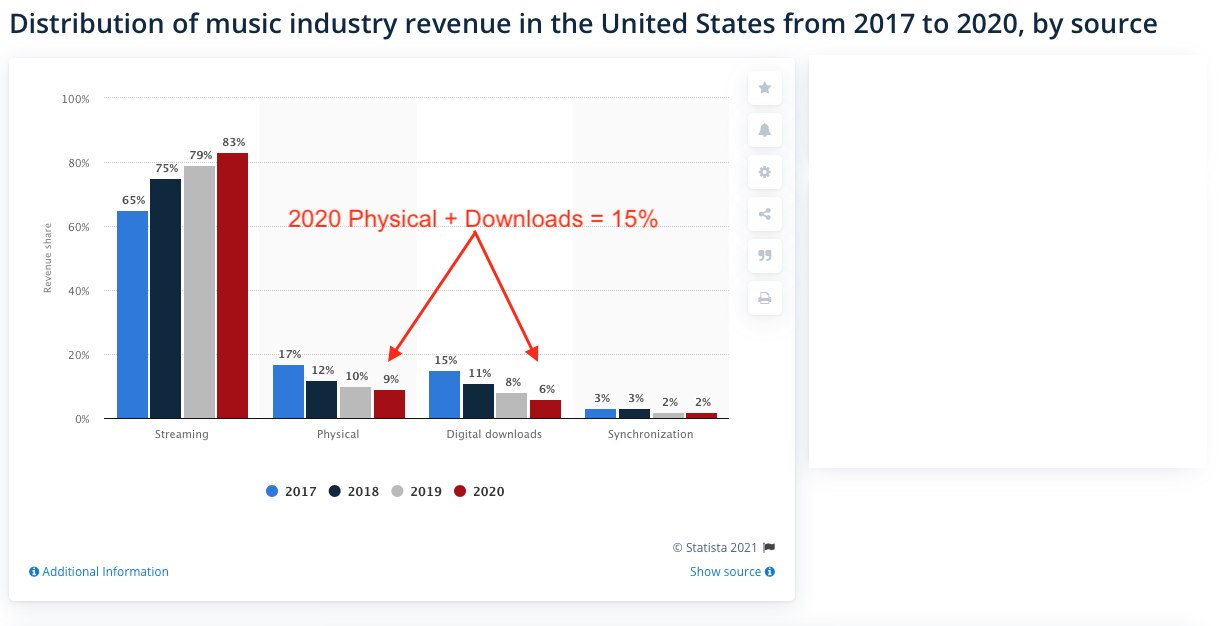
On average–on average–the physical and download configuration make up 15% of billing for the majors and for some artists vinyl is a welcome change from fractions of a penny on streaming. And then there’s Record Store Day–hello? These are a couple of the many reasons anyone who is paying attention should reject the terms of the settlement.

US Revenue by Source 2020

The Coalition had a simple ask: Let the public comment:

In the interests of justice and fairness, we respectfully implore the CRB to adopt and publicize a period and opportunity for public comment on the record in these and other proceedings,especially in regard to so-called proposed “industry settlements” in which creators and other interested parties have had no opportunity to meaningfully participate prior to their presentation to the CRB for consideration, modification or rejection. In the present case, hundreds of millions of dollars of our future royalties remain at stake, even in a diminished market for traditional, mechanical uses of music. To preclude our ability to comment on proposals that ultimately impact our incomes, our careers, and our families, simply isn’t fair.

The Copyright Royalty Board responded! According to our sources, the Copyright Royalty Board said that they would publish the private settlement in the Federal Register and give the pubic the chance to comment. This is great news!

But we will see what they actually do. The Copyright Royalty Board does not have a great track record in understanding songwriter interests in raising the mechanical rates as we can see in this except from their final rule freezing mechanicals again in 2009:

Copyright Owners’ argument with respect to this objective is that songwriters and music publishers rely on mechanical royalties and both have suffered from the decline in mechanical income. Under the current rate, they contend, songwriters have difficulty supporting themselves and their families. As one songwriter witness explained, “The vast majority of professional songwriters live a perilous existence.” [Rick] Carnes [Testimony] at 3. [Rick Carnes signed the Coalition letter as President of the Songwriters Guild of America.] We acknowledge that the songwriting occupation is financially tenuous for many songwriters. However, the reasons for this are many and include the inability of a songwriter to continue to generate revenue-producing songs, competing obligations both professional and personal, the current structure of the music industry, and piracy. The mechanical rates alone neither can nor should seek to address all of these issues.

We simply do not accept that the Founders put the Copyright Clause in the Constitution so creators could have a side hustle for their Uber driving which is exactly where frozen mechanicals take you, particularly after the structural unemployment in the music business caused by the COVID lockdowns.

Here is a summary of who is for and who is against frozen mechanicals.

Against Frozen MechanicalsProposing Frozen Mechanicals
Songwriters Guild of AmericaNational Music Publishers Association
Society of Composers and LyricistsNashville Songwriters Association International
Alliance for Women Film Composers 
Songwriters Association of Canada 
Screen Composers Guild of Canada 
Music Creators North America 
Music Answers 
Alliance of Latin American Composers & Authors 
Asia-Pacific Music Creators Alliance 
European Composers and Songwriters Alliance 
Pan African Composers and Songwriters Alliance 

Which side are you on? If you want to write your own comment to the Copyright Royalty Board about frozen mechanicals, send your comment to crb@loc.gov

Coalition of Songwriter Groups Call on Copyright Royalty Board for Fairness and Transparency on Frozen Mechanicals

[Editor T says this is a letter from a coalition of US and international songwriter groups to the Copyright Royalty Board about the frozen mechanical issue. If you want to write your own comment to the Copyright Royalty Board about frozen mechanicals, send your comment to crb@loc.gov]

MUSIC CREATORS
NORTH AMERICA

May 17, 2021

Via Electronic Delivery

Chief Copyright Royalty Judge Jesse M. Feder
Copyright Royalty Judge David R. Strickler
Copyright Royalty Judge Steve Ruwe
US Copyright Royalty Board
101 Independence Ave SE / P.O. Box 70977
Washington, DC 20024-0977

To Your Honors:

As a US-led coalition representing hundreds of thousands of songwriters and composers from across the United States and around the world, we are writing today to express our deep concerns over the “Notice of Settlement in Principle” recently filed by parties to the proceedings before the Copyright Royalty Board concerning its Determination of Royalty Rates and Terms for Making and Distributing Phonorecords (Phonorecords IV) (Docket No. 21–CRB–0001–PR<(2023–2027)). For reasons explained below, several highly conflicted parties to this proceeding have apparently agreed to propose a rolling forward to the year 2027 of the current US statutory mechanical royalty rate for the use of musical compositions in the manufacture and sale of physical phonorecords (such as CDs and vinyl records). This proposal (and related industry agreements yet to be disclosed by the parties— see, https://app.crb.gov/document/download/23825) should neither be acted upon nor accepted by the CRB without the opportunity for public comment, especially by members of the broad community of music creators for whom it is financially unfeasible to participate in these proceedings as interested parties. It is our livelihoods that are at stake, and we respectfully ask to be heard even though we lack the economic means to appear formally as parties. If procedures are already in place to accommodate this request, we look forward receiving the CRB’s instructions as to how to proceed.

The current U.S statutory mechanical rate for physical phonorecords is 9.1 cents per musical composition for each copy manufactured and distributed. That rate has been in effect since January 1, 2006. It represents the high-water mark for US mechanical royalty rates applicable to physical products, a rate first established in 1909 at 2 cents. That 2-cent royalty rate, in one of the most damaging and egregious acts in music industry history, remained unchanged for an astonishing period of sixty-nine years, until 1978. Nevertheless, the recording industry now seeks  to repeat that history by freezing the 9.1 cent rate for an era that will have exceeded twenty years by the end of the Phonorecords IV statutory rate setting period.

Inflation has already devalued the 9.1 cent rate by approximately one third. By 2027, 9.1 cents may be worth less than half of what it was in 2006. How can the US music publishing industry’s trade association, and a single music creator organization (which represents at most only a tiny sliver of the music creator community) have agreed to such a proposal?

The answer to that question is an easy one to surmise. The three major record companies who negotiated the deal on one side of the table have the same corporate parents as the most powerful members of the music publishing community ostensibly sitting on the other side of the table. Songwriter, composer and independent music publisher interests in these “negotiations” were given little if any consideration, and the proposed settlement was clearly framed without any meaningful consultation with the wider independent music creator and music publishing communities, both domestically and internationally.

How on earth can these parties be relied upon to present a carefully reasoned, arms-length “Settlement in Principle” proposal to the CRB under such circumstances, fraught as they are with conflicts of interest, without at least an opportunity for public comment? Further, how can these parties be relied upon in the future to argue persuasively that mechanical royalty rates applicable to on-demand digital distribution need to be increased as a matter of economic fairness (which they most certainly should be), when they refuse to seriously conduct negotiations on rates applicable to the physical product the distribution of which is still controlled by record companies (who not so incidentally also receive the lion’s share of music industry revenue generated by digital distribution of music)?

The ugly precedent of frozen mechanical royalty rates on physical product has, in fact, already served as the basis for freezing permanent digital download royalty rates since 2006. Is this the transparency and level playing field the community of songwriters and composers have been promised by Congress through legislation enacted pursuant to Article I, Section 8 of the Constitution?

The trade association for the US music publishing industry is supported by the dues of its music publisher members, the costs of which are often in large part passed along to the music creators affiliated with such publishers. It is thus mainly the songwriter and composer community that pays for the activities of that publisher trade association, a reality that has existed since that organization’s inception. Still, the genuine voice of those songwriters and composers is neither being sought nor heard. Further in that regard, we wish to make it emphatically clear that regardless of how the music publishing industry and its affiliated trade associations may present themselves, they do not speak for the interests of music creators, and regularly adopt positions that are in conflict with the welfare of songwriters and composers. Their voice is not synonymous with ours.

Unfortunately, the music creator community lacks the independent financial resources –in the age of continuing undervaluation of rights, rampant digital piracy and pandemic-related losses–to rectify these inequities by expending millions more dollars to achieve full participation in CRB legal and rate-setting proceedings. Clearly, such an inequitable situation is antithetical to sound Governmental oversight in pursuit of honest and equitable policies and results.

In the interests of justice and fairness, we respectfully implore the CRB to adopt and publicize a period and opportunity for public comment on the record in these and other proceedings,especially in regard to so-called proposed “industry settlements” in which creators and other interested parties have had no opportunity to meaningfully participate prior to their presentation to the CRB for consideration, modification or rejection. In the present case, hundreds of millions of dollars of our future royalties remain at stake, even in a diminished market for traditional, mechanical uses of music. To preclude our ability to comment on proposals that ultimately impact our incomes, our careers, and our families, simply isn’t fair.

Finally, we request that this letter be made a part of the public record of the Phonorecords IV
proceedings. We extend our sincere thanks for your attention to this very difficult conundrum
for music creators, and further note that your consideration is very much appreciated.

Respectfully submitted,

Rick Carnes
President, Songwriters Guild of America

Ashley Irwin
President, Society of Composers and Lyricists
Officer, Music Creators North America Co-Chair, Music Creators North America

List of Supporting Organizations
Songwriters Guild of America (SGA), https://www.songwritersguild.com/site/index.php
Society of Composers & Lyricists (SCL), https://thescl.com
Alliance for Women Film Composers (AWFC). https://theawfc.com
Songwriters Association of Canada (SAC), http://www.songwriters.ca
Screen Composers Guild of Canada (SCGC), https://screencomposers.ca
Music Creators North America (MCNA), https://www.musiccreatorsna.org
Music Answers (M.A.), https://www.musicanswers.org
Alliance of Latin American Composers & Authors (ALCAMusica), https://www.alcamusica.org
Asia-Pacific Music Creators Alliance (APMA), https://apmaciam.wixsite.com/home/news
European Composers and Songwriters Alliance (ECSA), https://composeralliance.org
Pan-African Composers and Songwriters Alliance (PACSA), http://www.pacsa.org

cc: Ms. Carla Hayden, US Librarian of Congress
Ms. Shira Perlmutter, US Register of Copyrights
Mr. Alfons Karabuda, President, International Music Council
Mr. Eddie Schwartz, President, MCNA and International Council of Music Creators (CIAM)
The MCNA Board of Directors
The Members of the US Senate and House Sub-Committees on Intellectual Property
Charles J. Sanders, Esq.

Open Letter: Dozens of Artists, Musicians and Songwriters Seek Referral to UK Regulators to Oversee Streaming Royalties

[A bit of context: With all the riches being made from streaming, session musicians and vocalists make zero. And don’t forget that music made Daniel Ek a billionaire.]

Broken Record Campaign

Ivors Academy

Musicians Union

April 20, 2021

The Rt Hon Boris Johnson MP
Prime Minister
10 Downing Street
W1A 2AA

Dear Prime Minister,

We write to you on behalf of today’s generation of artists, musicians and songwriters here in the UK.

For too long, streaming platforms, record labels and other internet giants have exploited performers and creators without rewarding them fairly.  We must put the value of music back where it belongs – in the hands of music makers.

Streaming is quickly replacing radio as our main means of music communication. However, the law has not kept up with the pace of technological change and, as a result, performers and songwriters do not enjoy the same protections as they do in radio.

Today’s musicians receive very little income from their performances – most featured artists receive tiny fractions of a US cent per stream and session musicians receive nothing at all.

To remedy this, only two words need to change in the 1988 Copyright, Designs and Patents Act. This will modernise the law so that today’s performers receive a share of revenues, just like they enjoy in radio. It won’t cost the taxpayer a penny but will put more money in the pockets of UK taxpayers and raise revenues for public services like the NHS.

There is evidence of multinational corporations wielding extraordinary power and songwriters struggling as a result. An immediate government referral to the Competition and Markets Authority is the first step to address this. Songwriters earn 50% of radio revenues, but only 15% in streaming. We believe that in a truly free market the song will achieve greater value.

Ultimately though, we need a regulator to ensure the lawful and fair treatment of music makers. The UK has a proud history of protecting its producers, entrepreneurs and inventors. We believe British creators deserve the same protections as other industries whose work is devalued when exploited as a loss-leader.

By addressing these problems, we will make the UK the best place in the world to be a musician or a songwriter, allow recording studios and the UK session scene to thrive once again, strengthen our world leading cultural sector, allow the market for recorded music to flourish for listeners and creators, and unearth a new generation of talent.

We urge you to take these forward and ensure the music industry is part of your levelling-up agenda as we kickstart the post-Covid economic recovery.

Yours Sincerely,

Damon Albarn OBE

Lily Allen

Wolf Alice

Marc Almond OBE

Joan Armatrading CBE

David Arnold

Massive Attack

Jazzie B OBE

Adam Bainbridge (Kindness)

Emily Barker

Gary Barlow OBE

Geoff Barrow

Django Bates

Brian Bennett OBE

Fiona Bevan

Aflie Boe OBE

Billy Bragg

The Chemical Brothers

Kate Bush CBE

Melanie C

Eliza Carthy MBE

Martin Carthy MBE

Celeste

Guy Chambers

Mike Batt LVO

Don Black OBE 

Badly Drawn Boy

Chrissy Boy

Tim Burgess

Mairéad Carlin

Laura-Mary Carter

Nicky Chinn

Dame Sarah Connolly DBE

Phil Coulter 

Roger Daltrey CBE

Catherine Anne Davies (The Anchoress)

Ian Devaney

Chris Difford

Al Doyle

Anne Dudley

Brian Eno

Self Esteem

James Fagan

Paloma Faith

Marianne Faithfull

George Fenton

Rebecca Ferguson

Robert Fripp

Shy FX

Gabrielle

Peter Gabriel

Noel Gallagher

Guy Garvey

Bob Geldof KBE

Boy George

David Gilmour CBE

Nigel Godrich

Howard Goodall CBE

Jimi Goodwin

Graham Gouldman 

Tom Gray

Roger Greenaway OBE

Will Gregory

Ed Harcourt

Tony Hatch OBE

Richard Hawley

Justin Hayward

Fran Healy

Orlando Higginbottom

Jools Holland OBE, DL

Mick Hucknall

Crispin Hunt

Shabaka Hutchings

Eric Idle

John Paul Jones

Julian Joseph OBE

Kano

Linton Kwesi Johnson

Gary Kemp

Nancy Kerr

Richard Kerr

Soweto Kinch

Beverley Knight MBE

Mark Knopfler OBE

Annie Lennox OBE

Shaznay Lewis

Gary Lightbody OBE

Tasmin Little OBE

Calum MacColl

Roots Manuva

Laura Marling

Johnny Marr

Chris Martin

Claire Martin OBE

Cerys Matthews MBE

Sir Paul McCartney CH MBE

Horse McDonald

Thurston Moore

Gary “Mani” Mounfield

Mitch Murray CBE 

Field Music

Frank Musker 

Laura Mvula

Kate Nash

Stevie Nicks

Orbital

Roland Orzabal

Gary Osborne 

Jimmy Page OBE

Hannah Peel

Daniel Pemberton

Yannis Philippakis

Anna Phoebe

Phil Pickett 

Robert Plant CBE

Karine Polwart

Emily Portman

Chris Rea

Eddi Reader MBE

Sir Tim Rice 

Orphy Robinson MBE

Matthew Rose

Nitin Sawhney CBE

Anil Sebastian

Peggy Seeger

Nadine Shah

Feargal Sharkey OBE

Shura

Labi Siffre

Martin Simpson

Skin

Mike Skinner

Curt Smith

Fraser T Smith

Robert Smith

Sharleen Spiteri

Lisa Stansfield

Sting CBE

Suggs

Tony Swain 

Heidi Talbot

John Taylor

Phil Thornalley 

KT Tunstall

Ruby Turner MBE

Becky Unthank

Norma Waterson MBE

Cleveland Watkiss MBE

Jessie Ware

Bruce Welch OBE

Kitty Whately

Ricky Wilde

Olivia Williams

Daniel “Woody” Woodgate

Midge Ure OBE

Nikki Yeoh

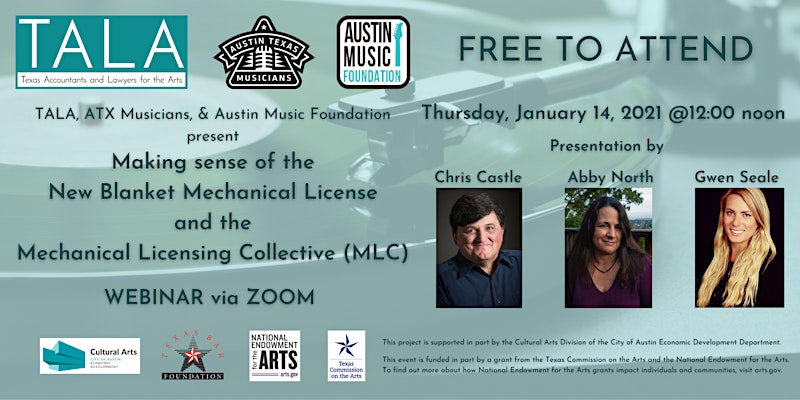
Save the Date! January 14 at Noon CST, Zoom Panel with @musictechpolicy @northmusicgroup @sealeinthedeal for Independent Songwriters

This image has an empty alt attribute; its file name is https%3A%2F%2Fcdn.evbuc.com%2Fimages%2F122288515%2F87998774455%2F1%2Foriginal.20210105-173522

By Chris Castle

I’m grateful to Texas Accountants and Lawyers for the Arts, Austin Texas Musicians and the Austin Music Foundation for hosting an information webinar next week on the impact of the new blanket mechanical license under the Music Modernization Act on independent songwriters. We will also cover the nuts and bolts of dealing with The MLC, Inc. and a unit on the Digital Licensee Coordinator.

I couldn’t be happier to have two great panelists in music publisher and song data solver Abby North and my fellow Austin music lawyer Gwen Seale.

While this panel has an Austin origin, the topics are not Austin-centric and will apply to all songwriters in the world just like the MLC does.

Please RSVP to Eventbrite if you think you might attend at this link and also take a moment to complete the anonymous 10 question MLC Awareness Questionnaire on Survey Monkey at this link. The Zoom code to join will be posted through Eventbrite.

I’ll be posting some other materials, but for those who want the more nitty gritty background, you can read this package of documents at this link.

#ShowUsTheMoney: Guest Post: @CopyrightOffice Regulates the @MLC_US: Selected Public Comments on MLC Transparency: Chris Castle

[This is an except from Chris Castle‘s June 7 comment to the Copyright Office regarding the transparency of The MLC. You can read the entire comment here. Although The MLC has launched its “Data Quality Initiative” to great fanfare, that DQI process merely confirms how bad the HFA database is since there still is no MLC database as required by law. Since there’s no indication of when The MLC is going to launch and there is a strong indication that nobody in power is doing anything about it (looking at you, Copyright Office), this is a particularly timely excerpt. Remember you heard it here first if your mechanical royalty statements drop to zero once The MLC takes over on January 1. That is 113 days from today and we have yet to seen a thing from The MLC and we have no promise of when we will see anything. Given that there has been zero investigative journalism on this topic from industry outlets aside from “how does The MLC withstand its own awesomeness” the comments that we are serializing are about all you’re going to get in the way of transparency.]

Quality Control of The MLC’s Operations and Platforms

There is an immediate need for The MLC to demonstrate that its systems actually work.  That need will be ongoing, so it would be well for the Office to promulgate regulations requiring a periodic public demonstration of the operability of The MLCs systems, a frequent public disclosure of bugs and bug fixes, and a frequent public disclosure of any missed payments or other glitches.  These matters are appropriate for the transparency of The MLC because if either The MLC or another MLC are not required to disclose these items, no one may ever know there was a problem (but see the discussion of whistleblowers below).

In considering the timing, I would caution the Office against thinking in years rather than weeks.  There is a tendency to think about these things in annual or more time periods.  This will prove to be a mistake given the scale and volume of transactions.  Would you tell Visa it only need to confirm the integrity of its fraud detection systems once every three years?  Or should it be more frequently?  Financial services is a good corollary for streaming mechanicals, with the exception that the royalty payable for each stream starts several decimal places to the right unlike credit card transactions.

There is an immediate need for this transparency.  Recall that MLC executive Richard Thompson said at the Copyright Office panel on unclaimed royalties last December, “[A] lot of the time since July has been spent working very closely with the staff at HFA and ConsenSys, really starting to nail down how all of this is going to work at the, you know, lowest operational level, all of the things that we need to work out.”  (Referencing the July 8, 2019 designation of The MLC as the MLC.) [1]   

Of course, The MLC didn’t announce the selection of HFA and ConsenSys until November 26, 2019[2] and was evidently still interviewing vendors up to that date.  Even so, I’m sure The MLC has been hard at work on developing their platform.

Mr. Thompson also stated at the December 2019 panel:

So our current timeline has the first version of the portal going live late Q2, early Q3, of next year [i.e., 2020]. I emphasize again that is the first version. That will not be functionally complete. It will have the, you know, the first set of functionality that we want to make available to the rightsholder community. So in particular, sort of, being able to look at your catalog, manage your catalog.[3]

Late Q2 to early Q3 is now.  [As of this post, it is the end of Q3 and we still have nothing but Mr. Thompson still has a job.] To my knowledge, The MLC has made nothing available for songwriters to know what is going on at The MLC or how to start registering works. 

Mr. Thompson also stated:

“You know, the first version of the portal doesn’t have statementing on it, because we won’t need statementing until 2021, you know, the first quarter of 2021.”[4]

I would respectfully ask the Office to determine what happens if The MLC is not able to render statements on time.  Presumably the income from streaming mechanicals that had been paid by the services directly to songwriters or music publishers would be transferred over to The MLC as of the License Availability Date (currently January 1, 2021).  If that transfer occurs and The MLC is not then ready for “statementing” (or, presumably, its corollary, “paymenting”) for the billions if not trillions of streaming transactions for all the world’s music in less than a year’s time from today, then streaming mechanical royalties could drop to zero until The MLC could handle both statementing and paymenting.[5]

While Mr. Thompson seems to be focused on the Q1 2021 distribution date for royalties payable in the normal course, the other significant statementing and paymenting date is July 1, 2021 when the first unmatched distribution is to be paid under Title I.  There are also the obvious and expressly stated “public notice of unclaimed royalties” reporting requirements for The MLC’s public facing website listing all unmatched songs (or shares of songs) and publicity efforts for the unmatched.[6]  This provision, too, is glitchy, but  presumably will come into effect soon.  I realize there may be some side deals cut regarding extending that statutory payment date, but it would at least be a confidence building exercise to know that The MLC could make the unmatched payment as of the statutory date if called upon to do so. 

Songwriters have very little visibility into The MLC’s operations except what came out at the Copyright Office panels, for which I am grateful, and also various interviews.  There is little substantive information in the press, and even less on The MLC’s website.  Therefore, it would be very helpful if the Office could require The MLC to demonstrate to the public how its platform is to function.  Such a demonstration might bring helpful suggestions from their peers or the ex-US CMOs that have been operating for decades.

It would also be helpful if the Office promulgated a bright line regulation that told songwriters around the world if the July 1, 2021 goal posts have moved and if so where they have been moved to.  I must say I have somewhat lost the page on this, given former Register Temple’s last testimony to the House Judiciary Committee about who has agreed what on delaying distribution.  This rulemaking would be a great opportunity to tell the world if and how the insiders have decided to change the law.

As the House Judiciary Committee stated:

Testimony provided by Jim Griffin at the June 10, 2014 Committee hearing highlighted the need for more robust metadata to accompany the payment and distribution of music royalties….In an era in which Americans can buy millions of products via an app on their phone based upon the UPC code on the product, the failure of the music industry to develop and maintain a master database has led to significant litigation and underpaid royalties for decades. The Committee believes that this must end so that all artists are paid for their creations and that so-called ‘‘black box’’ revenue is not a drain on the success of the entire industry.[7]

Having accomplished their goal through compulsory legislation, we are all watching the database cadre get to work and looking forward to learning how it is done from their teaching.

Alternatively, as is widely suspected among some songwriters I have spoken to, The MLC might rely on HFA’s statementing and paymenting functionality to limp along by sending necessary but not sufficient statements to HFA publishers or publishers that HFA can match.  This would be, essentially, the same process that got a couple of HFA’s licensing clients sued repeatedly, and ironically led to the Title I safe harbor in the first place. 

Absent proper transparency in the runup to the License Availability Date, any sudden drop in revenue would catch songwriters by surprise.  In the time of the pandemic, such a sudden contraction of income could be even more devastating than usual.[8]

Transparency would help shine sunlight on that problem.  While The MLC may give interviews and appear on panels describing their activities, we should remember the words of the great Bruin John Wooden who cautioned that we should not mistake activity for achievement.  If you practice free throws by yourself all weekend, it doesn’t mean you’ll be a better player with the team at Monday practice—or that the team is any more likely to win when it is game time at Pauley on Saturday.


[1] Transcript, United States Copyright Office Unclaimed Royalties Study Kickoff Symposium (Dec. 6, 2019) at 28 ln 15 hereafter “Kickoff Transcript”.

[2] Tatania Cirisano, Mechanical Licensing Collective Selects Leadership, Partners for Copyright Database, Billboard (November 26, 2019).

[3] Kickoff Transcript at 40 ln 2.

[4] Kickoff Transcript at 40-41.

[5] It is well to note that such a contraction probably would not affect direct licenses or HFA’s modified compulsory licenses.

[6] 17 U.S.C. § 115 (d)(3)(J)(iii).

[7] House Report at 8.

[8] Songwriters are already expecting lower royalties in January 2021 according to BMI’s President and CEO Mike O’Neil: “[We] anticipate an impact in January 2021, when today’s performances and corresponding licensing dollars (2nd quarter 2020) will be reflected in your royalty distributions. While you may see a lower distribution that quarter than you might typically receive under ordinary circumstances, given BMI’s business model, we have the time and ability to plan for this outcome.” A Message from Mike O’Neil, BMI.com (April 7, 2020) available at https://www.bmi.com/news/entry/a-message-from-bmi-president-ceo-mike-oneill-regarding-royalty-payments