Pandora’s Publicity Stunt: Pandora bought South Dakota terrestrial radio station minus the broadcast license.
Back in June of 2013 Pandoras Associate Chief Counsel Chris Harrison (Songwriter Enemy #1) wrote an article for The Hill that implied that Pandora had purchased a radio station in South Dakota. The idea was that they were somehow now equivalent to Clear Channel and deserved the same percentage of revenue deal for sound recordings that Clear Channel receives. Never mind that much of Clear Channel’s content IS NOT MUSIC and terrestrial broadcast has enormous capital costs so percentages of revenues are not comparable. THE REAL PROBLEM and why this is misleading is that Pandora did not own the broadcast license of this station. Transfer of this license requires FCC approval and as far as we can tell it appears Pandora had not even filed for transfer of this license at the time of this announcement (we could be wrong but we can’t find evidence, glad to correct if we are wrong). Do you really own a radio station without a broadcast license? It’s not really clear what it is that Pandora actually purchased.
A year later this broadcast license is not in the hands of Pandora. And indeed the foxes in the henhouse over at the FCC (much to our surprise) rejected Pandora’s license. There is a rule that a company must demonstrate it has less than 25% foreign ownership to own a radio station broadcast license and Pandora could not demonstrate this. However silly this rule may be, it’s still a rule, and Chris Harrison as an attorney with long experience in radio surely knew this. Right? So shouldn’t Congress and the SEC ask Pandora and Harrison if they intentionally misled Congress and investors?
Maybe they didn’t mislead investors and they really didn’t understand the requirements for purchasing a broadcast license. But this implies that the top legal staff of Pandora is incompetent. What does that say to investors?
Informal Trichordist poll calls Chris Harrison Songwriter Enemy #1. Here’s some reasons why songwriters feel this way about Pandora’s litigator in chief.
We don’t know quite why, but Pandora seems to have put Tim Westergren on ice. If we had to guess, we’d guess that this is because Westergren has served his purpose to the corporate overseers at Pandora. You know, you’ve done good job, Tim, we’ll take it from here.
Tim’s made bank on his project, we figure he’s closing in on $20 million or so. Pandora is sitting on top of about $200 million in cash. The corporate overseers gave the old management team a chance to get their numbers up the old fashioned way—screw the artists and songwriters. This artist friendly crap is over. Tim Westergren, Joe Kennedy, etc., got iced. The big dogs want the real cold blooded types now because they’re gonna get their money. And the shirts off our backs.
Enter Christopher Harrison. You may not have noticed him until recently, but he’s now firmly in charge of the artist screwing crew. Our bet is that he’ll do what the Wall Street overseers want every time like a good boy and roll over for the tummy scratch and a big green bone in his mouth—cash or stock. For whatever reason, from what we can tell he’s had a big one for creative types for a long time, especially songwriters and most particularly ASCAP.
The rumor is that this started when Harrison was at the DMX background music service. The story goes that he got the company to partner up with Music Reports (you’ve probably gotten a few thousand NOIs from them along with penny checks) to try to make an end run around the songwriter PROs. DMX—apparently led by Harrison—went out to make direct deals with publishers. The rumor is that they went to a big publisher and paid them money under an NDA to get them to give a low rate. Then they supposedly told a bunch of other songwriters and publishers what the rate was and convinced them to take most favored nations on the rates, but left out the part about the up front money. Some people might call this lying.
Then the rumor is that Harrison took the direct deals to the rate courts and showed them as evidence of a “free market rate” and the rate court Song Czars forced the PROs to take the chump MFN rate on all the songs that DMX didn’t have direct deals with, thus rat stumping all songwriters, including foreign writers.
Pretty slick!
Since the DOJ supervises pretty much anything to do with Songwriters it’s mighty mighty curious they have never investigated this.
So if you’re a corporate overseer at Pandora and want to find someone whose really got a major big one for songwriters and artists, Harrison has to be on your short list. He’s already made his bones. If the rumors are true.
And if you look at the last Congressional hearing where Pandora appeared, guess whose bright and shiny…face…showed up at the witness table. And he you can tell he. Just. Loves. It.
He’s a serial songwriter stumper. Songwriter enemy Number 1. Can’t you just see him rolling over and barking for the corporate overseers to throw him a bone?
Other notable outrages committed by Pandora under Chris Harrison
– This addendum compiled by David Lowery
*Apparently colluded with Sirius and Clear Channel to stop paying royalties to legacy artists with pre-1972 recordings. The bizarre rationale simultaneously taken by all these companies is that there is no copyright for pre 1972 recordings. ( Where is DOJ on this collusion?) As a result Pandora will pay no royalties to civil rights icons The Freedom Singers.
The revolution will be webcast but performers won’t be paid.
Write Pandora and ask them why they are doing this: investor@pandora.com and pandora-press@pandora.com. Institutions should consider the moral implications of investing pension funds in this company.
* Under Chris Harrison’s leadership Pandora has repeatedly sued songwriters. These suits have cost songwriters at least 10 million dollars in legal fees.. It likely cost the US Taxpayers and Pandora just as much. This was all so Pandora and Chris Harrison could save $4 million dollars in 2013.. These suits are so cost ineffective you have to wonder if Pandora is simply doing this to pump up their stock price. Fake good news for the wall street stock analysts that are pedaling this crap to little old ladies and pension funds? You need buyers when all the top executives are selling tens of millions of dollars of stock each year while the company is hemorrhaging money. I am not a lawyer but where is the SEC investigation of this?
* Pandora may have pretended to buy a South Dakota radio station and trumpeted this to stock analysts and the US Congress as a way to lower payments to performers. The problem is we have been unable to find any evidence that Pandora actually owns this station. If you have contrary evidence please send it to us. We are stumped. If it turns out Pandora did not buy this station they should be investigated for all manner of fraud.
* Under Chris Harrison’s direction Pandora pushed the Orwellian named Internet Radio Fairness Act. I say Orwellian named because it claimed to level the playing field for internet broadcasters to compete with terrestrial broadcasters like Clear Channel. Yet Clear Channel supported the bill. How does that work. In truth it would have slashed digital royalties owed to performers by as much as %85 percent for Clear Channels on their web simulcasts. False and misleading statements again. How do the feds let these guys get away with this over and over again? Especially since this was trumpeted to stock analysts.
*Pandora used the virulently anti-gay Rep Chaffetz of Utah to co-sponsor the IRFA bill. They also contributed money to this demagogue. Again institutions should consider the moral implications of investing in Pandora.
*I believe Pandora (and Sirius) has engaged in false advertising by claiming to pay royalties to artists performers that they no longer pay royalties to under their bizarre interpretation of the copyright act. I don’t understand why the feds have given them a free pass on this?
*I suspect that Pandora lobbyists or operatives under the direction of Chris Harrison instructed Greg Barnes (DiMA and moderator of the semi-secret hearing on Capitol Hill monday July 21st 2014) to block me from asking questions during the public panel. Fact: I observed a woman in the row in front of me frantically texting someone. Later I observed her smartphone displayed the following two texts. “David Lowery” and “Watch out.” Shortly before this Greg Barnes had visually indicated that he would take my question but after the frantic texting, he told me that he was only accepting questions from “staffers.” How did he suddenly know I wasn’t a staffer? Was that a result of the text message? (He then took a question from a law student.) I could be mistaken but I’d like to remind you that Pandora could easily clear this up by publishing the text messages of all operatives and lobbyists sent from that room at that time.
*Pandora false and highly misleading statements about me personally on national television and to national press. These were to counter a blog post explaining how I was paid less than $17 dollars in songwriter performance royalties for a million spins of the song Low on Pandora. These statements were clearly intended to damage my credibility and personal reputation. Yes a 6 billion dollar company has to resort to the dirtiest of tricks to counter a single songwriter. I believe that Chris Harrison wrote or at least approved this carefully constructed obfuscation. I could have easily launched a lawsuit against Pandora but I did not. I suggest shareholders consider the reckless nature of those at the helm of this company.
Here is the statement. It accuses me of grossly misstates Pandora’s payments to songwriters when I did not. I have the royalty statements to prove it.
“Mr. Lowery misrepresents and grossly understates Pandora’s payments to songwriters,” a Pandora spokesperson said in a statement. The spokesperson said that Pandora must pay BMI and ASCAP, the organizations that represent songwriters and publishers, along with other parties — adding up to “many times more” in songwriter royalties than what Lowery noted in his post.
See how they did that? To date Pandora has not retracted or apologized for this false and misleading statement despite my request to do so.
Arguments for digital piracy are drivel – it’s high time we steered away from this cultural cliff, argues author Chris Ruen.
Piracy may feel like victimless “free culture” to the user, but they are in fact participating in a digital black market. It’s not about information wanting to be free, but rather it’s about exploitative black marketeers and willfully blind tech companies wanting to get rich. They are simply capitalising on loopholes in the regulatory framework. In this sense, mass digital piracy is a symptom of underdevelopment. It’s the Internet Third World, with outdoor markets hawking counterfeit goods and purveyors bribing the local cops to look the other way.
Tech companies will go on skimming profits off the top of this black market until enlightened governments cooperate to squeeze out these illicit profiteers in an effective and transparent manner. As Google’s own Chief Economist Hal Varian has written, “all that is required is the political will to enforce intellectual property rights”.
Yesterday, the lobbyists for Pandora, Sirius and Clear Channel held a “staff briefing” in the Rayburn House Office Building entitled “Governing ASCAP and BMI”. What they left out of that title was any reference to songwriters–of course if the title was “Governing ASCAP and BMI Songwriters” that would have had a certain antebellum tone. Not what Pandora was going for.
So understand what this is: An invitation only meeting held in the public offices of the U.S. House of Representatives conducted by lobbyists to advance their agenda. These kinds of meetings happen frequently on Capitol Hill in the people’s buildings and can only be held if a Member of Congress authorizes the use of the meeting room. What that means is that somebody’s lobbyist calls and asks for the space, and then lobbying teams work on inviting the “right people” to the presentation. And if you think that the presentation…
The fact is: pirate sites don’t discriminate based on a movie’s budget. As long as they can generate revenue from advertising and credit card payments—while giving away your stolen content for free—pirate site operators have little reason to care if a film starts with an investment of $10,000 or $200 million. Whether you’re employed by a major studio or a do-it-yourself creator, if you’re involved in the making of TV or film, it’s safe to assume that piracy takes a big cut out of your business.
We know piracy won’t go away altogether, and we won’t always agree on the best way to go about disrupting it. But we can agree on a vision for a digital future that better serves audiences and artists alike, and that future depends on reducing piracy.
The major webcasters and broadcasters decided to convene a nearly secret last minute congressional panel to urge Congress and the DOJ to keep in place the 73 year old “temporary” consent decree that forces songwriters to let companies like Clear Channel, YouTube, Sirius, Pandora, Amazon and Spotify use our songs without any negotiation whatsoever. The consent decree also empowers a single appointed-for-life federal judge to arbitrarily decide what a “reasonable” rate is for songwriters. In effect we have been forced by federal courts to provide subsidy to corporations that have a combined market cap of more than a trillion dollars.
As I demonstrated in this an earlier post as a songwriter I received less than $17 dollars from Pandora for over a million spins of my song Low.
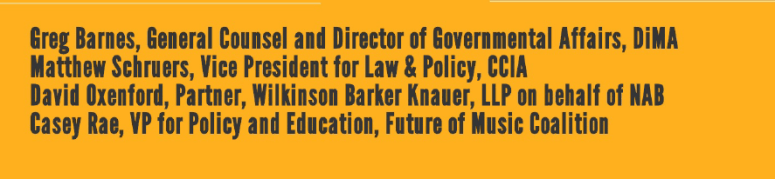
The panel was hosted by Greg Barnes of DiMA. Other panelists included David Oxenford National Association of Broadcasters and Mathew Schruers from the CCIA. The companies represented by these lobbying outfits (Amazon, Clear Channel, YouTube/Google, Spotify, Pandora, Microsoft, Yahoo have a combined market cap of over a trillion dollars. YET THERE WAS NOT A SINGLE REPRESENTATIVE OF SONGWRITERS ON THE PANEL. This is particularly appalling considering that songwriters are the ones living and working under the consent decree.
I had prepared a short set of comments detailing my experience as a songwriter, especially the financial effects of the consent decree on my digital royalties. I parked myself in the second row and waited for the moderator Greg Barnes to start taking questions from the audience. Mine was the first hand up and Barnes indicated that he would call on me but first he wanted one more comment from Oxenford. It was during Oxenford’s comment that I noticed the lobbyist (?) seated directly in front of me pulled out her smartphone and started frantically texting something. Curious I leaned forward and could clearly read my name and then the phrase “watch out”. Funny stuff. I wanted to say “Hey dumbass, I’m sitting right behind you.” But I resisted.
Curiously it was immediately after this that Barnes suddenly announced that they would only be taking comments from “Staff” members and I would have to wait “til the vey end and time permitting only.” He then proceeded to call upon a college student from GW.
SERIOUSLY? The Digital Media Association is in the business of selling songwriters music but their chief DC lobbyist is afraid of having a songwriter speak. Spineless coward. If that’s not clear, Yes, Greg Barnes, I am calling you a spineless coward. And I’m standing by it.
When the college student finished his comments I raised my hand again. Once again Barnes told me that they were only taking questions from staffers despite the fact he had just demonstrated that they were in fact taking questions from anyone.
This went on for a while and I realize that Barnes clearly intended to not let me ask a question. For amusement I started to stare down the not-quite-slimey representative of the National Association of Broadcasters. He suddenly found something in his lap extremely interesting and wouldn’t look up. If I was absolutely certain that he was not suddenly transfixed by the unexpected appearance of a colony of miniature unicorns dancing on his lap I’d call him a spineless coward as well. But as I actually couldn’t see his lap, I can’t rule out the possibility of miniature unicorns, and so for now I’ll give him a pass.
The night before this event I had been warned that it was likely that I would be blocked from asking any questions or making any comments. Considering the fact I was gonna have to get up at 5:45 am to make it to the panel I wasn’t really in the mood to go to all this effort for nothing. I had to have a plan B.
A few days before a songwriter friend remarked that the current licensing system for songs and digital services was so fucked up that songwriters really had nothing left to lose except “the shirts off our backs.” I remembered this. I went across the street to the local grocery store bought some gift bags and wrapping paper and proceeded to gift wrap three shirts that had been worn by me and my bandmates as “gifts” for the NAB, CCIA and DiMA. I figured that at the very least I could present them with the shirts off our backs and eke out a photo op.
Of course it didn’t go that way. Clearly Barnes was terrified of having an actual songwriter air a viewpoint that was contrary to the party line. When he asked for questions again, I asked that as the only person in the room forced against their will to live and work under the consent decree I be allowed to speak. He refused.
So shit, I did what I had to do. I marched up to the panelists and presented each of them with a gift wrapped “shirt off of a songwriters back”. They looked like they were gonna pee their pants. It was priceless.
“I got less than $17 dollars for a million spins on Pandora, that’s your consent decree at work.” I told the room and walked out.
The whole thing was so fucking stupid on the broadcasters/webcasters’ part. If they’d just let me speak they could have spent the final 15 minutes to counter my questions and statements with measured doses of non-sensical legalese and mock concern for the plight of the independent songwriters. But by acting like spineless cowards they totally screwed themselves. Just goes to show that if you put on a “Show trial?” you very well may end up with a show you didn’t expect.
Alright, this is not a music law blog. It is, however, a blog where law and music meet. So, here we go. If you don’t know the ante-fact, have a read here or here.
And there’s also this update that Google may be revising its position now.
Why is the contract so bad? Wait, is it really bad?
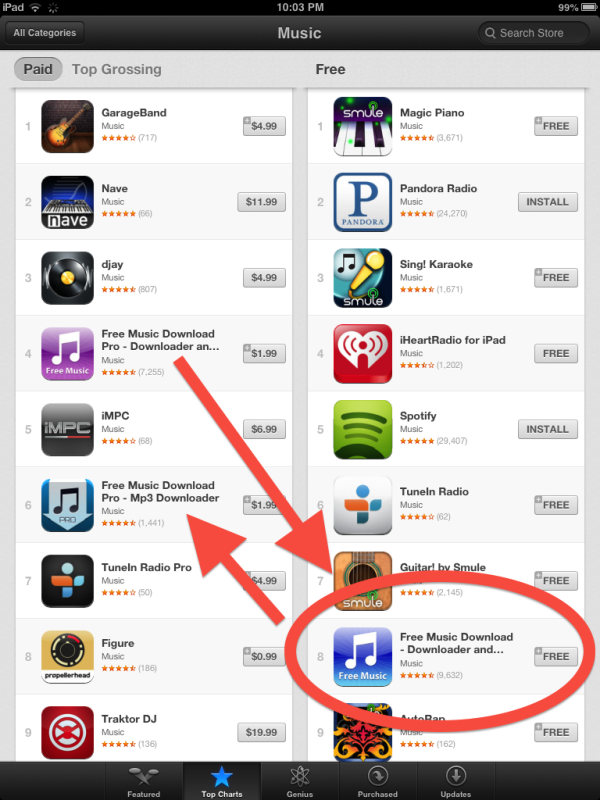
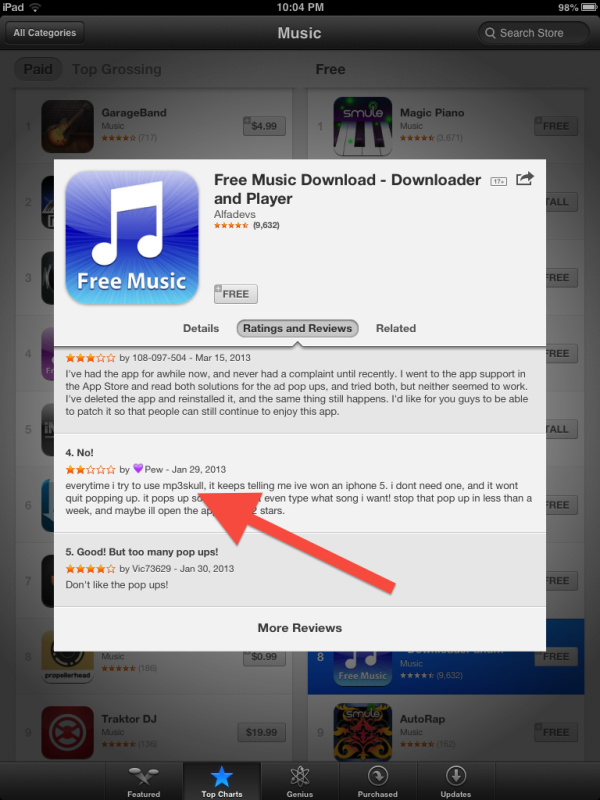
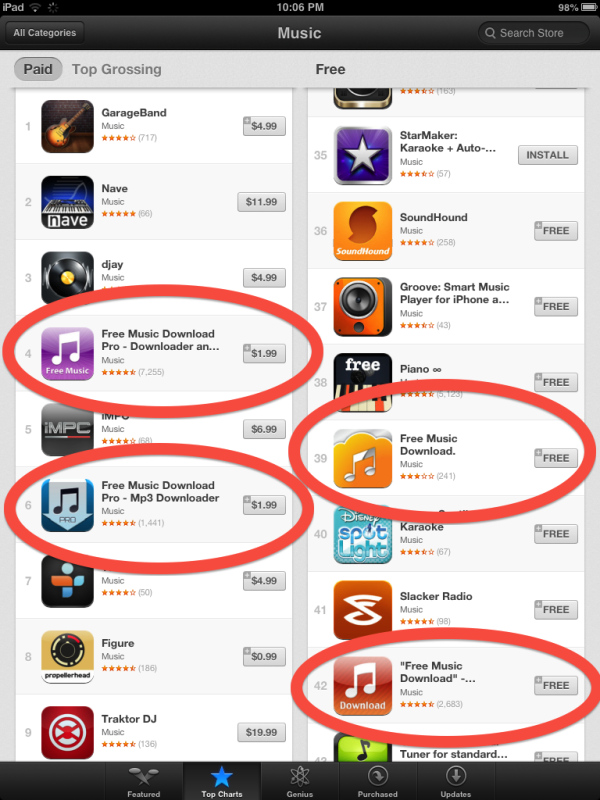
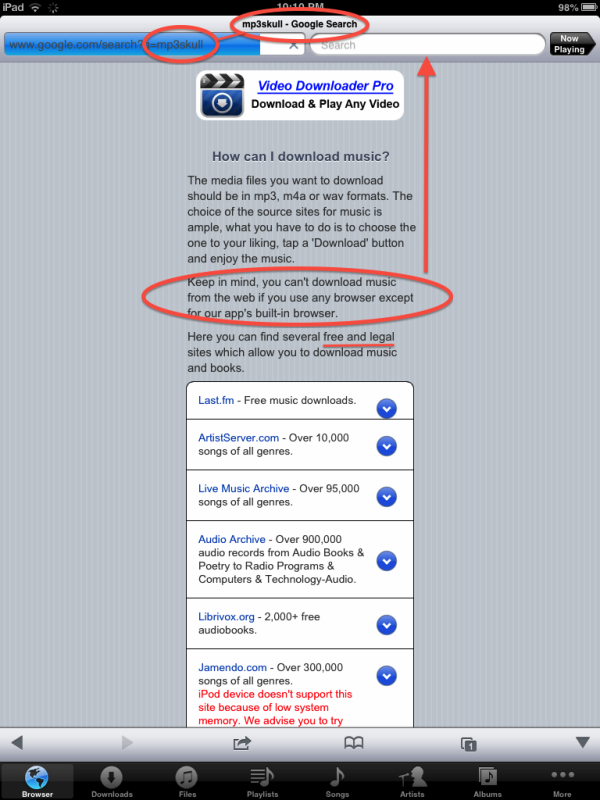
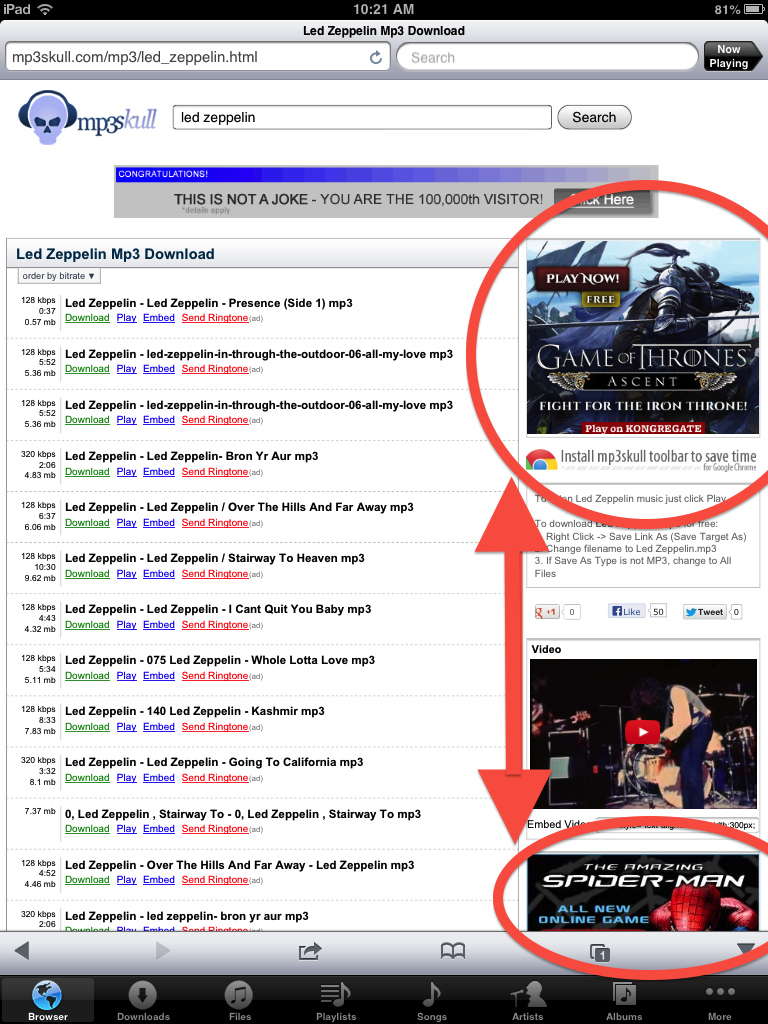
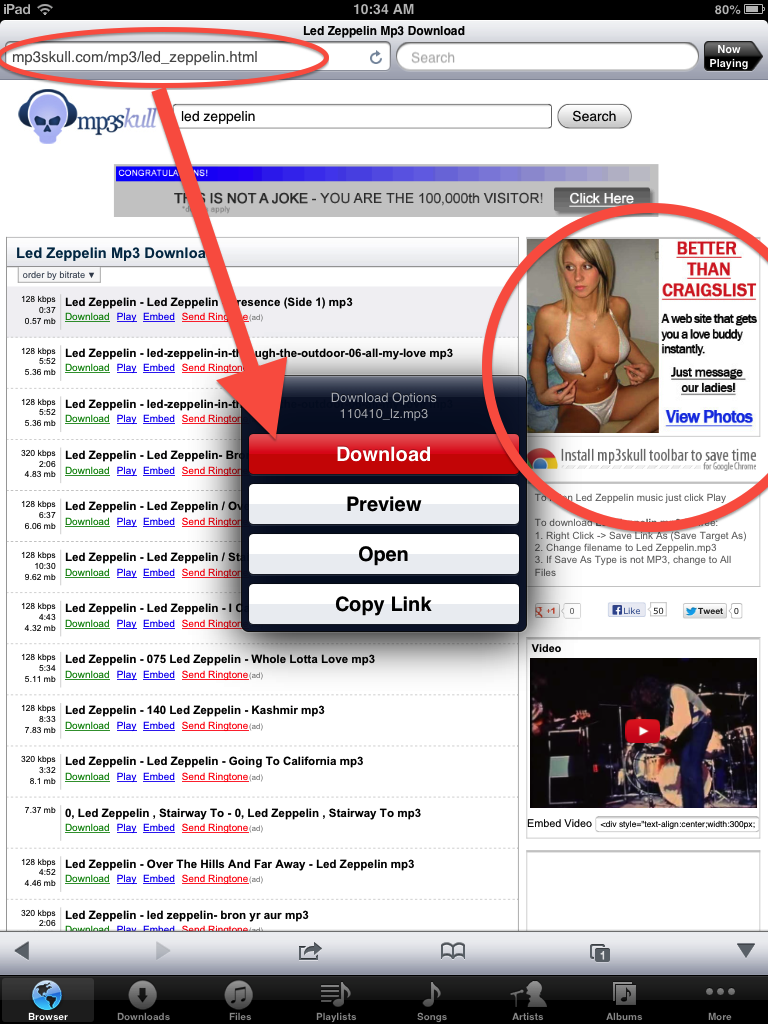
Advertisers need to capture the mobile market. The problem is the functionality of the some of the most frequented websites by the coveted youth demographic is disabled on iDevices (the inability to download content to the idevice). In other words, there is no draw to pirate websites (and to the advertising they serve) if the infringing music is no longer accessible. Worry no more, there’s an APP for that… note the top grossing and most popular music apps for the ipad…
And uhm… let’s not worry that ads for Adult Services are being targeted to minors…
Recently, my band Katagory V created a crowdsourcing campaign to finance the release of our latest album, which had been completed (recorded, mixed, and mastered) over three years ago. As much as Silicon Valley seems to laud this as “the way” to finance a musician’s work, I personally was very resistant to it for a long time. This was more of a moral issue for myself than one of not wanting to “get with the times”, as we artists are so often accused of. Recently, however, it became far more than a moral problem; it became a political one, too.
Don’t get me wrong. I think the whole crowdsourcing concept is brilliant. It’s a fantastic way to kick-start your craft if you have no capital to work with and arejust getting started as a band, filmmaker, writer, etc. It is something I wish had existed when I started my musical endeavor years ago. However, the more I look at it concerning my own band which has existed for 15 years, I feel like we are essentially panhandling. It is one thing, in my opinion, to use this to “kickstart” your dream career, it is another creature all together when you rely on it as your sole source of income to maintain it.
With that said, let’s not mince words here and just call it what it really is — crowdsourcing is panhandling on the internet. I can’t be the only person that sees it this way…or am I? I was raised to believe that hard work and perseverance gets rewarded, and when you reap these rewards, you do so with absolute humility. Panhandling completely negates what I was taught. Granted, people who contribute get “perks” or a finished product IF…if it succeeds. However, it is still asking for money for something that doesn’t actually exist yet. Money for a promise: this is where my moral compass just spins out of control. Are we asking consumers, our fans, to become investors now?
The part that goes beyond my moral problems with this is that we are not crowdsourcing our unreleased album to get our career started, rebooted, as a noble cause, or even to try and break away from the whole record label cycle. We are doing it because after three years, we have no other choice. Labels are reluctant to take risks or give advances, consumers are using streaming or free options, both of which obviously pay us nothing, and we don’t have any more capital ourselves to fund it. Nothing is more frustrating or humiliating than doing something that you find absolutely immoral AND politically backwards, yet knowing that you HAVE to do it as a means to an end. There is no Plan B or C; this is the ONLY plan left. It’s very ironic, but one of the songs we had written for this unreleased album, “I Am Change,” lyrically and inadvertently prophesied this very situation.
When I told the members of my band that I was going forward with this panhandling scheme, I insisted that our campaign bio had to explain to our fans WHY we were doing it. Unlike most artists doing these funding projects, I wanted it spelled out in big bold letterson the front page of the campaign, that thanks to the “new boss,” we had no choice but to have our fans directly fund our work. Otherwise, this album would never be released.
There are several paragraphs in our campaign explaining what has happened in the music business in the last decade, why our “middle-class” band had been forced at gunpoint to climb aboard the express train to “poverty,” and why we are now holding out our hands, begging for spare change. By laying out the truth and thus risking the possibility of being viewed as sniveling and whiny, we may be pushing our potential contributors away.
Why would these potential contributors be turned off? Because NO ONE likes cry-baby musicians. They literally tune them right out. Music consumers don’t want to hear our problems. They just stuff cotton in their ears and mouse click over to the next free meal. And you know what? I don’t care…it’s already been three years. I can wait another three, ten, or even twenty years if it means standing my ground on how I feel about the digital age and how we as artists are being bent over the proverbial barrel more than ever in the history of the music business.
The band was surprisingly supportive of this idea to add this segment to the campaign. I had been preaching this possible doomsday scenario to them (and anyone else who would listen) as far back as 2007. I always knew it was going to get worse before it got better when we started recording this album back in 2010; I just never imagined it would get THIS bad with no real resolution in sight. I can’t help but wonder if this is the end of days for music.
Our fans (and others looking to contribute) need to know the truth. Of course we want people to contribute; we want this album out there just as much as our fans do, or else we wouldn’t have resorted to creating a panhandling campaign! If it doesn’t work, this album is going to go back on the shelf indefinitely. Even if people don’t contribute and they walk away from it with a little education and a better understanding of how things work (or don’t work) in the world of music today, I will personally feel a little better about having to resort to this fundraising tactic. I can only hope we don’t ever have to take this route again.
The financial ecosystem in which our band had worked under for over a decade has been eradicated. It’s as if we are living out that John Carpenter movie, “They Live.” The music industry isn’t even an industry anymore; they/we are the puppets of this new boss. We put in thousands of dollars of our own money into this album thinking that things would get better, that someone would find this miracle “new business model” that would restore the balance to the force, and that we would at least see a return that would pay back our expenses. This has yet to happen and, sadly, probably never will. So now, after three years of waiting for the other shoe to drop, we decided to stop bruising our backsides from sitting on the fence, swallow our pride, and fund our music by turning our band into a PBS pledge drive. I never in my wildest dreams thought I would be panhandling for my career in music.
Pandora and Sirius have decided to stop paying performance royalties to artists, producers and background performers who recorded before 1972–in other words, the creators of the greatest music that influenced us all and their heirs. Billie Holiday, Duke Ellington, Louis Armstrong, Miles Davis, Aretha Franklin, Willie Nelson, Buddy Holly, Jack Teagarden, and everyone in 20 Feet from Stardom. Just to name a few.
This is due to a gotcha in the US copyright law–the Pandora loophole–that supposedly does not extend the SoundExchange royalty to recordings made before 1972 because the U.S. did not adopt federal copyright protection for sound recordings until 1972. The only problem with Pandora’s position is that there are lots of Members of Congress still in office who passed the 1995 and 1998 laws that created the SoundExchange royalty–and there is no Member of Congress who thought that they were creating a loophole so that Pandora…



 The Trichordist
You must be logged in to post a comment.