DMCA Safe Harbor is NOT a “License to Infringe”

The Trichordist

Thanks to Music Tech Policy for alerting us to this post from The Association of Independent Music Publishers:

Apparently, some internet users interpret the DMCA “safe harbor,” which is designed to strike a balance between copyright and technology, as something quite different, a “license” to post anything you like, even if you know it is infringing, unless and until the copyright owner complains.

The distinction may seem small, but it may represent how the general public regards copyright on the internet.  Instead of avoiding infringement and respecting copyright, the concept of the “DMCA License” is that you don’t have to respect copyright.  Do what you like, and at the worst the copyright owner might force your ISP to remove the material.

There is no such thing as a “DMCA License” because under the DMCA, copyright owners are not in any way consenting to unauthorized use.  They are simply trying to…

View original post 22 more words

Text of Songwriter Equity Act of 2014

Music Technology Policy

[Congressional Bills 113th Congress]
[From the U.S. Government Printing Office]
[H.R. 4079 Introduced in House (IH)] 113th CONGRESS 2d Session H. R. 4079 To amend title 17, United States Code, to ensure fairness in the establishment of certain rates and fees under sections 114 and 115 of such title, and for other purposes. _______________________________________________________________________ IN THE HOUSE OF REPRESENTATIVES February 25, 2014 Mr. Collins of Georgia (for himself and Mrs. Blackburn) introduced the following bill; which was referred to the Committee on the Judiciary _______________________________________________________________________ A BILL To amend title 17, United States Code, to ensure fairness in the establishment of certain rates and fees under sections 114 and 115 of such title, and for other purposes. Be it enacted by the Senate and House of Representatives of the United States of America in Congress assembled, SECTION 1. SHORT TITLE. This Act may be cited as the ``Songwriter Equity…

View original post 493 more words

BitTorrent’s Dictator Problem. Belarus is Worse than Russia, Why Does Bittorrent Operate Development Center in Minsk?

Screen Shot 2014-03-05 at 11.21.48 AM

Photo BitTorrent.  Parody, Commentary and Criticism by Trichordist Staff.  This would be a hilarious Kickstarter project, right? Imagine this billboard  along the 101 after you come off the Bay Bridge into San Francisco.

San Francisco is known as a bastion of liberalism and progressive politics. It’s also home to many strident libertarian advocates of free speech and an open and robust internet.   That is why we find it appalling that the San Francisco based BitTorrent operates a development facility in  Belarus or as we like to call it “Little North Korea.”  We have to assume that the coders who work at this facility–like all residents of Belarus–do not enjoy anything like what the international community would consider to be meaningful civil rights.  Belarus’ Internet and media are severely censored.  There have been mysterious deaths of journalists  and by any measure Belarus is one of the most repressive regimes in the world.  The Belarus Government has gone so far as to ban clapping in public.  I’m not kidding.

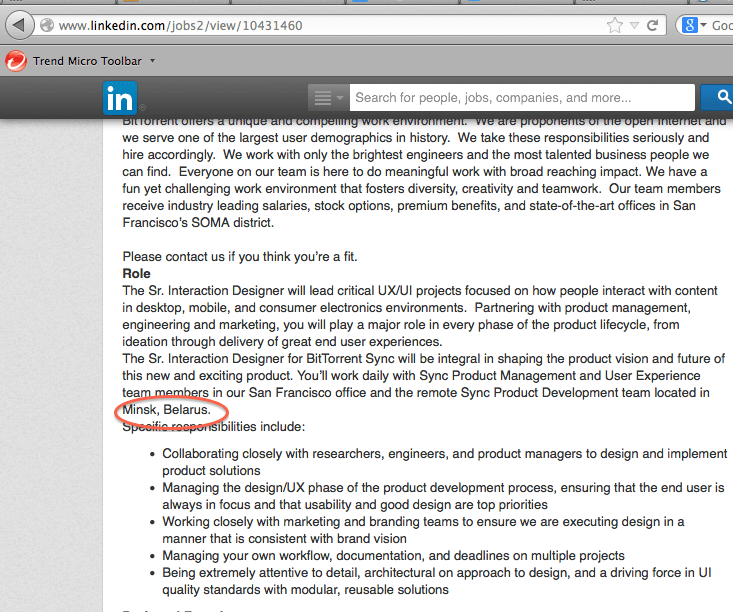
Here is a recent job listing confirming the existence of the development facility.
Screen Shot 2014-03-05 at 12.17.55 PM

This is sheer hypocrisy coming from a company that spent a small fortune putting up billboards that said things like

Your Data Should Belong To The NSA You

BitTorrent should be ashamed of its behavior.  Further, I think that BitTorrent’s Matt Mason–who has recently conducted an apparent public messaging push to “legitimize” BitTorrent–should explain to artists why BitTorrent indirectly supports such a repressive regime.   Finally, everyone should check to see if their pension funds invest in the venture capital funds that back BitTorrent and consider whether this matches your ethical and political sensibilities.  According to BitTorrent’s website these are their main investors:

Accel http://www.accel.com/

DCM http://www.dcm.com/

DAG https://www.dagventures.com/

Read more about oppression in Belarus.

http://www.theguardian.com/world/2012/oct/07/belarus-inside-europes-last-dictatorship

http://www.rferl.org/content/uzbekistan_iran_belarus_media_censors/24567209.html

http://www.globalpost.com/dispatch/news/politics/world-leaders/130803/europe-last-dictator-belarus-lukashenko

What ASCAP Members Need to Know About the Songwriter Equity Act and What You Can Do | ASCAP

Songwriters, composers and music publishers earn royalty income through two separate rights: the right to publicly perform their music works, and the right to make reproductions of those works and distribute those reproductions.

However, two outdated portions of the Copyright Act, Section 114(i) and Section 115, prevent songwriters and composers from receiving royalty rates that reflect fair market value for the use of their intellectual property. This has created inequity in the marketplace that harms America’s songwriters, composers and music publishers in the digital age. Now is the time to fix it.

READ THE FULL POST AT ASCAP:
http://www.ascap.com/playback/2014/02/action/songwriter-equity-act.aspx

A Great Question from @ZoeCello: Should Digital Retailers Own the Artist’s Fan Data?

Music Technology Policy

I want my data and in 2012 I see absolutely no reason why I shouldn’t own it. It seems like everyone has it, and exploits it…everyone but the creators providing the content that services are built on. I wish I could make this demand: stream my music, but in exchange give me my listener data. But the law doesn’t give me that power. The law only demands I be paid in money, which at this point in my career is not as valuable as information. I’d rather be paid in data.

Zoë Keating, What I Want From Internet Radio

Zoë Keating has raised a number of interesting points in a recent blog post about digital music services and one of them caught my eye–why is it that artists can’t get in the loop with the fans who buy or listen to their music?  When artists spend significant amounts of time and…

View original post 780 more words

Beggars said to have contributed more in UK Taxes than Apple, Google, Facebook and Amazon combined. | Telegraph UK

The Government has been “seduced” by technology companies such as Google, and is “cosying up” to them, even though they keep their tax contributions to a minimum, leading music executive Martin Mills has warned.

Mr Mills, who founded Adele’s record label, Beggars Group, claimed his company pays more tax in Britain than Google, Facebook, Apple and Amazon. But he said creative businesses like his receive less support from the Government.

READ THE FULL STORY AT THE TELEGRAPH UK:
http://www.telegraph.co.uk/finance/newsbysector/mediatechnologyandtelecoms/9844225/Government-seduced-by-tech-firms-like-Google.html

Why Streaming Music Isn’t Like Bottled Water… | Digital Music News

Streaming music is just like bottled water, right?  Not all, actually.

1. People happily pay outrageous premiums for bottled water (a glass of tap water costs about $0.001).
Relatively few people actually pay for streaming music.

2.  People are convinced that there’s a difference between bottled water and tap water.
Not enough people feel there’s a difference between ad-based (free) streaming and premium (paid) streaming.

3. Sometimes, tap water tastes funny.
Free streaming always tastes good!  You just have to wait for it a little longer.

4. Bottled water is a proven, $100 billion industry that’s been around for decades.
Streaming music isn’t a profitable industry, hasn’t been around for more than a decade, and remains financially speculative.

READ THE REST OF THE 11 POINT LIST AT DIGITAL MUSIC NEWS:
http://www.digitalmusicnews.com/permalink/2014/02/26/bottledwaterstreaming

Homegrown Music: The Challenges Of Running A Record Label in D.C. | DC Music Download

“I don’t think people understand the idea that music is someone else’s property because it’s just in digital bits,” Feigenbaum says. “It’s intangible. People who feel music has no value and want to steal from you will steal from you. It’s so ubiquitous—it’s so easy”.

“I have people come up to me and tell me how much they love what I do, and I’ll be like, ‘That’s great, where do you buy it?’” notes Feigenbaum. “And you can see they weren’t expecting that and they start to stammer. It’s like, ‘You’re not helping me. You’re not a fan-you’re a leech.’”

“I could go on and on about the things I don’t like about iTunes,” he says, “But they do pay. It’s not my favorite business model, but I get paid from them.” Spotify, however, is another matter.

“They don’t pay shit,” he says. “The only people who make money off of Spotify is Spotify. We were getting thousands of listens on Spotify, which added up to literally one and a quarter pennies. So we opted out.”

READ THE FULL STORY AT DC MUSIC DOWNLOAD:
http://dcmusicdownload.com/2014/02/12/homegrown-music-the-challenges-of-running-a-record-label-in-d-c/

MTP Interview with Blake Morgan on the First 30 Days of #irespectmusic

Music Technology Policy

MTP:  How was the audience reaction for your first 30 days on the I Respect Music petition campaign? 

Blake Morgan: It’s honestly––and very happily––been above and beyond anything we could have estimated or ever hoped for. If you ask anyone who’s been working with me on this, they’ll tell you that the goal I’d set for us was to try to get 1,000 signatures in our first 30 days. A daunting number to try and reach for a petition to Congress about paying artists for radio airplay. But, it turns out that after 30 days we’re actually at 10,000 signatures.

A Huffington Post Op-ed of mine in December [“Art and Music Are Professions Worth Fighting For“] garnered a huge reaction going viral with over 44,000 likes and over 8,000 Facebook shares. That was the piece where I first wrote the words “I Respect Music.” So I knew there…

View original post 630 more words

The Tyranny of Legality | The Cynical Musician

Music piracy is a subject that has been talked to death over the past decade. So much, in fact, that it seems scarce conceivable that we could say anything more of interest on the subject.

The fundamental point I’d like you to take away from this is: it’s a lot more important to keep a watchful eye on ostensibly legal services – recall that both Pandora and (perhaps to a lesser extent) YouTube are legit – than to agonize over overt piracy.

That pirate services should be hunted to as close to extinction as is feasible goes without saying, but we mustn’t lose sight of the fact that nobody deserves a medal for going legit. It’s what you’re f-ing supposed to do.

READ THE FULL POST AT THE CYNICAL MUSICIAN:
http://thecynicalmusician.com/2014/01/the-tyranny-of-legality/