Silk Road Arrest Shines Light on ‘Dark Web’ | ABC News

The wild west wasn’t wild forever, and neither will the internet be… Sooner or later the good guys will catch up to the bad guys and people will value law, over lawlessness. This bust proves that the issues musicians and creators face online is not so much about technology, but rather how that technology is used.

The FBI’s takedown of a billion-dollar black market website that allowed users to sell and purchase illegal items has shined a spotlight on the “dark Web,” which masks users’ online identities while providing a shield for everyone from hackers to journalists and the police.

Ross William Ulbricht, 29, was arrested Tuesday and charged with a battery of conspiracy crimes allegedly committed through his Silk Road website, which has been called the “Amazon of illegal drugs” or the “eBay of illicit substances.” It was described by the FBI as “the most sophisticated and extensive criminal marketplace on the Internet.”

READ THE FULL STORY HERE:
http://abcnews.go.com/Technology/silk-road-arrest-shines-light-dark-web/story?id=20460774

Copyright: The Inverted Human Pyramid | The Cynical Musican

You are no doubt aware of the hearings currently being undertaken by the US House of Representatives Subcommittee on Courts, Intellectual Property, and the Internet – part of a major review of existing copyright law (and if not, I just told you). As can be expected in this enlightened (or, at least, interconnected) age – recordings are available on the web and I’ve been trying to catch up with the debate.

Whilst watching the hearing from two weeks ago (with representatives from the “rights holder side” present) I couldn’t help feeling that none of the witnesses was able to articulate just why copyright was so important to the nation as a whole – not just the small portion of it that actually owns marketable copyrights. Given that the House of Representatives represents all Americans, it would seem that such an explanation is deserved.

This got me thinking of how I would go about explaining it and I offer it for your reading pleasure.

READ THE FULL POST AT:
http://thecynicalmusician.com/2013/08/copyright-the-inverted-human-pyramid/

The End of Quiet Music | The New York Times

There’s a lot to take away from the recent opinion piece in the New York Times from Alina Simone about the new (but not better) realities for musicians and creators. Here are two paragraphs that have resonated with us, asking the important questions about where we are, and where we are going.

Instead of helping these musicians, we tell them they just have to adapt to the new realities of the music economy. And short of embedding MP3s in toilet paper, they have. Bands have demonstrated remarkable creativity in trying to monetize whatever they can to make up for the inability to, er, monetize their music itself. They will come over and play Xbox 360 with you or personally record your outgoing voice mail message.

We’ve placed the entire onus of changing-with-the-times on musicians, but why can’t the educational, cultural and governmental institutions that support the arts adapt as well, extending the same opportunities to those whose music provides the soundtrack to our lives? If they don’t, Darwinism will probably ensure that only the musical entrepreneurs survive. I can’t say if the world of music will be better or worse off if that happens, but it will certainly be a lot louder.

READ THE FULL STORY HERE AT THE NEW YORK TIMES:
http://opinionator.blogs.nytimes.com/2013/09/25/the-end-of-quiet-music/?_r=0

Meet the Free Market Royalty Act, an Elegant Solution to Some Complex Issues | Billboard

This guest post at Billboard is a great overview for understanding the “Free Market Royalty Act.”

Representative Mel Watt (D-NC-12) has introduced the Free Market Royalty Act (H.R. 3219), one of the most intriguing royalty proposals in years. The bill accomplishes two principal goals: Watt starts the process of getting the government out of the music business by eliminating the compulsory license for digital audio transmissions, and extends the sound recording public performance right to all audio performances.

Here’s why this is a productive solution to a knotty problem.

READ THE FULL POST AT BILLBOARD:
http://www.billboard.com/biz/articles/news/legal-and-management/5740706/guest-post-meet-the-free-market-royalty-act-an

Why Copyright Infringement is Theft | Copyhype

This post by  Devlin Hartline at Copyhype was Cross-posted on the Law Theories blog.

In the never-ending copyright debate, one often comes across certain words the usage of which both sides vehemently disagree upon. One such point of contention is the use of the word “theft” to describe copyright infringement. Ars Technica ran an article a few years back where Vice President Joe Biden was quoted as saying that “[p]iracy is flat, unadulterated theft.” Copyhype’s Terry Hart had a post a week later discussing the infringement-as-theft meme, mentioning the fact that even Justice Breyer, a copyright skeptic, had referred to deliberate infringement as “garden-variety theft.”1 The response from the other side of the debate was predictable, with the usual suspects demanding that copyright infringement is not theft—though the skeptics conspicuously neglected to define the word theft or to actually explain why it’s wrong to refer to infringement as theft.

READ THE FULL POST AT COPYHYPE:
http://www.copyhype.com/2013/09/why-copyright-infringement-is-theft/

Grand Theft Auto V : How Profits Soar when Piracy Is Managed.

Both the PS3 and the XBOX 360 have anti-piracy and digital rights management mechanisms in place that lock out users who are detected to have loaded cracked or unauthorized versions of the games.

It’s no wonder then that Grand Theft Auto 5 is the fastest selling entertainment product to reach one billion dollars in gross revenue. In just three days the game that took over $250 million dollars and years to produce had set a new record.

This is what we should all be looking at. This is the kind of wild imagination, innovation and investment that is possible when piracy is managed into acceptable levels. Of course we know there may be people who find functional work-a-rounds, but they are largely the exception, not the rule, and the numbers pretty much prove it.

What is interesting about the release of GTA V is that it looks more like the release of an iphone than a new album or movie. In other words, it is a digital entertainment release with the same potential of sales as a piece of hardware (or pre-internet piracy entertainment products).

This alone illustrates the possibilities for the size and scope of the digital entertainment market with adequate (not perfect) anti-piracy measures in place. You’ll also note that the #2 and #3 fastest selling products are also console video games which employ the same anti-piracy mechanisms.

With an estimated production/marketing budget of $265 million, GTA V is not only the most expensive video game of all time, but also more expensive than most of today’s Hollywood blockbusters. Considering this, it seems only fair to compare GTA’s commercial success to that of Hollywood movies.

READ THE FULL STORY AT STATISTICA:
http://www.statista.com/topics/868/video-games/chart/1501/most-successful-entertainment-products/

SoundExchange and BandPage Collaborate to Put $2M in Unclaimed Royalties in Musicians Pockets | Music Industry News Wire

Music Industry Newswire reports on some good news!

WASHINGTON, D.C. /Music Industry Newswire/ — SoundExchange, a music industry non-profit focused on distributing digital performance royalties to recording artists and record labels, and BandPage, a leading solution for musicians to manage their presence online, recently teamed up to notify recording artists of unclaimed royalties with SoundExchange.

Together the two groups identified more than $2 million in unclaimed digital performance royalties for thousands of BandPage musicians who have not yet registered with SoundExchange. Bandpage musicians with unclaimed performance royalties will be notified by BandPage directly via email.

READ THE FULL POST AT MUSIC INDUSTRY NEWS WIRE:
http://musicindustrynewswire.com/2012/08/07/min5749_140533.php/soundexchange-and-bandpage-collaborate-to-put-2m-in-unclaimed-royalties-in-musicians-pockets/

David Lowery in The New York Times | Defining and Demanding a Musician’s Fair Shake in the Internet Age

The New York Times business reporter Ben Sisario profiles David Lowery on the artists rights in the Copyfight. Maybe advocacy is the new radio?

The issue has become hot as technology companies like Pandora and Google have replaced major record labels as the villains of choice for industry critics. Recently, Thom Yorke of Radiohead caused a stir by removing some of his music from Spotify and saying that the service would hurt new artists.

To his detractors, Mr. Lowery is a divisive ranter who pines for a lost, pre-Internet economy. But his knowledge of legal and technological minutiae — he is a lecturer at the University of Georgia’s music business program — make his arguments hard to dismiss.

“He’s telling his personal story and standing up to the big corporations who claim to support songwriters, even as they work to undermine our rights behind the scenes,” said Paul Williams, the songwriter and president of Ascap. “He hasn’t flinched, and I think that’s given courage to other artists.”

READ THE FULL STORY HERE AT THE NEW YORK TIMES:
http://www.nytimes.com/2013/10/01/business/media/defining-and-demanding-a-musicians-fair-shake-in-the-internet-age.html?_r=0

@SFmusicTech Take Note – The 13 Most Insidious, Pervasive Lies of the Modern Music Industry… | Digital Music News

One of the most succinct and accurate assessments of the modern music business. As digital music hopefuls head to Nor Cal for @SFMusicTech the attendees should be aware that this conference has promoted many if not all of these “13 Most Insidious, Pervasive Lies of the Modern Music Industry.”

The list covers everything from “T-shirts & Touring” to “The Long Tail”  and from “Kickstarter” to “Streaming.”

Lie #1: Great music will naturally find its audience.
Lie #2: Artists will thrive off of ‘Long Tail,’ niche content.
Lie #3: The death of the major label will make it easier for artists to succeed.
Lie #4: There will be a death of the major label.
Lie #5: Digital formats will produce far greater revenues than physical.
Lie #6: “The real money’s in touring”
Lie #7: There’s an emerging middle class artist.
Lie #8: Kickstarter can and will build careers.
Lie #9: Spotify is your friend.
Lie #10: Google and YouTube are your friends.
Lie #11: If Pandora could just lower royalties, they could then survive, and really help all the artists out there.
Lie #12: T-Shirts!
Lie #13: ‘Streaming is the future…’

Here’s one in detail…

Lie #10: Google and YouTube are your friends.

The Lie: Google and YouTube have anything but their own profit-maximization goals in mind.

The Truth: This is business, not altruism, not matter how it gets spun. And, the interests of Google and rights owners are diabolically opposed and will continue to be so. Which also means that anything that is DMCA-compliant is ultimately great for Google, and fantastially bad for content owners.

So if you want exposure, go to YouTube. If you want a paycheck, find it somewhere else.

Perhaps the most encouraging thing about this story at Digital Music News is that we didn’t write it. As we’ve stated repeatedly more and more people can see the truth as plain as day that musicians are not empowered by the internet as much as they have been more exploited by it.

A very basic refresher is in order to all of these businesses who are using music as the basis of their business models online: NO MUSIC = NO BUSINESS.

READ THE FULL POST AT DIGITAL MUSIC NEWS:
http://www.digitalmusicnews.com/permalink/2013/20130925lies#r67vc32IgD2J_zeHZy7D0g

Record Labels Invest $4.5 Billion Annually In Artists… Pirates, $0… Any Questions?

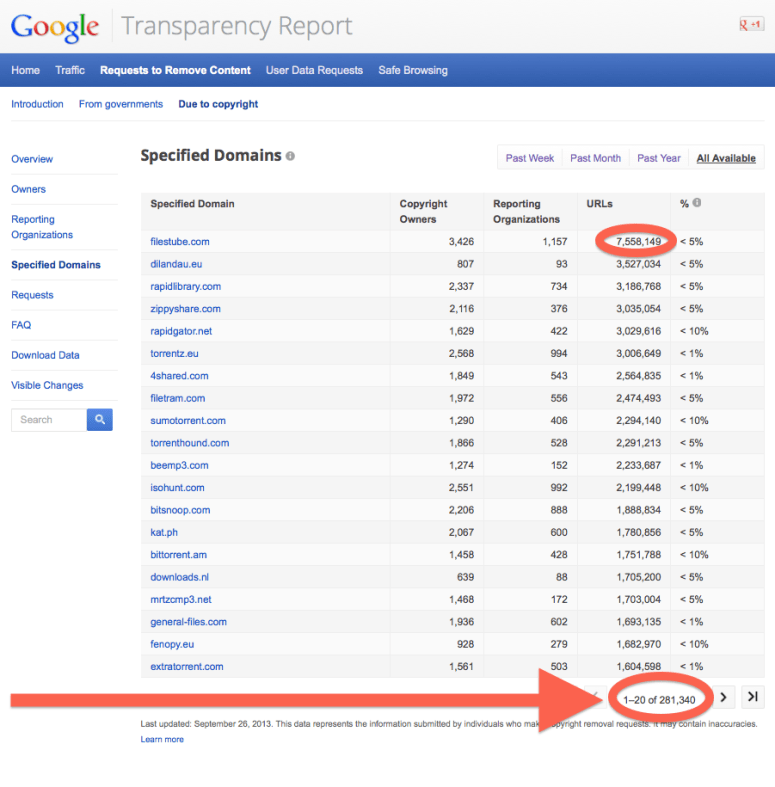
So record labels invest in the careers of artists about $4.5 Billion annually in A&R and Marketing. Meanwhile, there are 200,000 infringing sites exploiting artists work and paying them nothing that we can see from the looks of the Google transparency report.

To be precise at the time of the writing of this post there are 281,340 infringing sites on the report with the #1 offender having received over 7.5 Million DMCA takedown notices! Seriously, 7.5 Million… and Google can’t determine that this is a site “dedicated or primarily used for infringement.” Wow.

FIRST DISCLAIMER:

Now look, we don’t always like record labels, but when we do, it’s because they are actually paying artists and investing capital into developing careers (hello Trent Reznor returning to a major label). Ninety percent of new releases financed by labels don’t recoup or break even, but the bands still gain the marketing and PR benefit from the labels investment after the deal ends (hello Thom Yorke and Radiohead).

SECOND DISCLAIMER:

Any wrong doing should be unacceptable. We’ve heard far to many stories of artists being exploited by record labels, publishers, managers, booking agents, concert promoters and a wide range of those offering services from radio promotion to independent PR and marketing. If anything, the internet has added to this list a whole new group of opportunists including the ad tech industry, pirate sites, cyber lockers and more.

So yes, any wrong doing against artists and creators should be unacceptable, even if it happens online.

So here’s some quick notes from the report published by the IFPI:

* Record companies’ total investment in A&R and marketing tops US$4.5 billion annually according to IFPI’s Investing in Music report

* Labels have maintained A&R spending at US$2.7 billion, representing 16 per cent of global recorded music revenues, despite the economic recession

* US$1 million to break a new artist in major markets

* More than 70 per cent of unsigned artists would like a recording contract according to two new surveys

Record companies remain the primary investors in artists, maintaining A&R spend despite declining overall revenues in recent years. Labels spent US$2.7 billion in 2011, only marginally down on 2008 (US$2.8 billion), despite an overall decline of 16 per cent in the trade value of the industry globally over the same period. Revenues invested in A&R increased from 15 to 16 per cent of industry turnover between 2008 and 2011.

Music companies invest a greater proportion of their global revenues in A&R than most other sectors do in research and development (R&D). Comparisons show music industry investment exceeding that of industries including software and computing (9.6%) and the pharmaceutical and biotech sector (15.3%). The comparisons are based on the European Commission’s 2011 EU Industrial R&D Investment Scoreboard.

Two new surveys, conducted in the UK and Germany in 2012, show more than 70 per cent of unsigned acts want a record deal, with marketing leading the perceived benefits of record company support.

Ok, then you have this… those who pay nothing, invest nothing, and pocket everything for themselves… this is the future you want? When artists complain about tiny payments from Spotify it’s important to note the reason why they can get away with paying so little, is because of all of those who pay nothing at all.
200kinfringingsitesAnd most of this is financed by Fortune 500 Companies flowing money through online ad networks like Google and others. The situation has even gained the attention of The White House, although we’ll see what good it does.

So if you want to get paid, focus on removing the bad actors from the marketplace and restoring fairness. Our hope has always been that the internet would in fact create a new middle class of professional musicians, by the means of their own choice. Unfortunately what we’ve seen is just more exploitation.