Stop short-changing songwriters | The Hill

Web streaming is quickly becoming the preferred method for listening to music in this country. And Pandora, with more than 70 million active listeners and about a 70 percent market share, is by far the nation’s most popular service.

That’s why we’re deeply troubled by the pitifully low royalty Pandora pays to songwriters, composers and music publishers for the rights to stream their creative works online.It makes sense that one of Pandora’s core input costs should be royalties paid to the creators of the music they stream.

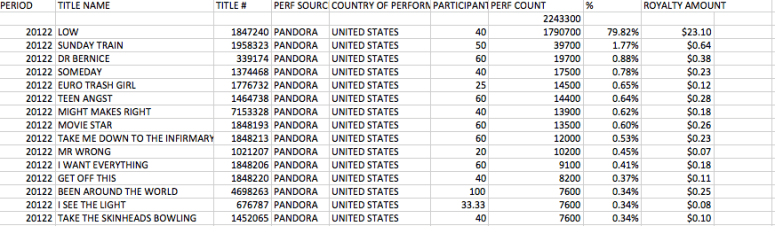
But right now, Pandora only pays about 4 percent of their annual revenue in performance rights royalties to songwriters, composers and music publishers.

READ THE FULL STORY AT THE HILL:
http://thehill.com/opinion/op-ed/314531-stop-short-changing-songwriters

Does Sirius and “Piped in” Airline Music Lead to More Music “Discovery” than Pandora? PT 2

After one get’s past the debate about whether webcasting and streaming pay artists fairly, you find there is a more complicated question.  How much of webcasting and streaming is “discovery”  and how much is just plain old consumption.  Listening to familiar tracks we already know.  This is not an academic question.  This fact can be taken into consideration by Copyright Royalty Board judges when they set the rates for webcasting. (Yes believe it or not in the year 2013 the prices to webcast songs and music are set by the US government!!).

Clearly all forms of broadcasting and webcasting are a little of both consumption and discovery (or promotion).   But the Webcasters have been arguing that they are better suited for “discovery” and thus are giving unknown artists and listeners something of value.  That argue they are better for music “discovery” than traditional broadcasters. Is that really true?

Yesterday I took my top 5 bonafide radio hits from the 80’s and 90s and subtracted their spins from each service then I looked at the percentage of spins “left” on each service.  The idea being the more a service plays the non hits the more likely listeners are discovering music.  I found something surprising.   Sirius XM and “Piped in” Airline Radio played more deep tracks or non-hits  than any other format.  Thus listeners were more likely to discover songs they didn’t know on these two services.  At least from my catalogue.

Following up with yesterdays post.  I’m digging deeper into my catalogue and subtracting spins for the minor hits, regional hits and tracks that otherwise garnered significant popularity from other sources.

Yesterday I subtracted spins for just the Top 5 tracks.

Low, Teen Angst, Get Off This, Take The Skinheads Bowling, Eurotrash Girl.

We will now subtract the spins for an additional 10 tracks.

All these tracks garnered significant radio promotion and sales through the years.

Eye of Fatima pt 1*  (Minor National  Rock/Modern Rock success)

Happy Birthday to Me*  (Minor national alternative paly, Minor recurrent play).

Turn On Tune In Drop Out With Me.  (#13 AAA radio.  Minor format.  Featured in Californication.)

Sweet Thistle Pie* (Mid-Atlantic, Chicago,  South Florida, Texas regional)

Good Guys And Bad Guys* (MTV Specialty and College Radio)

Big Dipper ( Coastal Carolinas regional).

Cracker Soul (Virginia, Carolinas and Chicago regional).

Turquoise Jewelry* (KROQ Los Angeles only)

I See The Light  ( Indie 103.1 Los Angeles Only. Daily airplay for nearly 3 years because DJ Steve Jones of Sex Pistols just decided to play the shit out of it on his popular afternoon show!)

Yalla Yalla  (Armed Forces Radio, mildly viral YouTube remix.)

* Promotional CD or Vinyl serviced to radio. 

This is not subjective.  These tracks were selected after looking at various royalty statements and airplay reports.  These are the top 15 tracks that still generate significant spins and individual sales.  There are certain tracks that were worked as singles like “I Hate My Generation” that generated a brief period of airplay but have never sustained spins.   Nor have they sustained individual sales over the long term.  These tracks are not included.  As further evidence please note that the aggregator of web simulcasts Live 365 pretty much agrees that these are the top 15 tracks.  See last screenshot.

Now the question is “Who plays the largest percentage of my catalogue outside the Top 15 tracks”

Airlines 39.27% broadcast
Sirius XM 28.57% broadcast
College Radio 25.02% broadcast
Pandora Radio 17.28% webcast
Live 365 16.91% webcast/broadcast
Rhapsody Radio (not on demand) 10.19% webcast
Terrestrial UK 8.81% broadcast/webcast?
Terrestrial US 1.07% broadcast

So for music discovery your best bet is a little air travel!  Followed by Sirius and then College Radio.  To be fair Pandora moves up a notch and it’s relative percentage of songs in the “tail” of my catalogue hardly changes.  This seems to argue that at least 17% of the time Pandora seems to be true music discovery.  It’s not just playing what the crowd says is already popular.  Again that 17% is nothing to sneeze at.  This suggests  that at least some significant portion of the time Pandora is playing you some artists or songs you would have likely never encountered.   That is encouraging.

Tomorrow let’s look at the On-Demand streaming stats.

Live 365 shows 13 of the 15 tracks in it’s top 25.
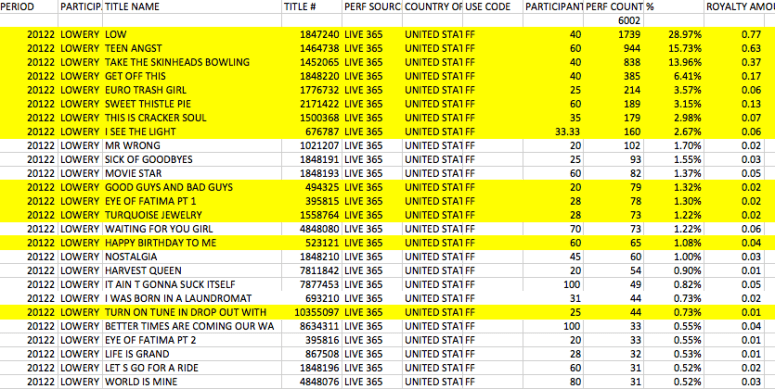
13 of tracks in top 25

Does Sirius and “Piped in” Airline Music Lead to More Music “Discovery” than Pandora?

Readers of this blog know that there is a raging debate over the rates that artists are paid by Streaming and Webcasting services.    But underpinning that debate is the notion that certain webcasting services and streaming services help people discover new music and are thus giving something of value back to the artist.  It occurred to me that I have a big enough song catalogue that we could actually look at the question try to measure if these services lead people to new music or just sort of spin what is most popular and familiar.

So in my own catalogue there are 5 songs that were genuine radio hits on multiple radio formats.  At least here in the US.   As individual tracks they also tend to be in my top ten sellers. They were also released commercially as singles.    They are:

Low

Teen Angst

Get Off This

Take The Skinheads Bowling

Eurotrash Girl

(Pictures of Matchstick Men is a Status Quo cover and I don’t get granular statements for that track).

There are also another dozen tracks that were minor hits, regional hits,  or garnered significant but fleeting radio play.  I deal with these and “On-Demand” services in a subsequent posts.

So the question I attempted to answer is  “What percentage of spins on these service are NOT the top 5 hits?”   This is not necessarily the only way to look at the question.  This is perhaps the bluntest of measurements.  However it is interesting to actually look at the data rather than just make unverified claims.   (For balance I’ve also asked a friendly yet sometimes adversarial fellow blogger to look at my raw data and ask the question differently.)

Here are the somewhat surprising results.

Percentage of spins that are NOT my top 5 hits.  Webcasters and Broadcasters only.   On Demand Streaming services like Spotify or Rdio are not considered.  

Sirius XM 46.13% broadcast
Airline Radio 46.02% broadcast
College Radio 32.15% broadcast
Live 365 31.36% webcast/broadcast
Pandora 18.18% webcast
Rhapsody radio 16.02% webcast
Terrestrial UK 8.90% broadcast/webcast?
Terrestrial Radio US 3.47% broadcast

Here are the big surprises.   Sirius XM although relatively few spins, tends to play more stuff out in the “long tail” of my catalogue than every other source.  And Airlines?  how did that happen?

Pandora which loudly boasts of it’s music genome project ends up in the middle of the pack.  Further 4 out of 5 spins on Pandora are for “Low” my biggest hit.  The only other service that spins Low as much is US terrestrial (85% of all spins).   However there is one caveat with Pandora.  The other 20% of the time the spins are more evenly distributed throughout my catalogue.  At least relatively speaking.   I mean the number two played track is an obscure outtake  from Kerosene Hat “Sunday Train.”  I assume that is the music genome at work.  So 20% of the time Pandora acts as claimed as a music discovery service.  At least with my catalogue.  Second caveat.  This is just within my catalogue.  It’s entirely possible that in aggregate Pandora as claims plays more indie music and artists out in “the tail” of popularity.

Percentage of Spins that are the track  “Low.”  Webcaster and Broadcasters. 

Terrestrial Radio US 85.26% broadcast
Pandora 79.82% webcast
Rhapsody Radio 63.75% webcast
Terrestrial Radio UK 39.56% broadcast/webcast?
Live 365 28.97% webcast/broadcast
Airline Radio 25.09% broadcast
College Radio 24.99% broadcast
Sirius XM 24.96% broadcast

About 20% of the time Pandora seems to really play some obscure tracks. Kudos!

Pandora plays

Lou Reed and Dead Kennedys Go Public Against Ad Funded Piracy with Facebook Posts

We’d just like to say a very big thank you to both Lou Reed and the Dead Kennedys who publicly posted to Facebook this week our posts showing how they are being exploited by major brands and big tech internet advertising corporations.

LOU REED FACEBOOK POST:
https://www.facebook.com/LouReed/posts/10151804045145953

DEAD KENNEDYS FACEBOOK POST:
https://www.facebook.com/deadkennedys/posts/10151784946510638

In the recent weeks we’ve heard from Aimee Mann, Pink Floyd, Thom Yorke, Blake Morgan, Lou Reed and the Dead Kennedys on various issues negatively effecting artists in the “digital economy.”

These artists have presented their concerns ranging from Spotify royalty rates, Pandora’s dishonest attempts to cut  their currently mandated rates by 85% and of course Ad Funded Piracy which pays artists absolutely nothing.

In each of the cases addressed above artists are speaking out against the exploitative practices of corporate interests destroying the ability of professional musicians to maintain sustainable careers.

Change happens when artists speak up and speak out.

8 Takeaways from today’s IP Subcommittee Hearing

Artists and Creators or all types, this is what you are up against, and we’re not even kidding. Wish we were… this is a Must Read.

Music Technology Policy

Every now and then you get a gift from the ether–today’s hearing “Innovation in America: The Role of Technology” at the Subcommittee on Courts, Intellectual Property, and the Internet was no exception.  It’s hard sometimes to convince lawmakers and staff that “yes, they really are that self-centered” when speaking of the groovier-than-thou Big Tech community, so it’s always nice when Big Tech does it for you.

First of all–get it straight that it is highly unlikely that anyone on today’s panel uttered a word that was not approved somehow by Google or its intermediaries. And certainly not one word was uttered that would give Google any heart palpitations (or as they say in the mountains, “agida”).

Having said that, I think the testimony of the witnesses at today’s hearing can be distilled into a few recurring themes, although I encourage anyone who thinks I’m oversimplifying to read the transcript…

View original post 797 more words

Steal a Little: Piracy & the Economy via The Illusion Of More

I’ve wanted a sailing yacht for years but have never been able to afford one — until now. Thanks in part to a report on piracy and counterfeiting by the GAO and this explication by CCIA (Computer & Communications Industry Association) lobbyist Matt Schruers, I now have a plan that will put me at the helm of the sloop Larceny by the Summer of 2016. And the best part is the whole family gets to collaborate to make it happen. According to my rough calculations, all we have to do is steal groceries like a Dickensian gang for three full years, and we’ll save enough for a substantial down payment on the boat. I’m thinking Beneteau 45ft, but if any seasoned mariner out there has a recommendation, let me know.

READ THE FULL POST AT THE ILLUSION OF MORE:
http://illusionofmore.com/piracy_and_economy/

Repeat after me… “Artists are Innovators!” via VOX INDIE

Testimony from copyright hearing highlights what’s at stake for content creators

On Thursday (July 25th) the House Subcommittee on Courts, Intellectual Property, and the Internet held another hearing on copyright reform, “Innovation in America: The Role of Copyrights,” with the following witness invited to testify:

Sandra Aistars, Executive Director, Copyright Alliance
Eugene Mopsik, Executive Director, American Society of Media Photographers
Tor Hansen,Co-Founder, Yep Roc Records / Red Eye Distribution
John Lapham, General Counsel, Getty Images
William Sherak, President, Stereo D

Unfortunately, to some in the press–who the witnesses were seems to have overshadowed what they may have actually said. In The Washington Post Andrea Peterson bemoaned the lack of “innovators” on the witness list.

READ THE FULL POST AT VOX INDEI:
http://voxindie.org/house-hearing-copyright-reform

Spotify is Right on Ad Funded Piracy and YouTube

We were very pleased to see this statement by Spotify’s in house economist Will Page (and sorry if we missed it before) :

“Copyright infringing websites are big businesses … 2/3 of piracy sites have advertising, and 1/3 also include credit card logons. This competition is real: consider how ad pricing is distorted by those unlicensed sites who offer more scale and no content costs.”

This is exactly what we’ve been saying and are glad that we can find some common ground between artists and streaming/webcasting services.  Ad supported  piracy reduces revenues for both artists and legitimate licensed services.

We’d also like to note that one Spotify executive pointed out to us the inconsistently in artists pulling their music from Spotify but keeping their music on YouTube.

They are both on-demand streaming services but YouTube is a much less artist friendly service.  Artists don’t seem to realize these facts:

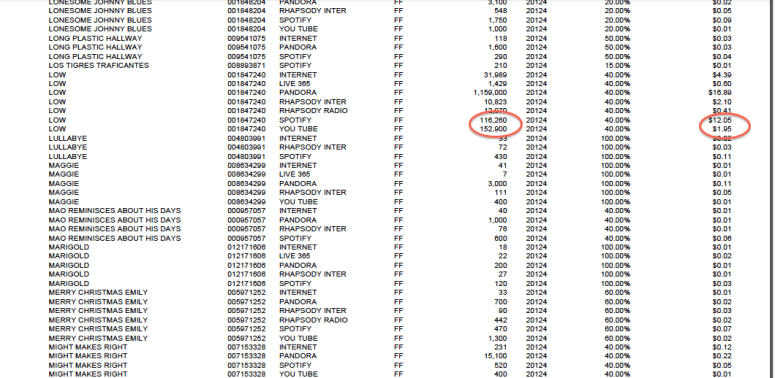
*Spotify appears to pay more than YouTube.  A lot more (see my songwriting statement below).

*Spotify relies on licenses from rightsholders.  Whereas YouTube often relies on  the legally questionable premise that it’s “users”  make the songs available on YouTube and thus aren’t responsible for getting a license.

* If artists control enough of their rights  they can remove their music from Spotify.  Try that with YouTube.

*YouTube is essentially the  largest on-demand music streaming service.  If Artists are being underpaid by these services  the logical place to start is with YouTube not Spotify.

*YouTube sounds terrible compared to Spotify.  It sounds like every song has a flanger on it. ( Sorry this is just my pet peeve.)

(Ed note:  And then there is the matter that YouTube’s policies on comments and free speech.  These allow YouTube to be a platform for every conceivable form of hatemongering. Do you really want your kids going to this site?)

spotify vs pandora

Poll: Ad Agency Giants Unite for More Innovative Brand Sponsored Piracy?

Music Technology Policy

Some of you may have seen the story about the merger of Omnicom and Publicis the huge global advertising agencies.  When the House IP Subcommittee holds hearings about “innovation”, they will hopefully be interested in the effect of this merger on brand sponsored piracy.  We have noted in the past that Omnicom clients (particularly Chiat Day clients) have been particularly nonresponsive on explaining why they support online theft of music and movies.  Plus, who can forget the Chiat Day “Arists vs Artists” campaign.

Poll by Damn the Science!

View original post

Why Spotify is NOT the Enemy of Artists, and Who Is…

Spotify has been taking a beating in the press lately and we understand why. We have offered our own criticisms which mostly revolve around royalty rates and transparency. But we’ve also stated that Spotify is a symptom of a much larger disease of illegally operating, infringing businesses who make millions individually and billions collectively while paying absolutely zero to artists and rights holders.

As much as we disagree with Spotify over their rates and PR spin on several issues, we also recognize that they are legal, licensed and pay out royalties as they have been negotiated. Artists are able to opt out of Spotify individually (and also if their label permits).  It is for these reasons that Spotify are NOT the enemy.

However this begs the question, if Spotify are not the enemy, who is? Well, as we stated above it is the massively deceptive Ad Tech businesses who have been financing mainstream music piracy for over a decade. This is the Silicon Valley internet tech lobby (lead by Google) who seek to dismantle and destroy copyright protection for individual creators.

Yes, we hear a lot of lip service about how these people say they are really pro-copyright and pro-artist, but when every meaningful action and suggestion is to the contrary of protection and compensation of the artists work and labor it all rings a bit hollow. We now know after a decade plus of internet/tech snake oil salesmen there is no magic bullet and that “touring and t-shirts” is an admission of the failure of these online businesses to provide sustainable earnings for creators.

Piracy is NOT Promotion

Exploitation is NOT Innovation

In our ongoing “Exploited By…” series of posts we illustrate how major Fortune 500 companies, represented by Madison Avenue Advertising Agencies have been, and continue to finance the destruction of the creative community.

So we say this…

Let us focus first on the many who pay nothing at all to musicians while pocketing 100% of the Profit. Let us focus our energies on the illegally operating companies and corporations who have made infringement for profit their business model.

We are encouraged to see Spotify also take up this mutually beneficial fight against those companies and business who have so greatly devalued the work of musicians as well as impeding the growth potential of legal and licensed companies to create sustainable models for all stakeholders.

Will Page a Spotify spokesperson had this to say in The Register UK:

“Copyright infringing websites are big businesses … 2/3 of piracy sites have advertising, and 1/3 also include credit card logons. This competition is real: consider how ad pricing is distorted by those unlicensed sites who offer more scale and no content costs.”

This is the first step towards making real change that will remove the bad actors from the marketplace and move towards a sustainable ecosystem for all legal and licensed stakeholders.

We’ve commented before that we believe that Spotify is unsustainable at current rates. It is also worth noting that Spotify pays significantly MORE than YouTube, a business that was founded and built on the premise of infringement for profit. Although YouTube and Google have made improvements in their services for rights management they still fundamentally devalue the work of artists hiding behind the DMCA.  Google and YouTube also continue to create and distribute anti-copyright and anti-artist propaganda asserting that any “remix” of an artists work is “fair use.” It is not.

In the end Spotify needs to increase it’s revenue per stream so it can increase it’s royalties per stream to be sustainable for artists. The number one way to do this is to capture the millions or even billions in advertising revenue that are financing illegally operating and infringing businesses that pay artists nothing.

In closing, the enemy is not so much those who pay so little offering artists both consent and compensation, but more so those who are paying nothing at all and deny the artists consent.

Exhibit A:

Lou Reed Exploited By American Express, AT&T, Chevorlet, Chili’s, Lysol, Pottery Barn, Vons, Domino’s Pizza, Netflix, Galaxy Nexus and Ron Jeremy!