But This Time We Mean It… Welcome To The Ad Tech Time Machine…

Welcome to the Interactive Advertising Time Machine… set the dial for 2010

“The Interactive Advertising Bureau (IAB) has pledged to work with content producers to make sure that ads don’t inadvertently end up on sites peddling unauthorized copyrighted material.”

That was back in 2010 when NPR aired the story, “Feeding Pirates: When Legit Companies Advertise On Shady Sites.” That’s right, 2010 when filmmaker Ellen Seidler brought the issue to light when she documented the piracy around the release of her indie film “And Then Came Lola.” Highly recommended reading is Ellen’s highly detailed blog, PopUpPirates.

Ok, so maybe not far enough back for you? Set your Interactive Advertising Time Machine to the year 2007...

Here’s  the case of easydownloadcenter.com which found Google caught red handed actually helping the site improve it’s SEO to maximize advertising revenue. This as reported by DailyTech at the time:

“The two men said in sworn statements that Google offered them credit as an easy start to advertise on Google’s search engine, and that the search company also suggested ad keywords such as “bootleg movie download,” “pirated,” and “download harry potter movie.” According to the report, Google received $809,000 for its advertisements.”

And this was Google’s response at the time (arguably the biggest member of the IAB):

“Google declined to comment on the specific clash over its ads, but did say that it is working on ways to screen out ads that violate the company’s policies.

A spokesman for Sony Pictures said, “Discussions with Google have been ongoing for a while, and there’s hope it can result in a mutually satisfactory arrangement whereby Google will not give support to pirate sites.”

Read that again. “Discussions with Google have been ongoing for a while,” that was in 2007 for activity that dates back to 2003.

So please forgive us if we are less than optimistic over the latest so-called “Best Practices” announced by the IAB. This is not a new or unknown issue and what’s worse is that actual knowledge by Google and other members of the IAB dates back at least to 2003, a decade ago.

Think we’re biased? Ok, fair enough but DigiDay calls the latest appeasement “Toothless” and it is a trade publication that reports on internet advertising that is owned by The Economist:

There are also plenty of built-in outs. The networks, for instance, can keep ads running on sites engaging in piracy if those sites have “substantial non-infringing uses.” Also, the agreement lets networks simply remove ads from pages engaging in piracy, while leaving ads running on the rest of the site. The agreement places the onus on the rights holder to notify the networks about pirated content, not requiring the networks to monitor the content themselves. The agreement “cannot, be used in any way as the basis for any legal liability.” The agreement excludes ad servers and ad exchanges.

The agreement may not be not much of an agreement at all.

Yeah, that’s pretty much what we think too. So, what does the creative community have to do to protect itself from the blatant exploitation of its products and labor from internet robber barons? Stay tuned…

YOU MAY ALSO BE INTERESTED IN READING:

The Ad Network Transparency Conspiracy

Rat Farming: How The Interactive Advertising Bureau’s “Best Practices” Incentivizes Piracy.

There is a famous story about the French Colonial authorities in Vietnam trying to reduce the rat population in Hanoi. They offered a bounty for each rat pelt turned into the colonial authorities. However instead of reducing the rat population it exploded. Why? The vietnamese did what any logical group of people would do when faced with such a financial incentive. They started farming rats!

Anytime you give people an financial incentive to do something they will do it. This is the case with Ad Supported Piracy. If Ad Networks don’t screen the websites on which they publish their ads the websites will do anything to generate page views to receive more revenue. One of the easiest ways to generate pageviews is to host popular infringing content.

Faced with this problem the White House tried to broker a deal with the Interactive Advertising Bureau. Recently they announced a “best practices” intended to address the problem of Ad Supported Piracy. Unfortunately The White House despite their best intentions was totally duped on this. As Bill Rosenblatt has so clearly spelled out in his Copyright and Technology Blog, the best practices will for many reasons NOT make the situation better:

So how will compliance be enforced? Consider this: the companies that have signed on to these guidelines are 24/7 Media, Adtegrity, AOL, Condé Nast, Google, Microsoft, SpotXchange, and Yahoo!. These companies have agreed to have the Internet (Interactive) Advertising Bureau (IAB, the trade association for internet advertising) monitor them for compliance. The largest six of these eight companies have seats on the IAB board. In other words, this is rather like foxes agreeing to be monitored by the American Fox Association for compliance with henhouse guarding guidelines.

I’ve now had some time to dig into this best “practices” document and here are my observations:

At best it attempts to legitimize the illegal status quo whereby companies Google and AOL “try” not to advertise on bad sites.

At worst it creates a DMCA whack-a-mole like process whereby individual creators and rights holders assume the burden of telling the online advertising networks exactly who are their bad (as in criminal) customers. Further it then seems to creates a new Kafkaesque process whereby the creator would (among other things) have to learn to use highly specialized packet logging and data tracing tools to even file a complaint. I quote from the document:

(prove) (ii) that the advertising appearing on the participating website containing the illegitimate activity is provided by the Ad Network. This can be done by providing, for example, a Tamper Data trace and relevant screenshots showing that the participating website is making ad calls to the Ad Network for the advertising reflected in the screenshots.

How many indie musicians do you know that know how to use packet logging and data tracing programs?

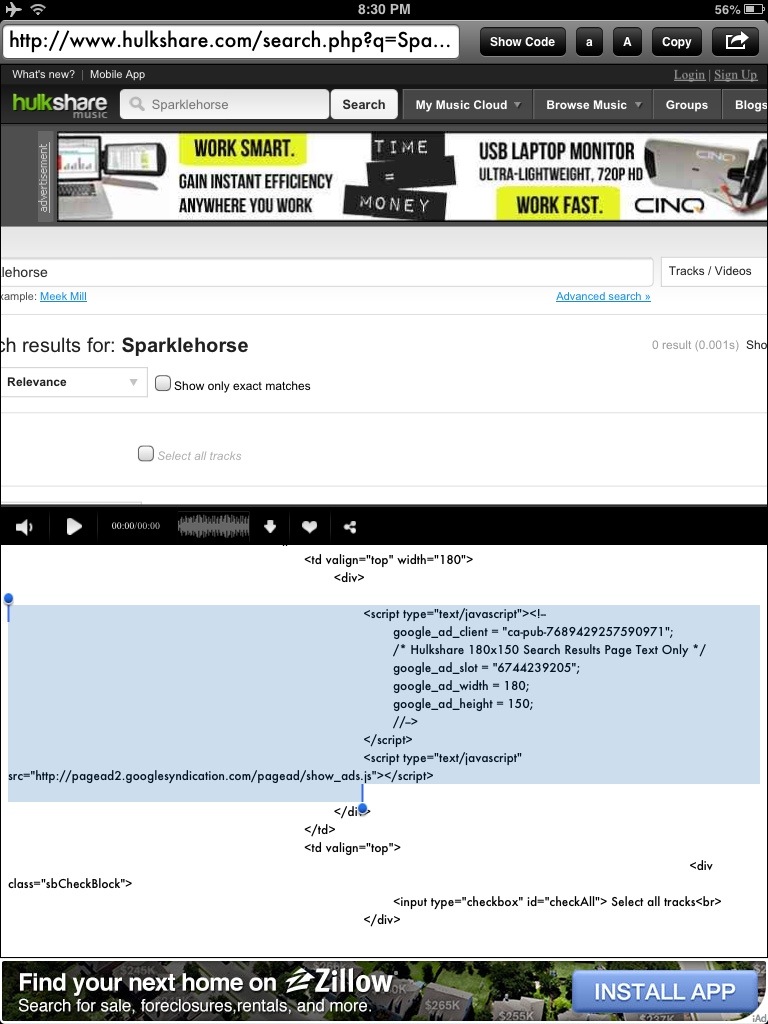
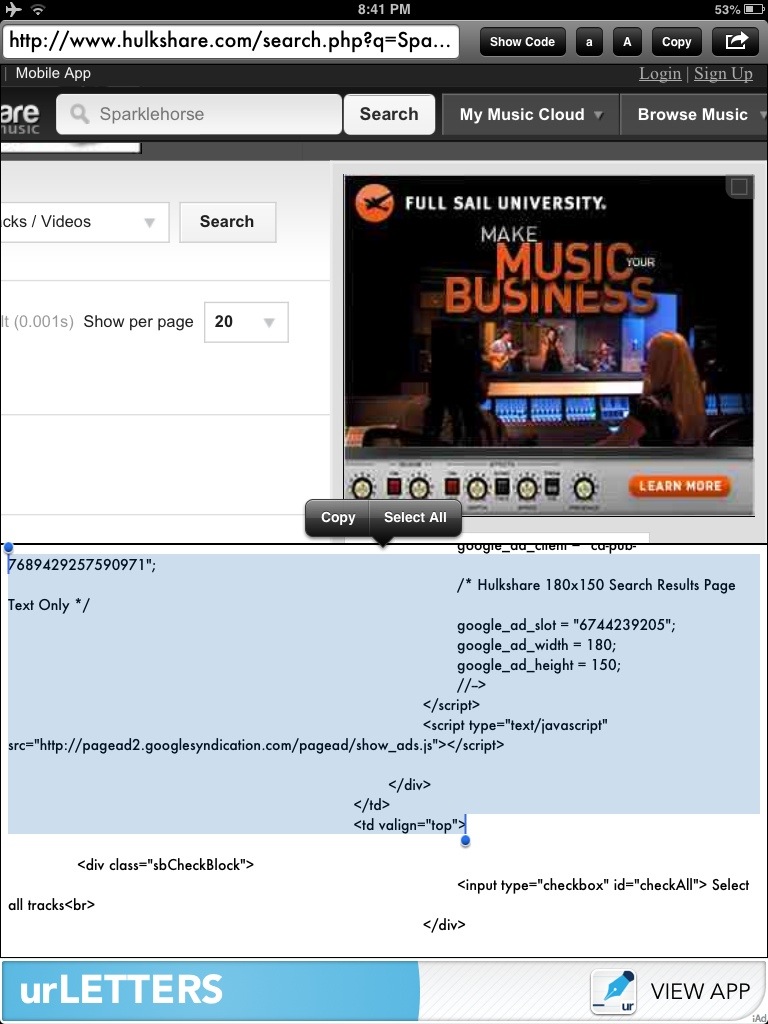
Even if you know how to use this software it’s time consuming to find the exact “call” associated with a particular ad. (see screenshot).

Finally the “best practices” allow the copyright infringing website in question to challenge the creators claim setting up a never ending cycle of claim and counterclaim.

This document is so heavily weighted in favor of powerful (Editor note and Obama supporting?) corporate interests it’s absurd.

The creative community should reject this “best practices” for what it is: A tacit legitimization of current illegal and unethical practices.

Fortunately the “best practices” are voluntary and have no legal standing. Further they are a gift to people like me. It should make it even easier to name and shame Fortune 500 brands. Why? I’m sure their online advertising networks will be telling their brands that “the problem is now fixed.” Amusing. I look forward to the next few months.

But what does this have to do with Rat Farming?

The online networks – no let’s face it mostly Google wants to be able to push ads onto any website without the burden of screening any of the sites. Without even screening who they are paying. It’s like they are putting out bowls of yummy pest attracting food out in the garden. What happens if you leave bowls of food around your garden? Eventually you get rats. Lots of rats. It’s rat farming.

The IAB/White House “best practices” absurdly burdens the creators with the task of finding the rats, proving they are rats, DNA testing the rats, packet tracing the food the rats eat and finally getting rid of them but not before the rats initiate an endless loop of claims and counterclaims that it has not been proven definitively that they are always rats.

Once gain this is a SUBSIDY from creators to Silicon Valley and Madison Avenue. We work for free to clean their networks. They make the money.

Here’s a much simpler and effective “best practices”. The IAB should ask their members not to create the incentives in the first place.

After all advertising is THEIR business not ours.

Do they teach packet logging and data tracing at Berklee School of Music?

Screen Shot 2013-07-21 at 11.04.43 PM

Ad Networks Adopt Notice-and-Takedown for Ads on Pirate Sites

Bill Rosenblatt has an insightful piece on the problems with the White House brokered IAB “Best Practices” with online Advertising. We largely agree with Bill and will be following up with our own post.

Copyright and Technology

Eight top Internet advertising networks will participate in a scheme for reducing ads that they place on pirate sites — websites that exist primarily to attract traffic by offering infringing content as well as counterfeit goods.  The Best Practice Guidelines for Ad Networks to Address Piracy and Counterfeiting document, announced on July 15th, specifies a process modeled on the US copyright law’s notice-and-takedown regime, a/k/a DMCA 512: a copyright owner can send an ad network detailed information about websites on which it placed ads and that feature pirated material; then the ad network can decide to remove its ads from the site.

Although this scheme may result in some ads being pulled from obvious pirate sites, it has several major shortcomings.  First of all, because this is a voluntary scheme, ad networks don’t risk legal liability for failing to comply with takedown notices, as they do under the DMCA.

So…

View original post 926 more words

Tell Us Again “Streaming Is The Future” As Paid Downloads Are Down 2.3 Percent In the US…

Let’s see… maybe streaming services are cannibalizing transactional sales, maybe? Streaming Royalties are small but they can really grow? Really? Let us guess… the good news is streaming is reducing piracy? In Norway and Sweden

According to half-year stats shared by Nielsen Soundscan with Digital Music News this weekend, paid downloads are slumping 2.3 percent at the half-point, meaning the period from January 1st through June 30th.

All of this points to the same issue of streaming services paying too little, while illegally operating, infringing businesses pay absolutely nothing at all. So much for sustainability…

READ THE FULL POST AT DIGITAL MUSIC NEWS:
http://www.digitalmusicnews.com/permalink/2013/20130721downloads

The New Yorker : If You Care About Music, Should You Ditch Spotify?

The New Yorker weighs in on the controversy surrounding music streaming royalty rates…

The issue beneath all the complaints about micropayments is fundamental: What are recordings now? Are they an artistic expression that musicians cannot be compensated for but will create simply out of need? Are they promotional tools? What seems clear is that streaming arrangements, like those made with Spotify, are institutionalizing a marginal role for the recordings that were once major income streams for working musicians—which may explain the artist Damon Krukowski’s opinion that music should simply be given away, circumventing this entire system. But first, some words from Godrich, condensed and edited for clarity.

READ THE FULL STORY AT THE NEW YORKER:
http://www.newyorker.com/online/blogs/sashafrerejones/2013/07/spotify-boycott-new-artists-music-business-model.html

The Digital Royalty Fight: A Primer for Business Journalists. Pt 2 Thom Yorke and Spotify

The Digital Royalty Fight: A Primer for Business Journalists Part Two

How Thom Yorke And Nigel Godrich Pulled Their Solo Recordings From Spotify.

Thom Yorke and Nigel Godrich blew up the Internets last week when they abruptly pulled some of their catalogue from Spotify.  I’ve been getting many inquiries as to how they managed to do this, when other artists and songwriters can’t.  Short answer: they were able to do this because they controlled all or most of the rights to their recordings.  They actually pulled their recordings but not their songs.   Confused?  Let’s dive in.

#1.  I covered this in part 1 but let’s reiterate.  The copyrights for songs and recordings are two separate copyrights.  Sometimes they are owned by the same individuals or companies.  But most of the time they are not.  However the songwriting copyright is contained within every recording of the song.   For this reason any service using a recording needs TWO licenses.  One from the songwriter and another from the owner of the recording.  This is also why as explained in part 1 there are two kinds of royalties.  Songwriter royalties and Performer royalties.

#2.  Copyrights for songs and copyrights for recordings are treated differently under the law.   Different rules, rates and uses are mandated (or not mandated) by the government for songs and recordings.  (Again why in 2013 the government is involved in setting prices for different uses of songs and recordings makes no sense to me either.)

#3 Different rules and rates are mandated (or not mandated) for different kinds of digital services. Webcasting has different rules and rates than streaming.

#4 Webcasting and Streaming are two totally different kinds of digital services.  Pandora is webcasting.  Among other things you can’t play a song on demand. Spotify is Streaming. You can play a song on demand.   Spotify is like virtually owning a song and is purely “consumption” not promotion.  Pandora allows you to play a particular artist on demand but not the exact song.   Pandora is a combination of promotion and consumption (See part 1 #4 and #5 for explanation.)

#5. A compulsory license is a use that is essentially mandated by the government. It is a use for which a songwriter or performer cannot “opt out”.   It also generally mandates a price that the songwriter and performer must sell the right to use that song or recording. However companies and individuals may privately negotiate that rate lower.

#6.  A consent decree is similar to a compulsory license but it’s even weirder.  It essentially allows a service to use a song while negotiating prices and use of song. Again it’s virtually impossible for an individual songwriter to “opt out”.   The consent decree only covers songs not recordings.

Still with me?  Cause here comes the interesting part.

#7  A streaming services like Spotify uses a compulsory license and the consent decree to allow it access to songs.  But there is no compulsory license for the recordings.  Therefore Spotify had to go around and cut private deals with all the major record labels and a large alliance of independent labels.   Independent artists often get their recordings on Spotify through services called aggregators.  These aggregators also cut deals with Spotify.  So for recordings these are all private agreements.  No one is compelled by the government to let the Spotify play their recordings.

#8  Since Yorke and Godrich likely control all or most of their rights to their solo recordings they could pull their recordings from Spotify.  Remember there is no compulsory license for recordings when it comes to Streaming services.  Yorke and Godrich are not mandated to let Spotify use their recordings.

#9.  But Radiohead is still on Spotify?   Yes. Yorke and Godrich are unlikely to control these recordings.  These recordings are likely controlled by their record label or perhaps Yorke simply decided to leave his “back catalogue” on Spotify.

#10. On the other hand Spotify has a government mandated compulsory license to use any songs. (Also the Consent Decree comes into play, but it’s too complicated to explain here).  No songwriter can prevent the use of their songs on a commercial service like Spotify as long as they pay the government mandated royalty.   This is true for any streaming service. So strangely Someone could record covers of Yorke and Godrich’s songs and put them back on Spotify.

11.  Pandora and webcasters are in an even stronger position.  They enjoy government mandated access and rates for both the song copyrights and the recording copyrights.    Technically there is a consent decree for the songs and then a compulsory license for the recordings. Songwriters nor performers can “opt out” of webcasting no matter how terrible the rates.  Hence Yorke and Goodrich are still on Pandora.

12.  I sort of lied about #11.   You can opt out but it’s a sort of a “Nuclear Option”. I don’t quite understand how this works yet but it goes something like this:  If you as a songwriter also happen to be what is known as a publisher. AND you are represented by the Non-profit-member-owned American Society of Composers Authors and Publishers apparently you can withdraw your digital rights from ASCAP and cut or rather choose NOT to cut a direct deal with Pandora and other webcasters.  It appears the band Tool somehow managed to do this.  The downside is, if you want to be on some digital services but not others, you have to go around and individually negotiate deals and collect monies. Essentially you throw away your right to be part of any collective-like bargaining.  Also good luck getting paid.  Not a very good position to be in.   It’s still unclear to me if you can do this if you are a member of BMI instead of ASCAP.

***************************************

Now allow me to editorialize for a moment.   The United States Congress has started a periodic review of the copyright laws.  IMHO I think that congress should consider doing less,  when it amends the copyright act. In particular it should rethink the compulsory licenses for webcasting and streaming. In particular it should get rid of them.   There may have once been a rationale for compulsory licenses and rates  when these industries were in their infancy. But now these compulsory licenses have essentially become subsidies to some of the richest companies on earth (Google and Apple are now in the streaming game!)

These one price fits all compulsory licenses commoditize music and limit the kind of monetization models available to musicians. They limit innovation on the artists side.  They are anti market and prevent the market from discovering the true prices of songs and recordings.

Further I believe these licenses limit innovation on the tech side by specifying the exact model for streaming and webcasting businesses.  Finally they are just plain unnecessary.  Terrestrial radio does not have the luxury of a compulsory license for songs yet BMI/ASCAP/SESAC and the broadcast industry seem to manage to come to agreement on prices and uses without government interference.   Webcasters and Streaming services should be expected to do the same.

Why are you still fighting for Torrents, If Piracy is Collapsing Due to Legal Alternatives?

Oh, like the drunk who insists they don’t have a drinking problem, perhaps “the lady doth protest too much.”

In the latest offer of highly selective reasoning of what may be a dubious study (er uhm, sorry, make that survey) our favorite (ok, maybe second favorite) site for tech lobby disinformation lets loose with another gem, “Piracy Collapses As Legal Alternatives Do Their Job.” Which, you know, may or may not be true, based on the methodology of the “survey” and the bias of the subjects questioned.

It seems once a year we get one of these “no really, piracy isn’t really happening” survey’s passed off as science. First it was pirates buy 10xs more music than non-pirates, despite there being no factual sales data to support that claim. This is categorically different than say the actual traffic studies that show how BitTorrent is 99% infringing.

And why is it that “illegal” is positioned as a necessary alternative to “legal” in the first place? Why the false binary? There should be no excuse for allowing illegally operating businesses making billions of dollars a year in advertising revenue from the illegal exploitation of artists work to even exist. This has nothing to do with copyright but everything to do with common sense.

Also Norway may not exactly be the best model for the rest of the world. The same people that like to tell us that when they ask college students about piracy, we’re told that “Norwegian students think piracy is OK.” So the outcome of this latest survey should not come as a surprise and it’s always the spin that is most amusing,

So what is responsible for these significant drops in piracy? First of all this effect cannot be put down to anti-piracy campaigns. Only a tiny number of Norwegian file-sharers have been prosecuted in the past five years and only since July 1st has the law been loosened to allow that position to change.

Really now? Not to put to fine a point on it but this is the same tech lobby and freehadi talking points we’ve been hearing for over a decade and not much unlike Kim Dotcom’s “End Of Piracy” hubub. Over and over for more than a decade the same tech lobby and anti-artist talking points are repeated, “piracy isn’t hurting you, it’s helping, get over it.” Not so fast…

All of this despite what the source article states here:

In a report by IFPI, an organization for the international record companies, it also appears that in countries where it is introduced legislation that will block sites like Pirate Bay, the number of users of Pirate Bay has more than halved in 2012. This includes countries such as Denmark, Finland, the Netherlands and the United Kingdom.

Perhaps it’s just common sense that a “study of studies” not surprisingly reported that “Yes, Piracy Does Cause Economic Harm.

if dozens of researchers have tried, all using different methodologies, then their conclusions in the aggregate are the best we’re going to do. Put another way, it will henceforth be very difficult to dislodge Smith and Telang’s conclusion that piracy does economic harm to content creators.

But the proof is really that despite all of these claims, there are 45% fewer professional musicians since 2002. Even the best spin to put on the numbers (by the IFPI no less) at the end of 2012 was a net gain of three tenths of one percent… Even being an optimist and giving the benefit of the doubt that sales may have actually increased by less than a third of one percent is that really any evidence that ad sponsored piracy isn’t continuing to destroy the careers of artists?

And there’s this, courtesy of the New York Times (hint, graph going wrong direction despite decade plus of dubious “survey’s”)…

So the question remains if piracy is collapsing due to legal alternatives why is there such a need to keep defending the ripping off musicians and creators without their consent, and without paying them?

If piracy is irrelevant, it makes little sense to keep fighting for something that has outlived it’s usefulness now that “legal alternatives” are providing the better user experience. Except for just one thing… that little bit about money… who makes it, how, who actually get’s paid (the illegally operating businesses) and of course, who doesn’t get paid (the creators).

Could it be this is the last stand of Free Culture’s Epic Fail? We think so.

[UPDATE] The “collapse” of piracy seems to have been short lived…

Half of surveyed Britons listened to pirated music last month says Bloom.fm

Almost half of a sample of Britons listened to illegally downloaded music last month, according to new survey by music streaming service Bloom.fm.

When asked whether they had listened to music acquired from an illegal online service, from the 976 respondents, 49 per cent admitted that they had, reports Music Ally.

The Spotify Shakedown: “That’s a Real Nice Album You Got There I’d Hate For It To Be Torrented”

We’ve been hinting at this for a while.  That essentially the streaming services implicitly  use the threat of piracy to negotiate lower rates with artists.    We suspect that is why a service like Spotify that claims to be “Pro-Artist”  refuses to speak out against Ad Supported Piracy despite our previous request for them to do so and despite the fact the “legal” services and pirate sites compete for exactly the same ad revenue.

We no longer have to hint at this.  It appears Spotify has crossed the rubicon.  In this corporate “study” they explicitly link non-availability on Spotify to increased piracy.  In other words:

“Thats a real nice album you got there. I’d hate to see it torrented”

To me this reads like a admission that the threat of piracy is fundamental to their business model.

(Ed note: Is this legal? A question for National Association of Attorneys General?)

But I could be wrong.  Spotify could easily clear this up. We ask once again for Artist-in-Residence at Spotify D.A Wallach to take action against Ad Supported Piracy.  Will Spotify join us in the fight against Ad Supported Piracy?

When will the streaming and webcasting  services understand that their low payments (to songwriters especially) make them qualitatively no different than a pirate site.  In fact I’d rather have an honest conversation with a pirate party advocate than to listen to lies from some Silicon Valley billionaire.

“Oh please! Tell me again how your 5th amendment violating, government mandated and  artists subsidized streaming service is gonna be good for me  ‘when it scales?‘”

Poll: Should Songwriters Have The Right To Opt Out Of Individual Digital Music Services?

Many of my non-music business friends ask “If streaming services and webcasters pay so little to songwriters  why don’t you pull your songs off the services?”

To further confuse things you probably know by now Thom Yorke pulled his recordings from Spotify.   But oddly any “covers” of his songs will remain on Spotify.   Why is it that?  Why don’t songwriters pull their songs from digital services like Pandora and Spotify if the rates are so bad?

The short answer is:  By government mandate we are not allowed.

And here’s the short explanation: There are two similar government mandates that prevent us from doing this. Something called a “consent decree” and another called “compulsory licensing”.  Yes believe it or not in 2013 The Government of The United States mandates terms and prices  for certain digital uses of songs!

The long explanation:  We can sort of opt out but we have to exercise the “Nuclear Option” and pull our digital rights from ASCAP/BMI/SESAC.   We would then have to negotiate and collect directly from each and every single digital service on the planet.  This is feasible for someone with a lot of catalogue and market power (like Sony ATV)   but not for individual songwriters.  In other words the only way to “opt out” is to essentially abandon our ability to bargain in a collective manner.

Maybe the solution is to allow songwriters to  “opt out” of specific services, or to pick and choose which songs are available on which types of services.  This would be a small step towards free markets and  aid in “price discovery.”   If we have true price discovery for songs we could eliminate the need for governments to set prices and mandate licenses in the first place.  I realize this could create new challenges for Songwriters and publisher but can the situation really get any worse?

But heck what do we know?   We’d  genuinely like to hear what you think.