Uncertainty, Copyright and Courage by Paul Williams

On Wednesday, June 5th, ASCAP President and Chairman Paul Williams delivered a powerful keynote to attendees of the CISAC World Creators Summit in DC. He spoke passionately and pointedly about what it means to be a creator in today’s challenging digital environment.

This excerpt of the talk touches on one of many well made points.

Literature, music and art have value to individuals, to businesses and to countries. They open our hearts and minds. They inspire. They teach. They comfort. They drive economic growth and innovation. They define our time; they define our cultures; they bring us together.

So then, why are we now in the position of having to defend ourselves against the insidious erosion of the basic principles of copyright in so many parts of the world?

Intellectual property rights are a cornerstone of democracy. As a citizen, a creator and a consumer, I should have a reasonable expectation that I live in a society where thieves and outlaws are not allowed to run rampant – even when they are operating in cyberspace. But when lawmakers in North America and Europe tried to enact legislation that would help enforce laws against online fraud and theft, the technology sector said it would break the internet. They called it censorship.

Creators are in the business of free expression. Freedom of speech is about political speech, it is not about protecting fraud or theft. They trivialized what free speech means. Forces that want to control and diminish the value of our work for their own economic benefit are systematically attacking the rights of creators. They are methodically attacking the validity of copyright laws. They are building their businesses in a way that makes enforcement of our copyrights next to impossible.

The hope that creative work will pay off for the author, composer, filmmaker or photographer if it becomes successful is no longer a given. Fair payment has become another profound uncertainty in the professional life of every creator. This is true for people at the top of their game, and especially so for those just starting out. This is true globally – not just in the United States, in Canada, in the European Union – all over the world.

PLEASE READ THE FULL KEYNOTE ADDRESS HERE AT ASCAP:
http://www.ascap.com/playback/2013/06/action/uncertainty_copyright_and_courage.aspx

DMCA Safe Harbor is NOT a “License to Infringe”

Thanks to Music Tech Policy for alerting us to this post from The Association of Independent Music Publishers:

Apparently, some internet users interpret the DMCA “safe harbor,” which is designed to strike a balance between copyright and technology, as something quite different, a “license” to post anything you like, even if you know it is infringing, unless and until the copyright owner complains.

The distinction may seem small, but it may represent how the general public regards copyright on the internet.  Instead of avoiding infringement and respecting copyright, the concept of the “DMCA License” is that you don’t have to respect copyright.  Do what you like, and at the worst the copyright owner might force your ISP to remove the material.

There is no such thing as a “DMCA License” because under the DMCA, copyright owners are not in any way consenting to unauthorized use.  They are simply trying to keep up with the millions of infringements, using what the law gives them to work with.

READ THE FULL POST HERE:
http://www.aimp.org/copyrightCorner/8/The_DMCA_License

Google in Spotlight for Links to Criminal Websites… Again…

Just like groundhog’s day for Google… Here we go… Again…

“On every check we have made, Google’s search engine gave us easy access to illegal goods including websites which offer dangerous drugs without a prescription, counterfeit goods of every description, and infringing copies of movies, music, software and games,” said Attorney General Hood.  “This behavior means that Google is putting consumers at risk and facilitating wrongdoing, all while profiting handsomely from illegal behavior.”

If reading this triggers a sense of deja vu, don’t worry– you’re not crazy.  Less than 2 years ago, in August of 2011, Google agreed to a 500 million dollar settlement with the U.S. Justice Department over online advertisements for illegal Canadian pharmacies.

READ THE FULL POST AT VOX INDIE:
http://voxindie.org/google-links-to-criminal-websites-under-scrutiny

YOU MAY ALSO BE INTERESTED IN READING:
Google, Advertising, Money and Piracy. A History of Wrongdoing Exposed.

AND:
ADWEEK : “Ad Industry Takes Major Step to Fight Online Piracy”… Again…

New models, huh?

YouTube’s biggest partners are learning there’s nothing innovative in the exploitation of labor. David Newhoff at The Illusion of More offers this insight…

…the first and most important story is this one about YouTube’s biggest producing partners coming to realize that their revenue doesn’t exactly coincide with increases in viewership.

I can’t say I was surprised to read, “These partners feel that YouTube’s business approach enriches YouTube without making them nearly as wealthy.”  Presumably, this is simply a failure of the partners to embrace the new model of “you make product, we make money.”

READ THE FULL POST HERE AT THE ILLUSION OF MORE:
http://illusionofmore.com/new-models/

YOU MAY ALSO ENJOY:
So Much For Innovation, YouTuber’s Meet The New Boss…

“Fair Trade Music” Initiative Launched

FROM THE PRESS RELEASE:

For the first time in music industry history, over 25,000 songwriters and composers from nearly fifty countries throughout Europe, North America, South America, and Africa have joined together to form a new, wholly independent advocacy Network for music creators. Its immediate goal will be the championing of a set of Fair Trade Music Principles designed to ensure transparency, fair compensation, and autonomy for music creators in an increasingly complex and non-transparent music business landscape.

The Fair Trade Music Principles are as follows:

1. FAIR COMPENSATION — Music business models must be built on principles of fair and sustainable compensation for music creators.

2. TRANSPARENCY–International standards must be developed and adopted that ensure efficient and transparent management of rights and revenues derived from the use of our works. These standards must apply to all entities that license such rights, and which collect and/or distribute such revenues.

3. RECAPTURE OF OUR RIGHTS–Music Creators must have the ability to recapture the rights to their works in a time frame no greater than 35 years, as is currently available to songwriters, composers and artists in the United States. The effect of recapture of rights must apply globally.

4. INDEPENDENT MUSIC CREATOR ORGANIZATIONS–Music Creators must have their own independent entities that advocate for, educate and provide knowledgeable support for members of their community, including aspiring songwriters, composers and artists. Music Creators speak for themselves, not through those with interests in conflict with them.

5. FREEDOM OF SPEECH–Music Creators must be free to speak, write and communicate without fear of censorship, retaliation or repression in a manner consistent with basic human rights and constitutional principles.

READ MORE HERE:
http://online.wsj.com/article/PR-CO-20130604-903736.html

YOU MAY ALSO ENJOY:
Principles for an Ethical and Sustainable Internet

The Tech Industry is a “Special Interest” too!

Vox Indie’s Ellen Seidler points out that the Tech Industry is a special interest too in response to Derek Khanna’s assertion that “Hollywood” or rather the musicians, artists, filmmakers, photographers and other creators are a “special interest” who should not have a voice in how the fruits of their own labor are monetized and exploited, and by whom.

Let us not forget that these are rights not just granted by the United States Constitution but also in Article 27 of the Universal Declaration of Human rights proclaimed by the United Nations General Assembly in Paris on 10 December 1948.

Derek Khanna argues that the special interest that is the elite Silicon Valley internet and tech businesses who profit from exploiting artists should be making the rules. Fancy that, self serving, self interests for profit hungry corporations the size of a nation states wanting to make their own rules over the proceeds from individual labor.

Mr. Khanna gives readers a list of examples that, to him, demonstrate why copyright law is bad for creators and industry innovators alike. Why’s that a problem? Well, it’s a problem because, as is often the case with the copy-left, he doesn’t see fit to talk to tell the full story as to how crucial copyright protection is for those whose livelihoods depend on content creation. Khanna lists Hank Shocklee of Public Enemy, as an example of an artist constrained by current copyright law, but fails to mention that while Shocklee is a musician, he’s known for work often derived from sampling the work of others. His situation is not exactly representative of all artists, musical or otherwise, who have a stake in this debate.

Why not talk to some 45% of professional musicians who are no longer working in large part because our current copyright law is flouted by today’s digital pirate profiteers? Why not make mention of the independent filmmakers whose innovations are routinely stolen and monetized by bootleggers and online thieves?

READ THE FULL POST HERE AT VOX INDIE:
http://voxindie.org/Derek-Khanna-one-sided-copyright-reform

YOU MAY ALSO ENJOY:
Derek Khanna is Wrong: Copyleft Mystery Man’s Misleading Memo Creates its Own Myths…

Time For Silicon Valley To Grow Up And Take Responsibility For Their Online Advertising Business Model.

The EFF assumes the worst – of everyone else.

An interesting look at the Electronic Frontier Foundation’s highly selective reasoning regarding the DMCA by David Newhoff at The Illusion Of More.

“The long and shameful history of the Digital Millennium Copyright Act file takedown abuse teaches us that intellectual property owners cannot be trusted with the enforcement tools they already have  we should hardly be giving them new ones.”  The “long and shameful” true history of the DMCA is how utterly useless the mechanism is for rights holders to protect their works.

Many creators have demonstrated over an over again that the DMCA notice and takedown procedure is spitting in the wind for even very large, well-funded producers, and completely hopeless for independent and smaller rights holders.

Meanwhile, it is the (internet/tech) industry that funds the EFF, who have made sure that DMCA remains a fly swatter in a storm of raptors.  And that’s bad enough, but to add insult to injury, McSherry sticks this fact in a paper bag and lights in on fire on our doorstep when she says the DMCA has a “history of abuse” by rights holders.  And one reason we can know she’s full of it, is the flimsiness of the cases her own organization chooses to take on as exemplary of this so-called abuse.

READ THE FULL POST HERE AT THE ILLUSION OF MORE:
http://illusionofmore.com/eff-assumes-worst/

Time For Silicon Valley To Grow Up And Take Responsibility For Their Online Advertising Business Model.

Time For Silicon Valley To Grow Up And Take Responsibility For Their Online Advertising Business Model.

Whitelist vs Blacklist Advertising.

Last week much of the world was horrified to learn that Facebook was serving ads from major brands on pages devoted to what the Huffington post described as:

horrific rape-oriented Facebook pages… (including) graphic images of gore and horror, beaten children, naked children, women bound and gagged, or thrown down stairs.

The public outcry against the brands and Facebook was overwhelming. Facebook and many brands were forced to apologize and revise policies (let’s see how long this lasts!).  Dove may have suffered long term damage to their brand.

WAM (Women Action Media), feminist Soraya Chemaly and Everyday Sexism should be commended for bringing this issue to light and achieving real change (and the stunning coordination of their campaign should be a lesson to artists advocates).

What we find interesting here at The Trichordist  is that many of our brands were the usual ad-supported piracy suspects.  In particular  Nationwide and American Express.  We have repeatedly called out these companies for advertising on cyberlocker sites that exploit artists and others.  And as we have noted over and over again this is not just about music.  Generally these sites  include links to bestiality, rape, illegal pornography videos as well as music (Urban Outfitters and Lexus advertising against beastiality links.)  We’ve both publicly and privately reached out to many of these advertisers to no avail. www.adland.tv  actually ran an article entitled “American Express Thinks You Might Like Piracy and Child Pornography” after reviewing my research.

Just as Facebook was long aware of these horrific pages, American Express and many other companies have long known their advertising was ending up on these pages. This latest brouhaha shows (as we have noted) they have yet to take effective action.

And we know why.  Total obfuscation by the online advertising ecosystem: in house ad buyer, Madison Avenue advertising agency, online ad network, ad exchanges and possibly complicity by the brands themselves.

We have seen and documented the following responses from the online advertising ecosystem (In fact I just got a refresher course May 28th at Westminster College in London as I participated in a panel discussion  “Follow The Money: Can The Business Of Ad-Funded Piracy Be Throttled?):

Lame Excuse #1.   We can’t control where these ads end up.

Response:  Then why on earth would anyone pay for your product?  Are you  admitting that your product is faulty? Cause I can think of a couple of lucrative class action lawsuits.   We think you can control where the ads end up. You just want the money.

Lame Excuse #2:  We are not the internet’s policeman (most recently by Google at Westminster College London).

Response: This is a “straw man” argument.  No one is asking YOU to be the web’s policeman. We are simply asking you to run your  company ethically and responsibly. Please stop obfuscating.  Sure the police arrest the thieves, but just like pawnshops, Google and the rest of the online advertising ecosystem have a ethical, moral and LEGAL obligation to make sure they are not selling stolen pageviews.  If a pawnshop used this excuse to sell stolen goods they would be shut down and the owners would go to jail.

Lame Excuse #3:  We don’t know who the bad guys are.

Response:   Really? Then who get’s the money for the CPMs  and/or Clicks?  Are you just leaving suitcases of cash in lockers at greyhound stations?  And if you are doesn’t that seem a tad suspicious? Who pays the taxes on these transactions?   If you don’t know you are probably in violation of many tax laws in many countries. And that’s how they put Al Capone in jail. Don’t mess with the tax man.

Lame Excuse #4:  Apple and Coca Cola don’t end up on these sites because they use “White Lists”.   This was the response from Alexandra Scott the UK Public Policy Executive for Internet Advertising Bureau.  This as always was delivered with an undertone of dismissiveness. As if Apple and Coca Cola just “don’t get it!” and should be advertising on shitty file infringing sites next to trojan downloads and Russian bride ads.

Response: Exactly. Whitelists.  They actually vet the websites on which they are advertising. They check to see if these sites are legitimate sites.  Using the pawn shop analogy.  They actually check to see if the goods-in this case pageviews- are stolen.

And this brings us to the fundamental problem with the internet advertising ecosystem.  It’s not the obligation of artists, feminists, anti-human trafficking activists and animal rights groups to tell you where you should not be advertising. It’s your job. Grow up. Quit trying to force us to do your job for you.

Blacklist systems too often put the burden on the victims or advocates for the victims while enabling brand advertising and Madison Ave/Silicon Valley profits at the expenses of others.

Whitelist systems put the burden on those reaping the benefits:  Brands, Madison Ave. Silicon Valley and Publishers.   This is the ethical model.

Note:  whitelists and blacklists are not created by the government.  These lists are designed for a narrow purpose–brands should be able to spend their advertising dollars in a predictable way that results in the brand being able to control the brand’s own speech.  These lists are not designed to block anyone’s speech.

There’s another way to look at this from the brand’s point of view, which may be better than developing “lists” that are either/or lists that put a site in or out or operation.  It is entirely consistent with the brand’s ability to control the integrity of their products and their right to not be defrauded out of advertising money for the brand to put together lists of sites that they want to avoid, or “undesirable” sites as Google’s Theo Bertand said on our panel in London.

Time for the internet advertising ecosystem and their Silicon Valley enablers to learn to act ethically and responsibly.  Companies like Starbucks and Costco have figured it out.  Companies like Walmart that came under criticism for various unethical practices mostly addressed these problems.  What is Silicon Valley’s response?  “Censorship” and “You silly people don’t understand the internet.”

I call bullshit on this argument.  And we “silly people” understand you better than you think.

Silicon Valley is the new wall street.  Sure they have green buildings and make the occasional charitable donations.   But mob bosses were notorious for making donations to the local orphanages and policemen benevolence societies.

Silicon valley doesn’t give a damn how it makes money. It will do anything to make money.  No matter what the moral implications.   It has a fake censorship argument that it uses to mask it’s fundamental amorality and greed.   Entire PR campaigns (including fake paid bloggers and fake public interests groups) are devoted to promoting a techno Nihilism: If you can do it on the internet-no matter how horrific that act may be-stopping someone from doing it is “censorship” and  infringes someone’s “freedom”.

This is the kind of argument a 13 year old wouldn’t even make.  And it’s amazing that the mainstream press never calls them out on this.  Again why is it left to a 50 year old  moderately successful indie rocker to call them out on this bullshit?

Look it’s very simple.

Grown up style freedom:

“My right to swing my fist ends at the tip of the other man’s nose.”

Silicon Valley petulant 13 year old style freedom:

“My right to swing my fist is absolute.  And you’re not the boss of me!”

Silicon Vallley and the rest of the online advertising ecosystem needs to grow up.

YOU MAY ALSO ENJOY READING:

Google, Advertising, Money and Piracy. A History of Wrongdoing Exposed.

ADWEEK : “Ad Industry Takes Major Step to Fight Online Piracy”… Again…

Over 50 Major Brands Supporting Music Piracy, It’s Big Business!

Look who’s Pirating now! University Of Georgia Music Business Program’s Preliminary Study Of Advertising On Copyright Infringing Sites.


Julian Assange : Google Is Evil in “The New Digital Age”

Very interesting reading as Julian Assange comments on Google, CEO Eric Shchmidt and his book, The New Digital Age. Read on…

“THE New Digital Age” is a startlingly clear and provocative blueprint for technocratic imperialism, from two of its leading witch doctors, Eric Schmidt and Jared Cohen, who construct a new idiom for United States global power in the 21st century. This idiom reflects the ever closer union between the State Department and Silicon Valley, as personified by Mr. Schmidt, the executive chairman of Google, and Mr. Cohen, a former adviser to Condoleezza Rice and Hillary Clinton who is now director of Google Ideas.”

He goes onto say,

“This book is a balefully seminal work in which neither author has the language to see, much less to express, the titanic centralizing evil they are constructing….If you want a vision of the future, imagine Washington-backed Google Glasses strapped onto vacant human faces — forever.”

What does this have to do with artists rights you may ask? Well, the way we see it is that Privacy and Anti-Piracy are bound together by the same common bond of respecting the rights of individual citizens. Which is why individual citizens are granted BOTH the right of individual privacy and the right to protection of their labor under Article 27 of the Universal Declaration of Human Rights.

READ THE FULL ARTICLE AT THE NEW YORK TIMES HERE:
http://www.nytimes.com/2013/06/02/opinion/sunday/the-banality-of-googles-dont-be-evil.html

Mostly Online Advertising is a Cesspool For Brands. But Sometimes it’s funny @ldschurchuk

Good Morning Mormon Church UK!

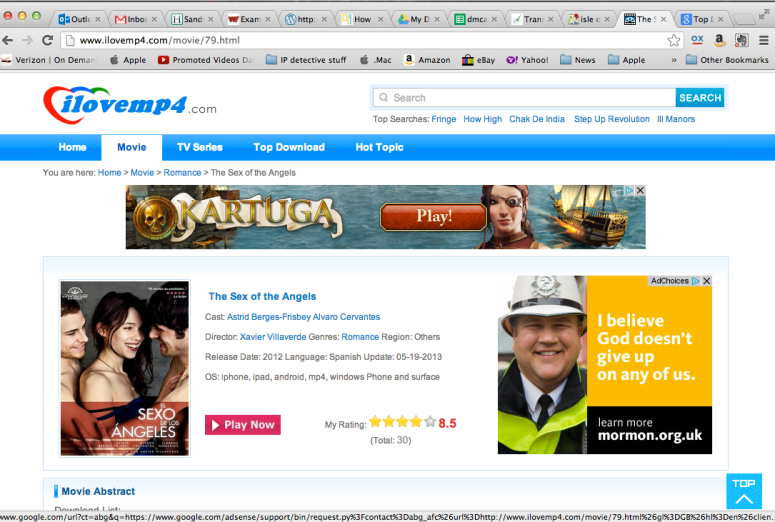
Unless I’m reading this html wrong it looks like adsense (google) helped serve your ad onto a Pirate Site against  a film called “Sex of the Angels.”  And this film is  about?… well maybe you should watch it.   Let’s just say it looks  like there is some “plurality” involved. Pretty sure you didn’t intend this!

Screen Shot 2013-05-31 at 7.58.18 PM