Artists Rights Watch – Monday May 13, 2013

MUSIC TANK:
* Follow The Money: Can The Business Of Ad-Funded Piracy Be Throttled?

Piracy is not some romantic fantasy of rebellious teenagers sharing music and sticking it to the man; it is brand-sponsored – with advertisements for major blue chip FTSE and Fortune 500 corporations being served systematically to the most nefarious corners of the Web on an industrial scale – keeping the likes of MP3Ape and 4Shared in business, while diverting much-needed revenues from the pockets of creators.

We are delighted to announce that David Lowery (Artist & Commentator ) and Theo Bertram (UK Policy Manager, Google ) will both be key speakers at this event.

WIRED:
* The Real Danger of Copying Music (It’s Not What You Think)

It is one thing to sing for your supper occasionally, but to have to do so for every meal forces you into a peasant’s dilemma: The peasant’s dilemma is that there’s no buffer.

ADLAND:
* David Lowery’s UGA study compiles Top 40 list of brands supporting piracy

But isn’t it strange that Dodge Dart, Victoria’s Secret, AT&T and the like are advertising in illegal places. But I guess they figure why not, because money. Right? Maybe. But the more Taplin and Lowery (and Adland, for that matter) calls you out on it, the greater the chances your reputation, and your brand will take a hit.

DIGITAL MUSIC NEWS:
* Dear Congress: Please Consider These Points for Your Massive Copyright Overhaul…
* The RIAA Just Made It Easier to Earn a Gold Plaque Than to Pay Rent…
* Pandora Tries to Convince a Musician That He Isn’t Getting Screwed…

From: Blake Morgan
To: Tim Westergren @ Pandora

Without us, you don’t have a business.

The idea of “allowing” us to “participate” in a business that is built solely on distributing and circulating our copyrighted work is like a grocery store saying it has an idea to “allow” the manufacturers of the goods it carries to get paid. The store isn’t “allowing” Del Monte to get paid for their cans of green beans, right? Of course not.

COPYHYPE:
* Do Kim Dotcom’s lawyers think he’s guilty? The answer may shock you.

Taking your case to the court of public opinion could be a sign that your case in a court of law is not going well.

THE TELEGRAPH:
* Ads for Australia’s big brands on-sold to piracy websites

The companies were unaware their ads were running on a piracy website before being alerted by news.com.au. And the list of those affected is long, with Westpac, Telstra, ING Direct, Allianz Insurance, The Iconic, ANZ, The Good Guys, Commonwealth Bank, AustralianSuper and Medibank included.

JUNKEE:
* Combating The Cost Of The Free Economy

You can see where this is going: paying little for digital goods, which make up the majority of all goods sold, means that profit margins drop dramatically. So even when we are using these legal alternatives like Spotify, iTunes and Amazon, the goods they are selling are vastly undervalued – are ebooks really worth only $0.99? We need to get used to paying more for digital goods than we have been, because they are worth a lot more than what we have been paying. They aren’t just files and bytes of information — they are the goods now. For the incredible convenience alone, what we pay should be a lot more than we do.

We also need to stop thinking in terms of physical objects, and thinking in terms of the man hours that went into creating what we are consuming – ultimately, the medium through which we consume it does not dull our engagement with or enjoyment of those works.

TONEDEF:
* The Campaign To Stop The World’s Major Brands From Funding Music Piracy

“Whenever we talk to a brand about the fact that their ads are all over the pirate sites, they’re like, ‘Oh, how did that happen?’” says Taplin. “We thought it would be easier if they knew what ad networks were putting ads on pirate sites — so they could avoid them.”

MUSIC TECH POLICY:
* From EFF to Obstruction of Justice
* The Copyright Principles Project: The Arrogant Thimblerig of Contrived Consensus
* The Copyright Principles Project Misses the Point on Copyright Registration–we have registration now, where is the benefit?
* YouTube Beats TV With 1 Billion Watching….TV, and loves them some payola, escorts and drugs

THE STREET:
* The Digital Skeptic: Here’s All the Music Money Lost to the Web

I could model, sample and tinker with the numbers, as long as I gave the association credit. But now, taxiing for takeoff flying to the once-and-future monument of decay — Venice, Italy — all I can say is, it’s stunning how sad a song these numbers sing.

MUSIC WEEK:
* Google and Trichordist to debate piracy profits in London

In 2013, it seems somewhat amazing that advertising from major corporations is still being served to unlicensed music services – especially when, in theory, creative and tech businesses could pragmatically and constructively tackle the practice.

HOME MEDIA MAGAZINE:
* Report: Copyright Enforcement Needed Outside U.S.

Although copyright law and other remedies under the [Digital Millennium Copyright Act] remain an effective tool against infringing services located in the United States, most, if not all illegal services have moved off shore to territories that lack effective enforcement mechanisms making it nearly impossible to slow the proliferation of infringing download and streaming services,” the report reads.

VOX INDIE:
* Kim Dotcom’s Truth = Nothing but Lies (mega lies)
* Steven Soderbergh Speaks out Against Online Piracy in his “State of Cinema” Address at SFIFF
* MacKeeper Software Ads Blanket Pirate Websites, Providing Profits to Thieves
* Google’s Hypocrisy-Seeing the World Through Green Colored Glasses

THE JAKARTA POST:
* Piracy may cost record firms $1.65m a day

The illegal download of Indonesian songs through the Internet has also caused a sharp decline in the sale of music CDs in the country. Last year, the sales of original music CDs totaled only 11 million copies, far lower than the average 90 million copies a year several years ago.

THE TIMES OF INDIA:
* International film piracy gang busted in Indore

For an year now, the duo were capturing full-length new Bollywood and Hollywood releases, first day-first show from major cine-plexes, Velocity and Sky Lounge section of Satyam Cineplex, and then sharing high-quality products via the internet with operators of pirated movie markets across the globe.

The duo was charging prices ranging between Rs 25,000 to Rs 3 lakh from the buyers, depending on the product quality.

MUSIC ALLY:
* Devo’s Kickstarter-funded DevoBots synthesizer iOS app goes live
* Event report: ‘Copyright in Crisis’ ft. PRS for Music and Pirate Party
* Hoping for Apple iRadio launch in June? Dealmaking continues…
* Music Dealers: ‘Brands are picking up the pieces of the music industry’

PRIVACY.NET:
* Why is Video Piracy Still Called A “Censorship” Problem?

Why is video piracy still called a censorship issue? And when did it become a threat to privacy? What I continue to find amazing is the fact that supporters of video piracy continue to refer to the attempts to block illegal access as “censorship.”

TORRENT FREAK:
* Pirate Bay Takes Over Distribution of Censored 3D Printable Gun
* Game Pirates Whine About Piracy in Game Dev Simulator
* Police Flex Muscles Again, Arrest Admin of Sweden’s #2 BitTorrent Site
* FileServe Hit With $1,000,000 Movie Piracy Lawsuit

THE WOMB:
* I Just Signed Copyright Alliance Petition Against Brand Sponsored Piracy

Look who’s Pirating now! University Of Georgia Music Business Program’s Preliminary Study Of Advertising On Copyright Infringing Sites.

Jonathan Taplin at  USC’s  Annenberg Center has spent the last few month studying which parts of the online advertising ecosystem are delivering advertising (and hence revenue) to unlicensed music sharing and streaming sites.   His study has caused quite a stir in the advertising and entertainment industry.  Jonathan recently asked me to corroborate some of his findings regarding which brands are advertising on these websites. These are  the results of my preliminary survey.

Over two weeks in April  I had a group of students at UGA note which “brands” were advertising on a small set of sites that stream and distribute my own music without permission or compensation.  I chose sites that featured my own music for a very specific reason:  I could be 100% certain that they were exploiting my material without permission and were hence illegitimate sites.  Third party sources agree with my assessment. For instance The Google Transparency Report has all but 1 of these sites  in the top 200 recipients of DMCA takedown notices.

The purpose of the preliminary study  is not to identify how these advertisements end up on these infringing sites, but simply which brands are appearing on these sites.  We realize that brands often do not realize that their ads are appearing on these sites.   We hope this information is useful to advertisers, advertising agencies and the entertainment industry.  We believe along with artists the brands are also victimized by this practice because they are not geting the quality advertising for which they’ve contracted. And often their ads  appear next to unseemly videos and ads for adult and fetish sites thus damaging the image and reputation of the brands.  We encourage the listed brands to conduct audits of those responsible for placing these ads.  If it’s not possible for those responsible  to comply with an audit demand you should be aware that it is then highly likely that your ads will continue appearing on these sites!

Below I’ve listed the brands in two orders.  The first lists the brands by frequency, adjusted by a “breadth” coefficient. I will explain this breadth coefficient in subsequent post, but because of the way advertisers “track” web users,  the sheer number of a brand’s ads on a website can be somewhat misleading.   For instance ads for the apartment complex “River One” seemed to follow a single student the entire two weeks, but none of the other students recorded an ad from this company. This does not mean that “River One” isn’t in fact funding sites that exploit artists without compensation, it’s just a number of factors could be distorting their overall rankings.  Hence the breadth adjustment to dampen some of these effects.

In the following days  I’ll publish my rather simple  methodology and links to raw data.  Items that expose students identity will be redacted.

University Of Georgia Music Business Program Top 40 Brands Advertising On File Infringing Sites- Preliminary Survey (Breadth Adjustment):

Based on sample of 1,851 pageviews.

April 10-26 2013

rank Top Advertisers instances % “breadth” frequency adj for breadth
1 Country Financial 157 8.5% 100.00% 8.48%
2 Become.com 89 4.8% 100.00% 4.81%
3 AT&T 60 3.2% 100.00% 3.24%
4 Champion roofing 51 2.8% 100.00% 2.76%
5 State Farm 47 2.5% 75.00% 1.90%
6 Target 39 2.1% 87.50% 1.84%
7 Georgia Natural Gas 31 1.7% 100.00% 1.67%
8 AAA 29 1.6% 87.50% 1.37%
9 Rooms To Go 33 1.8% 62.50% 1.11%
10 Allstate 20 1.1% 100.00% 1.08%
11 Transunion 24 24 1.3% 75.00% 0.97%
12 H&R Block 18 1.0% 75.00% 0.73%
13 Pirate storm 26 1.4% 50.00% 0.70%
14 Quibids.com 13 0.7% 100.00% 0.70%
15 Coca-Cola/American Idol 16 0.9% 75.00% 0.65%
16 The New York Times 16 0.9% 75.00% 0.65%
17 One River Place (Atlanta GA) 94 5.1% 12.50% 0.63%
18 Progressive insurance 22 1.2% 50.00% 0.59%
19 Xfinity 15 0.8% 62.50% 0.51%
20 Nationwide 15 0.8% 50.00% 0.41%
21 Suntrust 14 0.8% 50.00% 0.38%
22 The Gold Coast Casino 11 0.6% 62.50% 0.37%
23 Norton 9 0.5% 62.50% 0.30%
24 Just fab boots 14 0.8% 37.50% 0.28%
25 Wartune 10 0.5% 50.00% 0.27%
26 Bing 5 0.3% 100.00% 0.27%
27 Dominos 15 0.8% 25.00% 0.20%
28 Karaolke Pink 28 1.5% 12.50% 0.19%
29 Charter 7 0.4% 50.00% 0.19%
30 Google chrome 12 0.6% 25.00% 0.16%
31 Sea World Busch Gardens 6 0.3% 50.00% 0.16%
32 Victoria’s Secret 11 0.6% 25.00% 0.15%
33 Royal Carribean 11 0.6% 25.00% 0.15%
34 Publix 7 0.4% 37.50% 0.14%
35 Dodge dart 20 1.1% 12.50% 0.14%
36 Bodies The Exhibtion 10 0.5% 25.00% 0.14%
37 The Heist 16 0.9% 12.50% 0.11%
38 HTC 5 0.3% 37.50% 0.10%
39 Pull-ups 5 0.3% 37.50% 0.10%
40 Spirit Airlines 5 0.3% 37.50% 0.10%

Unadjusted for “breadth.”

rank Top Advertisers instances % “breadth” frequency adj for breadth
1 Country Financial 157 8.5% 100.00% 8.48%
2 One River Place (Atlanta GA) 94 5.1% 12.50% 0.63%
3 Become.com 89 4.8% 100.00% 4.81%
4 AT&T 60 3.2% 100.00% 3.24%
5 Champion roofing 51 2.8% 100.00% 2.76%
6 State Farm 47 2.5% 75.00% 1.90%
7 Target 39 2.1% 87.50% 1.84%
8 Rooms To Go 33 1.8% 62.50% 1.11%
9 Georgia Natural Gas 31 1.7% 100.00% 1.67%
10 AAA 29 1.6% 87.50% 1.37%
11 Karaolke Pink 28 1.5% 12.50% 0.19%
12 Pirate storm 26 1.4% 50.00% 0.70%
13 Transunion 24 24 1.3% 75.00% 0.97%
14 Progressive insurance 22 1.2% 50.00% 0.59%
15 Allstate 20 1.1% 100.00% 1.08%
16 Dodge dart 20 1.1% 12.50% 0.14%
17 H&R Block 18 1.0% 75.00% 0.73%
18 Coca-Cola/American Idol 16 0.9% 75.00% 0.65%
19 The New York Times 16 0.9% 75.00% 0.65%
20 The Heist 16 0.9% 12.50% 0.11%
21 Xfinity 15 0.8% 62.50% 0.51%
22 Nationwide 15 0.8% 50.00% 0.41%
23 Dominos 15 0.8% 25.00% 0.20%
24 Suntrust 14 0.8% 50.00% 0.38%
25 Just fab boots 14 0.8% 37.50% 0.28%
26 Quibids.com 13 0.7% 100.00% 0.70%
27 Google chrome 12 0.6% 25.00% 0.16%
28 lowermybills.com 12 0.6% 12.50% 0.08%
29 The Gold Coast Casino 11 0.6% 62.50% 0.37%
30 Victoria’s Secret 11 0.6% 25.00% 0.15%
31 Royal Carribean 11 0.6% 25.00% 0.15%
32 Wartune 10 0.5% 50.00% 0.27%
33 Bodies The Exhibtion 10 0.5% 25.00% 0.14%
34 Norton 9 0.5% 62.50% 0.30%
35 Colorado tech 8 0.4% 12.50% 0.05%
36 Charter 7 0.4% 50.00% 0.19%
37 Publix 7 0.4% 37.50% 0.14%
38 Bruno Mars 7 0.4% 12.50% 0.05%
39 Sea World Busch Gardens 6 0.3% 50.00% 0.16%
40 Alzhiemer association 6 0.3% 25.00% 0.08%

Permission, Privacy and Piracy : Where Creators and Consumers Meet

It’s amazing how situationally dependent perspectives about the internet appear to be that something as fundamental as consent (aka permission) would be controversial. Much ink has been spilled over a consumers right to privacy in the digital age and that concern now extends beyond the internet to personal privacy fears over the potential misuse of domestic drones.

The irony of course about all the hysteria being discussed about drones (military, commercial or private) is that the greater threat to personal privacy is much more local than an unmanned aircraft at 14,000 feet, or even a home built quad copter. The real threat that will bring the real world to the same persistent observation (and cataloging) of our daily lives will be Google Glass (where is the EFF when you need them?).

Google Glass is a device that records to the cloud a persistent stream of visual and audio data as the user experiences it. Anything, and everything a person would have experienced as a personal and private experience will be recorded, cataloged, geo-tagged, and stored online. Automated face recognition technology will make it less possible to be anonymous in the real world than it currently is in the online world via the use of avatars.

But what does this have to do with piracy? Specifically what does this have to do with content piracy? How are privacy and piracy related? It’s simple, both privacy and piracy revolve around how we view the importance of the individuals right to grant consent. An individual should have the right to grant the specific permissions to access information about us and how that information can be used. Agreed?

This is the same fundamental individual right that governs the protection of a creators work from illegal exploitation. Permission is the cornerstone to a civilized society. Maybe ask these women in Texas about it?

Below is a recent example of how ordinary people, who are also creators got a first hand lesson in “permissionless innovation” aka, “you will be monetized” or “all ur net proceeds now belong to us.”

When Instagram attempted to change it’s terms of service that would allow the company to monetize the work of the individual without the individuals permission, consumers went ballistic. It seems that permission is not such a difficult concept to grasp when people are personally effected. This is why privacy is a much more universal issue, because everyone is effected by it.

It is strangely ironic (or not really) that the companies who were so quick to threaten an “internet blackout” really have no such motivation in detailing how individual personal data is being collected and monetized. Even when that data is from children. So much for being open and transparent.

What’s worse is that Google has been repeatedly caught red handed violating the privacy of not just it’s users but also unsuspecting consumers. Two cases that immediately come to mind are the Safari privacy scandal and resulting settlement and the much broader real world illegal data collection scheme known as Wi-Spy.

So, just like everyone understands the basic fundamental right to privacy is built on the permissions we grant by consent to other citizens, businesses and institutions, individual creators also have the same right to grant permission to who and how their work can be exploited (yes their work, as in labor) for profit and gain.

This is even more important when those doing the profiting are corporations and businesses like Google, various advertising networks and others.

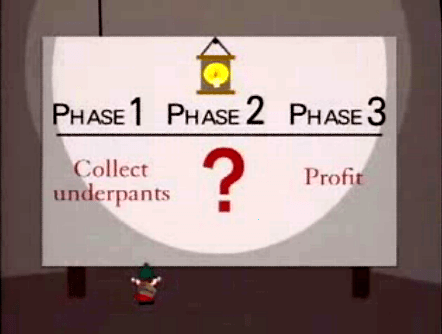
The Underpants Gnomes. Pandora and the Return of the Internet Radio Fairness Act.

Gnomes_plan

(image courtesy Southpark)

In 1998 Southpark presciently lampooned the entire Dot Bomb bubble in an episode  called The Gnomes.  Essentially the Gnomes had a business plan:

Step One: Collect Underpants.

Step Two: ?

Step Three: Profit.

The excellent Seeking Alpha writer Stephen Faulkner last year  pointed out the similarities between Pandora’s business strategy and the Underpants Gnome’s business model.

However Pandora did eventually come up with a step 2.  It’s called the Internet Radio Fairness Act.   Basically this bill would ask the government to step in and mandate lower royalties to artists.   Essentially a bill that would largely benefit  ONE publicly traded company: Pandora  (although curiously Pandora terrestrial radio competitor Clear Channel is signed onto the bill along with Google,  what’s that about?,  Here is a wild guess. Pandora is for sale.)

So basically this is the Pandora Underpants Business Model:

Step 1 Collect Users

Step 2  Ask Congress to pass a bill that benefits a single private company , by mandating lower royalties to artists for Pandora.   Or perhaps more accurately Artists are forced by government  to subsidize Pandoras bad business model.

Step 3 Profit.   ( Stockholders cash out in sale to Clear Channel or Google?).

++++++++++++++++++++++++++++++

But here’s the thing.  The so called Internet Radio Fairness Act was shot down in Congress, largely due to grassroots efforts by artists.   But the rumour is the bill is coming back.   And I’m gonna make a fairly educated guess as to what changes are gonna be in the bill.

While at a social event in Washington DC a rather transparent aparatchik of the telecommunications industry suggested a couple changes to the bill that might possibly meet the approval of the artists.   Essentially it was this:

Why not lower Pandora’s royalties but give a larger percentage to the artists and less to the record labels.

Okay, so yeah I fucking fell off the turnip truck yesterday and that sounds like a really good deal! Sign me up!!

1).  If IRFA passed, royalties from Pandora could be cut 85%.  Even if artists got 100% of the royalties  and record labels got zero we’d still take a whopping paycut of 70%.

2) Like most artists nowadays I own my own “masters” .  That is,  essentially I am the record company.   Most independent artists are their own record labels.  Therefore for the vast majority of artists this is exactly the same paycut and  amounts to the  Internet Radio Fairness Coalition saying “Artists are stupid and they’ll never catch on”.

(Ladies/Guys: after surviving in the music business for 30 years it should be a assumed that I have a finely tuned bullshit detector.)

So I’m gonna take a wild guess here:

The Internet Radio Fairness Act comes back next month with exactly this change.  They think they are gonna be able to divide us from record labels. Not realizing that most artists are the record labels. A divide and conquer strategy. Let’s hope I’m not right. But just in case.  Be ready.

Once Again Techdirt Has Nothing Intelligent To Say So They Just Resort To Mocking Musicians for Being from “Crappy Town” in Southwest Virginia.

Why does anyone take Techdirt seriously? How are  Techdirt writers any different than your typical cyberbullies and trolls on some abusive reddit thread?   Editor Mike Masnick has repeatedly made the  claim (unsupported by the objective facts) that he is on the side of musicians, especially those independent musicians that are trying to make it outside of the major label system.  Yet when a group of independent musicians working outside the major label system from a relatively poor but culturally rich region of Southwest Virginia take a position that he doesn’t like?   His blog (which is based in the  wealthy elitist  cultural wasteland of Silicon Valley) resorts to mocking these artists for being from some “crappy” part of America.  I quote the subtitle of the article:

“from the we-gotta-go-to-the-crappy-town-where-i’m-a-hero! dept”

Unfortunately this is the way that Techdirt and Masnick ALWAYS operate.  The idea is that through mocking and name calling they will intimidate into silence  these particular musicians – and any others  thinking of  joining them. That’s what he did to Lily Allen. That’s what he has repeatedly tried to do to me (to the point it’s beginning to resemble cyberstalking).

Ultimately Masnick et al are not really for freedom of speech. They are anti-democratic and elitist at heart. Over and over again we’ve watched he and his writers stir up and allow a frenzy of name calling and ugly threats in the comment section at Techdirt. He rarely seem to  moderate offensive, slanderous or threatening comments.  It’s a hatefest by design. Intimidate and silence.  It’s like lord of the flies over there. Few people understand that this seems to be the point of Techdirt. Not the poorly written articles but the manipulation of an ignorant and hateful mob in the comments section.  These are the freehadist foot soldiers that spread this hatred elsewhere on the web.

Now Masnick and Techdirt aren’t always trying to stifle all speech. Just speech they don’t like.  For instance when it comes to criminal conspiracies started by “Keep Sweden Swedish” rich extremist xenophobes who exploit artists without compensation (The Pirate Bay)  Masnick et al are quick to find common cause with them on some far fetched “freedom of speech” or “censorship”  grounds. But ordinary US citizens from the Southwestern Virginia Songwriters Association get a very different treatment.  These songwriters apparently had the gall to say something that might-barely-possibly-slightly threaten the power,influence and profits of Masnick’s powerful Silicon Valley sponsors.  So right on cue Techdirt resorts to name calling and  attempts to create viral mockery. Because usually this silences artists.  IMHO the silicon valley demagogues that make up the writing staff of Techdirt are just the cowardly cyber versions of the fascists of old who used  mobs to intimidate dissidents into silence (or worse). Make no mistake that’s what they are methodically attempting to do here: silencing critics.  Sure the mob is virtual  but it’s still a mob.

And I for one do  not use the term fascist lightly.  But sadly in this case the comparison applies. Check it out. Techdirt is the place where these pathetic little Gollums go to feel important and “part of a group” by treating others cruelly.  To feel superior than those ignorant “others.”  Those people from “crappy towns.” Those “bad” people who are threatening “our”  internet way of life.   Masnick has created a safe place for these writers to dehumanize and deligitimize others by insinuating they are not “real” and therefore much easier to treat disgracefully. I quote from the story:

“members of the Southwest Virginia Songwriters Association Seriously? That’s a thing?”

“So congratulations, Songwriters Association of Wherever.”

There can’t possibly be songwriters in Southwestern Virginia!  These people aren’t real, therefore treat them as non-humans.

You don’t even have to read between the lines to conclude this. Just read the comments, Masnick’s Vulgus technoridicae do it for you.

You got to wonder what is wrong with this particular writer that chose  to join team Masnick.  Did he dream his whole life of working for a blog that methodically mocked the weak and powerless on behalf of the rich and powerful? Was that his goal in life?

And what about the trillion dollar internet industry that is so chicken-shit afraid of a handful of musicians petitioning their elected representative  that they seemingly fund people like Masnick to specifically  go after ordinary citizens expressing opinions that they find inconvenient.  See the Google vs Oracle Amended Shill List.

But here is the funny part.  Despite suffering from high self esteem Masnick and his writers are completely inept and  spectacularly ignorant. They’ve probably caused more problems for their cause/paymasters than they have prevented.  Follow along:

The subtext of the Techdirt piece is this:

Bad musicians from  some backwoods part of America that unlike the technology industry doesn’t deserve to be represented in the corridors of power in washington DC.

IGNORANT:

1)The music of  Southwestern Virginia and the Southern Appalachians is the root of much of modern American music.  Bands selling out Red Rocks, The Fillmore, Madison Square Garden this summer are playing songs that originate in this region. And it’s not just obvious mountain, folk and country blues music that originate from this region. Acts like  Sparklehorse, and  Those Darlins have roots here.  Masnick and his staff are totally ignorant  of this easily googled fact.

2) This region is home to some of the most popular and longest running music festivals in the US.  Everything from The Floydfest to The Galax Fiddler Convention. Each summer hundreds of thousands of people trek here from all over the world for the dozens of music festivals.  Again google it.  Look at those links.  You might be surprised if you think music festivals in this region are  just mountain fiddling and enormously popular country stars.

One would assume Goodlatte and his staff have pride in the musical heritage of Southwestern Virginia.

INEPT

3) The Congressman, Bob Goodlatte, the head of the Judiciary Committee represents many of the “crappy towns” in Southwest Virginia right?  During hearings earlier this year Rep Goodlatte asked Maria Pallante  from the Copyright Office “Why is the debate over copyright so polarized?”  This is why the debate is so polarized! Blogs like Techdirt that  refer to his district as a “crappy town” and the only place he could possibly “be a hero!”

This is how it reads in the district of the very powerful  House Judiciary Chairman:

Elitist  Northern Californian Liberals making fun of Southwestern Virginia as an unimport region of “crappy towns” and unintelligent people.

If Google or the CCIA are still paying Masnick, they really are not getting their money’s worth.  Or maybe they are, who knows.

Artists Rights Watch – Monday April 22, 2013

POLITICO:
* Creators need Copyright Protection

So let’s agree that certain principles should be the foundation of any update of the Copyright Act:

Creators should receive fair compensation for their work when it is exploited. Too often we’ve heard that new and old businesses should be allowed to use creators’ works at a below-market (or zero) royalty rate to protect a flawed business model. Creators want to be partners with distributors, but they should never be forced to subsidize those businesses.

A right is meaningless without reasonable enforcement.Without effective enforcement, copyrights will have little value. If creators are to benefit from the fruit of their labor, they must have confidence that their work will be protected in the constantly evolving digital marketplace.

Freedom of expression depends on copyright. Copyright gives individual creators the freedom to choose how they express themselves. With copyright, writers and artists can decide how and when to use their work. They can freely give their work to the public, to a cause they believe in, or they can try to earn a living from it. Consent is a critical part of the creator’s freedom.

HUFFINGTON POST:
* Online Piracy, Following The Money
* Grammys On The Hill 2013: Jennifer Hudson Honored By Clive Davis, Yolanda Adams, Kara DioGuardi

Recognizing that proceeds from Grammys on the Hill benefit the Grammy Signature Schools Program, which fights to keep music education in schools, Hudson noted the importance of her own childhood music teachers, admitting, “That why I had perfect attendance in school — because I could not miss music class. I didn’t really care about any other class — even on my lunch break, I would go to music.”

MUSIC TECH POLICY:
* How YouTube “Monetizes” Your Songs to Sell Illegal Goods

Note three things:  The video is “user generated content” (“user” in this context means a YouTube user not a drug user.  We think.)

Second, the video has a music bed.  Ironically, it is “Teardrop” by Massive Attack which is also the theme from the House television show.  I seriously doubt that Massive Attack has any idea that their song is being used to sell drugs through this sketchy video.

We know that YouTube knows the song in the video because they have a link to it by name on Google Play.

Finally, the video is monetized–ads are playing on the page, pre-roll before the video, and inside the video–in fact, the same ads are in each, so the campaign is coordinated.

ZOE KEATING INSTAGRAM:
* Me, Barbara Lee, Sheila E and Melvin Watt @ U.S. Capitol – House Of Representatives

VENTURE BEAT:
* Sarah Hanson, the 19-year-old teen who auctioned 10% of her income for a $125K startup investment, may not exist

DIGITAL MUSIC NEWS:
* If Only the Tech Industry Understood the Music Industry They Want to ‘Replace’…
* Just Got My YouTube Royalty Check In the Mail…
* How Artists Who Support “Piracy” Can Avoid Looking Like Hypocrites…

TORRENT FREAK:
* Hijacker Tears Large BitTorrent Site Apart, Succeeds Where U.S. Authorities Failed
* Interpol Probe Targets Funds of Major File-Hosting Services
* Pirate Bay Founder Charged With Hacking Companies and a Bank

THE DEAN’S LIST:
* Music, Copyright and New Technology in the News From a Creator’s Perspective

REUTERS:
* New anti-piracy law should keep Spain off U.S. watch list – minister

Spain is working on a new anti-piracy law which will be robust enough to keep the country off a U.S. watch list of copyright violating countries, Education and Culture Minister Jose Ignacio Wert said.

NIGERIAN TRIBUNE:
* Spinlet to proffer solution for music piracy

Resistance is Futile: Google Says Don’t Fetishize Royalties

Music Technology Policy

If I worked for a company like Google that got slammed by Members of Congress for promoting “sex club” apps on Android and YouTube, I’d be a bit careful about using the word “fetish” to describe anything, even metaphorically.

But Google spends hundreds of millions in legal fees annually to try to force creators into submission and induce a state of learned helplessness so using “fetish” to describe a business that Google wants to compete with shouldn’t surprise anyone.  Evidence?  Here’s a few recent examples, backing an appeal by the adjudicated thief Isohunt, receiving well over 19 million takedown notices a month for links to infringing sites that Google drives traffic to in their monopoly search engine, supporting brand sponsored piracy, trying to disallow the authors ability to sue as a class in the Google Books case so that authors would have to individually bring millions of…

View original post 452 more words

Google’s Charm Offensive Comes to Nashville Behind YouTube Front: But Where is the Straight Count?

Well worth the read.

Music Technology Policy

It’s really important that we protect the rights of really good looking people in this society,”

Attorney Andrew Bridges of Fenwick & West (frequently representing Google) quoted at Beautiful Person Derek Khanna’s SXSW Panel

______________________________________

First They Send the Missionaries

If you read much about the expansion of the British Empire, you will begin to get the idea: First they send the missionaries.

This is the thought that went through my mind a few years ago when I was on a panel with Alex Curtis from Public Knowledge at the Leadership Music Digital Summit in Nashville.  (MTP readers will remember this is the panel at which we formed the rule–don’t participate in panels when your fellow panelists are using iPads on the stage.  They may be tweeting questions to a ringer in the audience who then asks questions that the Tweeting Panelist wants to answer.)

That summit was…

View original post 1,645 more words

Google’s Charm Offensive Comes to Nashville Behind YouTube Front: But Where is the Straight Count?

Music Technology Policy

It’s really important that we protect the rights of really good looking people in this society,”

Attorney Andrew Bridges of Fenwick & West (frequently representing Google) quoted at Beautiful Person Derek Khanna’s SXSW Panel

______________________________________

First They Send the Missionaries

If you read much about the expansion of the British Empire, you will begin to get the idea: First they send the missionaries.

This is the thought that went through my mind a few years ago when I was on a panel with Alex Curtis from Public Knowledge at the Leadership Music Digital Summit in Nashville.  (MTP readers will remember this is the panel at which we formed the rule–don’t participate in panels when your fellow panelists are using iPads on the stage.  They may be tweeting questions to a ringer in the audience who then asks questions that the Tweeting Panelist wants to answer.)

That summit was…

View original post 1,645 more words