@MikeHuppe: Protecting the Creative Class

Guest post By Mike Huppe
President & CEO at SoundExchange

Creators – whether they be writers, actors, or musicians – are the heart of the entertainment industry. They inspire us with their words, move us with their performances, and get our blood pumping with their beats. 

Now two of the major unions representing creators – the Writers Guild of America (WGA) and the Screen Actors Guild (SAG-AFTRA) – have gone on strike to make the case for better pay and residuals, improved working conditions, fairer treatment in the age of streaming, and protections against the widespread use of artificial intelligence to replace creators. 

This is the first time that writers and actors have gone on strike at the same time since 1960, and it has brought the movie and TV industry to a virtual standstill. After cable increased content to fill a new crop of channels, streaming platforms fueled an explosion of new series and features to feed a new business model. Now, production has ground to a halt and the availability of new movies and shows will dwindle in the coming days, weeks, and months.

At its core, this dispute is about ensuring that, even as business models evolve and change, creators are treated fairly so they can continue to do the work that brings meaning to them and joy to us.

At SoundExchange, we love creators. We champion their work. We’ve seen the music industry go through technology-driven disruption (just as the motion picture industry is now), and we were created to ensure that streaming music business models enable creators to make a living doing what they do best. We’ve been fighting for 20 years to build a fairer, simpler, and more efficient music industry – by successfully increasing royalty rates across a variety of platforms; by holding accountable those who seek to cheat creators; by increasing the speed and transparency of payments, and by scoring a big win for music creators with the Music Modernization Act in 2018 (which provide comprehensive music licensing reform).

And we continue to fight these battles.

As streaming matures and new royalty models are debated, and as technology platforms evolve in Web3 and the metaverse, SoundExchange will remain a strong and vocal voice to ensure creators are fairly compensated. As artificial intelligence improves and matures at an astounding rate, SoundExchange became a founding member of the Human Artistry CampAIgn to demand that the rights of human creators are at the center of any copyright and intellectual property decisions, and we are proud that both SAG-AFTRA and the Writers Guild of America (WGA) are among the coalition’s members.

And it’s worth noting that music performers are still not compensated – at all — for their work when played on AM/FM broadcast radio. For this reason, SoundExchange is a driving force in the effort to convince Congress to act on the American Music Fairness Act, which would require multi-billion-dollar radio corporations to pay performance royalties like digital streaming platforms do.

So, to the creators out there on strike, we say this. We stand with you and hope that these disputes can be resolved quickly in a way that supports fair treatment, compensation, and protections for creators. And for those of you who are registered with SoundExchange, we will continue to work every day to make sure that you receive the digital royalties that you are due in a timely manner. 

We know this mission matters more now than ever.

[This post first appeared on LinkedIn]

Five Points for Potential AI Framework Agreements

By Chris Castle

This post first appeared on MusicTechPolicy

When you see Big Tech start to make Newspeak noises about wanting to license creative works for artificial intelligence, it’s well to remember a couple facts about how they treat people, business practices that they don’t talk about at parties. Or to Congress.

Take their supply chain, particularly their manufacturing supply chain in China where some of all their products use slave labor. And the cobalt that goes into every battery powered device like your smartphone is obtained through the equally Newspeak “artisanal mining” otherwise known as impossibly poor children mining cobalt by clawing it out of the dirt with their bare hands. You know, “artisanal”. (Read Cobalt Red by Sid Kara for that story.). Not to mention the grotesque and parasitic waste of electricity and the resources that provide it whether they are crowding out the public investment in renewables or driving coal powered generators. They don’t talk about it because they feel entitled to all of it which is to be expected from that feeder school for the Silicon Valley elites built with blood money from the Central Pacific Railroad.

So when you sit down at the negotiating table with these people, this is who they really are. That realization tells you a few things, but it mainly tells you they simply cannot be trusted in either life choices or in business choices.

Universal has taken a real leadership role in the AI negotiations that has both respected their artists and songwriters and given teeth to the principles of the Human Artistry Campaign. First of all, the company has made it clear that they are going to support their artists and songwriters in having a meaningful seat at the table. They will not send their artists to the charnel house. The only artists who participate will be the artists who decide to participate–opt in rather than Google’s preferred “opt out” structure which relies on the abuse of various safe harbors at scale. 

It appears that until such time as both the artists and songwriters and Universal are comfortable with the integrity of the creative and business model of YouTube’s AI music suite of tools, there’s no deal. Negotiations presumably will continue so there may be at least a commercial frameworks. 

To that end, here are five points that might prove useful.

  1. Artists and songwriters need to be at the table: One takeaway from the frozen mechanicals experience is how necessary it is for the creators to be included–not through an organization but actual individuals who speak for themselves and are not influenced by lobbyists.  Universal has proven that this is possible. This is a huge advancement in label-artist relations and publisher-writer relations, particularly because it’s obvious from the creators who stepped forward that these are articulate independent thinkers who are not going to tow the party line.  That is the whole idea. If you don’t trust your artists and writers enough to give them freedom to speak their minds, then let’s face it–there’s something wrong with your business model.
  2. All AI licenses should be opt in: Most of YouTube’s many artist relations issues arise from artists not having the right and ability to withhold their work from whatever the platform is. This is particularly true with UGC and advertising supported platforms. When you have poured out your soul in a recording that ends up with ads for drugs or miracle hair replacement treatments, it’s deflating and if anyone asked for approval, you’d probably decline. Which is why you negotiate marketing restrictions that prevent your music being used in advertising.
  3. No blind check deals and no “big pool” royalties: We haven’t gotten to the royalty rates yet, but there will be riots in the streets if anyone tries to perpetuate YouTube-style accountings, the grotesquely unfair TikTok blind check deals or “big pool” market centric royalties. AI gives us all a chance to get it right and build a new system that is artist centric. It’s encouraging that Lucian Grainge’s blog post announcing the relationship with YouTube is entitled “An artist centric approach to AI innovation” which is consistent with his prior statements about making streaming royalties more fair.
  4. Ability to track and account is a precondition: It should go without saying that in order to have meaningful royalty accounting, the service must have the ability to track and account. This is especially challenging in AI given the “training” issues. I will be pleasantly shocked if Google engineers designing the music AI tools have not entirely ignored tracking and accounting which they typically have viewed as a bug, not a feature. This is what gives rise to the blind check deals and other unworkable approaches which are most definitely not “artist centric.” Accordingly, the need to issue per work reports is essential.
  5. Audits should be much more frequent: This new product is a chance to revisit the standard approaches to auditing which have unfortunately become perpetuated in digital deals and most prominently in the Music Modernization Act (Title I). There is not much difference between the MMA audit rights and the audit clause from a 30 year old record deal notwithstanding the vast difference in commerce between the two. With AI, not only have the DSPs blown up the album to a commercial singles world, they are now trying to blow up the single to mind-numbing fragmentation. Potentially, this world will be like selling stems. This ushers in a whole new need for minimum viable data laws and enforcement for using standard identifiers.

There will be many other issues to address, but I think if we don’t address these key points we’ll find ourselves to be artisanal workers scratching out a living for ChatGPT. 

Press Release: Universal and YouTube Announce AI Music Principles Consistent with Human Artistry Campaign and Artist Advisors

NEW YORK, Aug. 21, 2023 /PRNewswire/ — Today YouTube published a first ever set of AI music principles and launched the YouTube Music AI Incubator, kicking off with artists, songwriters and producers from Universal Music Group. YouTube’s three fundamental AI music principles are rooted in its commitment to collaborate with the music industry alongside bold and responsible innovation in the space. 

YouTube CEO, Neal Mohan, shared the platform’s AI music principles and his vision for how the framework will enhance creative expression while also protecting artists on the platform. The principles include:

  • Principle #1: AI is here, and we will embrace it responsibly together with our music partners. As generative AI unlocks ambitious new forms of creativity, YouTube and our partners across the music industry agree to build on our long collaborative history and responsibly embrace this rapidly advancing field.  Our goal is to partner with the music industry to empower creativity in a way that enhances our joint pursuit of responsible innovation. 
  • Principle #2: AI is ushering in a new age of creative expression, but it must include appropriate protections and unlock opportunities for music partners who decide to participate. We’re continuing our strong track record of protecting the creative work of artists on YouTube. We’ve made massive investments over the years in the systems that help balance the interests of copyright holders with those of the creative community on YouTube.
  • Principle #3: We’ve built an industry-leading trust and safety organization and content policies. We will scale those to meet the challenges of AI. We spent years investing in the policies and trust and safety teams that help protect the YouTube community, and we’re also applying these safeguards to AI-generated content. Generative AI systems may amplify current challenges like trademark and copyright abuse, misinformation, spam, and more. But AI can also be used to identify this sort of content, and we’ll continue to invest in the AI-powered technology that helps us protect our community of viewers, creators, artists and songwriters–from Content ID to policies and detection and enforcement systems that keep our platform safe behind the scenes. And we commit to scaling this work even further. 

In a rare guest YouTube blog Universal Music Group Chairman and CEO, Sir Lucian Grainge – who helped shape the principles – shared his vision for an artist centric approach to generative AI and how partnering with YouTube would best position the music industry for success as this technology continues to develop. Excerpts from the blog post include: 

  • “Our challenge and opportunity as an industry is to establish effective tools, incentives and rewards – as well as rules of the road – that enable us to limit AI’s potential downside while promoting its promising upside. If we strike the right balance, I believe AI will amplify human imagination and enrich musical creativity in extraordinary new ways.”
  • “Our enduring faith in human creativity is the bedrock of Universal Music Group’s collaboration with YouTube on the future of AI. Central to our collective vision is taking steps to build a safe, responsible and profitable ecosystem of music and video—one where artists and songwriters have the ability to maintain their creative integrity, their power to choose, and to be compensated fairly.”
  • “Today, our partnership is building on that foundation with a shared commitment to lead responsibly, as outlined in YouTube’s AI principles, where Artificial Intelligence is built to empower human creativity, and not the other way around.  AI will never replace human creativity because it will always lack the essential spark that drives the most talented artists to do their best work, which is intention. From Mozart to The Beatles to Taylor Swift, genius is never random.” 

Today’s announcement also introduced YouTube’s AI Music Incubator, a program that will bring together some of today’s most innovative artists, songwriters, and producers to help inform YouTube’s approach to generative AI in music. The incubator will kick off with a genre-spanning cohort of creatives from Universal Music Group, that includes Anitta, Björn Ulvaeus, d4vd, Don Was, Juanes, Louis Bell, Max Richter, Rodney Jerkins, Rosanne Cash, Ryan Tedder, Yo Gotti, and the Estate of Frank Sinatra, amongst others. 

  • Björn Ulvaeus shares: “While some may find my decision controversial, I’ve joined this group with an open mind and purely out of curiosity about how an AI model works and what it could be capable of in a creative process. I believe that the more I understand, the better equipped I’ll be to advocate for and to help protect the rights of my fellow human creators.”
  • Juanes shares: “Music is fundamental to the human experience – culturally and personally. For artists, our music is part of who we are. Given music’s role, artists must play a central role in helping to shape the future of this technology.  I’m looking forward to working with Google and YouTube as part of this influential group of UMG artists to assure that AI develops responsibly as a tool to empower artists and that it is used respectfully and ethically in ways that amplify human musical expression for generations to come.”
  • Max Richter shares: Like every new technology, AI brings with it opportunities, but it also raises profound challenges for the creative community. The tech world and the music distribution ecosystem are quickly evolving to embrace this transformative technology and, unless artists are part of this process, there is no way to ensure that our interests will be taken into account. We have to be in this conversation, or our voices won’t be heard. Therefore, I’m very happy to be part of the “artist incubator” which will allow me to advocate for the interests of the creative community in the applications of AI to music and music distribution.” 

Neal Mohan Blog : https://blog.youtube/inside-youtube/partnering-with-the-music-industry-on-ai/
Sir Lucian Grainge Guest Blog: https://blog.youtube/news-and-events/an-artist-centric-approach-to-ai-innovation/

I Grift Therefore I Am: Jared Polis Supports Silicon Valley’s “Speculative Tickets” Grift in Colorado

If you had a chance to watch the CLE panel that David Lowery, Mala Sharma and Chris Castle did for the University of Texas School of Law CLE last week, you’ll remember that the panel spent a good deal of time talking about “speculative tickets”. In fact, the title of the panel was “When is Ticketing Like Pork Bellies?” which was a direct reference to the similarities between speculative tickets and commodities futures contracts (like pork bellies).

The way this grift works is that somebody (or some thing in the case of bots) offers to sell a promise to sell a ticket in the future. The trick is that the ticket is not yet on sale anywhere but certain dates have been announced so it will be on sale. This could be any ticket, like a concert tour or a sporting event like the Super Bowl, the Rose Bowl, the World Series, and so on.

This is actually worse than a pork belly contract, because you know that the pork bellies exist when you buy the contract, you just don’t know the price. Market events could cause the price to fluctuate, but there will be some pork belly available somewhere. So to even call it a ticket is a misnomer. It’s a promise to sell something that may exist to get all Cartesian about it.

The grifter prices the speculative ticket promise at a premium, naturally. Some of them actually promise an actual seat, some promise a certain section or block of seats. They then list that ticket on a ticket reseller market place like Stubhub which was most definitely lobbying in force for the nonsensical Georgia ticketing bill that failed and which we assume is behind all these bills that keep popping up like syphilitic warts.

After the ticket is listed, a fan buys the speculative ticket promise and waits to get their actual tickets. And this is the really insidious part. As David noted on our panel, the grifter’s transaction is like covering on a naked short in short selling. Naked shorts are a very risky thing because unlike with speculative tickets, the market enforces the trade. You will pay on that bet unlike speculative tickets where there is no market enforcement except the occasional prosecution by a state attorney general or the FTC.

It seems impossible for the speculative ticket short seller to obtain the actual tickets without using bots. Plausible, perhaps, but seems very unlikely. Thanks to Senator Marsha Blackburn and Richard Blumenthal and their BOTS Act, federal law prohibits using bots, but again, it’s a science of getting caught. Senator Blackburn recently complained quite rightly that the FTC is not sufficiently enforcing the BOTS Act.

If the grifter cannot come up with the tickets, it is apparently very rare that the fan gets their money back. The fan will be offered all manner of things other than cash or maybe the grifter just slithers off into the night. Awful stuff, right?

The grifter is preying on the buyer’s love of the artist or the team (or the family member of the buyer) which is so great that they are willing to spend the money because they are made to believe they have a sure bet that will pay off with a real ticket. What kind of a heartless dickweed would do that to someone?

And here’s where Jared Polis comes in. If you’ve never heard of him, Jared Polis is the governor of Colorado. The Colorado legislature recently passed SB60 that would have joined other states in banning speculative tickets. But–on June 6, 2023 Jared Polis vetoed the bill.

So how did StubHub get to Jared Polis? Remember, Jared Polis is a 99er who made a fortune on the Internet before the Internet repriced itself. He also founded TechStars, so he’s a VC, too. So he knows all about grifters and could not give a rip about artists–as he has demonstrated many times. But his veto letter is worth reading because of its complete head up the ass approach to speculative tickets.

Polis goes through the “if you only had a brain” analysis saying there are some good things in SB60 which he could support but then there are the bad things which he, Polis the Lawmaker, simply cannot abide–like a prohibition on speculative tickets. Except he doesn’t call them speculative tickets like the Federal Trade Commission does, or the Attorney General of New York. Oh, no. In his veto letter, he calls them “innovative products that address existing market failures, such as online ticket waiting services“.

Wait a minute–are we talking about the same thing here?

The bill prohibits anyone that “Advertises, offers for sale, or contracts for the resale of a ticket unless the person has possession or constructive possession of the ticket and the person has an agreement with the rights holder.”

Somehow the bill language got transformed from protecting consumers against speculative ticketing to a whole new thing, an innovative product that a VC might invest in and even take that company public. Or could have in 1999.

Sure seems like Polis is in on the grift, don’t it? You can’t call it a conspiracy theory because there’s nothing theoretical about it.


@tinadaunt: Universal Music Exec Jeff Harleston Calls On Senate to Regulate AI: ‘Ensure Creators Are Respected and Protected’

Companies using artificial intelligence software are shamelessly ripping off artists from film and music, and it will get worse if not regulated, members of the entertainment industry told U.S. Senators at a hearing Wednesday.

“AI in the service of artists and creativity can be a very, very good thing,” executive vice president of business and legal affairs for Universal Music Group Jeffrey Harleston said. “But AI that uses or worse yet appropriates the work of these artists, their name, their image, their likeness, their voice, without authorization, without consent, simply is not a good thing. Congress needs to establish rules that ensure creators are respected and protected.”

Read the post on The Wrap

Jeff Harleston also said in his statement:

Long before an AI-generated recording imitating Drake and The Weeknd – both Universal Music artists – went viral and captured the attention of press and policymakers, UMG has been thinking about artificial intelligence. One of our companies, Ingrooves, has three patents in AI to assist with marketing independent artists. And AI has long been used as a tool in the studio: For example, Apple Logic Pro X to generate drum tracks, or Captain Plugins to generate chord progressions. We also use AI regularly as a tool to assist in creating Dolby Atmos immersive audio music. It’s a great technology when employed responsibly – and one that we and our artists use. 

However, we are before you today because generative AI is raising fundamental issues of responsibility in the creative industries and copyright space. Each day, troubling examples emerge. We know some generative AI engines have been trained on our copyrighted library of recordings and lyrics, image generators have been trained on our copyrighted cover art, and music generators have been trained on our copyrighted music, all without authorization. 

We have a robust digital music marketplace, and UMG has hundreds of legitimate partners who’ve worked with us to bring music to fans in a myriad of ways. Those companies and services properly obtained the rights they need to operate from UMG, or from the associated record labels and publishers. So, it’s unfathomable to think AI companies and developers think the rules and laws that apply to other companies and developers don’t apply to them. 

Read Jeff’s full statement here

@tinadaunt: Universal Music Exec Jeff Harleston Calls On Senate to Regulate AI: ‘Ensure Creators Are Respected and Protected’


Companies using artificial intelligence software are shamelessly ripping off artists from film and music, and it will get worse if not regulated, members of the entertainment industry told U.S. Senators at a hearing Wednesday.

“AI in the service of artists and creativity can be a very, very good thing,” executive vice president of business and legal affairs for Universal Music Group Jeffrey Harleston said. “But AI that uses or worse yet appropriates the work of these artists, their name, their image, their likeness, their voice, without authorization, without consent, simply is not a good thing. Congress needs to establish rules that ensure creators are respected and protected.”

Read the post on The Wrap

Jeff also said in his statement:

Long before an AI-generated recording imitating Drake and The Weeknd – both Universal Music artists – went viral and captured the attention of press and policymakers, UMG has been thinking about artificial intelligence. One of our companies, Ingrooves, has three patents in AI to assist with marketing independent artists. And AI has long been used as a tool in the studio: For example, Apple Logic Pro X to generate drum tracks, or Captain Plugins to generate chord progressions. We also use AI regularly as a tool to assist in creating Dolby Atmos immersive audio music. It’s a great technology when employed responsibly – and one that we and our artists use. 

However, we are before you today because generative AI is raising fundamental issues of responsibility in the creative industries and copyright space. Each day, troubling examples emerge. We know some generative AI engines have been trained on our copyrighted library of recordings and lyrics, image generators have been trained on our copyrighted cover art, and music generators have been trained on our copyrighted music, all without authorization. 

We have a robust digital music marketplace, and UMG has hundreds of legitimate partners who’ve worked with us to bring music to fans in a myriad of ways. Those companies and services properly obtained the rights they need to operate from UMG, or from the associated record labels and publishers. So, it’s unfathomable to think AI companies and developers think the rules and laws that apply to other companies and developers don’t apply to them. 

Read Jeff’s full statement here

@NorthMusicGroup Testimony to The IP Subcommittee Hearing on The Mechanical Licensing Collective

HEARING BEFORE THE UNITED STATES HOUSE OF REPRESENTATIVES
COMMITTEE ON THE JUDICIARY
Select Subcommittee on Courts, Intellectual Property, and the Internet


June 27, 2023
Testimony of Abby North
SUMMARY STATEMENT
Mr. Chairman, Members of the Subcommittee:

My name is Abby North. I am an independent music publisher and publishing administrator. I am a songwriter advocate. I am a technologist. I am a small business owner.

I began my career writing music, engineering and mixing recordings and ultimately created a
production music library. The library introduced me to music publishing.

My husband’s father was a film composer and songwriter named Alex North. When our family
had a worldwide reversion of rights in Alex’s song “Unchained Melody,” I wanted to learn about
global music publishing. “Unchained Melody” is a “standard” that has been recorded by thousands of artists but is best known as a recording by The Righteous Brothers in 1965. It is an “American Songbook” composition: one of the great songs of the 20th Century. Together, my family and the family of “Unchained Melody” lyricist Hy Zaret formed Unchained Melody Publishing LLC in 2013, and I began to administer our jointly owned copyright.

Unchained Melody Publishing then joined various foreign collective management organizations
(CMOs) and in doing so, I was able to identify incorrect or missing work and party metadata. By
correcting that metadata, I significantly increased our royalty collections. This is partly because
once I corrected our CMO registrations, our metadata stayed corrected over time.
Soon, other legacy songwriters and their families asked if I would administer their works as well.

As a music publishing administrator, I am responsible for accurately and comprehensively
maintaining metadata related to the musical works owned and created by my songwriter and
composer clients, their families and heirs. I must accurately and comprehensively register their
works with collective management organizations around the world.

These global CMOs rely on their music publisher affiliates to deliver works registrations that
clearly identify information about the musical works, about the songwriters and their publishing
entities, about the shares of the works that we own and collect, and about sound recordings that embody these songwriter’s works.

If we publishers do not register our works, we do not get paid and neither do our songwriters. It’s a simple equation: accurate, comprehensive metadata equals accurate, comprehensive royalty distribution.

THE MUSIC MODERNIZATION ACT
When I first heard about the Music Modernization Act and the possibility of a mechanical blanket license administered by one central CMO, I was pleased and hopeful. The previous method of one-off mechanical licensing was inefficient, unscalable, and absolutely
not meant for the digital distribution of music and the limitless supply of sound recordings being delivered to the Digital Service Providers. Blanket licenses can create efficiencies if based on authoritative and complete metadata.

In fact, every other CMO I am aware of outside of the United States has been blanket licens
mechanical rights for years. How exciting to see the United States catch up to the rest of the world’s CMOs!

That the Music Modernization Act was wholeheartedly supported by every sector of the music
business: songwriters, publishers, labels, artists and producers seemed like a modern-day miracle. We all have competing interests, but we came together, and the Music Modernization Act passed. I believed (and was promised) that the intention of the MMA was for a new authoritative database to be engineered and created, with closely interrogated and vetted, accurate, authoritative, comprehensive musical work, songwriter, publisher, performer and even sound recording data.

The music industry was told that The MLC’s data set was going to be the gold star standard that every global CMO could access and rely on.

Songwriters need this, and that’s what we were promised.

And, we were promised that the DSPs would pay for The MLC to perform this fundamental
obligation.

THE MECHANICAL LICENSING COLLECTIVE
The MLC Inc. won the assignment to be the first Mechanical Licensing Collective as created by
the MMA. We were told that after interviewing many competitors, The MLC, Inc. opted to engage the Harry Fox Agency as its data and back-end operations and administration vendor for an “unprecedented and truly revolutionary project.”

HFA has been integral to the music business since 1927. But the industry is well-aware that like
every other collective, HFA’s data is incomplete and sometimes inaccurate. Incomplete accounting by HFA was one driver of the push for the MLC in the first place.

One data set is not enough for the Herculean task of creating the best-in-class musical works
database. Based on my experience as a publishing administrator and technologist, I think that The MLC must license data from many providers, including HFA, Music Reports, SX Works/CMRRA, Xperi, and others.

Thus far, to my knowledge, the promised newly-created MLC database and new data set do not
exist.

When The MLC launched, it used slogans like “Play Your Part” to drive music publishers and
self-administered songwriters to sign up with The MLC, register their works and confirm the
completeness of The MLC’s data, often manually and on a song-by-song basis. But, it seems that “Playing Our Part” means doing The MLC’s job and devoting our own resources to the tasks the DSPs pay The MLC to do. Publishers have to go to The MLC to search for their works, one-by-one to see if the data and shares are correct. Publishers have to slowly and painstakingly search through the MLC’s Matching Tool to find unmatched recordings of their works.

MATCHING SOUND RECORDING TO MUSICAL WORK

Publishers and songwriters receive statutory mechanical royalties when recordings of their works are streamed or downloaded.

A significant part of The MLC’s mandated role is to match sound recordings to musical works in
its database. If a sound recording is not matched to a musical work, the publisher and songwriter do not receive mechanical royalties for that recording’s streams and downloads.
As an example of one kind of problem I’ve experienced with The MLC’s data, per The MLC,
“Unchained Melody” has been recorded by more than 30,000 performers. I would like to diligence those recordings by comparing The MLC’s data to my own data to confirm and track payments.

As part of my due diligence, I asked The MLC for a list of those sound recordings that The MLC
claims to have matched to the “Unchained Melody” composition. That type of list should be
exportable by The MLC for copyright owners and is available from other CMOs. However, The
MLC told me it was not possible for The MLC to export such a list. I was told if I had access to
the MLC’s vast data dump, then I could go find the information for my one song.
In order for publishers to perform mechanical royalty income tracking exercises, we must know
the International Standard Recording Code (ISRC) of the sound recording so we may confirm we have accurately been paid for the correct number of streams or downloads.

With a song like “Unchained Melody” and other very important and iconic American Songbook
songs, there are possibly hundreds, or thousands of new cover recordings released every year.
Publishers use various sources to identify and track royalties received (or not received) for streams and downloads of those recordings.

Fortunately, I do have access to The MLC’s data dump. I paid tens of thousands of dollars to create tech that allows me to compare data from The MLC and other sources in order to identify data gaps and errors. In order to get a sense of the quality of The MLC’s data, I queried The MLC data on behalf of various clients. For one well-known legacy song, 11% of the sound recording to composition matches were incorrect. For another, 20% of the sound recording to composition matches were incorrect. This is why I wanted to export a list of sound recording matches made by The MLC. I can’t be the only publisher who needs a streamlined, efficient way to access, view and analyze The MLC’s data.

THE BLACK BOX
Prior to the inception of The MLC, the DSPs held approximately $424,000,000—that we know
of–in unallocated royalties, otherwise known as Black Box money. After the MMA passed, the
DSPs transferred that money to The MLC, which has held those monies and even more unallocated sums for years.

If I licensed my works to DSPs pre-MMA and if I now register my works with The MLC, my
money should not be in that Black Box. But sometimes I have co-publishers who deliver different data about our shared works that overwrites data I delivered. Sometimes I am unaware of a recording of my work, perhaps because it’s in a foreign language, or perhaps because as in Jamaica where “Unchained Melody” is popularly known as “Unchanged Melody” the recording has a known title permutation inconsistent with the US song title.

Foreign songwriters or songwriters from within the United States who are not affiliated with
established CMOs and/or who are unfamiliar with the registration process undoubtedly have
money in that Black Box. This is especially likely for songwriters who create in languages other
than English, such as Spanish-language songwriters.

Foreign language characters such as accents or tildes often come across as jumbled data on
reporting statements from The MLC. Asian characters may be extremely difficult to translate.
It is understandable that all collectives have some unidentified works and parties from time to time, but by statute, The MLC is mandated to aggressively work and create technology to reduce that Black Box significantly. The world is experiencing rapid growth and development of Artificial Intelligence talent and technology. AI and machine learning technology utilized and trained well could assist in making composition to sound recording matches and identification of works and their parties.

Some of the money that is referred to as “Black Box” is actually claimed and matched but has been held as The MLC awaits the final decision regarding CRB Phonorecords III rates and terms. These 2018 – 2022 royalties apparently will soon be distributed by The MLC. We must prevent the wrong parties from receiving these royalties. As per above, my own research showed recordings matched to the wrong musical works.

The MLC must develop or license and utilize the best technology, the best and most comprehensive data and extremely attentive human beings to improve its quality of data.

AGGREGATORS OPENING FLOODGATES OF BAD DATA

Another example of a recurring problem I have with the MLC involves misclaimed copyright
shares by independent, DIY artists, of which there are thousands. Sound recording distribution aggregators such as Tunecore and CDBaby have lowered the barrier for delivery to DSPs in a dramatic way. Today, approximately 100,000 recordings per day are distributed to the various DSPs.

However, in creating the unfettered opportunity for anyone to distribute a sound recording, these aggregators have also flooded the CMOs with incorrect musical work data.
It is an honor and a blessing to control a song that so many performers choose to record. However, it is time-consuming to constantly police the erroneous data provided by so many of these performers. This is particularly frustrating when I have already corrected the same data.
In order to deliver a sound recording via an aggregator, the label or independent artist is required to provide information regarding the musical works embodied in the sound recordings to be distributed. Even if that artist has no idea who the writer or publishers are, that artist must provide some data.

Giving them the benefit of the doubt, many of these independent artists are unfamiliar with the
fact that the sound recording copyright is different from the composition copyright, and they
regularly identify themselves as writer and copyright owner when they are neither, and then falsely assign publishing administration to the aggregator’s publishing services. The aggregator’s publishing administration provider then executes its administrative role and attempts to collect this infringing share.

At least on a monthly basis. I must play whack-a-mole, searching The MLC’s portal to find new
registrations of “Unchained Melody” that make no mention of Alex North as composer, Hy Zaret as lyricist, or of our publishing entities.

We, as an industry, must force some vetting and validation mechanism in between the aggregators and The MLC (and other CMOs) and the DSPs. Musical work data must not be delivered into the music ecosystem until it has been vetted and validated. Every American Songbook and most frequently covered song I have reviewed at The MLC has the same problem with infringing data delivered on behalf of unknowing independent artists, and
we need a solution.

When I claim these infringing registrations at The MLC, my underlying registration of “Unchained Melody” goes into suspense. Meaning, “Unchained Melody” is iconic and well-known worldwide, and our data is easily searchable at other CMOs who do know who the writers and publishers are.

Unfortunately, music publishers have to repeatedly fight for our rights and our data at The MLC.
This is not the gold standard. With all the promise and hope of The MLC, I expected that the US
collective would be at least as good as, if not better than, the best foreign CMO.

I suggest that some iconic musical works should have flags preventing the wrong parties from
making claims. For example, if the song was a hit written and performed by a band, that song’s
writers are widely known, and no other person should be able to submit a registration claiming
that work. If I try to claim I am a writer of the Mancini/Mercer composition, “Moon River,” The
MLC should be aware I have no rights to that work. Our precious American Songbook treasures
and their songwriters must be protected.

The MLC was presented as a savior to songwriters. With the passing of the MMA, songwriters
were promised they’d finally receive all the mechanical royalties they are entitled to. Protecting
the works created by songwriters is a powerful step in this direction.
It’s been three years and the MLC is a long way from best in class. In fact, US publishers are
engaging the Canadian collective CMRRA, for a fee, to fix their data problems at The MLC. In
my experience, I have never heard of one CMO cleaning another CMO’s data. And, the publishers are paying for this service despite promises to the contrary.

CLAIM OVERLAP/DISPUTE RESOLUTION
To make the above even more complicated, there is no claim overlap/dispute resolution portal
within The MLC’s website.

With tens of millions of dollars paid by the DSPs to The MLC for operations and technology
development, The MLC has the opportunity to create truly innovative products, including at least a basic claim overlap/dispute resolution portal. Other collectives, such as SoundExchange and CMRRA have functional claiming portals.

A claiming overlap/dispute resolution tool could allow the parties to upload documents
substantiating claims, could allow the parties to directly communicate via the portal and facilitate resolution.

In the “Moon River” example above, this claiming portal could have information about “Moon
River” and its writers and parties that alerts others they have no right to claim this work, and also indicates to The MLC that it must block the infringing new claim. Preventing the infringing claims from occurring in the first place would also prevent “Moon River’s” mechanical royalties from going into suspense.

MLC CREATING BUSINESS RULES THAT CONTRADICT EXISTING LAW AND
REGULATIONS AND CREATE DOUBLE STANDARDS

The US copyright law permits authors or their heirs, under certain circumstances, to terminate the exclusive or non-exclusive grant of a transfer or license of an author’s copyright in a work.
The ability to recapture rights via the United States copyright termination system truly provides
composers, songwriters and recording artists and their heirs, a “second bite of the apple.” Many of my clients exercise this right and subsequently become the original publisher in the United States.
The unilateral decision made by The MLC that rights held at the inception of the new blanket
license might remain, in perpetuity, with the original copyright grantee was frightening. Not
recognizing that the derivative work exception does not apply in the context of the mechanical
blanket license would unquestionably have benefited the major publishers who control the bulk of legacy copyrights. It would have harmed songwriters and their families.

Fortunately, the US Copyright Office stepped in clarify that the appropriate payee under the
mechanical blanket license to whom the MLC must distribute royalties in connection with a
statutory termination is the copyright owner at the time the work is used.


The MLC has made unilateral decisions regarding how it treats public domain works. It invoices
the DSPs for streams of recordings that embody these public domain works, but no publisher is
entitled to these royalties. That means the MLC may collect money it may not pay out. This
makes little sense.

CONCLUSION
Music publishing administration and collective management of rights are very challenging
businesses. I control one of the most iconic of all of the American Songbook works, but I am truly an independent publisher. I work for my family and the other heirs who use the royalties we receive from our musical works to pay for mortgages, college educations, and food. I realize that The MLC considers me to be annoying and difficult, but I am responsible for the livelihood of others, and I am responsible for keeping alive the legacies of Alex North, Hy Zaret and the many other legacy songwriters I represent.

As such, I will continue to push for The MLC to meet the promises made by the MMA.
As a songwriter advocate, it is so important to me that songwriters collect every penny they are
due. Without songwriters and the songs they create, there is no music business. Songs connect people, define eras and bring joy.

The MLC must use its resources to perform its mandated duty to create a truly authoritative,
accurate, comprehensive database. It must use its resources to identify unidentified works and
parties. And it must make sure the wrong parties do not receive songwriter royalties.
The MLC must not make unilateral decisions that affect the lives of songwriters and music
publishers. If there is a question regarding a law, regulation or internal policy, the US Copyright
Office must be consulted and must participate in the decision- or rule-making process to take
corrective action or refer a matter to someone who can.

The MMA does not authorize The MLC to make legal decisions. The MLC is not judge, not jury,
and not arbiter. Rather, it was created to be a neutral mechanical royalty pass-through entity.
On behalf of songwriters who were told The MLC was going to get them paid, The MLC must
engage every resource, every data set, every technique and technology available in order to identify the unidentified and the misidentified. The MLC has the money and it has the staffing.

The MLC simply must do the job the DSPs are paying it to do. Until these tasks are completed, songwriters are not only being ill-served, songwriters are being harmed.

@RepDarrellIssa Holds a Hearing on the Mechanical Licensing Collective

By Chris Castle

U.S. Representative Darrell Issa and the House Judiciary Subcommittee on Courts, Intellectual Property, and the Internet that he chairs will hold a field hearing on Tuesday, June 27, 2023, at 10:00 a.m. CT at Belmont University, Gabhart Student Center, in Nashville, Tennessee. The hearing, entitled “Five Years Later – The Music Modernization Act,” will focus on the entire blanket licensing regime added to the Copyright Act by the MMA to (1) administer blanket mechanical licenses for “covered activities” (largely streaming) and (2) to collect and distribute compulsory mechanical licensing royalties. 

Most importantly, the IP Subcommittee website tells us that “[t]he hearing will also explore whether the legislation is operating as intended by Congress and consider reforms.”  So why is this happening and why is it happening right now given everything else that Congress is dealing with.

Congress considers whether to renew The MLC, Inc.‘s designation as the mechanical licensing collective. If that sentence seems contradictory, remember those are two different things: the mechanical licensing collective is the statutory body that administers most of the compulsory license under Section 115 of the Copyright Act that was the entirety of Title I of the Music Modernization Act (aka the Harry Fox Preservation Act). The MLC, Inc. is the private company that was “designated” by Congress through its Copyright Office to do the work of the mechanical licensing collective. This is like the form of a body that performs a function (the mechanical licensing collective) and having to animate that form with actual humans (The MLC, Inc.). The MLC, Inc. was designated by the Copyright Office in 2019.

Congress reviews the work product of The MLC, Inc. every five years (17 USC §115(d)(3)(B)(ii)) to decide if Congress should allow The MLC, Inc. to continue another five years. That is, Congress has the right to fire The MLC, Inc. and find someone else if they fail to perform. Hence, “Five Years Later” in the title of the field hearing. This process is called “designation” or “redesignation” and is performed for Congress by the U.S. Copyright Office in their soft oversight role.

That five year period is actually up next year, so Congress may be getting an early start to identify performance benchmarks for The MLC, Inc. so that the Copyright Office doesn’t have to wing it. If you have some thoughts about what The MLC, Inc. could be doing better or is doing well, you have a chance to write to your representative or even members of the subcommittee before (or after) the June 27 hearing and let them know.

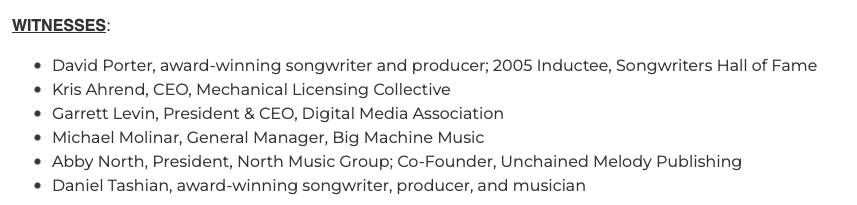
The witness list is well-chosen and seems unlikely to produce the usual propaganda from the controlled opposition that the lobbyists usually try to spoon feed to lawmakers:

I have a few concerns myself. 

  1. Investment Policy: According to its 2021 tax return, the MLC, Inc. was at that time holding more than $650 million in publicly traded securities. According to the MLC, Inc.’s annual report (at p. 4), this sum seems to include the $424 million of black box monies that the MLC, Inc. received in 2021. Congress is entitled to know exactly how this money is handled, where it resides and who is responsible for making investment decisions.

    Congress should consider whether all black box sums and unspent operating costs advanced by blanket licensees should be held in a bank account controlled by the US government so that there is no confusion if Congress fires The MLC, Inc. or any successor.

    Congress should also consider whether the same fiduciary duties apply to The MLC, Inc.’s management of the black box as would apply to a pension fund (under ERISA) or comparable duty. (There’s lots of pension funds and even banks with less than $600 million in assets and they are all regulated.) At least with a pension fund the fund trustees know who they owe money to; The MLC, Inc. seems like it should have an even higher responsibility to be good stewards of money it owes to the very unknown songwriters Congress tasked it with finding, thus cementing the moral hazard.  

    It goes without saying that the infamous “Hoffa Clause” in the MMA should be repealed (17 U.S.C. § 115 (d)(7)(C)). The Hoffa Clause allows the collective to dip into the black box to pay its expenses if the millions of the administrative assessment paid by the blanket licensees just isn’t quite enough.
  2. Succession Plan: What if Congress did fire The MLC, Inc.? Is there a succession plan in place that would allow the seamless transfer to a new collective of databases, operating software, cash on hand, and of course the black box? If there is a succession plan in place, then perhaps Mr. Ahrend should bring it with him to Chairman Issa’s hearing for the records. If not, perhaps he could draft one. In any event, Mr. Ahrend should have ready answers to at least some questions about a succession plan should the Subcommittee ask him. After all, the lobbyists wrote the bill and the five year review language was written into the earliest drafts so he should expect a few questions about what happens. Particularly since the Subcommittee has announced that they want to know “…whether the legislation is operating as intended by Congress and consider reforms.”
  3. Nondisclosure Agreements: I am struck by the fact that there have been no leaks of information about the black box, investment policy, or even life at The MLC, Inc. This usually means that there are nondisclosure agreements in place that scare people into silence–along with a healthy dose of intimidation in a small and incestuous industry when it’s likely that your employer is on the board of directors. Maybe not, but Congress may want to find out what these people are up to so it can decide if it wants to let them keep doing it. This may seem like a small issue, but either people aren’t talking because they have nothing to say or people are talking but nobody will print the story.
  4. Songwriter Directors and Geographical Diversity: The hearing may provide a good opportunity for the Subcommittee to look into how the collective’s controversial board composition is working out, not to mention the membership levels in the confusing by laws of The MLC, Inc. For example, I for one really see no reason to continue the concept of non-voting directors on the board, and Congress could just eliminate that role. One need only look to other collectives and PROs in the US and around the world for examples. A non-voting board member is a close analog to a “board observer” which is usually someone appointed by an investor to essentially spy on the board.  

    Similarly, it must be said that all the board members are either from New York, Nashville, Los Angeles or are lobbyists from the Imperial City. There are songwriters all over the country and internationally. Since the collective is really a quasi governmental organization, it is entirely in the remit of Congress to increase transparency and fairness as well as diversity. This could be accomplished by requiring an equal number of songwriter and publisher directors and having them come from states or regions with a big music contribution to America such as one of the reservations ,Atlanta, Chicago, Houston, Miami, New Orleans, Tulsa or Appalachia.  
  5. Revisit the Compulsory License: There is, of course, the threshold question of whether the compulsory license should be continued at all. This five year examination really should include this fundamental review rather than just blindly pushing forward with the compulsory license. (I discussed this in some detail in a separate post.) One songwriter has suggested that the Copyright Office reprise another study on the continued viability of the entire compulsory license system and I think he’s got a point there. Perhaps the Subcommittee could task the Copyright Office with conducting such a study as a finding of the field hearing. Those studies allow the public to comment without fear or favor which would be a breath of fresh air. Congress could then hear from more people whose jobs depend on the system working well resulting in the payments to songwriters that Congress wanted rather than the system just stumbling on resulting in high salaries to the operators and little to no transparency.

    Let’s see what happens at the field hearing.  You can watch it here courtesy of the YouTube monopoly.


    This post first appeared in MusicTechPolicy