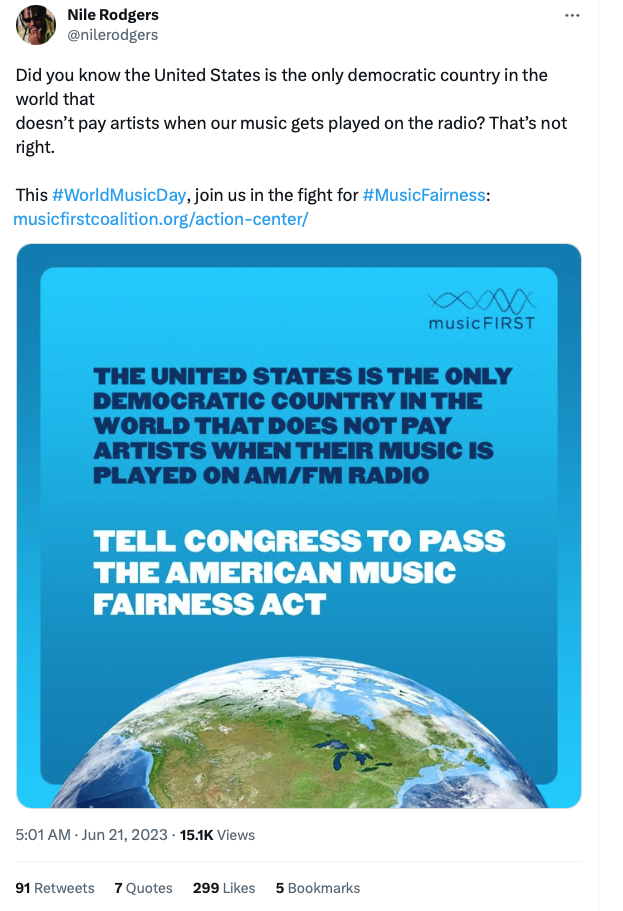
Did you know the United States is the only democratic country in the world that doesn’t pay artists when our music gets played on the radio? That’s not right.
Well that was only a matter of time. Nature, one of the leading scientific journals in the world, has announced that it will not allow the use of generative AI images or video. (Thanks to Cynthia Turner for the catch.).
I must say that the journal’s rationale for rejecting this latest stop in Silicon Valley’s newest bubble is a pretty concise statement of the criminality of the bubble riders:
Why are we disallowing the use of generative AI in visual content? Ultimately, it is a question of integrity. The process of publishing — as far as both science and art are concerned — is underpinned by a shared commitment to integrity. That includes transparency. As researchers, editors and publishers, we all need to know the sources of data and images, so that these can be verified as accurate and true. Existing generative AI tools do not provide access to their sources so that such verification can happen.
Then there’s attribution: when existing work is used or cited, it must be attributed. This is a core principle of science and art, and generative AI tools do not conform to this expectation. (Not to mention the Universal Declaration of Human Rights (article 27(2)) among other human rights instruments.)
Consent and permission are also factors. These must be obtained if, for example, people are being identified or the intellectual property of artists and illustrators is involved. Again, common applications of generative AI fail these tests.
Generative AI systems are being trained on images for which no efforts have been made to identify the source. Copyright-protected works are routinely being used to train generative AI without appropriate permissions. In some cases, privacy is also being violated — for example, when generative AI systems create what look like photographs or videos of people without their consent. In addition to privacy concerns, the ease with which these ‘deepfakes’ can be created is accelerating the spread of false information.
So that about sums it up. I would add that what Silicon Valley likes is the free-riding profit that is built in to failing to honor each of Nature’s objections aka what economists and tort lawyers call negative externalities.
We’ve all seen the headlines from around the world. Musicians, songwriters and composers attacked as rabble-rousers and enemies of the state. Singers arrested, their performances banned as un-patriotic or sacrilegious. We’ve even seen lethal attacks committed against music creators for refusing to perform, or simply for attempting to entertain, not even to proselytize or lampoon. And just in the past few days, we have seen legal action instituted by a foreign global power against the performance of domestic protest music on a global basis.
No matter our individual political or musical affiliations, the mission of the American music community is clear. We must quickly and effectively formulate ways to help curb this global, governmental trend of singling out artists and music creators for punishment, due in large measure to the perceived, “dangerous” power of music. Case in point:
In 2019, amid civil unrest in Hong Kong over Chinese Government efforts to crack down on what it deems unacceptable speech, a pro-Hong Kong Independence movement leader known only by the pseudonym “Thomas dgx yhl” penned a song known as “Glory to Hong Kong.” The composition was immediately embraced by Hong Kong street protesters, translated into various languages on the Internet, and eventually widely recorded and distributed. In short order, those recordings were being played not only on the Net but in Hong Kong shopping malls and at sporting events and other gatherings, prompting public sing-alongs that have increasingly alarmed Chinese Government officials in Beijing.[1]
Two weeks ago, on June 5, 2023, the Beijing-aligned Government of Hong Kong announced it had heard enough. Having previously banned the secessionist anthem “Liberate Hong Kong” after protests began in 2019, it went to court seeking an even broader injunction against “Glory to Hong Kong” that if granted would bar performance, broadcast, and distribution of the song throughout China (and potentially lead to the punishing of Chinese citizens and companies operating in China for violating the ban elsewhere in the world). According to the Government’s court submissions, the song’s lyrics are meant to provoke secessionist acts in violation of Chinese law, and the court should act to eliminate the dangerous confusion that has been caused by the “mistaken use” of the song in place of the official Chinese national anthem at local and international events in Hong Kong and elsewhere.[2] Court hearings are scheduled to resume in Hong Kong on July 21, 2023.
As is often the case when governments attempt to ban musical works, the song instantly skyrocketed in popularity. Within days of the court filing, “Glory to Hong Kong” topped the Apple iTunes charts, which may have resulted in further governmental action behind the scenes. The original version of the song recorded by DGX Music (presumably related to Thomas dgx yhl) has now reportedly been pulled from global music streaming platforms such as Spotify, Apple Music, Facebook and Instagram’s Reels system. According to DGX, the disappearance of its version from these services is due to the company’s “dealing with some technical issues related to streaming platforms,” and it expressed regret for this “temporary” issue. The specter of likely governmental coercion against the creator(s), the label and its distributors, however, continues to hang heavily over the entire incident.
Obviously, what we are witnessing in real time is yet another in a nearly endless series of attempts by governments and powerful interests around the world to forcibly remove politically contentious musical works from the public sphere and punish their creators.
This past March, the National Music Council of the United States (NMC), in partnership with the International Music Council (IMC) based in Paris, explored the historical roots of this phenomenon in the hopes of helping the world-wide music community to fashion strategies for ensuring more effective, speech-related protections for music creators in the future. The NMC’s extensive briefing papers for the symposium trace the long litany of repression and coercion against individual creators who used their music to protest social and political injustice, including the murder by the extreme right-wing Pinochet regime in Chile of folksinger Victor Jara, the genocide carried out against Cambodian musicians and composers by the extreme left-wing Khmer Rouge Regime, and the attempted erasure of Native American/First Nation/Aboriginal music and culture by Constitutional democracies including the United States, Canada, the UK and Australia—efforts that often resulted in the brutal deaths of those who resisted.[3]
Music-based repression and coercion, the NMC concluded, are clearly global problems unlimited by either their political or geographic origins:
Music’s dual, facile ability to serve as both a powerful tool of propaganda and as an existential threat to power structures and political leaders has made it a prime focus of nervous governmental concern over the entire span of history….[M]usic creators and performers have [thus] not only been frequently subject to pressure to conform and participate in governmental propaganda efforts, but also to repressive actions up to and including murder to enforce the silence of those dangerous, high-profile individuals who will not comply. In many cases, this effectively neuters the most persuasive voices of protest, while at the same time setting an example of what happens to those less visible citizens who choose dissent. The repression of music and creators is a government’s way of warning all of its people, “if this is what we’ll do to them, imagine what we’ll do to you.”
For the American music creator community, it’s that last point that should be our initial, paramount concern. While we may argue over whether certain a musical expression (other than outright hate speech) constitutes patriotism or treason, it is incumbent upon us to champion the position that violence and imprisonment for expressing unpopular views should not be imposed on any person by any government, anywhere. Though speech freedom advocates may argue for a far broader effort to protect free musical expression –and in the future that may come– job one is to protect the lives and liberties of music creators who have been singled out today for political punishment.
How? By not remaining silent.
At the NMC/IMC symposium, international experts and activists such as Ole Reitof of UNESCO, Julie Trébault of the Artists at Risk Coalition, Mark Ludwig of the Terezin Music Foundation, Dr. Ahmad Sarmast of the Afghanistan National Institute of Music, and Arn Chorn Pond of the Cambodian Living Arts organization, all agreed on the opportunities for the US music community to protect fellow, global music creators and performers from official repression by speaking out in appropriate ways. Their advice may be distilled to three basic principles:
First, do no harm. This Hippocratic starting point for every effort to assist requires that all international actions must be carefully calibrated to avoid backlash against the endangered individual or group, and should be undertaken only in consultation with those knowledgeable about the local intricacies related to each incident.
Second, take action by shining a spotlight in the United States on the most egregious cases of music suppression wherever in the world they take place. Write letters to the White House, to Congress, and to the US State Department and the US Trade Representative concerning individual cases, requesting that the US Government take appropriate steps to save the lives and freedoms of those at risk. (Other actions may be contemplated, but only after the “no harm” principle has been fully strategized).
Third, for those not willing or unable to take such actions, lend support to organizations engaged directly in protecting the lives and liberties of members of the music community around the world.[4]
Artistic activism and the defense of it will never be an act of courage devoid of risk. The ability in the US to speak out on such issues principally without fear of government reprisal, however, places on us a special responsibility to shine that brighter light on these escalating injustices and attacks. Our community’s responsibilities are to ensure that such anti-democratic activities not remain hidden in the shadows, no matter where in the world they occur—including within our own borders.
If history has taught us one thing about the persecution of artists and creators, it is that silence is neither an effective nor an acceptable strategy.
Charles J. Sanders
Chair, The National Music Council of the United States
[2] Hong Kong, a former British protectorate the rule over which was transferred to Beijing in 1997, has continued to maintain its own political and economic systems for the past quarter-century. Within the past decade, however, the Government of China has concentrated its efforts on bringing Hong Kong more closely in line with Beijing’s governing philosophies—including the stricter control of political speech. In its submission to the court, the Government pre-emptively sought to quash accusations of censorship by asserting that Beijing “respects and values the rights and freedoms protected by the Basic Law (including freedom of speech), but freedom of speech is not absolute…. The application pursues the legitimate aim of safeguarding national security and is necessary, reasonable, legitimate, and consistent with the Bill of Rights….”
Pathetic and gutless Daniel Ek kowtows for the money: Spotify Says Distributor Removed ‘Glory to Hong Kong’ Amidst Chinese Government Crackdown https://t.co/fFen3lG3ff
If you’re like us, you have an office pool on who will win the eagerly anticipated release of the MLC’s 2022 tax return! “Winning” in this case means who will get the biggest salary and bonus bump–for what, we’re not sure, but don’t that stop anything.
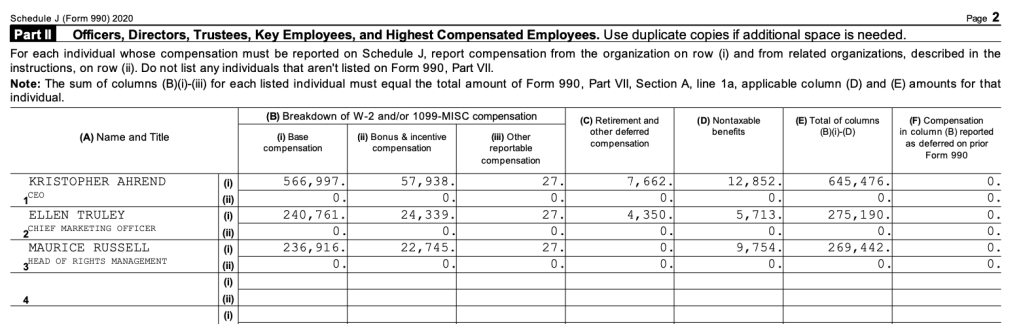
Based on the MLC’s 2020 tax return, these employees were the only ones disclosed:
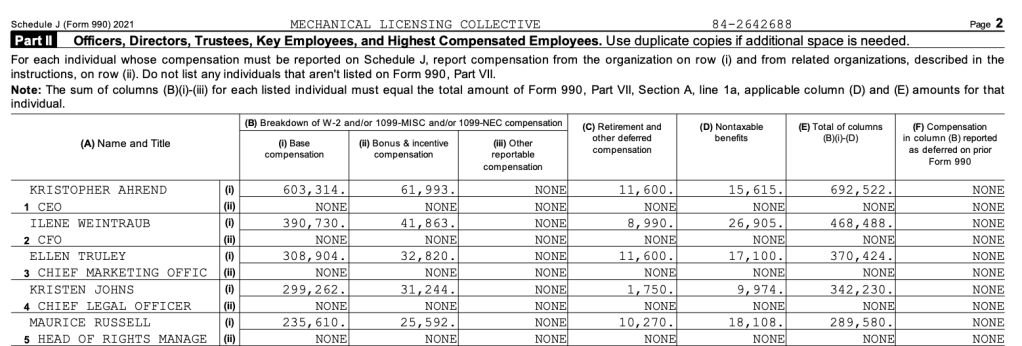
But on the 2021 tax return, the MLC must have exceeded expectations so much that everyone got a raise and they staffed up! Nothing but blue skies on the sunlight uplands!
CEO Kris Ahrend went from a mere $566K a year base with a $57K bonus in 2020 to $603K base and an even bigger bonus in 2021. Ellen Truley also had a fantastic year with her base moving like a rocket from a mere $240K to $308K! During COVID!! And her bonus practically doubled. But for some reason Maurice Russell’s salary actually declined slightly from $236K to $235K, but maybe they pushed it into his bonus which rose from $22K to $25K.
But stay tuned for the 2022 results and maybe bet the trendline going up, because the MLC gets a statutory cost of living adjustment that is not based on performance! Just like streaming royalties they administer!
No wait–the MLC gets the cost of living adjustment not the songwriters, sorry. No, remember that songwriters are told that they will do better if the services do better on revenues. Not on the services’ stock price, but rather on revenues for people who never raise their prices but make millions on selling stock. Except for the physical royalty paid by the labels that agreed to give the songwriters they depend on a higher mechanical rate AND a cost of living bump. But these trillion dollar market cap Big Tech music users don’t ever include the real money in the rising tide that sinks all boats with the trickle down royalty. But we’re told to put it all on red and let it ride.
But we’re glad that the MLC employees are so well compensated and that their salaries are protected in the highest inflation in 40 years with that built-in inflation adjustment.
It's simple" Do you create, produce and market so that totalitarians can use your music to crush freedom? Freedom is priceless–without price. Shut them down and then slick lobbyists and execs can answer how they sleep at night. https://t.co/4xSttvWzdH
— MusicTechPolicy.com (@MusicTechPolicy) June 13, 2023
SO excited that @YouTubeEffect will be screening in @alamodrafthouse theaters across the US starting next month! Check the link below to see where (hopefully near you). Director/producer Alex @Winter and I will be doing Q&As so please come see us! https://t.co/rHX9A9fkR8
"Sold"? Or set $30 million on fire and flushed it down the toilet? You know that Spotify just can't make a profit. But Daniel Ek is as smart as Steve Jobs, just ask @Netflix. Spotify has sold music creation app Soundtrap back to its founders https://t.co/VvFaXWOdvU
Congress is considering whether to renew The MLC, Inc.‘s designation as the mechanical licensing collective. If that sentence seems contradictory, remember those are two different things: the mechanical licensing collective is the statutory body that administers the compulsory license under Section 115. The MLC, Inc. is the private company that was “designated” by Congress through its Copyright Office to do the work of the mechanical licensing collective. This is like the form of a body that performs a function (the mechanical licensing collective) and having to animate that form with actual humans (The MLC, Inc.), kind of like Plato’s allegory of the cave, shadows on the wall being what they are.
Congress reviews the work product of The MLC, Inc. every five years (17 USC §115(d)(3)(B)(ii)) to decide if The MLC, Inc. should be allowed to continue another five years. In its recent guidance to The MLC, Inc. about artificial intelligence, the Copyright Office correctly took pains to make that distinction in a footnote (footnote 2 to be precise. Remember–always read the footnotes, it’s often where the action is.). This is why it is important that we be clear that The MLC, Inc. does not “own” the data it collects (and that HFA as its vendor doesn’t own it either, a point I raised to Spotify’s lobbyist several years ago). Although it may be a blessing if Congress fired The MLC, Inc. and the new collective had to start from scratch.
But Congress likely would only re-up The MLC, Inc. if it had already decided to extend the statutory license and all its cumbersome and byzantine procedures, proceedings and prohibitions on the freedom of songwriters to collectively bargain. Not to mention an extraordinarily huge thumbs down on the scales in favor of the music user and against the interest of the songwriters. The compulsory license is so labyrinthine and Kafka-esque it is actually an insult to Byzantium, but that’s another story.
Rather than just deciding about who is going to get the job of administering the revenues for every songwriter in the world, maybe there should be a vote. Particularly because songwriters cannot be members of the mechanical licensing collective as currently operated. Congress did not ask songwriters what they thought when the whole mechanical licensing scheme was established, so how about now?
Before the Congress decides to continue The MLC, Inc. many believe strongly that the body should reconsider the compulsory license itself. It is the compulsory license that is the real issue that plagues songwriters and blocks a free market. The compulsory license really has passed its sell by date and it’s pretty easy to understand why its gone so sour. Eliminating the Section 115 license will have many implications and we should tread carefully, but purposefully.
Party Like it’s 1909
First of all, consider the actual history of the compulsory license. It’s over 100 years old, and it was established at a time, believe it or not, when the goal of Congress was to even the playing field between, music users and copyright owners. They were worried about music users being hard done by because of the anticompetitive efforts of songwriters and copyright owners. As the late Register Marybeth Peters told Congress, when Congress created the exclusive right to control reproduction and distribution in 1909, “…due to concerns about potential monopolistic behavior [by the copyright owners], Congress also created a compulsory license to allow anyone to make and distribute a mechanical reproduction of a nondramatic musical work without the consent of the copyright owner provided that the person adhered to the provisions of the license, most notably paying a statutorily established royalty to the copyright owner.”
Well, that ship has sailed, don’t you think?
This is kind of incredible when you think about it today because the biggest users of the compulsory license are those who torture the bejesus out of songwriters by conducting lawfare at the Copyright Royalty Board–the richest corporations in commercial history that dominate practically every moment of American life. In fact, the statutory license was hardly used at all before these fictional persons arrived on the scene and have been on a decades-long crusade to hack the Copyright Act through lawfare ever since. This is particularly true since about 2007 when Big Tech discovered Section 115. (And they’re about to do it again with AI–first they send the missionaries.)
If the purpose of the statutory scheme was to create a win-win situation that floats all boats, you would have expected to see songwriters profiting like never before, right? If the compulsory was so great, what we really needed was for everyone to use Section 115, right? Actually, the opposite has happened, even with decades of price fixing at 2¢ by the federal government. When hardly anyone used the compulsory license, songwriters prospered. When its use became widespread, songwriters suffered, and suffered badly.
Songwriters have been relegated to the bottom of the pile in compensation, a sure sign of no leverage because whatever leverage songwriters may have is taken–there’s that word again–by the compulsory license. I don’t think Google, a revanchist Microsoft, Apple, Amazon or Spotify need any protection from the anticompetitive efforts of songwriters. Google, Amazon, Apple, Microsoft, Spotify are only worried about “monopolistic behavior” when one of them does it to one of the others. The Five Families would tell you its nothing personal, it’s just business.
Yet these corporate neo-colonialists would have you believe that the first thing that happens when the writing room door closes is that songwriters collude against them. (Sounding very much like the Radio Music Licensing Committee–so similar it makes you wonder, speaking of collusion.)
The Five Year Plan
Merck Mercuriadis makes the good point that there is no time like the present to evolve: “In the United States, we have a position of stability for the next five years – at the highest rates paid to songwriters to date – in the evolution of the streaming economy. We are now working towards improving the songwriters’ share of the streaming revenue ‘pie’ yet further and, eventually, getting to a free market.” The clock is ticking on the next five years, a reference to the rate period set by the Copyright Royalty Board in the Phonorecords IV proceeding. (And that five years is a different clock than the five years clock on the MLC which is itself an example of the unnecessary confusion in the compulsory license.)
What would happen if the compulsory license vanished? Very likely the industry would continue its easily documented history of voluntary catalog licenses. The evidence is readily apparent for how the industry and music users handled services that did not qualify for a compulsory license like YouTube or TikTok. However stupid the deals were doesn’t change the fact that they happened in the absence of a compulsory license. That Invisible Hand thing, dunno could be good. Seems to work out fine for other people.
Let’s also understand that there is a cottage industry complete with very nice offices, pensions and rich salaries that has grown up around the compulsory license (or consent decrees for that matter). A cottage industry where collecting the songwriters’ money results in dozens of jobs paying more in a year than probably 95% of songwriters will make, maybe ever. (The Trichordist published an excerpt from a recent MLC tax return showing the highest compensated MLC employees.) Generations of lawyers and lobbyists have put generations of children through college and law school from legal fees charged in the pursuit of something that has never existed in the contemporary music business–a willing buyer and a willing seller. Those people will not want to abandon the very government policy that puts food on their tables, but both sides are very, very good at manufacturing excuses why the compulsory license really must be continued to further humanity.
The even sadder reality is that as much as we would like to simply terminate the compulsory license, there is a certain legitimacy to being clear-eyed about a transition. (An example is the proposals for transitioning from PRO consent decrees–ASCAP’s consent decree has been around a long time, too.) There would likely need to be a certain grandfathering in of services that were pre or post the elimination of the compulsory, but that’s easily done, albeit not without a last hurrah of legal fees and lobbyist invoices. Register Pallante noted in the well-received 2015 Copyright Office study (Copyright and the Music Marketplace at 5) “The Office thus believes that, rather than eliminating section 115 altogether, section 115 should instead become the basis of a more flexible collective licensing system that will presumptively cover all mechanical uses except to the extent individual music publishers choose to opt out.” An opt out is another acceptable stop along the way to liberation, or even perhaps a destination itself. David Lowery had a very well thought-out idea along these lines in the pre-MLC era that should be revisited.
X Day
However, while there is a certain attractiveness to having a plan that the dreaded “stakeholders” and their legions of lobbyists and lawyers agree with, it is crucially important for Congress to fix a date certain by which the compulsory license will expire. Rain or shine, plan or no plan, it goes away on the X Day, say five years from now as Merck suggests. So wakey, wakey.
That transparency drives a wedge into the process because otherwise millions will be spent in fees for profiting from moral hazard and surely the praetorians protecting the cottage industry wouldn’t want that. If you doubt that asking for a plan before establishing X Day would fail as a plan, just look at the Copyright Royalty Board and in particular the Phonorecords III remand. Years and years, multiple court rulings, and the rates still are not in effect. Perseveration is not perseverance, it’s compulsive repetition when you know the same unacceptable result will occur.
But don’t let people tell you that the sky will fall if Congress liberates songwriters from the government mandate. The sky will not fall and songwriters will have a generational opportunity to organize a collective bargaining unit with the right to say no to a deal.
Who can forget Sally Fields in Norma Rae?
The closest that Congress has come to a meaningful “vote” in the songwriting world is inviting public comments through interventions, rule makings, roundtables and the like–information gathering that is not controlled by the lobbyists. Indeed, it was this very process at the Copyright Royalty Board that resulted in many articulate comments by songwriters and publishers themselves that were clearly quite at odds with what the CRB was being fed by the lobbyists and lawyers. So much so that the Copyright Royalty Judges rejected not only the “Subpart B” settlement reached by the insiders but the very premise of that settlement. Imagine what might happen if the issue of the compulsory license itself was placed upon the table?
Now that songwriters have had a taste of how The MLC, Inc. has been handling their money, maybe this would be a good time to ask them what they think about how things are going. And whether they want to be liberated from the entire sinking ship that is designed to help Big Tech. And you can start by asking how they feel about the $500 million in black box money that is still sitting in the bank account of The MLC, Inc. and has not been paid–with an infuriating lack of transparency. Yet is being “invested” by The MLC, Inc. with less transparency than many banks with smaller net assets.
This “investment” is another result of the compulsory license which has no transparency requirements for such “investments” of other peoples’ money, perhaps “invested” in the very Big Tech companies that fund the The MLC, Inc. That wasn’t a question that was on the minds of Congress in 1909 but it should be today.
Attention Must Be Paid
Let’s face facts. The compulsory license has coexisted in the decimation of songwriting as a profession. That destruction has increased at an increasing rate roughly coincident with the time the Big Tech discovered Section 115 and sent their legions of lawyers to the Copyright Royalty Board to grind down publishers, and very successfully. That success is in large part due to the very mismatch that the compulsory license was designed to prevent back in 1909 except stood on its head waiting for loophole seekers to notice the potential arbitrage opportunity.
The Phonorecords III and IV proceedings at the Copyright Royalty Board tell Congress all they need to know about how the game is played today and how it has changed since 1909, or the 1976 revision of the Copyright Act for that matter. The compulsory license is no longer fit for purpose and songwriters should have a say in whether it is to be continued or abandoned.
We see the Writers Guild striking and SAG-AFTRA taking a strike authorization vote. When was the last time any songwriters voted on their compensation? Maybe never? Voting, hmm. There’s a concept. Now where have I heard that before?
MRA asks a good question. There's nearly half a billion in songwriter "black box" money sitting at the Music Licensing Collective. What do they have it invested in? Unlike foreign songwriter rights societies, the US MLC doesn't have to disclose this. https://t.co/z5Co2VSfv0
Well, another quarter is rolling around and the MLC is still sitting on 100s of millions of dollars of songwriter money as far as I can tell. Billboard says the MLC has “matched”–maybe different than “paid”–$200 million of the $427 million in black box that it was paid by the services in 2021. This doesn’t count the unmatched that the MLC has itself added to that sum. And Congress still haven’t required them to disclose their investment policy, returns on investment or much of anything else.
Compare the MLC to community banks. There are approximately 1,000 community banks with net assets between $250,00,000 to $500,000,000. There are approximately another 1,200 community banks with net assets between $100,000,000 to $250,000,000. It’s admittedly rough justice, but why should one entity holding hundreds of millions of other peoples’ money have virtually no disclosure requirements and be essentially unregulated while another is the opposite?
Remember that the MLC is supposed to pay interest “at the Federal, short-term rate” “for the benefit of copyright owners entitled to payment of such accrued royalties.” Note that the Federal short-term rate is today a lot higher than it was when the lobbyists wrote the Music Modernization Act, currently 4.21% or thereabouts. And through the power of compound interest, that’s a bunch of cash the MLC is supposed to come up with. I wonder where they’ll get it from. Wouldn’t you like to know?
Anyway, let’s talk about interest rates. The “risk free rate” is often thought of as the rate of interest paid on US government bonds. That interest rate is thought of as risk free because it is backed by the full faith and credit of the United States that you hear so much about these days. Want to know where you can find that full faith and credit? Look in the mirror.
When you ask around about what collective management organizations do with their “black box” monies while they are waiting to match money with songwriters or at least copyright owners, you often hear that the money is invested in very safe instruments, like U.S. treasury bonds. This might be particularly true of CMOs that are required to pay interest on black box because that interest has to come from somewhere.
But–and here it is–but, as we have learned from the Silicon Valley Bank collapse and the number of federal government officials in the mumble tank about why these banks are failing and why they are getting bailed out by, you know, the full faith and credit of the United States, “risk free” seems to be a relative concept. When you buy US government bonds, there are a number of different maturity dates available to you, kind of like buying a certificate of deposit. A common maturity date is the 10-year bond and the two-year bond, both of which were recently down sharply.
But–there is a connection between the interest rate that the bond pays, the price of the bond, and the maturity date of that bond. When bond interest rates increase, the face price tends to decrease. So if you paid $100 for a bond with a interest rate of say .08% and that rate then increased to say 4.5%, the face price of that bond will no longer be $100, it will be less. If that increase happens fairly quickly, you can have difficulty finding a buyer. The good news is that when the Federal Reserve raises the interest rate, there is about as much news coverage of the event as it is theoretically possible to have, both before during and after the rate increase, not to mention the Federal Reserve chair testifying to Congress. It’s very public. Closely watched doesn’t really capture that level of attention.
When bond prices decline, holders only “realize” the loss or gain if they sell the bond unless the bond is marked to market so the firm has to disclose the amount of what the loss would be if they sold the bond. Hence the concept of “unrealized losses,” “maturity risk,” or “interest rate risk.” Some think that US banks currently have $620 billion in unrealized losses due to interest rate risk. And don’t forget, these are your betters. These are the smart people. These are the city fellers.
This interest rate risk issue is not limited to banks, however. It is also present anytime that an entity tasked with caring for other people’s money invests that money in treasury bonds, crypto, or whatever. Like the MLC. You don’t have to be Wall Street Bets to end up losing your shirt or something in this environment.
So the point is that the same problem of interest rate risk and unrealized losses could apply to CMOs, such as The MLC, Inc. because of their undisclosed “investment policy” of investing the $424 million of black box they were paid by the services. They don’t disclose what the investment policy is and they don’t disclose their holdings so we don’t really know what has happened, if anything. The money could be perfectly safe.




You must be logged in to post a comment.