Guest Post: Honesty In Our Favor: HFA Loses Attempt To Exit Eight Mile Style Case–What Implications For MLC?

Guest post by Chris Castle

The Uniform Commercial Code defines “good faith” as “honesty in fact and the observance of reasonable commercial standards of fair dealing.”

Spotify was sued by Eight Mile Style and Martin Affiliated, two publishers that control rights in some of the early Eminem repertoire, including Lose Yourself. Remember that earlier this year, Spotify announced with great fanfare that Lose Yourself was streamed over 1 billion times on the platform. That’s just one measurement of Eminem’s dominance on Spotify. Turns out that Spotify had failed to license a good chunk of Eminem’s catalog.

The publishers eventually joined the Harry Fox Agency to the lawsuit as participating in the situation, adding claims of vicarious and contributory copyright infringement against the long-time publishing administrator to the industry. In fact, the Harry Fox Agency gave some people the impression that when it came to Section 115 of the Copyright Act, HFA thought they were the government. What ever is this venerable organization doing getting sued for copyright infringement instead of leading the charge against the infringer?

At one point a few years ago, quite a few years ago now, HFA decided to jump up on top of the wall. They started working for tech companies like Spotify and also administering publishing rights. That’s right–both sides. What could possibly go wrong?

Let me illustrate with an anecdote (one that does not involve HFA, or MRI for that matter). A highly ethical licensing administrator interviewed for a job handling music licensing for a big tech company. After several rounds of interviews, the administrator was told they weren’t getting the job. Asking for a reason, the tech company told the administrator that the company thought the administrator were likely going to flag and at least try to fix any problems they found in the tech company’s reporting. The administrator didn’t find this remarkable as this was the honest thing to do. The company said, we don’t want honesty when it’s not in our favor. The company hired someone else because they did not want “honesty in fact”.

There are serious allegations against the Harry Fox Agency in the Eight Mile Case. Remember, this is a defense motion to dismiss, so the plaintiff largely gets the benefit of the doubt in their favor. You may ask yourself what possible motivation could Spotify have for engaging in such risky behavior. In her order denying in part and granting in part HFA’s motion to dismiss, Judge Trauger puts her finger right on the most plausible explanation:

[I]t is undisputed that [Eminem, aka Marshall] Mathers is an artist who has enjoyed extraordinary commercial success and has built a large, dedicated fanbase, such that his omission from a major streaming platform might discourage some meaningful number of potential users from subscribing

In other words, they did it for the subscribers, they did it for the growth and they did it for the money.

While Eight Mile alleged both vicarious and contributory infringement, Judge Trauger dismissed the claim for vicarious infringement on technical grounds (with leave to amend). Not so with the claim for contributory infringement, however:

HFA objects that it was under no obligation to police Spotify’s in-house decisions regarding infringement. Whether that is true or not, the plaintiffs have not merely alleged that HFA failed to affirmatively police Spotify’s conduct; they have alleged both that HFA knew and, through the ordinary fulfillment of its duties, should have known that the infringement was occurring and that HFA was helping to conceal it.…There is little doubt, moreover, that those allegations of knowledge were pleaded sufficiently. Even when a claim is governed by the heightened pleading requirements of Rule 9(b), “[m]alice, intent, knowledge, and other conditions of a person’s mind may be alleged generally.” Fed. R. Civ. P. 9(b). The Supreme Court, moreover, has recognized a party’s “aiming to satisfy a known source of demand for copyright infringement” as evidence of an improper purpose in the contributory infringement analysis. Grokster, 545 U.S. at 939. That circumstantial evidence is only heightened when the defendant, knowing of the capacity for infringement, fails to take steps to avoid it. See id. (citing Groskter’s lack of “attempt[s] to develop filtering tools or other mechanisms to diminish the infringing activity using their software”).

The plaintiffs have plausibly alleged that HFA became aware of Spotify’s licensing predicament and offered services that directly filled its need to maintain an illusion of lawfulness while continuing to infringe. 

If these allegations turn out to be proven true, songwriters (and the Copyright Office for that matter) may well ask themselves if there are implications for HFA’s continued role as a vendor for The MLC, if not why they were selected in the first place.

This post first appeared in MusicTechPolicy

@unite4copyright: Celebrate World IP Day/Week 2021

On April 26, 2021, the Copyright Alliance will once again celebrate World IP Day (WIPD). WIPD is recognized on the same day in April of each year to remind everyone of the critical role that intellectual property plays in encouraging creativity and innovation. And from April 26-30, the Copyright Alliance will celebrate WIPD by joining our members, partners, and countless creators and organizations around the world to mark the occasion by amplifying blogs and videos, hosting virtual events, and much more—all designed to celebrate the fact that IP helps the global arts scene to flourish and enables the innovation that drives human progress.

Read the post on Copyright Alliance

Open Letter: Dozens of Artists, Musicians and Songwriters Seek Referral to UK Regulators to Oversee Streaming Royalties

[A bit of context: With all the riches being made from streaming, session musicians and vocalists make zero. And don’t forget that music made Daniel Ek a billionaire.]

Broken Record Campaign

Ivors Academy

Musicians Union

April 20, 2021

The Rt Hon Boris Johnson MP
Prime Minister
10 Downing Street
W1A 2AA

Dear Prime Minister,

We write to you on behalf of today’s generation of artists, musicians and songwriters here in the UK.

For too long, streaming platforms, record labels and other internet giants have exploited performers and creators without rewarding them fairly.  We must put the value of music back where it belongs – in the hands of music makers.

Streaming is quickly replacing radio as our main means of music communication. However, the law has not kept up with the pace of technological change and, as a result, performers and songwriters do not enjoy the same protections as they do in radio.

Today’s musicians receive very little income from their performances – most featured artists receive tiny fractions of a US cent per stream and session musicians receive nothing at all.

To remedy this, only two words need to change in the 1988 Copyright, Designs and Patents Act. This will modernise the law so that today’s performers receive a share of revenues, just like they enjoy in radio. It won’t cost the taxpayer a penny but will put more money in the pockets of UK taxpayers and raise revenues for public services like the NHS.

There is evidence of multinational corporations wielding extraordinary power and songwriters struggling as a result. An immediate government referral to the Competition and Markets Authority is the first step to address this. Songwriters earn 50% of radio revenues, but only 15% in streaming. We believe that in a truly free market the song will achieve greater value.

Ultimately though, we need a regulator to ensure the lawful and fair treatment of music makers. The UK has a proud history of protecting its producers, entrepreneurs and inventors. We believe British creators deserve the same protections as other industries whose work is devalued when exploited as a loss-leader.

By addressing these problems, we will make the UK the best place in the world to be a musician or a songwriter, allow recording studios and the UK session scene to thrive once again, strengthen our world leading cultural sector, allow the market for recorded music to flourish for listeners and creators, and unearth a new generation of talent.

We urge you to take these forward and ensure the music industry is part of your levelling-up agenda as we kickstart the post-Covid economic recovery.

Yours Sincerely,

Damon Albarn OBE

Lily Allen

Wolf Alice

Marc Almond OBE

Joan Armatrading CBE

David Arnold

Massive Attack

Jazzie B OBE

Adam Bainbridge (Kindness)

Emily Barker

Gary Barlow OBE

Geoff Barrow

Django Bates

Brian Bennett OBE

Fiona Bevan

Aflie Boe OBE

Billy Bragg

The Chemical Brothers

Kate Bush CBE

Melanie C

Eliza Carthy MBE

Martin Carthy MBE

Celeste

Guy Chambers

Mike Batt LVO

Don Black OBE 

Badly Drawn Boy

Chrissy Boy

Tim Burgess

Mairéad Carlin

Laura-Mary Carter

Nicky Chinn

Dame Sarah Connolly DBE

Phil Coulter 

Roger Daltrey CBE

Catherine Anne Davies (The Anchoress)

Ian Devaney

Chris Difford

Al Doyle

Anne Dudley

Brian Eno

Self Esteem

James Fagan

Paloma Faith

Marianne Faithfull

George Fenton

Rebecca Ferguson

Robert Fripp

Shy FX

Gabrielle

Peter Gabriel

Noel Gallagher

Guy Garvey

Bob Geldof KBE

Boy George

David Gilmour CBE

Nigel Godrich

Howard Goodall CBE

Jimi Goodwin

Graham Gouldman 

Tom Gray

Roger Greenaway OBE

Will Gregory

Ed Harcourt

Tony Hatch OBE

Richard Hawley

Justin Hayward

Fran Healy

Orlando Higginbottom

Jools Holland OBE, DL

Mick Hucknall

Crispin Hunt

Shabaka Hutchings

Eric Idle

John Paul Jones

Julian Joseph OBE

Kano

Linton Kwesi Johnson

Gary Kemp

Nancy Kerr

Richard Kerr

Soweto Kinch

Beverley Knight MBE

Mark Knopfler OBE

Annie Lennox OBE

Shaznay Lewis

Gary Lightbody OBE

Tasmin Little OBE

Calum MacColl

Roots Manuva

Laura Marling

Johnny Marr

Chris Martin

Claire Martin OBE

Cerys Matthews MBE

Sir Paul McCartney CH MBE

Horse McDonald

Thurston Moore

Gary “Mani” Mounfield

Mitch Murray CBE 

Field Music

Frank Musker 

Laura Mvula

Kate Nash

Stevie Nicks

Orbital

Roland Orzabal

Gary Osborne 

Jimmy Page OBE

Hannah Peel

Daniel Pemberton

Yannis Philippakis

Anna Phoebe

Phil Pickett 

Robert Plant CBE

Karine Polwart

Emily Portman

Chris Rea

Eddi Reader MBE

Sir Tim Rice 

Orphy Robinson MBE

Matthew Rose

Nitin Sawhney CBE

Anil Sebastian

Peggy Seeger

Nadine Shah

Feargal Sharkey OBE

Shura

Labi Siffre

Martin Simpson

Skin

Mike Skinner

Curt Smith

Fraser T Smith

Robert Smith

Sharleen Spiteri

Lisa Stansfield

Sting CBE

Suggs

Tony Swain 

Heidi Talbot

John Taylor

Phil Thornalley 

KT Tunstall

Ruby Turner MBE

Becky Unthank

Norma Waterson MBE

Cleveland Watkiss MBE

Jessie Ware

Bruce Welch OBE

Kitty Whately

Ricky Wilde

Olivia Williams

Daniel “Woody” Woodgate

Midge Ure OBE

Nikki Yeoh

@ddayen: Arts Venue Closures Likely After Months-Long Delay in Federal Grant Program #saveourstages

A critical $16.25 billion grant program to sustain thousands of small creative venues that haven’t been able to open since the pandemic began has yet to deliver a cent of relief four months after passage, due to delays and faulty technology at the Small Business Administration (SBA). A website constructed to take grant applications closed last week after only four hours online, because of constant crashes and an inability to intake documents. It has not been restored and there’s no timetable for its return….

The disastrous situation is an example of how passing a bill is only the beginning of the policy process. Too many pundits have skipped right ahead to measuring President Biden for Mount Rushmore based on one piece of emergency legislation. But he will likely rise or fall on implementation; if beloved music venues and theaters close across the country because the SBA can’t manage a functioning website, all the legislation in the world won’t matter. 

Read the post on The American Prospect

The Metadata Hot Potato: The MLC Enters the Jerry McGuire Reality

By Chris Castle

Here it is: Today is the day that the MLC is required to send out their first round of statements and payments. The deadline they gave themselves when their wrote their law.

The MLC is about to hear those beautiful words. They will hear it in English. They will hear it in Spanish. They will hear it in Bantu, French, Portuguese, Pashto, Russian, Hausa, Berber and Czech.

And songwriters will say it like they mean it. They won’t want to hear about “connect to collect” they won’t want to hear about “play your part” or the ontological definition of “match.”

They will say just one thing–show me. The MLC will hear it on the phone, in email, maybe even in person. And songwriters will want to hear everyone at MLC say those magic words. Loud. The family motto. A very personal and important thing. It should be said with conviction maybe even shouted from the rooftops.

No more hot potato. And while it may start with MLC it won’t end there. If the services think they are off the hook, there’s just one thing to say. Are you ready? You know what it is.

The money. They got it, we want it, now show it. Very simple.

But just in case it doesn’t all go swimmingly on April 15, it might be time to start thinking about drafting an affirmative obligation on your publisher to take care of any bad data in your publishing or administration agreements (or at least try–let me know how far you get). Most of what I’ve heard anecdotally about the quality of the MLC public database leads me to think that songwriters think the publisher is registering their songs correctly at the MLC. So why not put it in writing?

If you don’t, that hot potato will just keep on bouncing around if there’s not a clear place where the buck stops. The services will blame the MLC, the MLC will say you didn’t connect to collect to play your part, your publisher will blame the MLC, and round and round and round it goes.

You know what you tell them, right? The family motto.

This post first appeared on MusicTechPolicy

Here to Help: Small Business Administration’s Shuttered Venue Operator’s Grant Portal is Still Down

By Chris Castle

The eight most terrifying words are “We’re from Washington and we’re here to help.” Notwithstanding the appropriation of billions in revenue, the SBA’s application portal for the Shuttered Venue Operators Grant is still not up and running. This means that at least hundreds of venues that are on the verge of collapse or have collapsed can’t get the money that Congress appropriated, or even apply to get those funds.

Remember, this grant program is not on the magnitude of the Affordable Care Act launch catastrophe or the nonexistent musical works database. The SVOG is a relatively manageable number of potential applicants by comparison. And yet they still can’t get out of their own way. Rest assured, everyone at the SBA will get their paycheck this week, their overhead will be paid for, no problem. And somewhere, someplace in the federal government’s apparatus sits billions of dollars to save our culture. And sits. And sits.

The site was supposed to launch a week ago on April 8 which was itself after months of delay. It’s no wonder the the SBA Inspector General issued a scathing report calling out the organization for mismanagement of the SVOG program–before it even launched.

So you can know two things–there’s no way to know when the money will be paid but there is a way to know that no one–and I mean not a soul–will be held accountable. They can have all the reports they want, but nothing ever happens with these things. They’re from Washington and you can embrace the suck.

This post first appeared on MusicTechPolicy

SBA Inspector General Report: Serious Concerns About SBA’s Control Environment and the Tracking of Performance Results in the #SaveOurStages/Shuttered Venue Operators Grant Program

By Chris Castle

As we’ve noted before, the Small Business Administration is seriously behind on opening the application process for the Shuttered Venue Operators Grant program. Turns out we’re not the only ones who are concerned–the SBA Inspector General has issued a damning report on the SBA’s failure to properly staff and administer the billions in funds appropriated by Congress to get venues up and running in the music economy.

The federal assistance directive also specifies that the Director of the Office of Grants Management appoints all grants management officers and makes decisions on the respective warrant level based on the training, qualifications, and experience of the grants officer. However, on March 10, 2021, the acting Chief Operating Officer waived the standard experience, training, and certification requirements and the agency grants training plan for administering all existing and future emergency grant programs related to the impact of COVID-19. SBA established these requirements and the training plan to address the systemic weaknesses OIG found in prior audits of SBA’s grants management.

Currently, the [SVOG] program office has one designated official and its staff are on temporary detail. At this time, SBA has not formalized a plan for staffing this office relative to the volume of applications expected. The agency has also not defined the organizational structure for administering the program.

SBA expects the majority of the awards made under this program to be $1 million or less. Based on the current risk model, these awards would be disbursed as lump-sum advance payments with minimal reporting requirements and agency oversight. It is important that the application reviewing officials use careful scrutiny to review the applicants’ proposed budgets to ensure funds will be used for allowable, allocable, and reasonable expenses. OIG believes that SBA does not have the staff necessary to provide effective oversight over the SVOG program. Insufficient oversight of the SVOG program increases the risk that funds will be misspent, inadequately monitored, or improperly paid.

The Inspector General tends to worry about waste, fraud and abuse, but does it really need to be said that they assume the money is actually paid?

It is incredible that Congress has appropriated the funds but the bureaucracy cannot manage to get the funds through the last mile to the venues that desperately need the money–it’s really beyond desperation. I realize that the stimulus bill was passed immediately before a change in Executive Branch administrations, but that’s really no excuse.

Right now the money is just sitting at SBA and there better be a nice crisp answer for when applications are open and when money is to be disbursed. Applications were supposed to be open today, but the Inspector General’s report strongly suggests that there is not enough staffing available to actually process the applications. Remember–the money for this one comes directly from the SBA.

Austin Rep. Roger Williams, the bill’s House author, issued this statement:

“The SVOG Application opened this afternoon at 12pm ET. I’ve already heard from constituents experiencing issues with the SBA’s application portal, as of this afternoon the SBA temporarily suspended the portal due to technical difficulties. The SBA’s rollout of the SVOG has been torturous for venue operators who were promised relief more than 3 months ago,” said Congressman Williams. “My bipartisan Save our Stages Act authorized the SVOG and was signed into law by President Trump on December 27th. Under the Biden Administration the program has been plagued with delays and mismanagement at every juncture. President Biden failed to put in place capable SBA officials to deliver relief for small businesses and taxpayers in need. Just yesterday, the SBA’s Office of the Inspector General issued a report detailing the Biden SBA’s shortcomings with the SVOG, which hampered the application process and called into question whether the appropriate governance and oversight is in place.

It’s critically important that that the House Small Business Committee address the SBA’s shortcomings. Further delays for eligible business owners are unacceptable. I urge the SBA to make the SVOG a top priority moving forward and President Biden to put qualified individuals into key leadership positions so similar failures will not occur in the future.”

Guest Post: Where is the Save Our Stages Money to #SaveOurStages? Texas Music Office Leads the Charge

By Chris Castle

We all breathed a bit easier when we heard that the $15 billion Save Our Stages legislation authored by Austin Rep. Roger Williams and Texas Senator John Cornyn had passed the Congress and was signed into law last December as part of the $2.3-trillion Consolidated Appropriations Act of 2021. SOS is administered by the Small Business Administration and allows live performance venues, movie theaters, and talent agencies to apply for relief grants if they’ve lost at least 25% of their revenue due to the pandemic up to a maximum of $10 million. Venues employing fewer than 50 full-time (also known as every music venue I know of) can apply for a share of a $2 billion of the fund to cover payroll, rent, utilities, and insurance. 

The problem is that the Small Business Administration has failed to implement an application process so that venues can even apply–and months are going by.  As states reopen, thriving venues are going to be a big part of the economic recover, particularly in a state like Texas.  What’s even more bizarre than the SBA not having an application process in place (or bridge loans or something) is that the City of Austin has managed to distribute millions to the Austin music community while waiting for the legislation, which Rep. Williams and Senator Cornyn got through Congress in record time–which may be because Austin wants to keep the title of “Live Music Capitol of the World” when the live music business reopens.

It is very difficult to understand why the SBA is taking so long to distribute appropriated funds for federal legislation that was bipartisan and not controversial.  It’s not just me–Governor Abbot’s Texas Music Office s leading the charge to light a fire under the SBA.  

If you want to let you views be known, you can write to the SBA at advocacy@sba.gov contact your local members of Congress or your state and city economic development offices.

Here’s a letter from Texas Music Office Director Brendon Anthony to the head of the SBA asking for her to expedite the applications:

February 25, 2021

Tami Perriello, Acting Administrator
U.S. Small Business Administration
409 3rd St SW
Washington, DC 20416

Dear Acting Secretary Perriello:

Thank you for all that you do in service of the SBA, on behalf of  the American  people. And  thank  you for your organization’s steadfast work assisting small businesses across the state of Texas, and beyond, during the pandemic. At the TMO, we hear firsthand from our constituents that the daily work of the regional SBA offices has provided an invaluable lifeline of resources and information, supporting the livelihoods of countless hardworking Texans.

As Director of the Texas Music Office (TMO), a division of the Office of the Governor’s Economic Development & Tourism Office, my team and I represent the more than 210,000 constituents and their permanent jobs within the Texas music industry. We implore you to accelerate opening the application window for the U.S. Small Business Administration’s (SBA’s) Shuttered Venue Operators Grant in order to help provide a bridge to saving one of the first industries impacted by Covid -19 mitigation,and ultimately one of the last industries that will be able to fully re-open.

As of February 2020, combined, the music industry and music education in Texas directly accounted for $4.4 billion in annual earnings, and just over $ I 0.8 billion  in  annual  economic  activity.  The ripple effects associated with the direct injection related to music business and  music education  in Texas bring the total impact to $8.8 billion in earnings and $27.3 billion in annual economic activity.

Although most music fans around the world are familiar with our state’s largest music brands like Austin City Limits Festival and the SXSW Music Conference, it’s the small venues and historic dancehalls where Texas musicians cut their teeth which are currently impacted by closure. These hallowed venues are the testing grounds for our chart-topping artists like Beyonce, Selena, Willie Nelson, George Strait, Travis Scott, and so many more.

As each week passes, we lose more and more small music venues to permanent closure. The Shuttered Venue Operators Grant will be a crucial stopgap to helping our state’s music industry survive, providing the state’s music venues a bridge to help them weather this catastrophic event

On behalf of the Texas Music Office and its constituents from all across the state, please take the necessary steps to open applications for the Shuttered Venue Operators Grant so that the Texas music industry    and the thousands of individuals employed by the state’s small venues – may live to see another day, as the permanent closure of these venues would  be immeasurable  to our state’s economy and culture.

Brendon Anthony

Director, Texas Music 
Office Office of the Governor

The venues really need our help to pry loose the money from the SBA that has already been appropriated by Congress.  I don’t ask for this often, but the Trichordist audience is very effective at contacting their governments.  Remember, that’s advocacy@sba.gov

Guest Post by @musictechsolve: SoundCloud Throws Down With Fan Powered Royalties and User-Centric

by Chris Castle from the MusicTechSolutions Blog

SoundCloud is the first music service to adopt a version of the ethical pool principles in a user-centric royalty model and I have to applaud the effort. It’s a really good first step.  “Fan Powered” royalties tries to connect the dots between what fans actually listen to and what fans actually pay for.

SC Fan Powered

Remember, the point of the ethical pool was to do something right now to remedy the hyper efficient marketshare distributions of the “big pool” or “market-centric” royalty allocation model that is pretty much the rule with digital music services (and to one degree or another with streaming mechanicals, too, although that’s a topic for another day). I acknowledged the transaction cost involved of truly changing the model which would require renegotiating all the big pool catalog licenses. The workaround in ethical pool is to allow those who want out to opt in to a user-centric model that would be separate from the big pool. This is a way to avoid the significant transaction costs of trying to change a system that is working well for some but not all artists on the service.

SoundCloud appears to have done something very similar. This accomplishes another goal of ethical pool which is to not upset the big pool model entirely as it is working for a lot of people and there’s a benefit to the entire industry that flows from that success. By adopting this middle-ground user centric model, SoundCloud is actually able to promote its user centric method as a competitive advantage to attract independent artists to sign up with the service. 

When you consider that the real choice of independent artists is to stream or not to stream because the revenues are microscopic but the cannibalization is gigantic, it is competition that is going to get the market forces aligned to produce real organic change. If services understand that offering at least some version of user centric is actually a competitive advantage, we may find that there’s greater uptake than anyone imagined.

It must also be said that fans will feel a lot better about SoundCloud’s model than the market-centric approach. It comes as abrupt news to fans that their royalty is being paid for music they don’t listen to–it’s only a matter of time until someone brings a false advertising claim against the services for failing to educate consumers about that one. And this is really the underlying issue with whatever flavor of user-centric you like: It’s better for the fans. As the erudite Martin Goldschmidt said in MusicAlly:

The bottom line, for me, is that user-centric is obviously a big win for the consumer. Long term, this will be a big win for artists, labels, distributors and DSPs. And we will all make more money.

Or as one fan said to me, I’m tired of my money funding crap. This is an isolated anecdote, but imagine what will happen if a million fans (or even 1,000) had this same reaction. All while the services are literally printing money.

As you can see from this comparison of Spotify share price to the FAANG stocks (Facebook, Amazon, Apple, Netflix and Google), Spotify has far, far outpaced the FAANG stocks in its relative growth rate. You can also see that the COVID pandemic that has decimated the artist community has been rocket fuel for Spotify’s riches and has made Daniel Ek a multi-multi billionaire all why paying out fractions of a penny to artists.

Spot 3-3-21

You can find the SoundCloud user centric royalty terms here. And bear in mind–we’re all better off if artists don’t feel they have to opt out of the entire streaming business in order to make a living. 

Will the @CommonsDCMS Committee Ask How Apple and Spotify Got Away With Hundreds of Millions in Black Box for So Many Years?

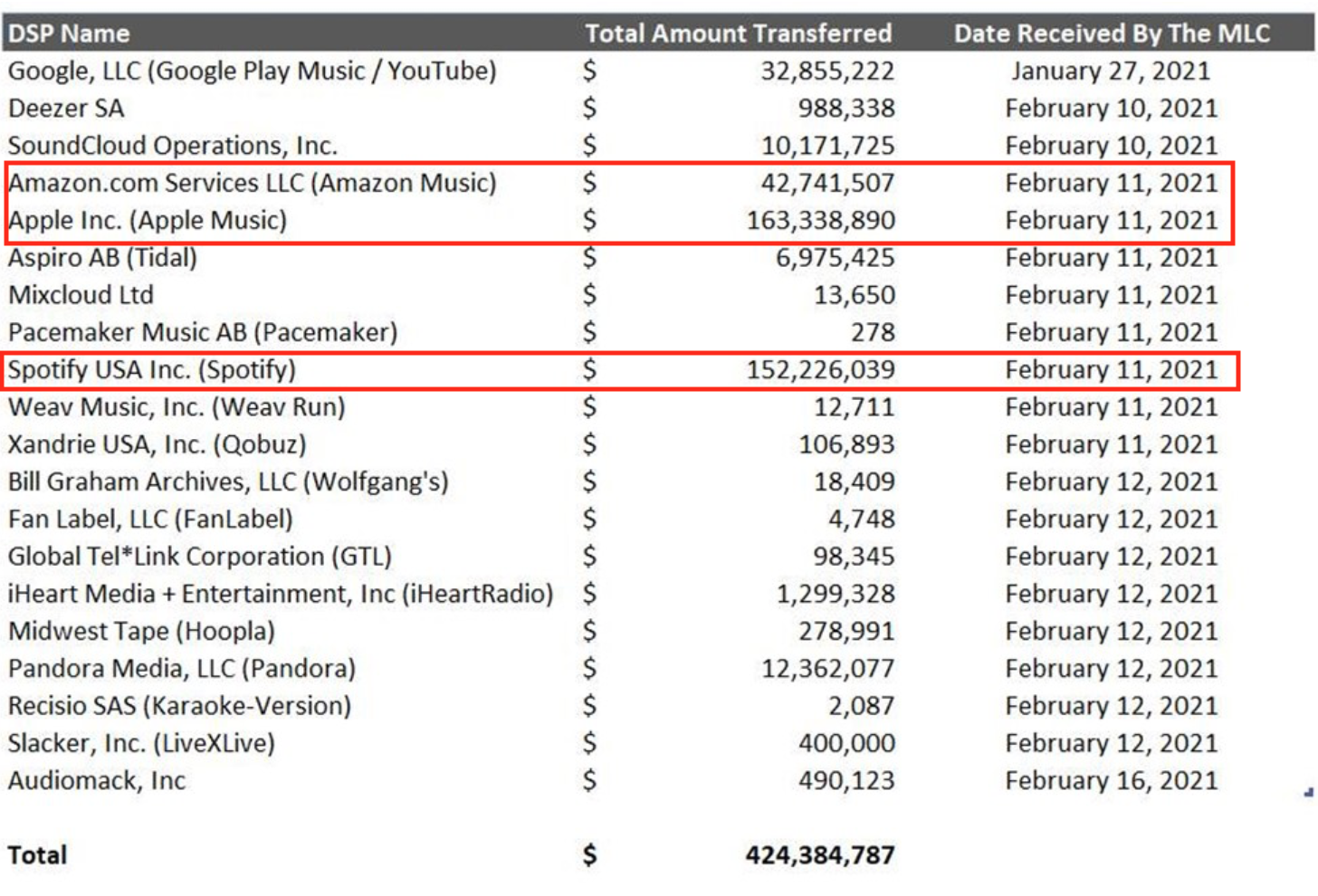
One of the questions that immediately comes to mind with the announcement of the MLC’s $424 million black box payment is how did they get away with owing so much money to so many people for so long? Tough question to get an answer to for the average songwriter, but good news: The UK Parliament’s inqiury into the economics of streaming is meeting on February 23 and will have before it senior representatives of Amazon, Apple and Spotify! Great timing! These three companies alone account for $350,000,000 in black box, or 82% of the total.

MLC Payments

So not only can the Committee inquire into how long the companies got away with it and the justification for holding onto so much of other people’s money for so long, but the Committee could also inquire as to whether there are any UK songwriters included in the respective companies black box payments for exploitations in the US during the worst pandemic in living memory.

Remember, these services are required by law to obtain a license to exploit all these songs. This was always the deal and they knew going into business what was expected of them. The law requires them to find the songwriter or not use the song. It doesn’t require them to not find the songwriter but use the song anyway.