Curiouser and Curiouser: Strange Loose Ends with Apple Music and The MLC

[Guest post by Chris Castle. This post first appeared on MusicTechPolicy. This is interesting because songwriters don’t often see shenanigans from Apple Music but it is probably due to the overpowering litigation magnet of the MMA. Put this in The MLC redesignation file]

Here’s an update on the bizarre saga of Apple Music and The MLC. Remember that HFA sent to its publishers this termination notice from Apple Music on Apple’s lyric and cloud services licenses (and assume for the moment it was also sent to other non-HFA publishers):

Apple Termination

This is remarkable because the Music Modernization Act limits the kind of licenses that the MLC can administer because the blanket license only applies to a limited number of activities (on demand streaming, limited downloads and permanent downloads). It does not apply to lyric licenses or cloud services because the blanket license is not available for those rights. Those rights would still need to be licensed under the very type of agreements that Apple is terminating.

This question came up during a recent MLC webinar moderated by MLC executives Kris Ahrend (CEO) and Serona Elton (Head of Educational Partnerships). These two executives were asked the obvious question, how can The MLC do lyric licensing for Apple. An eagle eyed MTP reader sent this screen capture from the chat:

MLC Apple Answer

So you have to ask, if The MLC can’t license lyrics, why did Apple terminate their lyric licenses and transfer to The MLC?  And what does “separately from us” mean?  The answer is not really responsive to the question.

Separately from us could easily mean that while The MLC is not licensing lyrics, some other entity is. (Presumably the lyrics are from songs that are subject to the blanket license so the MLC would play a role.)   Remember that the termination notice came from HFA.  Could it be that “separately from us” means HFA would be issuing a side by side lyric license on behalf of its publishers?

And remember that the notice from Apple includes this language:

[W]e intend to move our licensing and royalty administration for Apple Music to the MLC starting from January 1, 2021.

Congress did not intend that The MLC offer licensing and royalty administration for DMPs like Apple.  That would mean that The MLC would be paying itself for Apple’s blanket activities.  That is what HFA does through a rather porous ethical wall (and for which they have been at the center of two class actions and numerous copyright infringement lawsuits and are currently a co-defendant with Spotify in another post-MMA lawsuit).

It has long been assumed that somehow some way The MLC intends to offer bundled licensing which is currently prohibited.  Bundled licensing could take the form of performances, ex-US rights, sync, even general licensing.

It seems like that effort is quietly underway.  What is an alternative explanation for Apple terminating a large number of agreements and transferring its licensing and royalty administration functions to The MLC?  Is the plan that The MLC gets the business and HFA does the work that The MLC is prohibited by statute from performing (at least until they move the goalposts again)?

This does help to explain why there is no MLC database and all The MLC’s “data quality initiative” corrections and improvements are being performed on the HFA database (which HFA owns and will use for work not limited to the blanket license).

Curiouser and curiouser.

What is Apple Music Up to with the MLC?

You may have received this notice from HFA Client Services with the subject line “APPLE LEGAL NOTICE OF TERMINATION OF AGREEMENT” which a vigilant reader sent to us:

What is interesting about this is the opening paragraph:Dear Publisher, Reference is hereby made to that certain Subscription, Lyrics, and Cloud Services License Agreement or Subscription and Cloud Services License Agreement (the “Agreement”) between Apple Inc. (“Apple” or “we”) and the publishing entity with which you are affiliated (“Publisher” or “you”)In support of the Orrin G. Hatch-Bob Goodlatte Music Modernization Act and the significant benefits this new legislation is expected to deliver to music publishers and songwriters, we intend to move our licensing and royalty administration for Apple Music to the MLC starting from January 1, 2021.Accordingly, we hereby notify you that Apple has elected, pursuant to the Agreement, to terminate the Agreement, effective December 31, 2020. If you have never entered into such an agreement with Apple you may disregard this notice.

Focus on that “lyrics” and “cloud services” part.  The MMA blanket license does not cover lyrics or cloud services.  That means that Apple is out of contract with the publisher concerned because they terminated the agreement.  They cannot get those rights under the blanket.

Then notice that Apple says, “we intend to move our licensing and royalty administration for Apple Music to the MLC”.  The MLC cannot license outside the blanket to my knowledge.

But also realize that Apple are not stupid, so this must mean something.  We’re looking into it.

“MILLION A MONTH” TIM IS BACK WITH NEW IMPROVED PROFITEERING–BUT #IRESPECTMUSIC @THEBLAKEMORGAN FIGHTS BACK–AGAIN

[This post first appeared on MusicTechPolicy]

Sessions Cody Snow

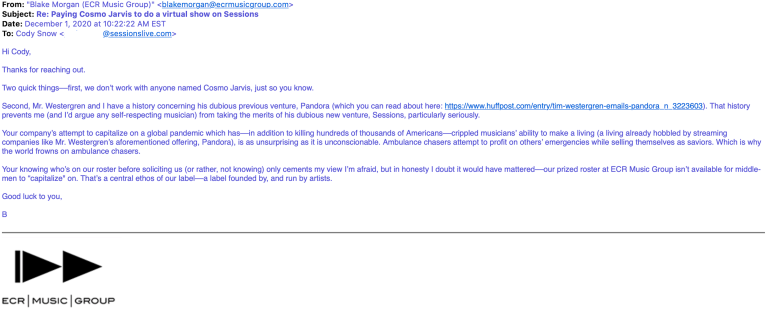
You may have received an email from something called “Sessions” like this one above received by our friend Blake Morgan, and Blake wanted us to alert MTP readers. Here’s Blake’s reply:

Sessions Blake Reply copy

Who can forget the epic confrontation between Blake and “Million a Month” Tim Westergren during what Billboard called “World War P”, which shows what can happen when artist relations are grossly mismanaged.

pandora_500_billboard_cover

Why do we say “Million a Month” Tim?  Because that’s what he made from selling Pandora stock while poor mouthing about paying royalties from Pandora’s loss-making revenues.  It may not seem logical, but in Silicon Valley, they care far less about profit than they do about valuation because valuation is, as bank robber Willie Sutton said, where the money is. So “Million a Month” Tim was engaged in the gaslighting of all time.

 I guess Blake hasn’t forgotten.

westergren 5-5-14

Of course in fairness, Daniel Ek and Spotify are running the same play on a much grander scale of international gaslighting as demonstrated by the COVID Misery Index. Big thanks to Blake for calling out another one and speaking truth to power.

COVID Misery Index 12-5-20
Comparison of post-pandemic stock trading of Spotify, Google, Facebook, Amazon, Apple and Live Nation

The DLC Finally Confirms (Sort Of) How Much is in the MMA Black Box–Bigger than a breadbox

By Chris Castle

[This post first appeared on MusicTechPolicy]

We’ve all heard rumors about how much is in the “inception to date” black box at the digital music services. The main reason that nobody knows is another example of the dismal drafting of the Music Modernization Act.

Limitation on Liability

Wouldn’t you think that if the class actions against Spotify gave the insiders the leverage to negotiate the MMA giveaway that they could at least have gotten an immediate accounting from the services for how much of the songwriters’ money they’ve been holding all these years? But no, it’s sleepy time in Washington yet again. From the Land of Frozen Mechanicals they bring you more Brinksmanship 101. The retroactive black box payment is due to be made by the services to the MLC and its data vendor, HFA–remembering that HFA was also the data vendor for at least some of the services that created the black box in the first place.

limitation on liability 2

However, there is some activity at the Copyright Office now about how to get this money paid. It’s at the Copyright Office because while drafting the aircraft carrier revision to the Copyright Act (aka Title I of the Music Modernization Act), the hard parts were never drafted and were left to the Copyright Office to handle through regulations. Musicians–you’ve seen this before. This is the Washington version of “we’ll fix it in the mix.” So you do have feel sympathy for the Copyright Office in the situation when all the smart people leave them twisting in the breeze.

Not that I necessarily believe this number, but for the first time the services have given a bigger than a breadbox idea of how much is in the black box. The DLC’s lawyers filed an “ex parte” letter in which they made that revelation (along with the known universe: Artist Rights Alliance Ex Parte Letter (Nov. 17, 2020)Digital Licensee Coordinator Ex Parte Letter (Nov. 17, 2020)Mechanical Licensing Collective Ex Parte Letter (Nov. 17, 2020)Music Artists Coalition Ex Parte Letter (Nov. 17, 2020)Nashville Songwriters Association International Ex Parte Letter (Nov. 17, 2020)National Music Publishers’ Association Ex Parte Letter (Nov. 17, 2020)Recording Academy & Songwriters of North America Ex Parte Letter (Nov. 17, 2020)Songwriters Guild of America et al. Ex Parte Letter (Nov. 18, 2020).)

The DLC itself is at the mercy of its members in terms of revealing this number but they claim the following in the Digital Licensee Coordinator Ex Parte Letter (Nov. 17, 2020):

DLC also provided a rough estimate of accrued royalties that are available to be transferred to the MLC, based on a limited survey of a subset of DLC members at a particular point in time, and with the crucial caveat that the precise amounts are in flux as digital music providers continue to engage in robust matching efforts. Specifically, DLC estimated that several hundred million dollars were available to be transferred to the MLC as accrued royalties, even after accounting for the derecognition of accruals based on preexisting agreements containing releases to claims for accrued royalties.

DLC also explained that the accruals that were derecognized because copyright owners were paid and provided releases were a fraction of that amount—on the order of tens of millions of dollars.

So now we know at least that much. We know there are “several hundred million” dollars at issue in the black box and we generally know where the money is. We may know that DLC members hold the money. We also know that this money has not been identified, but we at least know enough to get the nose of the camel in the tent.

As COVID Decimates State Revenues Tennessee Franchise Tax Comes for out of State Performers

Most people do not realize this, touring bands end up paying income taxes in multiple states. It tends to be the high population states in the West and Northeast. Think California and New York. This makes sense in some ways as the income tax is based on revenue you make in these states. Big states big revenue. It’s a pain to file multiple state returns but at least there is a reasonable rationale.

A franchise tax is different and is not usually based on a businesses income. It is essentially a flat fee tax on the corporate or LLC entity doing business in that state. The idea is that a business based in that state should pay for the services the state provides. These franchise taxes generally have minimum fees between $150-$800. Bands that use a corporate or LLC structure pay these taxes in their home state because they have a “nexus” in that state. A nexus generally means you have some regular place of business in that state. However some states try to apply the franchise tax even when an out of state business or band has no nexus in that state. However it is exceedingly rare. At least until recently…

Over the last couple months I’ve been hearing anecdotal stories about bands suddenly getting tax bills from the State of Tennessee. Odd. The music state? Aggressively taxing musicians? I didn’t think much of this as, it’s pretty common for bands to not realize they owe sales or income tax in states in which they perform frequently.

But last week I received a surprising notice from the State of Tennessee. A retroactive assessment for 7 years of Tennessee franchise tax. As far as I can tell we have no nexus in that state. I have not heard back from the Tennessee Department of Revenue, but apparently the State of Tennessee considers us to be subject to their franchise tax (now?) because we played a single show in the state in each of these years. Wow. This is ridiculous. Imagine if every state you played in required you to file taxes and pay $150-500 in franchise taxes for the privilege of playing a single show in the state?

Further, this retroactive assessment (including penalties and interest) comes at a time when most states are facing tax revenue shortfalls. When states and local governments face revenue shortfalls they have a bad habit of enacting dubious “revenue enhancement” schemes. Often these amount to badgering businesses and taxpayers into paying taxes and fees they would not normally be assessed. I have no evidence this is what is happening here, but something has changed with way my band is being treated by Tennessee tax authorities. And it is apparently happening to other bands.

WTF? I won’t be rushing back to Tennessee to play shows, record albums or even co-write songs until I have some clarity on the tax situation. I suggest other bands also exercise caution.

One last thought: The federal Music Licensing Collective will come online next year. The MLC is based in Tennessee. Does this mean every songwriter and publisher will now have to pay the Tennessee Franchise Tax? Hardly seems fair but it’s possible.

Black Box Hunting: The Songwriters Guild/Society of Composers & Lyricists/Music Creators North America’s Ex Parte Letter Stands Up for Transparency

[Editor T says: Remember when songwriters were promised that the Music Modernization Act was going to solve all your problems—AND give you a set of steak knives? Remember? Never needs ironing? And doubles on sax? One big feature was digital music services paying up to the Mechanical Licensing Collective for matching the entire black box from “inception” meaning all the money a service ever held that their data vendors couldn’t match and weren’t paid to try very hard, especially Spotify aka “defendant”. Who was that data vendor who couldn’t match? HFA. And who is the MLC’s data vendor? HFA. So the last couple weeks the insiders have been back-tracking behind closed doors at the Copyright Office on how–or if–that black box will be paid to songwriters. The only way you’d ever know this was happening is if you were paying very close attention to the Copyright Office “ex parte” letters. (sign up for email alerts there.) The Songwriters Guild/SCL/MCNA group is the songwriter’s junkyard dog with their teeth sunk in the tuchus of the insiders. We’ll be posting a selection of these recent “ex parte” letters which publicly document private conferences held by the Copyright Office with “stakeholders”. “Everyone’s a winner, bargains galore….the large print giveth and the small print taketh away” as Tom Waits said.]

EX PARTE MEETING SUMMARY WITH

THE UNITED STATES COPYIGHT OFFICE

Docket Number 2020-12

November 18, 2020

Re: Summary of the November 13, 2020 Ex-Parte Meeting Between the United States Copyright Office on behalf of the following independent, US-based music creator organizations: the Songwriters Guild of America, Inc. (SGA), the Society of Composers & Lyricists (SCL), and Music Creators North America, Inc. (MCNA)

On Friday, November 13, 2020, an ex-parte video-conference meeting was conducted by the United States Copyright Office (USCO) with multiple interested parties concerning rulemakings in connection with Doc. No. 2020-12. This summary is submitted on behalf of SGA, SCL and MCNA (together, the “Independent Music Creator Organizations” or “IMCOs”), all of which were represented at the meeting. Attending for SGA were President Rick Carnes, outside counsel Charles Sanders, and outside legislative consultant Marla Grossman of the American Continental Group (ACG). Attending for SCL was President Ashley Irwin. Attending for MCNA was President Eddie Schwartz. The meeting was chaired on behalf of the USCO delegation by its General Counsel, Regan Smith.

Individuals representing the IMCOs began by respectfully stressing, as they had in their ex parte tele-conference with the USCO on September 11, 2020, the bedrock principle that independent music creators speak for themselves on all issues related to their rights and interests, and that no other music community groups have the right or authority to claim otherwise. Specifically, the IMCOs rejected the assertion by some music publisher representatives (backed by at least one of their affiliated songwriter groups) that the USCO’s oversight and rulemaking authority concerning matters related to 2020-12 should be viewed as being narrowly limited.

The IMCOs have stressed on multiple occasions through their USCO Comments a strong belief that Congress, by its very construction of the Music Modernization Act (MMA), intends the Office to have broad and expansive authority to oversee and guide the implementation of the MMA by the Mechanical Licensing Collective (MLC). That is especially so in regard to ensuring transparency, reliability and fairness regarding the safeguarding of music creator rights, the class of persons for whom the MMA was most clearly enacted to protect pursuant to Article I Section 8 of the US Constitution.

The main issue of concern addressed at the November 13, 2020 meeting was the oversight and disposition of accrued, unmatched royalties collected and held by Digital Music Providers and subsequently distributed pursuant to private negotiated agreements with music publishers. It is believed by the IMCOs that as regards those agreements and royalties, some or all of the parties thereto were very likely aware at the time of negotiation and execution, that (i) such confidential agreements and payments concerned royalties accrued from the unauthorized reproduction or distribution of musical works owned by unrelated third parties; (ii) little to no effort had been made to properly identify rightful ownership, and (iii) such accruals might soon be subject to payment rules under the MMA that would require strictly delineated sharing of such “permanently” unmatched royalties with music creators by music publishers (including a minimum floor of 50%) after the conducting by the MLC of bona fide searches for rightful owners.

Further assertions were made by the IMCOs at the meeting that after three years of discussions, still no informed estimate had yet been made by Digital Music Providers of the aggregate amounts of unmatched royalties both still being held and already distributed. Thereafter, one knowledgeable representative of Digital Music Providers estimated that while there remain hundreds of millions of dollars in accrued, unmatched royalties in the possession of the Digital Music Providers, tens of millions of dollars in accrued unmatched royalties were indeed turned over directly to music publishers pursuant to the terms of the confidential, private negotiated agreements.

As was also made clear during the meeting, the IMCOs have no direct information as to the content of such private negotiated agreements, and no direct information as to what became of the unmatched royalties such music publishers received.

Several music publishers have claimed in ex parte letters to the USCO that they indeed shared such unmatched royalties with their affiliated music creators, but no specific information has been provided as to the methodology and details of such sharing, including whether the principles and and guarantees eventually set forth in the MMA as enacted were applied.1 Moreover as the IMCOs reported at the meeting, an informal and ongoing process of canvassing creators currently being conducted by each MCNA member organization have yet to confirm a single instance in which a songwriter or composer received a royalty statement indicating that portions of such accrued, unmatched royalties were included (though they may have been) and on what basis.

As the IMCOs asserted at the meeting, were such unmatched royalties paid to songwriters and composers by music publishers on terms resembling the MMA rules concerning music creator protections (as either drafted or eventually enacted), it seems counter-intuitive that that no line item would appear anywhere in accounting statements indicating the source of such payments, not only as a matter of sound accounting practice, but of earned good will. No other music creator groups present at the meeting challenged or contradicted these ongoing findings or assertions. In any event, as noted, it seems that the burden of demonstrating the details of such payments is more properly placed on the music publishers who claim to have made them, which could be as simple as each publisher disclosing a properly predicated and binding assertion that the payments were made, how many were made, what was the aggregate payment, and how was each songwriter’s share determined.2

Under such circumstances as they currently exist, as SGA President Rick Carnes pointed out at the meeting, asking interested parties to render opinions on the minutiae of proposed rules concerning the disposition of accrued unmatched royalties –with only some parties having an understanding of how the private agreements operated, who got paid, who didn’t, and why– is a difficult position in which to place the IMCOs and other parties with important, related interests.

As Mr. Carnes pointed out, the issues of (i) how to protect the rights of those music creators and copyright owners who did not participate in the privately negotiated agreements by ensuring that there is an opportunity to actually match those already-distributed royalties to their proper owners and to effect the prompt payment of such sums, (ii) how to balance accounts once such proper identifications have been made, while also ensuring that affiliated music creators have been properly paid by their music publishers concerning royalties collected under the private negotiated agreements that otherwise would have flowed through the MLC and been explicitly subject to MMA distribution requirements, (iii) how to address demands of Digital Music Providers that they not be made to pay twice for the same unmatched uses, and (iv) how to ensure that such private negotiated agreements are not utilized in the future in attempts to override the provisions of the MMA, all need to be addressed prior to a proper analysis of how most effectively to move forward.3

Thus, as was stated at the meeting, while the IMCOs agree the MMA makes clear that ALL accrued unmatched royalties for unauthorized reproductions and distributions dating back to inception must be turned over to the MLC by Digital Music Providers, and that the term “generally accepted accounting principles” used in the Act in no way provides an exception to that unambiguous provision, the crucial questions enumerated above also need to be immediately addressed as matters of fairness and transparency mandated by the Act.

As to the very important issue of retroactive effect of the MMA provisions concerning guaranteed music creator participation in the distribution of permanently unmatched royalties at or above the fifty percent level, the IMCOs adamantly believe, as stated at the meeting, that it is wholly illogical for any interested party to argue that Congress intended as it did to require that all accrued, unmatched royalties be rendered to the MLC by Digital Music Providers back to each service’s date of inception, but that the songwriter, composer, transparency and good faith protections guaranteed by the Act would not otherwise be applicable in the event of premature disgorgement of unmatched royalties by Digital Music Providers to music publishers pursuant to prior agreements. This is an issue that certainly requires further attention, and calls for more comprehensive discussion than for which there was time at the meeting.

As was noted several times by various speakers, the Chair of the Senate Judiciary has warned that absent a fair and transparent resolution of these complex issues, the MMA may become a magnet for litigation, the very opposite effect that it was intended to achieve. The IMCOs wholeheartedly agree, and stand ready to assist the USCO in taking all reasonable measures to achieve the transparency, fairness and robust oversight that the legislation demands in order to avoid that undesirable result.

To reiterate in closing, as the IMCOs tried to make clear at the meeting, voluntary disclosure of the specific details of the privately negotiated agreements, redacted to protect legitimate privacy and antitrust concerns, is an important prerequisite to achieving those goals. The IMCOs further repeat their stated beliefs that the USCO has the singular ability if not to compel, at least to facilitate such disclosures in a timely manner, and respectfully urge it to do so.

Further comments of SGA, SCL and MCNA will be forthcoming in regard to the proposed rulemaking by next week’s deadline. As stated at the conclusion of the meeting, however, the IMCOs believe that all parties would benefit by a brief extension for the submissions of such comments until the Monday after the Thanksgiving holiday in order to allow for further discussions among the parties. The IMCOs acknowledge a certain lack of unified support for this suggestion at the meeting, and active opposition by at least one music publisher representative, but continue to believe it to be an advisable accommodation. Those parties wishing to abide by the original deadline would always be free to do so, as was explicitly pointed out.

The IMCOs thank the USCO for scheduling the ex parte discussion, and look forward to continuing this constructive dialog.

Respectfully submitted,

Charles J. Sanders
Outside Counsel
Songwriters Guild of America, Inc.

cc: Regan Smith, General Counsel, The United States Copyright Office
Rick Carnes, SGA President
Ashley Irwin, SCL President
Eddie Schwartz, MCNA President

  1. At least one publisher has indicated an alleged willingness to share details of such payments with any writer who makes inquiry as to his or her own works, an unlikely scenario considering that a huge percentage of writers have no knowledge of the private negotiated agreements in the first place, and –to the knowledge of the IMCOs based on informal canvassing– have not been directly informed about them by their publishers. See, e.g., Ex Parte letter from Sony/ATV dated October 28, 2020: “It has been SATV’s practice to explain to our writers who inquire how these royalties are distributed and reflected on their statements.”

2. Likewise, it seems that the burden of demonstrating how much each Digital Music Provider paid to music publishers is more properly placed on the services who claim to have made the payments, which in turn could be as simple as disclosing a properly predicated and binding assertion that the payments were made, how many were made, what was the aggregate payment, and how was each publisher’s share determined. It is anticipated that such details may be forthcoming from Digital Music Providers in their reporting under the MMA, but that remains uncertain.

3 That is especially so in light of the apparent assertions of one or more Digital Music Providers that they may forego the limited safe harbor provisions provided by the MMA by not turning over to the MLC the full amount of accrued, unmatched royalties dating back to inception of use, probably under the assumption that the potential running of applicable statutes of limitations will provide the same protections as the safe harbor without payment of the royalties due. The IMCO raised this statute of limitations issue at the meeting, and was gratified that at least one Digital Music Provider representative felt that this was an issue worthy of further discussion, hopefully with the important input of the USCO. See also, related comment of DLC that “…a DMP could make the rational choice to forego the payment of accrued royalties entirely, and save that money to use in defending itself against any infringement suits.” Comments Of Digital Licensee Coordinator, Inc. In Response To Notice Of Proposed Rulemaking , Docket 2020-12, Document COLC 2020-0011-0008 (Aug. 17, 2020) at 4.

Guest Post: The False Double Payment Bottom of the MMA Black Box

By Chris Castle

[T-Editor says: This post first appeared on MusicTechPolicy]

The Dog Who Didn’t Bark On the Mirror

There seems to be some concern about pre-Music Modernization Act confidential lump sum payments of accrued black box monies under direct licenses or settlement agreements.  Services are promoting the idea that these payments must be deducted from the cumulative black box payments required for services to get the benefit of the limitation on liability and reach back safe harbor. 

That limitation on liability, of course, comes with a condition that the services use “good faith, commercially reasonable efforts” to match works to copyright owners.  Uses that remain unmatched are then turned over to the Mechanical Licensing Collective for matching and distribution.

The Digital Music Providers [“DMPs”] are now promoting the payment of black box as an option for which they can elect to take the limitation on liability.   The Digital Licensee Coordinator [representing the DMPs] tells us “If the regulations make it less likely that a DMP will be able to rely on that liability protection when it needs iti.e., if it increases the risk that a court would deem a DMP to not have complied with the requirements in section 115(d)(10)—a DMP could make the rational choice to forego the payment of accrued royalties entirely, and save that money to use in defending itself against any infringement suits.”

The SOCAN company MediaNet tells us that absent some aggressive concessions by the Congress to essentially re-write the Copyright Act in their favor, “MediaNet may decline to take advantage of the limitation on liability, which may deprive copyright owners of additional accrued royalties.”  

The DMPs have somehow managed to convince themselves that payments of unallocated sums under settlement agreements (which they weren’t required to match before the MMA) and payments of unallocated sums under the MMA’s black box (which they are required to match under the MMA) are a “double payment.”  While easy to say, “double payment” makes it sound like someone paid twice for the same thing.  That would be bad if it were true.  

But it’s not.

Betting and Strangers

Certain DMPs and certain publishers made settlement agreements of prior unpaid royalties.  We don’t know exactly what gave rise to those agreements but we do know that they covered unmatched (and therefore unallocated) black box payments.  Because the payments were unmatched, they were necessarily a lump sum payment to the participating publisher (although the amounts may have been reduced by commissions for administering the lump sum distributions under so-far confidential settlements).  

At the time of the settlement, nobody did the work to match the unallocated.  This is important for at least two reasons:  Because the works were not matched, the lump sum couldn’t have been allocated to specific works owned by strangers to the settlement.   Therefore there was no initial payment to those strangers, the strangers were not represented in the transaction, the strangers did not authorize the settlement of their claims, and there was no legal basis for the parties to settle ripe but inchoate claims the strangers could have made had they been asked.

The lump sum settlement was evidently based on market share of the then-unallocated black box.  Market share payments would be a typical way to avoid doing the work of matching.  It’s like a DMP saying to a publisher “I’ll make you a bet—if you have 10% market share of the known knowns, I’ll bet that the most I owe you for then known unknowns is 10% of the cash value of the unallocated black box.  Particularly if you are the first payment.”

Why not do the matching at the time?  We’ll come back to that.  

Betting Secrecy

The settling publisher feels they made a good bet and accepts the terms.  The DSP adds one additional post closing condition—the bet must be secret.  The settling publisher will likely voluntarily distribute the monies to their own songwriters on a ratio of earnings (similar to market share), so it can’t be entirely secret.  And there are no secrets in the music business.  But given these realities, why must the bet be secret?  

To keep the strangers to the bet in the dark.

If the bet is announced, strangers to the bet may decide they need to look into how much they are owed.  They may not be willing to take a bet.  They may want what the statute contemplates—good faith commercially reasonable efforts to actually match.

After the DMPs negotiated their safe harbor in the MMA—remembering that the black box payment was never sold to songwriters as optional—it became apparent that all the strangers were now going to be paid for all the uses that were never matched as a part of the lump sum bet.  All the DMPs efforts to keep the strangers in the dark were going to be exposed.  And exposed all at once.  To what end is this secrecy?  Probably for the same reason the DMPs have never posted the unmatched (unlike Royalties Reunited or the AFM-SAG/AFTRA Trust Funds.

Who’s At Fault?

The settling publishers have done absolutely nothing wrong here.  They could have pressed for matching but chose to take the bet.  Could be high, could be low, but seemed like a good bet at the time.  

Plus, by making the bet, they did not take anything away from strangers.  The DMPs still owed an obligation to the strangers.  The settling publishers did not owe the strangers anything.  

This is why the bet is not a double payment so long as the settling publishers are not claiming any uses that were released and settled, which they are not as far as we can tell.  

If the DMPs made a bad bet, that’s on them.  

The DMPs cannot now reduce a cumulative unmatched black box by the prior bets they made.  And of course, as transactions are matched, the unknown knowns become known knowns and are paid out.  In order to accomplish the purpose of the statute, all the transactions must be reported. 

The MMA “deal” was for cumulative payment of the black box.  If settling publishers end up having matched works in the black box—when the unknown become known—those per-transaction payments can be offset to the extent they were covered by a prior release agreed to by a bettor.

But what they cannot do is simply say I made a bet with these guys, so I’m going to claw that back from what I owe to other people who are strangers to the bet.  That’s not a double payment either to the bettor or the stranger to the bet.

Letter of Misdirection

I also do not understand a conversation about letters of direction in this context.  As known unknowns get matched, the DMP should render a statement.  

If the known unknown becomes a known known, that statement will reflect at a minimum the title, copyright owner and the usage as well as whatever other metadata the regulations require.  The now known knowns will either be payable as matched works or have already been covered by a settlement and release for the corresponding period.

In the former case, the payable royalty will be available.  In the latter case, the royalty will have already been paid as part of the settlement.  If that settlement royalty is included in the corresponding black box, that settled usage would be deducted as already paid, which would have a corresponding reduction in the total amount of accrued but unpaid royalties.  That’s not a letter of direction, that’s an offset against otherwise payable royalties due to matching.  

Alternatively, the settling publisher would not be allowed to make a claim for the periods subject to the release because they have no live claims, assuming a total settlement and release for the corresponding accounting period.

Said another way, whatever transactions are in the pending file stay in the pending file with accrued royalties until claimed.  Prior settlements can only be deducted from the transaction lines in the pending file that are for songs owned or controlled by publishers that fall under a prior settlement.  

Tolling the Statute of Limitations

The way the DMPs have actually harmed the strangers is by keeping quiet on this idea that the reach back safe harbor is optional.  They could have raised this issue during the drafting of MMA and after.  But they waited until they had scared away anyone except Eight Mile Style from suing while in theory statutes of limitations ran out starting on 1/1/18 at a minimum.  They used the MMA as a kind of in terrorem stick.

That is grossly unfair.  This has to be changed so that strangers who didn’t make the bet, who didn’t get the payment, and who were silent with their ripe claims since 1/1/18 are not harmed.  

It’s all fine for the DLC to say they do a cost benefit analysis and elect not to take the safe harbor while allowing strangers to be duped.  They should not be able to fool both Congress and the strangers.  Any statute of limitations running since 1/1/18 should be tolled, perhaps under the Copyright Office emergency powers.

Songwriter Black Box Payments

It is rare for a songwriter to have a royalty claim on unallocated catalog-wide payments such as black box monies absent a specific negotiated deal point.  This is a point of some contention with songwriters, so the Copyright Office should look into it as part of the black box study if nothing else.

This black box issue that keeps coming up may be many things, but a double payment it’s not.  

Thank You @irvingazoff!

“These people, when they start out — whether it’s Facebook, Snapchat, TikTok, whatever — they resist paying for music until you go beat the f— out of them. And then of course, none of them pay fair market value and they get away with it. Your company’s worth $30 billion and you can’t spend 20 grand for a song that becomes a phenomenon on your channel? Even when they pay, artists don’t get enough. Writers don’t get enough

Thank God for Irving Azoff! (Although how about $1 trillion?) In a must-read profile interview with the LA Times, The Great One lays down the only strategy that works with Big Tech–not unity dinners, not lobbyist sell-outs, not sucking up to monopolists like Daniel Ek. And you know why he’s right? Because they do it to us and weakness in the face of bullies is not an option.

Yes, Dr. Azoff has identified the Tech Gene that turns entrepreneurship into a kleptocracy faster than you can say disrupt. But what should we expect in the coming years given the Tech Gene pandemic? The Big Tech kleptocracy goes way beyond stealing from creators.

Moonalice band member and venture capital investor Roger McNamee recently wrote a good description of policy expectations in Wired:

One of the policy areas that demands a new approach is technology. New technologies like facial recognition and artificial intelligence have been plagued by racial and gender bias, with particular harm in areas like law enforcement, job hiring, and mortgage applications. Internet platforms like Facebook, YouTube, Instagram, and Twitter have amplified hate speech, disinformation, and conspiracy theories, undermining our politics, our pandemic response, and the safety of our citizens. More than 1,000 marketers have joined the #StopHateForProfit campaign, agreeing to pause their advertising on Facebook for a month or more to protest the amplification of hate. In addition, many companies in Silicon Valley have been accused of racial and gender bias relative to employees, most recently Facebook, where an employee and two applicants filed a complaint of alleged racial bias. For all its past contributions to our nation, Silicon Valley now has issues with culture, business models, and business practices that require government intervention.

Imagine my disappointment last week when The New York Times reported that President Obama had suggested that you work with two members of the Silicon Valley establishment, former Google CEO Eric Schmidt and LinkedIn founder Reid Hoffman. I know both men well. They are brilliant and very successful. Their money and expertise may be valuable to your campaign, but I hope you will not turn to them for policy guidance. They were architects of the culture and values that produced the problems I described above.

I hope you will take to heart the words of Albert Einstein, who said, “We cannot solve our problems with the same thinking we used when we created them.” This is particularly true in tech.

And the New York times story said:

Mr. Biden’s campaign and transition team include advisers with ties to tech companies and other industries that worry liberals. Avril Haines, a former Obama national security and intelligenceofficial who is helping to lead Mr. Biden’s transition team, was a consultant for the data-mining company Palantir and WestExec Advisors, a firm that represented a major tech company it hasn’t identified.

A WestExec co-founder and Obama State Department official, Antony J. Blinken, is running the Biden campaign’s foreign policy operation. WestExec has worked with the philanthropy started by Eric Schmidt, the former Google chairman, and with Google’s in-house incubation unit, Jigsaw. But Mr. Blinken and Ms. Haines did not participate in that work, according to the Biden campaign, which said both advisers stepped away from WestExec this month.

Cynthia C. Hogan, a former White House lawyer for Mr. Biden who is helping to lead his vice-presidential selection process, was a lobbyist and government affairs executive at Apple. She tendered her resignation from the company in April, according to the Biden campaign.

If you’ve never heard about these advisory network, don’t be surprised. As the Times tells us:

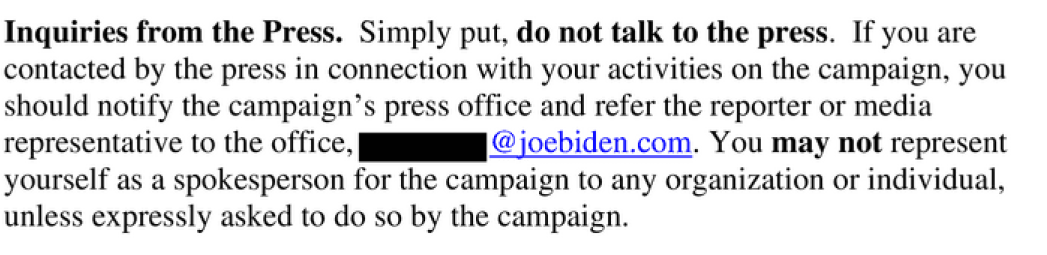
list of rules provided to members of the policy groups, a copy of which was obtained by The Times, instructs participants not to disclose their participation “on social media such as Facebook or LinkedIn or in your professional bio.” It also warns them not to discuss or distribute names of other committee members, contents of committee conversations, emails from the committee or to talk to the news media.

“Simply put, do not talk to the press,” the document reads, emphasizing “do not talk to the press” in boldface.

Biden Press

And what is Eric Schmidt doing?  According to Recode:

Google Cypress

Yes, to paraphrase former government official Susan Crawford, it looks like “Uncle Sugar” Eric is trying to “geek around the nation state.” Why? It’s very odd but it’s exactly the kind of thing that Roger McNamee warned of. As Recode tells us, it could be a COVID play to allow Uncle Sugar to travel to raves in Europe more easily (as Cyprus citizenship gets him an EU passport), but:

[I]t is still uncommon to see Americans apply to the Cyprus program, according to published data and citizenship advisers who work with the country. The program is far more popular with oligarchs from the former Soviet Union and the Middle East, and it has become mired in so many scandals that the Cypriot government announced last month that it was to be shut down.

But not for Uncle Sugar. So there goes the confirmation hearing. Why did Uncle leave Google again? We never got an answer to that or why his NY pad is soundproofed–from the inside.

Yes, they’re psycho kleptocrats just like Irving says, and it looks like they’re back. But thankfully we have Irving Azoff and we’re not waiting for the cavalry to save us–which they never have.

@digitalmusicnws Asks Is the MLC Putting Smaller Streaming Platforms Out of Business? — ArtistRightsWatch

By Editor Charlie

Dylan Smith at Digital Music News asks the question, “Is the MLC Putting Smaller Streaming Platforms out of Business?” We’ve raised this very question long, long ago, back in early 2018 when the Music Modernization Act was getting passed and the chorus of braying by MLC supporters was at a fever pitch. Everyone ignored the obvious flaws in the legislation, especially the anticompetitive nuances that Dylan has highlighted today. 

But understand–this issue is not new. We raised it in the blogs, and Chris raised it to Congressional staff directly–he said the response was a hangdog “I know, I know. It’s what the parties wanted.”

In other words, Congressional staff knew it was stupid, but were being railroaded into doing it anyway by “the parties” (plural) and there are so many hours in the day. When staff said “the parties” back in 2018 before there was an MLC, guess who they meant? One of those parties was the Digital Media Association which still runs the “Digital Licensee Coordinator” or the DLC–which is essentially the companies with trillion-dollar market caps who we think of as Big Tech. (The DLC’s membership application is here.)

And as you will see, it’s more like is the DLC putting smaller streaming platforms out of business. (See the DLC membership assessment fees “explainer” for DLC members.)

DLC Members

And since the DLC appears dominated by Google, Amazon and Spotify, maybe the real issue is that it’s Thursday, so of course Big Tech wants to keep competition weak and vulnerable to being shut down or acquired. And the MLC and its promoters did nothing to stop it because of the pact between the MLC and the DLC that they would each keep anyone out of the vicinity of the Copyright Royalty Judges who might get in their way. 

Of course the most ludicrous part of this is that these trillion-dollar companies don’t just eat the cost of running the DLC since by the time you get finished reading this post, they will have collectively grossed some sum well, well in excess of the annual operating costs.

But–as we will see, there may be some hope for brave startups to challenge the insider deal that penalizes them without giving them an opportunity to speak up for themselves.

As Dylan writes in DMN:

According to the document [establishing the insiders’ allocation of the fee structure], digital service providers have to cover the MLC’s startup fee ($33.5 million) via a “startup assessment,” or “the one-time administrative assessment for the startup phase of the Mechanical Licensing Collective.” This payment must be made alongside the first annual bill, which is due on February 15th, 2021; the second annual fee disclosure is due in November of the same year and must be paid by January of 2022, for a considerable overall obligation.

Total-wise, platforms “that have a Unique Sound Recordings Count” – or the average number of “royalty-bearing” works streamed or downloaded each month – of less than 5,000 will pay an annual minimum fee of $5,000, to a $60,000 annual minimum fee for those with over 5,000 such works. For DSPs that break the 5,000 threshold, it appears that 2021 will bring with it a low-end bill of $120,000.

Significantly, our source proceeded to indicate: “That’s just the minimum – the total assessment is dependent on market share, which is basically unpredictable at this point. And that’s on top of mechanical royalties for those who use the blanket license.”

This completely out of whack cost structure was obviously a major, major flaw in the Music Modernization Act–specifically the incredibly muddled and meandering Title I which established the Mechanical Licensing Collective and the DLC. The chickens are now coming home to roost.

As Chris wrote in Newsmax Finance on August 20, 2018:

[T]he problem [with the MMA] doesn’t come from songwriters. It comes from the real rule makers—Amazon, Apple, Facebook, Google and Spotify. And startups know which side butters their bread.

Public discussion of MMA has focused on the song collective and the compulsory blanket license for songs, but the mandated digital services collective is more troubling given the size of the players involved…Rule taker startups are governed by the rule maker DLC, but have no say in the DLC’s selection.

Like Microsoft’s anonymous amici, startups know their place —especially against Google, Amazon, and Facebook, whose monopoly bear hug on startups includes hosting, advertising and driving traffic.

The MMA authorizes these aggressive incumbents to effectively decide the price to startups for the “modernized” blanket license. Why? Because the MMA requires users of the license to pay for the lion’s share of the “administrative assessment,” the licensees’ collectivized administrative cost payment that the CBO estimates will be over $222 million for eight years….

Why should the government only permit one game in town? Rather than have the DLC run by the usual suspect monopolists, why not allow competition?

This is important–if startups can’t afford to buy-in to the license, it does them no good, and their biggest competitors decide the price of that license through the DLC.

“Modernization” should make licensing easier: level the playing field for startups and protect them from famously predatory competitor incumbents, as well as copyright infringement lawsuits from the rule takers.

These are all good reasons for the private market solution. Competition at least gives startups hope for the pursuit of fair treatment.

“The parties” and everyone else ignored this warning (and of course, since it wasn’t included in a press release, the trade press did no investigation). This is exactly what Dylan is focused on in DMN. It was only a matter of time until the invoice for startups came due. 

That invoice arrived as part of the “administrative assessment” hearing mandated by Congress in Title I. This is a curious procedure before the Copyright Royalty Judges that expressly excluded anyone from participating who might get in the way of the check that would reunite the Harry Fox Agency with its former owners. That order by the CRJs is the document that Dylan links to.

In a blog post at the time on MTP, Chris drilled down on the nuances of this settlement for the administrative assessment (which is what gives teeth to the mechanism to sandbag startups:

Notice two things:  First, the CRJs’ adopt the position of the MLC and the DLC that the only people who could object to the settlement were “participants”.  Who might that be?  Why the DLC and the MLC, of course.  There were other participants, most prominently the Songwriters Guild of America.  SGA was hounded out of the proceeding because the MLC apparently did not want to include SGA in the negotiation of a settlement.

I can understand the complexity of a three-way negotiation with those pesky songwriters about a matter that affects all the songwriters in the world who have ever written a song or that may ever write a song.  Those songwriters might really get in the way.  What I do not understand, however, is why the songwriters would not be afforded the opportunity to at least comment on the settlement that carries the awesome power of the Leviathan behind it.  I do understand how the rules came to be written the way they are, however.

And this leads to the other thing to observe about this ruling.  “Because there were no non-settling participants…the proposed settlement was unopposed.”  Rather tautological, right?  How can the settlement be opposed if those who might oppose it are not allowed to do so?

Let’s be clear what “opposition” means in this context.  You could just as easily say “improve” or “make fair”.  And lest you think that this is yet another example of sloppy legislative drafting in the mistake-prone Title I, this time I don’t think it’s a mistake.  I think it is exactly what the drafters intended.

This is all pretty darkly typical swampy behavior by the insiders and their lobbyists dedicated to lawyering their way to an unfair court order masquerading as a good thing for songwriters. Of course.

Here’s the ray of sunshine:

After the world “unopposed” the CRJs drop a footnote.  And it is this footnote that is probably the most important point to the unrepresented songwriters and startups who either couldn’t afford to participate or who were afraid of back alley retaliation if they did.

“The Judges have been advised by their staff that some members of the public sent emails to the Copyright Royalty Board seeking to comment on the proposed settlement agreement.Neither the Copyright Act, nor the regulations adopted thereunder, provide for submission or consideration of comments on a proposed settlement by non-participants in an administrative assessment proceeding. Consequently, as a matter of law, the Judges could not, and did not, consider these ex parte communications in deciding whether to approve the proposed settlement. Additionally, the Judges’ non-consideration of these ex parte communications does not: (i) imply any opinion by the Judges as to the substantive merits of any statements contained in such communications; or (ii) reflect any inability of the Judges to question, [on their own motion without a filing from a participant] whether good cause exists to adopt a settlement and to then utilize all express or reasonably implied statutory authority granted to them to make a determination as to the existence…of good cause [to reject the settlement now or in the future].

This footnote is very, very important.  I would interpret it to mean that the CRJs may anticipate that they are directly or indirectly appealed or their decision is examined by the Congress that has ultimate oversight. 

Note that the Judges clearly anticipate reviewing the assessment for “good cause” without a filling from the DLC or the MLC. It’s not clear exactly how that might happen, but it might be as simple as a startup complaining to the CRJs in an email.

So it seems to us that it’s only an MLC issue in that both the MLC and the DLC are each complicit in keeping outsiders away from the decisions about the administrative assessment and how it will be tagged to startups or smaller services. You know, “the parties” decided how the little people are to make do.

Chris Castle’s Copyright Office Comments on the Black Box Controversy

Here’s some more MLC news you’ll never read about in the trade press.

Yesterday we posted a shocking revelation from the MediaNet/SOCAN ex parte letter to the Copyright Office: It appears that the digital music services have no intention of complying with the much ballyhooed benefit to the Music Modernization Act–in return for the “reach back” safe harbor that somebody decided to grant the services retroactively, the services would pay over (or you could say “disgorge”) all the unmatched and unpaid mechanical royalties that they were holding, sometimes for years, and always secretly. (Adding insult to injury, MediaNet seems to think that referring to SOCAN’s ownership of MediaNet somehow makes screwing us over into a songwriter-friendly act of good fellowship and felicity. More likely, SOCAN itself knows nothing about it.)

Remember, MediaNet straight up threatened to decline the reach back safe harbor and not pay over the black box. As it turns out, MediaNet’s position is not unique–as Chris Castle identified in his reply comment on the Copyright Office’s black box study, all of the services represented by the DLC made that exact threat to the Copyright Office. As Chris observes, these are not idle threats. They are made by the biggest corporations in commercial history, one of which may be broken up due to antitrust investigations on two continents.

Something must be done and done quickly before the DLC decides to take the blanket license without the limitation on liability for past infringements having successfully scared off anyone who could have sued but didn’t thinking that there was a fixed reach back safe harbor. That seems like it will result in the big guys having paid off the big guys in the NMPA’s secret settlement that was being negotiated simultaneously with the MMA (the NMPA’s umbrella December 17, 2017 Pending and Unmatched Usage Agreement referenced in the MediaNet ex parte letter and talked around in other filings. Remember–the MMA was introduced a few days after the secret NMPA agreement on December 21, 2017 and Wixen Music Publishing felt they had to sue Spotify by December 31, 2017 because of the reach back safe harbor. So everyone except the songwriters–and perhaps most Members of Congress–seems to have known that the fix was in on black box.)

Another fine mess they got us into. Here’s the except from Chris Castle’s reply comment:

The DLC’s Quid Pro Quo Revelation

The concept of a “black box” distribution is a pale mimic of a simple
fact: It is not their money. The fundamental step that Title I excuses
is basic and would solve much of the unmatched problem if Title I did
not exist: Don’t use a work unless you have the rights.

It is a fundamental aspect of copyright licensing and it is not metaphysical.
Yet the message from all negotiators concerned in this process seems
to shelter legitimacy in a complication of dangers to the black box that
come down to another simple fact: Obey and be quick about it or the
law will take your money and give it to someone else.

How much is in the black box? They won’t tell you. From where? Not
your business. From when? Confidential. Is it yours? Already paid it
to someone else before you even knew it was there. And Lord knows
that money once taken incorrectly in the dark is unlikely to be paid
correctly in the light.

Comments by the DLC demonstrate conclusively that addressing the
black box has taken on even greater urgency. The DLC’s Initial
Comment in a related docket is unusually revelatory for a group with a
multitrillion dollar market capitalization that loves them some
protective orders. This passage is particularly breathtaking:

This was the heart of the deal struck by the stakeholders in
crafting the MMA: to provide legal certainty for DMPs, through
a limitation on liability, in exchange for the transfer of accrued
royalties.

If that were “the deal” it is news to me, and I like to think that I’ve
been reading along at home pretty attentively. If I wasn’t aware of
“the deal”, I’m sure I wasn’t alone in my ignorance, but I’m far more
understanding of why the negotiators would have been motivated to
keep “the deal” under wraps if that’s really what it was.

If “the deal” wasn’t kept quiet, someone might have asked why there
was a “deal” when the services were simply agreeing to pay money
they already owed and that they were already obligated to pay for infringements that already occurred. Yet, services still got the new
safe harbor trophy to put on the wall in the copyright hunting lodge
next to the DMCA and Section 230.

The gall doesn’t end there, however. The DLC goes on to make this
threat of imminent harm:

[The “deal”] is a crucial point for the Office to keep in mind as it
crafts rules in this space. If the regulations make it less likely
that a DMP will be able to rely on that liability protection when
it needs it—i.e., if it increases the risk that a court would deem a
DMP to not have complied with the requirements in section
115(d)(10)—a DMP could make the rational choice to forego the
payment of accrued royalties entirely, and save that money to
use in defending itself against any infringement suits.

It is a bit odd that the DLC seems to think of Title I as their private
contract, but there it is. The DLC members’ anticipatory repudiation
of the purported deal that the world now knows underpins Title I was
both refreshingly brazen and starkly shocking. Given that the Eight
Mile Style
case against DLC member Spotify (and both Spotify and
The MLC’s vendor the Harry Fox Agency) is a live action, the DLC is
not making an idle threat. The DLC tells us that if its market cap isn’t quite high enough to suit, Spotify could immediately dip into the black
box for “money to use in defending itself.”

The relationship with the services apparently has settled into the
customary laying about with threats and blackguarding both
songwriters and the Copyright Office. That’s reassuring in confirming
that human nature hasn’t actually changed and these companies really
were the Data Lords we had always known our betters to be after all,
sure as boots.17 Maybe one day the scorpion really won’t sting the frog.
Maybe another “unity dinner” is in order. But not today.

Regardless, it is clear that the Copyright Office is almost the only place
that songwriters can go for relief and an explanation of how the MMA
is to be implemented whatever secret deal the DLC now purports to
have made. Given the DLC’s unequivocal threat on behalf of its
members, there is no doubt of the imminent danger that the black
box currently being held is about to vanish into thin air if something
isn’t done immediately to preserve the status quo. The balance of
hardships pretty clearly tilts in favor of the songwriters as the safe
harbor services control the money and always have.