Press Release: @SoundExchange Praises European Union Court Decision On Equal Treatment for Creators

Sep 08, 2020

In Affirming “National Treatment” Principle, European Court of Justice Rejects Unfair Treatment of Music Creators Based on Nationality

Washington, DC – September 8, 2020 – SoundExchange praised the European Court of Justice’s ruling ordering European Union countries to treat music creators equally regardless of their nationality, recognizing this as an important milestone in the fight to ensure music fairness.

The ECJ ruling stemmed from a case in Ireland regarding whether US music creators should be paid royalties when their music is played on Irish radio or in places such as restaurants or bars. Some countries deny foreign music creators royalties for the use of their work even though royalties are otherwise paid to artists who are nationals of those countries.

The ruling has broad implications for music creators around the world. By adopting the principle of “national treatment” – that a country should provide foreign entities the same benefits and protections as it would its own citizens – the ECJ is setting the stage for all artists to be paid royalties when their music is played on EU radio broadcasts and public performances.

“Today’s decision by the European Court of Justice reflects a growing global recognition that countries should treat all music creators the same, regardless of their nationality. The ECJ reaffirmed equal treatment as a fundamental principle of how nations engage with one another,” said SoundExchange President and CEO Michael Huppe.

“We appreciate the leadership of Ireland’s RAAP in advancing the cause of fairness within the global community of music creators. We urge EU member states to quickly follow suit so that ALL musicians and labels, from whatever territory, can be properly respected for the benefits they provide beyond their home country,” added Huppe.

The ruling comes as the United States and United Kingdom undertake negotiations on a post-Brexit trade agreement. A broad spectrum of organizations representing artists, publishers, musicians and managers have urged negotiators to insist that national treatment be included in the final US-UK trade agreement.

Unfair treatment denies US music creators an estimated $330 million in direct global royalty payments a year. For more information on the Fair Trade of Music campaign, please go to www.fairtradeofmusic.com.

Press Release: @SoundExchange Praises European Union Court Decision On Equal Treatment for Creators — Artist Rights Watch

Guest Post: This is the Only Question for the Next Head of the Copyright Office

by Chris Castle

At some point in the coming days, there will be an announcement for the new head of the U.S. Copyright Office. I fully expect that everyone will have their litmus test for whether the new person (called the “Register” for historical reasons that have probably outlived their usefulness) should be appointed. The fact is that the Register is, if you ask me, a thankless job that has been filled by wonderful people for many, many years. It’s not a job that is really suited to anyone’s litmus test.

The reason it is not susceptible to a “factiness” approach is that the job is a balancing act between creators across all copyright categories, some of the biggest tech corporations in commercial history, and users (or as we call them, fans). When you review the past Registers all but the last two or so had one thing in common–they didn’t have to deal with corporations who were dedicated to the corrosion and eventual recasting of copyright into something that wasn’t what anyone previously thought of as copyright and so did not deserve the name.

Google Lobbyist and DNC Speaker Susan Molinari

Past Registers didn’t have to deal with corporations with trillion dollar market caps that have an endless lobbying budget. They didn’t have to deal with corporations who could get their lobbyist a speaking slot at the Democratic National Convention just in case you didn’t get the point. (Remember–AOC got 60 seconds.) Like the anaconda in the chandelier, they didn’t even have to say a word about the real issue.

Prior Registers didn’t have to deal with big tech corporations who hired prior employees of the Copyright Office to lobby–or at least advocate–against copyright.

True, there has been a revolving door at the Copyright Office before, but those hires were all devoted to preserving strong American copyrights which is also the mission of the Copyright Office to a large extent. They were not devoted to destroying copyright as we know it, distorting exceptions into giant loopholes, and looking the other way while major search corporations filed millions of “address unknown” notices for songs that started with the absurd premise “Google can’t find…”

So really there is simply one question for the next Register. “Do you support codifying Google’s terms of service in the law?” That’s a yes or no question. And it is absolutely serious with not a hint of sarcasm.

There are many signals that this is exactly what the anti-artist cognoscenti have in mind. Lawrence Lessig, Brewster Kahle, Pamela Samuelson, Christopher Sprigman, Fred von Lohmann, the EFF, Engine Advocacy, R Street Institute, Tech Freedom, Public Knowledge, the list goes on and on and on. All of them are dedicated to codifying Google’s terms of service in U.S. law. And that is where they will start if they capture the Copyright Office–they will use the springboard of the vast influence that the U.S. has on treaty negotiations to do the same in other countries and eventually the world.

You could throw a dart at a map of the world and you will hit a country where Google, Facebook, Amazon and the rest are trying to destroy copyright as we know it. Try South Africa, the European Union, Canada, Australia, New Zealand, India, Brazil. All are on the menu.

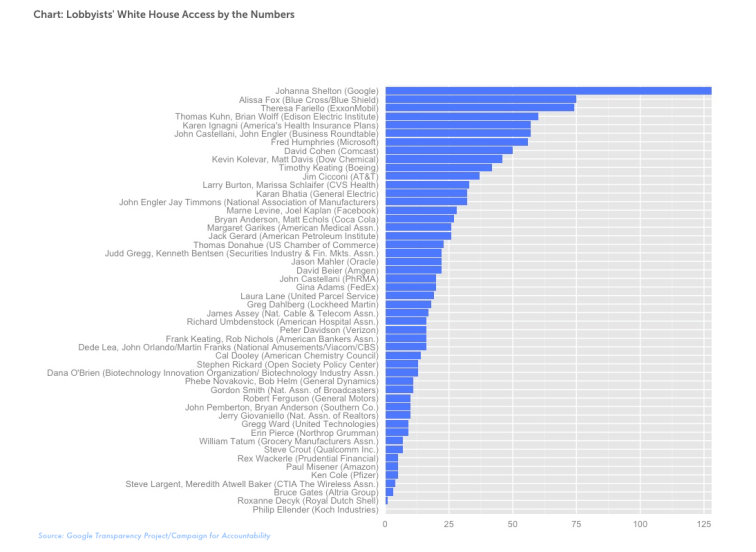
And by the way it’s not just the Register. Remember the Google Transparency Project (now the Tech Transparency Project) identified through public records the vast influence that Google and other FAANGS companies had over the Obama White House (Facebook, Amazon, Apple, Netflix, Google and Spotify). (Remember President Obama’s #POTUSPlaylist? Not an Apple playlist, a Spotify playlist.) And who has post-term deals from Netflix and Spotify? Just sayin.

Which multinational corporation had more meetings at the White House than any other? Just sayin.

Roger McNamee, long time Silicon Valley venture capitalist and member of the band Moonalice summed it up in a recent Wired opinion post as an open letter to Vice President Biden:

One of the policy areas that demands a new approach is technology. New technologies like facial recognition and artificial intelligence have been plagued by racial and gender bias, with particular harm in areas like law enforcement, job hiring, and mortgage applications. Internet platforms like Facebook, YouTube, Instagram, and Twitter have amplified hate speech, disinformation, and conspiracy theories, undermining our politics, our pandemic response, and the safety of our citizens….

Imagine my disappointment last week when The New York Times reported that President Obama had suggested that you work with two members of the Silicon Valley establishment, former Google CEO Eric Schmidt and LinkedIn founder Reid Hoffman. I know both men well. They are brilliant and very successful. Their money and expertise may be valuable to your campaign, but I hope you will not turn to them for policy guidance. They were architects of the culture and values that produced the problems I described above.

Let’s be clear–this is not about politics.  I know some of your political knees are jerking right about now.  But be clear–this is about survival and these are facts.  As Roger McNamee says–and he’s hardly the only one saying this–we all have to do everything we can to fight back Silicon Valley’s government takeover.  You don’t have to be for or against any particular candidate to understand that Google & FAANGS once had pretty much all they ever wanted in the wildest dreams of any lobbyist or swamp creature.  They liked that control over the administrative state and they mean to have it again–if they ever really lost it.

Also remember that the FAANGS have been vastly enriched by the COVID crisis while artists have been weakened like never before.  Now is the time that the anaconda in the chandelier is most likely to strike and crush its prey.

So let’s ask the only question that’s relevant of the next Register:  Do you intend to codify Google’s terms of service.  Yes or no.  And take good notes on the answer because they need to be held to it.  It is an absolutely serious question, particularly now.

Copyright Office Regulates The MLC: Selected Public Comments on the Copyright Office Black Box Study: The DLC Spills the Beans, Part 3

[Read Part 2 here.  This is the last of 3 parts]

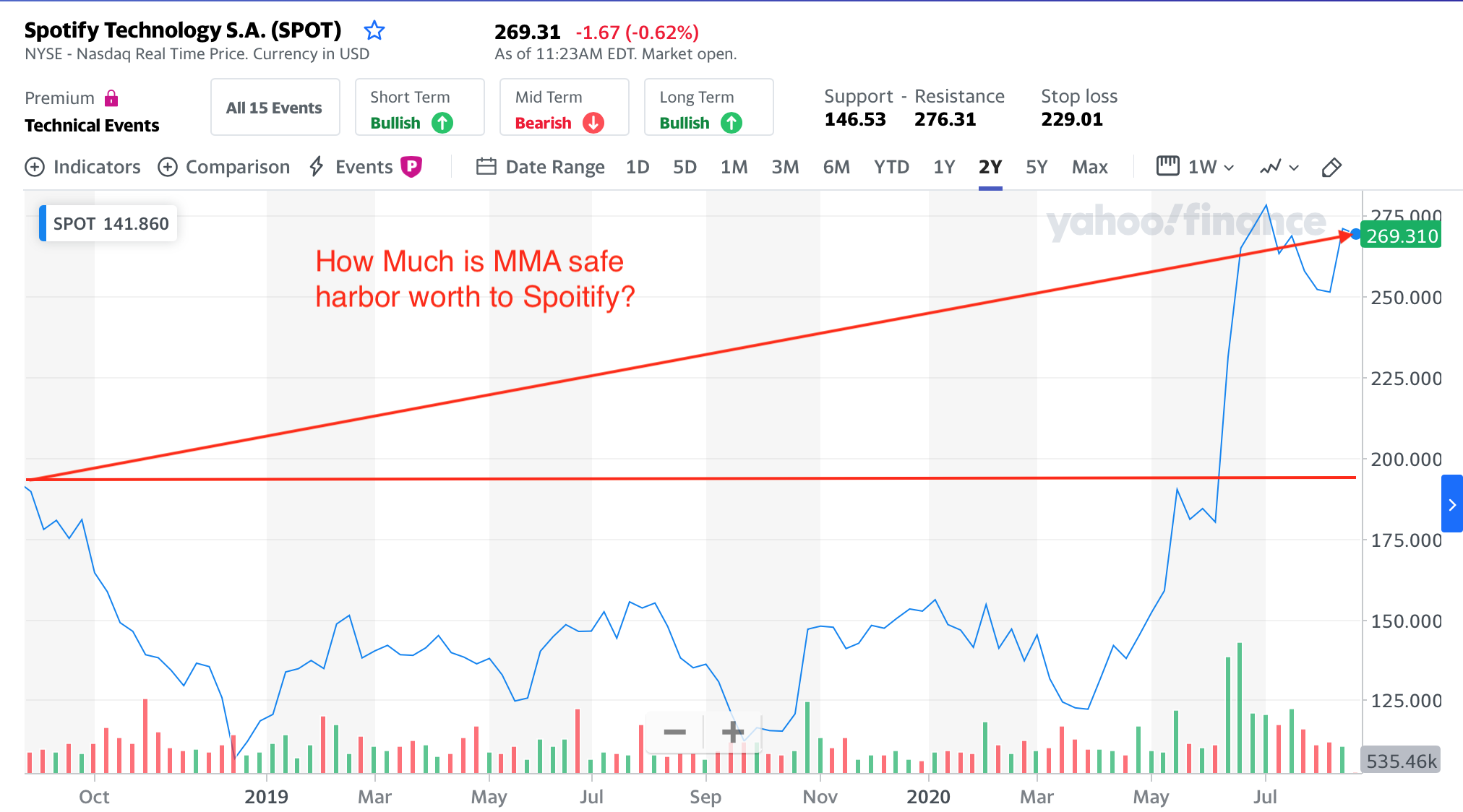
The services tell us in their Copyright Office comment that the whole point of the Music Modernization Act was this (largely secret) deal to get them a new retroactive safe harbor so their massive infringement couldn’t be stopped by songwriters.  (That’s their third statutory safe harbor counting DMCA and Section 230.)  What do you think that MMA safe harbor is worth to them to avoid what they call “ruinous litigation”?

Let’s use Spotify’s market cap as a proxy for the value of the safe harbor–imperfect, yes, but at least it is transparent unlike anything else having to do with Title I of the MMA.

SPOT Safe Harbor Value

Around October of 2018 when the MMA was signed into law, Spotify traded at $189.  A recent closing price for SPOT is $268.  Is it fair to say that the MMA was the rocket fuel that made Daniel Ek a billionaire?  Not entirely.  You can see from the graph that Spotify actually broke through a $190 per share support level to the downside right after the MMA was signed and bounced around below that price for a year or more.

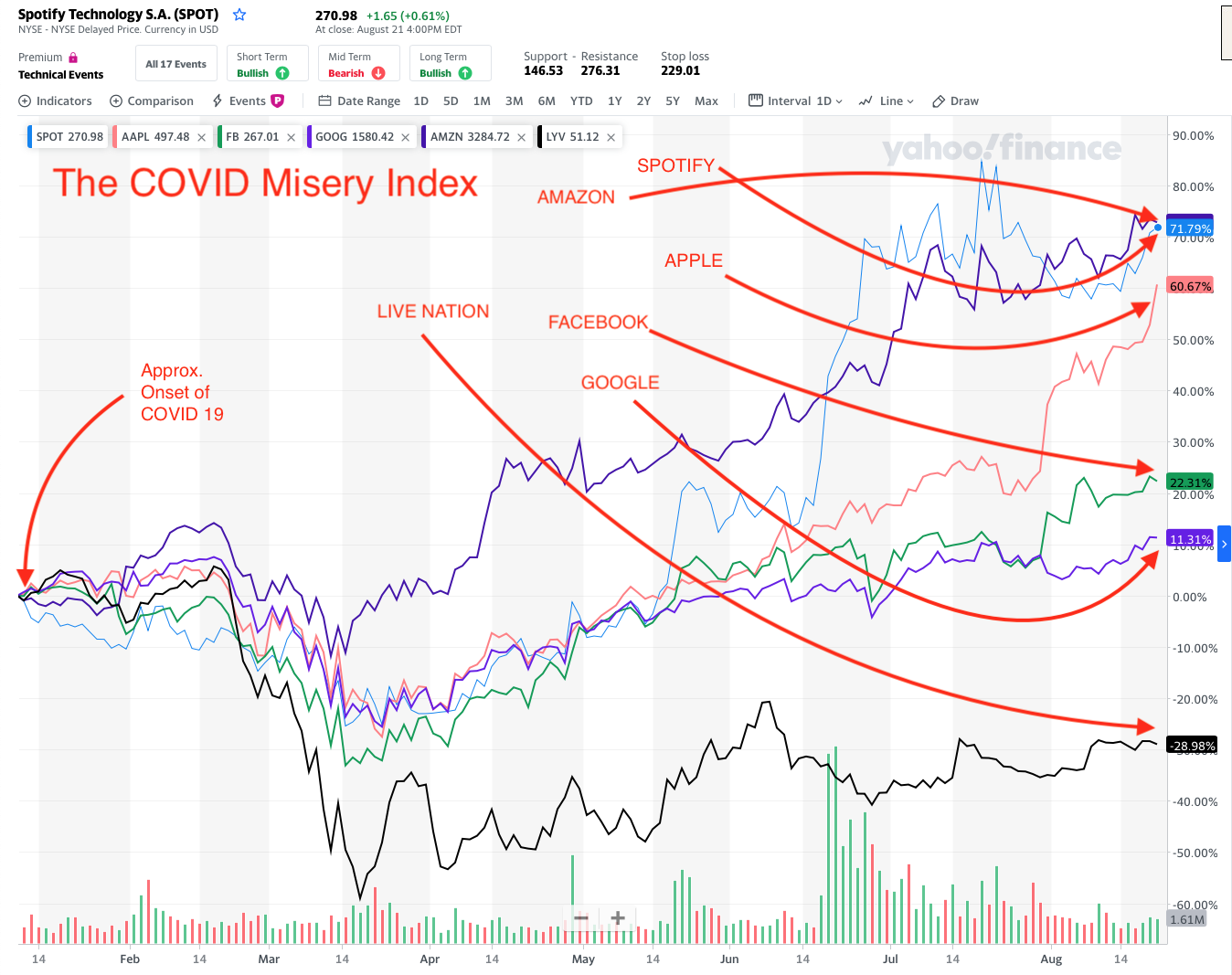
The clear driver of Spotify CEO for Life Daniel Ek’s wealth and profiteering is the COVID virus.  Make no mistake, human misery–not the MMA safe harbor–is what provided the rocket fuel for Spotify’s 2020 growth.  In fact, the same rocket fuel of misery seems to have benefited each of the exploitative cohort as this graph shows using Live Nation as a proxy for the collapse of touring:

COVID MISERY INDEX 8-22-20

So it could be said that the entire “ruinous litigation” argument from the DLC is simply so much bullshit that these companies fed to the MMA negotiators by the plateful.  What is not bullshit, however, is that the one thing the negotiators could have scored that they didn’t is a waiver of the services appeal rights in the Phonorecords III rate setting decision.  This is the appeal that the services recently won when the appeals court handed the negotiators heads to them.  There could also have been a settlement since they seem to like those so much.  The negotiators didn’t do either.  We’ll see how the do-over turns out, but one thing we know is that there will be millions in legal fees that songwriters will have to eat one way or another that could easily have been avoided.

What is also not bullshit is the other side of the MMA transaction:  The loss to songwriters of this heretofore secret deal.

You will note that none of the music services appear to have paid out jack in the way of newly matching the previously “unmatched” in the years since the signing of the MMA. Why?  Because the MMA negotiators did not require any interim payments of matched funds or any public reconciliation of black box to matching efforts.  No, no, the first time the black box gets disclosed publicly is when those funds are paid to the MLC, not to the songwriters who earned the money.  Round and round and round it goes, and where it stops, nobody knows.

If you believe as we do that the services have not lifted a finger to increase their matching efforts (and based on the DLC’s disclosures seem to have already paid out pre-MMA black box on a market share basis), you will better understand why we think this was a colossally terrible deal for songwriters.  You will also understand why this part of it was largely kept secret or downplayed.

The Eight Mile Style complaint against Spotify and the Harry Fox Agency (which is the same Harry Fox Agency that is now going to be handing your royalties for The MLC, how curious) has an informative passage about the timing of this retroactive safe harbor:

In addition, the retroactive elimination of the right to profits attributable to infringement, statutory damages, and attorneys’ fees under the MMA is an unconstitutional denial of substantive and procedural due process, and an unconstitutional taking of Eight Mile’s vested property right, and this Court should so declare.

It is settled law that an infringement claim is a property right that vests in a plaintiff the moment the infringement occurs. The Bill that ultimately became the MMA, written by the NMPA, with input from Spotify, became law in October 2018, but provides retroactively that a plaintiff who did not file an action by December 31, 2017, could lose any right to profits attributable to infringement, statutory damages, and attorneys’ fees if successful in a case against Spotify or other DMPs of interactive streams. On information and belief, the MMA, according to the NMPA’s own announcements, lobbyist spending, and congressional testimony on Capitol Hill, was jointly crafted by members of the NMPA (whose three top markets shares and dues-paying affiliated companies own equity in Spotify) and Spotify, DiMA, and other interactive streaming companies.

They knew what they were doing….

[W]ith the removal of these remedies, it cleared the last hurdle for Spotify to go public, thereby reaping tens of billions of dollars for its equity owners, including the major music companies as mentioned above. The unconstitutional taking of Eight Mile’s and others’ vested property right was not for public use but instead for the private gain of private companies.

The reference to timing on Spotify “going public” means Spotify filing their “DPO” to sell stock on the public markets–the really big money.  That’s relevant to the MMA negotiation because the MMA bill was introduced on December 21, 2017.  Spotify filed a confidential paper with the Securities and Exhange Commission on January 3, 2018 and Spotify’s stock started trading on April 3, 2018.  The MMA allowed them to show the markets that they were doing something about their systemic copyright infringement problem and gave fuel to the specious argument that lawsuits against them were merely opportunistic gotcha lawsuits and not a bellweather for their utter incompetence and cavalier treatment of songwriters.

Why is this timing important?  Because the MMA was filed on December 21.  What happened on December 22?  Congress closed for the holidays and would not reopen until after January 1, 2018.  That meant there would not be an official version of the bill until after January 1, 2018, the deadline to sue before the retroactive safe harbor would eventually take effect.  Various copies leaked, but since the entire music industry was also shut down for the holidays, it was unlikely that any songwriters would see it, particularly because we can’t find that their so-called “representatives” ever brought it up in any public messaging before the January 1 deadline had passed.

Do you think that timing is a coincidence?

As Eight Mile Style tells us:

The proof is in the pudding: Spotify was sued many times prior to December 31, 2017, for similar acts of copyright infringement as alleged herein, but not once since December 31, 2017. This is because the Bill that ultimately became the MMA first publicly leaked shortly before December, 2017, leaving music publishers with little or no time to investigate or file a lawsuit for infringement, even if they somehow became aware of the Bill at that time.

It just happened that Wixen Music Publishing was already on a war footing from opposing the various Spotify settlements and was able to easily pivot to filing its own lawsuit against Spotify before the December 31, 2017 deadline in a move worthy of General Patton at Bastogne.  But Wixen was alone.  No one else probably even knew the deadline was passing or what it meant.

The value of what the “negotiators” gave away cannot realistically be measured for the reason that Eight Mile Style clearly states, which is also the same reason that the retroactive safe harbor is unconstitutional:

The only practical or realistic remedies in these cases is the statutory damage remedy, and profits attributable, together with the ability to receive attorneys’ fees, and the drafters of the MMA knew it. The elimination of these remedies takes away from Eight Mile and others who may be similarly situated any practical or realistic remedy, immunizes complying DMP’s from suit, and should be declared an unconstitutional deprivation of due process and a taking of a vested property right.

So what’s the value that songwriters gave up in the MMA?  Wixen sued for $1.6 billion.  You figure it out.

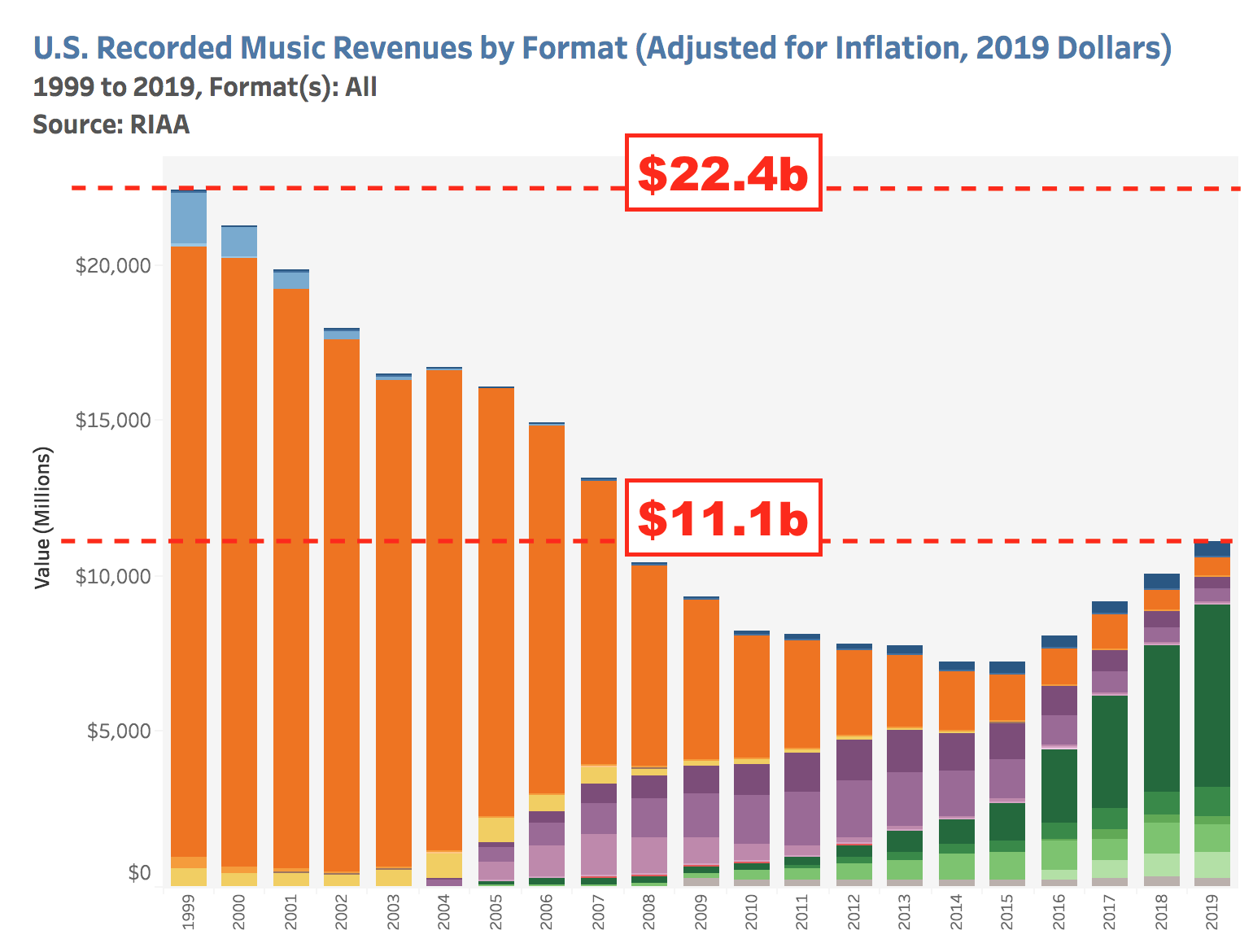
Still Down by 50%, The Problem With Streaming 2020 Edition

There’s absolutely nothing wrong with music streaming, except the economics. In the chart above from the RIAA it’s painfully clear the record industry is still down by over 50% of the revenues achieved at the peak of the business in 1999. So despite what people might like to say about the value of streaming, the actual facts beg to differ.

We recognize that at it’s worse the industry was down by almost two thirds of the peak, and gains are being made. However, it’s important to have clear perspective in these conversations if we are to address some of the challenges with the current economic model.

The fundamental problem with streaming is that revenue does not grow with consumption. Revenue only grows with subscriptions or advertising revenue. Once that revenue is capped, everyone from Taylor Swift to indie garage bands are splitting that same revenue which is divided by the total number of plays for that specific revenue period. This also means hit records don’t add overall revenue for anyone, they just get a larger piece of the revenue that is available.

When a major artist has a release (like Taylor Swift for example) everyone’s streams are worth less. This is because Taylor generates so many plays/streams that the pie is now cut into much smaller slices. Of course, Taylor gets the majority of those slices so she gets the most money from the pool of revenue that is available.

In other words, the pie doesn’t grow with consumption, it can only be cut into smaller pieces. The more overall plays there are, the smaller the slices get for everyone. This isn’t the fault of the superstar artist, but rather it’s a fundamental flaw in the design of the business model.

The only way for streams to generate more revenue for all artists is to create solutions that generate more revenue for the streamers as well. The easiest and most common sense solution is an actual per stream rate which would allow consumption to drive revenue. It’s hard to believe such a win/win would be controversial, but here we are.


Copyright Office Regulates The MLC: Selected Public Comments on the Copyright Office Black Box Study: The DLC Spills the Beans, Part 2

[Continued from Part 1]

The DLC’s comment to the Copyright Office makes it clear that there is a substantial likelihood that the services are holding substantial monies in the black box—substantial amounts of other people’s money.  Probably some—or a lot—of your money.  The comment suggests more strongly and openly than we have seen before that not only are the services holding more money than they intend to acknowledge that they owe, they know they are and they intend to get away with it.  And as our friend Guy Forsyth has written in his classic song Long Long Time, nothing says freedom like getting away with it.

The DLC’s comment makes it clearer than ever that the whole point of Title I was for the services to get away with it under the guise of doing you the huge favor of paying you the money that they already owe you in return for “stakeholders” acting under color of authority to give away the few rights songwriters have.  And we’d bet you didn’t even know it happened.  Yet you are going to be bound by the deal these people made who don’t represent you and had no actual authority to make any deal on your behalf.  The DLC tells us:

This was the heart of the deal struck by the stakeholders in crafting the MMA: to provide legal certainty for DMPs, through a limitation on liability, in exchange for the transfer of accrued royalties. That is a crucial point for the Office to keep in mind as it crafts rules in this space. If the regulations make it less likely that a DMP will be able to rely on that liability protection when it needs iti.e., if it increases the risk that a court would deem a DMP to not have complied with the requirements in section 115(d)(10)—a DMP could make the rational choice to forego the payment of accrued royalties entirely, and save that money to use in defending itself against any infringement suits.

Read that last clause again:  “a DMP could make the rational choice to forego the payment of accrued royalties entirely, and save that money to use in defending itself against any infringement suits.”

The DLC is threatening to use your money to cover the costs of defending itself against lawsuits yet to be filed.  Perhaps that assertion proves too much—if the deal was that the services would use your money to buy themselves a safe harbor, if they don’t pay you the money then they don’t get the safe harbor?

Presumably they would also seek to get their assessment money back from The MLC, too.  Which of course gives them even more leverage now that the Fox is in the henhouse.  Given that The MLC seems to be teetering on the edge of a complete meltdown and seems to exist for the sole purpose of driving signups to HFA, maybe songwriters should be saying, if the DLC threatens to abandon The MLC can we please get that in writing?  They should understand that threatening to withhold money from The MLC is pushing on an open door for most songwriters who are not part of the insider cabal.

It’s pretty obvious from this comment that there’s an imminent danger that the monies owed by the services for the black box are likely to evaporate if something isn’t done to preserve the status quo.  You couldn’t ask for a more clear and compelling reason that the concern is justified.  Plus, what the services complain of is that the Copyright Office’s proposed regulations would make payments more accurate and that they might end up matching more than they already have.

They couldn’t be clearer:

DMPs supported enactment of the MMA fully intending to pay over any accrued royalties still on their books, with the assurance that the limitation on liability the MMA establishes in exchange will protect them from ruinous litigation.

Or said another way, getting caught.  And that’s what they really want to avoid.  One person’s “ruinous litigation” is another person’s justice.  Here they say it yet again:

The Copyright Office has proposed a regulation that requires DMPs to provide a “clear and detailed explanation” of any difference between “the total royalty payable” as reported on the cumulative statement of account (which reflects the royalties for all unmatched usage) and the “royalties actually transferred to the mechanical licensing collective.” We agree with this proposal, with one minor modification: we would suggest changing the phrase “total royalty payable” to “total royalty reported,” to avoid any suggestion that the amount reflected on the cumulative statement of account is necessarily “payable” to the MLC. DLC otherwise agrees with the Office that the MLC is entitled to such an explanation when there are such discrepancies.

The difference between “payable” and “reported” is the difference between what a service in fact owes compared to what they say they owe.  Remember, none of these statements will have been subject to a royalty compliance examination (or “audit”) at the time, if ever, that the money is paid over to The MLC.

Plus, we have absolutely no confidence that The MLC is going to be able to process the trillions of transactions involved which will inevitably lead to a huge black box problem that no one seems to be in a hurry to solve.  So the Copyright Office is exactly right to seek as much clarity as possible on the sums paid over to The MLC.  The balance of hardships tilt’s decidedly in the favor of songwriters.

As the House Judiciary Committee stated:

Testimony provided by Jim Griffin at the June 10, 2014 Committee hearing highlighted the need for more robust metadata to accompany the payment and distribution of music royalties….In an era in which Americans can buy millions of products via an app on their phone based upon the UPC code on the product, the failure of the music industry to develop and maintain a master database has led to significant litigation and underpaid royalties for decades. The Committee believes that this must end so that all artists are paid for their creations and that so-called ‘‘black box’’ revenue is not a drain on the success of the entire industry.

It’s obvious now that the only way to save the black box from total collapse is to have the services disclose immediately how much they are holding and for which songs, artist name and track name if nothing else.  There’s a real danger in not doing that—and the DLC is telling us clearly what their intentions are in a conclusive statement that raises serious questions.


Copyright Office Regulates The MLC: Selected Public Comments on the Copyright Office Black Box Study: The DLC Spills the Beans, Part I

We once had a mechanical licensing system in the U.S. that worked well enough for songwriters for 100 years.  The problem with the mechanical licensing system wasn’t so much the licensing function it was the royalty rate.  The government held down songwriters for 70 years to a 1909-based royalty rate that for some reason was frozen in time (more on frozen mechanicals here).  But if users failed to license, songwriters could at least sue for statutory damages.

After the Music Modernization Act passed in 2018, they managed to even give away songwriters’ rights to sue.  The songwriter part of the three-part MMA is called “Title I” and that’s the part that gave away the one hammer that songwriters had to be heard when their rights were infringed.  They called it the “limitation on liability” and it was retroactive to January 1, 2018—before the bill was actually passed by Congress and signed into law.

It’s entirely possible that even if you knew about the MMA, you didn’t know about this new safe harbor created by the same uber-rich companies that wrote themselves the DMCA safe harbor that has created the value gap and plagued artists for years and the “Section 230” safe harbor in the “Communications Decency Act” that services use to profit from human trafficking and revenge porn stalkers.  And now there’s the MMA safe harbor.

Only a handful of insiders got to be at the table when they gave away your rights in Title I without your even knowing what they were up to.  Don’t get us wrong, there are great things in the other parts of MMA dealing with closing the pre-72 loophole, some important changes to the rules for ASCAP and BMI with rate courts, and the fix for producers getting a fair share of SoundExchange royalties.  These are all good things.

The part that sucks is Title I that created this new safe harbor give away that will bedevil songwriters for generations to come.

So you may be asking how do we know this?  Since the so-called “negotiations” for the Title I give away happened behind closed doors, how do we even know what happened?  The answer is that we didn’t have the proof because anyone who tried to offer constructive criticism to the “negotiators” for songwriters was menaced, threatened and stabbed in the back.  Nobody was talking about the safe harbor give away.

But now we do have the proof courtesy of the music services representative at the “Digital Licensee Coordinator” who opened the kimono in their recent comments to the Copyright Office about the black box.  (Read the entire DLC comment here.)  Their comments make for quite a read, not only about the so-called “negotiations” by the unrepresentatives of songwriters but also about the run-up to the MMA in the private settlements that nobody sees.

The first issue is that the Copyright Office has proposed some well-meaning regulations to increase the likelihood that the black box will actually get paid to the songwriters who earned the money.  The services seem to be all in a huff about rules applying retroactively when they’ve been using old rules to organize their data.  You know, they don’t like this retroactive thing unless it’s a retroactive expansion of their safe harbor.  Then they like it just fine.

“The DLC emphatically opposes the Office’s proposal to retroactively expand the required reporting of sound recording and musical work information beyond that which is required by the existing regulations in 37 C.F.R. § 210.20. Those regulations were issued in interim form in December 2018, and finalized in March 2019, and unambiguously required collection of reporting information under the existing monthly statement of account regulations in 37 C.F.R. § 210.16. The Office has now proposed, in paragraph (e) of the proposed rule, to change the required reporting elements for the individual tracks, nearly two years after the MMA’s enactment and months before cumulative statements of account are due to be served.”

Sorry, but we think that the richest companies in commercial history, with trillions and trillions of dollars in market capitalization and the most advanced data mining capability in the known universe, can manage to figure out how to pay songwriters in a way that will actually result in songwriters getting paid. The truth is that they are so used to screwing songwriters that they are not going to lift a finger to help beyond the absolute minimum they have to do.

They got their retroactive safe harbor to give away, so don’t come whinging about retroactivity if it makes the distributions more likely to get to the right person, something the services have uniformly failed to do from their founding.

But now it gets interesting.

“It is well-known that—prior to enactment of the MMA—a number of DMPs entered into industry-wide royalty distribution agreements under the auspices of the NMPA, structured to allow all unmatched works to be claimed by their owners and all accrued royalties to be paid out, in what became the model for the MMA. These agreements were designed to, and did, put tens of millions of dollars in statutory royalties in the hands of copyright owners—money that they had been unable to access due to the broken pre-MMA statutory royalty system.”

First of all—“money that they had been unable to access due to the broken pre-MMA statutory royalty system” is utter crap.  The reason that services didn’t pay out is because they didn’t clear the songs but exploited them anyway.  For example, that’s also why Spotify got sued so many times and is still getting sued.  It’s not that the system was broken, it’s that the services didn’t care and handled licensing in an incompetent manner. In case you missed it, that’s what they want to keep doing by extending into the future the same sloppy practices they got sued for in the past.  The only thing new and improved about it is their absurd and undeserved safe harbor.

We don’t know what these “industry-wide royalty distribution agreements” were all about, but one thing we know for sure is that they weren’t “industry-wide” and the NMPA wouldn’t have had the authority to make those deals “industry-wide” in the first place.  “Industry-wide” seems to mean “with the major publishers” or with NMPA members or just plain insiders.  The implication is that “industry-wide” means everyone, which it clearly does not and cannot if you think about it for 30 seconds.

And if the copyright owners were owed a payment with their own money, the only reason that they couldn’t “access” the funds is that the services wouldn’t let them.  When you owe somebody money, you should pay them because you owe them, not act like you’re doing them a favor.

But here it comes:

Congress in the MMA’s limitation on liability provision enacted a compromise among stakeholders’ interests: elimination of the uncertainty of litigation facing DMPs in exchange for the transfer of accrued royalties to the MLC.

In other words, the services sat on the money and refused to pay until they got the MMA safe harbor.  That was the “trade”—do something the services were already required to do in return for something the songwriters were never obligated to do.  The songwriters paid for the safe harbor with their own money.

“As set forth in the relevant statutory provision, in exchange for payment of accrued royalties from “unmatched” usage prior to license availability date (and related reporting), DMPs are protected from the full brunt of copyright damages in any infringement lawsuits based on alleged failures to comply with the requirements of the prior mechanical licensing regime. The provision provides a clean slate for any past failures under the prior licensing regime for those DMPs who pay those back royalties and provide associated reporting. It provides requirements for DMPs that seek to take advantage of the limitation on liability, ensuring that DMPs that pay accrued royalties to the MLC can do so without having to second-guess whether the payment was worth it—that is, whether they qualify for the limitation.

This was the heart of the deal struck by the stakeholders in crafting the MMA: to provide legal certainty for DMPs, through a limitation on liability, in exchange for the transfer of accrued royalties.

Which “stakeholders” were these?  Did they include any of the plaintiffs who were then suing the services?  No.  Did they include anyone who didn’t drink the Kool-Aid?  No.

So let’s be clear—the reason that the services deigned to actually pay money they owed for failing to license properly is because they didn’t want to be sued for screwing up.  They wanted a vig of a new safe harbor, and as the DLC tells us very, very clearly this issue was at the core of the deal you didn’t make for Title I.

More in Part II


Must Read by @superwuster: A TikTok Ban Is Overdue

[Professor Tim Wu has a must read post in the New York Times that nails the problems with TikTok (and WeChat).  The subtitle are words that will live forever:  “Critics say we shouldn’t abandon the ideal of an open internet. But there is such a thing as being a sucker.”  Wowsa.]

Were almost any country other than China involved, Mr. Trump’s demands would be indefensible. But the threatened bans on TikTok and WeChat, whatever their motivations, can also be seen as an overdue response, a tit for tat, in a long battle for the soul of the internet.

In China, the foreign equivalents of TikTok and WeChat — video and messaging apps such as YouTube and WhatsApp — have been banned for years. The country’s extensive blocking, censorship and surveillance violate just about every principle of internet openness and decency. China keeps a closed and censorial internet economy at home while its products enjoy full access to open markets abroad.

The asymmetry is unfair and ought no longer be tolerated.

Read the post on the New York Times.

Open Letter to Jeff Bezos from Trixi the Three Legged Rescue Dog

Todays guest opinion is by Trixi a 5 year old female Pit Bull/American Bulldog mix and cancer survivor.

Hi Jeff

You don’t know who I am, but I’m pretty familiar with who you are.  You are the guy that sends those men and women up onto my front porch. This happens nearly every day. I’m not sure what it is I ever did to you but it is quite annoying. The newspapers that line the floor around the cat’s litter box (yes, I know I have a problem) also tell me you are the richest man in the world with a net worth of 188 billion dollars. I understand that your company has benefitted enormously from the current pandemic.  Those same newspapers report you and your fellow tech titans Zuckerberg and Musk have seen your net worth rise $115 billion just this year.  It is a good year to be a tech titan.

In contrast to that the family I live with is largely supported by money earned from performing music.  Concert musicians and concert promotion is the family business.  Since mid march there has been no concert income for my family. In fact our family income has fallen 80%.  Fortunately for me and my family we still receive songwriting royalties from streaming and sales. These royalties are from songs my dog dad wrote over the last 40 years.  My understanding is my family uses these royalties as a kind of rainy day fund that helps us get through tough times and the dry periods between albums and tours.

To be clear I’m not whinging here. I have it pretty good for a dog. I spent much of my first few years in kennels having puppies. I know how fortunate I was to be adopted by my family.  But back in the spring I developed a dull pain in my left front shoulder.  At first I thought it was a muscle injury from trying to scoot under the couch to get what I thought was an old dried up bit of bacon. Long story it wasn’t. It was pretty good. But it wasn’t bacon. Anyway,  the pain rapidly worsened until I couldn’t eat or even drink water.  I tried to crawl under the house to die. It was that bad.  The vet told us I had a malignant bone tumor.  I would need my left front leg amputated at the shoulder and a few rounds of chemo.  Fortunately the surgery and chemo appear to have been successful. Knock on wood.  It took me about a week to figure out how to walk. Now I get around pretty good. Here’s a little secret dogs: It’s easier to run than walk with three legs.

The point is without those songwriter royalties I don’t know if my family would have had the cash to pay for that surgery and treatment.  Well maybe that’s not quite true as I’m certain my family would have done anything they could to save me.  Put the surgery on credit cards or even taken out a loan.  But you get my point.  My life is an expense that many music families might not be able to afford.

Now the other day I was in the recycling bin checking to see if all the cans were properly washed out and I came across the full docket for the United States Court of Appeals Washington DC Case No. 19-1028.  Fascinating.  Basically you, Jeff Bezos, the richest man in the world sued the Copyright Royalty Board to “recalculate” songwriter royalties retroactively 2018-2022. And you won! Now the trade organization that represents you is claiming this is simply a technical detail. But that is not true. it is clear from the actual court filings that you (and your buddies Spotify and Google) want to retroactively reduce songwriter royalties from the current 13.3% downward to around 10.4%.  That is, a retroactive 28% pay cut to my family. There is a very real possibility of negative songwriter royalty checks in late 2020 or early 2021.  This is during a worldwide financial crisis. When my family has already lost 80% of their income.

So I just have one question for you Jeff.

“How much more fucking money do you need?  What kind of asshole sues to retroactively take pay from songwriters during a pandemic?”

Okay that’s two questions. I’m a dog. I’m not good at math.  I am good at empathy.  You should learn.

You can read the court opinion at link below.

2020-08-11 Case No. 19-1028 GJ v LOC UNSEALED OPINION FINAL

My Complaint to FTC Over Spotify False Claims They Weren’t Suing to Lower Songwriter Royalties

Spotify is completely full of shit (as usual). Spotify for Artists webpage the day after they argued in federal court to lower songwriter royalty rates.

Spotify’s claim that they are not suing to lower songwriter royalty rates appears to be a form of False Advertising, that may give them a competitive advantage over competitors.  For this reason I filed a complaint with the FTC.  Below.

On March 11th 2020 Spotify through its Spotify for Artists webpage made false claims about the nature of its appeal of songwriter royalty rates. (https://artists.spotify.com/blog/you-might-have-heard-about-the-streaming-industry%27s-crb-appeal-here%27s-what ). They also made these claims in a circulated press release on or around March 11th 2020. Specifically, they imply they were not trying to lower songwriter rates. The United States Court of Appeals For the District of Columbia ruling on their appeal (USCA Case #19-1028 Document #1856124 Filed:08/11/2020 Argued 10th of March) clearly indicates this is not the case. Further, Spotify apparently manufactured out of whole cloth the story that their appeal was centered on a technical matter of “bundling” lyric and video rights. On the webpage cited Spotify says “A key area of focus in our appeal will be the fact that the CRB’s decision makes it very difficult for music services to offer ‘bundles’ of music and non-music offerings.” The Appeals Court ruling nor the rest of the docket appear to support this contention. It appears the intention of this statement was to create the false impression that the goal of the appeal was not to lower songwriter rates, thus making consumers think Spotify was not taking a hard line towards songwriter pay. Consumers may have been misled and purchased Spotify subscription over competitors (like Apple) because they thought Spotify was not deeply hostile to pay raise for songwriters (Apple did not appeal songwriter royalties.) Finally, Spotify argued complaint March 10th 2020. The company had to know the March 11th statement was false.

If you want to file your own complaint go here

https://www.ftccomplaintassistant.gov/GettingStarted?NextQID=409&Url=%23%26panel1-9&SubCategoryID=17#crnt

Just use the “other complaint” form.  Let them sort it out.

Use this address for Spotify.

Spotify USA Inc.
4 World Trade Center, 150 Greenwich Street, 62nd Floor, New York, NY 10007
USA

I would use Horacio Gutierrez Head of Global Affairs & Chief Legal Officer at Spotify as the contact responsible for the false claim on FTC form.

United States Court of Appeals DC ruling on Mechanical Royalties Unsealed

Here is the ruling. Unsealed.  I just read it and I’ll tell you this, although it is a technical ruling in many ways, it clearly goes against songwriters.  There is little chance this will not lower your royalty rates in the subsequent rehearing.

First, The Court of Appeals all but directs the CRB to put the cap back on “total content costs.” This clearly will have a depressive effect on the alternate mechanical royalty calculation.  Second, the court seems to be fundamentally uncomfortable with the fact that songwriters get a (phased in over 5 years) 40% raise. Like everyone involved in the proceedings so far, no one seems to understand the initial rate was arbitrary. It was picked out of thin air when no one knew what streaming meant.  Finally it’s totally depressing to see a federal court reiterate the notion that the federal government can not put a streaming service out of business by raising songwriter rates too high.  It’s not the governments job to save companies that have bad business models.  If the streaming services can’t pay fair rates to songwriters perhaps they should charge their customers more, not pay songwriters less.  Why do the federal courts think songwriters have to subsidize the streaming business?  All in all a depressing read.  The system is broken.  Songwriters who every day add value to the GDP of this country are robbed and brutalized by their own government. A distant unaccountable unelected elite that has no concept of our lives.  Meanwhile they make Daniel Ek billions of dollars richer every year.  Does that seem right to you?


2020-08-11 Case No. 19-1028 GJ v LOC UNSEALED OPINION FINAL