Today’s podcast is about the impact on climate of the massive data centers operated in states outside of California and New York by Google, Facebook, Amazon and others. I focus on Oregon and Nebraska, but there are many other locations. These massive building projects enable Google to exercise its lobbying muscle in states you wouldn’t expect and on the federal senators and representatives of those states on issues familiar with our old adversary: Artist rights, profit from human trafficking, drugs and brand sponsored piracy.
“Upload your latest holiday photos to Facebook, and there’s a chance they’ll end up stored in Prineville, Oregon, a small town where the firm has built three giant data centres and is planning two more. [Hello, Senator Wyden.] Inside these vast factories, bigger than aircraft carriers, tens of thousands of circuit boards are racked row upon row, stretching down windowless halls so long that staff ride through the corridors on scooters.
These huge buildings are the treasuries of the new industrial kings: the information traders. The five biggest global companies by market capitalization this year are currently Apple, Amazon, Alphabet, Microsoft and Facebook, replacing titans such as Shell and ExxonMobil. Although information factories might not spew out black smoke or grind greasy cogs, they are not bereft of environmental impact. As demand for Internet and mobile-phone traffic skyrockets, the information industry could lead to an explosion in energy use.”
“Data centers are the backbone of the modern economy — from the server rooms that power small- to medium-sized organizations to the enterprise data centers that support American corporations and the server farms that run cloud computing services hosted by Amazon, Facebook, Google, and others. However, the explosion of digital content, big data, e-commerce, and Internet traffic is also making data centers one of the fastest-growing consumers of electricity in developed countries, and one of the key drivers in the construction of new power plants.
Google emits less than 8 grams of carbon dioxide equivalent per day to serve an active Google user—defined as someone who performs 25 searches and watches 60 minutes of YouTube a day, has a Gmail account, and uses our other key services.”
In Google-speak “less than 8” usually means 7.9999999999. So let’s call it 8. As of 2016 there were 1 billion active gmail users. So rough justice, Google acknowledges that it emits about 8 billion grams of carbon dioxide daily, or 9,000 tons. And based on the characteristically tricky way Google framed the measurement, that doesn’t count the users who don’t have a gmail account, don’t use “our other key services” and may watch more than an hour a day of YouTube.Upload today,
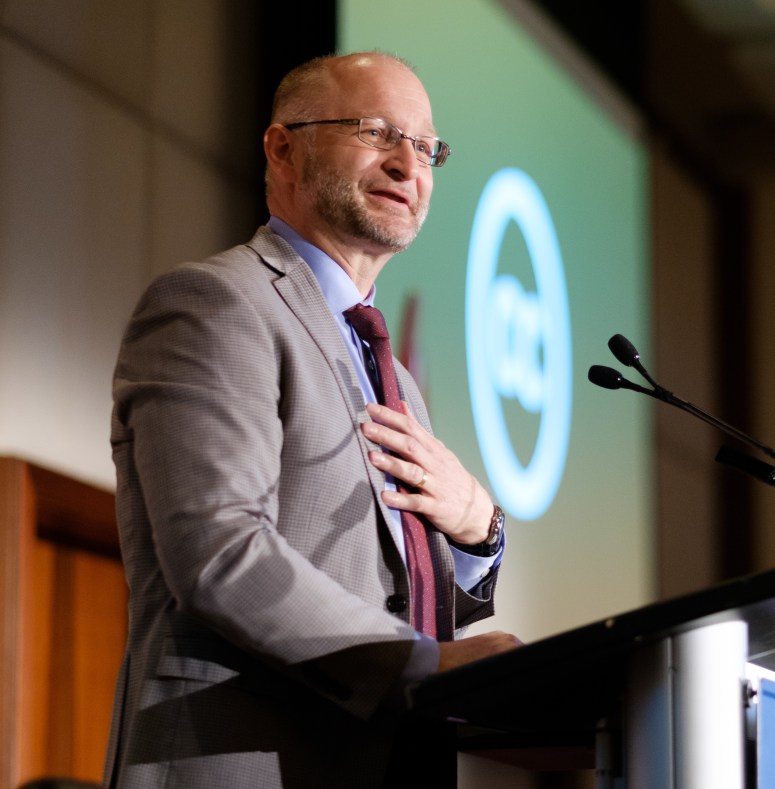
David Lemetti, pro piracy law prof now Canada’s Minister of Justice. Photo by Wikimedia commons.
You can’t make this shit up.
In cabinet shakeup Justin Trudeau has appointed David Lametti as Minister of Justice and Attorney General. We are very familiar with Lametti and this dude is very bad news for artists, authors, filmmakers and performers.
Lametti isn’t just a copyright skeptic he is for the legalization of piracy. A quote from his 2011 paper The Virtuous P(eer): Reflections on the Ethics of File Sharing
“Sharing is thus a key practice linked to virtue, and not necessarily to vice. I shall make an argument, again particularly with regard to music, that such a sharing ethos has always been part of the way that music has been written, performed and appreciated. Finally, I shall argue that current normative structures ought to be adapted to reflect this more profound understanding of the impulse to share music.”
What he means by that all this is
sharing is caring
we should change the law to legalize piracy cause that’s what the kids are doing.
Oh but there is more. So much more. In the same paper, after making a half assed economic argument that file-sharing doesn’t cause much economic damage, he says this:
“In addition to these economic arguments, I wish to bolster the argument that the sharing of music files is – if not absolutely justified in all circumstances – at least justifiable in many circumstances.”
Finally I’ll leave you with this little nugget on the ethics of copyright infringement:
“Indeed, there is a sense in which one can even disregard, in principle, certain rules while remaining faithful to the law.”
Remember this is the #1 law enforcement officer in Canada now. He advocates breaking the law.
“War is Peace”
“Freedom is Slavery”
“Breaking the Law is remaining faithful to the law”
What a train wreck. I genuinely feel bad for all Canadian artists.
Maria Schneider is a Grammy Award winning composer and jazz orchestra leader. She is also a strong advocate for rights of musicians and composers and has been featured on this blog in the past. Last month Maria sent us this article and we were blown away. Perhaps slightly off the topic of artists rights, but very provocative and pertinent to our struggle. – David Lowery
THREE SIMPLE WAYS TO PROTECT OURSELVES FROM BIG DATA COMPANIES
By Maria Schneider
Could the alarm bells ring any louder? Big data companies are finally being questioned daily in mainstream news in a multitude of ways, and some lawmakers are starting to speak of regulation. But the awakening is far too slow. Considering the degree to which these companies already overlord our lives, opinions, and political system, one questions whether regulation can actually happen, and the degree to which it would it ultimately protect us. Many are worried it’s too late to reign in the power and control of these companies.
In the face of all of this, I am presenting three simple, commonsense solutions for a) keeping big data companies in check, b) protecting our rights as individuals, and c) protecting our federal and local economies.
IDEA 1. Sunshine Laws for Algorithms Exploiting Our Personal Data
If a company like Google wants to extract our private personal data and use that data to drive an algorithm, then that algorithm should be made publicly available for inspection and study. No company should have the right to extract personal data from the public, pool that data with everyone else’s data, and analyze that data with “a secret algorithm that nobody can ever inspect,” and then turn that information into tools that manipulate us and change our behavior.
Companies like Google made their billions by harvesting, analyzing and exploiting the public’s data in endless ways. All of their secret recipes or algorithms have been, until now, protected indefinitely as “trade secret” intellectual property. But all reason would say, that “secrecy” is not OK when what’s hidden in those “trade secrets” can manipulate the public’s grand-scale behavior in predictable and even unpredictable ways.
Requiring that all algorithms driven by public data be open and transparent is a variant on the age-old theme – sunlight is the best disinfectant. Sunshine laws do just that for most processes where the public has a vested interest. It only stands to reason that we the public should be given the same sort of transparency for the algorithms that are manipulating, controlling, and misdirecting our lives to an alarming degree.
Of course, big data companies will fight to protect the secrecy of their algorithms. Secrecy might be fair if they cooked up this math on their own, but once they use public datain these algorithms for the express purpose of controlling the very public that gave them the data, that math should be open for us to inspect. This fix would quickly “out” the racial, socio-economic, and business prejudice and bias baked in to most algorithms, and would allow objective researchers to inspect the math and inform the public exactly how the math is impacting our choices. It would also “out” Google’s search manipulations that can downright censor or manipulate our opinions. A sunshine law would ultimately pressure big data companies into self-regulation.
Our government should make it clear: If a company wants to process data it siphoned from the public with algorithms that then control that very public, the algorithms must be open, not secret.
IDEA 2. Make “Terms of Use” Clear and Understandable
Everyone who wishes to get an app or subscription to any service knows the humiliation of being numbed into scroll-clicking themselves right into subservience and oppression. Collectively we are seeking to know what is happening with our own private “data” at the hands of big data companies. A helpful solution could be very simple: Create an easily understood “language” for terms of use by which companies must abide. Ideally, it should be icon driven – offering easily recognizable, quickly learned and understood icons. Icons are already prevalent and valuable for many products and services in our world, giving us an instant alert. When we face big data companies that are housing the entire planet’s private data and manipulating us with that data – that fact alone makes simple warnings in this context as urgent as any other product warning.
Universal, icon-driven language would help people worldwide quickly and accurately assess what personal information or rights they are trading for a service. It would “out” the real truth about the “terms of use” being forced on us. Lawyers couldn’t bury the truth in intentionally unintelligible (or downright misleading) language. Standardizing the way companies disclose to us what is happening to our data, forces companies to say what they mean, and mean what they say.
Europe’s GRDP is great and the U.S. should follow suit. But this idea goes further, as it addresses not only what is said, but HOW it is said. Our government demands such simple, clear and effective standards for drugs. They do it for space heaters, road signs, food allergies, cigarettes, paint. They do it for just about any product or service where there is a risk of harm to the user. So, of course we should require at least the same standard of clarity and accuracy and transparency from the most powerful and manipulative companies the world has ever known.
Our government should make it clear: Terms of use are so prevalent and impactful in this internet age, that any company that extracts and exploits data from its users must abide by a standardized system of icons and universally understood language when communicating its “terms of use.”
IDEA 3. Tax the Exchange of Data.
At various points, we’ve heard Facebook estimate the dollar value of the data it receives from each user. Whatever their public estimate, we know the real value is surely much higher, because that data is leveraged in so many different ways. But no one can argue that our data clearly has a specific dollar value, and each of us tradesour own private data(and its dollar value) for a serviceprovided by the big data company. We give Facebook or Google our data, and Facebook and Google each give us a service.
This kind of “exchange” just happens to be the exact definition of a good-old-fashioned “barter.” It’s a trade of data for services, and each side of the trade has a dollar value. The problem for Google and Facebook is that barters are taxable. The IRS taxes barters. The EU taxes barters. Just about everybody taxes barters for that matter. And there’s a great reason why barters are taxable, because if barters were not taxable, everyone would do everything through barter as much as they could, and that would suck the lifeblood out of our economy. There would be no way to pay for schools, ambulances, roads and more.
The simple reality is that Google, Facebook and others have perpetrated the most massive wholesale barter system the world has ever known, completely untaxed. The billions-worth of data that Google sucks out of us every month is amassed with no “taxable event,” city, state or federal. Economies on every level are being killed by the greatest wealth redistribution the world has ever known, and our government is giving data lord companies a tax-free pass to do it.
I suggest that every taxing authority treats these “contracts” we have with Google and Facebook as a barter. There could always be a threshold amount below which no tax would be owed by the average individual user. But when a single company on one side of these barters realizes a financial collective value of billions, millions, or even thousands from barters of services for data, it should be required to pay its fair tax for the value of those barters.
Our governments should make it clear: If a company extracts millions or billions-worth of value from our communities, they should pay back to those communities, the fair amount of taxes on those aggregate commercial transactions.
SUMMARY.
Our government and society have allowed a small few to become perversely wealthy and powerful on our collective backs. For communities and individuals’ lives to be sustainable and flourish, we absolutely need each of these three things: 1) the right to see and understand the algorithms into which public data is fed; 2) the right for an average person to know with confidence what a company is going to do with his/her private data; and 3) the right to have the value of our data reflected in the tax revenues in the towns, cities, states and country in which we live.
This is a July 30, 2013 summary from The Hill of Chris Castle’s series that first appeared in the Huffington Post on July 26, 2013–let’s see how he did after the Music Modernization Act.
1. Create an Audit Right for Songwriters for Compulsory Licenses: One of the oldest compulsory licenses in the Copyright Act is the “mechanical license”, the statutory mandate forcing songwriters to license songs that dates from 1909. The government mandates the license and also mandates the rate that songwriters are paid—from 1909 until 1977 that rate was set at 2¢ per recording. Although that rate was eventually indexed to inflation leading to the current 9.1¢ minimum, songwriters had to dig out of a deep hole.
Getting paid is another story. This statutory license requires songwriters be sent “statements of account” for royalties—but songwriters are not allowed to conduct a “royalty compliance” examination (called an “audit”). The law requires a company officer and a CPA to certify the company’s statements—a practice rarely complied with. As recently demonstrated by Aimee Mann’s lawsuit against Medianet, if songwriters don’t get paid there’s not much they can do except sue—a costly process.
The government tells the songwriter “trust—but don’t verify.” This is an easy fix. Congress could give songwriters an audit right as they did for stakeholders in the contemporary digital performance compulsory license for satellite radio and Internet radio.
2. Allow Artists and Songwriters to Opt Out of the Compulsory License: The recent blow-up regarding the so-called “Internet Radio Fairness Act” and the related ASCAP and BMI rate court proceedings should let the Congress know that there are many artists and songwriters who want to be able to decide who gets to license their songs. Again, the digital performance compulsory license allows copyright owners to control “interactive” uses of their works—why not at least do the same for the mechanical license as well?
3. Require Digital Royalties for pre-72 Sound Recordings: Sound recordings did not receive federal copyright protection until 1972. When the Congress established the digital performance royalty, it seemed to clearly apply to all recordings and did not arbitrarily exclude recordings prior to 1972. However, this “gotcha” is used by SiriusXM and others to avoid paying great American artists whose records were released before 1972—jazz, R&B and rock legends get nothing. Congress could fix this “gotcha” and secure a fair share of digital performance royalties to these authors of our musical heritage.
4. Require All Unpaid Statutory Mechanical Royalties Be Paid to the State Unclaimed Property Offices: As Aimee Mann’s alleged in her lawsuit against the white label provider Medianet, witnesses stated that 23 percent of the songs used by Medianet are unlicensed—which could easily be millions of songs if true. And there are likely a number of digital music services that are arbitrarily holding unpaid royalties in an unauthorized “escrow.”
It seems that there could be substantial royalties controlled by the very retailers who must pay songwriters under the law, a potentially significant moral hazard. Congress could require that any “escrowed” royalties be paid over under State unclaimed property laws—a lawful “escrow.”
5. Require that Online and Offline Videos Follow the Same Rules: As online video platforms become available through Internet enabled home televisions, attention should be paid to a frequently overlooked category of songwriter—the film and television music composers. Current reporting by online video platforms makes it difficult for score composers to be paid for their work. The Congress may well ask whether those who seek to replace television should be held to the same licensing standards as television.
These are but a few ideas the Congress could be addressing that might make a difference in the lives of artists and songwriters and would cost the taxpayer very little. All leverage existing structures and bureaucracies, eliminate “gotchas,” and help to reduce the unintended consequences of government mandated compulsory licensing.
This is the typical reaction from most musicians when I tell them Cloudflare is very bad for artists. I’m gonna make the argument that Cloudflare is now the key player in piracy ecosystem and thus at the root of the market failure that is driving value of music to zero. But first let’s back up and start with some fundamentals of the digital music market.
Streaming service and per spin rates
Spotify’s subscription tier pays 8 times what the free* ad supported tier pays per spin. If everyone who used Spotify free tier switched to the subscription tier overall service revenue to artists would at least double, maybe even triple.
Then there is YouTube. Oy. Where to start. Ad supported YouTube pays about 1/10th what Spotify’s premium tier pays per spin. YouTube represents approximate 56% of all streaming music consumption. If YouTube could get even 1/4 of their music listeners to subscribe to a premium subscription version of YouTube? It’s possible that revenues to artists would double or triple again, as it is reasonable to assume a YouTube subscription tier would pay something similar to Spotify premium on a per stream basis.
YouTube has tried to offer a subscription service but it has failed to attract many subscribers. Similarly Spotify has made great efforts to convert free users to premium subscription providers. But both services have had discouraging results. Why?
Peer to Peer Piracy and Cyberlockers.
Torrenting, peer to peer, or p2p piracy allows users to illegally download pretty much any song or movie they desire. Cyberlockers are similar, like Dropbox but chock full of unlicensed music and movies. These sites monetize infringement by charging fees for faster downloads, hosting sketchy advertising or making your computer part of a botnet. These “services” of course pay the lowest per stream rate of all: $0.00.
While torrenting, p2p and cyberlocker copyright infringement gets less attention than it used to, it’s still going strong. Curiously there is circumstantial evidence that on a per capita basis torrenting is most popular in wealthy white enclaves in developed countries. Also my cursory inspection of files available on computers that “seed” the networks suggest users are older and probably have good jobs.
“OMG dad!! Are you torrenting? You’re so embarrassing!”
Market failure.
Now put it all in context. One of the reasons that Spotify offers a free tier, and YouTube can’t seem to get subscribers for its subscription service is that consumers have the option of stealing music via torrent sites and cyberlockers. Even if a consumer doesn’t actively torrent they know it’s an option. The market for music and culture is no different from any other markets (despite the delusional musings of academic IP law professors). Consumers will gravitate to the cheapest option for any good including music. Licensed services must lower prices to compete with pirate sites. And suppliers (in this case artists) have virtually no bargaining power even with licensed services. A usurious rate from YouTube is better than nothing from ThePirateBay.se. Piracy is the root cause of the market failure.
Rights holders’ Strategies Against p2p and Cyberlockers
One solution to the torrenting and cyberlocker piracy problems are civil and criminal copyright infringement lawsuits. Napster, Grokster, MegaUpload and Hotfile were all brought down this way. This, however, is not easy. Civil litigation is very expensive. It’s fair to assume plaintiffs will need a minimum $100,000 to just walk into federal court. Criminal prosecutions are even more expensive, extremely rare and seem to be a low priority for federal prosecutors. Regardless both of these last resort strategies rely on plaintiffs and prosecutors being able to find the individuals behind the infringing websites. Naturally pirate operations go to great lengths to obscure identities of operators and owners. Plaintiffs and prosecutors often have to go “upstream” to the hosting company, or domain registrar and force them to divulge information on the pirates. Given enough time and money plaintiffs and prosecutors can often identify and shut down these websites. It costs a fortune but it is possible.
However sites are increasingly hosted on “black hat” hosts in countries that tolerate massive infringement, have dysfunctional governments or strict privacy laws. The operators of these black hat hosts are often anonymous and difficult to track. Even when the operators of these servers can be found they often don’t respond to legal notices. Thus it is impossible to shut down these websites. On the other hand these black hat hosts are often in remote locations and have low capacity. It is thus difficult for these pirate sites to scale as their services rapidly degrade with popularity. In the past this has acted as a kind of brake on the amount of infringing activity that these websites enable. At least until these sketchy website operators found a friend in Cloudflare. Now the game has totally changed.
How Cloudflare Enables Piracy
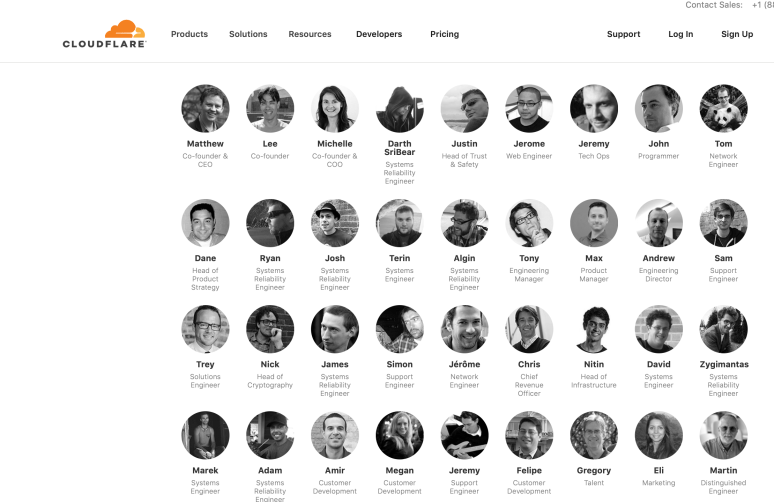
Cloudflare is a San Francisco company that provides various web traffic services to other websites. They do two key things that are very helpful to operators of websites, (legitimate or not.)
First they provide “reverse proxy” services that allow websites to keep their true IP addresses private. Among other things Cloudflare allows legitimate websites to ward off various kinds of cyberattacks. On the other hand they allow copyright infringing sites like ThePirateBay.se to hide their true location and associated webhosts. Thus Cloudflare effectively makes it impossible to track down the operators and hosts of infringing websites.
Cloudflare also provides a “content delivery network.” From Wikipedia:
“Cloudflare’s network has the highest number of connections to Internet exchange points of any network worldwide. Cloudflare caches content to its edge locations to act as a content delivery network (CDN), all requests are then reverse proxied through Cloudflare with cached content served directly from Cloudflare.” (italics added).
Now this is where it gets interesting. It’s difficult to run a robust traffic intensive pirate site on a sketchy black hat webhost operated out of the back of used tire shop in Pridnestrovian Moldavian Republic. That’s where Cloudflare’s content delivery network comes in handy. You see Cloudflare will cache “your” content on their servers. Cloudflare’s servers are much closer to population centers and can handle enormous amounts of web traffic. So essentially a pirate operator can set up a shop in a remote failed state somewhere with a dial-up modem for internet access (I exaggerate only slightly), but still sling infringing content like it is a high quality site hosted in San Francisco or New York. That’s because the infringing content is hosted and served from lightening fast high quality servers in San Francisco, New York and other population centers. That’s the point of a content delivery service. Since Cloudflare is actually making a copy of this infringing content that they know is infringing, this would seem to make Cloudflare liable for mass copyright infringement. But I’m not a lawyer. I’m just a simple country rocker.
The fact Cloudflare is willing to provide its content delivery services to anyone has made the company the top choice for pirates, terror groups, counterfeiters and other scumbags. According to sources that monitor torrenting and cyberlocker sites the top ten sites for infringing activity now use Cloudflare. Including a resurrected Pirate Bay! (PirateBay.org) This does not bode well for rights holders.
Ladies and gentlemen 2019 Artist Enemy #1 is Cloudflare!! And good luck with that IPO Goldman Sachs! Just remember to disclose to investors the legal risks associated with all that “cached content served directly from Cloudflare.” Not a lawyer but I read somewhere copyright infringement is a RICO predicate. You don’t want to run afoul of the SEC or get caught up in shareholder lawsuits a few years down the road.
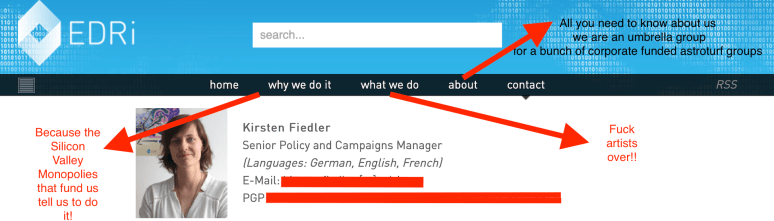
Kirsten Fiedler is the Senior Policy and Campaigns Manager for the European Digital Rights Organization. An umbrella organization of “digital rights” organizations across Europe, North America and Africa. A high percentage of their member organizations receive funding from Google and other US digital monopolies. 100% advocate policies that match Google’s copyright policies.
Now don’t be confused by the term “digital rights.” Fiedler/EDRI do not mean actual human digital rights. Judging by their actions and communications Fiedler/EDRi.org must be talking about the “digital rights” of the monopolistic US platforms like YouTube and Facebook. For their advocated policies allow the digital monopolists to monetize copyright infringement with impunity. Human rights? Not so much. EDRi would like see copyright weakened even further “in the digital marketplace” (as if digital marketplace is separate from the overall marketplace for culture). As artists well know, for all practical purposes copyright is unenforcible in the “digital marketplace” and this has resulted in a dramatic market failure that depresses the value of music across the board. Think it’s hard to feed your family now? Wait til Fiedler and EDRi get their way.
Now some regard EDRi and Fiedler as ignorant do-gooders that don’t understand the consequences of their actions. I disagree. I think they know exactly what they are doing. For Ms. Fiedler and EDRi engage in the most sinister form of corporate copyleftism: declaring they are “for artists rights” while pushing policy and talking points that are indistinguishable from policy positions of the Pirate Party and Google. These policies are clearly intended to strip authors of any copyright protection.
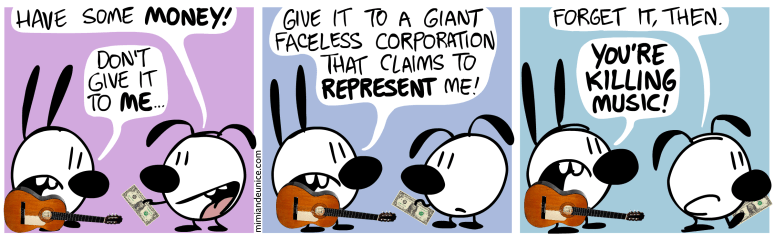
But that’s not all. Fiedler and EDRi frequently engage in clever disinformation campaigns that wildly distort the truth. Look at the comic Fiedler is fond of distributing with EDRi’s propaganda materials:
(Mimi and Eunice comic. Copyright notice states: “♡ Copying is an act of love. Please copy.” We are for artists choice. Copyright allows an author the CHOICE to enforce their rights or not. Piracy eliminates choice).
This is the old Pirate Party BIG LIE. “We’re not ripping off artists we are ripping off the giant corporations.” Every artist knows what bullshit this is and so do EDRi folks. (tl/dr in digital realm many royalty streams, but especially songwriter royalties flow directly through to artists without any label/publisher intermediation, and what about the 60% of professional performers that are independent?).
In fact it is clear that EDRi is working hand in hand with the Pirate Party. Above is a guest post from EDRi on the EU Pirate Party Medium account. Pirates Party really? Didn’t the founder of the Pirate Party call for the legalization of child pornography? These folks are far outside any Overton window of political respectability. As a result it’s fair to question not just Fiedler’s judgement, it’s fair to question her morality when she makes common cause with the Pirate Party. What’s next an alliance with far right white nationalists?
Oh wait they look like they’ve already started. See tweet above. I guess Fiedler is one of those “ends justify means” personalities.
And the sinister nature really shows in the campaign Fiedler and EDRi waged against Article 13. For Fiedler/EDRi were willing to use deliberate misinformation (some would say outright lies) to defeat article 13. What kind of people do this kind of thing?
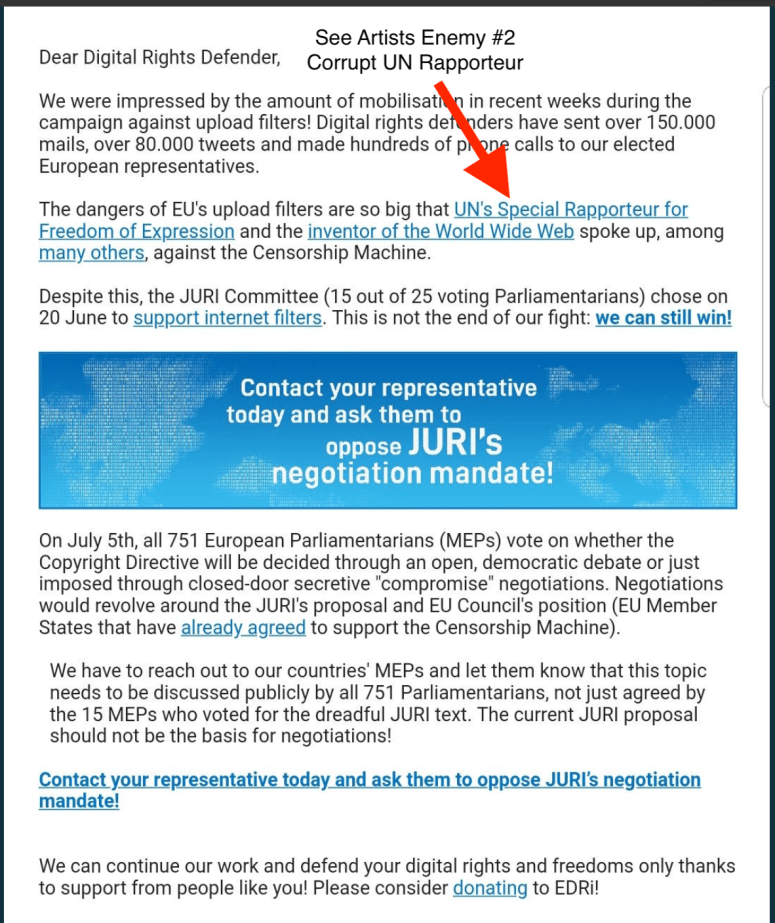
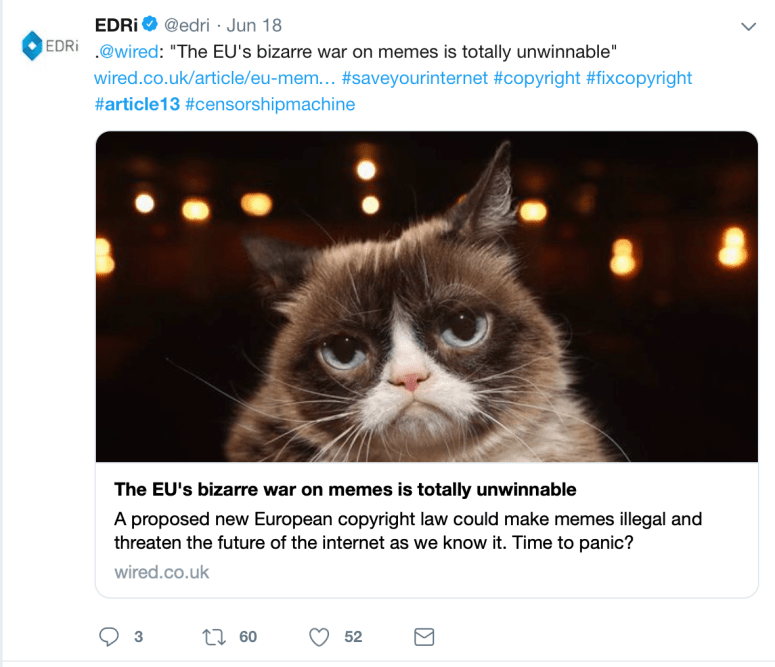
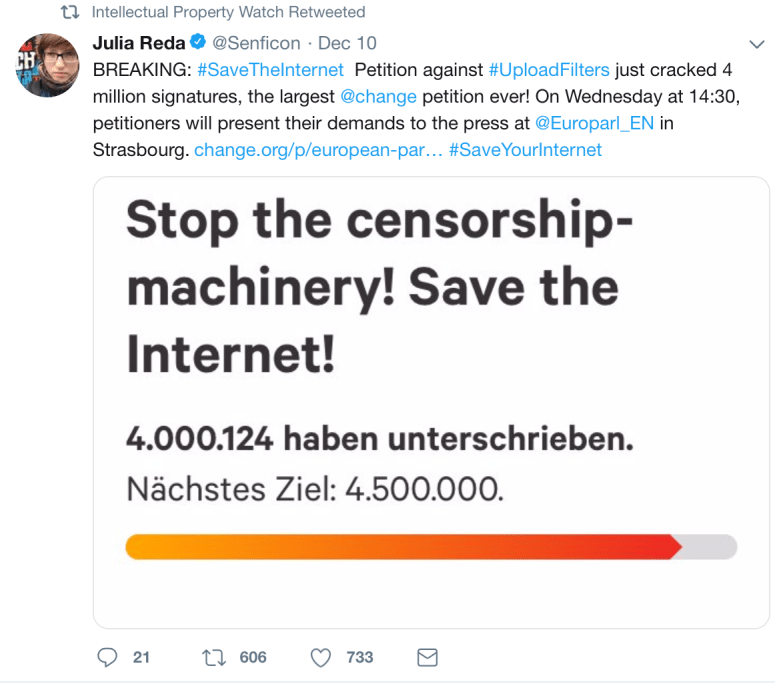
Screenshots 5-7: Gee the UN Human Rights Rapporteur surely is not collaborating with a corporate funded astroturf group. There must be some mistake. Also: there are no “censorship machines;” “upload filters” are already in use on all major platforms for pornography, terrorist content and in some cases copyright; no possible reading of language of Article 13 would “ban memes;” and Wired magazine sadly caters to its biggest advertisers (Silicon Valley) reprinting propaganda with no critical analysis, that’s EDRi retweeting Wired magazine’s article that is almost completely sourced from EDRi generated documents.
Just three examples. But they all repeat the censorship canard. It is impossible to overstate just how far from the truth is the claim that article 13 would result in censorship. It’s not even in the same time zone as the actual language of the directive. EDRi’s claim of censorship would seem to exist in a dystopian parallel universe in which copying wholesale artists works without permission is a digital platform’s “free speech.” Fundamentally Article 13 is about encouraging trillion dollar digital platforms to license works uploaded by their users. If users can’t upload works? It is because Google has decided to hoard its profits of $31billion a year rather than bother licensing works.
Similarly the frequent use of the term “upload filters” by Fiedler and EDRi is another kind of disinformation. Platforms already use upload filters for pornography, terrorist propaganda and copyrighted works from certain firms. Article 13 doesn’t create these things. They already exist.
It is telling to note that both the terms “upload filters” and “censorship machines” originated 6 months earlier with the Google funded/staffed Open Media astroturf group. This is the group that was caught spamming the EU parliament with robotic emails, tweets and phone calls. I’m gonna take a wild guess and say these terms were the work (or certainly inspired) by Jacob Glick the former International Head of Public Policy & Government Relations for Google. These terms are after all so Googley (circa 2012). Glick was (is?) board member of Open Media when these terms surfaced. BTW we briefly considered making Glick one of the top five artist enemies but it appears the guy now works for a reading glasses startup in Kitchener Ontario. While not a lower circle of hell its got to be close. Naming him an artist enemy would be like kicking a dog. Instead the award goes to Fiedler.
So congratulations Ms. Fiedler you are 2019 Artists Enemy #2. Good work. See if next year you can get to #1. The devil always needs more souls.
Scientists have concluded the Senator’s official photo likely violates the Myspace Rule: profile photos may not be older than (Current Age/10) – 1 year.
We are reprinting this article because once again Wyden is siding with Silicon Valley rather than his own Oregon Constituents. #PrimaryWyden2020
The longtime democratic Senator loves to boast about his progressive bona fides but when you look at his legislative record a different story is told. Sure he’s progressive on social issues but on everything else? He appears to be in the pocket of monied Silicon Valley interests, broadcasters and hedge funds. For our readers, the key issue is Wyden reliably supports legislation and policies that enrich anti-union right-wing billionaires and impoverishes union performers and songwriters.
Examples
IRFA or (the Orwellian named) Internet Radio Fairness Act. This was his bill. It would have slashed digital radio royalties to (largely union) performers as much as 70 percent. The beneficiaries? The Silicon Valley VCs backing all these digital broadcasters. Fortunately, the bill was withdrawn. What kind of “progressive” tries to pass a law that slashes wages to workers while enriching a cartel of mostly right-wing billionaires? Disgusting right?
Not convinced? How bout the recently passed Music Modernization Act? Parts of the bill were controversial, but not title II the so-called “Classics Act.” The Classics Act restored digital royalties to pre-1972 performers. Wyden was the lone senator who opposed the Classics Act.
A little background. In 2012 digital broadcasters in apparent coordination (Hello FTC? Is this thing on?) stopped paying royalties to performers who had the misfortune of recording before 1972. The justification the digital broadcasters used was a tortured interpretation of how the 1976 copyright act and a 1995 amendment interacted. In short an unintended highly questionable loophole.
However, the loophole provided a significant break to digital broadcasters. Some estimate the broadcasters got a 15% reduction in what they would have paid out to artists.
Why on earth would a “progressive” Senator support what is essentially a vast transfer of wealth from largely union performers to mostly right-wing billionaires?
(Update 10/30/2019): Now Wyden is opposing the CASE Act. A small claims copyright court that would allow small creators (i.e. Portland indie musicians, photographers and filmmakers) to do something about massive copyright infringement by major platforms. Without the CASE Act, the only option for small creators is to go into federal court. Not many of them have the $100,000 it takes to even mount a case. This has made it so only the biggest media companies can successfully enforce copyrights. The clear consequence is this is anti-competitive and has been driving the consolidation in the music business. Maybe that’s why Wyden opposes the Case Act. He never met a megacorp he didn’t like.
In this age of fake everything, Wyden is the fakest of all progressives.
Now consider Wyden represents the City of Portland and your head may begin to spin.
Portland has come to rival Nashville and Austin for its music economy. Portland produces groundbreaking new bands each year and is also home to many musical innovators from earlier generations. It’s also home to many labels and CD Baby the commercial heart of the DIY music industry. There are likely tens of thousands of folks employed by Portland’s music economic cluster.
On the other hand Silicon Valley has a cluster of Silicon Valley server farms out in the remote Eastern Oregon high desert. Oregon taxpayers subsidize these low employee operations (500 jobs statewide?) through tax subsidies and perhaps most importantly low-cost hydroelectric power from the Columbia River.
Every subsidized low-cost megawatt the Silicon Valley lampreys suck-up is a megawatt that Oregon taxpayers have to source from higher cost higher carbon sources. Does that sound like the kind of policy that benefits Wyden’s constituents or Silicon Valley billionaires?
Oregonians deserve better than the false progressive Senator Wyden.
It’s not too early to think about primarying the Silicon Valley apparatchik. 2022 is not far away. And who knows it could be even sooner…No one has ever really delved into the curious story that Wyden’s son started a “hedge fund” in his father’s Washington DC basement. Who gave junior the startup money? He started the fund immediately after leaving a financial firm owned by one of Wyden’s most prominent donors. Hmm. That smell like pay to play to you? It’s strange enough it deserves some real scrutiny.
Congratulations to Sen Ron Wyden: 2019 Artist Enemy #3
UC Irvine Professor David Kaye has been the UN Special Rapporteur for Freedom of Expression since 2014. So in this time Kaye has spent a lot of time advocating for the protection of journalists in autocratic states all over the world. Selflessly traveling to some of the most dangerous and repressive places on the planet to protect free expression. A true advocate for human rights!
Nah. Just kidding. The dude mostly sits in his cushy offices at UC Irvine in Orange County California scolding first world countries with robust free speech protections like Canada and the EU for proposing modest improvements to copyright protection regimes on internet platforms. As a result Kaye is protecting internet monopolies from having to pay artists. What an idiot.
Q. Best way to repress/discourage freedom of expression?
A. Defund it.
You can tell this guy never spent any time living in the real world working for a living. You think he’s ever considered market forces and free expression? Nah, that would require venturing outside of his academic bubble into the real world.
But even more disturbing, while Jamal Khashoggi was being dismembered the UN Special Rapporteur was largely devoting his energies to undermining Article 13 of the EU Copyright Directive by falsely claiming that Article 13 is a four alarm free expression emergency. It violates the UN Human Rights Declaration!!!!
It does no such thing and Professor Kaye knows it.
As we detailed on this blog previously David Kaye has written virtually identical screeds (one to Canada one to the EU) to support his highly questionable views that forcing trillion dollar internet companies to do a better job protecting authors from copyright infringement is a violation of the Universal Declaration of Human Rights. Kaye supports his argument by disingenuously switching (in footnote citations) between elements of Article 19 of the Universal Declaration of Human Rights, and then things that are not in the real Article 19 but from a private foundation that has the similar name Article19.org. Footnote formatting rules make it almost impossible for non lawyers to tell the difference between the two. We earlier called this “academic phishing” as it relies on mistaking on official document for another similarly named document of questionable provenance.
Kaye also supports his arguments by citing something called the Manilla Principles. A binding international treaty right?
Nah. It’s just a private document created by a group of NGOs, many funded by Google and Open Society Foundations; and others that don’t seem to exist at all. The Internet Research Agency is likely impressed.
If you haven’t grasped the level of fuckery here take a moment to think about it. This would be like the stagehands at the Aladdin Theatre in Portland (writing from backstage right now) producing a document called The Portland Principles that among other thing gives stagehands “the right to leave burning bags of canine feces on doorsteps of corrupt UN Special Rapporteurs.” When confronted by authorities they would simply claim The Portland Principles gave them the right.
Not going out on a limb here by saying David Kaye willfully misleads the reader into thinking Universal Declaration of Human Rights says things it doesn’t. This is a gross violation of his obligation as a special rapporteur; academic and as a decent human being. Why does this guy still have a job?
Ladies and gentleman I give you 2019 Artist Enemy #4: UN Human Rights Rapporteur David Kaye. Congrats professor. Now go work for Google.
Derek Slater is ready to run through Chinese walls!!
Despite the fact you’ve never heard of this guy, he has had a profoundly negative effect on the market value of your works.
As a senior public policy executive at Google his fingerprints are all over every proxy driven campaign against any meaningful copyright reform. You see the status quo is very good for the legacy internet monopolies like Google. They are not liable for their users/customers infringing activity yet are still happy to monetize infringing activities through advertising and data mining. Whether it’s an offshore pirate site with an Adsense account or unlicensed videos on YouTube, Google efficiently converts copyright infringement to cash.
But the ripoff doesn’t stop there. Google’s willful blindness to infringement in turn drives the price of music down across the board. For example the only reason Spotify must keep its royalty deficient ad-supported free tier is cause they must compete with YouTube and Google monetized piracy. Without all that free music out there, Spotify could conceivably jettison the free tier and a substantial portion of those spins would thereafter be on the subscription tier. The subscription tier pays approximately 8 times as much per spin as the free tier. Economist call this distortion a “market failure.” That’s a fancy way of saying Google with a market cap of $730 billion USD is taking money directly out of your pocket and food from your kids mouths.
So it’s no surprise that any proposed legislation, court case, trade treaty or pro-copyright news article that remotely threatens Googles obscene profits (31 billion last year) is met with a cloud of misleading talking points and out and out disinformation. Usually disseminated by Google funded bloggers,academics and astroturf groups.
But this year we saw the disinformation from Google go out in a particularly disturbing way. Google used its YouTube platform to feed disinformation about EU article 13 to our children to help lobby parents. “Mommy the EU is gonna ban YouTube.” Political advertising to children?
FTC? FTC? Hello? Hello? Is this thing on?
Derek Slater, Senior Public Policy & Government Affairs Manager at Google, we believe the buck stops with him. 2019’s Artist enemy #5.
Pirate Party MEP Julia Reda has been touting a dubious online petition against article 13. Despite claims to be acting on behalf of internet “users” the petition seems to be a fundraising effort by a “charity” group operating the website SaveTheInternet.Info.
SaveTheInternet.info gofund me page claims the group is a German charity.
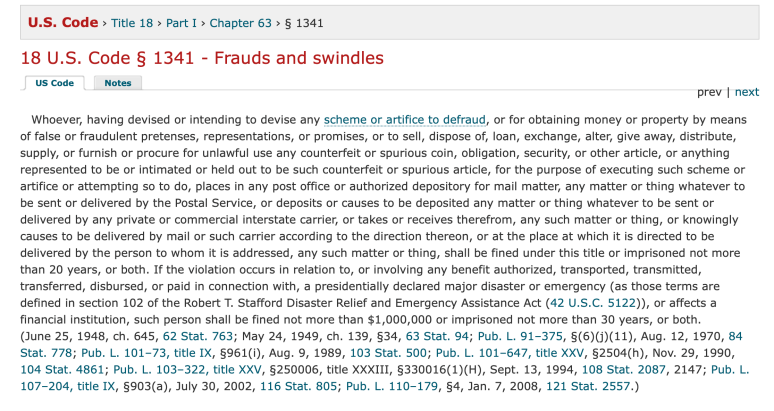
The problem is the “charity” does not appear to be a charity at all. According to our German sources the SaveTheInternet is not registered as a German charity as they clearly claim. That’s a misrepresentation. I am not a lawyer but a plain reading of the laws in the US concerning soliciting funds for a charity would make this criminal fraud in the US. Since the group is soliciting funds worldwide using the Redwood City California corporation (GoFund.me) I would argue this is a violation US law:
I suppose I could be wrong but there have been prosecutions for similar activity in the US. How is this any different?
On top of that I imagine that the German government has similar if not more strict laws on charities, solicitation of funds and misrepresentations.








 The Trichordist
You must be logged in to post a comment.