@crunchdigital Announces Digital Music Sandbox for App Developers — Artist Rights Watch

LOS ANGELES, Nov. 28, 2017 /PRNewswire/ — Today Crunch Digital, a music metadata management, reporting, and licensing service that bridges music rights owners with content users, is announcing the launch of the Crunch Digital Sandbox™.

The Sandbox is a music licensing platform that enables qualified app developers to include music legally from participating major and indie record labels and music publishers under short-term developer licenses – and do it faster.

The Crunch Digital Sandbox™ directly addresses the much-publicized problems and concerns surrounding music licensing, which have stymied innovation critical to new business models and new revenue streams for the music industry.

On one side, you have innovators and startups who need licenses now – because tech moves fast.  On the other side, you have record labels and music publishers who are inundated with emails and pitches for licenses, all vying for their attention.  It’s unrealistic to expect record labels and music publishers to take time away from their core business to quickly vet and assess the viability of all the incoming license requests.  You also have investors who have been shying away from backing new music companies due to scary infringement lawsuits and high licensing transaction costs.

In making the announcement, Keith Bernstein, Founder of Crunch Digital said, “With the Crunch Digital Sandbox™, app developers can prove out their concepts and features before engaging in all-encompassing music licensing negotiations.  They will have a better opportunity to gain market traction and attract potential investment for a full product launch. For record labels and music publishers, the Sandbox helps them to focus their attention on viable opportunities.  For investors, they can invest in companies that show proof of concept and mitigate the concerns they have about music licensing.”

Getting started with the Sandbox is easy.  Interested developers submit an application to Crunch. Crunch will vet the applications.  Once an application has been approved, Crunch will work with the applicant to help present their idea to labels and publishers who are participating in the Sandbox.

Crunch will then assist developers in requesting a customized limited use license for access to catalogs, either for a period of time or until the company hits a certain success threshold.  Crunch will share growth metrics with participating labels and publishers – and standout developers can start the conversation to “graduate” from the Sandbox and move up to a long-term licensing deal.

Bernstein added, “For innovators and entrepreneurs, being a part of the Sandbox gives them an invaluable opportunity to go from having no meaningful knowledge about music licensing, no meaningful connections, and probably no awareness of who to contact at labels and publishers, to working with a team of people at Crunch who can help to put them on a path to legally launch with music that will help them find an audience.”

The Sandbox will officially launch in January 2018, and Crunch is already accepting applications at www.digitalmusicsandbox.com.  Record labels and music publishers can also visit the site to become a content participant.  View a fun video about the Sandbox here:

via @crunchdigital Announces Digital Music Sandbox for App Developers — Artist Rights Watch

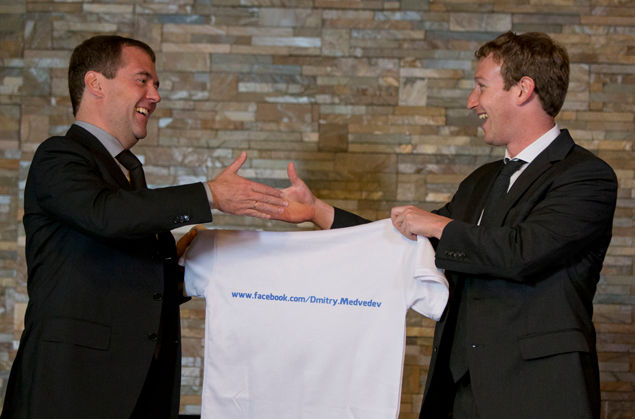
Mark Zuckerberg’s Kremlin “Investors”

We’d be happy to paid in Rubles, Zuck. Just license our music you fucking deadbeat.

Artist Rights Watch--News for the Artist Rights Advocacy Community

sovietfb

The “Paradise Papers” reveal that Facebook took approximately $200 million of cash investment from the Kremlin.  This huge chunk of cash came from the Kremlin’s VTD Bank was “funneled through DST Global”, an investment vehicle owned by oligarch Yuri Millner (known as “космонавт” loosely translated as “the spaceman”).   The papers also show that Gazprom (the controversial Kremin-owned energy company) heavily funded an offshore company that partnered with DST Global in a large investment in Facebook.

russia_medvedev_facebook_zuck

A story in the Guardian from 2009 about the transactions provides insight into how the deal was structured for Facebook:

[Digital Sky Technology], run by Russian entrepreneur Yuri Milner [“the Spaceman”), has also indicated that it is willing to spend at least another $100m buying out existing Facebook shareholders as part of a plan that would allow current and former staff to sell some of their shares.

Wonder who those “current and former staff”…

View original post 709 more words

Content Creators Coalition Nails It With New YouTube Ads #updatetheDMCA

Share these with your friends.   Two new videos from Content Creator Coalition succinctly explain the problem with YouTube for artists.  These videos will help civilians understand the fundamental unfairness of existing regulations.

First, YouTube pays a lot less than other licensed streaming services.

Second, YouTube hides behind a bad interpretation of the DMCA copyright act.  For all practical purposes artists can not remove their work from YouTube even though YouTube pays much less.   This has produced a market failure, making it impossible to fairly value songs and recordings in the digital realm.  Further YouTube/Google have unprecedented lobbying power in Washington DC and they are blocking any sort of sensible fix to the DMCA loophole.

#updatetheDMCA

And #BreakUpGoogle

Who You Gonna Call? University of Georgia Terry College Artists’ Rights Symposium Jan 22-23

asAnnouncing the inaugural Artists Rights Symposium hosted by The Music Business Certificate Program, Terry College at University of Georgia Jan 22-23.   The symposium is free and open to the public but seats are limited.  Contact Music Business Certificate Program for more information 706-542-7668.


ARTISTS RIGHTS SYMPOSIUM

Jan 22-23

WHO YOU GONNA CALL?

An examination of resources available to music creators beyond copyright infringement lawsuits

The rapid change in the digital music industry has left music creators and music industry rights holders confused, unaware of the extent of their intellectual property rights, and often unable to enforce those rights. Traditionally music creators and rights holders have resorted to federal copyright infringement lawsuits to rectify these problems.  Unfortunately these lawsuits are expensive, time consuming and inefficient.  The purpose of this symposium is to examine other tools that are available to enforce music creators’ rights beyond federal copyright infringement lawsuits.

Some of the subjects that could be covered are strategies that rely on voluntary agreements; best practices; federal, state and local legislation; moral rights; human rights; international intellectual property agreements; trade treaties; antitrust enforcement; corporate responsibility campaigns; activism; consumer education; internet governance; and conspiracy statutes.

The organizers hope to bring together academics and practitioners with a wide variety of backgrounds including (but not limited to) copyright and entertainment law, technology, public policy, economics, law enforcement, journalism, activism and international relations.

Jonathan Taplin, author, manager, film producer and Director of the Annenberg Innovation Lab at University of Southern California has agreed to keynote the discussion and help moderate panels. Sandra Aistars directs the Arts & Entertainment Advocacy Program at George Mason’s Antonin Scalia School of Law and has also agreed participate as well.  Other confirmed guests include: artist advocates such as Blake Morgan (#IRespectMusic), Kay Hanley and Michelle Lewis (Songwriters of North America) and  legendary music producer T-Bone; state and federal legislators and staff; representatives from law enforcement; international relations and public policy experts; and various prominent academics.

The Symposium will take place over two days Jan 22-23, 2018.  Jan 22th will be an evening reception 7-9pm at The 40 Watt Club, January 23 will consist of 4 discussion sessions beginning at 9:30 AM.  The symposium panels will take place at 200 Moore-Rooker Hall, Terry College of Business, University of Georgia, Athens GA 30602.


Successes in Artist and Songwriter Advocacy Show the Importance of Fighting Back

Great overview of the last few years of artists rights advocacy! Important and timely I urge everyone to read this.

Music Technology Policy

“Why does Rice play Texas?”

President John F. Kennedy, Sept. 12, 1962, Rice University

Google White House Meetings

It should be clear by now that when it comes to sheer lobbying power expressed in terms of money and access, Big Tech has put the creative community up against it.  And not only has Big Tech put their collective boots on our necks, they have joined in the MIC Coalition cartel for the express purpose of crushing any opposition.

We must properly and grimly assess the opposition and our resources.  I would not say that the odds are in our favor, but the odds are what they are and I don’t think any of us are ready to roll over and show the belly in surrender.

We actually have made significant progress over the last few years with both legacy types of lobbying as well as grassroots organizing.  Both are absolutely essential.

The music community’s…

View original post 403 more words

Once Again @Alalibrary Have No Dog in Fight but Come out Against Authors on Copyright Small Claims

Dear Google…er…uh-I mean American Library Association:

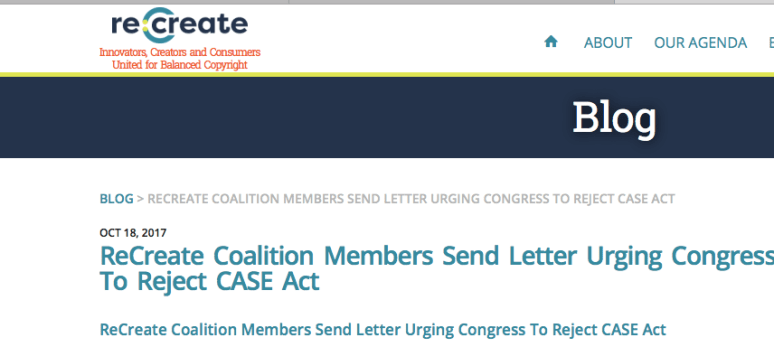
Really?  The American Library Association and it’s members are really gonna be impacted by a voluntary “small claims” copyright court?   How? How could this possibly have any impact on your member libraries?  This is quite a stretch even by Google apparatchik standards.

While there will always be plenty of money for DC lobbyist like you, the same cannot be said for your members. The average community library relies on the goodwill of authors, publishers and ordinary citizens.  In the US authors do not charge libraries a lending fee.  When the local community library faces budget cuts or threatened with closure,  it’s authors who go out and march in the streets.  So why does the ALA insist on alienating authors?

Where IS the ALA when misfortune befalls member libraries?  Not marching in the street.  I imagine we’re more likely to find you with your snout in the trough at some K street restaurant, than marching in the street.

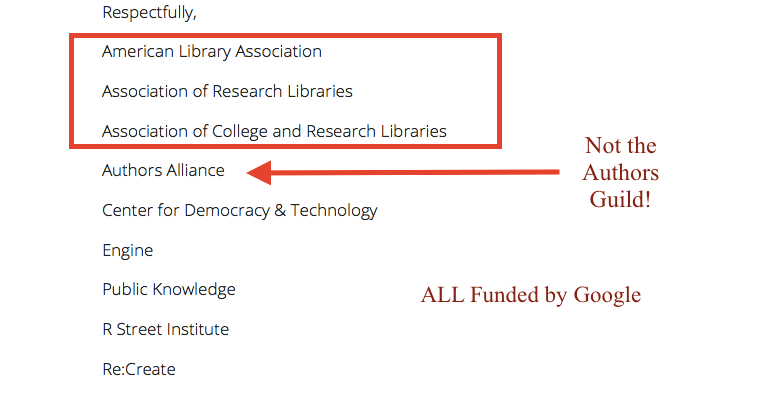
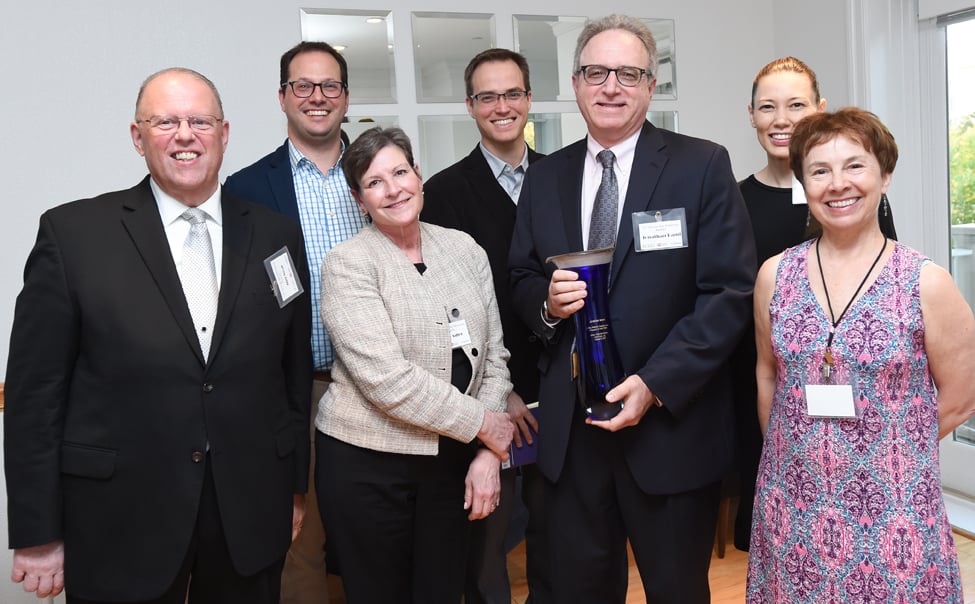
So let’s get to the point. Why don’t you fucks just come out and admit it?  You don’t give a shit about your member libraries, authors or readers. You apparently just do what Google tells you to do. Even if that hurts libraries in the long run. How can any sensible person conclude otherwise? And come clean on where you get your policy direction. Every single one of the co-signers on this latest letter is directly or indirectly funded by Google.  You don’t even try to hide it.  Look, here’s a picture from two weeks ago, ALA staff with Katherine Oyama, senior policy counsel for Google and a few other Google funded lobbyists.   Just stop.  Stop the charade. Stop misleading your members about what you are really doing and for whom you are working.

Google Circular Awards Ceremony.  (Hot linked from the ALA website).

If Google Claims It Is a Publisher and Search Results Are Its Own Speech Then Isn’t Google Illegally Favoring Youtube?

A Google Search for Ringo Starr’s “It Don’t Come Easy” returns a YouTube video as top result.  Try it at home but our experience shows for nearly any song the first result is a YouTube video.  If Google search results are as it claims “speech” isn’t Google favoring its own properties over competitors?  Isn’t Google leveraging its dominance in search to favor it’s video service? How is this any different from the EU antitrust case?  

I came across this blog by Barry Sookman in which he points out that Google, depending on the court case,  claims to be either a “publisher” and thus protected by various free speech statutes or is a “passive intermediary” and thus protected by various safe harbors.

Is Google, the operator of the world’s most popular search engine, a publisher entitled to the constitutional protections accorded to publishers of free speech? Or is Google a passive/neutral intermediary which has no control over what its search engine algorithms disseminate and which doesn’t publish the information in, or hyperlinked to, it’s search results? Google argues it is and is not a publisher, depending on which position will best exonerate it from legal demands including court orders that it de-index URLs and websites from which illegal content is made available.

http://www.barrysookman.com/2017/10/10/is-google-a-publisher-according-to-google-the-google-v-equustek-and-duffy-cases/

While Sookman is mostly addressing the liability issues associated with defamation and unfair competition,  I would think this contradiction should be interesting to music rights holders.  If Google is a publisher isn’t it acting in an anti-competitive manner with its own speech in example above?

Why does this matter to artists?

  1. YouTube pays far less than Spotify or Apple Music. Artists would be much better off if the top search result were a better paying service, preferably one that wasn’t larded with unlicensed videos, and wasn’t owned by Google.
  2. The US antitrust division continues to persecute songwriting organization for having the potential to act in an anti-competitive manner (literally pre crime), while ignoring the (post crime) anti-competitive behavior of companies like Google.

This is what corruption looks like.  Now read this article if you want to understand how we got here:

https://musictechpolicy.com/2016/08/09/how-google-took-over-the-justice-department-antitrust-division-renata-hesses-timeline/


The Flaw Behind Zuckerberg’s Universal Basic Income Scam — MUSIC • TECHNOLOGY • POLICY

These 21st Century Robber Barrons will expect the taxpayer to pay for those smart roads or if the beneficiaries of the infrastructurer will pay, they will expect to own the roads, no doubt. So the taxpayer will pay for the roads for the driverless cars that create the automation to creat mass firings and so that the taxpayer will pay Universal Basic Income to quiet down the clingers.

via The Flaw Behind Zuckerberg’s Universal Basic Income Scam — MUSIC • TECHNOLOGY • POLICY

Geist is More than Unbalanced on Copyright: Note to American University @WCL_PIJIP @Sean_Fiil_Flynn ‏

I literally laughed out loud when I saw that American University Washington Law School Program on Information Justice and Intellectual Property has invited the controversial Canadian academic Michael Geist to give a “balanced” talk on NAFTA, copyright and intellectual property.  (Editor note:  What IS information justice? How do “things” receive justice?)

Although Geist has largely managed to escape scrutiny in the US there has been plenty written about the professor and his Machiavellian machinations north of the border.  “Balanced” is not the word anyone familiar with Geist would use often to describe him. Especially if you want something other than conspiratorial narratives on rights holders and demagoguery.  IMHO “unbalanced” (see death threats article below) and “sleazy” (Lawbytes Inc, Poker, undisclosed connections to lobbyists) are probably more appropriate words to use when describing Geist (read articles below and you be the judge).

Let us just take the articles from a single blog that chronicle Geist and his many pseudo academic adventures with copyright policy in Canada.  Enjoy the reading!

The Geist in the Machine

Geist is Back: The Choirmaster of the Amen Chorus Complains of Orchestration

email from Geist

Geist blows it again: More hot air from the frozen North

“Witchcraft growing faster than other religions”! Geist blows it again

The Spy Who Consulted Them: A Closer Look at Lawbytes, Inc. f/s/o Michael Geist

Untendered is the Prof: More secrets in the Geist closet?

The Geist in the Hen House Redux: The Untendered Prof Travels the World while the Alcan of IP Stokes the Fires At Home

The Consultation of the Mikado Part 2: Geist is running his playbook again

Geist goes after Canadian labels group for “access”

Only the shadow knows: Let the Geist games begin anew

Geist Flips the Mob Switch

Geist Blows It Again: Stay out of the business, Mr. Chips

News From the Goolag: Geist strikes a blow for piracy…I mean, consumers

Is Geist singing from the EFF songbook?

News from the Goolag: Unions don’t go for Geist et al singing Google songbook redux

Oops…he did it again—Geist misses the point on artist rights

Dr. Ficsor takes Geist back to school

Surrender Dorothy! Are Geist’s Lobbyist Connections Revealed in Open Society “How To” Book?

Eeek a mouse! Geist really slagging the wrong guy

Geist allows death threats on public officials in blog comments; What Happend to the Poker Prof’s Student Group?

The Geist in the Hen House

Dissembling on Factiness Six Times Before Breakfast: Is the Geist Scandal Widening?

Guest Post: A response to Michael Geist’s Defense of Bootleg Beatles Records by Canadian Music Publishers Association’s Executive Director, Robert Hutton