
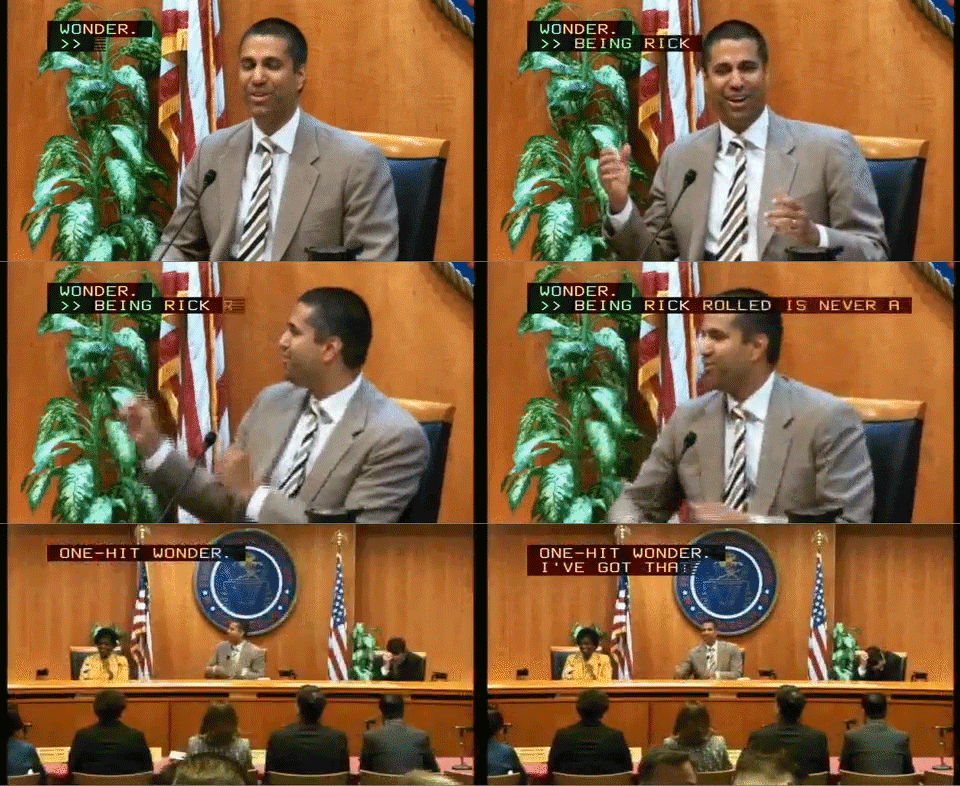
FCC Chairman Ajit Pai proposes rick rolling back FCC regulation, and this may be good for copyright holders.
A few years ago I was one of a number of artists that signed onto a petition to strengthen net neutrality. You have to understand why an independent musician, songwriter and label owner like myself might see this as important. There is a long history of “paid prioritization” in the music business. Radio payola being the most obvious. But back in the 80’s and 90’s there were all sorts of payola type fees. Even independent record stores (think High Fidelity) demanded fees and free goods for in store play and end racking. It was all a shakedown that favored the incumbent players and discriminated against startup labels.
So to my indie musician brain, net neutrality seemed akin to earlier anti-payola and anti-bribery prohibitions. Sure, in the end it was probably unenforceable but at least it was a gesture towards fairness. And looked at in another way, how was this any different then the public exchanges for equities? Aren’t public exchanges designed to treat each trade the same? Not prioritize some over others? Didn’t this guarantee a flat and fair “market” for each packet of music?
At the time a couple of friends warned me that I would come to regret this. That somehow net neutrality was simply a trojan horse for the FCC to not just regulate the ISPs but also the content creators and copyright holders. As it turned out I should have listened to my friends.
Ironically the true dimensions and implications of the net neutrality debate have been manifested in the hypocritical protestations of the defenders of Title ll in response to FCC Chairman Pai’s proposal to reverse Title ll’s application to net neutrality. First you have to understand that despite all the hyperventilating (and RickRolling) by groups like freepress.net, the FCC is not rolling back net neutrality. Instead it is handing back authority to the FTC. We DID have net neutrality before it was regulated by the FCC. Going back to the FTC does not mean it’s going away. It’s just the FCCs rather extraordinary power will not be hanging like Damocles sword over copyright holders as they negotiate with companies like Google and Amazon. As songwriters will tell you repeated intervention in music licensing by the DOJ (through the outdated 70 year old consent decrees) has radically depressed songwriter public performance royalties. Do we really want the FCC intervening in film, tv and cable in the same way? Songwriters are the last in line to get paid, and we always seem to suffer the most when there is agency capture.
Moreover, it has become increasingly clear that Title ll net neutrality is primarily a fight between corporate giants trying to secure negotiating leverage about who has to pay for what, with over the top providers (Google/Amazon) trying to decrease the costs for reaching their users.
More fundamentally, Title ll net neutrality is a form of internet exceptionalism under which the internet would operate under non-market rules. But why does this make sense? The internet may have started as a vehicle for the sharing of ideas, but today it is also the backbone of the global economy. Property rights encourage investment. We risk undermining the vitality of the global economy if we introduce (or in some cases, maintain) significant encroachments into the operation of market economies. The FTC can, and should, guard against anti-competitive practices by internet giants, whether they are ISP’s, or edge providers (Google, Facebook, Amazon etc). But we should not take actions based on some perception that the internet has upended the reason for encouraging market, rules-based, commerce.
We have already been down this path with the FCC with respect to set-top boxes. In 2016 the FCC under the guise of “opening up” set top box competition came up with its AllVid proposal for cable TV. The problem was that it wasn’t really about “unlocking the set top box” it was really about unlocking copyright holders content and giving Google, Amazon and other technology companies access to the content without having to go through the hassle of getting licenses. Maria Pallante then the US Register of Copyrights warned the new rules “could interfere with copyright owners’ right to license their works … and restrict their ability to impose reasonable conditions on the use of those works.”
Luckily, FCC Chairman Pai has scuttled this proposal, but given the near miss that copyright holders had with the FCC on the AllVid proposal, it probably a good thing for all copyright holders that he has proposed to eliminate Title ll net neutrality in favor of restoring authority to the FTC to address anti-competitive practices. To my fellow musicians and songwriters, I know some of you feel differently, and are drawn to the idea of limiting the capacity of perceived gatekeepers to skew fair and open access. I share that concern. But Title ll is the wrong remedy. There are a broad range of potential gatekeepers, but there is one company that undoubtedly has the greatest influence on what is relevant and irrelevant on the internet, and they support Title ll. That would be Google. Doesn’t this tell you something? At a minimum, it is not the David v. Goliath battle that Title ll defenders would have you believe.
I’m sure that some of you will disagree. Flame and troll away. I am on tour in Spain and will be off the grid for a while, don’t get your feelings hurt if I don’t respond.


 ”
”
 The Trichordist
You must be logged in to post a comment.