Right now I see no reason to think there is any likelihood that those trend lines will change direction for the frothy bubble in the markets that I think is a necessary condition for a Spotify IPO (or even a real unicorn like Uber). How long? Weeks and weeks for sure and probably months and months, well into 2017.
Labels made deals with @YouTube out of desperation. It’s pennies & whack-a-mole. How can labels renew YT deals with so much artist pressure? — Irving Azoff (@irvingazoff) June 22, 2016
Irving Azoff asks the right question of the labels that are in renegotiations with YouTube to extend their licenses: Given the global unity against Google’s business practices, how can labels close new deals without using that negotiation to fix the DMCA abuse problems that everyone knows are unique to Google?
Congressman Jerry Nadler’s leadership and courage on behalf of American music makers is unmatched in Congress. He was the first member of Congress I was ever invited to meet with. He was the first Representative to stand with #IRespectMusic. He’s co-authored (with Republican Rep. Marsha Blackburn) the #FairPlayFairPayAct to ensure that music makers get paid fairly for radio play.
Lowery: “The DMCA is an AOL law in a Snapchat world.” KFOG’s Matt Pinfield interviews David Lowery on air about the 180 artists joining the grassroots to oppose the DMCA. via @mattpinfield: KFOG Interviews David Lowery on Artist Letter Against DMCA Shakedown — Artist Rights Watch
Let me be honest. The Trichordist has succeeded in raising awareness of artists rights issues in the digital world not because we are particularly gifted. The secret to our success is that those arrayed against us, particularly those allied with the digital music services, keep serving up our talking points on a silver platter. I’m not sure if this is arrogance, hubris or sheer ineptitude but it keeps happening.
Case in point is the so-called Open Music Initiative (OMI). While this seemed to me to be a carefully crafted PR response to the songwriter class-action lawsuits, I couldn’t just come out and say that.
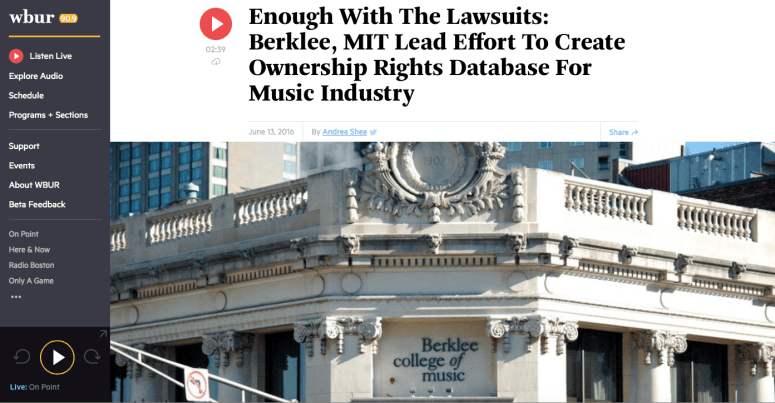
Fortunately the participants in the OMI made the connection for me. NPR and their local affiliate WBUR are participants in the Open Music Initiative and they published this super helpful article on their website:
So this is just what we suspected it to be all along, cynical counter-programming to burnish the public image of an industry that has been the target of a host of class-action lawsuits. Largely because these companies blatantly violated a host of federal laws by failing to license and pay songwriters. And BTW I’m not just talking about copyright law here. If I was a Spotify shareholder I would take a close look at those Spotify financial statements. (What are the EU rules for reporting contingent liabilities like potential lawsuits?)
Actually counter-programming is too nice of a term. If the WBUR article is any indication, expect the OMI to propagate falsehoods and propaganda that mislead the public and potential songwriter class members as to the nature of their rights. Look at this whopper by Berklee’s Panos Panay:
“It’s one of the few industries that I know where you can use something and it’s OK to not really know who to pay,” he said with a laugh. “Well we don’t think that that should be acceptable.”
Actually it’s not ok to use a song without knowing who to pay. The law is very clear on this matter, hence the class action lawsuits. This statement has the potential to mislead putative class members, specifically by making them think that their rights have not been violated. This is a very troubling statement since Spotify is somehow sponsoring this initiative.
Of course this could also be sheer ignorance on the part of Panay. He may really think that you can use music without “knowing who to pay.” As we demonstrated last summer Berklee’s academic scholarship on copyright and music licensing is quite shoddy:
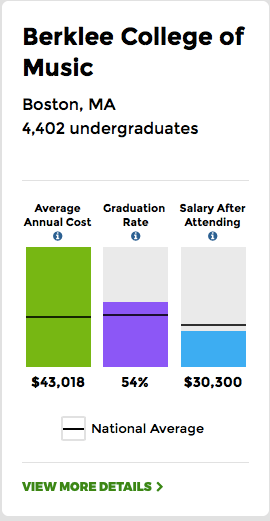
This may explain why a Berklee College of Music student pays $43k a year but typically earns less than a high school graduate after attending. That’s right attending Berklee College is negatively correlated with future earnings!
If Berklee College, NPR, WBUR and Spotify are truly serious about streaming transparency first order of business should be publishing a list of the “unmatched,” unpaid and unlicensed songs. They won’t. Because this is an elaborate corporate smokescreen.
WBUR Public Radio in Boston recently published this highly misleading and shoddy piece of journalism. This is yet another example of public radio being captured and co-opted by corporate interests, and downplaying the rights of songwriters and musicians.
Someone sent us this article by Boston’s NPR affiliate WBUR. I was quite surprised to see WBUR repeating wholesale misinformation on the Open Music Initiative.
Your title is funny. None of this would be happening without the class action lawsuits. 2 years ago in copyright office filings streaming services including Spotify were openly admitting they lacked procedures and technology to pay songwriters. A decade ago the then Attorney General of NY Elliot Spitzer nailed labels for “unmatched and unpaid” songwriter royalties. YouTube has come under fire for relying on a misinterpretation of “safe harbor” protections and is monetizing massive amounts of unlicensed “content” uploaded by their users. These are not “white knights” coming to the aid of songwriters and musicians, this is a cross-industry ass covering excercise. The parties involved had years to fix this problem. Your piece fails to note these facts. WBUR should be ashamed of their shoddy reporting. And Berklee should be held accountable for taking tuition money from aspiring musicians and songwriters ($30k+ a year) while simultaneously providing political cover for practices that make it difficult for graduates to pay back their loans.
While I welcome the efforts of the OMI, it should be properly portrayed. Streaming services, YouTube and yes even the record labels have failed to follow the law on licensing and royalty payments.
I happen to agree with WBUR on one small point: Class action lawsuits are not the ideal remedy, as they are expensive and place the burden on the victims. This problem is so big, and the malfeasance has gone on for so long, it is really a job for the Department of Justice.
Google’s response to the artist rights movement has been to form organizations of their own through proxies. The Internet Creators Guild looks to be another pillar of Google’s cynical PR campaign against artists.
The Hudson Valley enjoys a long and diverse relationship with the arts. Speaking as one artist, a resident, and a Democrat, I wish I could be enthusiastic about the candidacy of Zephyr Teachout. Her campaign says, “We can have a fair economy that puts the middle class back at its center,” and certainly this is a goal I support.
But for a segment of the middle class that includes artists and creative professionals, there is a corporate agenda working against our interests — one that is less visible than business tax avoidance or lobbying. It’s Silicon Valley’s assault on copyright; and Zephyr Teachout has played a significant role in furthering that agenda as an executive at the organization Fight for the Future.
There’s a classic scene in the book The Hitchhikers Guide to the Galaxy where a race of beings called the Magratheans create a super computer called Deep Thought to calculate the answer to the ultimate question of Life, The Universe, and Everything. After 7.5 million years of mulling it over, the answer, as it turns out is “42”.
As you can imagine, the Magratheans are not pleased.
To which Deep Thought responds:
“Only when you know the question will you know what the answer means”.
This is of course the state at which we find ourselves in the music industry. We all seem to know the answer is “DATA” but I’m not sure anyone yet understands what the question is.
——
My company recently became a founding member of the Open Music Initiative. An attempt at bringing academics, music industry members, and technology companies together to solve…well I’ll let them explain it:
THE MISSION OF THE OPEN MUSIC INITIATIVE IS TO PROMOTE AND ADVANCE THE DEVELOPMENT OF OPEN SOURCE STANDARDS AND INNOVATION RELATED TO MUSIC, TO HELP ASSURE PROPER COMPENSATION FOR ALL CREATORS, PERFORMERS AND RIGHTS HOLDERS OF MUSIC.
NEW TECHNOLOGIES CAN BE APPLIED TO RADICALLY SIMPLIFY THE WAY MUSIC RIGHTS OWNERS ARE IDENTIFIED AND COMPENSATED, RESULTING IN SUSTAINABLE BUSINESS MODELS FOR ARTISTS, ENTREPRENEURS AND MUSIC BUSINESSES ALIKE.
I met with Panos Panay, one of the founders of the project, on several occasions and was encouraged and impressed by the broader tent that was being pitched, but I was sold on the idea of participating after learning Jonathan Taplin (a hero of mine) would be participating. That’s a pretty bold and brave move, and I’m hopeful this will therefore not be “business as usual”.
I’m interested in this project because my hope is we can actually progress some ideas into meaningful change. Now as with many efforts like this that I’ve seen over the years, I have some concerns and reservations, but hopeful we can address them and find a solution. While I don’t yet know the structure of our first meeting, I thought I’d share some ideas I would like to see us address in the coming months.
—–
Now for many the belief is that simply solving an issue of data or creating a central and transparent repository of rights in the music industry will solve most of the issues when it comes to money and the speed at which it finds its way back to the creators.
But if the answer is “data”, what is the question?
Now I’m not here to talk about my own project, but I do want to take a moment to address my own search for this ultimate question. Three years ago I had a germ of an idea inspired by my co-founder, Rupert Hine. I had had some experience in the music industry from back when I did a project at Discovery Channel, where I conceived of, designed, and launched a music site. After that experience (less creative work and more legal work), I vowed never to work with the music industry again, and yet here I was leaping even deeper into the abyss.
The abyss in this instance, however, wasn’t just about music, but more of an existential concern about us all. I had fundamental questions I had been thinking about for several years, of who we were as a society and ultimately caring about the quality of our culture.
So we took this idea around to countless meetings with creators and stakeholders of all kinds (music, images, text, video), and I spent a year just researching how we might reimagine an ecosystem that gave everyone (rights owners, developers, and citizens) what they wanted, knowing that each party might have to give a little, in which to get a lot. Every difficult question I was asked I needed to find an answer for. It was a year of deep thought, before I wrote a single line of code.
Our methodology was guided by some basic principles:
We have to respect all creators, that includes visual, sound, and word.
We need to find new markets and build new marketplaces beyond advertising.
End animosity between rights owners, developers, and citizens.
Show citizens through action the value of their own ideas.
Make copyright compatible, regardless of laws or borders or nations.
Change our culture by providing a better alternative.
The reason I tell you this story is because, like the Magratheans, I knew the answer (we all know the answer), but I needed a framework to help us discover the question.
Now many competing ideas have been proposed for solving the issues surrounding data, but simply using a word like “transparency” is not a solution. I know very well just how complex the music industry is (I’m neck deep in data, copyright, anti-competition laws, regional issues, rights complications) and a change isn’t as simple as proclaiming “blockchain is the answer,” because frankly, many of the problems are issues involving human nature and behavior, and technology won’t magically solve this.
But I do have some ideas on where we might start.
1. Godzilla vs King Kong. It is important to ensure this doesn’t simply become a battle of giants (music vs tech), who aren’t interested in listening or working on actual solutions with the smaller voices in the group. While I applaud many smaller participants are invited and the goal is to have diverse opinions, if ideas are put forth yet those in power decide to shut everything down they feel isn’t in their interest, we’ll fail rather rapidly. Frankly, if all the giants in the room had the answers, we wouldn’t be here to begin with. It can’t just be about what best serves any individual company, but ensuring the best ideas can rise to the top and then supporting those ideas. At the end of the day we’re trying to improve the lives of creators, and we can’t lose sight of that.
2. Methodology to Prevent Madness. Better data can improve efficiencies, but we need to address another elephant in the room, which is that “transparency” does not change the fact that culturally we’ve created a society that does not value paying for music or asking permissions. The average 18-34yr old will pay over $1k a year for specialty coffee, but feels somehow asking for $120 a year for all the music in the world is too much.
So we can increase efficiencies to squeeze a tiny bit of juice out of a $15B lemon, or we can also give some thought as to how that $15B lemon can become a pitcher of lemonade. Data and transparency alone won’t solve this issue, it requires methodology as well.
3. Slow and Steady. We need to postpone the immediate urgency to create a central repository of rights, and especially the urge to move it to the blockchain (whichever blockchain). I know, I know, no one wants to hear this, especially if you are working on a blockchain solution. However, this constant talk about how blockchain solves all the data issues is nonsense. Blockchain as a database is still just a repository of data, no matter how fancy you make it. Bad data in is bad data out. Bad input processes lead to bad data. So you don’t start with the storage, you solve the processes first, data storage second. I’ve designed and repaired a lot of databases over the years and if you don’t have a solid process for how things go into it, you create problems that will be harder to fix later…especially if that database is immutable. We need to decide on “how” before we decide on “where”. The number one reason we have bad data is because we have bad processes in place and we should work to change/solve those first.
4. Getting to 42. I agree with Benji Rogers who has been banging the drum of the need for a minimal viable data set (MVD) to accompany a work and a recording. That said, a MVD is not a process, it is an outcome. You need to first decide how this happens. Therefore I suggest the following:
5. No Data/No Money. It isn’t simply that we have a fragmented music industry built on old tech, but we also have fundamental failures that occur because humans don’t do the work they are suppose to. I think we need to draw a line in the sand stating from THIS DAY FORWARD (TBD), no musical recording can be accepted into a system that will pay a royalty towards said recording unless it has a MVD. AND that data includes there is at least one corresponding publishing identifier linked to that recording. If DSPs and the companies that supplied them did this one simple task of refusing any recording that does not have this data associated with it, we could solve vast issues affecting problems with data and the speed of payments on the publishing side. I’m not talking about legacy, but a date in the near future where we “flip” this switch.
6. Blockchain. Quick, name one successful large scale blockchain company everyone is using today. Right. Saying a technology can do something, and then actually doing it are not the same thing. If we take some of the above steps first, and postpone the rush to create a central repository of data, we give ourselves room to see how that technology evolves (especially blockchain) over the coming year or two that it needs to mature. Even blockchain experts have said we’re looking at several years before this tech is fully ready. As Benji Rogers has mentioned before, there are perhaps 20 different competing companies “charging into this blockchain and music space”.
I would also remind you that financial companies (Fintech) are rapidly throwing money into blockchain development, and their ability to drive or steer said development vastly outweighs the power and influence of the music industry. We’re talking about organizations that control likely $100 Trillion in assets, and a total segment of investment that is reportedly in the tens of billions. The money they dump into this space may negatively effect what we’re trying to accomplish.
Being pragmatic with our approach allows us to take the process we create and test it first. Then we roll it out. Not rushing into a global decentralized database won’t kill the music industry, but fucking it up certainly will. If you don’t fix the above, the database you end up with is shit and we’ve made the problem worse.
This also means tabling the discussion of smart contracts and punting it down the road a bit. Again, I’ve been studying these issues and working with the data and on solutions for 3 years. The complexities involved in adding “rights expression” into metadata or a smart contract is immense and further complicates other types of licensing we need to get right across other systems. If even one aspect of this is incorrect it sets off a chain that breaks a lot of shit.
7. Short Term Goals Lead to Bigger Ideas. I’ve worked in technology for over 25 years, around 15 of which I wrote about technology for many leading tech publications. I’ve seen a lot of initiatives go absolutely nowhere, and I’ve seen them go nowhere fast the moment you start to discuss standards, codecs, file formats, etc. It took the W3C roughly 3 years to release the draft for HTML5, but another 3 years to release the final spec. Why? Well for one thing, like the music industry, it was pretty complex with lots of moving parts. Oh and politics certainly had something to do with it. One way to hopefully avoid industry politics is (to my point above) understanding the question to the answer. So let’s take some small but impactful first steps.
8. Build for Today, Plan for Tomorrow. Any and all first steps need to be compliant with today’s technology, not just looking towards tomorrow (because we don’t know what tomorrow looks like). What I mean by that is it is supremely difficult to get massive adoption of any new initiative and ensure it is unified and accepted. If any major player in any part of the space fails to implement this, the whole thing can fall apart. Not to mention, many of the parties that sign on to this project (or don’t), might have their own ideas on how to do things. As I often say, check the pool for water before diving in.
9. This Isn’t Just A Music Industry Problem. We are going to need massive buy in from a massive ecosystem. This is going to be tough. We’re not just talking labels, artists, songwriters, publishers, DSPs and so forth. We’re talking about many other ancillary industries that interact with the music industry. That means we cannot act as if we are an island, since other industries are reliant on music. We should be inviting others outside of music to the table. That means photographers, videographers, authors, publishers (not music), and so on.
10. The Music Industry Isn’t Broken
The Music Industry Isn’t Broken
-With Love,
Your Fans
At the end of the day, your amazing technology is not what drives adoption, it is the punter, the fan, the listener. The biggest mistake I see again and again from just about everyone trying to solve these issues is forgetting that without them, there is no point in making a better system for yourself. They put the money into the system you are trying to make more efficient. So in order for any of this to work, it can’t affect the customer in any negative manner that pushes them away.
Consider the experience of today’s music lover. Walking down the street, when they push play, the music plays. For a fan, they live in a near-utopian world where almost anything is available within seconds. Within a year or two this will be the expectation of almost everyone, including us old farts. Add to that, incremental improvements in experience from DSPs over the next year or two, means that whatever you want to accomplish to make a better experience for the rights owner, better not fuck with that user experience one bit. It better work on day one exactly as it does today…I push play…it plays. In fact I suggest you better make it amazing, or you are going to have a tough time getting tech to adopt it.
Remember, when you only view this from the rights owner perspective, you fail to see that the fan doesn’t think the music industry is broken. All they hear is a bunch of whiney artists complaining they aren’t making any money (just read any comments on any social media story about music). They don’t care about transparency, data, reporting, or speed of payments. They don’t even really care about giving you money directly and likely won’t care about fair trade, except as a passing idea. They want what they want the instant they want it. So remember the wisest words any sage has ever spoken:
“Don’t fuck it up.”
-Ru Paul
——
Again, I think it is a positive sign having all of these parties in a room together to address these issues, and I applaud even attempting this at all. I know it took Panay and the OMI group a lot of work to get this far. But it would be a damn shame if one year from now, we’ve got nothing to show but an even more fragmented industry and find ourselves back at “42”. None of us want that, but it is up to us all to make that a reality.





 The Trichordist
You must be logged in to post a comment.