
By now you’ve heard that Iron Maiden used torrenting data apparently obtained from a UK company called MusicMetric to find and embrace it’s “worst pirates” and go and play for them! This story appears to have originated on November 29 with Alexandra Topping in the Guardian in a post that focused more on the benefits to the British economy of “small businesses” like Iron Maiden–ahem.
Ms. Topping was smart enough to avoid the causal trap that MusicMetric fell into. But the post by ex-Slashdot blogger Andy Patrizio, a freelancer for Citeworld, went straight for that bait, and that post that was picked up by CNET and The Verge almost immediately. All loudly proclaimed that Iron Maiden embraced piracy and got rich–apparently without ever asking the band what they thought. Until Citeworld retracted the story, we can’t find any post that repeated the Patrizio story that also had quotes from the band.
http://www.theverge.com/web/2013/12/25/5244204/iron-maiden-responds-to-piracy-by-planning-tours
http://www.citeworld.com/consumerization/22803/iron-maiden-musicmetric
This story was then widely re-reported and re-blogged in the music press. In particular the two flagship music business publications Billboard and Rolling Stone ran with the story.
What is interesting about the Alexandra Topping story in the Guardian is in these opening paragraphs (links in the original):
Iron Maiden have never been exactly fashionable: too mainstream for punk, too scruffy for New Wave, too hairy and loud for pop. But it seems the classic British metal act is very good at turning metal into gold.
In a report published on Friday by the London Stock Exchange, the group – formed in Leyton, east London in the 1970s – has been cited as one of the UK’s fastest growing music firms, helping to pull the UK from economic heart failure into recovery.
Iron Maiden LLP, the group’s holding company, is one of six music firms at the vanguard of the new music business, according to the report entitled 1,000 Companies to Inspire Britain.
The Guardian story that Topping linked to was a generic news summary of stories about the London Stock Exchange. But that summary digest had a link to a post–a post with no by-line, just “Guardian Music”–that included this quote from MusicMetric’s CEO, the quote that launched a 1,000 retractions:
“Iron Maiden’s BitTorrent data suggests Brazil is a huge driver of fans – and given Brazil is one of the biggest file sharing nations on the planet, this is a strong indicator of popularity,” said Greg Mead, CEO and co-founder of Musicmetric.
“With their constant touring, [the] report suggests Maiden have been rather successful in turning free file-sharing into fee-paying fans. This is clear proof that taking a global approach to live touring can pay off, and that having the data to track where your fan bases lie will become ever more vital.”
Still–no one seems to have asked the band what they think about this classic post hoc ergo propter hoc fallacy of mistaken causation that is so fashionable.
But sure enough, the penny eventually dropped. According to Tech Crunch the entire story appears to be fabricated.
In fact–if anything, particularly given the band’s “constant touring” (since 1970s) as quoted by MusicMetric’s CEO, the opposite is the real story: How Pirates Turned Iron Maiden Fans into Advertising Revenue–for Pirates and Ad Exchanges.
Sorry, guys, the BS filter is full.
We suspected this story was bunk right from the start if for no other reason than because every band already has access to very reliable data that shows locations of your assumed fans. You don’t need bittorrent data. (Unless you’re part of the charm offensive for Bit Torrent, Inc.’s next round of financing.) And you don’t even have to be tech savvy to get the most important pieces. Facebook anyone?
But suppose you are tech savvy and need more detail? You still don’t need torrent data. Try Google or Quantcast analytics for your website.
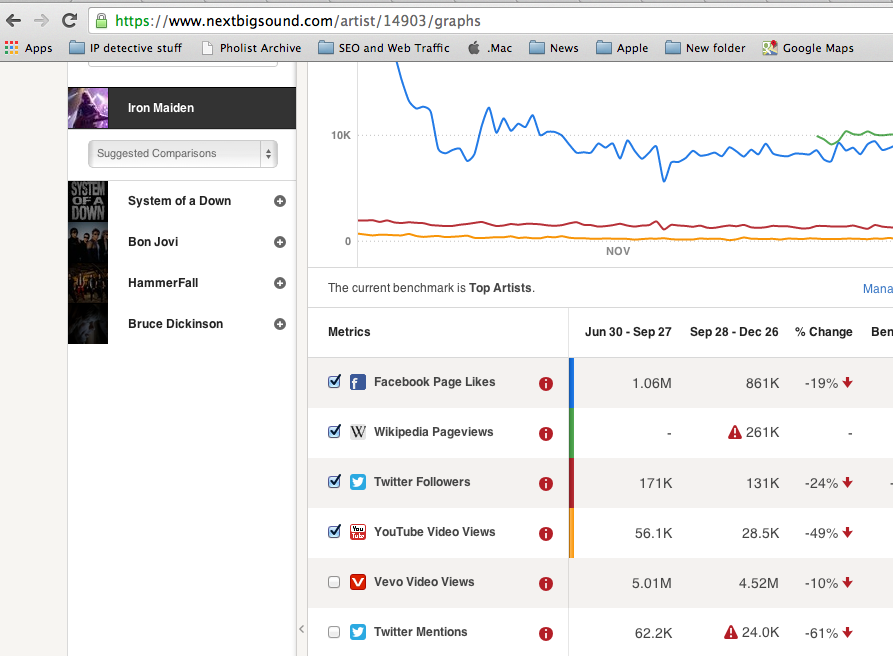
Somewhere in the middle? Use http://www.nextbigsound.com, to track all kinds of social metrics in a precise geographic manner on a single aggregated screen! Basic accounts are free!
(And actually-at least for the last 7 days-the embedded claim that Brazil, Argentina and Chile are hot markets for Iron Maiden is contradicted by the fact that tiny Luxembourg had more Iron Maiden oriented twitter activity than any of these markets. Hurry Iron Maiden! Go play Luxembourg!)
But you don’t even need the internet to figure this out. Analog PRO (BMI/ASCAP) statements or even record company royalty statements provide accurate if slightly stale data on where your fans are! Eyeballing my catalogue, bittorrent data mirrors this stuff exactly. My most popular bitTorrent territories are the same territories I get a high volume of airplay and streams. (In my very extensive experience with my own catalog, BitTorrent activity actually follows not leads radio play and other publicity.)
So Iron Maiden collaborating on a major touring project with MusicMetric to do what I teach my first year Music Business students to do in the 1st week of class? Seemed highly suspect to me.
Hence this retraction from Citeworld:
The original version of this article incorrectly stated that Iron Maiden used MusicMetric’s analysis to plan its South American tours. MusicMetric did not work directly with Iron Maiden. The analysis described in this article was carried out without the band’s participation or knowledge, and we have no confirmation that the band ever saw or used it. [Because why would the band ever have done so?] CITEworld deeply regrets this error, and we apologize to our readers [but didn’t change the patently false headline that still reads “How Iron Maiden turned piracy into paying customers”].
Look we’ve gotten things wrong here at the Trichordist a few times. It happens. But we’ve never f*cked up this bad. Did anyone ever actually bother to call Iron Maiden’s management? Agency? Press Officer? Did anyone question why Iron Maiden didn’t go to Southeast Asia or China at the same time? For they have an even greater volume of piratical fans in those territories.
Did anyone question how many times a band that’s been around since the 1970s has toured these same countries in the past and might have a watchamacallit–a fan base?
This is starting to seem like the Goldblox VS Beatie Boys lawsuit where many news outlets erroneosly reported that Beastie Boys were suing Goldieblox when in actuality it was the other way around!
The main question music business journalists should now be asking:
“Did MusicMetric have any role in pumping up this purportedly fabricated story?”
I’m not saying they intentionally did this to generate notoriety for themselves or funding for Bit Torrent, Inc. but like Goldieblox the misreported story certainly provided a lot of free publicity for their company. And in the world of Journalism 2.0 where “news” outlets print first and fact check later, headline consumers will likely walk around with a head full of garbage in, and we know then there’s going to be garbage out. It’s just that this particular strain of garbage–piracy is good for you, yummy–bears a striking resemblance to the talking points generated by the Computer & Communications Industry Association and of course Bit Torrent itself.
But there is also a question that the music industry and artists should be asking themselves:
Why should the artists send dollars to MusicMetric, a company that seem to provide propaganda for it’s enemies? If you look at the many of the company’s statements they seem to tacitly endorse piracy. As a result I certainly wouldn’t hire this company to work any of my product.
It’s too bad. MusicMetric generally provides a good product. They may come out of this looking like they are just another purveyor of digital snake oil aka the Bit Torrrent charm offensive, more interested in hyping their own product than actually helping their customers.
Makes you wonder where the funding is coming from.
 The Trichordist