
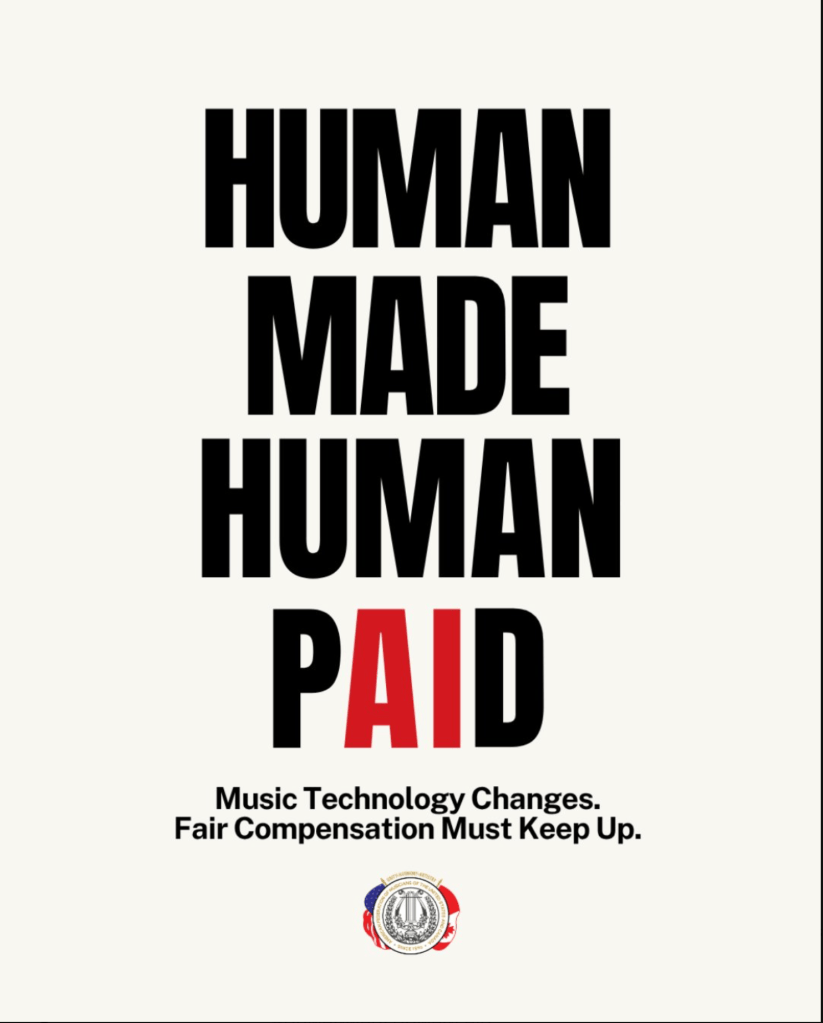
The American Federation of Musicians is drawing a line between the record labels’ AI licensing deals and the musicians whose performances made those deals valuable in the first place.
The American Federation of Musicians (AFM) launched its Human Made, Human Paid campaign this week, calling on the major record labels to recognize a fundamental principle: Musicians should have a say in whether their performances are used to train generative AI systems, and they should be compensated when those performances are exploited.
The campaign comes as the AFM prepares to resume negotiations with Universal Music Group, Sony Music, Warner Music and Disney’s Hollywood Records on November 3 over a new Sound Recording Labor Agreement (SRLA), the collective bargaining agreement governing employment conditions for musicians who perform on recordings.
The union’s demands are straightforward: consent, credit and compensation. Musicians should be able to approve or reject AI uses of their performances, receive appropriate attribution and participate financially when the labels license recordings to AI companies.
But the dispute is about considerably more than another royalty provision. It goes to the heart of who has the authority to license the human performances embedded in sound recordings and whether the owners of recording copyrights can bargain away interests that belong to individual performers.
The record companies originally sued the AI developers for copyright infringement, alleging unauthorized copying of protected sound recordings. But as the companies moved toward settlements and commercial licensing arrangements, the performers whose work was captured in those recordings faced a very different question: Where was their compensation?
AFM International President Tino Gagliardi put the union’s position succinctly: “The record labels cannot pocket profits built on the backs of human artistry while cutting working musicians out of the equation.”
The AFM argues that the labels cannot simply collect AI licensing revenue while disregarding obligations to the session musicians who performed on those records.
The missing rights in the AI licensing debate
The AFM campaign also highlights an important distinction that has been largely overlooked in the AI licensing debate.
A record label may own the copyright in a sound recording, but that does not necessarily mean it owns every right implicated by the use of that recording to train or operate a generative AI system.
Performers may possess independent contractual rights, rights of publicity or other protections relating to their voices, identities and performances. Those interests do not automatically transfer to the record company simply because the performer participated in a recording session.
This becomes particularly important when an AI system can imitate not only a composition or recording but the recognizable characteristics of an individual performer, including vocal timbre, phrasing or instrumental technique.
The AFM’s demand for consent therefore addresses a question that cannot necessarily be resolved by negotiating a copyright license with a record label.
Digital replica protections are a subset of performer identity protections, not a substitute for them. Whether the exploitation involves a digital replica or some other appropriation of a performer’s identity, the underlying rights are distinct from copyright. Ownership of a sound recording, including ownership under a work-for-hire agreement like the SRLA, does not itself convey the performer’s right of publicity. A copyright license is not a license of personal identity.


You must be logged in to post a comment.