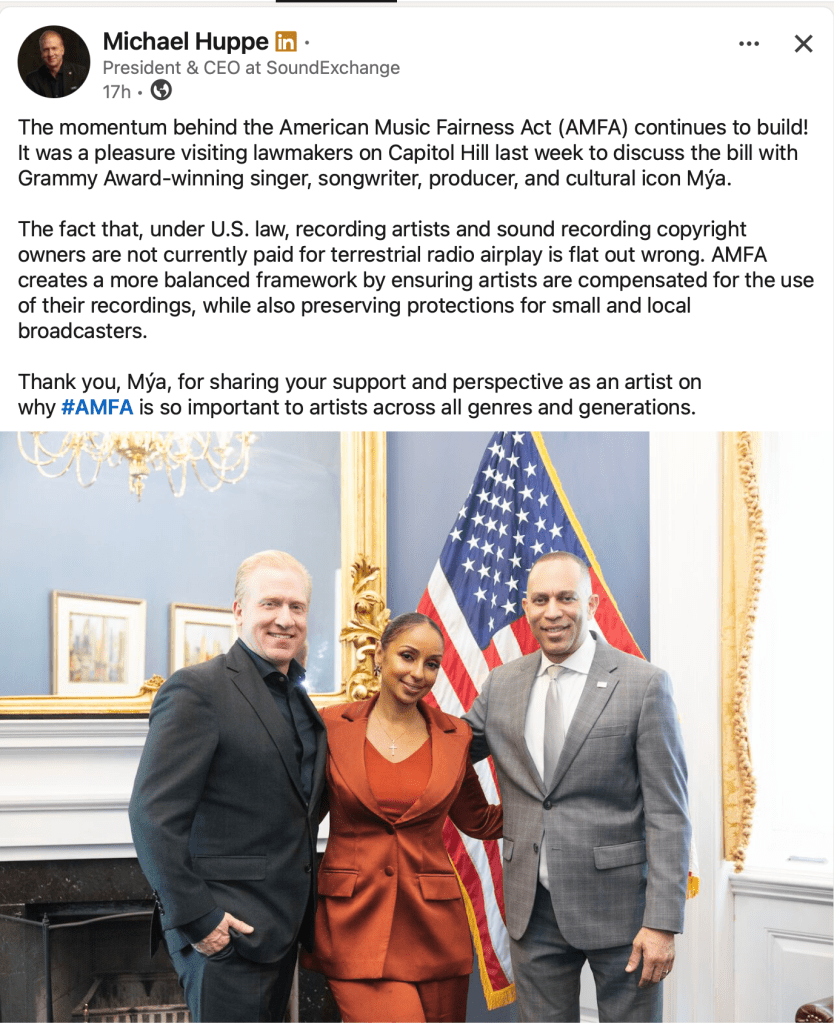
L-R: SX CEO Mike Huppe, Mya, House Minority Leader Rep. Hakeem Jeffries
Momentum around the American Music Fairness Act is building, and that’s a good thing. When Michael Huppe says artists not being paid for terrestrial radio airplay is “flat out wrong,” he’s right. The American Music Fairness Act (AMFA) closes the loop on Congress’s work beginning in 1995 to create a digital performance right in sound recordings. It extends that framework to terrestrial radio, ensuring artists and sound recording owners are paid consistently across platforms while preserving protections for small and local broadcasters.
The U.S. remains an outlier globally, denying performers a basic neighboring right recognized nearly everywhere else. Mýa’s presence underscores what’s at stake: real artists, real livelihoods. AMFA is about correcting a structural imbalance—one that has allowed broadcasters to monetize recordings without compensating those who made them. We appreciate the growing number of leaders in Congress working to get this right.
For more information on the American Music Fairness Act and the broader policy effort to align U.S. law with global norms, see the musicFIRST Coalition. They track the legislation, outline the issues, and provide a way to stay informed or engage if you choose.
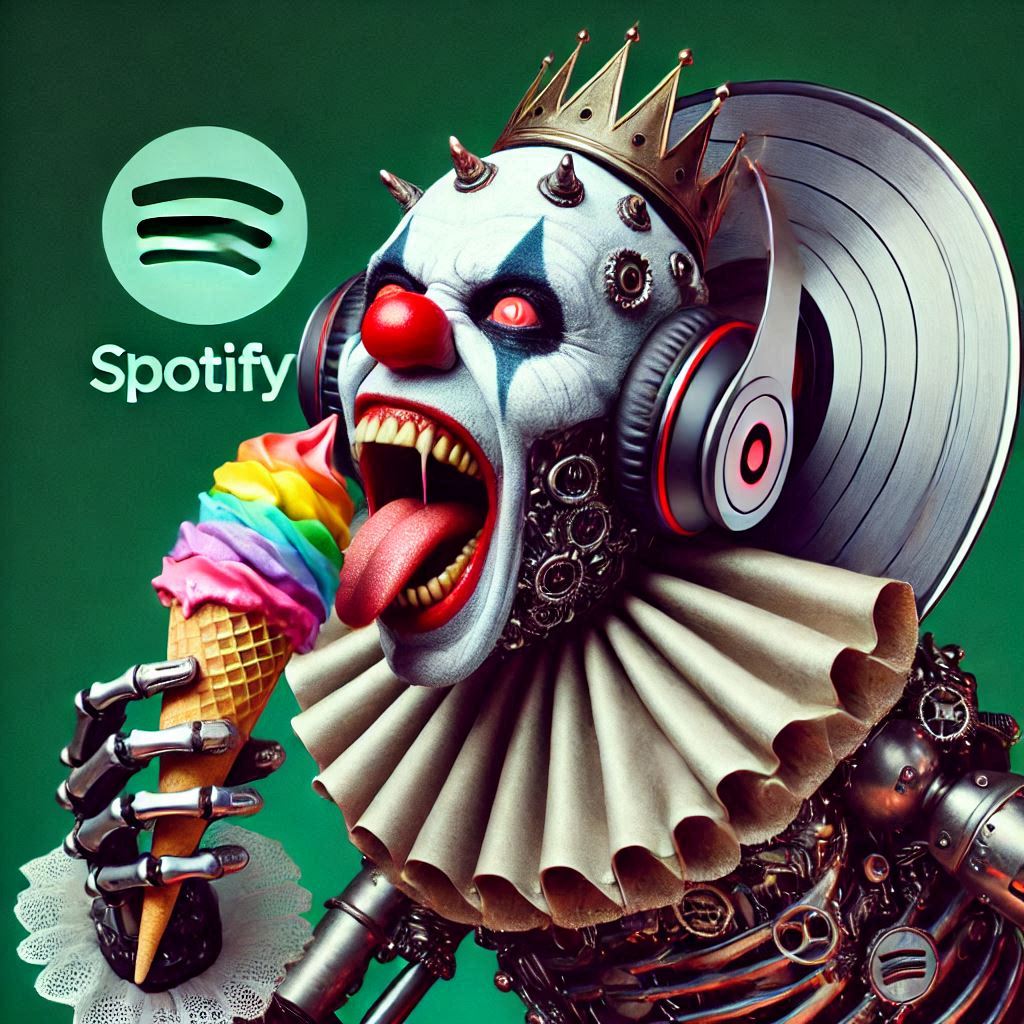
Spotify has long claimed its algorithms can spot breakout tracks and rising artists long before traditional gatekeepers notice. From Discover Weekly to Release Radar, the service positions itself as more than a music service — it’s an engine for musical discovery. You know…exposure.
In interviews, press releases, and annual shareholder letters, Daniel Ek the former pirate and future defense contractor and Spotify have boasted that their data can pinpoint the ‘next big thing,’ making Spotify the best place for discovering and nurturing new talent. They raise money on the issue and their market cap is $150.983B today. So they’re sharing the gold with the artists that they extract value from, yes?
The New Threshold Policy
Well, no. Spotify now imposes a threshold: tracks must reach roughly 1,000 streams per year to qualify for recorded music royalties. But understand this–while they don’t pay on those 1,000 streams, they do collect listener data on them and that powers their algorithm. You know, the algorithm they brag on can spot talent, kid. Because those first 1,000 streams are whatchamacallit…free goods. Or is it breakage? Or maybe a kind of packaging deduction?
Under this no-pay-but-track model, Spotify can recognize early listener activity and harness it for its personalized playlists and marketing efforts — yet it doesn’t pay artists for those early plays until the artist meets an arbitrary 1,000 stream threshold. And realize this–an artist could have 100 tracks with 1 million streams each and 100 tracks with less than 1,000, and they won’t get paid on the less streamed tracks. So the pitch here is the track not the artist, yet another contradiction from the Spotify pitch deck.
The Conflict
This creates a troubling tension:
For Spotify: The first few hundred plays are enough for its algorithm to assess the track, recommend it to listeners, and monetize engagement. And brag on it to investors.
For Artists: Those same early plays don’t count toward royalties. The track can gain exposure across the platform, but the artist sees no income until the threshold is crossed.
What It Means
Aside from they’re scumbags? Well, if Spotify can spot a breakout track when it has only a few hundred plays, why can’t it pay for those plays? Its data and recommendations benefit Spotify — obviously, they brag on it. The free goods data makes the service more attractive, bolstering its story to investors, and enriching its user experience — long before it benefits the artist making the records. (To add insult to injury, they do have to pay the songwriters under the benighted compulsory license which they no doubt are going to try to ditch in the next CRB.)
This paradox exposes a deeper tension in the streaming model: platforms excel at extracting value from listener data but adopt a policy to let them grab that data long before it translates into royalties for creators. Talk about data is the new oil.
This paradox shines a light on how platforms monetize listener data early — and benefit from it — while delaying or denying payments for those same streams. What Spotify promotes as ‘discovery’ often operates as monetization for the platform, leaving the artist with nothing until an arbitrary threshold is crossed. The same is likely true of all the platforms that adopt Spotify’s freebie threshold model in what the antitrust lawyers call conscious parallelism, looking at you Amazon and Deezer.
What is to be Done?
If Spotify truly champions discovery, it should champion fair compensation from the first stream. The ability to spot breakout tracks early must be matched by a commitment to pay for them.
It’s time for a more transparent and equitable approach — one that recognizes the value of every stream and every listener, regardless of its place in the self licking ice cream cone.
In the anticipation of the announcement of the new Mega launch, Pat Pilcher at The New Zealand Herald wrote an article titled “Kim Dotcom on Ending Piracy” in which the journalist listed Mr.Dotcom’s five steps to ending piracy. Pilcher writes,
As ironic as that may sound, Kim Dotcom’s logic is inescapably robust. Here’s what his end to piracy manifesto says:
1. Create great stuff 2. Make it easy to buy 3. Same day worldwide release 4. Fair price 5. Works on any device
Looking at what Kim is saying, the 5 points seem pretty obvious, although each could quickly get bogged down once Hollywood gets involved.
So let’s look at these one by one.
1. Create Great Stuff
Well, that’s a no brainer. The content industries create the most prized and sought after “stuff” in the world including films such as Avatar, The Avengers, and The Dark Night Rises as well as franchises like Iron Man, Transformers, Harry Potter and others. Music artists include the likes of Adele, The Black Keys, Taylor Swift, The Beatles and countless others. Making great stuff has never been a problem.
2. Make It Easy To Buy
Another no brainer. Perhaps a decade plus ago this might have been an argument, but not today. There are over 500 legal and licensed music services alone. For the film industry there are services like Netflix, Vudu and Cinemanow as well as other direct to home video on demand providers that give consumers more access to more content across more platforms than at any time in history.
3. Same Day World Wide Release
For music this is more less the standard now and is also more and more common for feature film releases as well. This is a common practice for the largest and most anticipated releases of music and films, the “stuff” that is the most aggressively pirated. For smaller indie releases this may not always be possible but than again I’m not sure that the problem we are combating is in Nigeria on indie rock albums and movies that are more or less film festival darlings.
4. Fair price
Done. Netflix is $7.99 a month for unlimited access to it’s entire library of films and tv shows. Spotify is $9.99 for unlimited access to it’s entire library which consist of probably 95% of every known recording in print. Add to this the cost of a song download is 99 cents. Less than the cost of a candy bar. Renting a movie from a video on demand service ranges from 3.99 to 5.99. Price is no longer an issue and has not been for years.
5. Works on Any Device
Music is DRM free and has been for at least half a decade. Streaming Services such as Netflix and Spotify are also available on every major platform including not only Mac and PC computers, but also mobile devices such as smart phones and tablets by a variety of manufacturers. Additionally most new video game consoles and blu-ray players also include many of these same apps.
Well there it is, RIANZ’s response in full. I can’t argue with much that they’ve said, as they’ve pretty much complied with most of Kim’s 5 points.
So Kim Dotcom’s five suggestions have been fulfilled and yet, I don’t think we’ll see an end to piracy anytime soon. There is still one thing piracy offers that legal, licensed and legitimate services do not, and that is compensation to the artists, musicians, filmmakers and creators which requires that consumers actually do pay the fair price asked.
It’s all pretty simple and by Kim Dotcom’s own suggestions and admission it’s pretty clear where the problem is from here on out, and it’s not in his five suggestions…




You must be logged in to post a comment.