@ArtistRights Symposium 5 Panel: In Our Own Backyard: Data Centers, AI Infrastructure, and the Creative Communities That Pay the Price

Registration is open for Artist Rights Symposium V at Eventbrite!

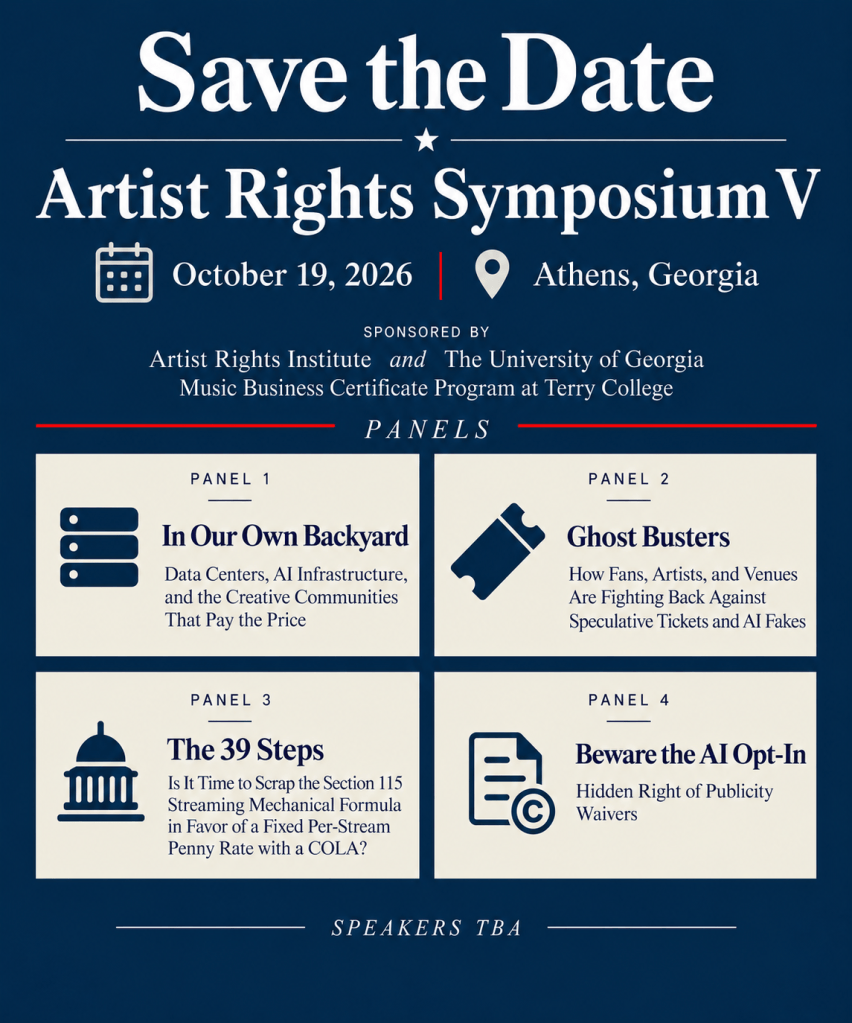
The Artist Rights Symposium V is coming on October 19 at Tweed Recording in Athens, GA hosted by the University of Georgia Terry College of Business Music Certificate Program and the School of Policy and International Affairs, and the Artist Rights Institute. More about the Symposium here and register on Eventbrite here. We’ll be posting panel overviews to introduce you to the speakers, this post is about the connection between data center opposition and artist rights.

When AI Comes for Your Dreams

Artificial intelligence is usually presented as something almost immaterial: software in the cloud, trained on data, producing an answer, an image or a song at the push of a button. But there is nothing immaterial about the massive physical infrastructure behind it.

Does somebody else’s need for your property give them the right to take it?

That is the connection we’ll explore at Artist Rights Symposium V with Ansley Brown; Georgia State Senator Sonya Halpern; and Dr. Moiya McTier of the Human Artistry Campaign and Moderator Chris Castle of Artist Rights Institute—bringing together community, public-policy and artist-rights perspectives on different sides of the same extraordinary AI buildout.

The panel highlights the increasingly important connection between data center protests and artist rights, bringing together leading human-creator advocates with a prominent Georgia community advocate whose family home was taken for data centers.

The panel will examine how AI not only depends on scraping vast swaths of human culture, but also requires enormous data centers, staggering amounts of electricity and water, sprawling new transmission infrastructure—real land in real communities. Someone bears the costs when family farms, homes and intellectual property become inputs to the AI economy.

Readers of the Data Center Backlash SITREP will remember Ansley Brown and her family’s fight in Coweta County, Georgia, where a proposed hyperscale data-center development brought AI’s extraordinary power demands quite literally to her doorstep—including Georgia Power’s effort to use eminent domain to take her family home for data center transmission lines.

Ansley did not set out to become a public advocate. She became one because a multibillion-dollar development threatened something deeply personal: the home and life her family had built in Coweta County, Georgia.

But Ansley’s story is also the story of thousands like her across America—and, indeed, around the world—as communities confront unprecedented demands for land, electricity, water and transmission capacity to support the accelerating AI buildout. At the same time, creators are watching their works appropriated by AI platforms that flood the attention economy with AI-generated content that competes directly with the human works used to build those systems.

Who bears the cost when someone else’s dream is reduced to an input for AI?

Artists have been asking essentially the same question—whether they’re protesting data centers next to the Nashville Zoo or suing to protect their works and personhood from unauthorized AI exploitation. Songwriters, recording artists, musicians, actors, writers and other creators have watched their work become an input into enormously valuable AI systems—without consent or compensation, if there even is a price for taking their dreams.

The AI economy has both i nputs and infrastructure. It needs creative works to build its products, and it needs land, power and water to run them. The legal issues are different, but the underlying question is remarkably similar: Ansley has described the human consequence in memorable terms: having to take the dream you built in one place and try to recreate it somewhere else—somewhere you hope will be safe from the next wave of AI development.

A family home and an artist’s life’s work are very different kinds of property. But neither becomes free for the taking merely because somebody else needs it to build a business.

What happens when the price of somebody else’s technological dream is that you have to surrender your own?

That’s the discussion we’re bringing to Athens on October 19 at Artist Rights Symposium V.  Registration is open at Eventbrite!
Gwen Seale Discusses the Streaming Mechanicals Panel at Artist Rights Symposium 5

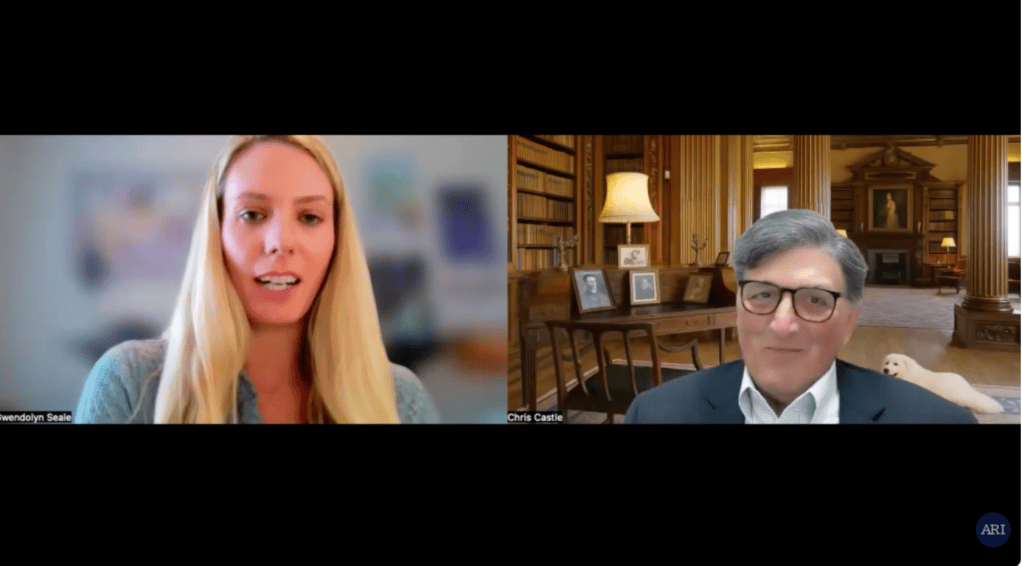
In this short video, Gwendolyn Seale and Artist Rights Institute Director Chris Castle preview “The 39 Steps,” a Symposium V panel asking whether Section 115’s complex streaming mechanical formula should give way to a fixed per-stream penny rate with a COLA.

Gwen joins fellow attorneys Tim Kappel and Shannon Sorensen—all three represent clients before the Copyright Royalty Board in Phonorecords V.  ARI Director and UGA professor David C. Lowery moderates. David teaches at the Terry College of Business Music Certificate program. He led the class action against Spotify over nonpayment of streaming mechanical royalties and is a class representative in the Isbell v. Suno class action.

Join us October 19, 2026, at the University of Georgia in Athens, Georgia, for Artist Rights Symposium V hosted by Terry College of Business and the UGA School of Policy and International Affairs.

Symposium information and registration

Fans Left Empty-Handed and Texas Attorney General Launches StubHub “Ghost Ticket” Investigation

For millions of soccer fans, attending a FIFA World Cup match is a dream. But for a growing number of ticket buyers, that dream has turned into a costly nightmare—and now the state of Texas is getting involved.

The Problem

It should come as a shock to no one that Texas Attorney General Ken Paxton has announced a formal investigation into StubHub over the massive number of fan complaints tied to 2026 FIFA World Cup ticket purchases. The only surprise in Paxton’s investigation is that it’s just him. Like so many other unfortunate ticket buyers before them, fans report that their tickets were either never delivered, canceled at the last minute, or were significantly inferior to what they originally paid for.

There is a fan class action case pending in New York federal court, but…The proposed class action filed by World Cup fans in the Southern District of New York will likely face an important threshold procedural issue before the merits are ever reached. As readers will recall from our coverage of the Kaiser v. StubHub case (also in SDNY), one issue to watch is whether StubHub seeks to enforce its online arbitration agreement and class-action waiver. Consumer platforms routinely invoke arbitration clauses to move disputes out of court and into individual proceedings, and StubHub may well attempt the same strategy here.

Whatever the outcome of the class action and StubHub’s challenges, that procedural defense is unavailable against a state enforcement action. A lawsuit brought by the Texas Attorney General under state consumer protection laws proceeds in court regardless of private arbitration agreements, potentially allowing public discovery, broader injunctive relief, and judicial scrutiny that individual consumer claims might never receive. This procedural distinction helps explain why state attorney general investigations can play a uniquely important role in policing mass-market online platforms, even when private class actions are already pending. And remember, Paxton has gotten over $1 billion from each of Google and Meta on privacy cases.

At the heart of Paxton’s investigation is speculative ticketing aka “ghost tickets” — where sellers list tickets they don’t actually possess, collect payment, and then cancel orders when they can’t deliver or cover their promise to deliver tickets. This seedy practice is not new to readers and we’ve been harping on it for years.  According to Paxton’s press release, consumer complaints suggest this isn’t an isolated issue but a broader, systemic pattern.  Ya think?

“In many cases, attending a World Cup match is a once-in-a-lifetime experience,” Paxton said. “If StubHub is ghost ticketing Texans out of that experience, my office will use every tool available to hold them accountable and help fans who have been wronged.”

One Fan’s Story

Edgar Correa’s wife wanted to make his World Cup dream come true. She purchased tickets through StubHub on June 11 for the Bosnia-Switzerland match at Los Angeles Stadium on June 18. The couple booked a hotel, paid for parking, and Edgar took the day off work.

Then came the devastating message from StubHub: “Unfortunately, your order was not processed. This means the transaction was not completed and, therefore, no tickets were reserved for you.”

After scrambling, Correa managed to find replacement tickets directly through FIFA’s official platform—but they cost more and placed him at the very top of the stadium, far from the seats he’d originally paid for.

The Finger-Pointing

StubHub has blamed the cancellations on “transfer problems” tied to FIFA’s ticketing platform, stating that “the issues fans have experienced at this World Cup are largely due to performance failures in the event organizer’s own ticketing infrastructure, which has caused transfer errors across all resale platforms.”

FIFA isn’t having it. A spokesperson fired back: “The official FIFA ticketing platform for the FIFA World Cup 2026 operates reliably and at scale, as demonstrated by the more than 4.6 million spectators who have attended matches to date, with tickets purchased, delivered, resold, transferred, and successfully validated through FIFA systems.” FIFA explicitly rejected any suggestion that third-party platform failures are the result of its infrastructure.

The Industry Pushback

Paxton isn’t the only one sounding the alarm. On June 18—just days into the tournament—the National Independent Venue Association (NIVA) and Fan Alliance sent a joint letter to congressional leadership demanding a federal ban on speculative ticket sales. The letter, signed by NIVA Executive Director (and ARS panelist) Stephen Parker and Fan Alliance Executive Director Donald Cohen, includes nearly two dozen exhibits documenting first-hand fan accounts of ghost ticketing (another name for spec tickets) from just the first week of the World Cup.

The groups have been warning about this exact scenario for years. As they wrote: “We warned that consumers would purchase tickets that did not exist. We warned that families would travel thousands of miles only to discover their tickets could not be delivered. We warned that refunds would not make consumers whole after airfare, hotels, rental cars, parking, and other travel expenses. Unfortunately, every one of those warnings has become a reality on the world’s biggest sporting stage.”

Their proposed fix is aggressive. They’re asking Congress to ban ghost ticketing outright, impose price gouging caps on resale, levy fines of at least $10,000 per listing per day, and require platforms like StubHub to disclose data on fulfillment rates, refunds, and consumer complaints—information the platforms have repeatedly declined to make public.

Notably, the letter takes direct aim at the TICKET Act currently before Congress, arguing it would still permit the very ghost ticketing that’s victimizing fans right now. The groups point to states like Maryland, Minnesota, Oregon, Connecticut, and Nevada, which have already banned speculative sales and closed the loopholes that let resellers rebrand the practice as “concierge” or “ticket procurement” services (which also confused Colorado Governor Jared Polis when he vetoed a ban on spec ticking).

The letter also makes a point that often gets lost in the World Cup headlines: this same consumer harm plays out every day at independent venues, theaters, and comedy clubs across the country. Unlike FIFA or the NFL, these small businesses can’t absorb the reputational damage when fans blame the venue for a scalper’s fraud.

The Securities Question

One open question: StubHub is now a publicly traded company (NYSE: STUB) following its September 2025 IPO. If ghost ticketing cancellations represent a material volume of failed transactions—and the lawsuits and state investigations suggest they might—does StubHub face disclosure obligations around the scope of unfulfilled orders, pending litigation exposure, and potential regulatory liability? At least one investor rights firm has already flagged a lead plaintiff deadline tied to StubHub’s IPO disclosures, suggesting the securities angle may not be far behind the consumer protection one.

What You Can Do

If you purchased World Cup tickets through StubHub and didn’t receive them—or received tickets significantly different from what you paid for—the Texas Attorney General’s Consumer Protection Division is encouraging you to file a complaint.

FIFA’s own FAQ is blunt: for any ticket sold through another platform, buyers must contact that platform directly. FIFA cannot access or manage those tickets. The organization recommends buying tickets only through its official site.  Well, it’s a little late for that.

The Takeaway

The 2026 World Cup has been a spectacular global event, but the secondary ticket market has exposed serious consumer protection gaps. Whether this is a case of ghost ticketing, platform infrastructure failures, or something in between, one thing is clear: fans are paying the price. With a state attorney general now on the case, StubHub may soon face real accountability for the broken promises left in its wake.